Enhanced Deep Learning Approach for Multi-parameter Hollow Shaped Cylindrical Dielectric Resonator Antenna Design
Fidan Gamze Kizilcay and Muhammet Hilmi Nisanci
1Department of Electrical Electronics Engineering
Sakarya University, Sakarya, Türkiye
fidan.kizilcay@ogr.sakarya.edu.tr, nisanci@sakarya.edu.tr
2Department of Information Technology
Zonguldak Bülent Ecevit University, Zonguldak, Türkiye
gamze.kizilcay@beun.edu.tr
Submitted On: December 13, 2024; Accepted On: August 22, 2025
ABSTRACT
The design of antennas for specific purposes often results in significant time costs due to the lengthy simulation processes required. Adopting deep learning-based approaches in antenna design can offer more efficient solutions. In this study, deep learning methods were applied to accurately and efficiently predict the resonant frequency value of the hollow shaped cylindrical dielectric antenna. For this purpose, a total of 1000 simulations were performed for the considered antenna, and corresponding operational frequencies in 6-12 GHz frequency band were obtained. The data was diversified to search for an optimal solution. A total of 800 simulation results were employed for training, and a series of operations were performed to develop the training model. As a result of these improvements the mean squared error (MSE) was observed to decrease to 0.128. In order to evaluate the performance of the model, the output was obtained by using randomly assigned input parameters. This revealed a difference of 0.49% between the actual result and the model output, which indicates improved prediction accuracy and reliability of the model.
Index Terms: Antenna design, deep learning, dielectric resonator antenna, hollow shaped antenna.
I. INTRODUCTION
Dielectric resonator antennas (DRAs) are predominantly designed for operation at microwave and millimeter-wave frequencies, particularly in applications such as 5G, WiMax, WLAN, and radar [1–3]. The performance of antennas utilized in these technologies is of paramount importance, especially concerning signal accuracy and efficiency in high-frequency bands. The frequency range of 6-12 GHz is a notable bandwidth for applications that demand high resolution and low latency. DRAs operating within this frequency range are distinguished from conventional metal antennas by their low loss, wide bandwidth, high efficiency, and compact structures [4, 5].
Achieving the desired antenna performance during the design phase is challenging. Many software tools provide features for optimizing antenna parameters. Deep learning algorithms offer the capability to perform multi-parameter optimization across a wide range, which not only enhances antenna performance but also accelerates physical prototyping processes. The integration of deep learning and machine learning techniques into antenna design has thus opened up a innovative field of research focused on improving antenna performance.
In [6], Ranjan et al. highlight the advantages offered by machine learning-assisted algorithms in optimizing hybrid DRA designs. This research encompasses improvements in antenna performance achieved through optimizing combinations of dielectric materials and geometric structures. Kushwaha et al. [7] focus on the optimization of cylindrical DRAs, addressing the contributions of machine learning to specific DRA geometries. This approach enables the optimization of critical performance indicators for DRA in the X-band, such as gain, radiation pattern, and bandwidth. The study by Pachori et al. [8] emphasizes the contributions of machine learning-based modeling in predicting the performance of multiple-input multiple-output (MIMO) antennas. This research demonstrates the significant potential of machine learning algorithms in accelerating the optimization process by enabling rapid and accurate predictions of antenna performance. In [9], Fu and Leung examine how evolutionary algorithms, when integrated with machine learning, can enhance efficiency in antenna design. These hybrid methods not only enable high-accuracy optimization of antenna parameters but also reduce computational costs throughout the process. This study illustrates how machine learning can work synergistically with evolutionary algorithms to meet the complex electromagnetic requirements of DRAs in the X-band, showcasing the multifaceted benefits these two fields bring to antenna design.
Numerous studies apply deep learning techniques to datasets of antenna and filter designs to produce fast and reliable results [10–17]. Depending on the processing speed of the computer and the size of the data set, initial calculations may take time; however, once the desired data is obtained, this method remains both relevant and efficient.
Although the main focus of the study is to investigate the role of deep learning in antenna design, another objective is to design an antenna with high gain and wide impedance bandwidth operating in the 6-12 GHz frequency region, which distinguishes it from conventional cylindrical DRAs. Various methods have been applied to improve impedance bandwidth in DRAs. These methods generally enhance impedance bandwidth by altering the permittivity distribution within the dielectric resonator [18–21]. In a related study aimed at improving impedance bandwidth [22], cavities of different diameters were introduced into a cylindrical DRA structure to modify the effective dielectric constant, achieving an improved impedance.
Overall, in contrast to traditional antenna designs, the physical parameters of the dielectric used in DRAs are typically analyzed through machine learning techniques [6–8, 23]. What distinguishes this study from similar ones is the involvement of more parameters in the application of machine learning methods in DRAs, as well as the incorporation of deep learning techniques, thereby introducing a novel approach.
Deep learning, as a subset of machine learning, employs multi-layered artificial neural networks (ANN) that automatically learn complex patterns and extract meaningful features from large and unstructured datasets. Unlike traditional machine learning, which relies on manual feature selection and works best with structured data, deep learning can identify complex structures directly from raw data, making it especially effective for difficult and high-dimensional problems [24, 25]. Building on these advantages, the deep learning models used in this study were further improved, resulting in enhanced predictive performance.
In the current study, the Latin hypercube sampling (LHS) algorithm was applied to accurately and efficiently predict the resonant frequency value of a hollow shaped cylindrical dielectric antenna. In order to increase the impedance bandwidth, two gaps were created within the cylindrical dielectric. These gaps were designed in such a way that they do not disrupt symmetry. The LHS algorithm was used to determine the design parameter values for the antenna to operate at the desiredfrequency.
The main purpose of LHS is to provide sampling points that represent a wide range of the design space. This comprehensive sampling offers better diversity, allowing for statistically reliable results to be obtained [26, 27]. To enhance prediction accuracy, a multi-layer ANN was developed and optimized using the adaptive moment estimation (Adam) optimization algorithm, widely recognized for its effectiveness in training deep learning models [28, 29]. In addition, advanced techniques such as early stopping and adaptive learning rate adjustments were employed to refine the deep learning model.
This paper is organized as follows. Section 2 explains the proposed cylindrical DRA design specifications as well as the dataset used in this study. Section 2 also describes the methodology for predicting the resonant frequency value of the DRA, the multi-layer ANN and deep learning models, and the optimization algorithm. In section 3, the obtained results are discussed. Conclusions and perspectives for future works are presented in section 4.
II. MATERIALS AND METHOD
A series of systematic steps are followed to accurately and efficiently predict the resonant frequency value of the hollow shaped cylindrical DRA. This process is illustrated in Fig. 1 which shows the five main steps the proposed design procedure includes: antenna design, LHS, algorithms and data, model improvement, and predicted results.
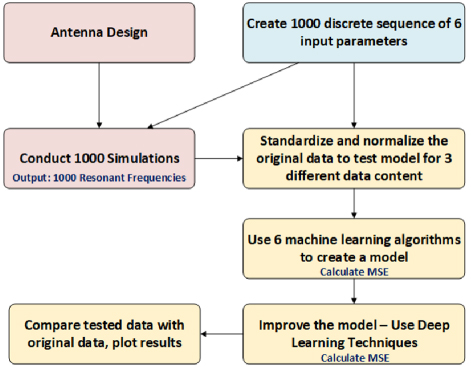
Figure 1: Design procedure flowchart.
A. Antenna design
Figure 2 shows the proposed hollow shaped cylindrical DRA components and the design parameters. As shown in Fig. 2, the proposed antenna has eight physical and two electrical design parameters: r1, r2, r3, r4, r5, h1, h2, h3, r and loss tg. In order to numerically obtain the data set, a commercial full-wave electromagnetic simulation program Computer Simulation Technology (CST) was used [30] in the simulations. The designed antenna was fed using a 50 waveguide port and a microstrip-slot coupling mechanism. The parameters utilized in creating the dataset, moving outward from the center, are: r1, r2, and the height from the ground of the solid object between these two values, h1; r3, r4, and the height from the ground of the solid object between these two values, h2. The other parameters of the antenna were kept constant. The dielectric substrate height is 1.52 mm, while the outer radius and height of the dielectric cylindrical antenna are r5 6 mm and h3 4 mm, respectively. Since changes in slot size have minimal impact on the results, they were not considered when generating the dataset.
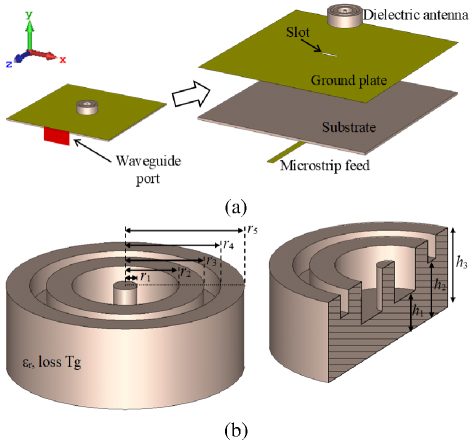
Figure 2: (a) Antenna design and (b) antenna scheme.
B. Latin hypercube sampling
LHS is a statistical technique used for sampling a multi-variable space. Unlike random sampling methods, LHS generates samples where each variable is evenly distributed across its value range. LHS divides the sample space into a specified number of cells and takes only one sample from each cell. This ensures that different values are selected for each variable, allowing the entire value range to be represented simultaneously for all variables.
A dataset was prepared for the six parameters in the design (r1, r2, r3, r4, h1, and h2), and simulations were performed. As shown in Table 1, the boundaries for each parameter were set as (r1 [0, 1.50], r2 [1.50, 3.00], r3 [3.50, 4.25], r4 [4.25, 5.00], h1 [0, 3.00], h2 [0, 3.00]). Subsequently, random values were assigned to each parameter within its limits, generating 1000 different inputs.
| # | r1 | r2 | r3 | r4 | h1 | h2 |
| 1 | 0.366 | 2.055 | 3.826 | 4.331 | 2.411 | 2.814 |
| 2 | 1.110 | 2.855 | 3.991 | 4.764 | 2.350 | 2.159 |
| 3 | 1.320 | 2.280 | 3.825 | 4.582 | 0.875 | 0.587 |
| ⋮ | ⋮ | ⋮ | ⋮ | ⋮ | ⋮ | ⋮ |
| 1000 | 0.027 | 1.550 | 4.016 | 4.318 | 0.929 | 2.234 |
C. Algorithms and data
In this study, the resonant frequency value was predicted using different machine learning methods with the values of r1, r2, r3, r4, h1, and h2. First, to assess the predictive success of traditional machine learning methods, the following machine learning algorithms were tested:
RandomForestRegressor
GradientBoostingRegressor
HistGradientBoostingRegressor
ExtraTreesRegressor
AdaBoostRegressor
BaggingRegressor
For each model, hyperparameter optimization was conducted using the Random Search method to obtain the best-performing model for the respective machine learning algorithm. Random search efficiently tunes hyperparameters by randomly sampling the search space, often outperforming similar strategies in many machine learning models [31, 32]. RandomizedSearchCV, an implementation of the random search strategy combined with cross-validation, was employed to optimize the hyperparameters of our machine learning models. Three different scaling methods were applied to each model: the original data, as well as two preprocessed versions (normalized and standardized), to test whether data preprocessing affected model performance.
The performance of each model was obtained using mean squared error (MSE) on the test data. In equation (1), n is the number of tested data, yi is the predicted resonant frequency by the model and is the resonant frequency of simulation for the same sequence of six input parameters:
| (1) |
MSE, which calculates the average of squared errors, serves as a metric to evaluate the predictive accuracy of the model. The lower the MSE, the better the model’s performance is considered to be.
D. Model improvement
To achieve better prediction performance a multi-layer ANN model was created and tested. For this purpose, a model that utilizes the dense layer concept was preferred. A dense layer is a layer in a neural network where every neuron is connected to all the neurons in the previous layer.
Based on the model’s output performance, the number of layers and neurons in each layer were optimized. As a result, the proposed ANN consists of nine hidden dense layers, in addition to an input layer and output layer. The number of neurons in the dense layers is set to 64, 128, 128, 64, 64, 32, 32, 16, and 8, respectively, from the first dense layer to the last. Considering factors such as the bimodal, positive, and linear nature of the data, the activation function preferred in this case is the Rectified Linear Unit (ReLU) for all layers. The ANN structure is illustrated in Fig. 3.
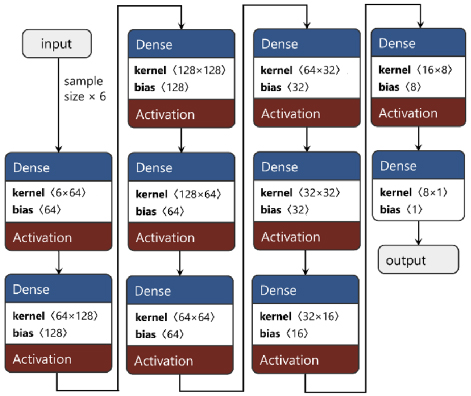
Figure 3: ANN structure of the model.
Additionally, to prevent overfitting during the training phase, features such as early stopping, automatic learning rate adjustment (ReduceLROnPlateau), and saving the best-performing model (ModelCheckpoint) were used in an effort to obtain the model with the best performance.
In the deep learning model, the MSE, which was used in traditional machine learning methods during testing, was preferred. The optimization algorithm chosen is the Adam optimization algorithm.
III. RESULTS AND DISCUSSION
The bar graph in Fig. 4 illustrates the operating frequency values obtained from simulations conducted within the 6-12 GHz frequency range.
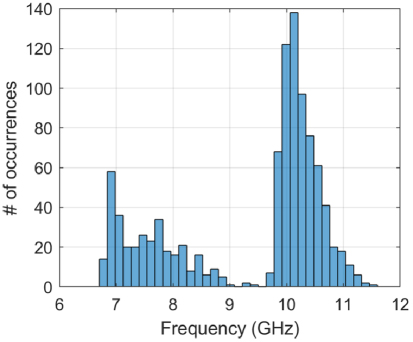
Figure 4: Obtained operating frequency values.
Since the designed antenna is expected to operate actively within the 6-12 GHz range, it is observed that the results concentrate in the 7-8.5 GHz and 9.5-11 GHz region. However, a small dense region between these is also shown in the graph, which does not align with the general data distribution. This minor density makes accurate predicting challenging. Subsequently, 800 of the data were used for training and 200 for testing.
Table 2: Performance of traditional machine learning methods
| # | Model | MSE | Data |
| 1 | ExtraTreesRegressor | 0.272 | Normalized |
| 2 | GradientBoostingRegressor | 0.276 | Normalized |
| 3 | RandomForestRegressor | 0.299 | Normalized |
| 4 | HistGradientBoostingRegressor | 0.328 | Normalized |
| 5 | ExtraTreesRegressor | 0.333 | StandardScale |
| 6 | BaggingRegressor | 0.340 | Normalized |
| 7 | ExtraTreesRegressor | 0.350 | Normal |
| 8 | HistGradientBoostingRegressor | 0.403 | Normal |
| 9 | HistGradientBoostingRegressor | 0.403 | StandardScale |
| 10 | RandomForestRegressor | 0.408 | Normal |
| 11 | GradientBoostingRegressor | 0.412 | StandardScale |
| 12 | GradientBoostingRegressor | 0.416 | Normal |
| 13 | RandomForestRegressor | 0.422 | StandardScale |
| 14 | BaggingRegressor | 0.429 | Normal |
| 15 | BaggingRegressor | 0.438 | StandardScale |
| 16 | AdaBoostRegressor | 0.617 | Normalized |
| 17 | AdaBoostRegressor | 0.710 | StandardScale |
| 18 | AdaBoostRegressor | 0.714 | Normal |
The original dataset was expanded through the processes of normalization and standardization. This dataset was used distinctly as input for both machine learning and deep learning models. As the output, a single operating frequency value was obtained, allowing for a performance comparison between the machine learning and deep learning models.
Accordingly, initially, all the data was fed into machine learning methods, and MSE was calculated (Table 2).
Table 2 indicates that ExtraTreesRegressor achieved the best prediction performance, particularly with normalized data, which resulted in an MSE of 0.272, followed closely by GradientBoostingRegressor. In general, normalization improved model performance, while standardization and raw data led to higher errors. AdaBoostRegressor performed the worst, with MSE values significantly higher across all preprocessing methods. These findings suggest that tree-based ensemble methods, especially ExtraTreesRegressor, are well-suited for this dataset, with normalization playing a key role in optimizing predictive accuracy.
In the next step, multi-layered ANNs were used, and the number of neurons in these layers was optimized. Then, early stopping and saving the best-performing methods were applied. Finally, the improving process was completed using the Adam optimization. With the deep learning model, a value of 0.128 was achieved for MSE. Thus, a performance improvement of 53% was obtained compared to the lowest MSE value obtained with traditional methods, which was 0.272. Figure 5 presents a comparison of actual simulation results with predicted values.
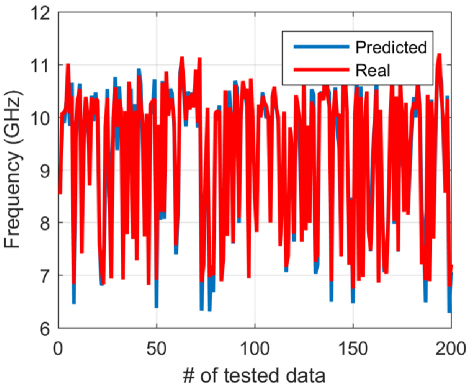
Figure 5: Predicted and real values.
Additionally, the MSE distribution of the entire test set, which contains 200 data points, was calculated. As seen in Fig. 6, the best predictions fall particularly within the 8-8.5 GHz and 10-11 GHz ranges, where sufficient training examples were available, allowing the system to learn effectively. Poor predictions were obtained below 7 GHz, which is the band edge. The sharp peak at 7 GHz, along with the limited number of training examples below 7 GHz, have led to uncertainty, causing the model to generate incorrect interpolations. In contrast, better predictions were observed in the 9-10 GHz range and at the upper band edge above 11 GHz. This can be explained by the fact that most of the test data is concentrated around 10 GHz, providing the model with more examples to learn from. As a result, the model was able to capture the underlying patterns more effectively in this region, leading to improved predictions.
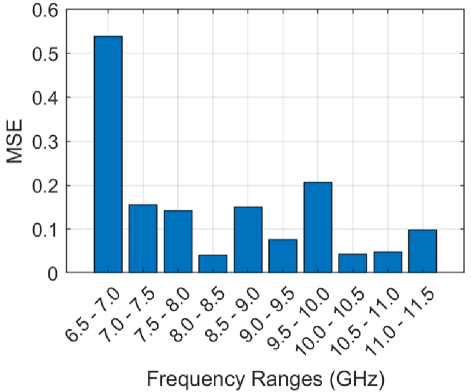
Figure 6: MSE of the test set.
In order to show the prediction performance of the resonant frequency value of the proposed deep learning methods for the hollow shaped cylindrical dielectric antenna, a numerical analysis was performed with random input parameters by using CST simulationsoftware.
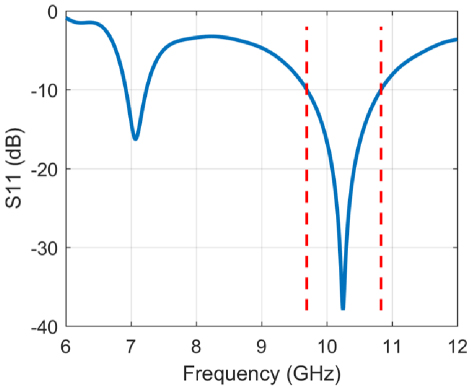
Figure 7: Simulation results for design parameter values r1 1.5 mm, r2 2.5 mm, r3 3.5 mm, r4 4.75 mm, r5 6 mm, h1 2.5 mm, h2 2.5 mm, and h3 4 mm.
As shown in Fig. 7, DRA operates at 10.25 GHz with a bandwidth of 1.14 GHz and return loss of 37.96 dB. When the same input parameters were fed into the proposed deep learning model, the obtained operating frequency was 10.30 GHz. It was observed that the two results closely match.
On a computer with 256 GB of RAM and an Intel Xeon Gold 6426Y processor and Nvidia RTX A5000 graphics card, 1000 simulation processes for this design were completed in approximately 16 hours, with each simulation taking around 57 seconds. The entire training and testing of the machine learning was completed within 150 seconds. Running deep learning processes took an additional 15 seconds. This process resulted in an improved MSE value when compared to the machine learning approach. To achieve better predictions, the deep learning process was rerun, which took 2 hours to complete. Once the training model was established, the prediction results were generated instantaneously. While traditional machine learning methods demonstrated solid performance, the deep learning model achieved a remarkable improvement, showcasing its superior predictive capabilities. Deep learning offers a promising approach for achieving even greater predictive performance.
IV. CONCLUSION
In this study, a novel approach was implemented to predict the resonant frequency value of the hollow shaped cylindrical dielectric antenna operating in the 6-12 GHz frequency band using a combination of traditional machine learning and deep learning methods. Through the use of Latin hypercube sampling (LHS), a diverse dataset of 1000 simulations were generated. Various preprocessing techniques, including normalization and standardization, were applied to enhance data representation, and multiple machine learning models were evaluated for performance. Among traditional methods, the ExtraTressRegressor demonstrated the best performance, achieving an MSE of 0.272.
To further improve prediction accuracy, a multi-layer ANN was developed, optimized using the Adam optimization algorithm. Advanced techniques such as early stopping and adaptive learning rate adjustments were employed to refine the deep learning model. This approach achieved an MSE of 0.128, representing a 53% improvement over the best-performing traditional method.
In order to show the performance of the improved model, a simulation was performed using random input parameters, and the simulation result was compared with the model output. The operating frequency obtained from the simulation was 10.25 GHz, while the model output was 10.30 GHz. Thus, the difference between the two results remained at a level of 0.49%. The consistency between the predicted and simulation results underscores the efficacy of the deep learning model.
The findings highlight the potential of integrating machine learning and deep learning techniques to enhance predictive accuracy in antenna design. This methodology not only accelerates the design process but also improves reliability, paving the way for further advancements in the field of electromagnetic simulation and optimization. Future work could focus on expanding the dataset and exploring alternative optimization techniques to further enhance the prediction accuracy.
ACKNOWLEDGMENT
The authors thank Abdullah Oguz Kizilcay from Zonguldak Bulent Ecevit University for his significant contributions to the field of deep learning, which have provided valuable insights for this study.
REFERENCES
[1] B. Mukherjee, P. Patel, and J. Mukherjee, “A review of the recent advances in dielectric resonator antennas,” Journal of Electromagnetic Waves and Applications, vol. 34, no. 9, pp. 1095-1158, June 2020.
[2] N. K. Mishra, J. Acharjee, V. Sharma, C. Tamrakar, and L. Dewangan, “Mutual coupling reduction between the cylindrical dielectric resonator antenna using split ring resonator-based structure,” AEU - Int. J. Electron. Commun., vol. 154, p. 154305, Sep. 2022.
[3] A. Vahora and K. Pandya, “A miniaturized cylindrical dielectric resonator antenna array development for GPS/Wi-Fi/wireless LAN applications,” Electron. Energy, vol. 2, p. 100044, 2022.
[4] A. Petosa, Dielectric Resonator Antenna Handbook. Norwood, MA: Artech House, 2007.
[5] S. Zheng, X. Chen, N. Yang, B. Qian, L. Zhao, and A. A. Kishk, “Broadband dual-polarized cup dielectric resonator antenna with stable omnidirectional radiation patterns,” Appl. Comput. Electromagn. Soc., vol. 39, no. 10, pp. 908-915, 2024.
[6] P. Ranjan, H. Gupta, S. Yadav, and A. Sharma, “Machine learning assisted optimization and its application to hybrid dielectric resonator antenna design,” Facta Univ. - Ser. Electron. Energ., vol. 36, no. 1, pp. 31-42, 2023.
[7] A. K. Kushwaha, V. Rai, G. Kumar, V. Kumar, A. Pandey, and R. K. Barik, “Cylindrical dielectric resonator antenna optimization: A machine learning perspective,” in 2023 Int. Conf. Comput. Electron. Electr. Eng. their Appl. IC2E3 2023, pp. 1-6, 2023.
[8] K. Pachori, “Performance prediction of dielectric resonator-based MIMO antenna for sub-6.0 GHz using machine learning algorithms,” Electromagnetics, vol. 43, no. 8, pp. 539-550, 2023.
[9] K. Fu and K. W. Leung, “A machine learning enhanced evolutionary algorithm for antenna design,” in IEEE Conf. Antenna Meas. Appl. CAMA, pp. 50-53, 2023.
[10] B. Şenel and F. A. Şenel, “Bandpass filter design using deep neural network and differential evolution algorithm,” Arab. J. Sci. Eng., vol. 47, pp. 14343-14354, 2022.
[11] N. Calik, M. A. Belen, and P. Mahouti, “Deep learning base modified MLP model for precise scattering parameter prediction of capacitive feed antenna,” Int. J. Numer. Model. Electron. Networks, Devices Fields, vol. 33, no. 2, Mar. 2020.
[12] Y. Kim, “Application of machine learning to antenna design and radar signal processing: A review,” in 2018 International Symposium on Antennas and Propagation (ISAP), Busan, Korea (South), pp. 1-2, 2018.
[13] N. Wang, Z. Kong, X. Ren, S. Chen, G. Dai, and K. Han, “A wideband butterfly antenna based on deep learning parameter optimization algorithm,” in 2020 Cross Strait Radio Science & Wireless Technology Conference (CSRSWTC), Fuzhou, China, pp. 1-3, Dec. 2020.
[14] M. M. Khan, S. Hossain, P. Mozumdar, S. Akter, and R. H. Ashique, “A review on machine learning and deep learning for various antenna design applications,” Heliyon, vol. 8, no. 4, p. e09317, Apr. 2022.
[15] A. M. Montaser and K. R. Mahmoud, “Deep learning based antenna design and beam-steering capabilities for millimeter-wave applications,” IEEE Access, vol. 9, pp. 145583-145591,2021.
[16] F. Mir, L. Kouhalvandi, L. Matekovits, and E. O. Gunes, “Automated optimization for broadband flat-gain antenna designs with artificial neural network,” IET Microwaves, Antennas Propag., vol. 15, no. 12, pp. 1537-1544, Oct. 2021.
[17] T. Sallam and A. M. Attiya, “Convolutional neural network for coupling matrix extraction of microwave filters,” Appl. Comput. Electromagn. Soc., vol. 37, no. 7, pp. 805-810, 2022.
[18] R. Chair, S. L. S. Yang, A. A. Kishk, K. F. Lee, and K. M. Luk, “Aperture fed wideband circularly polarized rectangular stair shaped dielectric resonator antenna,” IEEE Trans. Antennas Propag., vol. 54, no. 4, pp. 1350-1352, 2006.
[19] W. Huang and A. A. Kishk, “Compact dielectric resonator antenna for microwave breast cancer detection,” IET Microwaves, Antennas Propag., vol. 3, no. 4, pp. 638-644, 2009.
[20] P. Gupta, D. Guha, and C. Kumar, “Dielectric resonator working as feed as well as antenna: new concept for dual-mode dual-band improved design,” IEEE Trans. Antennas Propag., vol. 64, no. 4, pp. 1497-1502, 2016.
[21] S. Keyrouz and D. Caratelli, “Dielectric resonator antennas: Basic concepts, design guidelines, and recent developments at millimeter-wave frequencies,” International Journal of Antennas and Propagation, pp. 1-20, 2016.
[22] R. Chair, A. A. Kishk, and K. F. Lee, “Experimental investigation for wideband perforated dielectric resonator antenna,” Electron. Lett., vol. 42, no. 3, pp. 15-16, 2006.
[23] J. K. Rai, P. Ranjan, and R. Chowdhury, “Frequency reconfigurable wideband rectangular dielectric resonator antenna for sub-6 GHz applications with machine learning optimization,” AEU - Int. J. Electron. Commun., vol. 171, p. 154872, July 2023.
[24] C. Janiesch, P. Zschech, and K. Heinrich, “Machine learning and deep learning,” Elektron Mark., vol. 31, pp. 685-695, 2021.
[25] I. H. Sarker, “Deep learning: A comprehensive overview on techniques, taxonomy, applications and research directions,” SN Comput. Sci., vol. 2, p. 420, 2021.
[26] M. D. McKay, R. J. Beckman, and W. J. Conover, “A comparison of three methods for selecting values of input variables in the analysis of output from a computer code,” Technometrics, vol. 21, pp. 239-245, 1979.
[27] S. Shakya, C. Schmüdderich, J. Machacek, L. F. Prada-Sarmiento, and T. Wichtmann, “Influence of sampling methods on the accuracy of machine learning predictions used for strain-dependent slope stability,” Geosciences, vol. 14, no. 2, p. 44, 2024.
[28] D. P. Kingma and J. Ba, “Adam: A method for stochastic optimization,” in 23rd International Conference on Learning Representations (ICLR). 2015.
[29] H. Wang, D. Li, Y. Li, G. Zhu, and R. Lin, “Method for remaining useful life prediction of turbofan engines combining Adam optimization-based self-attention mechanism with temporal convolutional networks,” Appl. Sci., vol. 14, p. 7723, 2024.
[30] Computer Simulation Technology, CST Studio Suite, 2023. http://www.cst.com
[31] J. Bergstra and Y. Bengio, “Random search for hyper-parameter optimization,” J. Mach. Learn. Res., vol. 13, pp. 281-305, 2012.
[32] L. Yang and A. Shami, “On hyperparameter optimization of machine learning algorithms: Theory and practice,” Neurocomputing, vol. 415, pp. 295-316, 2020.
BIOGRAPHIES

Fidan Gamze Kizilcay received her B.Sc. and M.Sc. degrees in Electronics and Communication Engineering from Suleyman Demirel University, Isparta, Türkiye. She is pursuing her Ph.D. degree in Electrical Electronics Engineering at Sakarya University. She is currently working as an Instructor at Zonguldak Bülent Ecevit University. Her research interests include electromagnetics and microwave techniques, biomedical engineering and metamaterials.

Muhammet Hilmi Nisanci was born in Istanbul, Turkey, in 1983. He received the B.S. and M.S. degrees from Suleyman Demirel University, Isparta, Turkey, in 2006 and 2009, respectively, both in electronic and telecommunication engineering, and the Ph.D. degree in electrical engineering from the University of L’Aquila, L’Aquila, Italy, in 2013. Since November 2021, he has been working as an Associate Professor with the Department of Electrical and Electronics Engineering, Sakarya University, Sakarya, Turkey. He was involved in the research activities with the UAq EMC Laboratory, L’Aquila, Italy, from February 2007 to March 2009. He is extending his research to include grooved covers and/or cavities. His research interests include the numerical analysis of general electromagnetic problems, reverberation/anechoic chambers, interaction of electromagnetic field with dielectrics and composite media, and their modeling and application for EMC.
ACES JOURNAL, Vol. 40, No. 8, 694–701
doi: 10.13052/2024.ACES.J.400802
© 2025 River Publishers