Grey Wolf Optimization for Uplink Power Control in User-Centric Cell-Free Massive MIMO
Nguyen Van Cuong, Hoang Manh Kha, and Tong Van Luyen
School of Electrical and Electronic Engineering
Hanoi University of Industry, Hanoi, Vietnam
cuongnv@haui.edu.vn, khahoang@haui.edu.vn, luyentv@haui.edu.vn
Submitted On: March 30, 2025; Accepted On: October 25, 2025
ABSTRACT
User-Centric Cell-Free Massive Multiple-Input Multiple-Output (UC-CFmMIMO) is a promising architecture for B5G networks, offering improved spectral efficiency (SE) and fairness by enabling joint transmission from distributed access points. However, uplink power control remains challenging due to inter-user interference and the decentralized network structure. This paper introduces a Grey Wolf Optimization (GWO)-based uplink power control scheme tailored for UC-CFmMIMO, targeting two practical objectives: maximizing sum SE and enhancing user fairness. Inspired by the hunting behavior of grey wolves, the proposed algorithm efficiently navigates the non-convex solution space without relying on convex assumptions. Numerical results demonstrate that the proposed scheme significantly improves fairness among users (e.g., achieving 3.39-bit/s/Hz at a cumulative distribution function (CDF) of 0.1) while maintaining high throughput performance (e.g., 118.99-bit/s/Hz at a CDF of 0.5). Moreover, the algorithm exhibits excellent scalability and computational efficiency, making it a practical and effective solution for large-scale B5G deployments.
Keywords: Grey wolf optimization, max-min fairness, sum-rate maximization, uplink power control, user-centric cell-free massive MIMO.
I. INTRODUCTION
Next-generation wireless networks (B5G/6G) are envisioned to support massive connectivity, ultra-reliable low-latency communication, and pervasive intelligence across diverse industrial and urban scenarios [1, 2, 3, 4, 5, 6]. User-Centric Cell-Free Massive Multiple-Input Multiple-Output (UC-CFmMIMO) represents a pivotal component in the architectural evolution toward B5G networks, where densely distributed access points (APs) collaboratively serve users without cell boundaries. This cell-free and user-centric paradigm enhances spectral efficiency (SE), fairness, and scalability, enabling seamless connectivity in ultra-dense and Industry 4.0/5.0 environments such as smart factories, autonomous systems, and intelligent logistics [5, 6, 7, 8, 9]. Through centralized coordination and flexible resource allocation, UC-CFmMIMO supports the hierarchical and distributed computing architecture fundamental to B5G network design.
Power control remains a key enabler for UC-CFmMIMO performance optimization by mitigating inter-user interference and regulating transmission power efficiency [5]. Conventional convex-based optimization methods, including geometric programming and bisection search [7, 8, 9, 10], provide analytical tractability but exhibit limitations in large-scale non-convex settings due to their high computational complexity and reliance on convexity assumptions [11, 12, 13, 14]. The fixed-point algorithm (FPA), while effective for convex formulations, encounters convergence degradation under user-centric interference coupling and dynamic channel conditions [5]. These pitfalls restrict adaptability to rapidly varying topologies and heterogeneous quality of service requirements in dense B5G deployments.
Recent research has explored advanced computational intelligence to overcome these challenges. In particular, Grey Wolf Optimization (GWO) has gained attention as a population-based metaheuristic that efficiently explores non-convex search spaces and mitigates premature convergence [15, 16, 17]. Beyond classical optimization, machine learning and intelligent control have emerged as complementary approaches for adaptive communication and control systems. For instance, machine learning-enabled channel estimation (CE) frameworks, such as distributed compressed sensing-based MIMO-filter bank multicarrier estimation for Industrial Internet of Things (IIoT) [18], low-complexity sparse CE for industrial big data [19], and sparse Bayesian learning-based CE for Filter bank multicarrier with offset quadrature amplitude modulation IIoT networks [20], demonstrate the capability of learning-assisted models to address sparsity, interference, and channel uncertainty. Likewise, intelligent control models, including fuzzy-tuned brain emotional learning-based intelligent controller for satellite attitude regulation [21] and linear matrix inequalities-based stabilization of input derivative positive systems [22], illustrate the adaptability of learning-driven optimization and control paradigms across dynamic environments.
Motivated by these developments, this study proposes a GWO-based centralized uplink power control framework for UC-CFmMIMO networks, aligned with the B5G vision of sustainable, intelligent, and energy-efficient connectivity. Two distinct optimization formulations are considered: a fairness-oriented design maximizing the minimum SE among users and a throughput-oriented design maximizing the aggregate SE. The GWO algorithm is adapted to efficiently solve each non-convex problem without convex approximation, enabling scalable operation under dense user and AP deployments. Simulation results demonstrate that the proposed GWO-based schemes achieve superior trade-offs in fairness, throughput, and computational efficiency compared with conventional FPA, full power control (FPC), and bat algorithm (BA) benchmarks.
The main contributions of this paper are summarized as follows:
• We formulate two uplink power control problems in UC-CFmMIMO networks, one designed to enhance user fairness and the other to maximize system throughput.
• We adapt and integrate the GWO algorithm into the UC-CFmMIMO uplink power control framework, marking its first application in this context to effectively solve the formulated non-convex problems.
• We provide extensive simulation-based comparisons with conventional schemes (FPA, FPC) and BA to evaluate the performance of each proposed formulation in terms of SE, fairness, computational complexity, and scalability.
The remainder of this paper is structured as follows. Section II. presents the system model. Section III. formulates the optimization problem. Section IV. details the proposed GWO-based solution. Section V. provides numerical results validating the effectiveness of our approach. Section VI. concludes the study and discusses its implications for sustainable wireless networks.
II. SYSTEM MODEL
We consider a UC-CFmMIMO network consisting of single-antenna user equipment (UE) and APs, each having antennas as indicated in Fig. 1. The wireless channel is assumed to follow the block-fading model, where the channel remains constant over a coherence block and changes independently between blocks. A coherence block is a time-frequency block whose time duration equals the coherence time and whose bandwidth equals the coherence bandwidth. Hence, the channel between each AP-UE pair is constant and frequency-flat within a coherence block and can therefore be represented by a single channel realization.
In the considered time-division duplex protocol, each coherence block consists of transmission symbols, which are divided into three parts: symbols for uplink pilots, symbols for uplink data, and symbols for downlink data, satisfying . The uplink pilots are transmitted prior to downlink data so that channel estimates can be obtained and used for precoding.
The channel between the th AP and the th UE in an arbitrary coherence block is denoted by , modeled as a correlated Rayleigh fading distribution . Here denotes a circularly symmetric complex Gaussian distribution with zero mean vector and covariance matrix . The vector represents an all-zero vector. is the spatial correlation matrix between the AP and the UE. The Gaussian distribution is utilized to represent the effects of small-scale fading, while the positive semidefinite correlation matrix characterizes large-scale fading, which encompasses factors such as geometric path loss, shadowing, antenna gains, and spatial channel correlation [3, 4, 5].
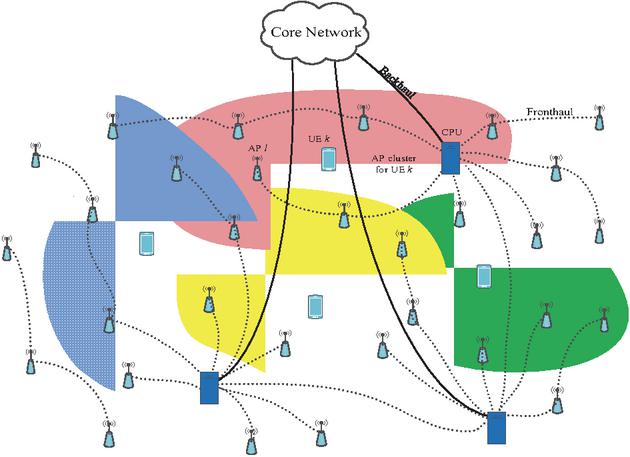
Figure 1: UC-CFmMIMO network with access points jointly serving user equipment.
The uplink transmission powers can be represented as a vector , influencing all UEs. The uplink SE of the UE is determined by its effective signal-to-interference-plus-noise ratio (SINR), which depends on . Specifically, the numerator of the SINR is influenced by the transmission power of the desired signal, while the interference term in the denominator is affected by all power components in . The effective SINR for the UE, applicable to centralized uplink operations, can be expressed in a generalized form as [5]:
| (1) |
where represents the average effective channel gain of the desired signal for the th UE, contains the average interference coefficients, and denotes the effective noise variance. These parameters are given by
| (2) | |
| (3) | |
| (4) | |
| (5) |
where denotes the statistical expectation operator. The combining vector denotes the centralized receive filter used at the CPU to extract the data of the UE from the aggregated uplink signal. In a centralized architecture the CPU collects (or has access to) the received signal components from all the APs and applies a single global linear combiner to the stacked receive vector. Concretely, is formed by stacking the local combining vectors from each AP , where is the local combiner applied to the -antenna signal at the AP. The combined scalar observation used to detect the UE is , where y is the full -dimensional received signal stacked across APs. is a block-diagonal matrix. is the channel vectors from all UEs. Therefore, the uplink SE of the UE depends on and can be written as [5]:
| (6) |
Here and are the numbers of symbols for uplink data and the total symbols in a coherence block, respectively.
Equations (1)–(6) represent the standard centralized SE formulation for uplink UC-CFmMIMO, derived from the general SINR structure given in [5, Theorem 5.2]. This formulation enables a unified optimization of the transmission powers across all UEs.
III. PROBLEM FORMULATION
The uplink power control process involves determining the appropriate uplink power levels for UEs to maximize a specific utility function, typically related to SE. In this study, we address two key power control problems: max-min SE fairness and sum SE maximization, each defined by its corresponding objective function and , respectively.
Here, represents the minimum SE among all users, aiming to enhance user fairness, while denotes the aggregate SE of the system, focusing on maximizing total throughput. These functions are formulated as:
| (7) | |
| (8) |
Accordingly, the two optimization problems can be expressed as:
| (P1): | ||
| (9) | ||
| (P2): | ||
| (10) |
While max-min SE fairness prioritizes users with poor channel conditions, it may not fully exploit the potential for higher SE in large networks. In contrast, the sum SE maximization problem focuses on maximizing the total number of transmitted bits, regardless of their distribution among UEs. This approach is particularly suitable for scenarios where each UE interferes only with a small subset of neighboring users.
These two optimization problems highlight different objectives: max-min SE fairness ensures equitable resource allocation, whereas sum SE maximization prioritizes overall throughput. In the following section, we develop a GWO-based approach to efficiently solve both formulations.
IV. PROPOSED APPROACH
We propose an uplink power control scheme using the GWO to address optimization challenges in UC-CFmMIMO systems. GWO efficiently explores high-dimensional solution spaces, overcoming the limitations of conventional methods by avoiding local optima and ensuring robust performance in complex wireless environments [23, 24, 25].
A. Fitness function formulation
Our approach addresses two distinct objectives: max-min fairness and sum SE maximization. To this end, we design separate fitness functions that directly represent each goal under system constraints, enabling the GWO algorithm to efficiently search for optimal power control solutions.
For the identified problems (P1) and (P2) defined in section III, each defined as a single-objective optimization, we construct two corresponding fitness functions, and , to guide the GWO algorithm toward fairness and throughput optimization, respectively.
The constraints define the allowable power control range for each user, ensuring compliance with system limitations. We set the feasible search space within , where represents the maximum transmission power. This ensures that all solutions generated by GWO satisfy power constraints while optimizing performance.
These formulations allow the algorithm to target distinct power control objectives in UC-CFmMIMO systems. This separation of objectives highlights the flexibility of the GWO framework in addressing diverse optimization goals under a unified metaheuristic paradigm.
B. Proposed algorithm
The GWO is a metaheuristic optimization technique inspired by the hierarchical leadership and cooperative hunting strategies of grey wolves. It categorizes wolves into four roles (alpha, beta, delta, omega), where the alpha leads the search process. The key strength of GWO lies in its ability to balance exploration and exploitation, efficiently navigating complex solution spaces while avoiding local optima [16].
Leveraging these properties, we develop a GWO-based algorithm to optimize uplink power control in UC-CFmMIMO systems. The detailed mathematical formulation of the proposed procedure is provided in Algorithm 1, which outlines the initialization, fitness evaluation, position update, boundary control, and termination criteria for achieving the optimal power allocation vector .
| Algorithm 1. Proposed GWO-based uplink power control algorithm. |
| Input: UC-CFmMIMO parameters; number of APs, number of UEs , population size , maximum iterations , lower bound 0, upper bound , fitness function |
| Output: Optimal transmission powers |
| for to do |
| if then |
| else |
| end |
| Evaluate and update |
| end |
| for to do |
| for to do |
| if or then |
| Project back into |
| end |
| Evaluate and update |
| end |
| end |
| return |
First, system-specific parameters such as the number of APs, UEs, antennas, and maximum transmission power are initialized, together with the GWO parameters including population size, search limits, and the fitness function. The initial power control vectors are then randomly generated within the search domain to ensure solution diversity.
Each wolf’s fitness is evaluated according to the optimization objective, and the top three wolves (alpha, beta, delta) are identified to guide the search. Subsequently, all wolves update their positions using adaptive coefficients that simulate encircling and attacking behaviors, balancing exploration and exploitation.
A random exploration factor is introduced to mitigate premature convergence. The iterations continue until a stopping condition is met, either the maximum iteration count or convergence in the fitness value. Finally, the best solution is returned, representing the optimal power control vector that ensures an effective trade-off between efficiency and fairness in uplink power control.
V. NUMERICAL RESULTS
To evaluate the proposed GWO-based uplink power control scheme in UC-CFmMIMO scenarios, a network is deployed over a 11 km area with 100 randomly distributed APs and 20 UEs. Each AP is equipped with a single antenna, resulting in a total of 100 antennas across the network. Both AP and UE positions vary across 1000 independent network setups, each simulated over 50 channel realizations to ensure statistical robustness.
Communication occurs over a 20 MHz bandwidth, with a receiver noise power dBm accounting for both thermal noise and a 7 dB receiver noise figure. UEs have a maximum uplink transmission power of , reflecting power constraints in practical deployments. The coherence block consists of samples aligned with a 2 ms coherence time and a 100 kHz coherence bandwidth, accommodating user mobility and outdoor propagation in sub-6 GHz bands. Large-scale fading follows the 3GPP Urban Microcell model, with Rayleigh fading channels exhibiting spatial correlation based on a local scattering model.
For performance benchmarking, the proposed GWO-based schemes are compared with conventional methods, including FPA, FPC, and BA [26]. The BA approach follows the same centralized uplink operation and optimization objectives as the proposed formulations, ensuring consistent evaluation criteria across all algorithms.
For optimization, both GWO and BA operate with a population size of 300 and 50 iterations to ensure a fair comparison. The BA parameters are configured as loudness of 0.5 and pulse rate of 0.5. The GWO algorithm and its procedural steps are fully presented in section IV. in algorithmic form to facilitate reproducibility.
The chosen population size and iteration count were determined based on the theoretical balance between exploration and exploitation in population-based metaheuristics. In GWO, a larger population enhances global exploration capability, reducing the risk of premature convergence, while an excessive number of iterations primarily improves local refinement at the cost of higher computational complexity. In this study, the selected configuration of 300 agents and 50 iterations achieves stable convergence behavior and consistent optimization performance, as evidenced in section V. part A. The convergence profiles confirm that this setting allows GWO to reach near-optimal solutions efficiently without requiring additional computational overhead. Therefore, the adopted parameters are both theoretically motivated and empirically validated to ensure robust and efficient operation for the UC-CFmMIMO uplink power control problem. SE serves as the main performance metric, evaluated through cumulative distribution function (CDF) curves and average SE measures to characterize both fairness and throughput trends across various network configurations.
A. Effectiveness of proposed scheme
The effectiveness of the proposed uplink power control schemes is validated through extensive numerical experiments, as illustrated in Figs. 2–5. The experiments were performed on a Windows Server 2019 using MATLAB R2023a with two Intel® Xeon® Gold 5115 Processors to assess computational performance and convergence efficiency.
Figure 2 depicts the convergence behavior of the normalized fitness functions corresponding to the two optimization formulations (F1-GWO for fairness-oriented P1 and F2-GWO for throughput-oriented P2). Both formulations exhibit rapid convergence toward optimality, with F1-GWO stabilizing after approximately 220 iterations and an average computation time of 5.25 ms. The slower convergence of F1-GWO reflects the complexity of achieving balanced SE distribution among UEs. In contrast, F2-GWO reaches convergence almost instantly because maximizing the sum SE inherently corresponds to full-power transmission, which is evaluated at initialization.
After 50 iterations, the normalized fitness values of F1-GWO and F2-GWO reach 0.96214 and 0.99991, respectively, confirming the high convergence efficiency of the proposed algorithm. These results demonstrate that the selected configuration (a population size of 300, 50 iterations) achieves near-optimal performance with minimal computational cost, providing a strong balance between convergence accuracy and runtime efficiency.
The strong convergence behavior observed in both F1-GWO and F2-GWO highlights the algorithm’s potential for near real-time applicability in UC-CFmMIMO systems. With an average computation time of only a few milliseconds per optimization round, the proposed framework can efficiently adapt to moderate variations in user distribution or channel conditions within a coherence block. Given that the uplink power control problem is quasi-static over short time intervals, the GWO process can be periodically reinitialized or triggered by network dynamics to update transmission powers with negligible latency. These attributes make the proposed approach particularly suitable for practical deployments requiring low-latency adaptation and consistent trade-offs between fairness and throughput.
To benchmark SE performance, Figs. 3–5 compare the proposed F1-GWO and F2-GWO schemes against conventional FPA and FPC. At CDF 0.1, the F1-GWO scheme achieves 3.39-bit/s/Hz, outperforming FPA (3.18-bit/s/Hz). At CDF 0.5, F1-GWO reaches 4.24-bit/s/Hz, while F2-GWO attains 5.66-bit/s/Hz, exceeding FPA (3.90-bit/s/Hz). These improvements indicate that GWO enhances SE optimization through dynamic adaptation of search agents, leading to superior power allocation.
The fairness performance comparison in Fig. 4 reveals that F1-GWO consistently achieves higher minimum SE than both FPC and F2-GWO, confirming its robustness in supporting users with weak links. At CDF 0.5, F1-GWO records 3.87-bit/s/Hz, surpassing FPC (3.15-bit/s/Hz) and F2-GWO (3.14-bit/s/Hz). The gain in minimum SE demonstrates that GWO effectively mitigates interference in decentralized UC-CFmMIMO networks, where local AP-UE associations cause heterogeneous link qualities.
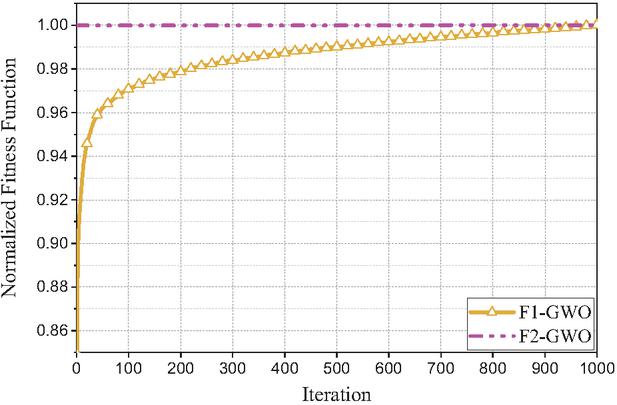
Figure 2: Convergence of the normalized fitness functions for the two optimization objectives: F1-GWO (fairness-oriented) and F2-GWO (throughput-oriented). The F1-based GWO scheme converges after around 220 iterations, whereas the F2-based GWO converges instantly, confirming the rapid convergence and computational efficiency of GWO.
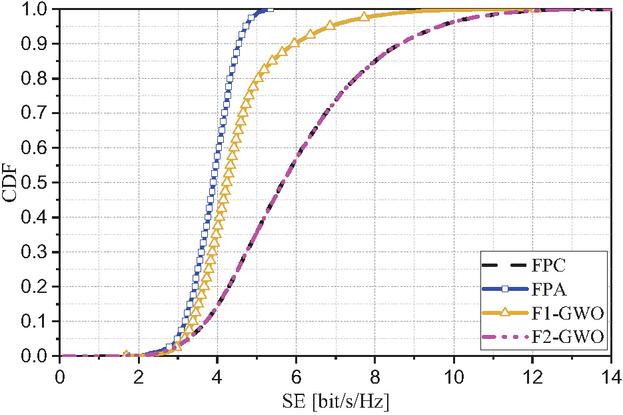
Figure 3: Cumulative distribution of SE per user for different uplink power control schemes. The proposed F1- and F2-based GWO schemes outperform conventional FPA and FPC methods, achieving higher median and tail SE values.
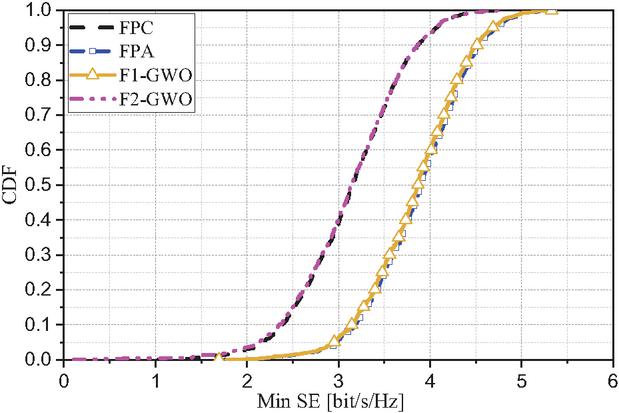
Figure 4: Minimum SE comparison among power control schemes. The fairness-oriented F1-GWO scheme provides the highest minimum SE, demonstrating improved user fairness relative to FPC, FPA, and F2-based GWO.
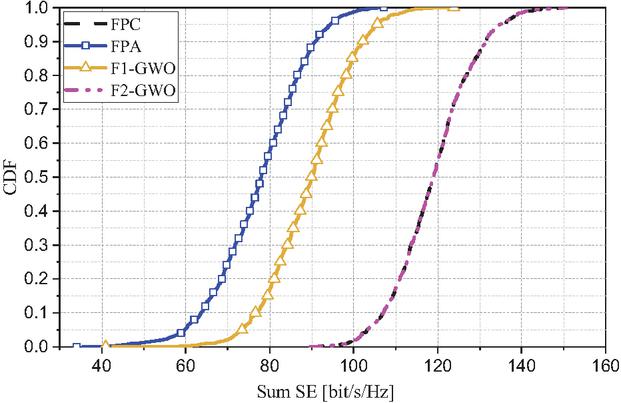
Figure 5: Sum SE comparison among power control schemes. The F2-GWO scheme achieves throughput comparable to FPC while the F1-GWO surpasses FPA, confirming the efficiency of GWO in optimizing both fairness and throughput.
Figure 5 illustrates the sum SE performance. At CDF 0.1, F2-GWO and FPC both reach 107.0-bit/s/Hz, while F1-GWO achieves 76.6-bit/s/Hz, outperforming FPA (63.7-bit/s/Hz). At CDF 0.5, F2-GWO maintains parity with FPC (118.99-bit/s/Hz), and F1-GWO continues to exceed FPA (89.98-bit/s/Hz vs. 77.97-bit/s/Hz). These results confirm that GWO can achieve comparable or superior throughput performance to conventional benchmark schemes while maintaining better fairness balance.
In summary, the proposed GWO-based schemes provide a comprehensive balance between fairness and SE while demonstrating computational efficiency and scalability advantages. The additional comparative insights and interpretation presented here strengthen the understanding of the proposed method’s value and its distinction from prior optimization approaches in UC-CFmMIMO systems.
B. Impact of number of APs and UEs
This section investigates the influence of AP and UE scaling on system performance in terms of the average minimum SE and sum SE. The evaluation further includes the BA for comparative analysis, employing the same optimization objectives as the proposed GWO schemes. The additional F1-BA and F2-BA cases provide a relevant benchmark, as BA has been previously adopted for centralized uplink power control in UC-CFmMIMO systems [26].
Figure 6 demonstrates that increasing the number of APs enhances average minimum SE due to improved spatial diversity and reduced signal attenuation. At 200 APs, F1-GWO achieves 6.02-bit/s/Hz, higher than FPA (5.95-bit/s/Hz) and F1-BA (5.84-bit/s/Hz), confirming the superior fairness control capability of GWO. The F2-GWO scheme also attains 5.28-bit/s/Hz, outperforming FPC (5.18-bit/s/Hz) and F2-BA (5.21-bit/s/Hz). These results indicate that GWO achieves better exploitation of distributed resources and faster convergence toward balanced power allocation compared with BA.
Figure 7 shows that the average sum SE improves with more APs, benefiting throughput-oriented schemes. At 200 APs, F2-GWO reaches 157.85-bit/s/Hz, exceeding both FPC (156.44-bit/s/Hz) and F2-BA (157.07-bit/s/Hz). Similarly, F1-GWO attains 130.62-bit/s/Hz, outperforming FPA (119.04-bit/s/Hz) and F1-BA (124.86-bit/s/Hz). The consistent gain over BA highlights the adaptability of GWO in complex multi-dimensional search spaces and its robustness to local optima.
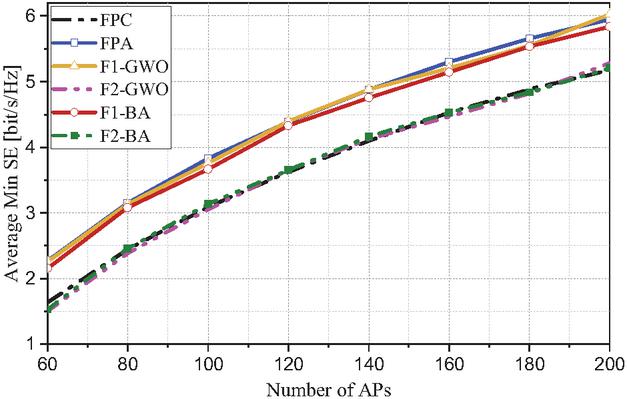
Figure 6: Average minimum SE versus number of APs. Increasing APs enhances spatial diversity and fairness. F1-GWO achieves the highest SE (6.02-bit/s/Hz at 200 APs), outperforming F1-BA and FPA, highlighting GWO’s superior resource utilization and convergence.
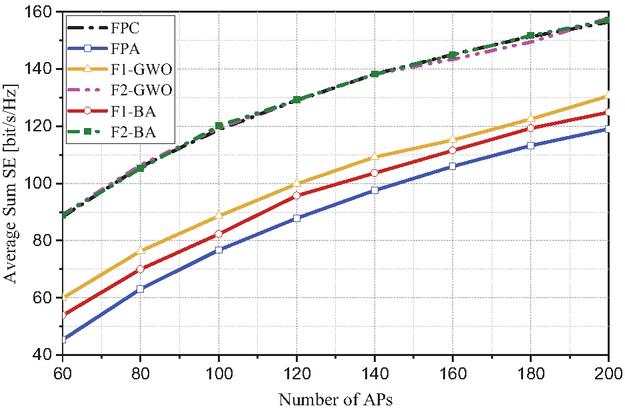
Figure 7: Average sum SE versus number of APs. Both GWO-based schemes show steady throughput improvement as APs increase. F2-GWO attains 157.85-bit/s/Hz at 200 APs, exceeding FPC and F2-BA, confirming better scalability and optimization robustness.
When the number of UEs increases, inter-user interference becomes dominant, causing a reduction in minimum SE for all schemes. Figure 8 shows that F1-GWO maintains higher minimum SE across all user densities. For instance, at 30 UEs, F1-GWO records 2.78-bit/s/Hz, compared to 2.53-bit/s/Hz (F1-BA), 2.80-bit/s/Hz (FPA), and 1.83-bit/s/Hz (FPC). This confirms that the fairness-oriented F1 formulation stabilizes user performance even under increased network loading.
In contrast, Fig. 9 reveals that total SE rises with the number of UEs because more concurrent uplink transmissions contribute to overall throughput. F2-GWO shows the highest growth, from 69.42 to 148.32-bit/s/Hz as UEs increase from 10 to 30, outperforming both FPC (70.46- to 146.85-bit/s/Hz) and F2-BA (70.63- to 147.24-bit/s/Hz). Furthermore, F1-GWO consistently surpasses FPA (51.99- to 115.63-bit/s/Hz versus 49.91- to 84.12-bit/s/Hz) and F1-BA (46.84- to 105.23-bit/s/Hz), proving that fairness-oriented GWO retains competitive throughput.
Overall, the results confirm that both proposed schemes, F1-GWO for fairness optimization and F2-GWO for throughput maximization, achieve superior trade-offs compared with BA and conventional benchmarks. The study differs from our prior work by extending power-control optimization to the UC-CFmMIMO framework under centralized uplink operation, incorporating GWO as an adaptive metaheuristic alternative to BA, and providing a more detailed scalability analysis with respect to both AP and UE densities. These outcomes emphasize the efficiency, robustness, and generalization capability of the proposed GWO-based formulations for UC-CFmMIMO uplink systems.
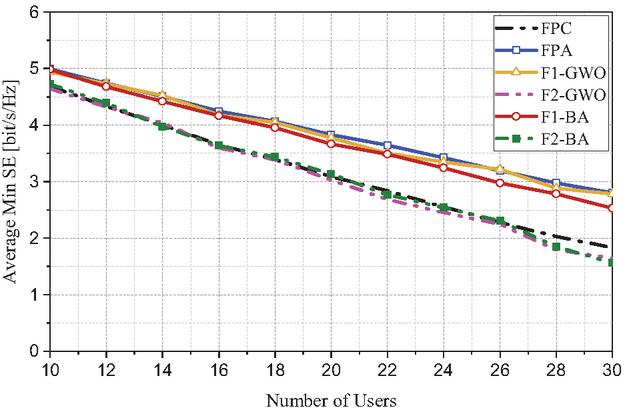
Figure 8: Average minimum SE versus number of UEs. As UE density rises, inter-user interference reduces SE for all methods. F1-GWO consistently maintains higher fairness, outperforming F1-BA and FPC, especially under heavy network loading.
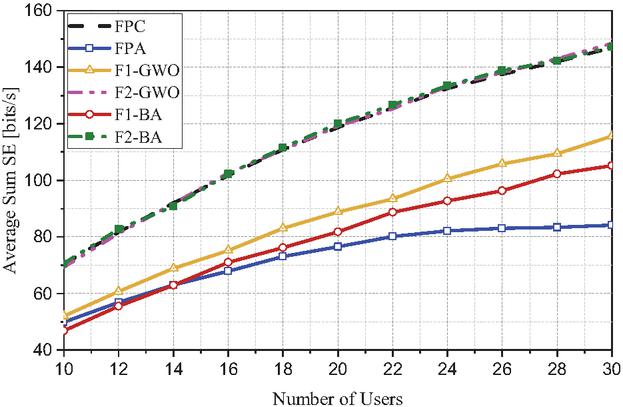
Figure 9: Average sum SE versus number of UEs. Throughput increases with user density, and F2-GWO exhibits the steepest growth, outperforming both BA- and FPC-based counterparts. F1-GWO also achieves superior throughput compared with FPA and F1-BA, verifying its robustness across network scales.
Although the simulations are conducted for sub-6 GHz UC-CFmMIMO systems, the proposed GWO-based optimization framework is not limited to a specific frequency band or communication standard. Its metaheuristic structure can accommodate varying system models by redefining the spectral-efficiency function or power constraints according to the target standard (e.g., mmWave or 6G massive MIMO). Moreover, the algorithmic scalability demonstrated across different AP and UE densities suggests strong adaptability to heterogeneous and evolving network environments. Future work may extend this analysis to include diverse communication standards and dynamic user distributions to further validate the robustness and generalization capability of the proposed approach.
VI. CONCLUSION
This paper presents a GWO-based uplink power control framework for UC-CFmMIMO systems, addressing fairness and throughput optimization through two formulations: F1-GWO for max-min fairness and F2-GWO for sum-SE maximization. The proposed approach achieves rapid and stable convergence, with F1-GWO reaching approximately 96% of its optimal normalized fitness and F2-GWO nearly full convergence (approximately equal to 100%) within 50 iterations. The average computation time of only a few milliseconds per optimization cycle highlights its feasibility for near real-time implementation. Numerical evaluations demonstrate that F1-GWO significantly enhances user fairness, while F2-GWO achieves throughput comparable to full-power transmission, both outperforming BA and conventional optimization schemes across various AP and UE densities. These outcomes confirm the robustness, scalability, and practical potential of the GWO framework for centralized UC-CFmMIMO uplink power control in future intelligent and adaptive wireless networks.
Despite its efficiency and adaptability, the GWO-based approach remains a data-agnostic metaheuristic that relies on iterative search rather than learning from prior network states. As such, it performs reactive optimization after network changes rather than proactive adaptation. Additionally, the current analysis focuses on static user distributions and sub-6 GHz operation, without explicitly modeling long-term temporal correlations or heterogeneous communication standards.
Future work will extend this study toward learning-based optimization frameworks that integrate GWO with machine learning or reinforcement learning. Such hybrid models could predict user mobility, channel variations, or traffic dynamics to enable proactive and context-aware power control. Further research will also investigate multi-objective formulations, joint uplink-downlink optimization, and online adaptation across diverse communication standards (e.g., mmWave and 6G networks), enhancing the generalization capability of the proposed framework in dynamic and large-scale wireless environments.
REFERENCES
[1] J. Wei and F. Luo, 6G Key Technologies: A Comprehensive Guide. New Jersey, NJ: Wiley-IEEE Press, pp. 447–463, 2023.
[2] Y. Zhao, I. G. Niemegeers, and S. H. D. Groot, “Power control in cell-free massive MIMO: A deep learning method,” IEEE Access, vol. 8, pp. 87185–87200, 2020.
[3] E. Björnson and L. Sanguinetti, “Making cell-free massive MIMO competitive with MMSE processing and centralized implementation,” IEEE Trans. Wireless Com., pp. 77–90, 2020.
[4] A. Zhou, J. Wu, E. G. Larsson, and P. Fan, “Max-min optimal beamforming for cell-free massive MIMO,” IEEE Commun. Lett., vol. 24, no. 10, pp. 2344–2348, 2020.
[5] Ö. T. Demir , E. Björnson, and L. Sanguinetti, “Foundations of user-centric cell-free massive MIMO,” Foundations and Trends in Signal Processing, vol. 14, no. 3–4, pp. 162–472, 2021.
[6] T. V. Luyen, N. V. Cuong, and P. D. Hung, “Convex optimization-based linear and planar array pattern nulling,” Progress in Electromagnetics Research M, vol. 128, pp. 21–30, 2024.
[7] M. Bashar, K. Cumanan, A. G. Burr, M. Debbah, and H. Q. Ngo, “On the uplink max-min SINR of cell-free massive MIMO systems,” IEEE Trans. Wireless Commun., vol. 18, no. 4, pp. 2021–2036, 2019.
[8] M. Bashar, K. Cumanan, A. G. Burr, H. Q. Ngo, M. Debbah, and P. Xiao, “Max-min rate of cell-free massive MIMO uplink with optimal uniform quantization,” IEEE Trans. Commun., vol. 67, no. 10, pp. 6796–6815, 2019.
[9] Y. Zhang, H. Cao, and L. Yang, “Max-min power optimization in multigroup multicast cell-free massive MIMO,” Proc. IEEE WCNC, pp. 1–6, 2019.
[10] H. Q. Ngo, L. N. Tran, T. Q. Duong, M. Matthaiou, and E. G. Larsson, “On the total energy efficiency of cell-free massive MIMO,” IEEE Trans. Green Com. Netw., pp. 25–39, 2018.
[11] M. Bashar, K. Cumanan, A. G. Burr, H. Q. Ngo, and H. V. Poor, “Mixed quality of service in cell-free massive MIMO,” IEEE Commun. Lett., vol. 22, no. 7, pp. 1494–1497, 2018.
[12] M. Bashar, H. Q. Ngo, A. G. Burr, D. Maryopi, K. Cumanan, and E. G. Larsson, “On the performance of backhaul constrained cell-free massive MIMO with linear receivers,” in Proc. 52nd Asilomar Conf. Signals Syst. Comput., pp. 624–628, 2018.
[13] E. Nayebi, A. Ashikhmin, T. L. Marzetta, H. Yang, and B. D. Rao, “Precoding and power optimization in cell-free massive MIMO systems,” IEEE Trans. Wireless Commun., vol. 16, no. 7, pp. 4445–4459, 2017.
[14] H. Q. Ngo, A. Ashikhmin, H. Yang, E. G. Larsson, and T. L. Marzetta, “Cell-free massive MIMO versus small cells,” IEEE Trans. Wireless Commun., vol. 16, no. 3, pp. 1834–1850, 2017.
[15] L. T. Trang, N. V. Cuong, H. T. P. Thao, and T. V. Luyen, “An unknown interference suppression scheme for advanced antenna systems,” Applied Computational Electromagnetics Society (ACES) Journal, vol. 50, no. 3, pp. 192–202, 2025.
[16] S. Mirjalili, S. M. Mirjalili, and A. Lewis, “Grey wolf optimizer,” Advances in Eng. Soft., vol. 69, pp. 46–61, 2014.
[17] T. V. Luyen and N. V. Cuong, “Metaheuristics-based hyperparameter tuning for convolutional neural networks,” Springer Nature Switzerland, pp. 41–54, 2024.
[18] H. Wang, F. H. Memon, X. Wang, X. Li, N. Zhao, and K. Dev, “Machine learning-enabled MIMO-FBMC communication channel parameter estimation in IIoT: A distributed CS approach,” Digit. Commun. Netw., vol. 9, no. 2, pp. 306–312, 2023.
[19] H. Wang, L. Xu, Z. Yan, and T. A. Gulliver, “Low-complexity MIMO-FBMC sparse channel parameter estimation for industrial big data communications,” IEEE Trans. Ind. Inf., vol. 17, no. 5, pp. 3422–3430, 2021.
[20] H. Wang, X. Li, R. H. Jhaveri, T. R. Gadekallu, M. Zhu, T. A. Ahanger, and S. A. Khowaja, “Sparse Bayesian learning based channel estimation in FBMC/OQAM industrial IoT networks,” Computer Communications, vol. 176, pp. 40–45, 2021.
[21] K. Safari and F. Imani, “A novel fuzzy-BELBIC structure for the adaptive control of satellite attitude”, in Proceedings of the ASME 2022 International Mechanical Engineering Congress and Exposition. Volume 3: Advanced Materials: Design, Processing, Characterization and Applications; Advances in Aerospace Technology, Columbus, Ohio, USA, 30 October–3 November2022.
[22] B. Shafai, F. Zarei, and A. Moradmand, “Stabilization of input derivative positive systems and its utilization in positive singular systems,” in 2024 10th International Conference on Control, Decision and Information Technologies, vol. 5, pp. 615-620, 2024.
[23] L. T. Trang, N. V. Cuong, and T. V. Luyen, “Efficient constraint handling technique-based beamformer for advanced antenna systems,” Journal of Communications, pp. 506–515, 2024.
[24] X.-S. Yang, Nature-Inspired Optimization Algorithms, 2nd ed. London: Academic Press, pp. 197–237, 2020.
[25] K. X. Thuc, H. M. Kha, N. Van Cuong, and T. Van Luyen, “A metaheuristics-based hyperparameter optimization approach to beamforming design,” IEEE Access, vol. 11, pp. 52250–52259, 2023.
[26] T. V. Luyen and N. V. Cuong, “Metaheuristics-based uplink power control scheme for user-centric cell-free massive MIMO systems,” IEEE Access, vol. 12, pp. 96603–96616, 2024.
BIOGRAPHIES

Nguyen Van Cuong received the engineer’s and master’s degrees from Hanoi University of Industry, Vietnam, in 2020 and 2022, respectively. He is currently pursuing the Ph.D. degree at Vin University, Vietnam. His research interests include wireless communications, optimization, smart EV charging, green communications, and energy-efficient wireless networks.

Hoang Manh Kha received the B.E. and M.E. degrees in electronics and telecommunications engineering from the Hanoi University of Science and Technology, Vietnam, in 2002 and 2004, respectively, and the Ph.D. degree in communications engineering from the University of Paderborn, Germany, in 2016. His research interests include wireless communication, positioning engineering, and deep learning.

Tong Van Luyen has been a lecturer at Hanoi University of Industry, Vietnam, since 2002. He received the B.S. degree and M.S. degree from Hanoi University of Science and Technology in 2002 and 2004, respectively, and the Ph.D. degree from VNU University of Engineering and Technology in 2019. His research interests are beamforming and artificial intelligence.
ACES JOURNAL, Vol. 40, No. 11, 1080–1089
DOI: 10.13052/2025.ACES.J.401104
© 2025 River Publishers