Experimental Assessment of a Non-Redundant Approach to Minimize Data in a Spherical NF-FF Transformation for Offset Mounted Elongated AUTs
Francesco D’Agostino, Flaminio Ferrara, Claudio Gennarelli, Rocco Guerriero, Massimo Migliozzi, and Luigi Pascarella
Department of Industrial Engineering
University of Salerno, via Giovanni Paolo II, I-84084 Fisciano (Salerno), Italy
fdagostino@unisa.it, flferrara@unisa.it, cgennarelli@unisa.it, rguerriero@unisa.it, mmigliozzi@unisa.it, lpascarella@unisa.it
Submitted On: May 28, 2025; Accepted On: September 02, 2025
Abstract
This work concerns the experimental validation of a near-field (NF) spherical scanning for an offset mounted long antenna under test (AUT), that requires a non-redundant (NR), namely minimum, amount of NF data. We address the issue of decreasing the number of voltage samples required to execute the traditional NF-far-field transformation (NF-FFT) technique in a non-centered case scenario, which would generally need a considerably higher amount of input data as compared to the onset case. In particular, by exploiting the theory of the NR sampling representations of electromagnetic field and adopting a rounded cylinder model of the antenna, the number of required samples is exactly the same as the minimum one involved in the onset scenario. Experimental results, which prove the goodness and efficacy of the approach, are presented.
Keywords: Antenna measurements, NF-FF transformations, non-redundant sampling representations of the electromagnetic field, offset mounting, spherical scan..
1 INTRODUCTION
Antenna characterization plays a key role in validating the performances of the antenna under test (AUT) in its realistic working conditions, since it ensures compliance with the design specifications and operational standards relevant to the intended application. The main objective of the measurement process is to determine the AUT far-field (FF) radiation pattern, which can be achieved using different methods, which exhibit distinct advantages and drawbacks in terms of accuracy, measurement setup complexity, and spatial constraints.
Conventional FF measurement techniques allow us to directly acquire the AUT FF parameters of interest but come with notable limits. Chief among these is the FF distance condition, which imposes a minimum separation between the measurement probe and the AUT, potentially leading to impractically large indoor measurement setups. These limitations have driven the spread of near-field (NF) measurement techniques over the past decades [1, 2, 3, 4, 5, 6, 7, 8, 9, 10, 11]. NF methods offer, among many others, a significant advantage by removing the need to satisfy the FF distance condition, enabling measurements to be performed at much shorter ranges than the FF ones in an anechoic chamber, a climate and electromagnetic controlled location [6]. NF techniques are classified into spherical, cylindrical, and planar NF measurements. In particular, spherical NF (SNF) methods [12, 13, 14, 15, 16, 17, 18, 19, 20, 21, 22, 23, 24, 25, 26] allow us to obtain the AUT complete FF pattern without introducing the errors resulting from the scanning area truncation but can lead to long measurement times with high related costs, due to the great number of necessary NF samples, particularly when electrically large AUTs are considered. This led to the development of innovative NF techniques aimed at reducing the massive amount of needed samples, such as non-redundant (NR) sampling representations of the electromagnetic (EM) field [27, 28], adaptive sampling [23], or compressed sensing [25, 26]. In particular, NR representations have emerged as exceedingly powerful tools, owing to their distinctive advantages. Indeed, they allow us to exploit all and only the available independent information of the problem, leading to a considerable reduction of required NF data. By properly exploiting the spatial bandlimitation of EM fields [29, 30], NR NF far-field transformation (NF-FFT) techniques with spherical scan have been developed [16, 20, 21, 22]. They necessitate the measurement of a minimum amount of samples, practically equal to the number of degrees of freedom (NDFs) of the field [30, 31], to accurately recover the voltage revealed by a non-directive probe [20, 21, 22], which exhibits a spatial bandwidth almost equal to the antenna field. Then, the NR samples, which are non-uniformly spaced, are efficiently interpolated to recover the massive NF data at the points, uniformly spaced, imposed by the traditional SNF sampling theory, by employing a 2-D optimal sampling interpolation (OSI) expansion. Finally, the AUT far-field is obtained by executing the standard spherical NF-FFT technique. These NR NF-FFT techniques outperform the standard spherical one, not only by requiring drastically less samples, thus entailing shorter acquisition times, but also enabling to exactly determine the highest-order spherical harmonic involved in the spherical wave expansion (SWE) of the field [16].
Unluckily, mechanical constraints or specific antenna mounting configurations often inevitably prevent the alignment of the antenna center with that of the measurement sphere (offset mounting). In such offset setups, the classical spherical NF-FFT technique requires collecting a drastically higher number of samples, due to the minimum sphere rule [15], thus increasing the acquisition time and related costs. To address this issue, Foged et al. [32, 33] proposed a modified formulation based on the computation of the SWE of the field with respect to the (offset) antenna center rather than to the one of measurement sphere. A similar approach was developed in [34]. While these techniques help in reducing the number of expansion coefficients and sampling points, they entail a huge computational effort, since they require us to perform a full matrix inversion. This problem was later mitigated by the iterative method proposed in [35]. In any case, these techniques require a number of samples slightly greater than in the onset mounting.
The goal of this paper is to give an experimental assessment of NR spherical scanning developed in [36] for an elongated AUT, mounted in offset and modeled by a rounded cylinder (see Fig. 1). This approach enables us to accurately recover the antenna far-field by using a minimum number of samples, equal to that required for the NR onset case, as previously demonstrated in [37] for an offset mounted long AUT modeled by a prolate spheroid, and in [38, 39] for quasi planar antennas offset mounted and modeled by an oblate spheroid and a double bowl. The experimental proofs have been performed via the roll-over-azimuth spherical NF measurement facility present in the Antenna Characterization Laboratory of the UNIversity of SAlerno (UNISA). The showcased results have demonstrated the efficacy of the technique from a practical viewpoint.
2 NR REPRESENTATION ON THE SCANNING SPHERE
In this section, the development of an NR representation of the voltage acquired by a non-directive probe on a scan sphere M having radius d in the NF region of a non-centered elongated AUT is presented. The problem geometry is displayed in Fig. 1. Firstly, let us consider two different spherical coordinate systems:
• the onset coordinate system having the origin O at the center of the scanning spherical surface ;
• the offset coordinate system obtained by translating the onset one S by a distance along the z-axis, so that its origin coincides with the center of the offset mounted antenna.
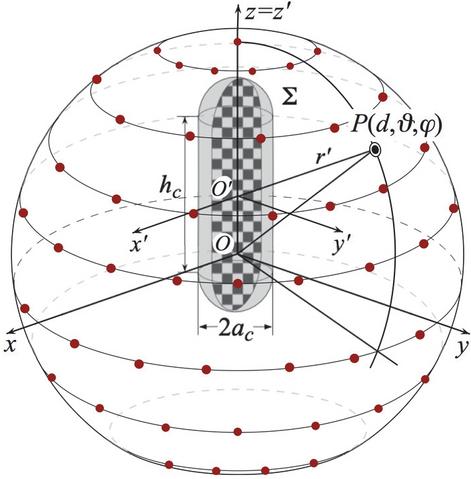
Figure 1 Problem geometry.
While the onset coordinate system identifies the generic observation point , the introduction of the offset one allows us to develop an appropriate NR representation of the voltage on the sphere. Therefore, the NR sampling points are computed in the offset coordinate system and subsequently mapped into the onset one S through the following coordinate transformation relations linking the two reference systems:
| (1) | |
| (2) | |
| (3) |
In accordance with the theory developed in [27], it is possible to define an NR sampling representation of the voltage V (i.e. a representation requiring a minimum amount of samples) by adopting a suitable parameterization to describe the observation curve and extracting an optimal phase factor from the expression of V, thus getting the so called “reduced voltage”:
| (4) |
which is a spatially quasi-bandlimited function. It is important to highlight that is the voltage revealed by the probe or by the rotated probe. It follows that, when approximating by a bandlimited function, a band-limitation error arises. However, this error has step-like behavior, being very small when the bandwidth is greater than a critical value . In particular, it is possible to ensure the validity of this condition by considering an enlargement bandwidth factor , so that the bandwidth of the chosen bandlimited function is . It is noteworthy that values slightly greater than one can be adopted when AUT sizes are large in terms of wavelengths.
As shown in [27], the number of NR samples, at Nyquist rate, necessary to accurately represent on a closed surface (even unbounded) encircling the surface modeling the antenna is proportional to the area of . Therefore, to minimize the number of required samples, an appropriate choice of the most suitable rotational surface is in order. In particular, must be selected in such a way as to minimize any volumetric redundancy by best fitting the shape of the AUT. Since we are dealing with an elongated AUT, a suitable choice is represented by a rounded cylinder centered in (see Figs. 1 and 2), namely a cylinder, of radius and height , terminated with two hemispheres. As previously stated, the NR representation of the voltage V on the scan sphere M, that is conveniently described by parallels and meridians, must be determined in . The spatial bandwidth relevant to a meridian, that is still a meridian curve in , i.e. a curve got as the intersection between M and the meridian plane through the observation point P, is [27]:
| (5) |
where is the length of the curve , intersection between and the meridian plane, and is the wavelength. Moreover, the optimal parameter and phase function are [27]:
| (6) | |
| (7) |
where and are the distances from the point P to the tangency points and on and and are the related arclength abscissas (see Fig. 2). These parameters depend, of course, on the specific choice of the surface . Having selected a rounded cylinder as a suitable surface modeling the AUT, we know that and hence:
| (8) |
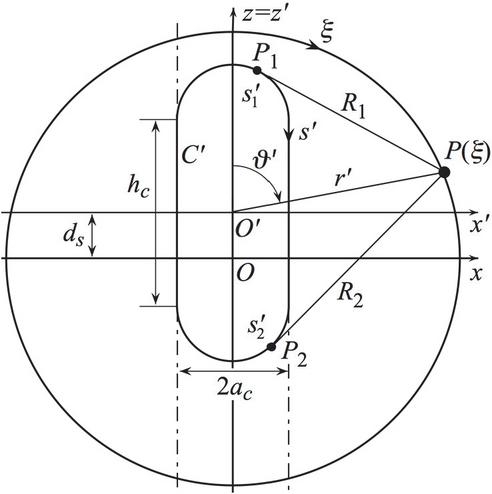
Figure 2 Relevant to a meridian.
The related expressions for and are got by substituting in (6) and (7) the distances and the curvilinear abscissas , whose expressions depend on the positions of the points and , which in turn change as the angle varies. As shown in [34], three cases occur.
For :
| (9) | |
| (11) | |
for , and are given by (9) and (10), while:
| (13) | |
finally, for , and are given by (13) and (14), and:
| (15) | |
For a parallel, the phase function is constant and can be effectively employed as an optimal parameter. The corresponding bandwidth is:
| (17) |
where and defines the rounded cylinder equation.
The maximum is achieved at:
| (18) |
where is the sign function.
The obtained NR samples are uniformly spaced with respect to the optimal parameter but not with respect to . This is why a suitable interpolation of the samples must be introduced to carry out the standard NF-FFT, which requires a set of uniformly distributed input data. It must be emphasized that interpolation of the NR voltage samples in the prescribed (uniformly spaced) positions on the sphere using the classical cardinal series would entail a massive computational effort. Indeed, this well-known technique is suboptimal when dealing with a great number of data, due to the use of the Dirichlet sampling functions, that, to prevent the truncation error, implicates the involvement of all input samples to determine any output one. Furthermore, this would also cause propagation of errors, which affect the samples, from high to low voltage values. Hence, a custom-made optimal interpolation algorithm, the 2-D OSI expansion [40], is used. Such an interpolation scheme allows us to reconstruct the voltage values at any point on the scan sphere by using a traveling sampling and adopting optimal self-truncating functions, which require us to retain only a small number of samples in the proximity of the considered output one to minimize truncation error. It is thus possible to lessen the computational load and to prevent error propagation from high to low voltage levels. Hence, probe voltage at the point can be reconstructed [36]:
| (19) |
where , , is the retained samples number, and:
| (20) | |
| (21) | |
| (22) | |
| (23) | |
| (24) |
In particular, Int(x) stays for the integer part function, while is the oversampling factor, introduced to control the truncation error. Furthermore:
| (25) |
where
| (26) | ||
| (27) |
are, respectively, the Tschebyscheff and the Dirichlet sampling functions [27, 36].
The interested reader can find, in [40], a detailed study on the error introduced by the OSI (plots of the normalized maximum and normalized mean-square reconstruction errors for various values of the oversampling factor and versus the retained samples number). Such an expansion is computationally simple and very fast. Its validity is widely demonstrated in many papers by the authors.
3 EXPERIMENTAL VALIDATION
The showcased NR NF-FFT has been validated through laboratory proofs at the UNISA Antenna Characterization Laboratory. This facility has an anechoic chamber ( m) sized for both NF and FF measurements, depending on the FF distance requirements. The chamber is paneled by pyramidal absorbers, guaranteeing a background noise level lower than 40 dB in the X band. Three rotary tables and a vertical linear scanner equip a versatile system (see Fig. 6 in [39]), allowing us to perform NF measurements not only using classical scans, like cylindrical, spherical, and plane-polar, but also the innovative helicoidal, spherical-spiral, and planar-spiral scans. A vector network analyzer (VNA) is utilized to perform accurate amplitude and phase measurements. Such a measurement facility provides an additional rotary table too, allowing us to execute direct FF or radar cross section measurements of electrically small AUTs/targets. A photo of the NF facility of the UNISA Antenna Characterization Laboratory is shown in Fig. 3. The interested reader can find a more detailed description of this NF facility and additional photos in Chapter 1 of [11].
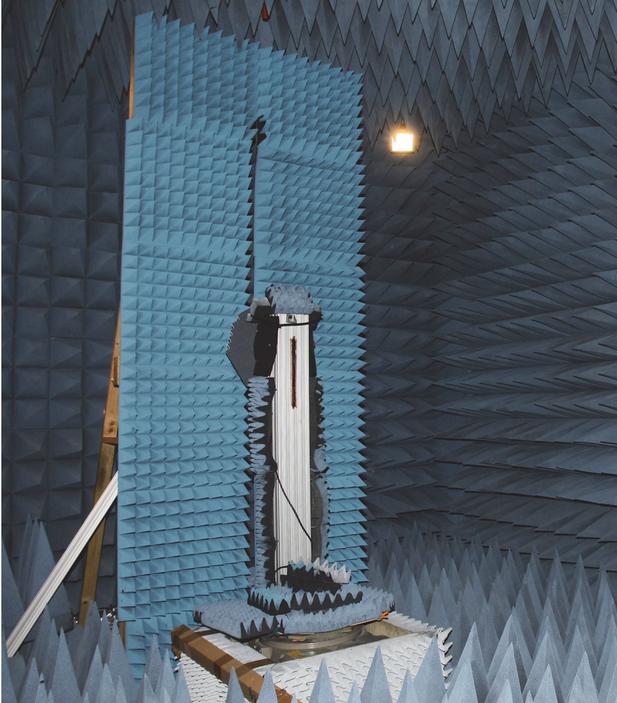
Figure 3 Photo of the NF measurement system available at the UNISA Antenna Characterization Laboratory.
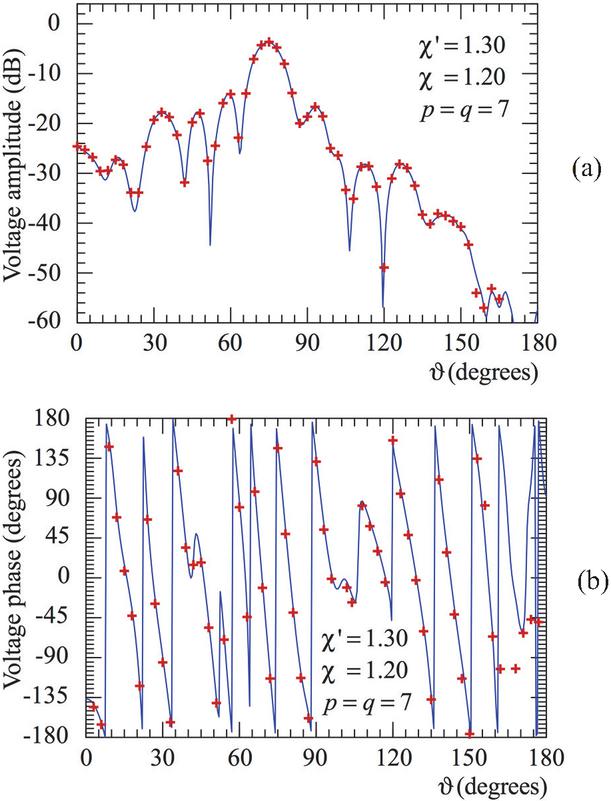
Figure 4 Voltage amplitude (a) and phase (b) on the meridian at —- measured. + + + NR data.
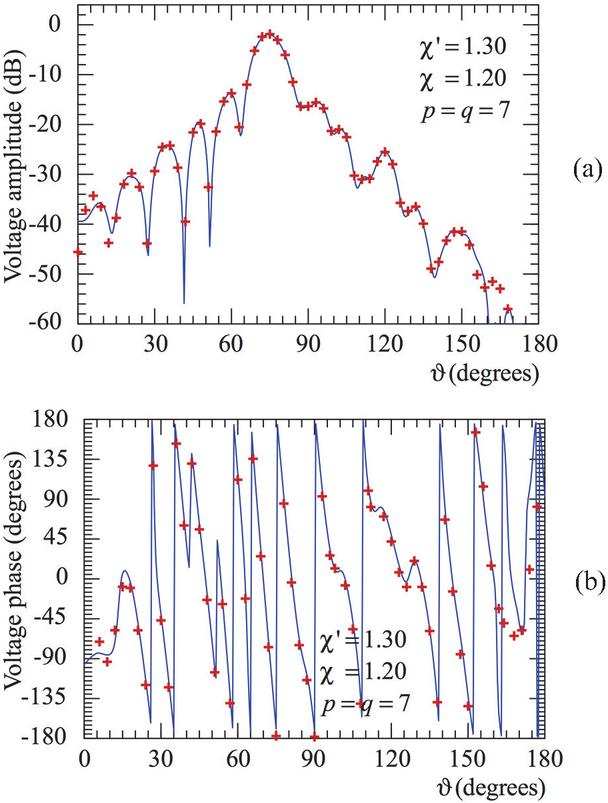
Figure 5 Voltage amplitude (a) and phase (b) on the meridian at . —- measured. + + + NR data.
In the reported experimental results, the employed antenna is a slotted waveguide array operating at 10 GHz. It was obtained by realizing eight rounded-ended slots in the large walls of a tapered rectangular waveguide and feeding it by means of a coaxial to rectangular wave-guide transition. It has been mounted with its broad walls parallel to the plane and its axis coinciding with the z one. An open-ended WR90 rectangular waveguide is utilized as the scanning probe. The standard spherical NF-FFT [15] is carried out by the MI-3000 package and is employed to compute both the reference FF patterns, directly got by processing the considerably great amount of (offset) NF data collected at the classical lattice [15], and those attained from the NF data recovered by interpolating the drastically lower amount of gathered NR NF samples. In the considered experimental tests, the AUT has been shifted along the z-axis by a distance .
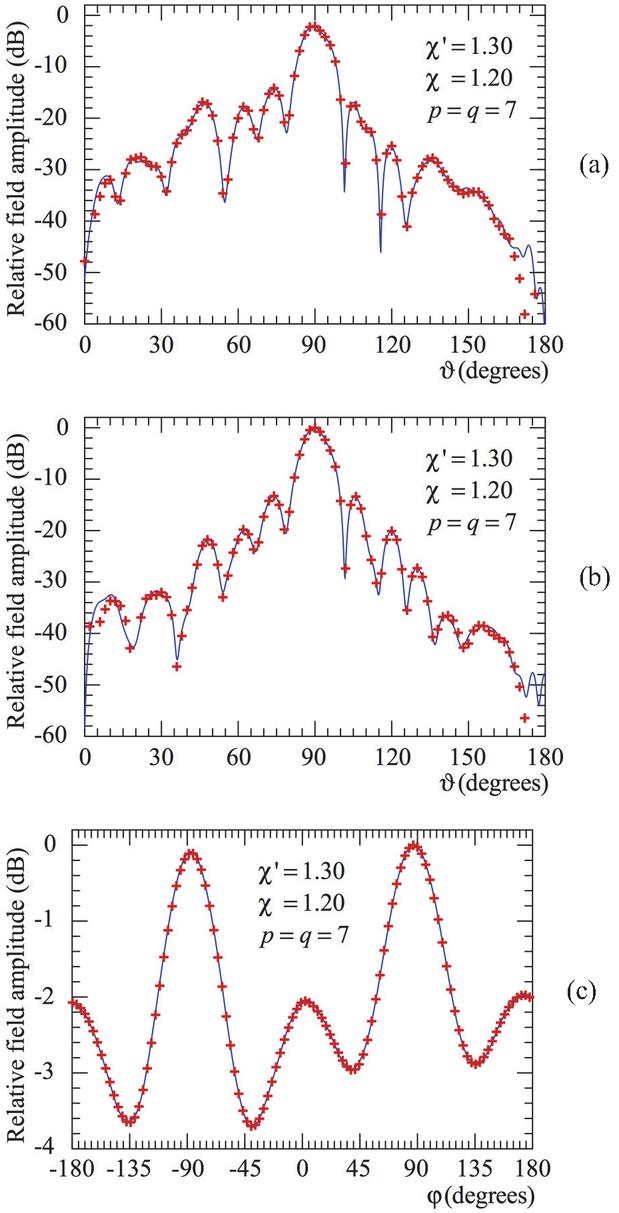
Figure 6 FF patterns at (a), (b), and (c). —- reference. + + + NR data.
The parameters of the rounded cylinder employed for modeling the AUT are and . The voltages have been measured on a sphere with radius and the shown recoveries have been got by adopting , , and . In Figs. 4 and 5, the amplitudes and phases of the recovered voltage on the meridians at and are compared with the directly acquired ones on the same meridians. The FF patterns at , , and , obtained from the NR NF samples, are compared in Figs. 6 (a–c) with those (references) taken from the massive number of offset data directly acquired on the NF grid for the standard NF-FFT. As can be clearly observed, both the NF and the FF recoveries results are very accurate, save for the regions where the voltage/field is very low, thus fully demonstrating the practical effectiveness of the approach.
It must be highlighted that the proposed technique allows a drastic decrease of the number of samples to be acquired and, consequently, a huge saving of acquisition time. Indeed, the AUT testing required only 705 NR NF samples, a remarkably lower amount of data than the 7320 required by the traditional spherical NF-FFT. It is interesting to compare the corresponding times employed to acquire the needed NF samples, namely 4.65 and 24.38 hours, respectively.
Further experimental results, which validate the effectiveness of the developed NR NF-FFT with spherical scanning for offset mounted elongated antennas and relevant to a different AUT and working frequency, are reported in [41].
4 CONCLUSION
In this paper, experimental validation of an NR NF-FFT technique with spherical scan for offset mounted long antennas is presented. The proposed approach, with respect to other existing techniques, requires the gathering of the same minimum number of NF samples fixed by the NR sampling for the onset mounting scenario, entailing not only a massive reduction in terms of needed NF data, but also of acquisition time. The experimental results are relevant to a rounded cylinder modeling of an elongated AUT, which represents the optimal choice since it suitably fits its shape without introducing any volumetric redundancy. Then, a custom-made 2-D OSI expansion allows us to accurately and efficiently reconstruct the NF data necessary to execute the standard spherical NF-FFT from the gathered NR ones. The accuracy and effectiveness of this innovative approach are experimentally confirmed by the very satisfactory agreement obtained in both the NF and FF reconstructions.
References
[1] A. D. Yaghjian, “An overview of near-field antenna measurements,” IEEE Trans. Antennas Propag., vol. AP-34, pp. 30–45, Jan. 1986.
[2] J. Appel-Hansen, J. D. Dyson, E. S. Gillespie, and T.G. Hickman, “Antenna Measurements,” in The Handbook of Antenna Design, A. W. Rudge, K. Milne, A. D. Olver, and P. Knight, Eds. London, UK: Peter Peregrinus, pp. 584–694, 1986.
[3] E. S. Gillespie, “Special Issue on near-field scanning techniques,” IEEE Trans. Antennas Propag., vol. 36, pp. 727–901, June 1988.
[4] S. Gregson, J. McCormick, and C. Parini, Principles of Planar Near-Field Antenna Measurements. London, UK: IET, 2007.
[5] M. H. Francis and R. C. Wittmann, Near-Field Scanning Measurements: Theory and Practice, in Modern Antenna Handbook. Hoboken, NJ, USA: John Wiley & Sons, pp. 929–976, 2008.
[6] IEEE Recommended Practice for Near-Field Antenna Measurements, IEEE Standard 1720-2012, 2012.
[7] C. Gennarelli, A. Capozzoli, L. Foged, J. Fordham, and D. J. van Rensburg, “Special issue on recent advances in near-field to far-field transformation techniques,” Int. Jour. Antennas Propag., vol. 2012, ID 243203, 2012.
[8] F. Ferrara, C. Gennarelli, and R. Guerriero, “Near-Field Antenna Measurement Techniques,” in Handbook of Antenna Technologies, Z. N. Chen, D. Liu, H. Nakano, X. Qing, and T. Zwick, Eds. Singapore: Springer, pp. 2107–2163, 2016.
[9] M. Sierra Castañer and L. J. Foged, Post-Processing Techniques in Antenna Measurement. London, UK: SciTech Publishing IET, 2019.
[10] C. Parini, S. Gregson, J. McCormick, D. J. Van Resburg, and T. Eibert, Theory and Practice of Modern Antenna Range Measurements. London, UK: SciTech Publishing IET, 2020.
[11] C. Gennarelli, F. Ferrara, R. Guerriero, and F. D’Agostino, Non-Redundant Near-Field to Far-Field Transformation Techniques. London, UK: SciTech Publishing IET, 2022.
[12] F. Jensen, “On the probe compensation for near-field measurements on a sphere,” Archiv Elektr. Übertr., vol. 29, pp. 306–308, Aug. 1975.
[13] F. H. Larsen, “Probe correction of spherical near-field measurements,” Electr. Lett., vol. 13, pp. 393–395, 1977.
[14] A. D. Yaghjian and R. C. Wittmann, “The receiving antenna as a linear differential operator: Application to spherical near-field measurement,” IEEE Trans. Antennas Propag., vol. AP-33, pp. 1175–1185, Nov. 1985.
[15] J. Hald, J. E. Hansen, F. Jensen, and F. H. Larsen, Spherical Near-Field Antenna Measurements. London, UK: Peregrinus, 1998.
[16] O. M. Bucci, C. Gennarelli, G. Riccio, and C. Savarese, “Data reduction in the NF-FF transformation technique with spherical scanning,” Jour. Electromagn. Waves Appl., vol. 15, pp. 755–775, 2001.
[17] T. Laitinen and S. Pivnenko, “Probe correction technique for symmetric odd-order probes for spherical near-field antenna measurements,” IEEE Antennas Wirel. Propag. Lett., vol. 6, pp. 635–638, 2007.
[18] T. Laitinen, S. Pivnenko, J. M. Nielsen, and O. Breinbjerg, “Theory and practice of the FFT/ matrix inversion technique for probe-corrected spherical near-field antenna measurements with high-order probes,” IEEE Trans. Antennas Propag., vol. 58, pp. 2623–2631, Aug. 2010.
[19] T. B. Hansen, “Numerical investigation of the system-matrix method for higher-order probe correction in spherical near-field antenna measurements,” Int. Jour. Antennas Propag., vol. 2012, ID 493705, 2012.
[20] F. D’Agostino, F. Ferrara, C. Gennarelli, R. Guerriero, and M. Migliozzi, “Effective antenna modellings for NF-FF transformations with spherical scanning using the minimum number of data,” Int. Jour. Antennas Propag., vol. 2011, ID 936781, 2011.
[21] F. D’Agostino, F. Ferrara, C. Gennarelli, R. Guerriero, and M. Migliozzi, “Non-redundant spherical NF - FF transformations using ellipsoidal antenna modeling: Experimental assessments,” IEEE Antennas Propag. Magaz., vol. 55, pp. 166–175, Aug. 2013.
[22] F. D’Agostino, F. Ferrara, C. Gennarelli, R. Guerriero, and M. Migliozzi, “Experimental testing of nonredundant near-field to far-field transformations with spherical scanning using flexible modellings for nonvolumetric antennas,” Int. Jour. Antennas Propag., vol. 2013, ID 517934, 2013.
[23] M. A. Qureshi, C. H. Schmidt, and T. F. Eibert, “Adaptive sampling in spherical and cylindrical near-field antenna measurements,” IEEE Antennas Propag. Magaz., vol. 55, pp. 243–249, 2013.
[24] F. R. Varela, B. G. Iragüen, and M. Sierra Castañer, “Under-sampled spherical near-field antenna measurements with error estimation,” IEEE Trans. Antennas Propag., vol. 68, pp. 6364–6371, Aug. 2020.
[25] A. Bangun and C. Culotta-Loìpez, “Optimizing sensing matrices for spherical near-field antenna measurements,” IEEE Trans. Antennas Propag., vol. 71, pp. 1716–1724, Feb. 2023.
[26] F. Peng, Q. Zhang, X. Liu, Z. Wang, and X. Chen, “An efficient antenna measurements method in spherical near field based on sparse sampling,” IEEE Antennas Wirel. Propag. Lett., vol. 23, pp. 3492–3496, 2024.
[27] O. M. Bucci, C. Gennarelli, and C. Savarese, “Representation of electromagnetic fields over arbitrary surfaces by a finite and nonredundant number of samples,” IEEE Trans. Antennas Propag., vol. 46, pp. 351–359, Mar. 1998.
[28] O. M. Bucci and C. Gennarelli, “Application of nonredundant sampling representations of electromagnetic fields to NF-FF transformation techniques,” Int. Jour. Antennas Propag., vol. 2012, ID 319856, 2012.
[29] O. M. Bucci and G. Franceschetti, “On the spatial bandwidth of scattered fields,” IEEE Trans. Antennas Propag., vol. AP-35, pp. 1445–1455, Dec. 1987.
[30] O. M. Bucci and G. Franceschetti, “On the degrees of freedom of scattered fields,” IEEE Trans. Antennas Propag., vol. 37, pp. 918–926, July 1989.
[31] O. M. Bucci and M. D. Migliore, “Degrees of freedom and sampling representation of electromagnetic fields: Concepts and applications,” IEEE Antennas Propag. Magaz., vol. 67, pp. 10–22, June 2025.
[32] L. J. Foged, F. Saccardi, F. Mioc, and P. O. Iversen, “Spherical near field offset measurements using downsampled acquisition and advanced NF/FF transformation algorithm,” in Proc. of EUCAP 2016, Davos, Switzerland, pp. 1–3, 10–15 Apr. 2016.
[33] F. Saccardi, F. Rossi, F. Mioc, L. J. Foged, and P. O. Iversen, “Application of the translated-SWE algorithm for the characterization of antennas installed on cars using a minimum number of samples,” in Proc. of AMTA 2017, Atlanta, GA, USA, pp. 1-6, 15-20 Oct. 2017.
[34] R. Cornelius and D. Heberling, “Spherical wave expansion with arbitrary origin for near-field antenna measurements,” IEEE Trans. Antennas Propag., vol. 65, pp. 4385–4388, Aug. 2017.
[35] F. R. Varela, B. G. Iragüen, and M. Sierra Castañer, “Fast spherical near-field to far-field transformation for offset-mounted antenna measurements,” IEEE Antennas Wirel. Propag. Lett., vol. 19, pp. 2255–2259, Dec. 2020.
[36] F. D’Agostino, F. Ferrara, C. Gennarelli, R. Guerriero, and M. Migliozzi, “Nonredundant NF-FF transformation with spherical scan accounting for an offset mounting of a long AUT,” in Proc. of AMTA 2016, Austin, TX, USA, pp. 167–172, 30 Oct. 4 Nov. 2016.
[37] F. D’Agostino, F. Ferrara, C. Gennarelli, R. Guerriero, and M. Migliozzi, “A nonredundant sampling representation managing an offset mounting of an elongated antenna in a spherical near-field facility,” IEEE Antennas Wirel. Propag. Lett., vol. 18, pp. 2671–2675, Dec. 2019.
[38] F. D’Agostino, F. Ferrara, C. Gennarelli, R. Guerriero, and M. Migliozzi, “A non-redundant sampling representation requiring the same number of spherical near-field measurements for both onset and offset mountings of a quasi-planar antenna,” Int. Jour. Commun. Antenna Propag., vol. 9, pp. 311–319, Oct. 2019.
[39] F. D’Agostino, F. Ferrara, C. Gennarelli, R. Guerriero, and M. Migliozzi, “A spherical near-to-far-field transformation using a non-redundant voltage representation optimized for non-centered mounted quasi-planar antennas,” Electronics, vol. 9, ID 944, pp. 1–13, June 2020.
[40] O. M. Bucci, C. Gennarelli, and C. Savarese, “Optimal interpolation of radiated fields over a sphere,” IEEE Trans. Antennas Propag., vol. 39, pp. 1633–1642, Nov. 1991.
[41] F. D’Agostino, F. Ferrara, C. Gennarelli, R. Guerriero, and M. Migliozzi, “Experimental validation of a non-redundant NF-FF transformation for long AUTs mounted in offset configuration in a spherical NF facility,” in Proc. of AMTA 2019, San Diego, CA, USA, pp. 115–120, 6–11 Oct. 2019.
Biographies

Francesco D’Agostino received his Laurea degree in electronic engineering from the University of Salerno, Italy. At the same university he also received the Ph.D. degree in information engineering and then was appointed Associate Professor of electromagnetics. His research activity includes application of sampling techniques to electromagnetics and to innovative NF-FF transformations, diffraction problems, radar cross section evaluations, and electromagnetic compatibility. In this area, D’Agostino has coauthored five books and over 300 scientific papers, published in peer-reviewed international journals and conference proceedings. He serves as a regular Reviewer for several journals and conferences and has been invited speaker and chair for international events and conferences. D’Agostino is a senior member and fellow of Antenna Measurement Techniques Association (AMTA), senior member of the Institute of Electrical and Electronics Engineers (IEEE), member of the Editorial Board of MDPI Electronics and of the Journal of Electronics and Electrical Engineering, member of the European Association on Antennas and Propagation (EurAAP) and of the Italian Electromagnetic Society (SIEM).

Flaminio Ferrara (Member, IEEE) was born in Salerno, Italy, in 1972. He received the Laurea degree in electronic engineering and the Ph.D. degree in information engineering from the University of Salerno, Fisciano, Salerno, Italy, in 1999 and 2003, respectively. Since 1999, he has been with the Research Group in Applied Electromagnetics, University of Salerno, where he is currently an Associate Professor of electromagnetic fields. He is the co-author of about 300 scientific articles, mainly in international journals and conference proceedings. In particular, he is the co-author of four books on NF-FF transformation techniques and the co-author of the chapter “Near-Field Antenna Measurement Techniques” of the Handbook of Antenna Technologies. His scientific interests include the application of sampling techniques to the efficient reconstruction of electromagnetic fields and to NF-FF transformation techniques, monostatic radar cross section evaluations of corner reflectors, and electromagnetic wave diffraction from canonical and complex structures. Ferrara is a reviewer for several international journals and a member of the Editorial Board of the International Journal of Antennas and Propagation and of Electronics.

Claudio Gennarelli (Senior Member, IEEE) was born in Avellino, Italy, in 1953. He received the Laurea degree (summa cum laude) in Electronic Engineering from the University “Federico II” of Naples in 1978. From 1978 to 1983, he worked with the Research Group in Electromagnetics at the same University. In 1983, he became an Assistant Professor at the Istituto Universitario Navale of Naples. In 1987, he was appointed as Associate Professor of Antennas, formerly at the University of Ancona, Italy, and subsequently at the University of Salerno, Italy. In 1999, was appointed as Full Professor at the same University. He retired in November 2023. He has coauthored more than 480 scientific articles, mainly in international journals and conference proceedings. In particular, he has co-authored four books on near-field to far-field (NF-FF) transformation techniques, the chapter Near-field antenna measurement techniques of the Handbook of Antenna Technologies, and the book Non-Redundant Near-Field To Far-Field Transformation Techniques published by Scitech. The main topics of his scientific activity are reflector antennas analysis, antenna measurements, diffraction problems, radar cross section evaluations, application of sampling techniques to electromagnetics and to NF-FF transformations, NF-FF transformations with spiral scannings, and compensation of the probe positioning errors in the NF-FF transformations. He is a member of the Editorial board of the International Journal of Antennas and Propagation and was a member of the Editorial board of the Open Electrical and Electronic Engineering Journal from 2007 to 2019.

Rocco Guerriero (Member, IEEE) received the Laurea degree in electronic engineering and the Ph.D. degree in information engineering from the University of Salerno, Fisciano, Italy, in 2003 and 2007, respectively. Since 2003, he has been with the Research Group in Applied Electromagnetics, University of Salerno, where he is currently an Associate Professor of electromagnetic fields. He is the co-author of more than 270 scientific articles, mainly in international journals and conference proceedings. In particular, he has co-authored three books on NF-FF transformation techniques and is the co-author of the chapter “Near-Field Antenna Measurement Techniques” of the Handbook of Antenna Technologies. His scientific interests include the application of sampling techniques to the efficient reconstruction of electromagnetic fields and to NF-FF transformation techniques, antenna measurements, inversion of ill-posed electromagnetic problems, analysis of microstrip reflectarrays, and diffraction problems. Guerriero is a reviewer for several international journals and conferences and a member of the Editorial Board of the International Journal of Antennas and Propagation and of Electronics.

Massimo Migliozzi received the Laurea degree in electronic engineering and the Ph.D. degree in information engineering from the University of Salerno, Fisciano, Italy, in 1999 and 2009, respectively. He is currently a Research Fellow in electromagnetic fields. His scientific research interests include the application of sampling techniques to the efficient reconstruction of electromagnetic fields and to NF-FF transformation techniques, antenna measurements, electromagnetic compatibility, antenna design, and diffraction problems. He has coauthored about 200 scientific papers, mainly in international journals and conference proceedings and he serves as a reviewer for several international journals.

Luigi Pascarella received the Bachelor’s and Master’s degrees (summa cum laude), both in Electronic Engineering, from the University “Federico II” of Naples, in 2020 and 2022, respectively. Since November 2022, he is a Ph.D. candidate in Industrial Engineering at the University of Salerno, Fisciano, Italy, with the Research Group in Applied Electromagnetics. His research focuses on developing innovative approaches for the synthesis of antenna arrays capable of radiating complex waveforms in the near-field, the application of advanced sampling techniques to electromagnetics and also to innovative NF-FF transformation techniques. He is a member of the Italian Electromagnetic Society (SIEM).
ACES JOURNAL, Vol. 41, No. 2, 128–136
DOI: 10.13052/2026.ACES.J.410203
© 2026 River Publishers