Figures of Merit Analysis for Over-the-Air Testing of the Non-Terrestrial Network Direct-to-Smartphone Handsets
Siyang Sun1, Meijun Qu2, and Zheng Liu1*
1China Telecommunication Technology Labs
China Academy of Information and Communications Technology, Beijing 100191, China
sunsiyang@caict.ac.cn
*Corresponding: liuzheng@caict.ac.cn
2National Key Laboratory of Scattering and Radiation
Beijing 100854, China
qumeijun@126.com
Submitted On: September 30, 2025; Accepted On: December 16, 2025
Abstract
The Non-Terrestrial Network (NTN) is a critical component of the 6G integrated space-air-ground-sea network. The comprehensive Over-the-Air (OTA) performance evaluation of NTN terminals is essential for ensuring wireless connection reliability and quality of experience. However, major international standards bodies including 3rd Generation Partnership Project (3GPP) and Cellular Telecommunications and Internet Association (CTIA) remain in the preliminary stages of developing their OTA specifications for mobile terminals supporting NTN communications. Accordingly, the objective of this paper is to investigate key Figures of Merit (FoMs) for OTA testing of NTN handsets from the perspective of satellite coverage multiplicity, to better characterize, distinguish, and rank OTA performance of different NTN handsets for future testing methodology development. During the analysis, coverage models are created for Low Earth Orbit (LEO) and Geosynchronous Orbit (GEO) constellations separately, based on which the coverage multiplicity for Starlink Direct-to-Cell (DTC) and TianTong-1 constellations is evaluated and determined for different target regions quantitatively. By comparing the coverage multiplicity and usage scenarios with those of the Global Positioning System (GPS), whose OTA FoMs and testing methods have been clearly defined in specifications, the FoMs for OTA testing of NTN handsets are recommended, including integrated FoMs for LEO (e.g., Total Isotropic Sensitivity [TIS] and Upper Hemisphere Isotropic Sensitivity [UHIS] metrics for receiver performance, and Total Radiated Power [TRP] and new Upper Hemisphere Radiated Power [UHRP] metric [corresponding to the UHIS] for radiation performance evaluation) as well as directional FoMs (e.g., requiring the average or minimum of Effective Isotropic Radiated Power [EIRP] and Effective Isotropic Sensitivity [EIS] values within a specific zenith angular range to exceed the limit) for GEO constellations, respectively.
Keywords: Direct-to-Smartphone (DTS), Figures of Merit (FoMs), Non-Terrestrial Network (NTN), Over-the-Air (OTA) testing..
1 INTRODUCTION
Driven by the advancement of telecommunications, the exponential growth of smart devices, and the rising demand for ubiquitous connectivity, satellite-enabled Non-Terrestrial Networks (NTNs) are globally expected to be integrated into terrestrial network infrastructures as an indispensable complement, playing important roles in 5G and beyond by providing seamless space-air-ground-sea coverage that eliminates service deserts and fulfills the goal of truly global connectivity [1, 2, 3, 4, 5, 6, 7]. As defined by the 3rd Generation Partnership Project (3GPP) [8], an NTN refers to a network where spaceborne or airborne vehicles act either as a relay node or as a base station, thereby distinguishing transparent and regenerative satellite architectures. Since the 3GPP Rel-17 standard integrates NTN as part of 5G Advanced (5G-A) and enables Internet of Things NTN (IoT-NTN) and New Radio NTN (NR-NTN) features for handheld devices connected with Low Earth Orbit (LEO) and Geosynchronous Orbit (GEO) satellites [9, 10], satellite-enabled NTN has been playing an increasingly critical role in 5G-A and future 6G networks.
As a key enabler for 5G-A and 6G IoT-NTN and NR-NTN, Direct-to-Smartphone (DTS) technology has been a global research focus. The DTS technology allows commercial mobile terminals to establish direct wireless connections with satellites for data transmission and communication without relying on relay nodes or dedicated satellite equipment. It thereby supports a wide range of applications, including satellite IoT and Mobile Satellite Services (MSS). In DTS communication scenarios, the reliability, coverage, responsiveness, and security of wireless links are critical factors affecting both user experience and system quality of service, which are heavily dependent on agile and high-performance antennas [11, 12, 13]. Consequently, Over-the-Air (OTA) testing, which can accurately characterize the wireless performance of devices under test (DUTs) under realistic operating conditions, is essential for optimizing antenna and wireless performance of DTS smartphones and enhancing their quality of user experience [14, 15, 16, 17, 18]. OTA testing has been established as the standard methodology for wireless performance evaluation of DUTs by major standards bodies such as 3GPP and the Cellular Telecommunications and Internet Association (CTIA), as well as by leading network operators [19, 20, 21, 22, 23, 24].
For DTS handheld devices, the OTA testing methodology is under discussion in both CTIA and 3GPP while relevant testing specifications have not been determined and officially released yet. Currently, the consensus is to maintain and re-use the methodology for cellular smartphones temporarily as a starting point to meet the urgent testing requests from the industry, i.e., the device manufacturers and network operators, while proceeding with the methodology development in parallel. Accordingly, current Figures of Merit (FoMs) for OTA testing of DTS DUTs are Total Radiated Power (TRP) and Total Isotropic Sensitivity (TIS) for both radiated power and receiver performance, respectively. Considering the differences between cellular and satellite communication scenarios, including the following aspects:
(1) Different signal angles of arrival (AoAs): for cellular, the signal mainly comes from the angular region within 45∘ of the horizon, while for NTN DTS, it comes from a certain angular range of the zenith;
(2) Different testing or holding positions: in cellular scenarios, smartphones can be held in both portrait and landscape positions; in contrast, in NTN scenarios, DTS DUTs can only be held in portrait mode with the top side pointing to the sky, even though the internal antenna design in current commercial DTS terminals has been significantly enhanced compared to the original external antenna design.
Therefore, the current temporary FoMs for OTA testing of NTN DTS terminals are deemed incapable of comprehensively characterizing and distinguishing the OTA performance of different NTN DTS DUTs.
The primary objective of this work is to investigate key FoMs for OTA testing of NTN DTS handsets, with a specific focus on satellite coverage multiplicity. To this end, coverage models are first established for both LEO and GEO constellations. Using the latest publicly available Two-Line Element (TLE) ephemeris data, the coverage capacity of both the Starlink Direct-to-Cell (DTC) and China Telecom TianTong-1 constellations, serving as representative cases, is then quantitatively evaluated across different target regions. Subsequently, the recommended OTA testing FoMs for LEO and GEO constellations are derived through a comparative analysis of their calculated coverage multiplicity and usage scenarios against those of the Global Positioning System (GPS) constellation, whose OTA testing methodologies and associated OTA FoMs have been rigorously defined in standard specifications.
2 COVERAGE MULTIPLICITY ANALYSIS
The 3GPP Rel-17 standard enables IoT-NTN and NR-NTN features for handheld devices connected to GEO and LEO satellites. Correspondingly, coverage multiplicity analysis and related coverage models are established for both LEO and GEO constellations, respectively. In this analysis, coverage multiplicity is reflected in N Asset Coverage, which represents the number of satellites visible simultaneously from an observation point.
2.1 LEO mode
The direct connection to LEO satellites has become the dominant DTS technical mode due to its significant advantages, including relatively low latency, high data rates, and better link budget. In this mode, traditional terrestrial base stations are replaced by LEO satellite payloads. Challenges including latency issues and substantial Doppler frequency shift are mitigated by either the satellite payloads or the ground systems. This architecture enables existing commercial handsets to access the NTN without requiring dedicated modules or applications. Given the vast number of existing mobile terminals, this DTS mode is highly appealing. Representatives include the Starlink DTC constellation and the AST Space-Mobile (ASTS) BlueBird Block-1 constellation. Among them, the Starlink DTC constellation takes a leading position due to its larger constellation scale and higher commercial maturity. In February 2025, Starlink and T-Mobile jointly announced the official launch of the Starlink DTC satellite service. Starlink plans to further expand its service scope in 2026, gradually enabling data, IoT, and voice services. Therefore, the Starlink DTC constellation is chosen as the representative for the analysis. As of 1 September 2025, there are a total of 605 Starlink DTC satellites in orbit.
For the LEO mode, coverage multiplicity is one of the most important performance indicators and is thus analyzed here. The simulation period is set to 24 hours, from 04:00:00.000 UTCG on 31 August 2025 to 04:00:00.000 UTCG on 1 September 2025, to ensure that each satellite achieves orbital recurrence. Publicly available TLE data for the Starlink DTC and GPS constellations are used in the Satellite Tool Kit (STK) to create coverage models for the analysis, respectively. The analysis grid granularity for the target regions is set to 1∘ in both latitude and longitude. The calculated coverage multiplicity over time for US, California, and Washington, D.C. regions is illustrated in Fig. 1. For each curve, every data point represents the calculated maximum, minimum, and average count of simultaneously visible satellites across all grid points in the target region at that given time instance.
In this work, the GPS constellation is analyzed as a reference, and its coverage multiplicity over time for the same target regions is calculated and depicted in Fig. 2 for comparison. During the analysis, GPS Block IIF, IIR, IIR-M, and III satellites are considered, for a total of 31 satellites.
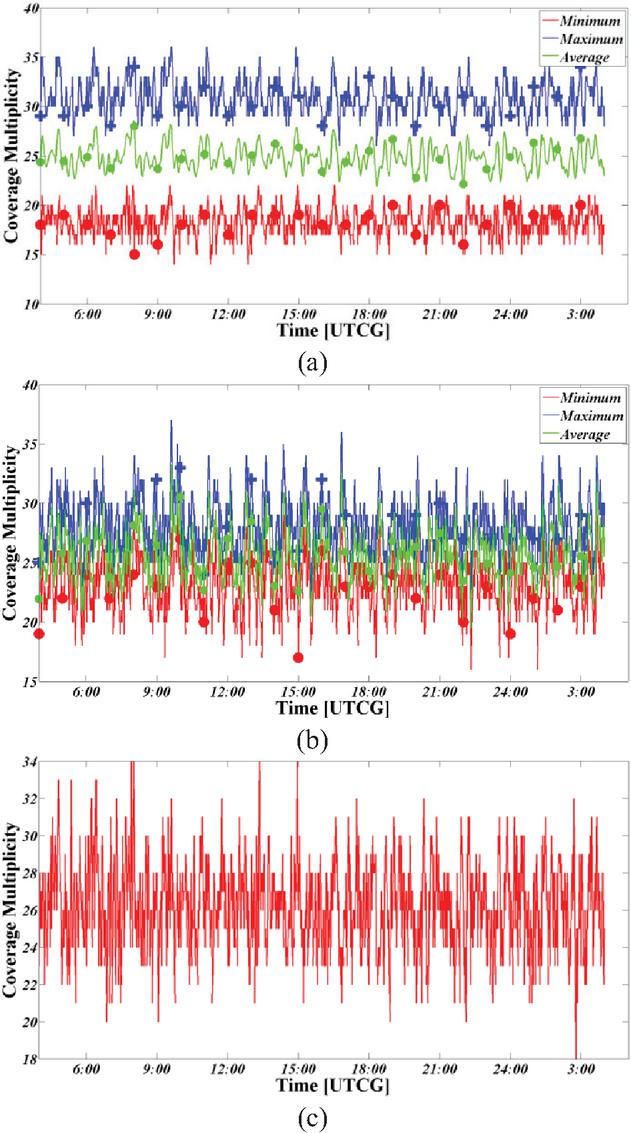
Figure 1 Calculated coverage multiplicity over time of the Starlink DTC constellation for US, California, and Washington, D.C. regions: (a) US mainland, (b) California region, (c) Washington, D.C. region.
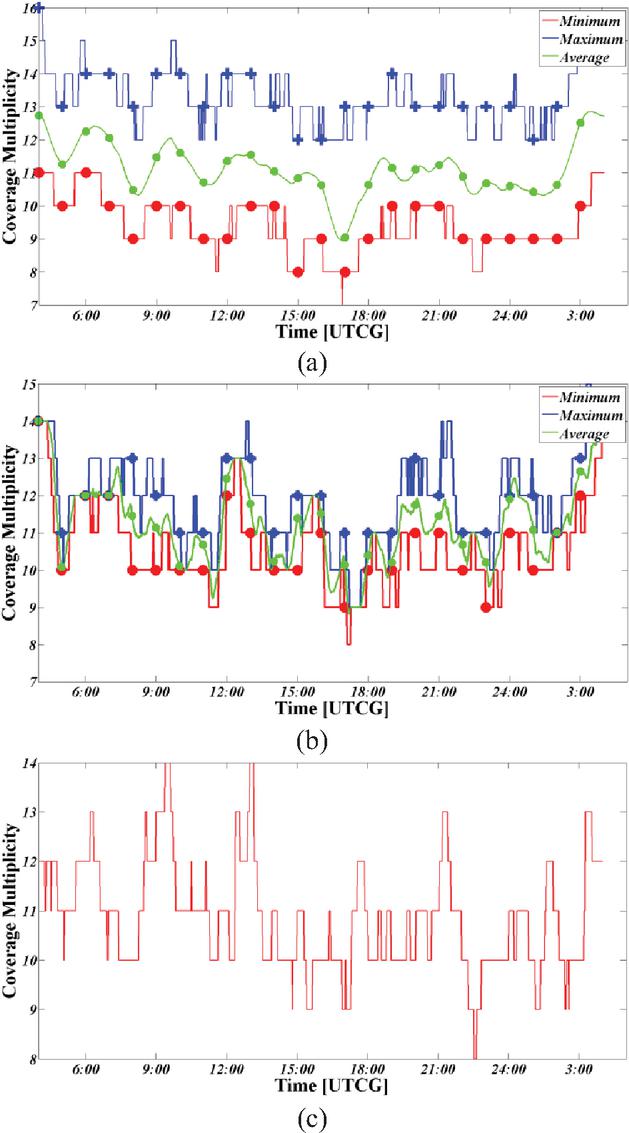
Figure 2 Calculated coverage multiplicity over time of the GPS constellation for US, California, and Washington, D.C. regions: (a) US mainland, (b) California region, (c) Washington, D.C. region.
The following observations could be obtained from the comparison:
(1) For a LEO satellite at an altitude of 500 km, the visibility duration to a ground user spans a mere 442.64 seconds. This fundamental constraint necessitates frequent inter-satellite handovers to maintain continuous service, which in turn requires dozens of satellites to be visible to a user simultaneously over the upper hemisphere and as evenly distributed as possible to ensure completely seamless handovers. The current Starlink DTC constellation is designed to meet this requirement and can provide 24-hour continuous coverage over the entire US mainland, as shown in Fig. 1. Consequently, the coverage multiplicity is high: for most of the day, the maximum and minimum values exceed 30 and 20, respectively. The average multiplicity fluctuates around 25, maintaining a relatively constant margin of approximately 5 from both extremes. This high-density coverage remains robust at the regional level: for the California region, the satellite distribution becomes more uniform. The maximum and minimum values converge toward the average, which remains nearly identical to that of the entire US mainland, hovering around 25. This increased uniformity is due to the significantly smaller size of the analyzed region. For the DC region, the coverage multiplicity curve follows a trend very similar to the averages of the US and California but exhibits more pronounced fluctuations.
(2) In contrast, the GPS constellation, residing in Medium Earth Orbit (MEO), operates with a distinct coverage profile. Across the entire US mainland, the maximum and minimum coverage multiplicities are approximately 13 and 9, respectively, with the average value fluctuating around 11. Despite this lower density, it demonstrates a similar scaling effect at the regional level: the California region again shows a more uniform satellite distribution, where the maximum and minimum curves converge toward the average, similar to what is observed in the LEO scenario. Similarly, the DC region’s coverage multiplicity closely follows the averages of the US and California while exhibiting its own characteristic fluctuations.
(3) Notably, despite the differences in orbital altitude and the resulting coverage multiplicity between the LEO (DTC) and MEO (GPS) constellations, they share essential system characteristics. Both systems, as satellite-dependent applications, require more than 10 concurrently visible satellites distributed as uniformly as possible across the upper hemisphere to ensure service stability and reliability. Furthermore, both operate in highly similar usage scenarios (e.g., handheld operation in portrait mode). The common characteristics and usage scenarios lead to closely aligned antenna performance requirements for both DTS and GPS handsets, specifically, a consistent and well-distributed upper-hemisphere radiation pattern to maximize the capture of visible satellites. Accordingly, the proposed OTA FoMs should reflect and distinguish the differences in the capability of different DUTs in terms of upper-hemisphere radiation pattern uniformity and further satellite capture capability, i.e., measured coverage multiplicity.
Therefore, the OTA testing methodologies and associated FoMs for GPS terminals can serve as a reference, while the FoMs for OTA testing of LEO handsets can be derived from those of GPS by comparing their coverage multiplicity. Since GPS terminals do not involve transmission, the currently required OTA FoMs are limited to receiver performance metrics, namely TIS and Upper Hemisphere Isotropic Sensitivity (UHIS). For a complete sphere measured with N theta intervals and M phi intervals, both with even angular spacing, they can be calculated [24]:
| (1) | |
where
| (3) |
is the average for the conical phi cut at each theta angle, and
| (4) | |
| (5) | |
| (6) |
with
| (7) |
Here is the theta-dependent weighting function. In this work, the Clenshaw-Curtis quadrature in equation (6) is utilized for TIS/UHIS calculations. The standard TRP measurement grid with 15-degree intervals in both theta and phi is illustrated in Fig. 3. The samples and weights for the Clenshaw-Curtis quadrature with the reference grid configuration () are illustrated in Table 1.
Table 1 Samples and weights for the Clenshaw-Curtis quadrature with
| Clenshaw-Curtis quadrature | ||
| i | [deg] | Weights |
| 0 | 0 | 0.007 |
| 1 | 15 | 0.0661 |
| 2 | 30 | 0.1315 |
| 3 | 45 | 0.1848 |
| 4 | 60 | 0.227 |
| 5 | 75 | 0.2527 |
| 6 | 90 | 0.262 |
| 7 | 105 | 0.2527 |
| 8 | 120 | 0.227 |
| 9 | 135 | 0.1848 |
| 10 | 150 | 0.1315 |
| 11 | 165 | 0.0661 |
| 12 | 180 | 0.007 |
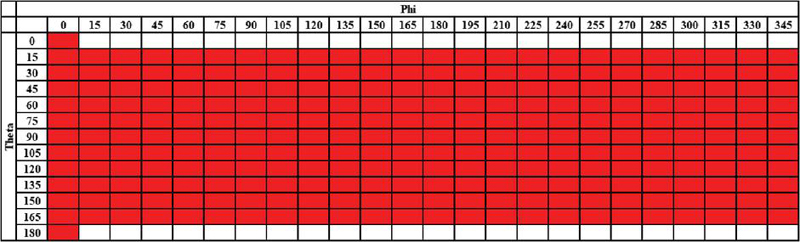
Figure 3 Illustration of the standard 15-degree TRP grid as reference.
Therefore, the TIS and UHIS can be reused for receiver performance evaluation of LEO DTS handsets, while the TRP metric can be reused for radiation performance evaluation. Furthermore, a new FoM corresponding to the UHIS, namely Upper Hemisphere Radiated Power (UHRP), is introduced to characterize the uniformity of the upper-hemisphere radiation pattern. The UHRP metric can be calculated correspondingly as:
| (8) |
where
| (9) |
is the average power for the phi cut at each theta angle.
2.2 GEO mode
Most early NTN deployments focus on using GEO satellites for fixed broadband and IoT applications, particularly those that are not delay-sensitive. Operating in a circular equatorial orbit at an altitude of 35,786 km, GEO satellites appear stationary to ground observers. This allows them to provide long-term, stable, and continuous coverage with a much larger single-satellite footprint than LEO satellites, making them especially suitable for scenarios that demand high communication continuity (e.g., emergency communications in remote areas). Moreover, establishing an NTN system with equivalent coverage requires far fewer GEO satellites than LEO satellites, significantly reducing both deployment and operational costs. Representative examples include the Huawei Mate60 Pro and China Telecom Tianyi Platinum smartphones (using the TianTong-1 satellite), as well as the IsatPhone Pro handset and Skylo-certified devices (utilizing Inmarsat satellites). Since the TLE ephemeris data of the TianTong-1 constellation is the only one available to us, it is analyzed as the representative; however, the proposed analysis and related conclusions also apply to other GEO constellations. As of 1 September 2025, there are a total of three TianTong-1 satellites in orbit.
The elevation analysis of the TianTong-1 constellation relative to ground users is performed with the same simulation period as that of the Starlink DTC. Publicly available TLE data is used to develop a coverage model in the STK. The calculated elevation angles over time for the Beijing and Shenzhen regions are summarized in Table 2.
Table 2 Calculated elevation angles over time for the Beijing and Shenzhen regions
| Elevation (deg) | TianTong-1_1_41725 | TianTong-1_2_46916 | TianTong-1_3_47321 | |
| Min | 58.63 | 57.86 | 45.96 | |
| Shenzhen | Max | 64.94 | 61.48 | 49.63 |
| Mean | 61.78 | 59.68 | 47.81 | |
| Min | 38.16 | 40.96 | 29.35 | |
| Beijing | Max | 44.45 | 45.02 | 33.89 |
| Mean | 41.30 | 42.99 | 31.62 |
It can be seen that the calculated elevation angles cover the wobble effect, even for GEO satellites that are supposed to stay stationary. Accordingly, for such GEO satellites (e.g., the TianTong-1 satellites used as the representative in this research), the elevation angle from the observation point varies within a very limited angular range over a 24-hour period (e.g., with a maximum variation of less than 6∘).
Given that only three satellites are visible simultaneously and a handset can maintain a signaling connection with only one satellite concurrently, users can easily adjust their device posture to align the DUT or its antenna toward the serving satellite as much as possible for better communication performance. Consequently, the key performance metric for GEO handset antennas should emphasize their EIRP or gain within a specific angular range of the zenith. This differs from GPS terminals, which are designed with a uniform upper-hemisphere pattern to capture as many visible satellites as possible for better Position Velocity Time (PVT) precision. Accordingly, it is recommended to adopt some directional FoMs, such as requiring the Cumulative Distribution Function (CDF) curves, the average, or the minimum of EIRP or EIS values within a specific angular range of the zenith to be larger than the limit, to comprehensively characterize the OTA performance of GEO terminals.
To sum up, the recommended OTA testing FoMs are derived through a comparative analysis of their calculated coverage multiplicity and usage scenarios with those of GPS, and further separated for LEO and GEO constellations, respectively. For LEO mode, such as Starlink DTC in this case, it is reasonable to reuse TIS and UHIS metrics for receiver performance evaluation, while reusing the TRP metric and introducing a new FoM named UHRP (corresponding to UHIS) for radiation performance evaluation. For GEO mode, such as TianTong-1 in this case, it is suggested to define some directional FoMs (e.g., requiring the CDF curves, the average, or the minimum of EIRP and EIS values within a specific angular range of the zenith to be larger than the limit) to characterize radiated power and receiver performance, respectively.
3 CONCLUSION
The objective of this work is to determine key FoMs for OTA testing of NTN handsets, aiming to better characterize, distinguish, and rank the OTA performance of different NTN handsets. During the analysis, coverage models are first established in the STK, and the related quantitative coverage multiplicity analyses are then conducted for GEO and LEO constellations separately. The recommended OTA testing FoMs are then derived through a comparative analysis of their usage scenarios and calculated coverage multiplicity with those of GPS. Based on the calculated coverage multiplicity as well as the usage scenarios comparison, it is recommended to reuse the TIS and UHIS metrics for receiver performance evaluation of LEO DTS terminals, while reusing the TRP metric and introducing a new FoM named UHRP (corresponding to the UHIS) for their radiation performance evaluation. Meanwhile, some directional FoMs (e.g., requiring the CDF curves, the average, or the minimum of EIRP and EIS values within a specific angular range of the zenith to be larger than the limit) are proposed for GEO handsets’ OTA performance evaluation. The recommended FoMs for OTA testing of NTN DTS handsets are considered to be a good starting point for related OTA methodology development.
ACKNOWLEDGMENT
This work was supported by Beijing Natural Science Foundation under Grant L253002.
References
[1] X. You, C.-X. Wang, J. Huang, X. Gao, Z. Zhang, M. Wang, Y. Huang, C. Zhang, Y. Jiang, J. Wang, M. Zhu, B. Sheng, D. Wang, Z. Pan, P. Zhu, Y. Yang, Z. Liu, P. Zhang, X. Tao, S. Li, Z. Chen, X. Ma, C.-L. I, S. Han, K. Li, C. Pan, Z. Zheng, L. Hanzo, X. S. Shen, Y. J. Guo, Z. Ding, H. Haas, W. Tong, P. Zhu, G. Yang, J. Wang, E. G. Larsson, H. Q. Ngo, W. Hong, H. Wang, D. Hou, J. Chen, Z. Chen, Z. Hao, G. Y. Li, R. Tafazolli, Y. Gao, H. V. Poor, G. P. Fettweis, and Y.-C. Liang, “Towards 6G wireless communication networks: Vision, enabling technologies, and new paradigm shifts,” Sci. China Inf. Sci., vol. 64, pp. 1–74, 2021.
[2] M. M. Azari, S. Solanki, S. Chatzinotas, O. Kodheli, H. Sallouha, A. Colpaert, J. F. M. Montoya, S. Pollin, A. Haqiqatnejad, A. Mostaani, E. Lagunas, and B. Ottersten, “Evolution of non-terrestrial networks from 5G to 6G: A survey,” IEEE Comm. Surveys & Tutorials, vol. 24, no. 4, pp. 2633–2672, 2022.
[3] M. Vaezi, A. Azari, S. R. Khosravirad, M. Shirvanimoghaddam, M. M. Azari, D. Chasaki, and P. Popovski, “Cellular, wide-area, and non-terrestrial IoT: A survey on 5G advances and the road toward 6G,” IEEE Comm. Surveys & Tutorials, vol. 24, no. 2, pp. 1117–1174, 2022.
[4] I.-K. Fu, O. Liberg, S. Chatzinotas, T. Q. S. Quek, and P. Xiao, “Guest Editorial: 6G non-terrestrial networks,” IEEE Wireless Communications, vol. 30, no. 6, pp. 10–11, Dec. 2023.
[5] F. Rinaldi, H.-L. Mättänen, J. Torsner, S. Pizzi, S. Andreev, A. Iera, Y. Koucheryavy, and G. Araniti, “Non-terrestrial networks in 5G & beyond: A survey,” IEEE Access, vol. 8, pp. 165178–165200, 2020.
[6] H. Al-Hraishawi, H. Chougrani, S. Kisseleff, E. Lagunas, and S. Chatzinotas, “A survey on nongeostationary satellite systems: The communication perspective,” IEEE Comm. Surveys & Tutorials, vol. 25, no. 1, pp. 101–132, 2023.
[7] Q. T. Ngo, Z. Tang, B. Jayawickrama, Y. He, E. Dutkiewicz, and B. Senanayake, “Timeliness of information in 5G non-terrestrial networks: A survey,” IEEE Internet Things J., vol. 11, no. 21, pp. 34652–34675, Nov. 2024.
[8] 3GPP, TR 38.811: “Study on New Radio (NR) to support non-terrestrial networks,” V1.0.0, 2018.
[9] 3GPP, TR 38.821: “Solutions for NR to support Non-Terrestrial Networks (NTN),” V16.2.0, 2023.
[10] G. Araniti, A. Iera, S. Pizzi, and F. Rinaldi, “Toward 6G non-terrestrial networks,” IEEE Network, vol. 36, no. 1, pp. 113–120, Jan. 2022.
[11] A. Sattarzadeh, Y. Liu, A. Mohamed, R. Song, P. Xiao, Z. Song, H. Zhang, R. Tafazolli, and C. Niu, “Satellite-based non-terrestrial networks in 5G: Insights and challenges,” IEEE Access, vol. 10, pp. 11274–11283, 2022.
[12] Y. He, Y. Xiao, S. Zhang, M. Jia, and Z. Li, “Direct-to-smartphone for 6G NTN: Technical routes, challenges, and key technologies,” IEEE Network, vol. 38, no. 4, pp. 128–135, July 2024.
[13] S. Saleh, P. Zheng, X. Liu, H. Chen, M. F. Keskin, B. Priyanto, M. Beale, Y. Ettefagh, G. Seco-Granados, T. Y. Al-Naffouri, and H. Wymeersch, “Integrated 6G TN and NTN localization: Challenges, opportunities, and advancements,” IEEE Commun. Stand. Mag., vol. 9, no. 2, pp. 63–71, 2025.
[14] S. Huang, X. Chen, S. Yan, Y. Ren, J. Yi, and Y. Huang, “An effective method for episphere total radiated power tests of millimeter-wave antenna arrays,” IEEE Trans. Instrum. Meas., vol. 72, pp. 1–3, 2023.
[15] X. An, F. Liu, M. Qu, and S. Sun, “Measurement grid optimization for OTA testing of 5G smart watches,” Sensors, vol. 25, p. 3185, 2025.
[16] M. Qu, G. Liu, P. Wang, and S. Sun, “Removing phase misalignment in the validation of a compact antenna test range for 5G mm-Wave UE OTA testing,” IEEE Trans. Electromagn. Compat., vol. 63, no. 4, pp. 1295–1299, Aug. 2021.
[17] X. Chen, X. Liu, and S. Sun, “Research on OTA testing optimization of 5G IoT devices,” Applied Computational Electromagnetics Society (ACES) Journal, vol. 38, no. 01, pp. 1–6, Jan. 2023.
[18] S. Huang, F. Li, and X. Chen, “An improved method for total radiated power tests in anechoic chambers,” IEEE Trans. Instrum. Meas., vol. 71, pp. 1–9, 2022.
[19] CTIA Certification Program: “Test Plan for Wireless Device Over-the-Air Performance,” V3.9.3, Sep. 2021.
[20] CTIA Certification Program: “Test Plan for 2x2 Downlink MIMO and Transmit Diversity Over-the-Air Performance,” V1.2.2, Dec. 2021.
[21] CTIA Certification Program: “Test Plan for Millimeter-Wave Wireless Device Over-the-Air Performance,” V1.0.2, Dec. 2020.
[22] 3GPP, TR 37.977: “Universal Terrestrial Radio Access (UTRA) and Evolved Universal Terrestrial Radio Access (E-UTRA); Verification of radiated multi-antenna reception performance of User Equipment (UE),” V16.0.0, June 2020.
[23] 3GPP, TR 38.810: “NR; Study on test methods,” V16.6.0, Sep. 2019.
[24] CTIA Certification Program. CTIA 01.20: “Test Methodology, SISO, Anechoic Chamber,” V4.0.0; Feb. 2022.
Biographies

Siyang Sun received the Ph.D. degree from the School of Electronic Engineering, Beijing University of Posts and Telecommunications (BUPT), Beijing, China, in 2011. He is currently an Associate Professor with China Telecommunication Technology Labs (CTTL), China Academy of Information and Communications Technology (CAICT). Since 2018, he has been a senior algorithm researcher at CTTL, CAICT and has been deeply involved in the research, standardization, and globalization of 5G/5G-Advanced MIMO OTA. He currently serves as the Co-Chair of the CTIA MIMO OTA Working Group. His research interests include MIMO antennas, metamaterials, and OTA testing for 5G, 5G-Advanced, and 6G communications.

Meijun Qu received the Ph.D. degree from the School of Information and Communication Engineering, Beijing University of Posts and Telecommunications (BUPT), Beijing, China, in 2020. From 2020 to 2025, she was with the School of Information and Communication Engineering, Communication University of China. Since 2025, she has been with the National Key Laboratory of Scattering and Radiation, Beijing, as an Associate Professor. Her research interests include antenna, metamaterial, and electromagnetic compatibility.

Zheng Liu received the B.S. degree from the Communication University of China in 2006 and the M.S. degree from the School of Information and Communication Engineering, Beijing University of Posts and Telecommunications (BUPT) in 2010. He is currently a senior engineer with China Telecommunication Technology Labs (CTTL), China Academy of Information and Communications Technology (CAICT). From 2010 to 2015, he led the TDD LTE/LTE-Advanced MIMO OTA research, standardization, and globalization at CAICT. Since 2015, he has been leading the R&D of 5G and 6G MIMO OTA at CAICT. He currently serves as the Chair of the CCSA TC9 WG5. His research interests include 5G-A and 6G channel models and transmission new techniques, AI enabled channel prediction and digital twin, and measurement and testing.
ACES JOURNAL, Vol. 41, No. 2, 186–193
DOI: 10.13052/2026.ACES.J.410210
© 2026 River Publishers