Design of Wideband Filtering Power Divider with High Port Isolation Performance for RF Energy Harvesting
Di Wang1, Zhenzhong Chen2*, Hao Li3, Na Sun1, and Jingqi Yang1
1School of Electronic Information Engineering Changchun University, Jilin 130022, China
diwang0719@163.com, sunn@ccu.edu.cn, 3191548426@qq.com
2Faculty of Electrical Engineering and Computer Science Ningbo University, Ningbo 315210, China
chenzhenzhong@nbu.edu.cn
3School of Electronic Information Engineering Nanjing Forestry University, Nanjing, 210037, China
1h1997@njfu.edu.cn
*Corresponding author
Submitted On: March 30, 2026
Accepted On: June 25, 2026
ABSTRACT
This paper presents a novel wideband filtering power divider with designable bandwidth and high port isolation, developed for RF energy harvesting applications. Two classes of structures integrate different shared networks with impedance transformers in their filtering branches to realize Chebyshev transformer functions. This synthesis approach allows for precise control over the bandwidth and return loss (). Furthermore, high isolation is achieved by incorporating two resistors between the two output ports. Measured results demonstrate a wide operating band 103.7%, and high isolation level better than 25 dB of the bandwidth.
Keywords: Filtering power divider, high isolation, RF energy harvesting, wideband power divider.
1 INTRODUCTION
Power dividers play a vital role in radio frequency (RF) energy harvesting by enabling efficient signal distribution [1]. In RF energy harvesting setups, power dividers are used to aggregate the collected energy from multiple antennas. Their low voltage standing wave ratio and high isolation between ports are critical for minimizing energy loss and preventing detrimental interactions between the harvesting channels, thereby maximizing the overall power collection efficiency and stability [2, 3]. Figure 1 depicts the block diagram of the system, where RF signals generated by multiple RF sources are captured by antenna. A broadband antenna is used to capture ambient RF energy across ISM/WiFi/5G bands. The power divider is designed to cover the corresponding wide operating bandwidth. The rectifier is optimized for large power conversion efficiency and the generated DC power is used to recharge its battery. Among these components, the power divider is essential for realizing the system’s overall functionality.
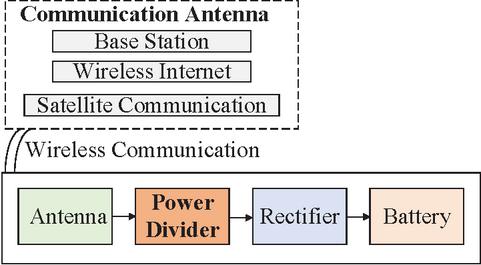
Figure 1 Wireless system architecture of proposed wideband filtering power divider for RF energy harvesting.
In RF energy harvesting systems, the received ambient RF signals are distributed across multiple frequency bands (e.g., GSM, WiFi, 5G). A multi-pole filtering response is employed to realize a wide passband with good in-band flatness and high out-of-band rejection. This ensures that only useful RF energy within the target frequency range is collected and transmitted to the rectifier, while out-of-band interference and noise are suppressed. This improves the stability and power conversion efficiency of the entire harvesting system. As for port isolation, high isolation between output ports is critical to avoid channel interactions. When port isolation is poor, the harvested RF power from one channel will leak into the other channel, causing unexpected signal reflection, power loss, and phase mismatch. Therefore, it is imperative to improve the bandwidth and isolation performance of power dividers. The conventional wideband Wilkinson power dividers are designed for the broadband RF energy harvesting system [4, 5, 6]. For example, in [4], a multisection Wilkinson wideband power divider is applied to the ultra-wideband energy harvesting circuit, but the isolation is only 10 dB.
Recent research has focused on integrating filtering functions into power dividers to improve overall performance. The resistive isolation technique, which introduces resistors between the output ports to absorb reflections, is demonstrated in designs with improved isolation [7, 8]. Multimode resonator structures utilize multiple transmission poles to improve bandwidth and isolation by adjusting coupling; however, achieving both wide bandwidth and high isolation simultaneously remains challenging. Although power dividers based on substrate-integrated waveguide (SIW) or self-packaged air-filled SIW can achieve good in-band isolation, these designs tend to be complicated and operate over relatively narrow bandwidths [9, 10, 11]. Advanced techniques employing composite isolation impedances and surface wave suppression can achieve high isolation of 36 dB, but usually at the expense of operating bandwidth [12]. Recent works in filtering power dividers focus on achieving wideband performance, utilizing approaches such as multilayer slotline structures, direct synthesis techniques, and multilayer stacked stripline designs [13, 14, 15]. In conclusion, most approaches suffer from inherent limitations in achieving both wide bandwidth and high isolation. Generally, even though the isolation component is appropriately selected, the crosstalk between output ports will also limit the isolation level of filtering power dividers. For most microstrip wideband filtering power dividers, crosstalk cannot be avoided, and the isolation level is usually below 25 dB [16, 17, 18, 19, 20]. Achieving over 25 dB of isolation remains challenging, particularly across a wide and designable bandwidth and, to our knowledge, no existing design has simultaneously met both of these requirements.
In this paper, we propose a novel wideband filtering power divider design featuring designable bandwidth and high port isolation. A novel integrated scheme of shared resonant network and Chebyshev impedance transformer is proposed to realize designable four-pole and five-pole wideband filtering responses. The shared resonant structure broadens matching bandwidth and miniaturizes circuit size, eliminating bulky multi-section cascaded configurations. Different from traditional single-resistor schemes, the design adopts dual isolation resistors cooperating with resonant branches, achieving high wideband isolation without degradation of bandwidth and filtering performance. The synergistic design of the filtering transformer and shared resonant structure enables precise control over the fractional bandwidth (FBW).
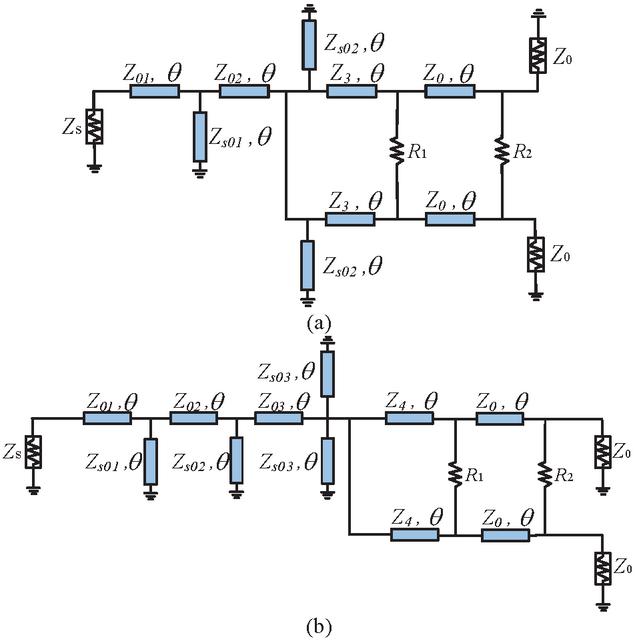
Figure 2 Proposed wideband filtering power divider with different shared networks. (a) Design I and (b) Design II.
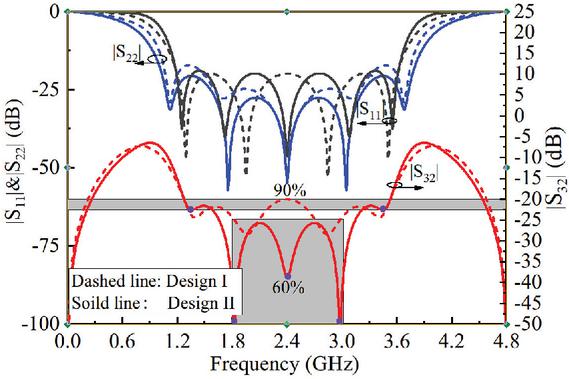
Figure 3 Theoretical results of proposed Designs I and II with same bandwidth of 100% and different isolation bandwidth of 90% (20 dB) and 60% (25 dB).
2 THEORETICAL ANALYSIS
To realize wideband responses, two classes of power dividers based on resonators, as shown in Fig. 2, are presented herein. First, two different shared networks before the power dividing junction are designed to enlarge bandwidth. Designs I and II realize four-pole and five-pole Chebyshev function, respectively. As Fig. 3 shows, both designs achieve a 20-dB bandwidth of 100%, demonstrating that both topologies manifest good bandpass responses in the passband range. Design I features a simple structure and achieves an isolation of 20 dB. In contrast, Design II incorporates increased complexity to achieve an enhanced isolation level of up to 25 dB. Second, all the impedance parameters of the two designs can be determined by the synthesis theory. Third, only two isolation resistors are used to ensure good isolation and port matching.
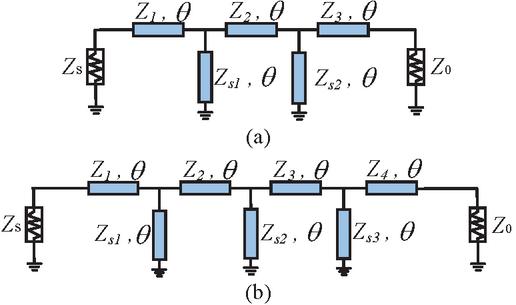
Figure 4 Proposed wideband filtering transformer I and II. (a) With four-pole Chebyshev response and (b) with five-pole Chebyshev response.
The working principle for the realization of the wideband power dividers is detailed as follows. To achieve wide matching bandwidth, two classes of filtering transformers shown in Fig. 4 as branches are synthesized. As an example, the filtering transformer I shown in Fig. 4 (a) is discussed in detail. The proposed wideband filtering transformer is designed with impedance transformer ratio . To implement the four-pole equal-ripple response, the Chebyshev polynomial function is adopted in [21, 22, 23]. The theoretical S-parameters of the wideband filtering transformer can be expressed by
| (1) |
where
| (2) |
All the impedance parameters are normalized by the load impedance . Then, the theoretical S-parameters can be transformed as
| (3) |
The , and of the entire filtering transformer can be obtained by multiplying the ABCD matrices of each transmission line segment. Through the formula derivation, the function of the filtering transformer I shown in Fig. 4 (a) can be derived as
| (4) |
where
| (5a) | ||
| (5b) | ||
| (5c) | ||
| (5d) | ||
| (5e) |
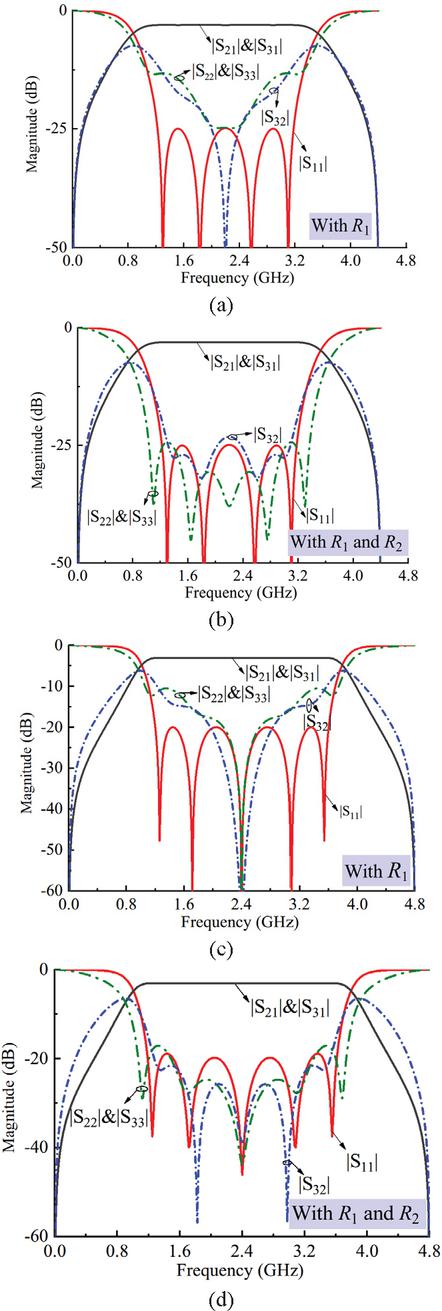
Figure 5 Simulated results of proposed wideband filtering power dividers. (a) Design I with isolation resistor , (b) Design I with isolation resistors and , (c) Design II with isolation resistor , and (d) Design II with isolation resistors and .
By solving equations (1) and (3), the five normalized impedance parameters , and are all determined by the specified FBW, , and . To achieve equal power divider, the filtering transformers with impedance transformer ratio are designed and simulated. The impedance parameters meet the condition of , and . The shared network reduces the size of the circuit and enlarges the available bandwidth of power divider. For enhancing isolation performance, two resonators with impedance of and two resistors are added as shown in Fig. 2 (a). Design II as shown in Fig. 2 (b) can be devised using a similar approach. By trading off the output port matching and isolation performance, the values of the isolation resistors can be finally decided. Figure 5 illustrates the simulated results of the proposed wideband filtering power dividers I and II with different numbers of isolation resistors. The wideband filtering power divider I exhibits a narrow isolation bandwidth with one resistor () and fails to achieve isolation below 25 dB with two resistors ( and ). In contrast, the wideband filtering power divider II delivers both good port matching and a wide isolation bandwidth when two resistors are incorporated.
The design method of the proposed wideband filtering power divider is summarized as follows:
(1) Specify the design goals: center frequency, fractional bandwidth, return loss level, and port isolation requirement;
(2) Determine the characteristic impedances of the filtering transformer using the proposed Chebyshev synthesis method;
(3) Synthesize the shared resonant network to extend the matching bandwidth;
(4) Calculate the initial circuit parameters of all transmission-line segments;
(5) Introduce two isolation resistors between the output ports and optimize their values for high port isolation;
(6) Perform fine-tuning in circuit simulation to satisfy specifications;
(7) Fabricate and measure the prototype for experimental verification.
3 SIMULATION AND EXPERIMENT
For verification, two wideband filtering power dividers are designed, simulated, and fabricated on an RO4003C substrate (, thickness 0.508 mm). The first design, shown in Fig. 2 (a) with center frequency of 2.2 GHz, , and dB is designed, simulated, and fabricated. Prior to simulation and fabrication, detailed theoretical calculations were conducted to determine the key characteristic impedance parameters of the divider’s transmission lines, which are critical to its filtering and power division performance. Its theoretical parameters are calculated as: , , , , . The second wideband filtering power divider shown in Fig. 2 (b) with center frequency of 2.4 GHz, , and is designed. Theoretical parameters are calculated as: , , , , , , , . After global tuning, the dimensions displayed in Figs. 7 (a) and 7 (a) are listed. The chip resistors in Fig. 7 (b) are selected as and . The chip resistors in Fig. 7 (b) are selected as and . The fabricated prototypes are measured by a Keysight N9918A vector network analyzer before measurement, two-port calibration are performed via electronic calibration module to eliminate the effects of test cables and connectors. For the 2.2 GHz design in Fig. 7 (b), the measured FBW is 108.6% with better than 10.6 dB and in-band isolation over 18.6 dB (90% isolation bandwidth). The 2.4 GHz design in Fig. 7 (b) achieves 103.7% FBW, better than 12.8 dB, and in-band isolation over 25 dB (60% isolation bandwidth). As observed in Figs. 7 (b) and 7 (b), slight discrepancy between simulated and measured can be reasonably attributed to several inevitable practical factors. First, fabrication tolerance of microstrip line width and etching deviation introduces impedance variation. Second, SMA connector soldering parasitic effect and assembly misalignment bring extra stray inductance and capacitance. These non-ideal practical factors are common in microstrip circuit implementation and lead to
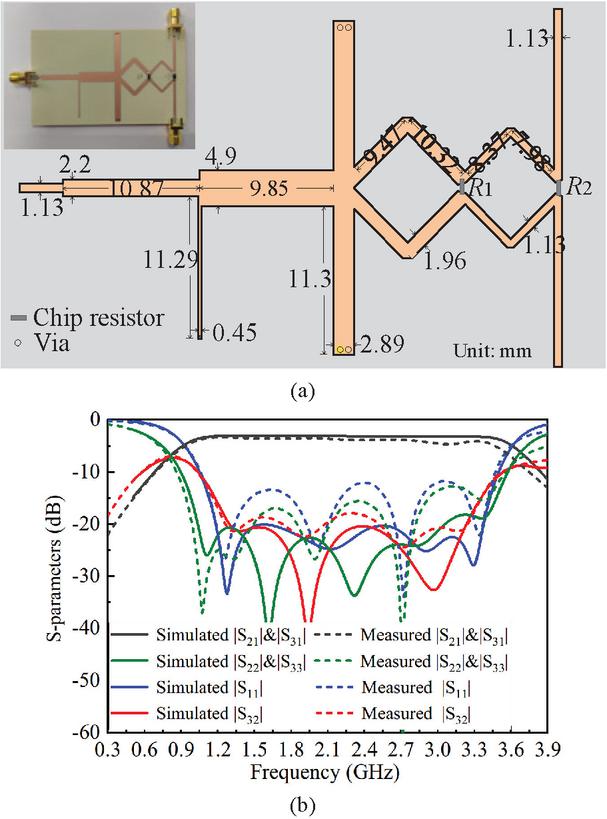
Figure 6 (a) Physical layout and photograph of Design I and (b) simulated and measured results of Design I.
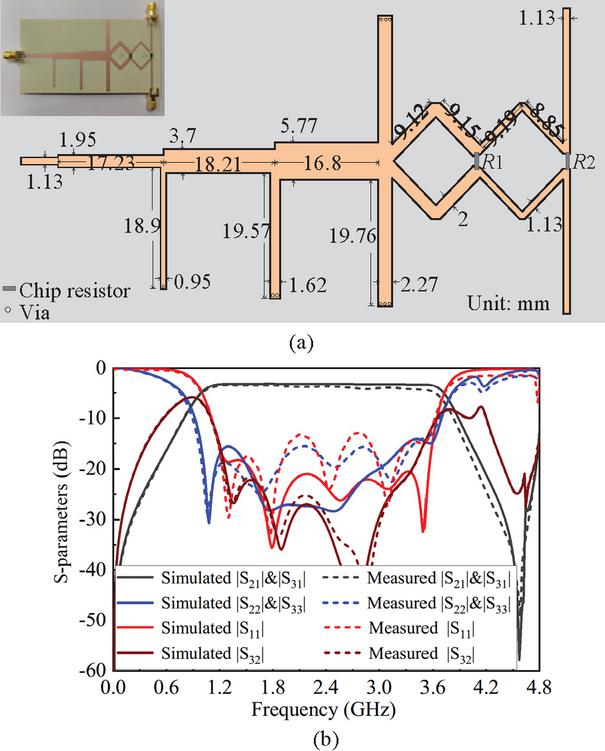
Figure 7 (a) Physical layout and photograph of Design II and (b) simulated and measured results of Design II.
the observable minor mismatch between simulation and measurement.
Table 1 Comparison with recently published power dividers
| Ref. | Freq. | FBW | Isolation | RL |
| (GHz) | (%) | (dB) | (dB) | |
| [12] | 1.28 | 12.5 | -36 | -20 |
| [8] | 2 | 33 | -10.1 | -15.1 |
| [20] | 30 | 46.67 | -12 | 14.1 |
| [18] | 2.35 | 55.32 | -17 | -14 |
| [16] | 1.8 | 73 | -18.5 | -10 |
| [15] | 3 | 84 | -19.5 | -15 |
| [6] | 6.5 | 138.5 | -10 | -10 |
| This | 2.2 | 108.6 | -18.6 | -10.6 |
| Work | 2.4 | 103.7 | -25 | -12.8 |
Table 1 summarizes the key performance parameters of the two proposed wideband filtering power dividers, along with a comparison with other state-of-the-art designs reported in the literature. The comparison clearly demonstrates that the proposed designs exhibit superior performance, including ultra-wide bandwidth, embedded filtering functionality (eliminating the need for additional filtering components), and high-level in-band isolation.
4 CONCLUSION
In this paper, two novel wideband filtering power dividers with improved isolation level have been proposed. The designs achieve Chebyshev transformer functions, enabling wideband impedance matching and equal power division. The two resistors further enhance port isolation without compromising insertion loss. The proposed wideband filtering power dividers demonstrate designable bandwidth and high isolation, thereby offering an efficient solution for broadband RF energy harvesting systems.
ACKNOWLEDGMENT
This work was supported in part by National Natural Science Foundation of China under Grant 62405326 and the Zhejiang Provincial Natural Science Foundation of China under Grant QN26F010032.
REFERENCES
[1] M. Zafar, S. Ekpo, and J. George, “Hybrid power divider and combiner for passive RFID tag wireless energy harvesting,” IEEE Access, vol. 10, pp. 502–515, 2022.
[2] Y. Zheng, A. Buzdar, and Y. Zhang, “Design of ultra-wideband (UWB) microstrip antenna for RF energy harvesting,” in 2021 IEEE MTT-S International Wireless Symposium (IWS), Nanjing, China, pp. 1–3, 2021.
[3] P. Rajeswari, A. Gobinath, and N. Suresh Kumar, “Hybrid 9-port power divider and combiner for enhanced wireless energy harvesting in passive RFID tag systems,” in 2024 Third International Conference on Intelligent Techniques in Control, Optimization and Signal Processing (INCOS), Krishnankoil, Virudhunagar District, Tamil Nadu, India, pp. 1–5, 2024.
[4] O. Kasar, M. Kahriman, and M. A. Gozel, “Application of ultra wideband RF energy harvesting by using multisection Wilkinson power combiner,” Int. J. RF Microw. Comput.-Aided Eng., vol. 29, no. 1, pp. 1–8, 2019.
[5] B. Ozturk and O. Coskun, “Design of wideband microstrip power divider/combiner with input and output impedance matching for RF energy harvesting applications,” Int. J. RF Microw. Comput.-Aided Eng., vol. 29, no. 1, pp. 1–7, 2019.
[6] N. F. A. Hakim, T. Hariyadi, and I. Kustiawan, “Ultra-wideband Wilkinson power divider using stepped impedance for communication system,” in 2023 17th International Conference on Telecommunication Systems, Services, and Applications, pp. 1–4, 2023.
[7] Y. Liu, L. Zhu, and S. Sun, “Proposal and design of a power divider with wideband power division and port-to-port isolation: A new topology,” IEEE Trans. Microw. Theory Tech., vol. 68, no. 4, pp. 1431–1438, 2020.
[8] H. Zhang, N. Zhang, and X. Wang, “A high isolation performance wideband power divider with multi-transmission zeros and poles,” in 2022 International Conference on Microwave and Millimeter Wave Technology (ICMMT), Harbin, China, pp. 1–3, 2022.
[9] A.-R. Moznebi, K. Afrooz, and M. Danaeian, “Four-way filtering power divider using SIW and eighth-mode SIW cavities with ultrawide out-of-band rejection,” IEEE Microw. Wireless Compon. Lett., vol. 29, no. 9, pp. 586–588, 2019.
[10] D. Li, J. Wang, and L. Shi, “Self-packaged mm-wave broadband air-filled SIW filtering power divider with sharp roll-off skirt and high In-band isolation,” IEEE Microw. Wireless Compon. Lett., vol. 34, no. 5, pp. 482–485, 2024.
[11] B.-G. Liu, Y.-P. Lyu, and L. Zhu, “Compact square substrate integrated waveguide filtering power divider with wideband isolation,” IEEE Microw. Wireless Compon. Lett., vol. 31, no. 2, pp. 109–112, 2021.
[12] G. Shen, W. Che, and W. Feng, “High-isolation topology for filtering power dividers based on complex isolation impedance and surface wave suppression,” IEEE Trans. Microw. Theory Tech., vol. 69, no. 1, pp. 43–53, 2021.
[13] K. Song and Q. Xue, “Novel ultra-wideband (UWB) multilayer slotline power divider with bandpass response,” IEEE Microw. Wireless Compon. Lett., vol. 20, no. 1, pp. 13–15, 2010.
[14] H. Tian, L. Xiao, and H. Yu, “Wideband microstrip filtering power divider designed by direct synthesis technique (DST),” IEEE Microw. Wireless Compon. Lett., vol. 32, no. 6, pp. 507–510, 2022.
[15] Z. Zhang, G. Zhang, and K.-W. Tam, “Packaged wideband highly selective filtering power divider with arbitrary phase difference and power dividing ratio on multilayer stripline,” IEEE Trans. Microw. Theory Tech., vol. 72, no. 8, pp. 4757–4769, 2024.
[16] Y. Zhang, H. Liu, and S. Chen, “All-port-reflectionless wideband filtering power divider using five-line coupled structure,” IEEE Microw. Wireless Technol. Lett., vol. 35, no. 1, pp. 31–34, 2025.
[17] X.-F. Li and J.-K. Xiao, “All-frequency-three-port-reflectionless wideband filtering power divider using self-packaged SCPW-MS with broadside-coupled technique,” IEEE Trans. Compon. Packag. Manuf. Technol., vol. 15, no. 3, pp. 560–567, 2025.
[18] L. Liu, L. Zhu, and Z.-B. Wang, “Proposal of hybrid filtering power divider with flexible power division ratio and phase difference for industrial applications,” IEEE Trans. Microw. Theory Techn., vol. 74, no. 1, pp. 832–846, 2016.
[19] Y. Ning, Z. Wei, and P.-L. Chi, “Multifunctional filtering power divider with flexible frequency, insertion phase/amplitude, and output ports using multiway phase control network,” IEEE Microw. Wireless Technol. Lett., vol. 36, no. 3, pp. 391–394, Mar. 2026. doi:10.1109/LMWT.2025.3630791.
[20] X. Zhang, S. Lin, and Y. Liu, “Ka-band wideband filtering power divider based on strongly coupled resonators,” IEEE Microw. Wireless Technol. Lett., vol. 36, no. 5, pp. 689–692, May 2026. doi:10.1109/LMWT.2025.3650173.
[21] R. Levy and L. F. Lind, “Synthesis of symmetrical branch-guide directional couplers,” IEEE Trans. Microw. Theory Tech., vol. 16, no. 2, pp. 80–89, 1968.
[22] M. C. Horton and R. J. Wenzel, “General theory and design of optimum quarter-wave TEM filters,” IEEE Trans. Microw. Theory Tech., vol. 13, no. 3, pp. 316–327, 1965.
[23] H. J. Carlin and W. Kohler, “Direct synthesis of band-pass transmission line structures,” IEEE Trans. Microw. Theory Tech., vol. 13, no. 5, pp. 283–297, 1965.
BIOGRAPHIES

Di Wang received the Ph.D. degree in electronic science and technology from Nanjing University of Science and Technology, Nanjing, China, in 2025. In December 2025, she became Assistant Professor with the Changchun University, Changchun. Her current research interests include microwave passive components and antenna feeding networks.

Zhenzhong Chen received the Ph.D. degree in electromagnetic field and microwave technology from Nanjing University of Science and Technology, Nanjing, China, in 2023. He is currently a Lecturer with Ningbo University, Ningbo. He serves as an Active Reviewer for multiple academic journals. His research interests include array antenna, filtering antenna, phased-array antennas, and microwave/millimeter-wave circuit integration.

Hao Li received the Ph.D. degree in electronic science and technology from the Nanjing University of Science and Technology, Nanjing, China, in 2025. In July 2025, she became Assistant Professor with the Nanjing Forest University, Nanjing. Her current research interests include reconfigurable microwave passive components and antenna feeding networks.

Na Sun received the Ph.D. degree in Physics from Changchun University of Science and Technology, Changchun, China, in 2022, followed by postdoctoral research at the Institute of Optics and Electronics, Chinese Academy of Sciences in Chengdu. In December 2024, she became Assistant Professor with Changchun University, Changchun. Her current research interests focus on photonic integrated technologies and devices.

Jingqi Yang is a 2023 student majoring in Electrical Engineering and Automation at Changchun University, China. His current research interests focus on RF circuit engineering technology and integrated circuits.
ACES JOURNAL, Vol. 41, No. 5, 473–479
DOI: 10.13052/2026.ACES.J.410509
© 2026 River Publishers