Most Valuable Player Algorithm Based State Estimation for Energy Systems
S. Shanmugapriya* and D. Maharajan
Dept. of EEE, SRM Institute of Science and Technology, Kattankulathur, Chennai, India
E-mail: shanmugs4@srmist.edu.in
*Corresponding Author
Received 22 October 2020; Accepted 02 March 2021; Publication 28 April 2021
Abstract
State estimation (SE) processes the real-time measurements and provides database to energy control centre for safety control of energy systems. Traditionally Weighted Least Square (WLS) and Weighted Least Absolute Value (WLAV) based algorithms have been suggested for SE but the development of very fast computers and parallel processing enable the system engineers to think of employing the computationally inefficient evolutionary algorithms, which are known to be robust and stable, in solving SE problems. This paper suggests a most valuable player algorithm based SE involving WLS and WLAV objectives one at a time, and presents results on four IEEE test systems for illustrating its superiority.
Keywords: Estimation, most valuable player algorithm.
1 Introduction
State Estimation (SE) is a vital process for transforming noisy measurements into system state at frequent intervals to effectively monitor and control the energy management systems (EMS) in recent decades. It is designed to handle uncertainties caused due to errors in measuring and communicating systems, errors in mathematical models, etc. The WLS approach has been popularly employed for SE but well-known to be unstable and sensitive to bad measurements [1, 2]. To circumvent the drawbacks, weighted least absolute value (WLAV) schemes employing linear programming (LP) were suggested but they required large computation time that makes the algorithm computationally inefficient [3]. The decoupling idea was adapted in SE schemes to overcome the computational inefficiency, but these methods fail to yield satisfactory SE, when any of the assumptions of the decoupling concept fails and sometimes causes oscillating convergence [4].
Majdoub et al. studied how the efficiency of WLS methods is influenced by type and number of measurements, measurement weight and noise level [5]. Pires et al. outlined a hybrid estimator, blending re-weighted WLS with Van-Loan’s technique, to perform robust SE in the presence of bad measurements [6]. Tripathi et al. studied the performances of WLS on standard power systems [7]. Sharma et al. outlined a software-based multi-agent model for SE with PMU measurements and employed a modified Cubature Kalman filter for SE [8]. Mallick et al. suggested a SE scheme that approximates the current measurements through a fixed observation matrix in terms of line parameters [9]. Sassan and Mohammad proposed agent-based modeling for dynamic SE and solved the problem using unscented Kalman filter [10]. Mehdi et al. presented a SE scheme by modifying the traditional SE formulation to account voltage-dependent load models and zero injections as equality constraints [11]. These traditional methods require differentiable and continuous objective and constraint functions, and may fail to provide SE on ill-conditioned systems.
New kinds of algorithms, named evolutionary algorithms, have been popularly applied in solving diversified optimization problems with a view of overcoming the limitations of traditional methods. Particle swarm optimization (PSO), evolutionary programming, bacterial foraging and artificial bee colony (ABC) fall in this new family [12]. These algorithms demand only the calculation of fitness function in obtaining the optimal solution, unlike classical algorithms. Hee-Myung et al. applied PSO in solving power system state estimation [13]. Basetti and Ashwani applied self-adaptive differential evolution in solving SE problem in [14]. Shanmugapriya and Jegatheesan applied artificial bee colony (ABC) in handling the SE problem [12]. Recently, Bouchekara proposed a Most Valuable Player Algorithm (MVPA), belonging to this family, for solving minimization problems in [15]. This MPVA is imitated from the behavior of players in each team of a game in winning the trophy.
The computational speed of present day computers has been exponentially increasing and the advent of parallel processing enables fast computations, and creates an opportunity to improve the solution speed of evolutionary algorithms. This paper thus proposes a new MVPA based SE algorithm with a view of obtaining numerically stable and robust solution.
2 State Estimation
The SE receives a set of measurements, , and performs optimization with an objective of minimizing the error components, , between the measurements and their respective functions, in terms of system state :
| (1) |
The SE is modeled as a problem of minimizing an objective function in the form of WLS or WLAV as,
| (2) | ||
| (3) |
The former objective can be handled by Newton’s approach, while the latter one can be solved by applying LP scheme, in addition to considering the measurement function of Equation (1). Both these approaches need Jacobian matrix for performing SE. The solution process is well explained in the existing publications [1–4].
3 Proposed Method
The proposed method exploits the MVPA in performing SE. The MVPA is a sports game based stochastic optimization technique comprising several teams of artificial players, and each player in these teams performs well with a goal of achieving the most valuable player trophy. Each player performance depends on various skills and is assessed by the score points. The proposed SE method employing MVPA primarily requires depiction of a player, and formation of a fitness function (FF). The i-th player of a team is therefore depicted by a state variables as,
| (4) |
Fitness Function: The fitness function (FF) of each player can be tailored from the SE problem as,
| (5) |
where represents WLS objective for Equation (2) or WLAV objective for Equation (3).
3.1 Competition Among Players
Each player plays together with his team-mates with a goal of leading the team as a franchise player. The enhancement of his team can be represented as,
| (6) |
where
: a random number
: franchise player in the i-th team.
: i-th team.
: the most valuable player.
K: a constant.
3.2 Competition Among Teams
Each team attempts to beat randomly selected another team by the following equation:
| (7) |
where the superscript-w indicates the probability of winning and represents the FV of team-i
If beats the game, then the players in are modified as,
| (8) |
Else, the players’ skills in the team are enhanced as,
| (9) |
3.3 Greediness
Accept the new player as accepted if the new FV is higher than the respective old FV.
3.4 Solution Process
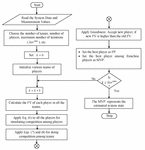
The solution process of the developed SE scheme (DSES) is depicted in Figure 1.
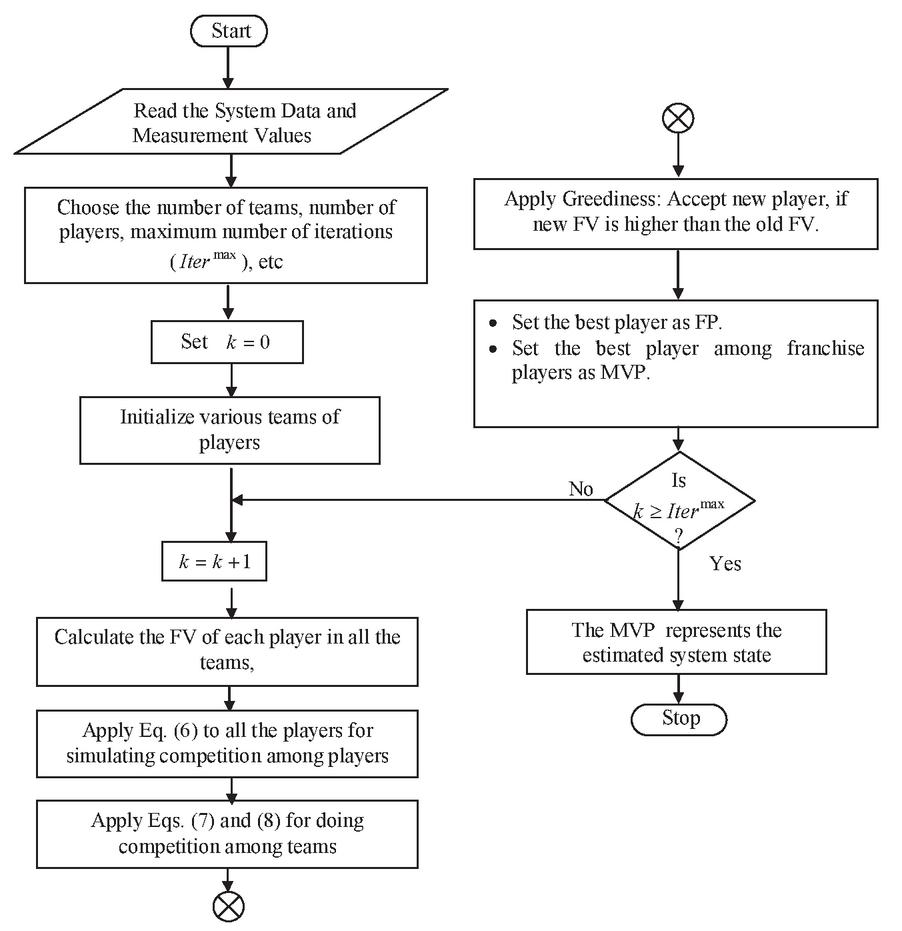
Figure 1 Flow chart of the DSES.
4 Simulation Results
The DSES was tested on 6, 14, 30 and 57 bus IEEE systems [16]; measurements are obtained by including small noise to the load flow results. The measurements are so chosen that the resulting SE problem is observable. The proposed method is validated by comparing the results with true voltage magnitudes and angles, besides comparing with WLS and ABC based SE methods. Table 1 presents the SE results for 6-bus system along with performance measures of Equations (10) and (11) with a view of exhibiting the computational accuracy.
| (10) | ||
| (11) |
Table 1 SE for 6-bus system
| Bus No | DSES | True State | WLS | ABC [12] |
| 1 | ||||
| 2 | ||||
| 3 | ||||
| 4 | ||||
| 5 | ||||
| 6 | ||||
The indices and are evaluated and furnished in Table 2. It is seen that the error components of the DSES are lower than WLS and ABC schemes.
Table 2 Performance Indices
| Test System | Index | DSES | WLS | ABC [12] |
| 6 bus | 0.002131 | 0.004350 | 0.003314 | |
| 0.001538 | 0.008176 | 0.002657 | ||
| 14 bus | 0.000592 | 0.000680 | 0.000671 | |
| 0.001507 | 0.001679 | 0.001603 | ||
| 30 bus | 0.000368 | 0.000540 | 0.000490 | |
| 0.001397 | 0.001378 | 0.001282 | ||
| 57 bus | 0.001694 | 0.001888 | 0.001863 | |
| 0.000924 | 0.000980 | 0.000967 |
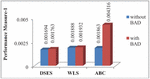
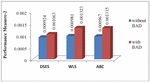
The performance of the DSES has also been studied by randomly choosing three bad measurements in the data set and setting their values as zeros for 57 bus system. The DSES, WLS and ABC approaches have been applied on the measurement data set with bad data. The developed algorithms have then been applied on the measurement set with bad measurements and the performance measures and have been calculated from the estimated system state. The performance measures are plotted in Figures 2 and 3. They exhibit that both the performance measures of the DSES are smaller than the other two approaches. For instance, the performance measures of DSES (0.001693, 0.000924) without bad measurement are raised to (0.001763, 0.001063) after inclusion of bad measurement. This very small raise indicates that the effect on the estimated system state is insignificant. But the increase on performance measures by other two approaches cannot be tolerated as its effect on the system state is significant and provide an estimate that widely deviates away from the true system state. This study portrays that the DSES is robust in the sense that it can reject bad measurements effectively without affecting the final system state.
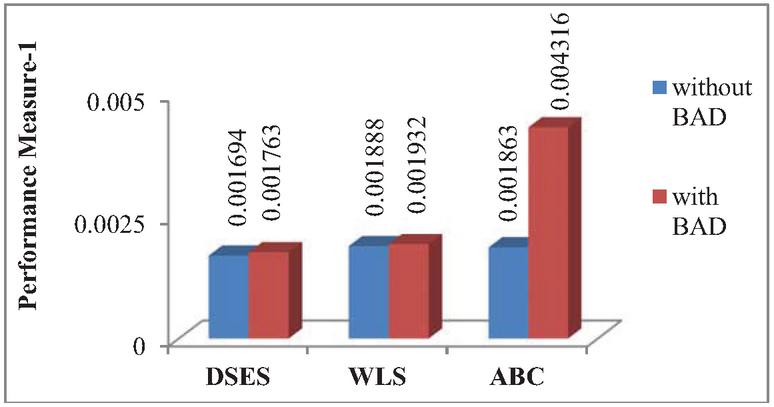
Figure 2 Effect of bad measurements on performance measure-1 for 57-bus system.
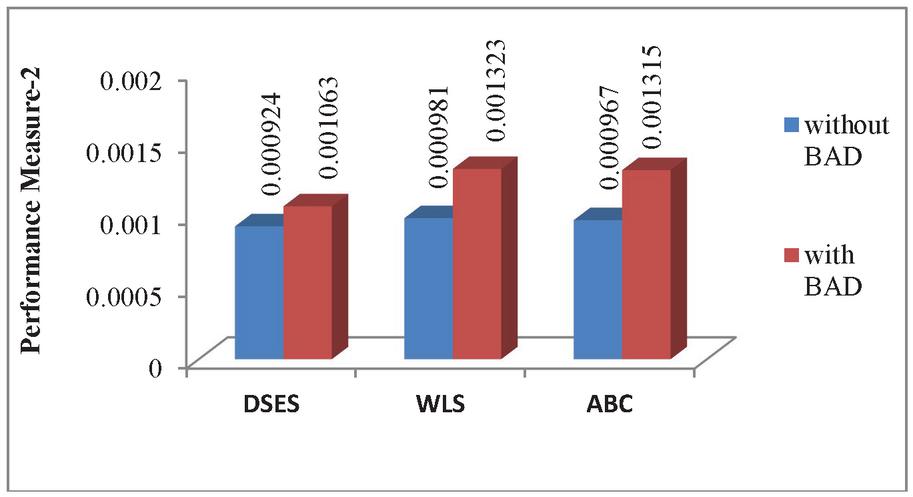
Figure 3 Effect of bad measurements on performance measure-2 for 57-bus system.
5 Conclusions
MVPA is population-based stochastic optimization approach for solving multimodal optimization problems. It is a more stable and robust algorithm, which are the essential requirements of SE algorithms in addition to being highly efficient. Considering the fast developments in the speed of recent computers and parallel processing, a new method involving MVPA has been suggested for solving SE problems in power systems. The method can be tailored to possess either the objective of WLS or WLAV without any modifications in the solution process. The results obtained by the proposed method have been validated by comparing them with those of standard WLS and WLAV approaches for all the chosen test systems. The effect of bad measurements has also been studied on 57 bus-system and illustrated that the proposed method is able to reject the bad measurements. It can be inferred that the proposed method is robust, stable and efficient. The presented results illustrate that the proposed method is robust, stable and efficient.
Acknowledgments
The authors thank the management of SRM Institute of Science and Technology, Kattankulathur Campus, for their support and encouragement in doing the research work.
References
[1] D. Singh, R. Misra, V. Singh and R. Pandey, ‘Bad data pre-filter for state estimation’, International Journal of Electrical Power & Energy Systems, vol. 32, no. 10, pp. 1165–1174, 2010. Available: 10.1016/j.ijepes.2010.06.016.
[2] D. Singh, J. Pandey and D. Chauhan, ‘Topology identification, bad data processing, and state estimation using Fuzzy Pattern Matching’, IEEE Transactions on Power Systems, vol. 20, no. 3, pp. 1570–1579, 2005. Available: 10.1109/tpwrs.2005.852086.
[3] H. Singh, F. Alvarado and W. Liu, ‘Constrained LAV state estimation using penalty functions’, IEEE Transactions on Power Systems, vol. 12, no. 1, pp. 383–388, 1997. Available: 10.1109/59.575725.
[4] P. Aravindhababu and R. Neela, ‘A reliable and fast-decoupled weighted least square state estimation for power systems’, Electric Power Components and Systems, vol. 36, no. 11, pp. 1200–1207, 2008. Available: 10.1080/15325000802084687.
[5] N. Cherkaoui et al., ‘Reactive and active power output optimization in a wind farm using the particle swarm optimization technique’, International Journal of Advanced Engineering Research and Science, vol. 4, no. 3, pp. 15–19, 2017. Available: 10.22161/ijaers.4.3.2.
[6] R. Pires, L. Mili and F. Lemos, ‘Constrained robust estimation of power system state variables and transformer tap positions under erroneous zero-injections’, IEEE Transactions on Power Systems, vol. 29, no. 3, pp. 1144–1152, 2014. Available: 10.1109/tpwrs.2013.2284734.
[7] P. Tripathi, J. Rahul and N.A. Radhamohan, ‘A review of power system state estimation by weighted least square technique’, International Journal of Advance Engineering and Research Development, vol. 3, no. 02, 2015. Available: 10.21090/ijaerd.ncrretee27.
[8] A. Sharma, S. Srivastava and S. Chakrabarti, ‘A multi-agent-based power system hybrid dynamic state estimator’, IEEE Intelligent Systems, vol. 30, no. 3, pp. 52–59, 2015. Available: 10.1109/mis.2015.52.
[9] C. Lin and S. Huang, ‘Integral state estimation for well-conditioned and ill-conditioned power systems’, Electric Power Systems Research, vol. 12, no. 3, pp. 219–226, 1987. Available: 10.1016/0378-7796(87) 90021-6.
[10] S. Goleijani and M. Ameli, ‘A multi-agent based approach to power system dynamic state estimation by considering algebraic and dynamic state variables’, Electric Power Systems Research, vol. 163, pp. 470–481, 2018. Available: 10.1016/j.epsr.2018.07.019.
[11] M. Kabiri, N. Amjady, M. Shafie-khah and J. Catal ao, ‘Enhancing power system state estimation by incorporating equality constraints of voltage dependent loads and zero injections’, International Journal of Electrical Power & Energy Systems, vol. 99, pp. 659–671, 2018. Available: 10.1016/j.ijepes.2018.02.016.
[12] S. Shanmugapriya and R. Jegatheesan, ‘Artificial bee colony based static state estimation for power systems’, International Journal of Recent Technology and Engineering, vol. 8, no. 3, pp. 6200–6202, 2019. Available: 10.35940/ijrte.c5614.098319.
[13] J. Kim, H. Lee and J. Park, ‘A modified particle swarm optimization for optimal power flow’, Journal of Electrical Engineering and Technology, vol. 2, no. 4, pp. 413–419, 2007. Available: 10.5370/jeet.2007.2.4.413.
[14] V. Basetti and A. Chandel, ‘Power system static state estimation using a least winsorized square robust estimator’, Neurocomputing, vol. 207, pp. 457–468, 2016. Available: 10.1016/j.neucom.2016.05.023.
[15] H. Bouchekara, ‘Most Valuable Player Algorithm: a novel optimization algorithm inspired from sport’, Operational Research, vol. 20, no. 1, pp. 139–195, 2017. Available: 10.1007/s12351-017-0320-y.
[16] ‘News from Washington’, IEEE Spectrum, vol. 20, no. 2, pp. 16–16, 1983. Available: 10.1109/mspec.1983.6368994.
Biographies

S. Shanmugapriya received the B.E. and M.E. degrees in Electrical and Electronics Engineering and Power Systems Engineering from Annamalai University, India in 2003 and 2005 respectively, and is presently working towards her Ph.D Degree. She is presently working as an Assistant Professor, Department of Electrical & Electronics Engineering, SRM Institute of Science and Technology, India since 2006. Her research interests are in the area of state estimation, evolutionary algorithms and power system analysis.

D. Maharajan was born in India in 1980. He received B.E Degree in Electrical and Electronics Engineering from Bharathiyar University in 2002. He obtained M.E degree in Power Systems Engineering and Ph.D in Electrical Engineering from Anna University in 2007 and 2019 respectively. He is currently working as an Assistant professor at SRM Institute of Science and Technology (Formerly SRM University). He is specialized in the area of Power System Dynamics, Wind Energy Conversion system, and Flexible AC Transmission system.
Distributed Generation & Alternative Energy Journal, Vol. 35_4, 295–306.
doi: 10.13052/dgaej2156-3306.3543
© 2021 River Publishers