Revenue Analysis and Evaluation of Wind-Solar-Thermal Coupled Systems in the Context of Peak Regulation Auxiliary Service Market
Chen Yeshuai1, Bian Guoliang1,* and Gong Jianguo2
1School of Electrical Engineering, Northeast Electric Power University, Jilin, China
2State Grid Zhejiang Electric Power Company Hangzhou Power Supply Company, China
E-mail: 1847094008@qq.com
*Corresponding Author
Received 30 July 2024; Accepted 19 September 2024
Abstract
In the northern regions of China, the co-location of new energy sources and thermal power plants at a single grid connection point has led to the formation of a unique operational entity. This configuration adheres to an operational paradigm where new energy predominantly fulfills contracted electricity requirements, while thermal power facilities provide ancillary services. This arrangement facilitates a synergistic integration of thermal and renewable energy resources, showcasing substantial potential in the peak regulation auxiliary service market. To rigorously assess the financial performance of such a coupled system in the peak regulation market, this study initially delineates the structure of a wind-solar-thermal coupled system at a unified grid connection point and subsequently evaluates its economic impact within the auxiliary service market. The analysis progresses by employing a bubble sorting methodology to model the participation of this integrated system in the market. Furthermore, the research implements a practical case study by establishing a coupled system in a specified locale within Liaoning Province, wherein its market performance and economic benefits are critically examined. Comparative analysis indicates that the coupled system significantly outperforms traditional power sources and its standalone counterparts in terms of market efficiency and economic viability in the peak regulation context. In the scenario set up in this paper, the revenue capacity of the peaking auxiliary service market after system coupled is enhanced compared with that before coupled, the revenue increases by 2 million yuan.
Keywords: Coupled system, peak shaving, electricity market.
1 Introduction
At present, transitioning from traditional fossil fuel-based power generation to renewable energy and advancing the energy system towards clean and low-carbon solutions have become global imperatives. The extensive adoption of new energy sources, coupled with their inherent variability and unpredictability, has imposed considerable strain on maintaining power system stability. Given China’s coal-dominated energy structure, thermal power will play an important role in smoothing the fluctuations of new energy for a long time.
Energy storage technology enhances the temporal alignment between the “source” side and the “load” side, substantially reducing energy losses during the peak regulation process of coal power systems and increasing the revenue of thermal power units in the peak regulation market. According to literature [7], various schemes for integrating thermal power units with molten salt heat storage systems have been proposed, evaluating peak regulation performance under different scenarios and highlighting the superior capability of coupled molten salt heat storage systems. Literature [8] suggests a system-level flexibility transformation scheme for coal power units based on hydrogen storage systems, which improves the safety and economic efficiency of thermal power units in the power market’s auxiliary services. Literature [9] presents a multi-energy supply system that combines thermal power with compressed air energy storage, demonstrating significant enhancements in thermal and economic efficiency post-integration. However, the challenges of integrating thermal power units with energy storage equipment include the limitations of energy storage technology, high investment costs, and operational and maintenance expenses.
It is a common practice to integrate thermal power units with renewable energy sources at a shared grid connection point. In recent research on coupled renewable energy with thermal power units, literature [11] suggests an optimized scheduling method for these combined systems, taking into account the stepwise ramp rate of thermal power units based on their deep peak regulation capabilities in auxiliary services. Literature [12] develops a bi-level planning model for coupled systems utilizing multi-agent systems, where the upper level focuses on distribution network planning and the lower level on system optimization operations. Literature [13] introduces a wind-thermal coupled multi-energy system incorporating hydrogen energy, designed to enhance the deep peak regulation limits of thermal power units and increase new energy consumption.
Participation in the peak regulation auxiliary service market incurs substantial costs for thermal power plants, thus reducing their motivation to participate in peak regulation efforts. In this regard, reference [16] details a market design and implementation strategy that incorporates both new and thermal energies into the bidding process. This research puts forward a dual-transaction model designed to optimize collective benefits and establishes a method for evaluating the advantages for various market participants. Further analyses by references [17] and [18] delve into the economic aspects of intensive peak regulation for thermal power stations, especially in scenarios where there is significant wind power integration. These studies examine key technical elements that affect the peak regulation capabilities of thermal power stations and suggest a model that outlines the energy costs associated with peak regulation during various phases. Building upon prior research and regulations related to peak regulation services, this document introduces a market strategy for interconnected systems to participate in peak regulation services and investigates the respective compensation frameworks for peak regulation expenses borne by thermal power stations in the interconnected system.
To investigate the application of market-driven utilization techniques for renewable energy and evaluate the strategic benefits and competitive edge of integrating renewable and conventional thermal power at a single grid interface for enhancing power system stability, this study addresses the variability in renewable energy generation within such an integrated system. It introduces an innovative approach for optimizing the use of new energy resources through market-based participation in services for peak load adjustment. Moreover, it develops a comprehensive model for a peak regulation market that involves both renewable sources and thermal power units. The model is implemented in a specified region of Liaoning Province, where the economic gains and overall effectiveness of the system’s engagement in the peak regulation market are thoroughly assessed and demonstrated.
2 Concept of Coupled System and Participation in Peak Regulation Auxiliary Services
2.1 Concept of Wind-Solar-Thermal Coupled System
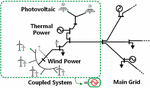
The coupled system internally realizes the complementary advantages of different types of power generation units, forming a power generation entity with multiple power sources’ complementary advantages. Externally, the coupled system operates as an independent power generation entity, optimized and controlled uniformly. Compared to traditional independent thermal power enterprises and renewable energy enterprises, the coupled system has lower marginal costs and better output quality. Due to the close electrical distance between renewable energy and thermal power within the coupled system, it emphasizes internal synergy and external independent controllability.
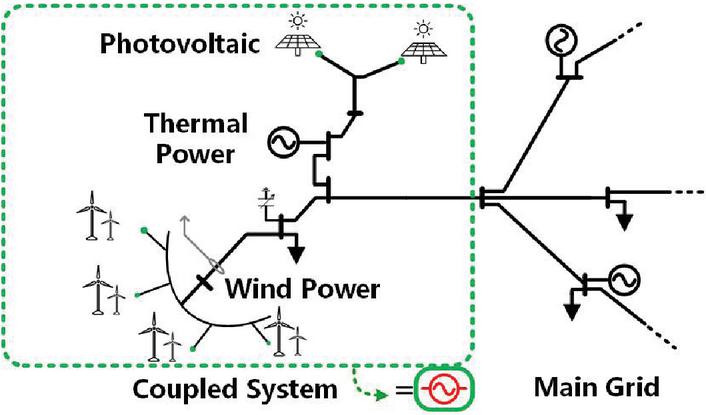
Figure 1 Coupled system diagram.
In the peak shaving ancillary service market, the coupled system should give priority to meeting the internal renewable energy peak shaving demand, and while maintaining the stability of the overall output node of the coupled system, the surplus peak shaving capacity should be entered into the external overall peak shaving auxiliary service market for bidding, so as to maintain the stability of its nodes and provide flexible resources for the system.
2.2 Research Value of Wind-Solar-Thermal Coupled System
Thermal power units in the Northeast region currently face high peak regulation auxiliary service costs and unreasonable auxiliary service cost allocation, leading to insufficient peak regulation incentives. Meanwhile, renewable energy faces high deviation assessment costs in the peak regulation auxiliary service market due to its output instability and uncertainty. Therefore, under the existing peak regulation auxiliary service market mechanism, it is difficult to ensure the interests of all market participants, and profitability is reduced. Faced with these practical problems, the above-mentioned characteristics of the coupled system show that constructing a coupled system of new energy and thermal power and enhancing their mutual complementarity is an effective solution. In the context of the national active promotion of “multi-energy complementarity” construction and further deepening power market-oriented reform, studying the benefits of the coupled system in the peak regulation auxiliary service market has important practical significance.
3 Comprehensive Cost Model for Coupled System Peak Regulation Auxiliary Services
3.1 Comprehensive Cost Model for Single Thermal Power Peak Regulation Auxiliary Services
During the deep peak shaving stage, the coal consumption rate of thermal power units increases significantly with the decrease of output, and the work efficiency of desulfurization, denitrification and dust removal equipment is also greatly reduced. Compared with running in the conventional peak shaving stage, the thermal power unit will generate more costs if it emits the same amount of electricity in the deep peak shaving stage.
3.1.1 Coal consumption cost
During the standard peak adjustment phase, the coal usage rate of thermal power units remains relatively stable. However, in the intense peak regulation period, this rate climbs sharply as the load decreases. The extra costs incurred from this heightened coal consumption during the deep peak regulation phase are computed as follows:
| (1) | |
| (2) | |
| (3) | |
| (4) |
Where Compensated peak shaving basis for thermal power unit i at 1st gear; Output upper limit for thermal power unit i; Compensated and uncompensated peak shaving limit output for thermal power unit i; , , Coal consumption coefficient for thermal power unit i; Peak shaving output of thermal power unit i at time t and time interval j; and Calculating for thermal power unit i at output levels of and the respective coal consumption rates of unit i under different output levels, the difference between the two, multiplied by the peak shaving generation within each 15-minute interval. is the additional coal consumption for peak shaving by thermal power unit i during time t and time interval j; denotes coal price; which represents the additional coal consumption cost for peak shaving.
3.1.2 Environmental cost
The expression for environmental costs of thermal power units is as follows:
| (5) |
Where is the type of pollutant emitted; is the unit taxable amount of the pollutant k; is the pollution equivalent of the pollutant k; is the emission of pollutant k during period t.
(1) The emissions of SO, NOx and soot are calculated as follows.
| (6) |
Where is the SO emission of thermal power plant i during period t; is the sulfur content of the coal-fired receiving base; K is the rate of conversion of coal-fired sulfur to flue gas sulfur; is the molar mass ratio of SO to S; is the desulfurization efficiency of the desulfurization equipment.
(2) Nitrogen oxide emissions
| (7) |
Where is the NO emissions from thermal plant unit i during period t; is the nitrogen content of the coal-fired receiving base; is the rate at which coal-fired nitrogen is converted to flue gas nitrogen; is the molar mass ratio of NO to N; is the desulfurization efficiency of the desulfurization equipment.
(3) Particulate matter emissions
| (8) |
Where is the periodical soot emission of thermal power unit i; is the ash content of the coal; is the percentage of fly ash carried out in the flue gas; is the percentage of combustible matter in the soot; is the dust removal efficiency of the dust removal equipment.
In summary, the additional costs for deep peak shaving by thermal power units include additional coal consumption costs and additional:
| (9) |
3.2 Calculation of Peak Regulation Costs for Wind-Solar-Thermal Coupled System
In the integrated wind-solar-thermal system, various energy generators are merged into a unified virtual entity that competes in the peak regulation market. The demarcation between compensated and non-compensated peak regulation is redefined according to the limits set by each constituent thermal power generator. The total peak regulation capacity from the internal thermal components in the coupled system equals the aggregate of the outputs from each individual thermal unit.
| (10) |
The coal consumption cost and environmental cost of the wind-solar-thermal coupled system are the sum of the additional coal consumption and environmental costs of internal thermal power units.
4 Compensation for Peak Regulation Auxiliary Services
4.1 Compensation Principle for Thermal Power Peak Regulation Auxiliary Services
Real-time deep peak regulation trading utilizes a tiered pricing and quoting system. According to the “Northeast Power Auxiliary Service Market Operation Rules,” this trading is segmented into two distinct bidding periods, each with its own predefined maximum and minimum price caps. Compensation for peak regulation is calculated based on the actual volume of peak adjustment provided by each unit and the relevant market clearing prices. For each thermal power unit, the base value for compensated peak regulation is documented accordingly.
Table 1 Paid peak shaving reference value
| Time | Type of Thermal Power Plant | Compensated Peak Shaving Benchmark |
| Non-heating period | Condensing thermal power unit | Load factor 50% |
| Cogeneration unit | Load factor 48% | |
| Heating period | Condensing thermal power unit | Load factor 48% |
| Cogeneration unit | Load factor 50% |
The peak shaving compensation obtained by thermal power units is as follows:
| (11) |
In the formula, r is the correction factor, with during the heating season and during the non-heating season. l represents the peak shaving level of the thermal power unit. denotes the bid quantity for unit i in time period t, time slot j, and at peak shaving level l. represents the clearing price and peak shaving pre-clearing output for time period t, time slot j, and peak shaving level l. represents the peak shaving compensation received by unit i in time period t and time slot j.
Peak shaving compensation obtained by coupled systems follows that of conventional thermal power units:
| (12) |
4.1.1 Peak upward adjustment
If a thermal power unit faces a situation requiring peak upward adjustment, the dispatching agency allocates the corresponding peak adjustment power proportionally according to the rated capacity of the thermal power unit. This power is compensated to the thermal power unit based on the corresponding nodal electricity price. The compensation received by thermal power units for peak upward adjustment is as follows:
| (13) |
Where is the nodal electricity price at the node where thermal power unit i is located at time t, time slot j; . The rated capacity of thermal power unit i.
Coupled systems receive peak upward adjustment compensation based on conventional thermal power units:
| (14) |
4.2 Compensation Principles for Peak Regulation Auxiliary Services in Wind-Solar-thermal Coupled Systems
Services in Wind-Solar-thermal Coupled Systems The participation of coupled systems in peak regulation involves surplus peak regulation service capacity provided externally by their internal thermal power units. In addition, fluctuations in internal new energy sources are mitigated by their own thermal power units. Therefore, based on the principle of “who calls, who bears,” internal new energy sources do not need to share in the compensation costs for external peak regulation auxiliary services.
Wind generation adjustment quantity:
| (15) |
In this context, for the heating season and for the non-heating season. For nationally accredited wind power concession projects, . Wind farms without subsidies and with grid prices less than 0.01 yuan compared to the local thermal power environmental benchmark price have , while other wind farms have . The coefficient for wind farms with annual utilization hours equal to or higher than the guaranteed purchase hours of the previous year.
Photovoltaic generation adjustment quantity:
| (16) |
In this context, for the heating season and for the non-heating season. Photovoltaic (PV) stations without subsidies and with grid prices within 0.01 yuan of the local thermal power environmental benchmark price have , while other PV stations have . The coefficient for PV stations with annual utilization hours equal to or greater than the guaranteed purchase hours of the previous year.
4.2.1 Peak upward adjustment
Peak upward adjustment can be seen as purchasing electricity from thermal power units, hence it does not involve sharing of thermal power peak shaving costs:
| (17) |
5 Peak Shaving Clearing Model
Thermal power units participating in real-time deep peak shaving auxiliary services use a “stepwise” pricing method and pricing mechanism. The uncompensated peak shaving level, namely level 0, defaults to a bid price of 0; levels 1 and 2 have floating bid prices. Specific tiering, bid price upper and lower limits are detailed in the table below:
Table 2 Peak shaving prices for thermal power units
| Type of | Thermal Power | ||||
| Peak Shaving | Thermal | Plant | Minimum | Maximum | |
| Time | Bid Levels | Power Plant | Load Factor | Bid Price | Bid Price |
| Non-heating period | Tier 1 | Condensing thermal power unit | 40% load factor 50% | 0 | 0.4 |
| Cogeneration unit | 40% load factor 48% | ||||
| Tier 2 | All generations | load factor 40% | 0.4 | 1 | |
| Heating period | Tier 1 | Condensing thermal power unit | 40% load factor 48% | 0 | 0.4 |
| Cogeneration unit | 40% load factor 50% | ||||
| Tier 2 | All generations | load factor 40% | 0.4 | 1 |
In this context, clearing is divided into two cases: downward and upward peak adjustments. Downward peak adjustments are settled based on the pricing tiers of thermal power units, while upward peak adjustments are settled according to dispatch center scheduling rules. The specific process is as follows:
Downward peak adjustment: Let matrix denote the peak shaving bid prices and matrix denote the corresponding peak shaving capacity provided by thermal power units at each tier. In the case of uncompensated peak shaving by thermal power units, these should be represented as two matrices, denoted as:
| (18) |
Where is the bid price of thermal power unit i at tier l, and it is also the initial value for the optimization algorithm; is the peak shaving capacity of thermal power unit i at tier l, time t, time slot j.
| (19) |
Arrange matrix by sorting each column in ascending order based on numerical values. Through this method, update matrix . The electricity dispatching agency calls upon the peak shaving capacities mapped to corresponding prices in response to the provincial peak shaving demand at time t, time slot j, based on pre-clearing results sorted from low to high bids. In case of tied bids, prioritize according to the proportion of peak shaving capacities. The quantities called upon are the awarded amounts , for thermal power unit i in time slot j at tier l, and for coupled system i at tier l. The market clearing price within the tier is determined by the bid price of the last dispatched peak shaving unit within time slot j, denoted as .
Objective function: In the market, each market participant competes with the objective of maximizing their own profit, expressed as:
| (20) | ||
| (21) |
In the equation, denotes the net peak shaving revenue obtained by thermal power unit i at time t and time slot j.
Constraints: Bid Constraint: According to the detailed rules of the peak shaving auxiliary service market, it is required to impose constraints on the bid prices of each market participant at each tier.
| (22) |
Thermal Power Unit Ramp Constraint: According to the ramp rate of thermal power unit i, appropriate constraints are imposed on the peak shaving output every 15 minutes.
| (23) |
, The ramping upper and lower bounds for thermal power unit i
Operational constraints for thermal power units:
| (24) |
Peak shaving power balance constraint:
| (25) |
6 Case Study Analysis
In this case analysis, the grid connection point of a 500 kV network in a Liaoning area features a coupled system. This system integrates 1200 MW from thermal power sources, 300 MW from offshore wind turbines first operational in 2017, and 400 MW from solar photovoltaic facilities, with installations of 200 MW completed in 2016 and another 200 MW in 2017. The model involves 8 power generation enterprises participating in annual bilateral trading, including 3 competitive thermal power plants with capacities of 600 MW each and one with 1000 MW capacity. Additionally, there are 4 renewable energy plants with capacities of 300 MW each and 400 MW each. The load profile is designed to be representative and accounts for fluctuations on weekdays, holidays, and weekends. The relevant parameters of the unit are set as shown in the following table.
Table 3 Thermal power unit parameters
| Coal Consumption Parameters | |||||||
| Climbing | Coal | ||||||
| Maximum | Minimum | Rate | a(kg/ | b(kg/ | Prices | ||
| Unit | (MW) | (MW) | (MW/15 min) | MWh) | MWh) | c(kg) | (yuan/kg) |
| Coupled System | 1200 | 360 | 540 | 1.71e-4 | 0.3897 | 853.9470 | 1.2 |
| 600 MW Thermal Power | 600 | 180 | 270 | 3.44e-4 | 0.3852 | 410.4965 | 1.2 |
| 600 MW Thermal Power | 600 | 180 | 270 | 3.97e-4 | 0.4207 | 414.3572 | 1.2 |
| 1000 MW Thermal Power | 1000 | 300 | 400 | 9.29e-5 | 0.1783 | 370.1213 | 1.2 |
6.1 Peak Shaving Auxiliary Service Pricing
Simulating the market over three working days, we obtained the peak shaving auxiliary service prices for the coupled system and three competitive thermal power enterprises, as shown in the table:
Table 4 Thermal power unit quotation
| 600 MW | 600 MW | 1000 MW | |||
| Coupled | Thermal | Thermal | Thermal | ||
| Unit | System | Power | Power | Power | |
| Weekdays | Tier 1 bid price | 241.8558 | 393.1459 | 383.8086 | 284.2848 |
| Tier 2 bid price | 652.5247 | 953.1781 | 980.2073 | 572.4805 | |
| Weekends | Tier 1 bid price | 306.4523 | 373.9026 | 368.103 | 346.0498 |
| Tier 2 bid price | 771.0773 | 987.9053 | 933.6495 | 681.2058 | |
| Holidays | Tier 1 bid price | 349.2157 | 353.0097 | 335.2844 | 313.5834 |
| Tier 2 bid price | 549.1909 | 806.5448 | 780.9996 | 681.0392 | |
The data presented in the graphs clearly show that both the integrated coupled system and the 1000 MW thermal power unit have considerably more competitive prices for peak shaving services during weekdays, weekends, and holidays, compared to the 600 MW units. This pricing advantage is attributed to the lower operational costs associated with peak shaving for the coupled system and the 1000 MW unit, which also highlight their superior adaptability and effectiveness in managing demand fluctuations.
6.2 Peak-shaving Ancillary Service Revenue
After participating in the peak-shaving ancillary service market, the total revenue and costs of coupled systems and competing thermal power enterprises for peak-shaving ancillary services are as follows (yuan).
Total revenue (yuan)
Table 5 Total revenue of peak shaving market
| Coupled | 600 MW | 600 MW | 1000 MW | |
| Unit | System | Thermal Power | Thermal Power | Thermal Power |
| Weekdays | 50793986.83 | 25126094.30 | 25321028.30 | 50439589.89 |
| Weekends | 45107045.09 | 21912698.74 | 21821783.94 | 44145607.44 |
| Holidays | 50688491.88 | 25136908.14 | 24949954.21 | 50243409.12 |
| Total | 146589523.80 | 72175701.18 | 72092766.45 | 144828606.50 |
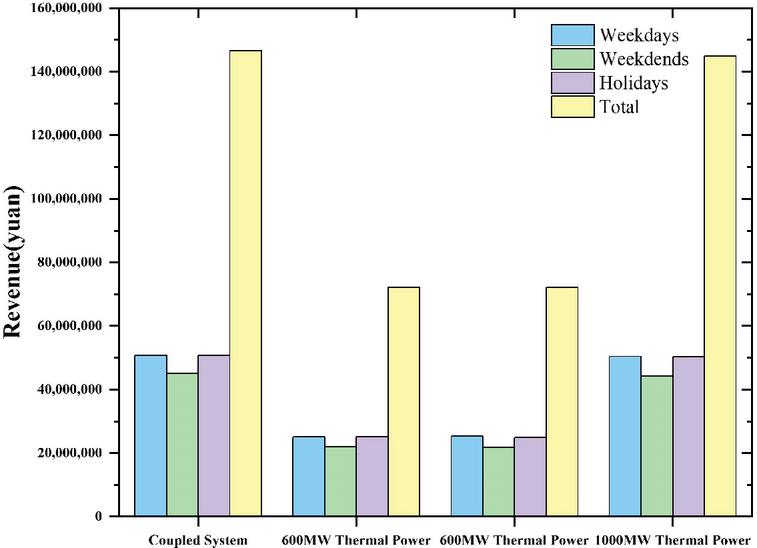
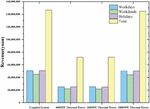
Figure 2 Total revenue comparison chart.
From the chart, it is evident that the coupled system and the 1000 MW thermal power unit exhibit superior peak-shaving capabilities in the ancillary service market, thus earning higher revenue compared to the 600 MW thermal power unit. This is primarily attributed to the complementary nature of wind, solar, and thermal power within the coupled system, which allows it to demonstrate greater flexibility and economic benefits in providing peak-shaving services. Similarly, the 1000 MW thermal power unit benefits from its scale and technological advantages, enhancing its peak-shaving capability and market competitiveness.
Both the coupled system and the 1000 MW thermal power unit achieve significantly higher peak-shaving revenues on weekdays, weekends, and holidays compared to the 600 MW thermal power unit. Particularly during holidays, where load fluctuations are pronounced and peak-shaving demand increases, the total revenue from peak-shaving is notably higher than on weekdays and weekends. This phenomenon reflects the advantage of coupled systems and large thermal power units in responding to load fluctuations and providing flexible services. Under various typical daily load conditions, the coupled system and the 1000 MW thermal power unit optimize internal scheduling and market pricing, effectively reducing peak-shaving costs and significantly increasing market revenue.
Table 6 Coal consumption cost (yuan)
| Coupled | 600 MW | 600 MW | 1000 MW | |
| Unit | System | Thermal Power | Thermal Power | Thermal Power |
| Weekdays | 8104077.713 | 3753949.722 | 3928862.072 | 7089978.873 |
| Weekends | 7492894.415 | 3401803.56 | 3559596.783 | 6430324.859 |
| Holidays | 8104077.713 | 3753949.722 | 3928862.072 | 7089978.873 |
| Total | 23701049.84 | 10909703 | 11417320.93 | 20610282.61 |
Table 7 Environment cost (yuan)
| Coupled | 600 MW | 600 MW | 1000 MW | |
| Unit | System | Thermal Power | Thermal Power | Thermal Power |
| Weekdays | 45109.07339 | 20816.33594 | 22200.06818 | 39617.24569 |
| Weekends | 41704.67235 | 18934.08541 | 19812.34611 | 35790.52052 |
| Holidays | 45106.45513 | 20894.09439 | 21867.63837 | 39462.08627 |
| Total | 131920.2009 | 60644.51574 | 63880.05266 | 114869.8525 |
| Coupled | 600 MW | 600 MW | 1000 MW | |
| Unit | System | Thermal Power | Thermal Power | Thermal Power |
| Coal consumption surcharge cost | 23701049.84 | 10909703 | 11417320.93 | 20610282.61 |
| Environmental surcharge cost | 131920.2009 | 60644.51574 | 63880.05266 | 114869.8525 |
| Total revenue | 146589523.8 | 72175701.18 | 72092766.45 | 144828606.5 |
| Net income | 122756553.8 | 61205353.66 | 60611565.47 | 124103454 |
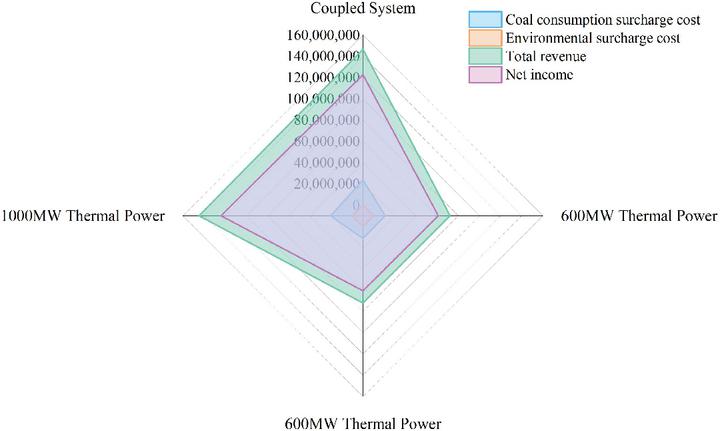
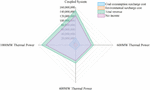
Figure 3 Radar chart of peak shaving profitability for market participants.
Firstly, renewable energy generation features low marginal costs but suffers from output variability and unpredictability. When operating independently, renewable energy plants face substantial penalty costs in the peak-shaving market due to their significant fluctuations. On the other hand, thermal power units, despite incurring additional coal consumption and environmental costs during deep peak-shaving periods, offer stable output that effectively compensates for the shortcomings of renewable energy generation. By integrating wind, solar, and other renewable energy sources with thermal power units into a unified market entity, the coupled system can leverage each component’s strengths to achieve stable and economical peak-shaving capabilities.
Secondly, the coupled system can optimize revenue in the peak-shaving ancillary service market through internal coordination. Specifically, the system prioritizes meeting the peak-shaving demands of internal renewable energy sources to maintain overall output stability, while surplus peak-shaving capacity is competitively offered in the market. Simulation results presented in the document show that the coupled system’s peak-shaving ancillary service pricing on weekdays, weekends, and holidays is significantly lower than that of an independently operated 600 MW thermal power unit, demonstrating superior flexibility and economic efficiency.
7 Conclusion
Through an exhaustive evaluation of the performance of the wind-solar-thermal coupled system in the peak-shaving ancillary service market, several key findings emerge: notably, the coupled system offers substantial financial benefits within this sector. In the conventional mode of operation where sources function independently, both thermal and renewable energy producers encounter significant challenges. Thermal units face heightened costs related to coal consumption and environmental impacts, particularly during intense peak-shaving activities, which diminish their enthusiasm for such operations. On the other hand, the variability and unpredictability of renewable outputs lead to high penalties in the peak-shaving market, making them economically unattractive.
The integration of wind and solar energies with thermal power at a single grid connection forms a combined entity that capitalizes on the low incremental costs of renewables and the consistent performance of thermal units. This synergy results in more effective peak-shaving capabilities. Simulations confirm that this integrated approach not only boosts market earnings but also minimizes the extra expenses associated with peak management. The coupled system consistently shows reduced losses in comparison to operations where energy sources work in isolation.
As electricity market reforms progress and the realization of coupled system types of technological progress, the outlook for coupled systems in peak-shaving markets is optimistic. Enhancing the operational strategies and market frameworks of these systems could further improve their economic performance, support the integration of renewable energy on a market basis, and aid in achieving a clean, low-carbon power sector. Moreover, the development and deployment of such coupled systems are crucial for managing the complexities introduced by large-scale renewable integration, helping to establish a power infrastructure that is more robust, adaptable, and efficient.
References
[1] Z. M. Liu, S. K. Wang, M. Q. Lim, et al. ‘Game theory-based renewable multi-energy system design and subsidy strategy optimization’, Advances in Applied Energy, 2021, 2.
[2] M. M. ZHANG, Z. K. YANG, L. Y. LIU, et al. ‘Impact of Renewable Energy Investment on Carbon Emissions in China - an Empirical Study Using a Nonparametric Additive Regression Model’, Science of the Total Environment, 2021, 785:1–11.
[3] X. L. Yang, D. X. Niu, M. Chen, et al. ‘An Operation Benefit Analysis and Decision Model of Thermal Power Enterprises in China against the Background of Large-Scale New Energy Consumption’, Sustainability, 2020: 12, 4642.
[4] D. Y. Sun, J. Geng, S. C. Yang, et al. ‘Coordinated Optimization Operation of Diverse Resources including Coal-fired Power and New Energy in a Novel Power System Environment and Its Challenges’, Power System Technology: 1–10 [2024-06-29].
[5] H. Zhou, L. Lu, M. Wei, L. Shen and Y. Liu. ‘Robust Scheduling of a Hybrid Hydro/Photovoltaic/Pumped-Storage System for Multiple Grids Peak-Shaving and Congestion Management’, IEEE Access, vol. 12, pp. 22230–22242, 2024.
[6] Z. Y. Li, K. Fang, Q. Qiang, et al. ‘Application of Energy Storage Technology in the Peak Shaving Field of Electric Power’, Electrical and Energy Management Technology, 2019(10): 69–73.
[7] M. C. Li, C. Q. Sun, X. Han. ‘Peak Shifting Performance Study of Coupled Thermal Power Units with Molten Salt Thermal Storage System’, Turbine Technology, 2024, 66(03): 198–202.
[8] L. Wang, X. S. Liu, P. Hu, et al. ‘Study on Flexible Modification Scheme of Coal-fired Power Units Based on Hydrogen Storage Energy. Industrial Heating’, 2024, 53(04): 63–67.
[9] J. J. Li, X. S. Li, F. C. Wei, et al. ‘Economic Evaluation of a Novel Compressed Air Energy Storage System Coupled with Thermal Power Units’, Proceedings of the Chinese Society for Electrical Engineering, 2023, 43(23): 9171–9183. DOI: \nolinkurl10.13334/j.0258-8013.pcsee.222819.
[10] G. Cheng, F. Xu, B. Hu, et al. ‘Synergistic Performance and Combined Design Research of Renewable Energy Integration with Thermal Power’, Power System Technology, 2021, 45(06): 2178–2191. DOI: \nolinkurl10.13335/j.1000-3673.pst.2021.0110.
[11] L. J. Yang, N. C. Zhou, B. Hu, et al. ‘Optimization Scheduling Method for Coupled Systems Considering Thermal Power Stepped Climbing Rates’, Proceedings of the Chinese Society for Electrical Engineering, 2022, 42(01): 153–164. DOI: \nolinkurl10.13334/j.0258-8013.pcsee.201831.
[12] X. D. Xu, H. J. Jia, D. Wang, et al. ‘Hierarchical energy management system for multi-source multi-product microgrids’, Renewable Energy, 2015, 78: 621–630.
[13] T. J. Yuan, L. Y. Gao, Y. S. Xie, et al. ‘Design and Comprehensive Evaluation of Wind-Thermal Coupled Multi-Energy Systems Based on Hydrogen Energy’, Electric Power Automation Equipment, 2021, 41(10): 227–233+255. DOI: \nolinkurl10.16081/j.epae.202110032.
[14] Z. C. Chen, J. F. Gao. ‘Optimization Discussion on Thermal Power Unit Load Allocation and Start-stop Schedule – Application of Dynamic Programming Method’, Automation of Electric Power Systems, 1985(01): 21–29.
[15] Y. Q. Meng, Y. W. Cao, J. Q. Li, C. Liu, J. L. Li, Q. G. Wang, G. W. Cai, Q. S. Zhao, Y. P. Liu, X. Meng, W. C. Ge, Q. Yang. ‘The real cost of deep peak shaving for renewable energy accommodation in coal-fired power plants: Calculation framework and case study in China’, Journal of Cleaner Production, Volume 367, 2022, 132913, ISSN 0959-6526.
[16] L. Sigrist, E. Lobato and L. Rouco. ‘Energy storage systems providing primary reserve and peak shaving in small isolated power systems: An economic assessment’, International Journal of Electrical Power & Energy Systems, 2013, 53: 675–683.
[17] T. T. Hou, R. C. Fang, Z. H. Wang, et al. ‘Optimization Scheduling and Cost Sharing Mechanism for Enhancing Source-Load Diversity Peak Shifting Initiative’, High Voltage Engineering: 1–12 [2024-06-28].
[18] G. Li, C. T. Cheng, Y. Zeng, et al. ‘Practical Study and Application of Improved Equal Incremental Rate Algorithm for Solving Thermal Power Load Allocation Problems’, Power System Protection and Control, 2012, 40(02): 72–76.
[19] P. X. Shi, P. R. Shi, P. W. Wang, et al. ‘Analysis and Operation Evaluation of Peak Shaving Ancillary Service Market in North China Region’, Automation of Electric Power Systems, 2021, 45(20): 175–184.
Biographies

Chen Yeshuai, male, from Anhui, is a master’s student in Electrical Engineering at Northeast Electric Power University, specializing in power markets.

Bian Guoliang, male, from Shandong, obtained his master’s degree in Electrical Engineering from Northeast Electric Power University in 2024 and is currently a doctoral student there. His primary research focus is on power markets.

Gong Jianguo, male, from Hangzhou, Zhejiang, holds a master’s degree in Electrical Engineering and is a senior engineer.
Distributed Generation & Alternative Energy Journal, Vol. 39_5, 941–960.
doi: 10.13052/dgaej2156-3306.3951
© 2024 River Publishers