Advancing Science in Microgravity – Implications for Effective Therapies
Anish Rangdal1, †, Steven Munoz1, †, Charles Ma1, Mariana S. De Lorenzo2,* and Lauren S. Sherman 1,*
1Department of Medicine, Rutgers New Jersey Medical School, USA
2Department of Cell Biology and Molecular Medicine, Office of Education, Rutgers New Jersey Medical School, USA
E-mail: shermala@njms.rutgers.edu; delorems@njms.rutgers.edu
*Corresponding Author
†Equal contributions
Received 15 October 2024; Accepted 26 December 2024
Abstract
The International Space Station (ISS) is a collaborative platform for advanced research in microgravity, significantly contributing to cancer studies, drug development, and tissue engineering. Since its assembly in 1998, the ISS has become an invaluable environment for experiments not possible on Earth. A key focus is organoid development – miniature, 3D human organ models grown in space, offering insights into disease mechanisms, drug responses, and regenerative medicine. Microgravity promotes scaffold-free tissue formation, advancing neurodegenerative disease research and therapeutic discovery.
Cancer research on the ISS has expanded since the 2010s, using microgravity to grow 3D tumor models that mimic human tumors more accurately than Earth-based systems. These studies have improved our understanding of cancer cell behavior, chemotherapy resistance, and immune responses, driving new drug development. NASA’s collaboration with initiatives like the Cancer Moonshot accelerates cancer research in space.
Emerging biomarker studies in space are enhancing early cancer detection and environmental monitoring. Additionally, ISS research on radiation-induced DNA damage has led to improved diagnostic tools, such as microsatellite instability (MSI) tests, which aid in cancer detection and treatment planning. Overall, the ISS continues to push boundaries in biomedical research, offering novel insights that are transforming cancer biology, regenerative medicine, and precision health, with far-reaching implications for human health on Earth and beyond.
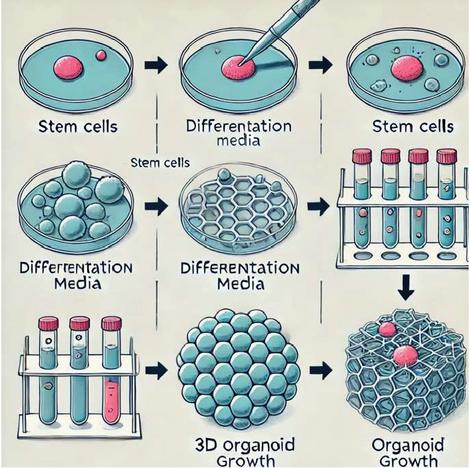
Figure 1 Different pathways in the creation of organoids. The process begins with stem cells, which are cultured in differentiation media to induce the differentiation of specific cell types The differentiated cells can be cultured in in 3D conditions to form organoids. The series of steps highlights the transitions from stem cells to differentiated cells that could be applied in space to form organoids. This basic diagram could be relevant to the formation of any type of organoid.
Keywords: Aerospace medicine, cancer, oncology, biomarker, organoid, space, microgravity.
Space Science History
The International Space Station (ISS) was built in space, analogous to a LEGO set with 16 pressurized modules. The ISS is powered by eight gigantic solar arrays that generate 735,000 kW-hours of electrical power per year, covering an area of 2247 m (24,187 ft). There are consistently seven astronauts and cosmonauts habiting the station [1]. The modules were taken into space aboard NASA’s Space Shuttle program covering 36 flights for several missions spanning over 10 years [1].
A staple of being an astronaut on the ISS is performing space walks, formally known as extra-vehicular activity (EVA). This type of activity has been conducted on Earth orbit (ISS), the moon’s surface (Apollo Missions), and in deep space between the Earth and Moon. The primary focus of the ISS is to promote international cooperation and to expand research and understanding of life in microgravity [1].
Prior to establishing the ISS, there were early concepts of space stations. In the 1960s and 1970s, both the United States and the Soviet Union had competing space station programs. The Soviets launched Salyut (1971–1986) and Mir (1986–2001), while the US developed Skylab (1973–1974) [2, 3]. However, the idea of a permanent space station gained traction. The goal was to conduct long-term scientific experiments in microgravity, but international cooperation was limited.
In 1984, the US president announced plans for Space Station Freedom, a precursor to the ISS, as a purely American effort. However, budget constraints and technical challenges delayed progress. The fall of the Soviet Union created an opportunity for collaboration between former rivals. In 1993, the US and Russia, along with space agencies in Europe, Japan, and Canada, decided to merge their efforts into a single ISS program [1–3]. This marked the beginning of the ISS, with modules and components contributed by different nations. The ISS was designed to serve as a space laboratory for international scientific research, human spaceflight studies, and Earth terrestrial observations. The first component of the ISS, the Russian Zarya module, was launched on 20 November 1998. Over the next decade, various modules from NASA, Russia’s Roscosmos, the European Space Agency (ESA), and Japan’s JAXA were added. The assembly of the station in orbit was one of the most complex engineering tasks ever undertaken.
Early research on the ISS focused on life sciences, studying the effects of long-duration spaceflight on human health. These experiments were essential for understanding how the human body reacts to extended periods of weightlessness, with implications for future missions to Mars and beyond. Experiments in physics, materials science, and biology began in earnest as laboratory modules from different countries came online. The scientific information expanded with collaborative roles of academic research sending samples to the ISS and then to study differences in their respective laboratories on Earth.
Research on the ISS in the 2010s–2020s provided insights into how microgravity affects a broad array in science. This includes fluid dynamics and combustion to the behavior of cells and organisms. The Alpha Magnetic Spectrometer (AMS-02), installed in 2011, has been searching for dark matter and cosmic rays, contributing to our understanding of the Universe [4]. Relative long stays of Mr. Scott Kelly and Mr. Mikhail Kornienko aboard the ISS allowed for the collection of extensive data on the physical and psychological effects caused by extended spaceflight.
The ISS continues to provide valuable data for understanding climate change, natural disasters, and other terrestrial systems through instruments like the Hyperspectral Imager Suite (HISUI) [5]. The ISS is a proving ground for new technologies needed for deep-space missions. This includes closed-loop life support systems, advanced robotics, and new space habitats [2, 6]. The ISS continues to be a symbol of international scientific cooperation, with ongoing contributions from Russia, Japan, Europe, and North America.
Organoids Research
Organoids are miniaturized, three-dimensional structures grown from stem cells in a laboratory that can mimic the architecture and functions of human organs [7, 8]. Organoids permit the study of behaviors that require 3D organization, overcoming a key limitation of 2D surfaces associated with traditional mammalian cell culture techniques. Traditional mammalian cell culture on Earth is further limited by gravity, which forces cells towards the surface of the culture plate or dish, impairing the formation of 3D structures [9]. The current biological models of relevant 3D structures on Earth have limitations such as halting to move towards larger size. As an example, internal cells remote from the fluid environment could be subjected to hypoxia or a lack of nutrients due to a lack of internal vascularization. The research continues among biologists and material scientists to establish 3D models.
The question is whether scientific studies in space can improve organoids. This is important for the broad relevance to health. Organoids can rapidly screen drugs with the benefit of limiting use of animals. Indeed, the literature reported on techniques to establish more biologically relevant 3D structures on Earth. However, it appears that there could be advantages of microgravity with respect to organoids. The evidence indicated that microgravity can facilitate the formation of organoids and scaffold-free 3D tissue formation [10]. The conditions of the space environment offer an opportunity to serve as a platform to establish organoids like human organs. The development of closely mimicked organoids could enhance studies to understand disease progression. Other benefits included screening and drug discovery for neurodegenerative diseases. The latter is impactful since about 50 million Americans each year are affected by neurodegenerative diseases, which are caused by the gradual loss of neural cells towards degeneration. The ISS National Laboratory researchers are investigating the mechanisms behind these and other neurodegenerative diseases.
Organoids can be used to study disease and development and have been used in space to study how microgravity, radiation, and other factors affect the human body. Organoids have been studied in space since 2019 [11]. Models such as the brain, heart, and breast have already been grown on the ISS. To understand microgravity’s impact on the production of stem cells and stem cell-based products such as organoids, researchers from Cedars-Sinai are investigating the reprogramming of skin fibroblasts into induced pluripotent stem cells (iPSCs) capable of producing a variety of tissue cells – heart, brain, and blood – that could be used in regenerative medicine therapies [11]. It is noteworthy that microgravity can cause premature aging and degenerative processes in organoids. We previously reported on a summary of premature aging in microgravity [12].
The ISS is a closed environment, and astronauts must adapt to a new habitat while visiting the ISS. Among several challenges, the astronauts’ skin shows a rash or dermatitis and aging because of alterations in the dermis composition linked to anemia, reduction in oxygen saturation, or dehydration [13]. Consequently, the process of wound healing presents a challenge in space. The ESA supports projects to study these common issues like tissue healing in space and has developed new techniques for promoting and monitoring tissue repair and regeneration. The two main projects “Wound Healing in Space: Problems and Perspectives for tissue regeneration and engineering – WHISPER” and “Wound Healing and Sutures in Unloading conditions – SUTURE IN SPACE” are focused on surgical wounds and tissue repair mechanisms in space flights. The research has demonstrated that microgravity causes a delay in healing and tissue structure alterations, as well as impairment in fibroblast migration in wound repair and that platelet-rich plasma (PRP) could be used to prevent these changes [14, 15].
Cell Biology Biomarkers
In contrast to the emphasis on organoids, there have been very few studies on biomarkers aboard the ISS. A biomarker could be identified as any molecule in blood, body fluids, or tissues that indicates a normal or abnormal process, condition, or disease [16]. It can be used during clinical diagnosis and/or to monitor treatment response. Biomarkers are also referred as molecular markers or signature molecules. For example, studies have reported that astronauts exposed to months of microgravity in the ISS had weakened the inner structure of load-bearing bones that represented at least a decade of normal age-related bone loss, potentially enhancing the onset of osteoporosis [17].
In cancers, biomarker testing can aid in the detection of specific gene or chromosomal changes that might raise an individual’s risk for cancer or other diseases. It helps plan treatments, evaluate treatment effectiveness, make prognoses, and predict if cancer will return or spread.
Several studies have shown the mechanisms by which spaceflight induces changes in cancer cells. Microgravity influences various biological processes such as survival, apoptosis, adhesion, focal adhesion, migration, growth, cytoskeleton arrangement, extracellular matrix, growth factors, and several signaling pathways such as PAM, MAPK, and VEGF [17, 18]. To elucidate the mechanisms behind the effects of microgravity on cancer cells, omics studies in space have evolved as a rapid area of research. The NASA GeneLab allows open sciences for this space research [19, 20]. This study is the first comprehensive space-related omics database and contains transcriptomics, genomics including metagenomics and epigenomics, proteomics, and metabolomics data from space, and g simulation studies performed on Earth [21].
Studies are conducted to develop biosensors that leverage the unique properties of microgravity to improve the detection of cancer biomarkers and microplastics [22]. In space, the absence of gravity allows bubbles in liquids to grow larger and last longer, enhancing the concentration of microscopic substances for analysis, and making it amenable to serve as a potential biomarker. This improved sensitivity could lead to earlier detection of cancers from a single drop of blood and more accurate identification of pollutants like nanoplastics in ocean water. This research also highlights dual-use applications, benefiting both terrestrial and space environments. In the future, these biosensors could assist astronauts in deep-space missions by monitoring health or checking water contamination.
Space travel also impacts cell aging with concomitant disruptions in metabolic pathways. Interestingly, these disruptions are akin to those seen in rare inherited metabolic disorders [23, 24]. Insights gained from space research could advance precision health on Earth and in space by validating improved biomarker-based risk scores and exploring new hypotheses and therapeutic targets. A recent review by Ferraro et al. describes this research in detail [11]. Recent reports have shown that spaceflight induces complex molecular damage, such as oxidative stress and DNA double-strand breaks, which parallels the genetic and epigenetic alterations observed in rare metabolic disorders [23–25]. In addition, it has been discovered that the disruption of metabolic processes in space, such as glutathione depletion and altered betaine metabolism, impacts cell membrane integrity and lipid metabolism, reflecting changes like those seen in these inherited metabolic disorders. Further, microgravity affects the endo-lysosomal system and autophagy, altering gene expression, protein modification, and biochemical markers, which may provide valuable insights into neurodegenerative disorders and cancer. Astonishingly, the investigators highlight research that has shown that spaceflight influences cytoskeletal morphology and function, affecting normal and cancer cell behavior, and contributing to muscle and bone atrophy, revealing potential links between cytoskeletal changes and cancer metastasis [16]. In conclusion, these findings in microgravity offer opportunities for developing new treatments by improving our understanding of mitochondria–lysosome interactions and cytoskeletal dynamics, potentially leading to advances in managing rare metabolic disorders and cancer.
ISS Cancer Research, Drug Discovery and Immunotherapy
In 2016, the White House launched the Moonshot initiative. NASA representatives, scientists, physicians, and researchers collaborated with the US federal government to fund national cancer investigations. Cancer continues to be the second most common cause of death in the US, after heart disease [17]. Cancer patient management requires a multidisciplinary team, mostly due to the paucity of early detection protocols, treatment options, and survival rates.
The ISS National Laboratory is uniquely poised to develop unique research platforms to advance the President’s Cancer Moonshot initiative. This is a bold call to action led by the National Cancer Institute to accelerate efforts to better prevent, diagnose, and treat cancer [26, 27]. The location provides a framework and a sense of urgency to drive research forward and accelerate the pace of discovery. In 2022, the US president set goals for several initiatives that have been launched with a revamp of the Cancer Moonshot program. It should be noted that cancer research on the ISS predates this initiative by decades.
Initially, research aboard the ISS was focused on basic human biology and long-term space habitation. However, the potential of biomedical research became a focus for scientists developing hypotheses with microgravity in a unique environment for studying cell growth, protein structure, and genetic expression. Such studies were not possible to simulate on Earth. Cancer research was relatively slow during the early ISS years. This was probably due to the priorities of other biomedical areas of research. However, the foundation was laid for future investigations by studying how cells behave in microgravity [28–30].
In the early 2010s, cancer cell growth in microgravity became an immense area of investigation. One of the early insights that led to cancer research on the ISS was the observation that cells behave very differently in microgravity. Cancer cells tend to form 3D tumor models (spheroids) in space, mimicking their growth pattern in the human body, as described previously. On Earth, cells tend to adhere onto 2D culture plates, which does not replicate these cells’ natural growth environment. In the weightlessness of space, cells grow into a more natural, 3D structure, making the ISS an ideal environment to study cancer biology. These 3D models provide scientists with a better understanding of tumor growth and response to treatments, offering more realistic results as compared to Earth-based models.
In the mid-2010s, protein crystallization studies occurred in space flight. Some of the first significant cancer-related studies involved the crystallization of proteins involved in cancer. On Earth, proteins do not always form high-quality crystals, which makes studying their structure challenging. In microgravity, however, proteins can form larger, more ordered crystals, allowing researchers to study their structures more effectively [31]. This helps scientists to develop drugs that target specific proteins with greater precision. Studies on proteins like KRAS, which is linked to multiple cancers including pancreatic and lung cancers, were able to grow better-quality crystals in space, showing insights into how these cancer-linked proteins function.
More recently, 3D tumor models have become an area of focus, primarily from the 2010s–2020s. In 2017, the SpaceX CRS-10 resupply mission carried the Protein Crystal Growth experiment to the ISS [28, 32]. The experiment aimed to improve cancer drug development by leveraging microgravity to better understand the structure of proteins tied to cancer. During that time, scientists began to investigate how cancer cells behave in 3D in microgravity. As described previously, in space, cancer cells grow into organ-like structures called organoids, providing an unprecedented model for tumor behavior. These spheroids closely resemble the way tumors grow within the human body, and how the tumors interact with surrounding tissues, offering insights into tumor metastasis.
Since 2020, there have been several advances and groundbreaking research. One of the more advanced research projects on the ISS involves Angiex therapy, which is focused on targeting the blood vessels needed for cancer cells to survive and metastasize [33]. By understanding how blood vessel are formed in microgravity, researchers hope to develop therapies that can cut off the blood supply to tumors to minimize nutrients.
The simple act of placing these human cancer cells in orbit causes biochemical and molecular biological changes, mainly due to exposure to microgravity. Cancer research in space has already demonstrated how cancer cell exposure to microgravity could influence biological processes such as proliferation, apoptosis, cell survival, adhesion, migration, the cytoskeleton, the extracellular matrix, focal adhesion, and growth factors [34].
Advances are not limited to solid tumor therapy [35]. In a series of studies involving acute myeloid leukemia (AML) cells, scientists have sent leukemia samples to the ISS to study their growth pattern in microgravity. They found that microgravity affected gene expression in the leukemia cells, which could lead to the identification of new therapeutic targets and more effective treatments [35].
Other scientists have performed the international cohort of nuclear workers (INWORKS) study. The authors discovered that in addition of the intensity and the type of ionizing radiation, the duration of the deep space missions was a point of concern. They discovered that ongoing exposure to very low doses of ionizing radiations can lead to an increased risk of both chronic myeloid leukemia (CML) and acute myeloid leukemia (AML) [36].
An emerging frontier is framing microgravity as a drug testing platform; one of the most exciting aspects of cancer research on the ISS is its potential for drug testing. Cancer cells in microgravity sometimes behave differently as compared to their terrestrial counterparts in culture, and drug interactions can be studied in ways not possible on Earth. Microgravity offers a unique environment to screen new anti-cancer drugs and test how they interact with cancerous tissues in 3D models. A particular area of interest is chemotherapy resistance [37]. Studying how cancer cells in space resist certain drugs could help scientists find ways to overcome this resistance on Earth, making emerging and existing treatments more effective.
These striking advances also extend to overarching institutional and governmental collaboration with NASA and other Space Agencies pioneering novel relationships between these organizations. NASA has increasingly partnered with other research institutions, including the NCI and private research organizations, to advance cancer research on the ISS. In 2023, the ISS National Lab, in partnership with NASA’s Biological and Physical Sciences Division, launched a new initiative called “Igniting Innovation: Science in Space to Cure Disease on Earth” to support cancer research. This solicitation offered up to $5 million in funding for multi-flight projects using the ISS to advance research and technology [38]. Five innovative projects were selected, showcasing the potential of space-based research to make significant strides in cancer prevention, diagnosis, and treatment. These projects highlight the effectiveness of collaboration in advancing cancer research.
Collaborative research studies take advantage of the ISS’s unique environment to accelerate the discovery of new cancer treatments. The ISS is also hosting experiments led by commercial space ventures and international partners, further expanding cancer research efforts. For example, Space Tango and Nanoracks, both private space research companies, have sent cancer-related experiments to the ISS to explore how space can speed up the drug development process [39].
Cancer research on the ISS is at an early stage with one of the most promising areas, immunotherapy. In this area, the immune system is treated to allow for effective targeting of the immune response against cancer cells. Researchers are studying how immune cells function in microgravity and whether space-based research can uncover new ways of making immunotherapies more effective against cancers. Space-based studies of cancer cells and tumor models are expected to advance personalized medicine. By understanding how tumors respond to different conditions in space, scientists hope to develop more individualized and effective treatments for patients based on their specific cancer biology. To develop new drug delivery systems, scientists are also working on methods to use the insights from ISS experiments to improve drug delivery systems [40, 41]. For instance, space research might lead to the development of nanoparticles or other technologies that can more precisely deliver cancer drugs to tumors, enhancing treatment while minimizing side effects.
Cancer research on the ISS has revolutionized our understanding of how cancer cells grow, how they respond to treatments, and how we can develop new, more effective therapies. The unique environment of space – particularly microgravity – has allowed researchers to explore cancer in ways that are not possible on Earth, pushing the boundaries of both basic science and therapeutic development. With continued investment, space-based cancer research may lead to major breakthroughs in the fight against one of humanity’s deadliest diseases.
Radiation and DNA Damage Biomarkers
NASA’s Office of Biological and Physical Research recently funded a study at Brookhaven National Laboratory to investigate how specific sections of DNA, known as microsatellites, could be used to track radiation damage over time [42]. Microsatellites are repetitive DNA sequences that can mutate in response to various factors, including radiation. The study focused on using microsatellites as indicators to measure personalized radiation exposure and to develop more sensitive biomarkers to detect DNA damage. The authors determined that certain long mononucleotide repeats (LMRs), a type of microsatellite, were particularly effective in detecting radiation-induced mutations [43]. This discovery paved the way for the development of the OncoMate MSI Dx Analysis System, a test approved by the FDA to detect microsatellite instability (MSI) in cancer cells. MSI-high tumors, characterized by numerous changes in microsatellites, can indicate genetic defects, such as those found in Lynch syndrome, which increases the risk of various cancers [44]. The technology is now being used not only in the US but also in Europe and other regions, expanding its diagnostic capabilities and potential applications. The research underscores how NASA’s support of scientific studies can lead to significant advancements in medical diagnostics and treatment.
The Future of Space Exploration and Research in Space
As NASA and the World move towards privatized space companies, the plan is to decommission the International Space Station and transition to private, modernized environments. NASA has selected SpaceX as its deorbiting vehicle to ensure that debris does not hit populated areas [45]. NASA hopes to move forward from the ISS with the Artemis Program [46]. Established in 2017 in Space Policy Directive 1, under the 45th and 47th US president, the program’s mission is to establish a permanent human presence on the Moon, to be the foundation for future missions to Mars. More specifically, the proposal for the Artemis Program called for the creation of the Lunar Gateway (LG), the successor of the International Space Station. The LG will be the first-ever space station to be built above low-Earth-orbit (LEO). The Artemis Program is a multi-year program aimed at landing the first woman and the first person of color on the Moon. This mission will pave the way for future human missions to Mars. The Artemis Program will use a variety of new technologies, including the Space Launch System (SLS) rocket and the Orion spacecraft. The SLS is the most powerful rocket ever built, and it will be capable of sending astronauts to the Moon and beyond. The Artemis Program could lead to the establishment of a permanent human presence on the Moon. This would provide scientists with an opportunity to study the Moon’s environment and resources in greater detail. It could also serve as a stepping stone for future missions to Mars. Private companies such as SpaceX, Blue Origin, Planet, Rocket Lab, Virgin Galactic, Axiom Space, and Sierra Space could be involved in the future to establish commercial space stations to replace ISS. Polaris Dawn, the first private spacewalk mission, performed to better understand spaceflight-associated 36 diverse experiments such as neuro-ocular syndrome (SANS), a condition in which astronauts experience permanent changes, and even damage to their vision [47].
NASA still hopes to hold prominence in low-Earth-orbit through the National Low Earth Orbit Research and Development Strategy [12]. In summary, the evolution of new space missions will increase the opportunities to perform future science experiments to solve Earth’s health issues in space. In conclusion, new technologies, such as artificial gravity generators and nuclear propulsion will allow humans to live in space for extended periods and explore beyond Earth’s boundaries [48]. By using artificial gravity, the detrimental effects of microgravity will be mitigated, and the time in space for important missions can be increased.
References
[1] J.L. Green, Space travel across the decades and beyond: A brief history of NASA’s space programme. J Physics: Conference Series, IOP Publishing, 2024, pp. 012046.
[2] W.D. Compton, C.D. Benson, P. Dickson, Living and Working in Space: A NASA history of Skylab, Courier Corporation. 2011.
[3] L.F. Belew, Skylab, our first space station, Scientific and Technical Information Office. Natl Aeronautics and Space. 1977.
[4] A. Iwasaki, N. Ohgi, J. Tanii, T. Kawashima, H. Inada, Hyperspectral Imager Suite (HISUI)-Japanese hyper-multi spectral radiometer. IEEE Intl Geosci NSD remote sensing symposium, IEEE, 2011, pp. 1025–1028.
[5] G. Rossi, A. Manfrin, M.P. Lutolf, Progress and potential in organoid research. Nature Rev Genetics, 19 (2018) 671–687.
[6] M. Aguilar, G. Alberti, B. Alpat, A. Alvino, G. Ambrosi, K. Andeen, H. Anderhub, L. Arruda, P. Azzarello, A. Bachlechner, First Result from the Alpha Magnetic Spectrometer on the International Space Station: Precision Measurement of the Positron Fraction in Primary Cosmic Rays of 0.5–350 GeV. Physical Rev Lett, 110 (2013) 141102.
[7] D. Dutta, I. Heo, H. Clevers, Disease modeling in stem cell-derived 3D organoid systems, Trends in molecular medicine, 23 (2017) 393–410.
[8] M.A. Giulianotti, L.A. Low, Pharmaceutical research enabled through microgravity: perspectives on the use of the International Space Station US National Laboratory. Pharm Res, 37 (2020) 1–4.
[9] G. Aleshcheva, J. Bauer, R. Hemmersbach, L. Slumstrup, M. Wehland, M. Infanger, D. Grimm, Scaffold-free tissue formation under real and simulated microgravity conditions. Basic & Clin Pharmacol Toxicol, 119 (2016) 26–33.
[10] D. Marotta, L. Ijaz, L. Barbar, M. Nijsure, J. Stein, N. Pirjanian, I. Kruglikov, T. Clements, J. Stoudemire, P. Grisanti, Effects of microgravity on human iPSC-derived neural organoids on the International Space Station. Stem Cells Transl Med, 13 (2024) 1186–1197.
[11] S. Ferraro, A. Dave, C. Cereda, E. Verduci, S. Marcovina, G. Zuccotti, Space research to explore novel biochemical insights on Earth. Clinica Chimica Acta, (2024) 119673.
[12] A. Rangdal, A. Petryna, B. Shadpoor, L.S. Sherman, E. Homsi, A Theory of Gravitational Generation to Mitigate Space-Induced Low Gravity – Relevance to Premature Aging in Space. Intl J Transl Sci, 2024 (2024) 77–96.
[13] E. Pavez Loriè, S. Baatout, A. Choukér, J.-I. Buchheim, B. Baselet, C. Dello Russo, V. Wotring, M. Monici, L. Morbidelli, D. Gagliardi, The future of personalized medicine in space: from observations to countermeasures. Frontiers Bioeng Biotechnol, 9 (2021) 739747.
[14] F. Cialdai, A. Colciago, D. Pantalone, A.M. Rizzo, S. Zava, L. Morbidelli, F. Celotti, D. Bani, M. Monici, Effect of unloading condition on the healing process and effectiveness of platelet rich plasma as a countermeasure: Study on in vivo and in vitro wound healing models. Intl J Mol Sci, 21 (2020) 407.
[15] F. Cialdai, L. Vignali, L. Morbidelli, A. Colciago, F. Celotti, A. Santi, A. Caselli, P. Cirri, M. Monici, Modeled microgravity affects fibroblast functions related to wound healing. Microgravity Sci Technol, 29 (2017) 121–132.
[16] K. Strimbu, J.A. Tavel, What are biomarkers? Curr Opinion in HIV and AIDS, 5 (2010) 463–466.
[17] C.A. Garcia, P. Suárez-Meade, M. Brooks, A.G. Bhargav, M.L. Freeman, L.M. Harvey, J. Quinn, A. Quiñones-Hinojosa, Behavior of glioblastoma brain tumor stem cells following a suborbital rocket flight: Reaching the “edge” of outer space. Microgravity, 9 (2023) 92.
[18] N. Monti, M.G. Masiello, S. Proietti, A. Catizone, G. Ricci, A.H. Harrath, S.H. Alwasel, A. Cucina, M. Bizzarri, Survival pathways are differently affected by microgravity in normal and cancerous breast cells. Intl J Mol Sci, 22 (2021) 862.
[19] X. Ma, J. Pietsch, M. Wehland, H. Schulz, K. Saar, N. Hübner, J. Bauer, M. Braun, A. Schwarzwälder, J. Segerer, Differential gene expression profile and altered cytokine secretion of thyroid cancer cells in space. FASEB J, 28 (2014) 813-835.
[20] D.C. Berrios, J. Galazka, K. Grigorev, S. Gebre, S.V. Costes, NASA GeneLab: interfaces for the exploration of space omics data. Nucleic Acids Res, 49 (2021) D1515–D1522.
[21] T.J. Corydon, H. Schulz, P. Richter, S.M. Strauch, M. Böhmer, D.A. Ricciardi, M. Wehland, M. Krüger, G.S. Erzinger, M. Lebert, Current knowledge about the impact of microgravity on gene regulation. Cells, 12 (2023) 1043.
[22] M.S. Soares, R. Singh, S. Kumar, R. Jha, J. Nedoma, R. Martinek, C. Marques, The role of smart optical biosensors and devices on predictive analytics for the future of aquaculture systems. Optics & Laser Technol, 177 (2024) 111049.
[23] M.J. Pecaut, X.W. Mao, D.L. Bellinger, K.R. Jonscher, L.S. Stodieck, V.L. Ferguson, T.A. Bateman, R.P. Mohney, D.S. Gridley, Is spaceflight-induced immune dysfunction linked to systemic changes in metabolism? PLoS One, 12 (2017) e0174174.
[24] J. Kim, J.-H. Cheong, Role of mitochondria-cytoskeleton interactions in the regulation of mitochondrial structure and function in cancer stem cells. Cells, 9 (2020) 1691.
[25] E. Harris, Cancer moonshot plan announced. J Am Med Assoc, 329 (2023) 1443–1443.
[26] E. Rehnberg, K. Quaghebeur, B. Baselet, N. Rajan, T. Shazly, L. Moroni, S. Baatout, K. Tabury, Biomarkers for biosensors to monitor space-induced cardiovascular ageing. Frontiers in Sensors, 4 (2023) 1015403.
[27] D. Grimm, H. Schulz, M. Krüger, J.L. Cortés-Sánchez, M. Egli, A. Kraus, J. Sahana, T.J. Corydon, R. Hemmersbach, P.M. Wise, The fight against cancer by microgravity: the multicellular spheroid as a metastasis model. Intl J Mol Sci, 23 (2022) 3073.
[28] D. Grimm, M. Wehland, T.J. Corydon, P. Richter, B. Prasad, J. Bauer, M. Egli, S. Kopp, M. Lebert, M. Krüger, The effects of microgravity on differentiation and cell growth in stem cells and cancer stem cells. Stem Cells Transl Med, 9 (2020) 882–894.
[29] M. Braddock, From target identification to drug development in space: using the microgravity assist, Current Drug Discovery Technologies, 17 (2020) 45–56.
[30] A. McPherson, L.J. DeLucas, Microgravity protein crystallization. Microgravity, 1 (2015) 1–20.
[31] M.L. Gaskill, Creating New and Better Drugs with Protein Crystal Growth Experiments.
[32] X. Mo, Y. Zhang, Z. Wang, X. Zhou, Z. Zhang, Y. Fang, Z. Fan, Y. Guo, T. Zhang, Z. Xiong, Satellite-Based On-Orbit Printing of 3D Tumor Models, Advanced Materials, 36 (2024) 2309618.
[33] C. Urbaniak, A.C. Sielaff, K. Frey, J. Allen, N. Singh, C. Jaing, K. Wheeler, K. Venkateswaran, Detection of antimicrobial resistance genes associated with the International Space Station environmental surfaces, Sci reports, 8 (2018) 814.
[34] J. Graf, H. Schulz, M. Wehland, T.J. Corydon, J. Sahana, F. Abdelfattah, S.L. Wuest, M. Egli, M. Krüger, A. Kraus, Omics Studies of Tumor Cells under Microgravity Conditions. Intl J Mol Sci, 25 (2024) 926.
[35] I.N. Muhsen, A.C. Zubair, T. Niederwieser, S.K. Hashmi, Space exploration and cancer: the risks of deeper space adventures. Leukemia, 38 (2024) 1872–1875.
[36] K. Leuraud, D.B. Richardson, E. Cardis, R.D. Daniels, M. Gillies, J.A. O’hagan, G.B. Hamra, R. Haylock, D. Laurier, M. Moissonnier, Ionising radiation and risk of death from leukaemia and lymphoma in radiation-monitored workers (INWORKS): an international cohort study. The Lancet Haematol, 2 (2015) e276–e281.
[37] A. Wani, B. Prabhakar, P. Shende, Strategic aspects of space medicine: A journey from conventional to futuristic requisites. Space: Science & Technol, 4 (2024) 0123.
[38] S. Maheshguru, J. Kethar, P. Rajagopal Appavu, Is Personalizing Space Medicine, Truly the Future of Space Medicine. J Student Res, 13 (2024).
[39] M. Yamada, K. Kihira, M. Iwata, S. Takahashi, K. Inaka, H. Tanaka, I. Yoshizaki, Protein crystallization in space and its contribution to drug development. Handbook of Space Pharmaceuticals, Springer 2022, pp. 887–912.
[40] Q.D. Tran, V. Tran, L.S. Toh, P.M. Williams, N.N. Tran, V. Hessel, Space medicines for space health. ACS Med Chem Lett, 13 (2022) 1231–1247.
[41] T.C. Ezike, U.S. Okpala, U.L. Onoja, C.P. Nwike, E.C. Ezeako, O.J. Okpara, C.C. Okoroafor, S.C. Eze, O.L. Kalu, E.C. Odoh, Advances in drug delivery systems, challenges and future directions, Heliyon, 9 (2023).
[42] J.M. Jaber, J. Ong, E. Waisberg, P. Sarker, N. Zaman, A. Tavakkoli, A.G. Lee, NASA’s Impact on Medical Innovation: Breakthrough Technologies from Space Research. Acta Astronautica, (2024).
[43] A. Beheshti, J.T. McDonald, M. Hada, A. Takahashi, C.E. Mason, M. Mognato, Genomic changes driven by radiation-induced DNA damage and microgravity in human cells. Intl J Mol Sci, 22 (2021) 10507.
[44] H. Yamamoto, K. Imai, Microsatellite instability: an update, Archives of toxicology, 89 (2015) 899–921.
[45] C. Link, Beyond the Moon: Examining NASA’s Communication Around the Artemis II Mission. (2024).
[46] S. Crouse, Factors Predicting Public’s Willingness to Support National Aeronautics and Space Administration’s Artemis Mission. (2024).
[47] L. Gabel, A.-M. Liphardt, P.A. Hulme, M. Heer, S.R. Zwart, J.D. Sibonga, S.M. Smith, S.K. Boyd, Incomplete recovery of bone strength and trabecular microarchitecture at the distal tibia 1 year after return from long duration spaceflight. Sci Reports, 12 (2022) 9446.
[48] A. Rangdal, S. Munoz, L.S. Sherman, S. Mahendrakar, Aerospace Medicine – An Evolving Field to Mitigate and Treat Organ Dysfunction Partly Caused by Premature Aging in Low Microgravity. Intl J Transl Sci, 2024 (2024) 167–176.
International Journal of Translational Science, Vol. 1, 1–16.
doi: 10.13052/ijts2246-8765.2025.001
© 2025 River Publishers