From Promise to Practice A HEALinc Global Summit White Paper
Desirée C. T. Cox
Founder and CEO, HEALinc (USA and Bahamas); Chair, National Longevity and Regenerative Therapies Board (LARTA Board) (Bahamas); Affiliate Member, Graduate Faculty, School of Graduate Studies, Rutgers, The State University of New Jersey
E-mail: dr.desireecox@gmail.com
Received 28 July 2026; Accepted 12 August 2026
Translating Regenerative and Longevity Innovation into a New Global Standard of Care
How can regenerative and longevity innovation be translated into a new global standard of care?
Based on the key keynote sessions, immersive discussion pods, and closing reflections of the HEALinc Global Summit, New York City, May 13, 2026.
Keywords: Regenerative medicine, longevity science, translational medicine, global standard of care, responsible global access, healthspan, risk-adapted regulation, governed learning environments, real-world evidence, evidence portability, whole-person health, patient agency, health equity, HEALinc Global Translation Architecture.
About this White Paper
This paper, developed by HEALinc CEO and Founder Dr. Desirée Cox, translates a day of multidisciplinary discussion at the 2026 HEALinc Global Summit, New York City (NYC) Day Conclave into a coherent systems framework and action agenda. It is not a transcript, clinical guideline, regulatory opinion, or endorsement of every intervention or claim discussed at the Summit.
The source material captures perspectives from scientists, physicians, biotechnology leaders, lawyers, investors, former regulators, patient advocates, educators, architects, and other participants. Sponsors, speakers, and key opinion leaders represented at the HEALinc New York City (NYC) Day Conclave are identified in the Appendices. The proceedings ranged from late-stage clinical development and international regulatory pathways to whole-person health, patient experience, digital monitoring, medical education, and the design of healing environments. The purpose of this paper is to identify the recurring system-level insights, clarify where genuine convergence occurred, and convert those insights into a practical architecture for translation.
Some interventions and outcomes described during the discussions were preliminary, anecdotal, contested, or outside established standards of evidence. They are treated here as signals of emerging questions and unmet needs – not as validated clinical conclusions. Any therapy must be evaluated according to its own evidence, manufacturing quality, ethical acceptability, regulatory status, and risk profile.
Interpretive Stance
The field should neither equate regulatory caution with obstruction nor equate permissive access with progress. The task is to create controlled velocity: faster, more coherent learning and access under stronger evidence, ethics, quality, and accountability.
Executive Summary
Regenerative medicine and longevity science are advancing faster than the systems required to translate them. The limiting factor is no longer discovery alone. It is the absence of an integrated architecture connecting science, regulation, evidence, manufacturing, clinical delivery, payment, professional adoption, patient trust, and global access.
The 2026 HEALinc New York City (NYC) Day Conclave discussions repeatedly returned to one central concern: promising therapies can remain niche, inaccessible, or controversial even after credible scientific progress has been made. Conversely, interventions can reach patients through fragmented or permissive pathways before their safety, quality, or effectiveness are adequately understood. Neither outcome constitutes translation. A new standard of care requires a system capable of moving innovation forward while learning in public, protecting patients, and earning legitimacy.
The NYC Day Conclave discussions revealed six interdependent main themes:
• First, regulatory systems must become more predictable, proportionate, dialogic, and capable of learning.
• Second, the field needs an evidence architecture that combines biological, clinical, functional, patient-reported, and real-world outcomes within shared definitions and auditable data standards.
• Third, emerging jurisdictions can become governed learning environments that connect access, evidence generation, manufacturing, and oversight – provided they compete on governance quality rather than permissiveness.
• Fourth, the clinical paradigm must expand from late-stage disease management toward prevention, regeneration, function, and whole-person health.
• Fifth, translation depends on trust, education, patient agency, and cultural legitimacy, not scientific publication alone.
• Sixth, convenings such as HEALinc can operate as translational infrastructure when they are designed to produce decisions, pilots, working groups, and accountable follow-through.
Four cross-cutting themes shape each of these domains:
• the economics of capital;
• commercialization and reimbursement;
• the opportunities and risks of artificial intelligence and continuous data;
• the practical power of language, semantics, and classification; and
• the need to balance urgency with firm ethical, scientific, and quality guardrails.
Core Proposition
A global standard of care will not emerge from a single breakthrough, approval, or jurisdiction. It will emerge from a connected learning system that can evaluate innovation proportionately, generate trustworthy and portable evidence, deliver care through capable ecosystems, and convert demonstrated value into routine, affordable practice.
The Proposed Response
This white paper proposes the HEALinc Global Translation Architecture: six substantive domains, four cross-cutting enablers, and a seven-stage pathway from readiness to continuous learning. The architecture is intended to support multiple technologies and jurisdictions without assuming that every intervention should follow the same route. Its objective is interoperability – not regulatory uniformity – and disciplined acceleration – not deregulation.
| Priority | Purpose | |
| 1 | Create a Global Translation Council | A standing multi-stakeholder body to coordinate definitions, pilots, regulatory dialogue, evidence standards, and public reporting. |
| 2 | Adopt a shared glossary and core outcome framework | Define longevity, healthspan, regeneration, function, and evidence maturity; align biological, clinical, functional, and patient-reported outcomes. |
| 3 | Build risk-adapted staged pathways | Match evidence and oversight requirements to product risk, uncertainty, reversibility, and clinical need; allow conditional access only with explicit milestones and stop rules. |
| 4 | Accredit governed learning environments | Establish criteria for jurisdictions that integrate regulation, ethics, manufacturing, clinical care, registries, follow-up, and local capacity building. |
| 5 | Create an interoperable global evidence infrastructure | Use common data models, auditable source data, patient consent, long-term registries, and pathways for responsible cross-border evidence reliance. |
| 6 | Treat manufacturing as part of the evidence | Require identity, purity, potency, comparability, chain of custody, and scalable production to be designed alongside clinical development. |
| 7 | Design whole-person care pathways | Integrate prevention, rehabilitation, mental health, lifestyle, environment, and long-term monitoring with advanced therapeutics. |
| Priority | Purpose | |
| 8 | Establish a patient and public trust compact | Disclose evidence stage, regulatory status, risks, uncertainties, conflicts, costs, and follow-up obligations; combine patient narratives with disciplined evidence. |
| 9 | Align finance and reimbursement with demonstrated value | Use blended finance, milestone funding, outcomes-based payment, pooled infrastructure, and access funds to reduce the gap between innovation and affordability. |
| 10 | Build responsible AI and data governance into the system | Use AI for interpretation, monitoring, and learning under privacy, fairness, security, transparency, and clinician-accountability standards. |
| 11 | Convert convenings into implementation laboratories | Organize problem-focused working groups with defined deliverables, owners, timelines, budgets, and public progress reporting. |
| 12 | Measure translation, not activity | Track time to clarity, evidence quality, safety, function, access, affordability, workforce readiness, adoption, and long-term value – not simply approvals or conference participation. |
1 The Translation Challenge
A therapy does not become a standard of care because it is scientifically interesting, because a patient is willing to travel for it, or because a regulator authorizes its use. Standard of care is a compound institutional achievement. It emerges when evidence, clinical judgment, professional guidance, manufacturing reliability, reimbursement, workforce capability, patient acceptance, and long-term monitoring become sufficiently aligned that an intervention can be delivered consistently and responsibly.
The HEALinc NYC Conclave discussions exposed the gap between invention and institutionalization. Sponsors described uncertain and changing regulatory expectations of mature regulatory bodies such as the U. S. Food and Drug Administration (FDA), European Medicines Agency (EMA) and others, unresolved inspection status, high trial costs, and difficulty using foreign data. Clinicians and patients described limited access, professional risk, and confusion about what is credible. Participants from emerging jurisdictions described the opportunity to move faster, but also the need for clear entry pathways, manufacturing capacity, ethical oversight, and external recognition of locally generated evidence. Across these conversations, the problem was not simply a “valley of death” between research and commercialization. It was a fragmented translation system.
Six Failure Points in the Current System
• Scientific fragmentation. Biological mechanisms, clinical indications, functional outcomes, and patient priorities are often studied in separate frameworks.
• Regulatory fragmentation. Products may face different classifications, evidentiary requirements, and access rules across countries – and sometimes across states or regions within one country.
• Evidence fragmentation. Trials, registries, patient-reported outcomes, wearables, and clinical experience frequently sit in non-interoperable systems and cannot be readily audited or reused.
• Delivery fragmentation. Manufacturing, clinical sites, rehabilitation, psychological support, and long-term follow-up may be disconnected from one another.
• Economic fragmentation. The entities that bear development cost, deliver treatment, insure patients, and capture long-term savings are rarely aligned.
• Trust fragmentation. Scientific evidence, patient experience, commercial promotion, and public information often travel through different channels, weakening legitimacy, and increasing susceptibility to both fear and hype.
These failure points produce two opposite but related risks:
• The first is translational paralysis: promising interventions remain delayed, unaffordable, or confined to small populations because no institution can coordinate the path forward.
• The second is premature diffusion: interventions spread through poorly governed markets before evidence, quality systems, or continuity of care are mature. A credible global model must solve both problems simultaneously.
Controlled Velocity
The policy choice is not speed versus safety. The design challenge is to increase the velocity of learning while preserving the integrity of the evidence, the quality of the product, the rights of the patient, and the accountability of every institution involved.
2 Defining a New Global Standard of Care
A “new global standard of care” should not mean that every jurisdiction adopts identical laws, every patient receives the same intervention, or every emerging therapy is normalized. It should mean that countries and institutions share sufficiently coherent principles, evidence standards, and data interfaces to learn from one another, while retaining local authority and clinical judgment.
Characteristics of the New Standard
• Learning rather than static. Evidence continues to accumulate after initial authorization and routine practice is updated when benefits, risks, or value change.
• Preventive and regenerative rather than solely reactive. The system measures function and resilience, identifies risk earlier, and supports repair or restoration where evidence warrants.
• Proportionate rather than one-size-fits-all. Oversight is calibrated to uncertainty, product complexity, reversibility, patient vulnerability, and unmet need.
• Globally interoperable and locally accountable. Evidence can travel across borders, but responsibility for patient safety, ethical conduct, and clinical quality remains clear in each jurisdiction.
• Whole-person and function-centered. Biological outcomes are connected to mobility, cognition, pain, independence, participation, psychological well-being, and quality of life.
• Equitable and economically sustainable. Adoption includes a credible strategy for affordability, reimbursement, supply, and access beyond wealthy early adopters.
• Transparent and trusted. Patients and professionals can see what is known, what is uncertain, who benefits financially, how outcomes are monitored, and how concerns are resolved.
This definition changes the objective of translation. The goal is not to move every innovation into use as quickly as possible. The goal is to identify which innovations merit progression, create the conditions to test them intelligently, expand access in stages when justified, and withdraw or narrow use when evidence does not support continued adoption.
3 Regulatory Architecture for Responsible Innovation
Regulation becomes translational infrastructure when it provides predictable pathways, proportionate scrutiny, meaningful dialogue, and durable decisions – not simply permission or prohibition.
Regulatory architecture was the most persistent theme of the NYC Day. Participants described changing personnel and expectations, difficulty obtaining formal closure after inspections, uncertainty about claims and cross-border recruitment, and the challenge of fitting cell, gene, tissue, exosome, and combination interventions into categories built for earlier generations of medicine. At the same time, experienced regulatory voices stressed the necessity of auditable data, manufacturing control, pre-specified analyses, and stable standards over the life of a development program.
What Innovators Need From Regulators
• Predictability across time. A sponsor should not face a materially different evidentiary bargain midway through a multi-year program without a transparent scientific reason.
• Early, iterative dialogue. Formal submissions cannot capture every contextual detail. Structured scientific advice should allow regulators, clinicians, statisticians, and manufacturers to identify issues before they become irreversible.
• Empathy with institutional discipline. Empathy does not mean lowering standards. It means understanding the therapeutic purpose, patient need, and operational realities well enough to design a workable pathway.
• Risk-adapted requirements. The same evidentiary and toxicology burden should not automatically apply to every autologous procedure, allogeneic product, gene therapy, extracellular vesicle product, or combination intervention.
• Procedural closure and escalation. Sponsors need clear inspection outcomes, ombudsman channels, and documented resolution of outstanding issues.
• Cross-border learning. Regulators should be able to examine how other credible systems manage similar risks, without treating international variation as evidence of either superiority or laxity.
A Staged Regulatory Model
A practical model would combine risk classification with staged authorization. Each intervention would be assessed across product complexity, source and manipulation, persistence, reversibility, route of administration, manufacturing variability, target population, seriousness of condition, available alternatives, and uncertainty. The stage of access would then be matched to the maturity of the evidence.
| Stage | Minimum System Expectations |
| Exploratory authorization | Small, closely monitored studies; strong preclinical and manufacturing rationale; no promotional claims. |
| Controlled clinical access | Defined eligibility, independent ethics review, registry participation, standardized outcomes, adverse-event reporting and stop rules. |
| Conditional or time-limited authorization | Broader access when safety and a credible signal of benefit exist, with mandatory confirmatory evidence and scheduled reassessment. |
| Full authorization and adoption | Robust evidence of benefit-risk, scalable manufacturing, clinical guidance, reimbursement strategy, and long-term surveillance. |
| Restriction, modification, or withdrawal | Medicine’s use should be narrowed or stopped when evidence, quality, or real-world performance no longer supports the authorized conditions. |
From Regulatory Competition to Regulatory Reciprocity
The Summit discussions repeatedly contrasted the United States with Japan, South Korea, the Bahamas, Costa Rica, and other jurisdictions. The most useful lesson is not that one model should displace all others. It is that systems can learn from differences in conditional approval, direct engagement, risk tolerance, institutional size, and use of foreign evidence. Regulatory reciprocity should allow one authority to rely, in defined circumstances, on another jurisdiction’s inspections, ethics review, manufacturing evidence, or clinical data. Reliance is not automatic mutual recognition; it is a structured decision to avoid unnecessary duplication when the source system is demonstrably trustworthy.
Policy Priorities
• Create standing cross-jurisdiction scientific-advice forums for selected regenerative and longevity technologies.
• Publish risk-tiering criteria and expected evidence packages for major product classes.
• Provide formal ombudsman and inspection-closure mechanisms with response timelines.
• Allow industry, academia, and patient groups to submit draft guidance for public regulatory consideration.
• Accredit external evidence sources and define when foreign clinical data can support local decisions.
• Require every accelerated or conditional pathway to include milestones, independent monitoring, public reporting, and a credible withdrawal mechanism.
4 Evidence, Measurement, and a Common Scientific Language
The field does not merely need more data. It needs agreement about what counts as meaningful benefit, how evidence should be generated, and how trustworthy data can move across institutions and borders.
The inconsistent use of terms such as longevity, lifespan, healthspan, geroscience, rejuvenation, and peak span is more than semantic. Definitions determine endpoints, claims, trial duration, regulatory classification, and public expectations. A therapy that changes a biomarker for six months is not equivalent to one that restores durable function, reduces disability or extends healthy life. A common language must therefore be linked to a hierarchy of evidence.
A Multi-level Outcome Architecture
| Evidence Level | Illustrative Questions |
| 1 Product and target integrity | Identity, purity, potency, dose, delivery, mechanism or target engagement, and manufacturing consistency. |
| 2 Biological effect | Validated biomarkers, cellular or molecular changes, imaging, and tissue-level effects. |
| 3 Organ and system function | Disc structure, ovarian function, vision, mobility, cognition, immune function, or other indication-relevant outcomes. |
| 4 Clinical benefit | Symptoms, complications, healthcare use, survival, or disease progression. |
| 5 Patient-reported and lived outcomes | Pain, energy, sleep, independence, participation, emotional well-being, treatment burden, and quality of life. |
| 6 Durability and long-term safety | Persistence of benefit, delayed adverse effects, repeat-treatment needs, and interaction with aging or comorbidity. |
| 7 Health-system and equity value | Affordability, access, workforce burden, cost offsets, geographic reach, and distribution of benefit. |
No single intervention will require every outcome at the same stage, and no biomarker should be dismissed simply because it is not itself a patient benefit. The principle is linkage: biological evidence should be connected over time to outcomes that matter clinically and personally.
Where longevity claims are involved, short-term surrogate measures should be described as intermediate evidence rather than proof of extended healthy life.
Trial Design for Complex Interventions
Conventional one-product, one-indication trials remain essential in many contexts, but they may be inefficient for platform technologies, multimodal protocols, or interventions expected to affect several related functions. The NYC discussions raised adaptive studies, open-label programs, master protocols, crossover designs, real-world evidence, and structured self-observation. These approaches can add value when they are protocolized, statistically defensible, and independently governed. They should not become a pretext for replacing controls, avoiding adverse-event reporting, or converting commercial treatment into unreviewed experimentation.
• Master and platform protocols. Evaluate related products, doses, or indications within a shared infrastructure and common control where scientifically appropriate.
• Adaptive designs. Permit pre-specified modification based on accumulating evidence without compromising statistical integrity.
• Pragmatic trials. Test interventions in real clinical settings while maintaining clear eligibility, data quality, and comparison groups.
• Prospective registries. Capture standardized long-term safety, function, and patient-reported outcomes across sites and jurisdictions.
• Protocolized N-of-1 studies. Use repeated, structured within-person observations for individualized interventions where population trials are difficult, while avoiding unsupported generalization.
Evidence Portability
Foreign clinical data can accelerate translation only when it is collected to a standard that another regulator, journal, payer, or professional body can interrogate. The Summit discussion emphasized good clinical practice, source-data traceability, audit trails, and inspectable sites. A global evidence system should go further by establishing common data dictionaries, standardized outcome instruments, interoperable consent, secure identifiers, and clear provenance for data generated through clinics, laboratories, wearables, and patient reporting.
Manufacturing is Part of the Clinical Claim
For cellular, genetic, tissue-derived, and extracellular-vesicle products, the treatment is inseparable from how it is sourced, processed, characterized, stored, transported, and administered. A positive outcome with one manufacturing process cannot automatically validate a superficially similar product. Identity, purity, potency, comparability across lots and donors, chain of custody and stability therefore belong inside the evidence architecture – not in a separate technical annex considered only at the end.
Evidence Principle
Patient stories can reveal outcomes that formal measures miss and can make scientific findings intelligible. They are strongest when paired with standardized patient-reported outcomes, clinical records, transparent follow-up, and peerreviewed analysis – not when used as substitutes for evidence.
5 Global Access and Place-Based Translational Ecosystems
The value of an emerging jurisdiction is not its permissiveness. It is its capacity to become a governed learning environment that connects responsible access, rigorous evidence, quality manufacturing, accountable care, and global learning.
The Bahamas and other jurisdictions were discussed as possible settings in which regenerative and longevity innovation could be introduced more responsively than in larger regulatory systems. Participants identified incentives, infrastructure, internal and external access, program clarity, manufacturing, direct engagement, and visible success stories as key conditions. These insights point to a model more demanding than medical tourism and more useful than a regulatory “sandbox” understood merely as exemption from ordinary rules.
The Governed Learning Environment
A governed learning environment is a jurisdiction or network of sites designed to admit selected innovations under explicit standards, generate high-quality evidence, protect patients, and create value for the host society. It must be capable of saying both yes and no – and of changing an earlier decision when new evidence warrants it.
| System Component | Minimum Expectation |
| A single front door | A defined authority or agent who can explain the pathway, coordinate agencies and respond rapidly to sponsors and clinicians. |
| Risk-adapted regulation and ethics | Transparent eligibility criteria, independent review, staged authorization, and enforceable conditions. |
| Accredited clinical sites | Qualified teams, emergency capacity, standardized consent, continuity of care, and adverse-event management. |
| Manufacturing and logistics | GMP-capable facilities or qualified import pathways, chain-of-custody controls and reliable storage and transport. |
| A mandatory evidence system | Prospective registration, common outcomes, auditable data, long-term follow-up, and public reporting. |
| Cross-border patient navigation | Pre-travel screening, legal and ethical recruitment, communication with home clinicians, and plans for complications after return. |
| Local capacity and benefit | Training, employment, infrastructure, research participation, and access for local patients – not merely hosting foreign commercial activity. |
| Affordability and access mechanisms | Transparent pricing, scholarship or assistance programs, payer engagement, and strategies to avoid permanent elite access. |
| External recognition | Formal routes through which evidence and inspections can be assessed by larger markets, journals, and professional bodies. |
Internal and External Access
The discussion usefully distinguished two kinds of access. Internal access is the ability of a sponsor or clinical team to enter a jurisdiction, understand requirements, establish operations, and begin a study or controlled program efficiently. External access is the ability to use the resulting evidence, manufacturing experience, and inspection history in other markets. A jurisdiction that offers internal access without external credibility may generate revenue but little durable scientific value. A system that produces external-grade evidence without enabling timely local operations will struggle to attract innovators. A credible ecosystem needs both.
Global Access Should Reduce, Not Institutionalize, Medical Travel
Cross-border care may be appropriate while expertise and authorization remain concentrated. It should not become the permanent architecture of equity. The long-term objective is to use early learning sites to establish transferable protocols, train additional centers, support local regulation, and bring validated care closer to patients. The measure of success is therefore not the number of people who travel, but the extent to which trustworthy care becomes geographically distributed and affordable.
6 From Sick Care to Prevention, Regeneration, and Whole-Person Health
A new standard of care must ask not only whether disease can be treated, but whether function can be preserved, decline can be detected earlier, regenerative capacity can be supported, and people can live with greater agency and well-being.
The HEALinc NYC Summit Day Conclave discussions placed advanced therapeutics within a broader continuum: injury, illness, repair or reversal, prevention and, more controversially, enhancement. Participants emphasized the widening gap between lifespan and healthspan, the value of mobility and cognition, the early biological changes that precede symptoms, and the possibility that multiple interventions may be required to influence complex aging processes. Fertility discussions highlighted the emotional burden of loss of function and the need for psychological support. Presentations on architecture argued that ventilation, nature, adaptability, and environmental design can shape health. Together, these contributions widened the field from isolated products to an architecture of regenerative living.
A Five-Layer Care Model
| Layer | Role in the Care Pathway |
| 1 Foundational health | Movement, nutrition, sleep, mental health, social connection, environmental quality, and prevention. |
| 2 Early detection and risk stratification | Functional measures, clinical assessment, biomarkers, and carefully governed digital monitoring. |
| 3 Targeted regenerative intervention | Evidence-based cell, gene, tissue, biologic, device, pharmacologic or procedural therapies matched to indication and patient. |
| 4 Recovery and integration | Rehabilitation, psychological support, behavior change, social support, and environments that enable function. |
| 5 Long-term learning | Durability, safety, repeat-treatment need, patient-reported outcomes, and adjustment of the care plan over time. |
Function as the Bridge Between Longevity and Care
Lifespan is slow to measure and difficult to attribute to a single intervention. Functional outcomes create a practical bridge between biological science and daily life. Mobility, cognition, sensory function, pain, independence, fertility-related function, sleep, emotional well-being, and participation can often be measured over clinically meaningful periods. These measures should not replace disease-specific endpoints, but they can reveal whether biological change translates into a life a person can actually live.
Combination Approaches and the Limits of Product-centered Regulation
A recurring idea was that aging and regenerative capacity may require combinations: clearing damaging processes, modifying the tissue environment, restoring resources, introducing or activating cells, and supporting behavior and recovery. Yet regulatory and reimbursement systems are typically organized around one product, one sponsor, and one indication. The appropriate response is not to accept untested “stacks,” but to develop research and governance methods for combination strategies: factorial designs, master protocols, standardized components, interaction monitoring, and clear attribution of risk.
Whole-person Does Not Mean Evidence-free
The Summit included discussions of psychosomatic approaches, plant medicines, and extraordinary clinical claims. Whole-person care should remain open to psychological, cultural, relational, and environmental dimensions of healing. It should also require disciplined claims, transparent uncertainty, appropriate controls, and respect for both indigenous knowledge and modern research ethics. Cultural legitimacy and scientific credibility strengthen one another when neither is used to exempt the other from scrutiny.
7 Trust, Education, Patient Agency, and Cultural Legitimacy
Evidence becomes care only when clinicians, patients, institutions, and communities understand it, trust the process that produced it and can act on it without being misled or abandoned.
Fear and misunderstanding were repeatedly identified as barriers to adoption. Participants described patients who do not know legitimate options exist, professionals who were not trained in regenerative or preventive medicine, policymakers whose understanding is shaped by outdated associations, and commercial actors whose promotional claims damage the credibility of the field. The answer is not marketing alone. It is a trust architecture.
The Trust Architecture
• Evidence integrity. Claims are proportionate to the quality, maturity and relevance of the evidence.
• Product and clinical integrity. Patients can identify who manufactured the intervention, who is qualified to deliver it, what oversight applies and how complications will be handled.
• Relational integrity. Patients can ask questions, understand uncertainty, obtain follow-up, and report concerns without losing access or being dismissed.
• Economic integrity. Pricing, conflicts of interest, referral relationships, and financial incentives are transparent.
• Information integrity. Public communication distinguishes hypothesis, early evidence, conditional access, authorized use, and established standard of care.
Patient Narratives: Powerful and Bounded
The Summit strongly endorsed patient storytelling as a means of making innovation real, influencing public understanding, and attracting regulatory attention. This insight is valid, but patient stories are vulnerable to selection bias, commercial pressure, and overgeneralization. A responsible narrative program should invite patients to describe benefit, non-response, side effects, cost, uncertainty, and follow-up. Where possible, stories should be linked to standardized outcome measures and independently verifiable clinical information. The objective is not to turn patients into advertisements; it is to restore lived experience to the evidence system.
Professional and Public Education
• Create modular curricula for clinicians on regenerative biology, evidence appraisal, risk communication, referral, and long-term monitoring.
• Build policymaker briefings that distinguish product classes, ethical issues, evidence stages, and realistic system options.
• Develop public-facing explainers that disclose what is known, what remains uncertain and how to assess provider credibility.
• Train independent patient navigators or trusted coaches who can interpret options without being compensated solely by treatment sales.
• Include younger generations and community institutions so that prevention, stewardship, and emerging science become part of public culture rather than elite discourse.
A Patient and Public Trust Compact
Every translational medicine program should provide a standardized public summary covering: the intervention and its evidence stage; regulatory status; anticipated benefits and uncertainties; known and plausible risks; alternatives; manufacturing source; clinician qualifications; total cost; follow-up obligations; data use; compensation and conflicts; complaint and redress routes; and what happens if the program closes or the patient returns home. This compact should be written for comprehension, not merely legal sufficiency.
8 HEALinc as Action-Oriented Translational Infrastructure
The HEALinc Summit’s institutional insight was that convening can be designed as infrastructure: a place where evidence, authority, experience, and resources are deliberately assembled to produce decisions and implementation.
How do we continue the conversation? This was the key question raised by the multidisciplinary participants of the HEALinc New York City (NYC) Day Conclave. Participants called for regulators to be brought into the room, longer and deeper breakouts, fellowship-style continuity, working micro-communities, publications, podcasts, stakeholder maps, and follow-up accountability. These requests point to a different model of scientific convening.
From Conference to Translation Laboratory
| Design Feature | Translation Function |
| Define one tractable challenge | For example, a shared outcome set, a cross-border evidence protocol, an inspection-closure mechanism or a patient follow-up model. |
| Assemble the full decision system | Include scientific, clinical, regulatory, ethical, legal, manufacturing, payer, patient, data, and implementation perspectives. |
| Provide a common evidence base | Circulate pre-reads, unresolved questions, constraints, and decision criteria before the meeting. |
| Design, do not merely discuss | Use facilitated sessions to produce a protocol, guidance draft, pilot design, funding plan, or governance instrument. |
| Assign ownership and resources | Name leads, participating institutions, budget needs, timelines, and dependencies. |
| Report progress publicly | Publish what was agreed, what remains contested, what changed, and what evidence was produced. |
Proposed HEALinc Implementation Platforms
• Global Regulatory Dialogue. Structured meetings among regulators, former regulators, innovators and patient representatives focused on a small number of concrete pathway problems.
• Evidence and Outcomes Collaborative. A technical group to develop the glossary, core outcome framework, registry specifications, and evidence-portability standards.
• Governed Learning Environment Network. Jurisdictions and clinical sites that commit to common criteria and share performance data.
• Patient and Public Trust Council. A body responsible for the trust compact, narrative standards, public education, and patient representation.
• Access, Finance, and Reimbursement Forum. Payers, investors, governments, and sponsors designing models that connect early funding to broad access.
• Translational Fellows and Working Groups. Time-bounded, cross-sector teams that work between convenings and report at the next HEALinc meeting and through publication.
HEALinc’s distinctive role is not to become the regulator, trial sponsor, manufacturer, or payer. It is to operate as a neutral architect and broker: identifying system gaps, convening those with the authority to address them, establishing shared language, enabling pilots, and maintaining public accountability for follow-through.
9 Cross-Cutting Enablers
Four issues run through every main theme. Unless they are addressed explicitly, progress in one domain will be neutralized by failure in another.
Economics, Capital, and Commercialization
Participants repeatedly described the high cost of cell and gene therapies, the capital intensity of trials and manufacturing, and the difficulty of creating broad demand while prices remain high. They also recognized that while commercialization can fund scale, it can also conflict with openness, publication and equitable access. Standard of care is ultimately a reimbursement and delivery achievement as much as a scientific one.
• Milestone-based blended finance. Combine public, philanthropic, and private capital, releasing funds as evidence, manufacturing, and access milestones are met.
• Shared infrastructure. Reduce duplicative capital costs through accredited manufacturing, data, regulatory, and clinical platforms available to multiple sponsors.
• Outcomes-based payment. Link part of payment to durability, functional benefit, or avoidance of downstream costs where measurement is reliable.
• Pooled procurement and indication-based pricing. Use coordinated purchasing and transparent value assessment to improve affordability as evidence matures.
• Access funds and cross-subsidy. Reserve capacity for local, lower-income, and underrepresented patients within early access programs.
• Precompetitive standards with protected innovation. Share data dictionaries, assay standards, and safety learnings while preserving legitimate intellectual-property incentives.
Proposals for patient-financed trials require particular caution. Cost recovery may be ethically defensible in limited circumstances, but payment must never purchase a place in scientifically weak research, reduce the sponsor’s duty of care or exclude those unable to pay from the evidence base. Independent review, transparent accounting, compensation for injury, and access safeguards are essential.
AI, Continuous Data, and Digital Infrastructure
The discussions imagined wearables, at-home testing, and AI systems that could interpret longitudinal health data and help individuals understand what is changing before disease becomes visible. These tools could improve patient stratification, adherence, safety detection, and real-world evidence. They could also create pervasive surveillance, amplify bias, concentrate control of health data, and overwhelm patients with poorly validated recommendations.
• Design digital systems around informed consent, data minimization, security, portability, and the right to withdraw.
• Use federated or privacy-preserving analysis where possible so learning can occur without unnecessary centralization of identifiable data.
• Validate algorithms across diverse populations and disclose performance limits, training data constraints, and commercial incentives.
• Maintain clinician accountability for diagnostic and treatment decisions; AI should support judgment, not obscure responsibility.
• Ensure that digital participation is not a prerequisite for access unless necessary and proportionate, and provide alternatives for patients with limited connectivity or digital literacy.
Language, Semantics, and Classification
Terms shape regulation, reimbursement, and trust. The same underlying procedure may be described as a transplant, biologic, minimally manipulated tissue, rejuvenation treatment, enhancement, or wellness intervention, with materially different consequences. A shared glossary should not suppress scientific evolution, but it should reduce strategic ambiguity.
• Define lifespan, healthspan, functional capacity, regeneration, rejuvenation, prevention, enhancement, real-world evidence, and conditional access.
• Require public materials to state evidence maturity and regulatory status in plain language.
• Reserve terms such as “cure,” “reversal,” and “age rejuvenation” for claims supported by appropriate evidence and duration.
• Distinguish product classification from clinical purpose: an autologous source does not by itself establish safety or efficacy, and a novel label does not make a familiar process new.
• Use classification reform to clarify oversight – not to shift interventions into less demanding categories for commercial advantage.
Urgency Balanced by Guardrails
A powerful sense of urgency ran through the Summit. Patients with degenerative conditions, fertility loss, and other unmet needs cannot wait indefinitely for institutional reform. Innovators face finite capital and rapidly changing science. Yet urgency can also be invoked to bypass controls, overstate benefit, or normalize poorly characterized products. The correct response is to shorten avoidable delay while strengthening the safeguards that make speed legitimate.
| Guardrail | Why it Matters |
| Independent ethics and scientific review | No program should rely solely on the treating or selling organization to judge acceptability. |
| Manufacturing and provider qualification | The source, identity, handling, and delivery of the intervention must be verifiable. |
| Prospective registration and standardized outcomes | Every controlled-access patient should contribute to a defined learning system unless a justified exception applies. |
| Transparent consent and claims | Uncertainty, alternatives, costs, and regulatory status must be understandable before treatment. |
| Safety surveillance and stop rules | Serious signals must trigger rapid review, communication, and the ability to pause or terminate use. |
| Long-term follow-up and continuity | Responsibility does not end when the patient leaves the clinic or the country. |
| Conflict-of-interest disclosure and redress | Patients need to know who benefits and how complaints or injury will be addressed. |
10 The HEALinc Global Translation Architecture
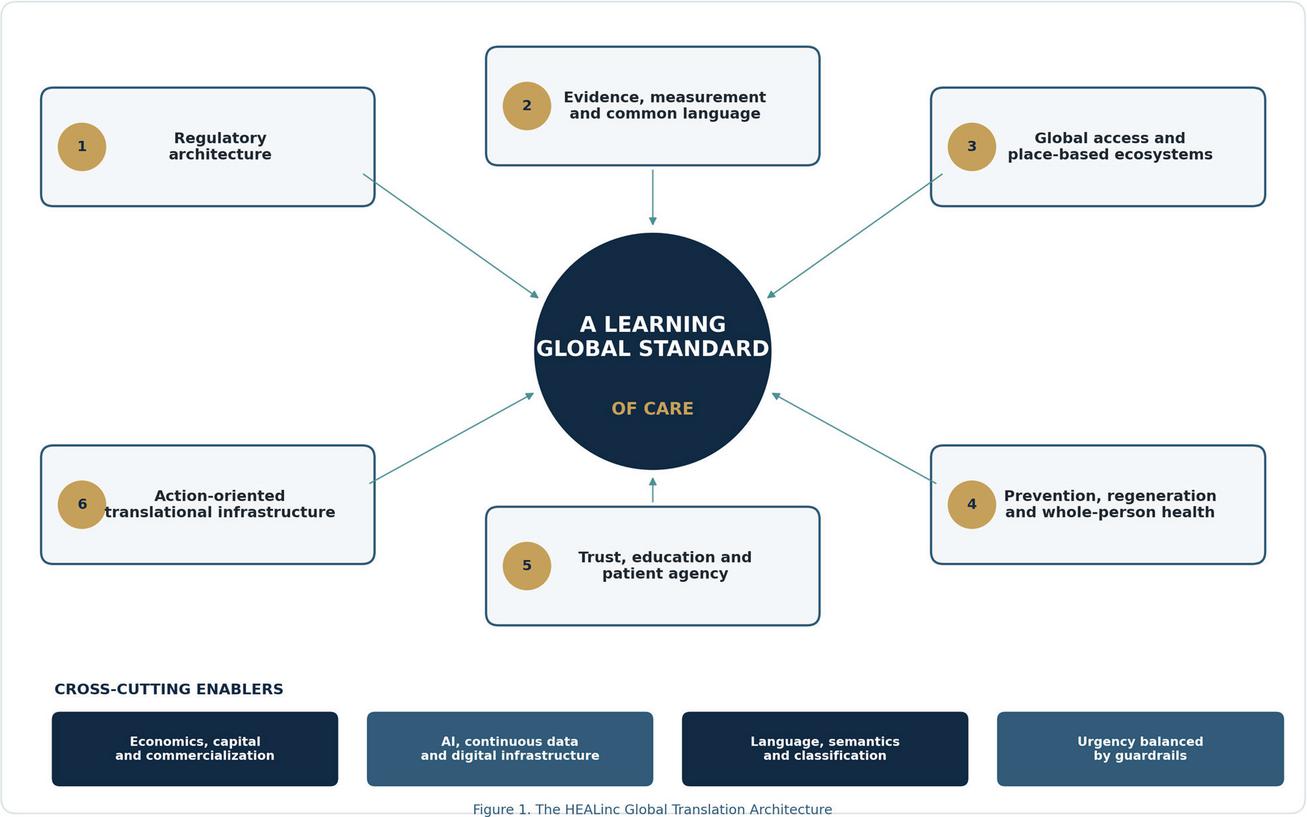
The proposed architecture (see Figure 1) connects the six main themes as one operating system, with the four cross-cutting enablers functioning as design constraints across the whole system.
Figure 1 The HEALinc Global Translation Architecture.
The architecture synthesizes recurring themes across the HEALinc NYC keynote Q&A sessions, immersive discussion pods and closing reflections.
Eight Operating Principles
| Number | Principle | Operational Meaning | |
| 1 | Patient and public benefit | Translation begins with meaningful unmet need and ends with demonstrable improvement in health, function, dignity, or access. | |
| 2 | Proportionality | Requirements match risk and uncertainty; neither low-risk interventions nor high-risk persistent products are forced into inappropriate pathways. | |
| 3 | Evidence continuity | Learning does not stop at authorization. Preclinical, clinical, real-world, and long-term evidence are connected. | |
| 4 | Global interoperability, local accountability | Data and learning can travel; responsibility for ethics, quality, and patient care remains identifiable. | |
| 5 | Equity by design | Access, representation, and affordability are built into pilots before scale, not added after commercialization. | |
| 67 | 6 | Transparency and trust | Evidence stage, uncertainty, incentives, outcomes, and adverse events are communicated honestly. |
| 7 | 7 | Implementation orientation | Every dialogue produces an owner, deliverable, timeline, and decision path. |
| 8 | 8 | Reversibility and correction | Pathways include the ability to pause, narrow, withdraw, or de-implement interventions when learning changes the benefit-risk judgment. |
The Seven-Stage Translation Pathway
The pathway (see Figure 2) creates explicit decision gates. An intervention should not move from exploratory use to broader access merely because demand exists. At each stage, the system asks whether the evidence, manufacturing, ethics, clinical capability, and access conditions are sufficient for the next level of exposure. The same pathway also allows movement backward: a product may require additional development, a narrower population, or suspension when new data change the judgment.
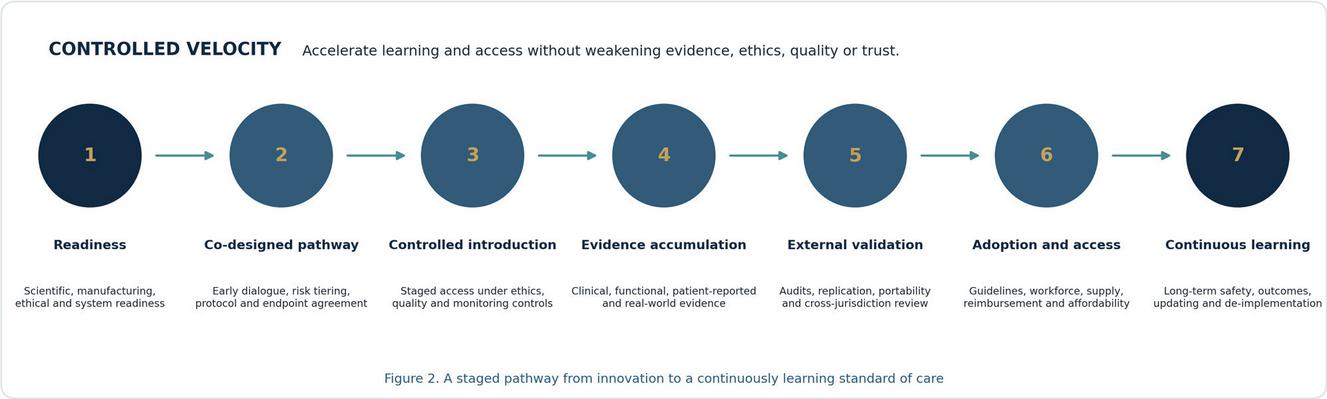
Figure 2 A staged pathway from innovation to a continuously learning standard of care.
Decision Gates
• Gate 1 – Is the intervention ready to enter humans or a new population? Assess product characterization, mechanism, preclinical rationale, manufacturing, protocol, ethics, and site readiness.
• Gate 2 – Is controlled access justified? Require an acceptable safety basis, meaningful unmet need, credible outcomes, informed consent, and monitoring capacity.
• Gate 3 – Is expansion justified? Look for reproducible benefit signals, acceptable risk, reliable manufacturing, and complete data – not demand or testimonials alone.
• Gate 4 – Can evidence travel? Confirm auditability, common definitions, protocol fidelity, population relevance, and regulatory access to source data.
• Gate 5 – Can the intervention become routine care? Require guidelines, workforce competency, supply, reimbursement, affordability, and integration with existing care.
• Gate 6 – Should use continue unchanged? Review long-term safety, durability, equity, real-world effectiveness, and alternatives; update, narrow, or de-implement when needed.
11 Action Agenda: 2026–2030
The architecture should be tested through a limited number of transparent, high-quality pilots – not launched as an abstract global initiative or a broad invitation to unproven treatment.
Phase I: Foundation and design – first 12 months
• Establish the HEALinc Global Translation Council with scientific, regulatory, clinical, manufacturing, ethics, patient, payer, legal, data, and jurisdictional representation.
• Publish version 1.0 of the shared glossary, evidence-maturity labels, and multi-level core outcome framework.
• Map the organizational anatomy of selected regulators: decision points, scientific-advice routes, inspection processes, ombudsman functions, and evidence-reliance mechanisms.
• Develop accreditation criteria and a readiness scorecard for governed learning environments.
• Design the minimum data model, consent framework, registry governance, and cybersecurity requirements for cross-border evidence.
• Select one or two pilot indications with significant unmet need, measurable function, credible product readiness, committed sponsors, and capable clinical sites.
• Adopt the Patient and Public Trust Compact and a standard conflict-of-interest policy.
• Create a finance and access plan before first patient enrollment, including local participation and long-term follow-up funding.
Phase II: Demonstration – months 12 to 36
• Launch governed pilot programs using common protocols, independent oversight, standardized outcomes, and prospective registration.
• Convene joint scientific-advice sessions with participating regulators and publish non-confidential points of alignment and disagreement.
• Qualify manufacturing and logistics networks and conduct external audits before expansion.
• Implement cross-border patient navigation and continuity-of-care protocols.
• Publish interim safety, feasibility, functional, patient-reported, and access findings at pre-defined intervals.
• Engage payers and health technology assessment bodies early to identify evidence required for reimbursement and value assessment.
• Create clinician training and site-certification modules linked to the pilot protocols.
• Run HEALinc Translation Labs every six months to resolve operational barriers and revise the architecture based on evidence.
Phase III: Validation and scale – months 36 to 60
• Complete confirmatory studies or external validation needed for broader authorization.
• Negotiate formal evidence-reliance, inspection-sharing, or data-portability arrangements among participating jurisdictions.
• Publish clinical practice guidance that defines eligible patients, required competencies, follow-up, and conditions for discontinuation.
• Introduce reimbursement or outcomes-based access agreements where value has been demonstrated.
• Expand to additional sites only after quality, data completeness, and continuity-of-care thresholds are met.
• Establish a permanent international registry and annual public scorecard.
• Use learning from successful and unsuccessful pilots to refine policy, close ineffective programs and select the next indications.
| Timeline | Primary Objective | Illustrative Deliverables |
| First 12 months | Foundation | Council; glossary; outcome set; regulator map; jurisdiction criteria; data model; pilot selection; trust and finance plans. |
| 12–24 months | Controlled introduction | Site and manufacturing qualification; first patients; common registry; public safety and feasibility reporting. |
| 24–36 months | Evidence development | Protocol adaptation where pre-specified; external audit; payer engagement; workforce training; interim comparative analysis. |
| 36–48 months | Validation | Confirmatory evidence; cross-jurisdiction review; guidance development; access and reimbursement decisions. |
| 48–60 months | Responsible scale | Additional sites and populations; formal reliance agreements; annual scorecard; continuous learning and de-implementation. |
12 Governance and Safeguards
Trustworthy acceleration requires governance that is independent enough to challenge sponsors and jurisdictions, close enough to operations to act quickly, and transparent enough to earn public confidence.
Proposed Governance Structure
• Global Translation Council. Sets strategy, selects pilots, coordinates jurisdictions and publishes the annual translation report.
• Independent Scientific and Ethics Board. Reviews protocols, benefit-risk, evidence milestones, safety signals, and decisions to expand, pause or stop.
• Patient and Community Council. Co-designs consent, outcomes, communication, access rules, and complaint mechanisms; includes local and cross-border patient perspectives.
• Data Governance Board. Oversees consent, access, privacy, security, interoperability, publication, algorithmic use, and commercial data rights.
• Quality and Manufacturing Committee. Defines qualification and audit standards for products, facilities, logistics, and clinical administration.
• Access and Value Committee. Evaluates pricing, reimbursement, local benefit, financial assistance, and distributional equity.
• Independent Secretariat. Maintains records, conflicts disclosures, milestones, meeting outputs, and public reporting.
Non-negotiable Safeguards
• Independent review and monitoring separated from commercial sales authority.
• Prospective public registration of protocols and material amendments.
• Pre-defined evidence milestones, expansion criteria, and stop rules.
• Full disclosure of conflicts, ownership, referral payments, and financial relationships.
• Validated manufacturing and chain-of-custody controls appropriate to the product.
• Comprehensible consent, including uncertainty, alternatives, cost, and post-treatment obligations.
• Adverse-event reporting, emergency response, and long-term follow-up across borders.
• Protection against misleading promotion, and pre-approval commercialization.
• Fair participant selection and a plan for access by local and underrepresented populations.
• Patient data rights, cybersecurity, privacy, and transparent secondary use.
• Compensation and redress mechanisms for research-related injury or program failure.
• Public reporting of negative, null, and safety findings as well as success.
How to Handle Contested Proposals From the Discussions
| Contested Proposition | Governed Alternative |
| “Guerrilla” or citizen-science trials | Translate the underlying demand for agility into protocolized registries, -of-1 studies, pragmatic trials or adaptive designs under independent ethics and data-quality oversight. |
| Self-experimentation by founders or clinicians | Treat as a conflict-rich form of human research requiring external review, medical supervision, adverse-event reporting, and no presumption of generalizable evidence. |
| Patient-financed studies | Permit only under transparent cost recovery, scientific validity, independent consent, injury protection and inclusion safeguards; payment cannot substitute for sponsor responsibility. |
| Bypassing established regulators | Use staged access, conditional authorization and reliance pathways rather than unaccountable evasion; legal uncertainty should not be transferred to patients. |
| Extraordinary therapeutic claims | Classify as hypotheses until supported by reproducible, appropriately controlled evidence; prohibit promotion that presents anecdote as established fact. |
| AI-enabled pervasive monitoring | Use only with meaningful consent, data minimization, security, independent validation, and options for non-digital participation. |
13 Measuring Progress
The system should be judged by whether it improves translation and patient outcomes – not by the number of meetings held, applications received, or therapies marketed.
| Domain | Illustrative Indicators |
| Regulatory clarity and speed | Time to scientific advice and decision; number of unresolved questions; consistency of expectations; time to inspection closure; proportion of decisions with published rationale. |
| Evidence quality and portability | Protocol registration; data completeness; audit findings; use of common outcomes; follow-up retention; number of external authorities able to assess or rely on the data. |
| Safety and clinical value | Serious adverse events; functional improvement; patient-reported benefit and burden; durability; non-response; discontinuation; comparative outcomes where available. |
| Manufacturing and delivery quality | Lot failures; deviations; chain-of-custody incidents; site competency; product comparability; time from manufacture to administration. |
| Access and equity | Participant diversity; local patient inclusion; geographic reach; waiting time; total patient cost; assistance uptake; proportion of eligible patients excluded for financial reasons. |
| Adoption and workforce readiness | Qualified sites and clinicians; guideline inclusion; referral patterns; payer coverage; time from authorization to routine availability. |
| Trust and transparency | Patient understanding; consent comprehension; public reporting timeliness; complaint resolution; disclosure compliance; public confidence and professional awareness. |
| Economic sustainability | Development cost and time; manufacturing cost trajectory; reimbursement; outcomes-based payment performance; system savings or cost offsets. |
| Learning-system performance | Protocol improvements; speed of safety-signal detection; publication of null results; interventions narrowed or stopped; reuse of infrastructure across programs. |
A public annual scorecard should report these indicators by program and jurisdiction, with appropriate privacy protection. It should also document failures and course corrections. A learning system that never narrows or stops an intervention is unlikely to be learning honestly.
14 Stakeholder Commitments
No single actor can create the new standard. Translation requires a reciprocal compact in which each stakeholder accepts responsibilities beyond its traditional boundary.
| Stakeholder | Core Commitment |
| Regulators and ethics bodies | Provide early dialogue, stable expectations, proportional pathways, clear decisions, cross-border learning, and credible enforcement. |
| Innovators and sponsors | Generate rigorous evidence, invest in manufacturing quality, disclose uncertainty and conflicts, fund long-term follow-up, and plan for access. |
| Clinicians and clinical institutions | Protect patient welfare, deliver only within competence, collect high-quality outcomes, avoid misleading promotion, and ensure continuity of care. |
| Manufacturers and laboratories | Establish identity, purity, potency, comparability, traceability, validated methods, and scalable supply. |
| Academic and research institutions | Provide independent study design, peer review, replication, critical interpretation, and professional education. |
| Patients and patient organizations | Co-design outcomes and consent, contribute lived experience, identify burdens and inequities, and participate in governance without being reduced to testimonials. |
| Payers and health systems | Define evidence needs early, test value-based access models, support prevention, and avoid reimbursement rules that freeze outdated care. |
| Governments and host jurisdictions | Build capable institutions, protect local interests, coordinate agencies, invest in workforce, and ensure public benefit. |
| Investors and philanthropies | Fund evidence and infrastructure, not only market entry; accept milestones tied to quality, access, and long-term value. |
| Media, educators, and digital platforms | Communicate evidence maturity accurately, distinguish reporting from promotion, and make complex science understandable without exaggeration. |
| HEALinc and other conveners | Create neutral working spaces, connect missing actors, preserve institutional memory, publish outputs, and maintain implementation accountability. |
Conclusion
The future of regenerative and longevity medicine will not be determined only by what science discovers. It will be determined by what institutions are capable of learning, governing, financing, delivering, and making accessible.
The HEALinc New York City (NYC) Day Conclave revealed a field alive with scientific possibility and institutional frustration. Participants did not agree on every pathway, intervention, or level of acceptable risk. They did converge on a deeper diagnosis: existing systems are poorly coordinated for technologies that cross traditional boundaries, generate complex evidence, require specialized manufacturing, implicate long-term follow-up, and challenge the distinction between treatment, prevention, and enhancement.
The answer is neither to force every innovation through unchanged twentieth-century structures nor to create zones in which ordinary safeguards disappear. The answer is a new translational architecture: predictable and proportionate regulation; a common evidence language; governed learning environments; whole-person care; public trust and patient agency; and convening designed for implementation. Economics, AI, semantics, and urgency must be treated as system-level design questions rather than afterthoughts.
A global standard of care will be credible only if it is capable of correction. It must learn from success, non-response, harm, cost, and inequity. It must expand access when evidence warrants and withdraw confidence when it does not. It must permit countries to innovate while making their decisions legible to one another. It must treat patients as partners in learning, not merely recipients of novelty or sources of revenue.
The Standard That Matters
Success should be measured not by how many emerging therapies are discussed, marketed, or even authorized, but by how many are translated into safe, effective, durable, trusted, and affordable improvements in human function and flourishing.
HEALinc can help make that standard real by continuing to do what the NYC discussions began: bring together people who normally operate in separate systems, expose the assumptions that keep those systems apart, and convert insight into governed experiments, shared evidence, and accountable action. The next phase is not another conversation about the future of medicine. It is the deliberate construction of the systems through which that future can responsibly become care.
References and Appendices
References: Working Bibliography
A. Translational science, implementation and learning health systems
[1] S. H. Woolf, “The meaning of translational research and why it matters,” JAMA, vol. 299, no. 2, pp. 211–213, 2008, doi: 10.1001/jama.2007.26.
[2] Institute of Medicine, Best Care at Lower Cost: The Path to Continuously Learning Health Care in America. Washington, DC, USA: National Academies Press, 2013, doi: 10.17226/13444.
[3] C. P. Friedman, J. C. Rubin, J. S. Brown, M. B. Buntin, M. Corn, L. M. Etheredge, et al., “Toward a science of learning systems: A research agenda for the high-functioning learning health system,” J. Am. Med. Inform. Assoc., vol. 22, no. 1, pp. 43–50, 2015, doi: 10.1136/amiajnl-2014-002977.
[4] L. J. Damschroder, D. C. Aron, R. E. Keith, S. R. Kirsh, J. A. Alexander, and J. C. Lowery, “Fostering implementation of health services research findings into practice: A consolidated framework for advancing implementation science,” Implement. Sci., vol. 4, p. 50, 2009, doi: 10.1186/1748-5908-4-50.
[5] National Academies of Sciences, Engineering, and Medicine, Crossing the Global Quality Chasm: Improving Health Care Worldwide. Washington, DC, USA: National Academies Press, 2018, doi: 10.17226/25152.
[6] M. E. Kruk, A. D. Gage, C. Arsenault, et al., “High-quality health systems in the Sustainable Development Goals era: Time for a revolution,” Lancet Glob. Health, vol. 6, no. 11, pp. e1196–e1252, 2018, doi: 10.1016/S2214-109X(18)30386-3.
These sources support the paper’s argument that translation is an institutional and systems achievement rather than a linear movement from laboratory discovery to market authorization.
B. Regenerative medicine, longevity, healthspan, and intrinsic capacity
[7] A. S. Mao and D. J. Mooney, “Regenerative medicine: Current therapies and future directions,” Proc. Natl. Acad. Sci. USA, vol. 112, no. 47, pp. 14452–14459, 2015, doi: 10.1073/pnas.1508520112.
[8] World Health Organization, World Report on Ageing and Health. Geneva, Switzerland: World Health Organization, 2015, ISBN 978-92-4-156504-2.
[9] J. R. Beard, A. Officer, I. A. de Carvalho, R. Sadana, A. M. Pot, J. P. Michel, P. Lloyd-Sherlock, J. Epping-Jordan, G. C. E. Peeters, W. R. Mahanani, J. Thiyagarajan, and S. Chatterji, “The World report on ageing and health: A policy framework for healthy ageing,” Lancet, vol. 387, no. 10033, pp. 2145–2154, 2016, doi: 10.1016/S0140-6736(15)00516-4.
[10] World Health Organization, Integrated Care for Older People: Guidelines on Community-Level Interventions to Manage Declines in Intrinsic Capacity. Geneva, Switzerland: World Health Organization, 2017.
[11] World Health Organization, Integrated Care for Older People Implementation Framework: Guidance for Systems and Services. Geneva, Switzerland: World Health Organization, 2019.
[12] World Health Organization, Integrated Care for Older People: Guidance for Person-Centred Assessment and Pathways in Primary Care, 2nd ed. Geneva, Switzerland: World Health Organization, 2025, ISBN 978-92-4-010372-6.
[13] M. Cesari, I. A. Carvalho, J. A. Thiyagarajan, J. M. Cooper, B. Martin, E. E. Araujo de Carvalho, A. Amuthavalli Thiyagarajan, A. Beard, and S. Chatterji, “Evidence for the domains supporting the construct of intrinsic capacity,” J. Gerontol. A Biol. Sci. Med. Sci., vol. 73, no. 12, pp. 1653–1660, 2018, doi: 10.1093/gerona/gly011.
[14] C. López-Otín, M. A. Blasco, L. Partridge, M. Serrano, and G. Kroemer, “The hallmarks of aging,” Cell, vol. 153, no. 6, pp. 1194–1217, 2013, doi: 10.1016/j.cell.2013.05.039.
[15] C. López-Otín, M. A. Blasco, L. Partridge, M. Serrano, and G. Kroemer, “Hallmarks of aging: An expanding universe,” Cell, vol. 186, no. 2, pp. 243–278, 2023, doi: 10.1016/j.cell.2022.11.001.
[16] B. K. Kennedy, S. L. Berger, A. Brunet, J. Campisi, A. M. Cuervo, E. S. Epel, C. Franceschi, G. Lithgow, A. N. Madeo, M. Passarino, K. B. Rando, E. Verdin, P. S. West, and A. J. B. M. Wyss-Coray, “Geroscience: Linking aging to chronic disease,” Cell, vol. 159, no. 4, pp. 709–713, 2014, doi: 10.1016/j.cell.2014.10.039.
[17] L. Ferrucci, M. Gonzalez-Freire, E. Fabbri, B. Simonsick, A. Tanaka, B. Moore, M. Salimi, A. Sierra, A. K. M. M. Barzilai, and J. B. A. C. De Cabo, “Measuring biological aging in humans: A quest,” Aging Cell, vol. 19, no. 2, p. e13080, 2020, doi: 10.1111/acel.13080.
[18] J. N. Justice, L. Ferrucci, A. B. Newman, E. A. A. A. Reuben, S. B. Walston, R. J. Harris, A. B. B. A. Seals, and M. E. K. A. Kuchel, “A framework for selection of blood-based biomarkers for geroscience-guided clinical trials: Report from the TAME Biomarkers Workgroup,” Geroscience, vol. 40, nos. 5–6, pp. 419–436, 2018, doi: 10.1007/s11357-018-0042-y.
[19] E. M. Crimmins, “Lifespan and healthspan: Past, present, and promise,” Gerontologist, vol. 55, no. 6, pp. 901–911, 2015, doi: 10.1093/geront/gnv130.
These references are particularly relevant to Sections 2, 4, and 6 and to the paper’s proposed glossary, outcome framework, and emphasis on function rather than lifespan alone.
C. Research ethics, regulatory architecture, staged access, and regulatory reliance
[20] World Medical Association, WMA Declaration of Helsinki: Ethical Principles for Medical Research Involving Human Participants. Ferney-Voltaire, France: World Medical Association, 2024.
[21] Council for International Organizations of Medical Sciences, International Ethical Guidelines for Health-Related Research Involving Humans, 4th ed. Geneva, Switzerland: CIOMS, 2016, doi: 10.56759/rgxl7405.
[22] World Health Organization, Guidance for Best Practices for Clinical Trials. Geneva, Switzerland: World Health Organization, 2024, ISBN 978-92-4-009771-1.
[23] International Council for Harmonisation of Technical Requirements for Pharmaceuticals for Human Use, ICH E6(R3): Guideline for Good Clinical Practice, final consolidated version, adopted Jun. 16, 2026, 2026.
[24] International Council for Harmonisation of Technical Requirements for Pharmaceuticals for Human Use, ICH E8(R1): General Considerations for Clinical Studies, 2021.
[25] International Council for Harmonisation of Technical Requirements for Pharmaceuticals for Human Use, ICH E9(R1): Addendum on Estimands and Sensitivity Analysis in Clinical Trials, 2019.
References [20–25] provide the principal ethical and methodological guardrails for the paper’s concept of “controlled velocity.”
[26] World Health Organization, Good Regulatory Practices in the Regulation of Medical Products, WHO Technical Report Series, no. 1033, Annex 11. Geneva, Switzerland: World Health Organization, 2021.
[27] World Health Organization, Good Reliance Practices in the Regulation of Medical Products: High-Level Principles and Considerations, WHO Technical Report Series, no. 1033, Annex 10. Geneva, Switzerland: World Health Organization, 2021.
WHO defines regulatory reliance as using or giving substantial weight to work performed by another trusted authority while retaining local responsibility for the decision. This is directly aligned with the White Paper’s distinction between interoperability and regulatory uniformity.
[28] H. G. Eichler, K. Oye, L. G. Baird, R. Abadie, J. Brown, C. Drumond, E. Ferguson, S. Garner, L. M. Honig, M. J. K. Lemery, S. M. Leufkens, and S. M. Ford, “Adaptive licensing: Taking the next step in the evolution of drug approval,” Clin. Pharmacol. Ther., vol. 91, no. 3, pp. 426–437, 2012, doi: 10.1038/clpt.2011.345.
[29] U.S. Food and Drug Administration, Expedited Programs for Regenerative Medicine Therapies for Serious Conditions: Guidance for Industry. Silver Spring, MD, USA: U.S. Food and Drug Administration, 2019.
[30] U.S. Food and Drug Administration, Regulatory Considerations for Human Cells, Tissues, and Cellular and Tissue-Based Products: Minimal Manipulation and Homologous Use: Guidance for Industry and Food and Drug Administration Staff. Silver Spring, MD, USA: U.S. Food and Drug Administration, 2017.
[31] U.S. Food and Drug Administration, Long Term Follow-Up After Administration of Human Gene Therapy Products: Guidance for Industry. Silver Spring, MD, USA: U.S. Food and Drug Administration, 2020.
[32] U.S. Food and Drug Administration, FDA Acceptance of Foreign Clinical Studies Not Conducted Under an IND: Frequently Asked Questions: Guidance for Industry. Silver Spring, MD, USA: U.S. Food and Drug Administration, 2012.
[33] U.S. Food and Drug Administration, Adaptive Designs for Clinical Trials of Drugs and Biologics: Guidance for Industry. Silver Spring, MD, USA: U.S. Food and Drug Administration, 2019.
[34] Ministry of Health, Labour and Welfare, Japan, Guidance for Conditional and Time-Limited Approval for Regenerative Medical Products and the Development of Subsequent Efficacy Evaluation Plan, PSB/MDED Notification No. 0329-3, 2024.
[35] Ministry of Health, Labour and Welfare, Japan, Handling of the Conditional and Time-Limited Approval for Regenerative Medical Products, PSB/MDED Notification No. 1006-1, 2025.
The Japanese documents are especially relevant to the staged regulatory model, post-authorization evidence requirements, mandatory surveillance, and the possibility of withdrawal when efficacy is not confirmed.
[36] European Parliament and Council of the European Union, “Regulation (EC) No. 1394/2007 on advanced therapy medicinal products and amending Directive 2001/83/EC and Regulation (EC) No. 726/2004,” Official Journal of the European Union, vol. L 324, pp. 121–137, 2007.
[37] Commonwealth of The Bahamas, Longevity and Regenerative Therapies Act, 2024, no. 51 of 2024, 2024.
[38] Commonwealth of The Bahamas, Longevity and Regenerative Therapies Act, 2024 (Appointed Day) Notice, 2024, S.I. no. 73 of 2024, 2024.
The Bahamian Act received assent on 26 July 2024 and came into force on 1 September 2024.
D. Evidence architecture, outcomes, real-world evidence, manufacturing, and data portability
[39] J. Woodcock and L. M. LaVange, “Master protocols to study multiple therapies, multiple diseases, or both,” N. Engl. J. Med., vol. 377, no. 1, pp. 62–70, 2017, doi: 10.1056/NEJMra1510062.
[40] R. E. Sherman, S. A. Anderson, G. J. Dal Pan, G. W. Gray, T. Gross, N. L. Hunter, L. LaVange, D. Marinac-Dabic, P. W. Miller, L. K. Robb, J. Shuren, and R. Temple, “Real-world evidence – What is it and what can it tell us?” N. Engl. J. Med., vol. 375, no. 23, pp. 2293-2297, 2016, doi: 10.1056/NEJMsb1609216.
[41] M. Calvert, J. Blazeby, D. G. Altman, D. Revicki, D. Moher, and R. A. Brundage, “Reporting of patient-reported outcomes in randomized trials: The CONSORT PRO extension,” JAMA, vol. 309, no. 8, pp. 814–822, 2013, doi: 10.1001/jama.2013.879.
[42] M. Calvert, D. Kyte, R. Mercieca-Bebber, C. A. Slade, P. Chan, P. King, M. J. H. Clinch, S. E. Arpin, J. A. O’Connor, D. Revicki, D. Moher, J. P. A. Brundage, and SPIRIT-PRO Group, “Guidelines for inclusion of patient-reported outcomes in clinical trial protocols: The SPIRIT-PRO extension,” JAMA, vol. 319, no. 5, pp. 483–494, 2018, doi: 10.1001/jama.2017.21903.
[43] P. R. Williamson, D. G. Altman, H. Bagley, G. Barnes, J. Blazeby, K. Brookes, P. Clarke, J. Gargon, and D. Gorst, “The COMET Handbook: Version 1.0,” Trials, vol. 18, suppl. 3, p. 280, 2017, doi: 10.1186/s13063-017-1978-4.
[44] M. D. Wilkinson, M. Dumontier, I. J. J. Aalbersberg, et al., “The FAIR Guiding Principles for scientific data management and stewardship,” Sci. Data, vol. 3, p. 160018, 2016, doi: 10.1038/sdata.2016.18.
[45] U.S. Food and Drug Administration, Considerations for the Use of Real-World Data and Real-World Evidence to Support Regulatory Decision-Making for Drug and Biological Products: Guidance for Industry. Silver Spring, MD, USA: U.S. Food and Drug Administration, 2023.
[46] International Council for Harmonisation of Technical Requirements for Pharmaceuticals for Human Use, ICH Q5E: Comparability of Biotechnological/Biological Products Subject to Changes in Their Manufacturing Process, 2004.
[47] International Council for Harmonisation of Technical Requirements for Pharmaceuticals for Human Use, ICH Q6B: Specifications – Test Procedures and Acceptance Criteria for Biotechnological/Biological Products, 1999.
[48] U.S. Food and Drug Administration, Potency Tests for Cellular and Gene Therapy Products: Guidance for Industry. Silver Spring, MD, USA: U.S. Food and Drug Administration, 2011.
[49] International Society for Stem Cell Research, Guidelines for Stem Cell Research and Clinical Translation, ver. 1.2. International Society for Stem Cell Research, 2025.
The current ISSCR guidelines emphasize scientific rigor, independent oversight, transparency, responsible communication, and evidence-based clinical translation.
[50] J. A. Welsh, D. C. I. Goberdhan, L. O’Driscoll, et al., “Minimal information for studies of extracellular vesicles – MISEV2023: From basic to advanced approaches,” J. Extracell. Vesicles, vol. 13, no. 2, p. e12404, 2024, doi: 10.1002/jev2.12404.
[51] Z. Master, K. R. W. Matthews, and M. Abou-El-Enein, “Unproven stem cell interventions: A global public health problem requiring global deliberation,” Stem Cell Reports, vol. 16, no. 6, pp. 1435–1445, 2021, doi: 10.1016/j.stemcr.2021.05.004.
These sources collectively support the paper’s seven-level outcome framework, use of patient-reported outcomes, core outcome sets, master protocols, real-world evidence, data interoperability, and the proposition that manufacturing is part of the clinical claim.
E. Global access, medical travel, affordability and reimbursement
[51] R. Johnston, V. A. Crooks, J. Snyder, and P. Kingsbury, “What is known about the effects of medical tourism in destination and departure countries? A scoping review,” Int. J. Equity Health, vol. 9, p. 24, 2010, doi: 10.1186/1475-9276-9-24.
[52] V. A. Crooks, P. Kingsbury, J. Snyder, and R. Johnston, “What is known about the patient’s experience of medical tourism? A scoping review,” BMC Health Serv. Res., vol. 10, p. 266, 2010, doi: 10.1186/1472-6963-10-266.
[53] L. P. Garrison, Jr., A. Towse, A. Briggs, et al., “Performance-based risk-sharing arrangements-Good practices for design, implementation, and evaluation,” Value Health, vol. 16, no. 5, pp. 703–719, 2013, doi: 10.1016/j.jval.2013.04.011.
[54] J. Jørgensen and P. Kefalas, “The use of innovative payment mechanisms for gene therapies in Europe and the USA,” Regen. Med., vol. 16, no. 4, pp. 405–422, 2021, doi: 10.2217/rme-2020-0169.
[55] National Academies of Sciences, Engineering, and Medicine, Making Medicines Affordable: A National Imperative. Washington, DC, USA: National Academies Press, 2018, doi: 10.17226/24946.
These references are especially relevant to the distinction between temporary cross-border access and a durable global-access system, as well as outcomes-based payment, risk-sharing, affordability and continuity of care.
F. Whole-person health, patient agency, trust, and healing environments
[56] G. L. Engel, “The need for a new medical model: A challenge for biomedicine,” Science, vol. 196, no. 4286, pp. 129–136, 1977, doi: 10.1126/science.847460.
[57] World Health Assembly, Framework on Integrated, People-Centred Health Services, document A69/39 and resolution WHA69.24. Geneva, Switzerland: World Health Organization, 2016.
[58] World Health Organization, WHO Guidelines on Physical Activity and Sedentary Behaviour. Geneva, Switzerland: World Health Organization, 2020, ISBN 978-92-4-001512-8.
[59] World Health Organization, WHO Housing and Health Guidelines. Geneva, Switzerland: World Health Organization, 2018, ISBN 978-92-4-155037-6.
[60] R. S. Ulrich, “View through a window may influence recovery from surgery,” Science, vol. 224, no. 4647, pp. 420–421, 1984, doi: 10.1126/science.6143402.
[61] H. Frumkin, G. N. Bratman, S. J. Breslow, et al., “Nature contact and human health: A research agenda,” Environ. Health Perspect., vol. 125, no. 7, p. 075001, 2017, doi: 10.1289/EHP1663.
[62] G. Elwyn, D. Frosch, R. Thomson, et al., “Shared decision making: A model for clinical practice,” J. Gen. Intern. Med., vol. 27, no. 10, pp. 1361–1367, 2012, doi: 10.1007/s11606-012-2077-6.
[63] K. L. Carman, P. Dardess, M. Maurer, et al., “Patient and family engagement: A framework for understanding the elements and developing interventions and policies,” Health Aff., vol. 32, no. 2, pp. 223–231, 2013, doi: 10.1377/hlthaff.2012.1133.
[64] National Academies of Sciences, Engineering, and Medicine, Communicating Science Effectively: A Research Agenda. Washington, DC, USA: National Academies Press, 2017, doi: 10.17226/23674.
These sources support the paper’s five-layer whole-person care model, its focus on function and participation, its patient trust compact, and its recognition that environmental design and public communication affect health and adoption.
G. Artificial intelligence, continuous data and digital governance
[65] World Health Organization, Ethics and Governance of Artificial Intelligence for Health: WHO Guidance. Geneva, Switzerland: World Health Organization, 2021, ISBN 978-92-4-002920-0.
[66] World Health Organization, Regulatory Considerations on Artificial Intelligence for Health. Geneva, Switzerland: World Health Organization, 2023, ISBN 978-92-4-007887-1.
[67] U.S. Food and Drug Administration and European Medicines Agency, Guiding Principles of Good AI Practice in Drug Development, 2026.
The joint FDA-EMA principles emphasize human-centered design, risk-based use, data governance, context of use, performance assessment, and lifecycle management.
[68] X. Liu, S. Cruz Rivera, D. Moher, M. J. Calvert, and A. K. Denniston, “Reporting guidelines for clinical trial reports for interventions involving artificial intelligence: The CONSORT-AI extension,” Nat. Med., vol. 26, pp. 1364–1374, 2020, doi: 10.1038/s41591-020-1034-x.
[69] S. Cruz Rivera, X. Liu, A. W. Chan, A. K. Denniston, and M. J. Calvert, “Guidelines for clinical trial protocols for interventions involving artificial intelligence: The SPIRIT-AI extension,” Nat. Med., vol. 26, pp. 1351–1363, 2020, doi: 10.1038/s41591-020-1037-7.
[70] Z. Obermeyer, B. Powers, C. Vogeli, and S. Mullainathan, “Dissecting racial bias in an algorithm used to manage the health of populations,” Science, vol. 366, no. 6464, pp. 447–453, 2019, doi: 10.1126/science.aax2342.
H. Internal HEALinc source documents
These should be cited in the methodology or source-base appendix as unpublished proceedings, not as independent scientific validation of therapeutic claims.
[71] HEALinc Global Summit, Keynote Q&A Sessions and Discussion Summaries, Day 2, New York City, May 13, 2026, unpublished draft proceedings, 2026.
[72] HEALinc Global Summit, HEALinc NYC Audio 1 Transcript, Day 2, May 13, 2026, unpublished transcript, 2026.
[73] HEALinc Global Summit, HEALinc NYC Audio 2 Transcript, Day 2, May 13, 2026, unpublished transcript, 2026.
[74] HEALinc Global Summit, HEALinc NYC Audio 3 Transcript, Day 2, May 13, 2026, unpublished transcript, 2026.
I. FDA draft references
These may be valuable where the White Paper discusses the direction of current regulatory reform, but they must be labeled draft guidance – not for implementation:
1. U.S. Food and Drug Administration. 2025. Expedited Programs for Regenerative Medicine Therapies for Serious Conditions: Draft Guidance for Industry.
2. U.S. Food and Drug Administration. 2025. Postapproval Methods to Capture Safety and Efficacy Data for Cell and Gene Therapy Products: Draft Guidance for Industry.
3. U.S. Food and Drug Administration. 2025. Innovative Designs for Clinical Trials of Cellular and Gene Therapy Products in Small Populations: Draft Guidance for Industry.
Appendices
Appendix A. Twelve Priority Actions at a Glance
1. Create a Global Translation Council. A standing multi-stakeholder body to coordinate definitions, pilots, regulatory dialogue, evidence standards and public reporting.
2. Adopt a shared glossary and core outcome framework. Define longevity, healthspan, regeneration, function, and evidence maturity; align biological, clinical, functional, and patient-reported outcomes.
3. Build risk-adapted staged pathways. Match evidence and oversight requirements to product risk, uncertainty, reversibility, and clinical need; allow conditional access only with explicit milestones and stop rules.
4. Accredit governed learning environments. Establish criteria for jurisdictions that integrate regulation, ethics, manufacturing, clinical care, registries, follow-up, and local capacity building.
5. Create an interoperable global evidence infrastructure. Use common data models, auditable source data, patient consent, long-term registries, and pathways for responsible cross-border evidence reliance.
6. Treat manufacturing as part of the evidence. Require identity, purity, potency, comparability, chain of custody, and scalable production to be designed alongside clinical development.
7. Design whole-person care pathways. Integrate prevention, rehabilitation, mental health, lifestyle, environment, and long-term monitoring with advanced therapeutics.
8. Establish a patient and public trust compact. Disclose evidence stage, regulatory status, risks, uncertainties, conflicts, costs, and follow-up obligations; combine patient narratives with disciplined evidence.
9. Align finance and reimbursement with demonstrated value. Use blended finance, milestone funding, outcomes-based payment, pooled infrastructure, and access funds to reduce the gap between innovation and affordability.
10. Build responsible AI and data governance into the system. Use AI for interpretation, monitoring, and learning under privacy, fairness, security, transparency, and clinician-accountability standards.
11. Convert convenings into implementation laboratories. Organize problem-focused working groups with defined deliverables, owners, timelines, budgets, and public progress reporting.
12. Measure translation, not activity. Track time to clarity, evidence quality, safety, function, access, affordability, workforce readiness, adoption, and long-term value – not simply approvals or conference participation.
Appendix B. Working Glossary
| Term | Working Definition |
| Conditional access | Time-limited or restricted use permitted before full evidence maturity, subject to mandatory data collection, monitoring, milestones, and reassessment. |
| Controlled velocity | Acceleration of learning and access while maintaining or strengthening evidence, ethics, quality, transparency, and accountability. |
| Evidence portability | The ability of data generated in one institution or jurisdiction to be assessed and potentially relied upon elsewhere because definitions, methods, provenance, and quality are sufficiently interoperable. |
| Governed learning environment | A jurisdiction or network that integrates risk-adapted regulation, ethics, clinical delivery, manufacturing, data, follow-up, and local benefit to test selected innovations responsibly. |
| Healthspan | The period of life lived with meaningful function, independence, and well-being; its measurement requires explicit domains and timeframes. |
| Learning standard of care | Routine care that is continuously updated through structured evidence generation, real-world monitoring, and transparent correction. |
| Longevity intervention | An intervention intended to influence the duration or quality of healthy life; claims may range from risk reduction or functional preservation to effects on aging biology and require different evidence. |
| Regeneration | Restoration, repair, or replacement of cells, tissues, organs, or function; the term should be linked to measurable biological and clinical outcomes. |
| Regulatory reliance | A decision by one authority to use or give substantial weight to work performed by another trusted authority, without surrendering local decision responsibility. |
| Whole-person care | Care that connects biological treatment with function, psychological health, behavior, social context, environment, patient goals, and long-term support. |
Appendix C. Source Base and Method
This White Paper is based on four documents supplied by HEALinc: a consolidated draft of the keynote Q&A sessions and discussion summaries, and three audio transcripts from the HEALinc Global Summit New York City Day held on May 13, 2026. The analysis identified themes that recurred across scientific presentations, group reports, participant exchanges and closing reflections. The six main themes form the substantive architecture of the paper; the four cross-cutting themes are treated as system-wide enablers and constraints.
• HEALinc Global Summit. Keynote Q&A Sessions & Discussion Summaries, Day 2, New York City, May 13, 2026. Draft proceedings document.
• HEALinc Global Summit. HEALinc NYC Audio 1 transcript, Day 2, May 13, 2026.
• HEALinc Global Summit. HEALinc NYC Audio 2 transcript, Day 2, May 13, 2026.
• HEALinc Global Summit. HEALinc NYC Audio 3 transcript, Day 2, May 13, 2026.
The analysis is thematic and interpretive rather than quantitative. Frequency of mention informed theme selection, but the paper also considered the importance of ideas to the central translation question. Statements in the source documents were not independently verified for this version. Future publication should add external scientific, regulatory, and policy references for specific claims and examples.
Appendix D. 2026 HEALinc NYC Day Conclave: Speakers, Sponsors and Key Opinion Leaders Attendees
*Note: To protect participants’ privacy, speakers and sponsors are named in full; all other individuals are identified by first initial and surname only.
| First Name | Last Name | Role | Affiliation |
| L. | Alexander | Sponsor | Qualia Life: Advanced longevity and regenerative medicine. |
| J, | Blouse | Sponsor | Hogan Lovells: Regulatory and law in biotech, life sciences, longevity, and regenerative medicine. |
| Dr. R | Bonilla | Keynote Speaker | Dentist (Costa Rica) |
| S. | Borowicz | Delegate | Non-clinical stakeholder – interest in longevity, functional medicine, and regenerative medicine. |
| B. | Burrows | Event planning | HEALinc |
| L. | Castle Flynn | Delegate | Non-clinical stakeholder – interest in longevity, functional medicine, and regenerative medicine. |
| A. | Cenni | Delegate | Non-clinical stakeholder – interest in longevity, functional medicine, and regenerative medicine. |
| N. | Collie | Graphic designer and artist/curator | HEALinc |
| M. | Costantini | Delegate | Non-medical stakeholder – interest in longevity, functional medicine, and regenerative medicine. |
| Dr. Desirée | Cox | HEALinc CEO | HEALinc |
| M. | Druckman | Keynote Speaker/Sponsor | Hogan Lovells: Regulatory and law in biotech, life sciences, longevity, and regenerative medicine. |
| S. | Dunn | Delegate | Stakeholder – interest in longevity, functional medicine, and regenerative medicine. |
| H. | Fantin | Delegate | Therapist/healthcare provider/ longevity, functional medicine, and regenerative medicine. |
| Kevin | Ferber | Sponsor | American Cell Technology: stem cell banking, research, and biotech company. |
| Flagg | Flanagan | Keynote Speaker/Sponsor | DiscGenics: Regenerative medicine and spinal cell-therapy biotechnology company. |
| E. | Galant | Sponsor | DiscGenics: Regenerative medicine and spinal cell-therapy biotechnology company. |
| N. | Gaskin | Delegate | Social entrepreneur, Founder/CEO of Hemp Thyself, with a background in wellness, health education, and community advocacy. |
| Ashley | Grey | Sponsor | Hogan Lovells: Regulatory and law in biotech, life sciences, longevity, and regenerative medicine. |
| Sally | Gu | Sponsor | Hogan Lovells: Regulatory and law in biotech, life sciences, longevity and regenerative medicine. |
| A. | Gupta | Delegate | Business development stakeholder – Big pharma, clinical stage biotech company (developing gene therapies for retinal diseases and blindness) |
| C. | Jamison | Delegate | Non-medical stakeholder – interest in longevity, functional medicine, and regenerative medicine. |
| A. | Johnson | HEALinc | Therapist, stakeholder with interest in longevity, functional medicine, and regenerative medicine. |
| A. | Karle | Delegate | Non-clinical stakeholder with an interest in longevity, functional medicine, and regenerative medicine. |
| Dr. Gregory | Kelly | Keynote Speaker/Sponsor | Qualia Life – a health and supplement company that makes products like Qualia Mind and Qualia Life |
| M. | Kilburn | Delegate | Performing artist and non-clinical stakeholder; Juilliard-trained violinist. |
| Sanjiv | Lal | Keynote | Regen Therapy: a clinical education, consulting, and digital ecosystem platform focused on regenerative medicine, cellular signaling, and longevity science. |
| T. | Lanni-Bodak | Delegate | Health, wellness and fitness-industry leader with a professional interest in longevity and social wellness |
| Dr. L. | Likver | Delegate | Board-certified physiatrist specializing in regenerative and non-surgical pain management. |
| R. | MacCammon | Delegate | Non-clinical stakeholder with a background in aviation and cybersecurity, bringing a systems, and technology perspective to preventive health and longevity. |
| J. | Mann | Delegate | Longevity and Regenerative Medicine CRO |
| Dr. Peter | Marks | Keynote Speaker/Sponsor | Former head of the FDA’s Center for Biologics Evaluation and Research (CBER), has joined Senior VP of Eli Lilly |
| Dr. Jeff | McNairy | Keynote Speaker/Sponsor | Rythmia. A luxury wellness company featuring an all-inclusive, medically licensed ayahuasca retreat center. |
| Dr. Zaher | Merhi | Keynote Speaker/Sponsor | Rejuvenating Fertility Center. Reconstructive and innovative reproductive care including cellular therapeutics. |
| Dr. Z. | Michelle | Delegate | Clinical neuropsychologist specializing in lifespan and neurological and neurodevelopmental conditions. |
| M. | Mooney | Sponsor | Kimera Labs: biotechnology company specializing in the research and manufacture of placental mesenchymal stem cell–derived exosomes. |
| K. | Musunuri | Delegate | Expert leader at clinical stage oncology and biopharma company |
| V. | Nair | Delegate | Industry experience in business development, medical affairs, drug safety epidemiology. |
| D, | Oved | Delegate | Non-clinical stakeholder, MBA, with a background in business and marketing an interest in longevity, functional medicine, and regenerative medicine. |
| C | Pecchio | Delegate | Architect and entrepreneur, extensive healthcare expertise. |
| E. | Perello | Delegate | Entrepreneur, gene therapy, and regenerative therapy. |
| S. | Peter | Delegate | Non-clinical stakeholder with an interest in longevity, functional medicine, and regenerative medicine. |
| Albert | Ramos | Sponsor | Regen Therapy: a clinical education, consulting, and digital ecosystem platform focused on regenerative medicine, cellular signaling, and longevity science. |
| A. | Rangarajan | Delegate | Non-clinical stakeholder with an interest in longevity, functional medicine, and regenerative medicine. |
| Dr. Duncan | Ross | Keynote Speaker/Sponsor | Kimera Labs: biotechnology company specializing in the research and manufacture of placental mesenchymal stem-cell-derived exosomes. |
| A. | Savchenko | Delegate | Clinical/medical stakeholder with an interest in longevity, functional medicine, and regenerative medicine |
| J. | Schaefer | Business Development/ HEALinc | Non-clinical stakeholder with an interest in longevity, functional medicine, and regenerative medicine. |
| E. | Schaefer | Delegate | Non-clinical stakeholder with an interest in longevity, functional medicine, and regenerative medicine. |
| Michael | Schuster | Keynote Speaker/Sponsor | Mesoblast: global leader in developing allogeneic (off-the-shelf) cellular medicines derived from mesenchymal lineage cells. |
| Dr. S. | Scott | Delegate | Medical/clinical stakeholder with an interest in longevity, functional medicine, and regenerative medicine. |
| M. | Shaner | Delegate | Non-clinical stakeholder, developer, business development, concierge VIP longevity, and regenerative medical care. |
| J. | Shepard | Delegate | Health Coach and therapist. Medical stakeholder with an interest in longevity, functional medicine, and regenerative medicine. |
| K. | Sinema | Delegate | Non-clinical stakeholder, legal expert, experienced in politics and health. |
| Thomas | Smeenk | Keynote Speaker/Sponsor | Hemostemix: a clinical-stage biotechnology company that develops blood-derived stem cell therapies. |
| S. | Smith | Delegate | Non-clinical stakeholder with interest in longevity and regenerative medical care. |
| T. | Wilson | Delegate | Non-clinical stakeholder, investor, with experience interest in longevity and regenerative medical care. |
| D. | Winkler | Delegate | Healthcare Investor relations associate. |
| M, | Shantel | Delegate | Non-clinical stakeholder with interest in longevity and regenerative medical care. |
| D. | Beach | Delegate | Investor. Healthcare, longevity, and regenerative therapies. |
International Journal of Translational Science, 2026, 1–48
doi: 10.13052/ijts2246-8765.2026.001
© 2026 River Publishers