Migration Matters: The Shift from 5G to 6G
Congchi Zhang1, Mingzeng Dai1, 3, Apostolis K. Salkintzis2, Dimitrios Dimopoulos2, Haiming Wang1 and Yin Xu3,*
1Lenovo Research, Beijing, China
2Lenovo Research, Greece
3Shanghai Jiao Tong University, Shanghai, China
E-mail: zhangcc16@lenovo.com; daimz4@lenovo.com; y1026c@lenovo.com; ddimopoulos@lenovo.com; wanghm14@lenovo.com; xuyin@sjtu.edu.cn
*Corresponding Author
Received 02 September 2025; Accepted 17 November 2025
Abstract
As the telecommunications industry gears up for the development of 6G mobile networks, the transition from the current 5G infrastructure requires careful and strategic management. This article examines the evolution from 4G to 5G, drawing valuable analysis on lessons learned and proposes strategies for the forthcoming 5G to 6G migration. We analyse standardized solutions from previous generational shifts, identifying their applicability and limitations in the context of emerging 6G technologies. By emphasizing cost-effective and strategic approaches, we provide insights to interested partners for navigating the complexities of this transition while leveraging emerging advancements for the next era of mobile communications.
Keywords: Migration, 5G, 6G, spectrum sharing, standalone, non-standalone, CN-based multiaccess.
1 Introduction
The commercial deployment of 5G networks began in 2019 and by 2024 numerous 5G networks had been established globally, serving billions of users. The number of 5G connections worldwide surpassed 1.5 billion at the end of 2023, four years after the arrival of the technology, making it the fastest-growing mobile broadband technology to date [1]. As mobile data traffic continues to surge and the demand for improved network performance grows, the telecommunications industry has initiated preliminary research and discussions on the next generation 6G mobile networks. Based on the preliminary timeline outlined by the 3rd Generation Partnership Project (3GPP), the study process for 6G is anticipated to commence by mid-2025, with the first release of the 6G standards expected to be finalized and published before 2030, paving the way for the subsequent commercial deployment [2].
One of the practical challenges faced by network operators during the transition to a new generation of mobile networks involves the gradual deployment of new infrastructure and the migration of user traffic from older networks to the new system. For instance, it might take several years for an operator to deploy sufficient new generation base stations to ensure adequate coverage. Throughout this transitional phase, operators must continue to rely on the existing infrastructure to serve the majority of their subscribers while gradually transitioning them to the new network. Innovative solutions are needed to enable concurrent operation of both generations of mobile networks during this period. Operators need to balance the costs associated with maintaining legacy systems while leveraging the advanced capabilities of the new generation to enhance user experience.
In the subsequent sections of this paper, we will review the strategies employed during the 4G to 5G transition and explore potential solutions that could facilitate the migration from 5G to 6G, considering the unique challenges and opportunities that distinguish this upcoming evolution.
2 Recap: The Migration from 4G to 5G
In this section, we review the challenges and solutions encountered during the 4G to 5G migration and discuss the lessons that can be considered to improve the transition from 5G to 6G.
2.1 Dynamic Spectrum Sharing
Licensed spectrum is a critical asset for operators running mobile networks. Broadly, licensed spectrum comprises two frequency ranges (FRs): FR1, which covers frequencies 410–7125 MHz; and FR2, which encompasses frequencies 24250–52600 MHz (FR2-1) and 52600–71000 MHz (FR2-2) [3].
During the initial deployment of 5G, operators predominantly utilized new spectrum in the FR1 mid-bands and FR2-2 high-bands. Despite the significant bandwidth these bands offer, they have limited coverage. The valuable FR1 low-bands (below 1 GHz), which are essential for widespread coverage, were already in use by established 4G networks. To solve this issue, dynamic spectrum sharing (DSS) was introduced, enabling 4G and 5G networks to share the FR1 low-bands spectrum [4]. This ensures that 5G can achieve adequate coverage. DSS technique also facilitates spectrum refarming in a dynamic way according to the demand. For instance, when an area has more 4G devices than 5G devices, more spectrum is allocated to 4G. Conversely, if there are more 5G devices or a higher demand for 5G services, the spectrum allocation shifts to support 5G.
The main foundation of DSS is to schedule NR users in the LTE subframes while ensuring no respective impact on LTE users in terms of essential channels and signals, such as a physical downlink control channel (PDCCH), synchronization signals, and cell-specific reference signals (CRS). The LTE CRS is typically the main concept where DSS options are designated, as CRS have a fixed time-frequency resource pattern based on cell identity and transmit antenna configuration. There are three standardized solutions for DSS: (1) a multimedia broadcast multicast service single frequency network (MBSFN) based approach that utilizes LTE MBSFN subframes which are typically muted during regular 4G transmissions for 5G transmissions; (2) a mini-slot based approach wherein 5G transmissions are scheduled in mini-slot granularity and only symbols free of LTE CRS are used; and (3) a rate matching based approach wherein 5G users are configured to avoid the specific time-frequency resources that are not available for 5G downlink data reception due to overlapping LTE CRS and PDCCH.
2.2 Deployment Options
Based on operators’ commercial deployment schedule, available spectrum resources, industry chain maturity, and overall network construction cost, operators can choose different network deployment evolution routes. When 3GPP discussed the transition from 4G to 5G, the industry identified eight potential deployment options, as defined in 3GPP TR 38.801 [5], summarized in Table 1, which reflects different combinations of RAN and core network deployment.
Among these options, option 1 signifies the traditional 4G network, whereas option 2 denotes a fully standalone 5G network. Operators may opt for a phased approach to ensure a smooth migration at a manageable cost, utilizing intermediate steps like options 3 to 8. For example, with the introduction of a 5G RAN node, an operator could begin with option 3, incorporating the 5G RAN as a secondary node within a dual connectivity framework, leveraging the existing 4G infrastructure (option 1). Once a 5G core becomes available, the operator can then transition from option 3 to option 7, setting the stage for the final implementation of option 2. Alternatively, if the 5G core is deployed first, an operator might initiate with option 5 and subsequently progress from option 5 to option 2 following the rollout of the 5G RAN.
Table 1 Deployment options discussed in 3GPP for 4G to 5G migration
| Option | RAN | Core |
| Option 1 | 4G RAN | 4G core |
| Option 2 | 5G RAN | 5G core |
| Option 3 | Master 4G RAN Secondary 5G RAN | 4G core |
| Option 4 | Master 5G RAN Secondary 4G RAN | 5G core |
| Option 5 | 4G RAN | 5G core |
| Option 6 | 5G RAN | 4G core |
| Option 7 | Master 4G RAN Secondary 5G RAN | 5G core |
| Option 8 | Master 5G RAN Secondary 4G RAN | 4G core |
2.3 Lessons Learned
The DSS technique and deployment options discussed above are considered very much helpful to operators for 4G to 5G migration. However, practical experience has yielded several important lessons. Firstly, although DSS enables the reuse of the FR1 spectrum originally allocated to 4G for 5G operations, the spectrum efficiency of the 5G network is constrained by the fixed reference signalling overhead, such as the CRS, present in the shared 4G spectrum. This necessitates additional configuration for 5G devices to identify and avoid 4G CRS resources when being scheduled for 5G transmissions and receptions within the same slots, resource blocks (RBs), or resource elements (REs).
Although eight possible deployment options were initially considered for 4G to 5G migration, eventually only options 1, 2, 3, 4, 5, and 7 were standardized in 3GPP. In practice, either option 2 or 3 was adopted by operators for 5G early deployment [6]. Some operators opted directly for option 2, deploying a standalone 5G network. Option 3 which was standardized early, relies on the low frequency coverage of the LTE network, and deploys an NR high frequency hot spot to provide both coverage and high capacity.
3 Shift to 6G: Insights and Directions
In this section, we analyze strategies and options for a smooth migration of the mobile network from 5G to 6G, incorporating lessons learned from the 4G to 5G transition discussed earlier, as well as considering new factors in 6G design. It is also worth noting that the coexistence of 4G and 6G mobile networks is not the focus of this article, as 4G devices are gradually being replaced by 5G devices in real-world deployments.
3.1 5G and 6G Spectrum Sharing
The allocation and management of the radio frequency spectrum for 6G is the first essential topic to be deliberated. As discussed in the earlier section, the current landscape includes FR1 and FR2 which have been utilized by existing 4G and 5G mobile networks. For 6G, the industry is eyeing the mid-band spectrum, specifically the range between 7125 MHz and 24250 MHz, known as FR3, as a potential new frontier for network deployment [7].
However, to fully leverage the advantages of 6G technology, it is imperative to consider the lower frequency bands below 3 GHz, which are essential for providing widespread coverage. These FR1 frequencies are currently occupied by 4G and 5G services, necessitating a strategy to coexist and share these valuable resources with 6G effectively. A mechanism akin to DSS, previously implemented for the coexistence of 4G and 5G, is likely to play a key role in reallocating existing 5G spectrum for 6G use, which is usually named as multi-RAT spectrum sharing (MRSS) [8]. MRSS is important for smooth migration from 5G to 6G since it supports co-existence of a 5G and 6G spectrum with higher performance and greater flexibility than static spectrum sharing, as depicted in Figure 1.
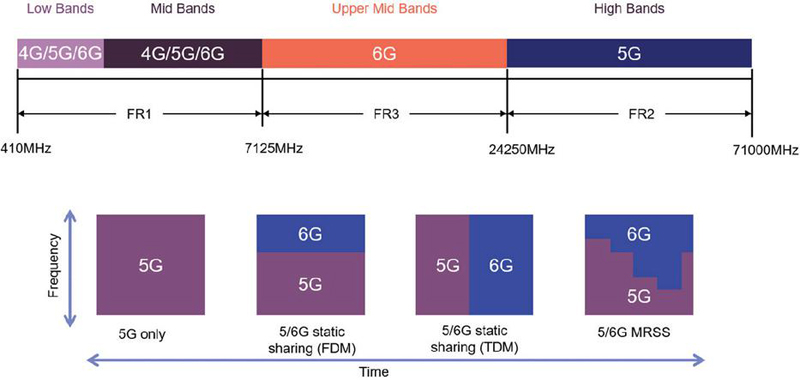
Figure 1 Spectrum sharing between 5G and 6G mobile networks.
5G/6G MRSS will be much easier to deploy than 4G/5G DSS due to the flexible air interface design of 5G. From the beginning of 5G design, almost every 5G signal and channel is configurable and flexible, and there is no always-on signal in the 5G downlink. Specifically, from a time domain point of view, symbol-level resource granularity is supported for time domain resource allocation; from a frequency domain point of view, RB-level resource granularity is supported for frequency domain resource allocation. The base station can quickly and dynamically adjust time-frequency resource between 5G and 6G, based on its scheduling algorithm and traffic variation. The only requirement for either a 5G or 6G terminal is to follow the resource allocation indication via physical layer signaling or high layer signaling from the base station, and this resource allocation procedure can be totally transparent to the user. The inherent flexibility of these 5G reference signals ensures that the overhead issues previously encountered with LTE CRS during 4G to 5G migration are mitigated, leading to more efficient spectrum utilization.
With MRSS based spectrum sharing, a 6G RAN may serve a user by utilizing both a re-farmed 5G carrier and a 6G new carrier leveraging carrier aggregation (CA) technology. For example, a cell of a re-farmed 5G FR1 carrier can be configured as a primary cell providing basic coverage, and one or multiple cells of a 6G FR3 carrier can be configured as secondary cells providing additional capacity. It is also worth noting that only intra-RAT CA is supported.
Although the technical discussion in 3GPP on 6G waveform and numerology started in August 2025, it is highly probable that OFDM-based waveform and numerology will be used as for 5G due to backward compatibility and proven performance. Adopting the same waveform and numerology is especially beneficial and efficient for 5G and 6G spectrum sharing due to the same time-frequency resource structure. In this sense, a base station supporting both 5G and 6G functionalities can schedule orthogonal time-frequency resources for 5G users and 6G users with existing symbol-level and RB-level resource allocation granularity and indicate non-available resources to 5G users or 6G users to prevent them from attempting to receive on resources reserved for any sparse and always-on signals designated for 5G or 6G.
3.2 Standalone or Non-standalone
Once 6G deployment commences, 6G RAN nodes and 6G core components will be introduced incrementally and an operator will face the selection of migration path from 5G to 6G. Similarly, there could be theoretically up to 8 options for deploying 6G components alongside existing 5G components as outlined in Table 1. However, drawing from the experience of the 4G to 5G migration, where only options 2 and 3 in Table 1 were ultimately commercially deployed, we focus on the following two pragmatic migration paths for the transition from 5G to 6G, as illustrated in Figure 2:
• Migration path 1: From SA 5G to SA 6G (6G RAN connected to 6G core).
• Migration path 2: From SA 5G to non-standalone (NSA) 6G (Master 5G RAN and secondary 6G RAN connected to 5G core) and then to SA 6G (6G RAN connected to 6G core).
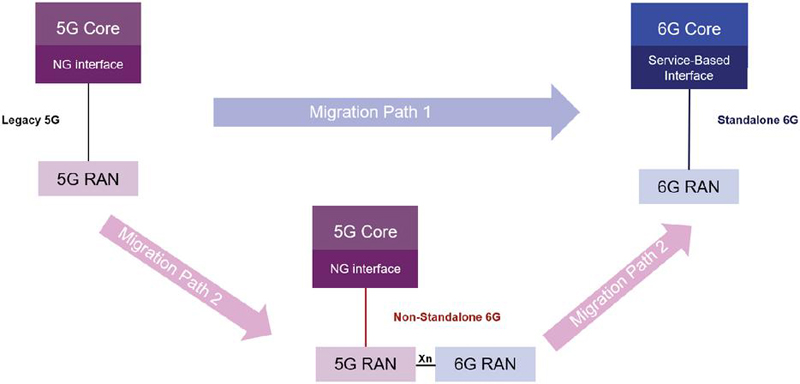
Figure 2 Migration paths from 5G to 6G.
3.2.1 Migration path 1: From SA 5G to SA 6G directly
In this migration path, the 6G system is evolved as a standalone system with the simultaneous rollout of 6G RAN and 6G core in the first release. In the standalone 6G system, besides the utilization of a new 6G spectrum (e.g., FR3) for capacity, coverage bands (e.g., FR1) occupied by 5G are expected to be re-farmed for 6G by spectrum sharing, as discussed previously.
Notably, for the control plane link between the 6G RAN node and 6G core, it is expected to introduce a service-based interface utilizing HTTP, replacing or in addition to the traditional point-to-point NG interface in legacy 5G [9]. Such a service-based interface, already prevalent in 5G core design, is considered good practice for its extensibility to future features and can thus be adopted for the interface between the 6G RAN node and the 6G core as well. The capabilities of the 6G RAN node, such as PDU session management, mobility management, radio resource management, and UE context management, can be organized into distinct services, each with a dedicated uniform resource identifier (URI) address, accessible by concerned core network functions (NFs) (such as AMF, SMF, NWDAF) via HTTP messages. As such, 6G core NFs can communicate directly with the 6G RAN node, bypassing the AMF as an intermediary, unlike in the 5G network. This would significantly simplify cross-domain coordination between the RAN and the core network. For instance, NWDAF introduced in 5G to provide analytics about the overall network performance, e.g., using AI/ML technology, faced limitations in promptly accessing air interface performance metrics due to the absence of a direct interface with the 5G RAN. In contrast, the service-based interface of 6G RAN allows NWDAF to directly subscribe to radio event exposure services. This subscription enables NWDAF to receive timely notifications regarding any degradation in radio performance. Consequently, NWDAF can generate more accurate and timely network performance analytics, potentially triggering adaptive adjustments in network configuration to optimize performance.
Building on the service-based architecture introduced in the 5G core, which inherently allows for future extendibility, the evolution to 6G core can take place into the existing core network framework, while introducing enhancements as illustrated in Figure 3. Possible advantages include:
• The 6G SBI may leverage HTTP/3, offering superior performance over the HTTP/2 protocol used in 5G SBIs, e.g., low latency and security [10].
• The 6G core will introduce dedicated 6G NFs and may also incorporate non-traditional communication NFs, e.g., sensing function and computing function.
• Distributed non-access stratum (NAS) concepts may be introduced in 6G, with terminations at various NFs rather than exclusively at the AMF as in 5G.
Meanwhile, certain services provided by NFs can be invoked by consumer nodes within both the 5G and 6G core. For instance, if positioning methodologies remain consistent between 5G and 6G networks, an evolved location management function (LMF) could provide location services to consumers across both generations, accessible via either 5G core or 6G core SBIs.
The interworking (IWK) between 5G and 6G is essential to be supported in this migration path. Similar to interworking between 4G and 5G, single registration IWK between the 5G core and 6G core is anticipated. For example, in the single registration IWK, UE is initially registered with only one system, either 6G or 5G. When IWK happens, the UE context will be transferred to the other system with PDU session possibly supported by a combo SMF and UPF.
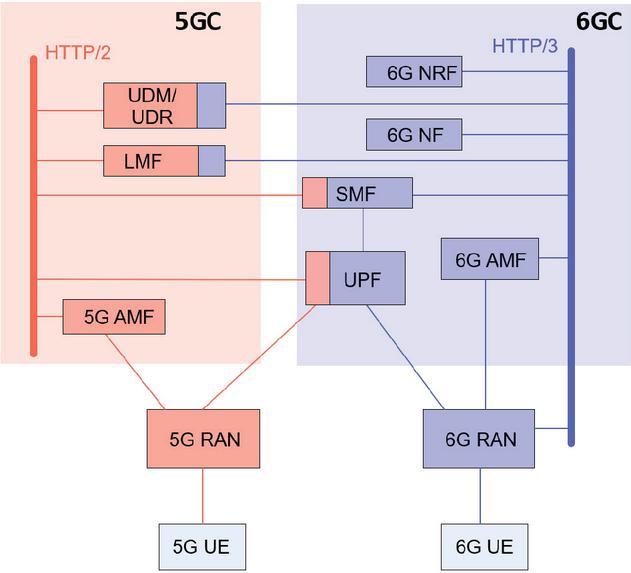
Figure 3 6G core network evolution.
3.2.2 Migration path 2: From SA 5G to NSA 6G and then to SA 6G
In the initial phase of the migration, when the 6G RAN node, using the new 6G spectrum (e.g., FR3) to enhance network capacity, is deployed, the 6G RAN node can be integrated within the existing 5G network as an additional component, the so-called NSA 6G, employing dual connectivity technology.
Specifically, in NSA 6G, a user is served concurrently by a 5G RAN node acting as the master node, providing basic coverage (e.g., via FR1), and a 6G RAN node functioning as a secondary node, offering additional capacity (e.g., via FR3). The Xn interface facilitates tight coordination between the master 5G RAN node and the secondary 6G RAN node, ensuring optimized radio resource allocation and efficient data transmission. For example, if the master 5G RAN node lacks sufficient radio resources to meet the quality of service (QoS) requirements for user data transmission, it can offload the relevant QoS flows to the secondary 6G RAN node, which possesses more abundant resources for capacity. In this dual connectivity framework, the master 5G RAN node manages essential control decisions, including the addition, modification, or release of the secondary 6G RAN node. Necessary control signaling (e.g., non-access stratum messages) is conveyed over the legacy NG interface between the master 5G RAN node and the 5G core. Consequently, while the secondary 6G RAN node does not necessarily require support for the legacy NG interface, it must support the legacy Xn interface to coordinate with the master 5G RAN node.
In the second phase of the migration, as the 6G RAN with coverage frequency and the 6G core are deployed, operators can make a transition from NSA 6G to SA 6G.
When comparing the two migration paths, migration path 2 offers a more gradual approach, enabling operators to incrementally introduce 6G network components. However, this method incurs higher development and maintenance costs due to its complexity. Specifically, in NSA 6G deployments, the 6G RAN must support dual connectivity, leading to extensive signaling exchanges over the Xn interface to coordinate with the 5G RAN serving the same user. Additionally, the 6G RAN under NSA mode must support 5G PDU sessions and QoS flows over the user plane, which are anchored by the 5G UPF in the core.
3.3 Migration using CN-based Multiaccess Connectivity
Another enabler of the transition from 5G to 6G is CN-based multiaccess connectivity, which leverages transmission across 5G and 6G RANs but without the need for direct RAN-level coordination. In this setup, the user plane data transmitted on the two RANs is aggregated at a common anchor UPF in the core network. This approach provides an efficient migration path by allowing both networks to coexist and collaboratively serve users during the transition phase. By integrating 6G advancements while maintaining the robustness of 5G, CN-based multiaccess connectivity ensures that network operators and users benefit from the best of both systems without requiring immediate and complete infrastructure overhaul.
CN-based multiaccess connectivity builds on the principles of the access traffic steering, switching, and splitting (ATSSS) framework [11], which enables simultaneous data transmissions across a 5G RAN and a non-3GPP access network, such as WLAN. A related feature, known as DualSteer, was studied in 3GPP as part of the Release-19 MASSS study item [12], which extends the capability of a 5G network to support data transmission across two 3GPP access networks, providing enhanced traffic steering and mobility. While the MASSS study focused on multi-3GPP access within 5G, the DualSteer feature can also be applied for enabling seamless multiaccess connectivity during the transition to 6G.
The DualSteer feature across 5G and 6G accesses has the potential to unlock a wide array of advantages by enabling simultaneous and dynamic use of both radio access networks. For example:
• DualSteer ensures efficient coexistence, allowing operators to gradually deploy 6G infrastructure while maintaining robust 5G operations. User plane data from 5G and 6G RANs is dynamically aggregated at a common user plane anchor, enabling efficient resource utilization and uninterrupted service.
• By supporting phased deployment, DualSteer mitigates the challenges of network fragmentation. 5G RANs can provide foundational coverage while 6G RANs enhance capacity and performance. This dynamic allocation of traffic between networks ensures optimized user experience during the transition, with high-performance applications leveraging 6G and basic services continuing on 5G.
• DualSteer can also accelerate 6G adoption by enabling inter-PLMN connectivity, allowing users to access 6G services via roaming partners even if their home operator has not yet deployed 6G. This flexibility reduces the risks and costs of transitioning, as operators can incrementally deploy 6G components while maximizing the utility of existing 5G systems.
A simplified architecture for DualSteer across 5G and 6G accesses is illustrated in Figure 4. In this setup, the UE registers to the common core network via both 5G access and 6G access. In addition, the UE establishes separate access connections to a common user plane anchor in the core network, which is selected by the control plane during the connection establishment phase. Based on network policy, the control plane generates traffic steering rules and distributes them to the UE and the user plane anchor. These rules dictate how uplink and downlink traffic should be distributed across the 5G access connection and the 6G access connection and enable dynamic resource utilization and seamless service continuity, which is critical for managing the transition from 5G to 6G.
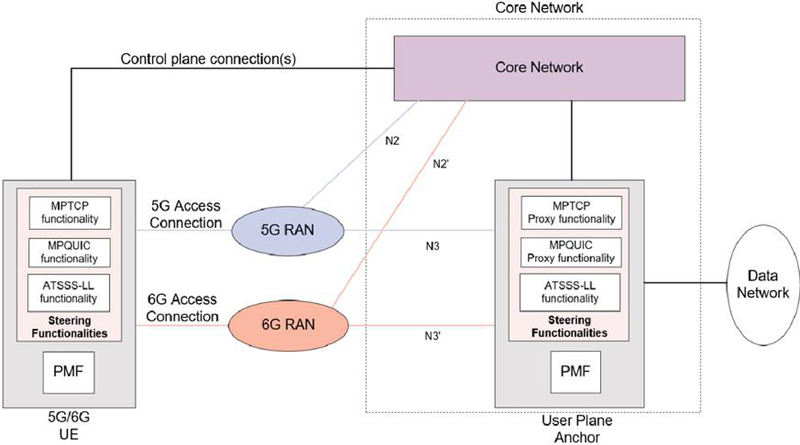
Figure 4 Simplified architecture for supporting DualSteer across 5G and 6G in the same PLMN.
The UE is equipped with multiaccess steering functionalities such as Multipath TCP (MPTCP), Multipath QUIC (MPQUIC), and ATSSS-Low Layer (ATSSS-LL) [12] to enable advanced traffic steering, switching, and splitting capabilities for various types of traffic, e.g., UDP, TCP, IP, Ethernet. These components in the UE collaborate with the corresponding multiaccess proxy functionalities in the user plane anchor to ensure efficient multiaccess connectivity in the uplink and downlink directions across the 5G and 6G access connections based on the corresponding traffic steering rules provided by the control plane.
The role of the performance measurement function (PMF) [13] within both the UE and user plane anchor is to dynamically measure performance metrics on each access (including RTT and packet loss rate) and adjust the traffic routing accordingly. By measuring these metrics, it is feasible to route traffic to the access with the smallest delay or to the access with the smallest packet loss rate.
As shown in Figure 5, each steering functionality can apply different steering modes for different traffic flows, such as the red, purple, and blue traffic flows. For example, the MPTCP steering functionality can apply the so-called active-standby steering mode for the blue flow (e.g., a TCP flow destined to address a.b.c.d), which sends the traffic of this flow over 5G access only and falls back to 6G access when the 5G access becomes unavailable. In another example, the MPTCP steering functionality applies the load-balancing steering mode for the red flow, which splits the red data packets across both 5G and 6G accesses. Several steering modes have been defined in the context of ATSSS work in 3GPP including active-standby, priority-based, smallest-delay, load-balancing and redundant steering. Different steering functionalities and steering modes can be applied by the UE for uplink traffic and by the user plane anchor for downlink traffic. More details on the defined steering modes can be found in TS 23.501, clause 5.32.8 [13].
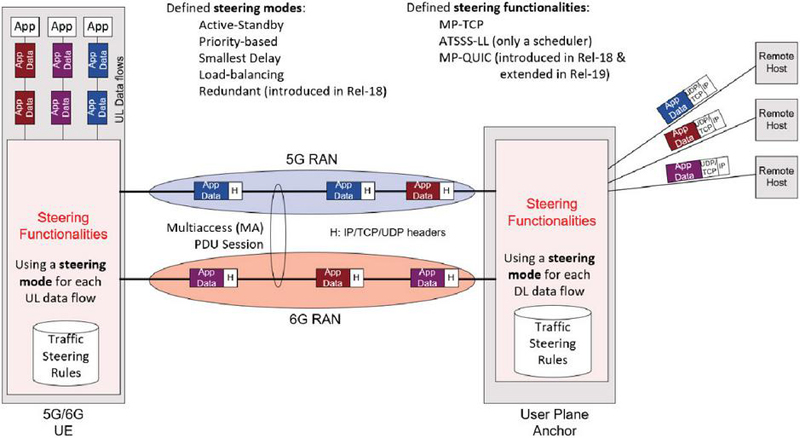
Figure 5 Distributing data traffic across 5G and 6G using different steering modes and steering functionalities.
The load-balancing steering mode can split the packets of a single data flow (e.g., all packets with the same IP 5-tuple) across 5G and 6G accesses. It can do so either by applying fixed split percentages, e.g., 20% on 5G access, 80% on 6G access, or by applying dynamic split percentages, which are autonomously and independently determined by the UE and user plane anchor with an intention of maximizing the throughput of the uplink and downlink data flows, respectively. The latter case is enabled when the network provides (as part of its traffic steering rules) an “autonomous load-balance indicator” for the data flow. If this indicator is not provided, then the fixed split percentages included in the traffic steering rules are applied.
As mentioned before, the distribution of data traffic across 5G access and 6G access can be based on traffic steering rules derived by the control plane of the core network when the UE establishes a multiaccess data connection (aka MA PDU session), which comprises separate access connections over 5G and 6G RANs between the UE and the user plane anchor. The traffic steering rules are generated based on multi-access control policy configured in the core network (e.g., by OAM). To better describe the traffic steering policy, we provide below an example of a traffic steering rule that may be provided to the UE:
’ Rule identity
’ Rule precedence
’ Traffic descriptor
– Application identity: com.example.app1
– Protocol: TCP
’ Access Selection descriptor
– Steering functionality: MPTCP
– Steering mode: Load-balancing
– Steering mode information: 50% over 5G and 50% over 6G
– Threshold values: Max round-trip-time (RTT) = 10 ms.
This traffic steering rule specifies that the TCP traffic of application “com.example.app1” should be steered using the MPTCP steering functionality and a load-balancing steering mode that must send 50% of the traffic over 5G access and 50% of the traffic over 6G access (fixed split percentages), provided that the RTT of each of these accesses does not exceed 10 ms. If the RTT of an access exceeds 10 ms, then no traffic should be sent on this access. Note that UEs can identify the traffic of individual applications (such as “com.example.app1”) by using existing tools that mark the traffic of different apps and apply different routing rules to the marked traffic.
4 Conclusions
To ensure a successful migration from 5G to 6G, this article has identified and analyzed several key aspects. Firstly, high-efficiency MRSS based spectrum sharing is crucial for achieving robust 6G cell coverage using re-farmed 5G frequencies. While NSA 6G deployment offers a gradual migration path, it introduces significant complexity in development and maintenance. This is particularly true because the 6G RAN is expected to support service-based interfaces connecting to the 6G core, which differs markedly from the NG interface used between the 5G RAN and the 5G core. In addition, solutions evolved from DualSteer can allow operators to support the same user using both 5G and 6G RANs simultaneously without the need for complex RAN level coordination required in NSA 6G RAN deployment.
References
[1] GSMA Intelligence, “The State of 5G 2024 Introducing the GSMA Intelligence 5G Connectivity Index.”, 2024.
[2] RP-240823, “Additional Considerations for 6G Timeline”, 2024.
[3] 3GPP TS 38.104, “Base Station (BS) radio transmission and reception,” v18.7.0, 2024.
[4] R. K. Saha and J. M. Cioffi, “Dynamic Spectrum Sharing for 5G NR and 4G LTE Coexistence – A Comprehensive Review,” in IEEE Open Journal of the Communications Society, vol. 5, pp. 795–835, 2024.
[5] 3GPP TR 38.801, “Study on new radio access technology: Radio access architecture and interfaces (Release 14),” 2017.
[6] GSMA, “5G Implementation Guidelines,” 2019.
[7] K. Chen et al., “An Experimental Analysis of Channel Similarity in the UMa Scenario for 6G FR3 Communications,” 2024 IEEE 7th International Conference on Electronic Information and Communication Technology (ICEICT), Xi’an, China, 2024, pp. 1075–1080.
[8] A. Valcarce et al., “The Role of AI in 6G MAC,” 2024 Joint European Conference on Networks and Communications & 6G Summit (EuCNC/6G Summit), Antwerp, Belgium, 2024, pp. 723–728.
[9] N. Li et al., “Service-based RAN: the next phase of cloud RAN,” 2022 IEEE Globecom Workshops (GC Wkshps), Rio de Janeiro, Brazil, 2022, pp. 1206–1211.
[10] A. Kadi et al., “Mining classification algorithms to identify flooding attacks through the HTTP/3 protocol”, 2023.
[11] A. K. Salkintzis et al., “Multipath QUIC for Access Traffic Steering Switching and Splitting in 5G Advanced,” in IEEE Communications Standards Magazine, vol. 7, no. 1, pp. 48–56, March 2023.
[12] 3GPP TR 23.700-54, “Study on Multi-Access (DualSteer and ATSSS_Ph4); (Release 19)”, v1.0.0, June 2024.
[13] 3GPP TS 23.501, “System architecture for the 5G System (5GS); Stage 2; (Release 18),” v18.5.0, March 2024.
Biographies

Congchi Zhang is a senior wireless researcher at Lenovo Research. He gained an M.Sc. in Electrical Engineering, Information Technology and Computer Engineering from RWTH Aachen University, Germany, in 2017. Since 2018, Zhang has been actively contributing to 5G standardization efforts. Currently, he represents Lenovo as a delegate in the 3GPP RAN2 and RAN3 working groups, concentrating on wireless communication architecture and protocols. His research interests span artificial intelligence, mobility management, dual connectivity, and V2X communications.

Mingzeng Dai received his master’s degree in telecommunication from Hangzhou Dianzi University in 2008. He is currently a Principal Researcher and 3GPP RAN delegate at the wireless research lab in Lenovo Research. He has over 17 years’ experience in 3GPP standardization. He also serves as the co-leader of the Native AI and Cross-Domain AI in the O-RAN nGRG. His research interests primarily focus on 6G RAN architecture, integrated sensing and communication (ISAC), and AI/ML-enabled RAN. Mr. Dai owns about 400 granted patents in wireless communication.

Apostolis K. Salkintzis received his Diploma and Ph.D. degree from the Department of Electrical and Computer Engineering, Democritus University of Thrace, Greece. In 1999, he was a sessional lecturer and postdoctoral fellow in the Department of Electrical and Computer Engineering, University of British Columbia, Canada. He is currently working for Lenovo on defining and standardizing B5G/6G mobile communication systems and has been an active 3GPP contributor for 25 years. His research interests include mobile networking, IoT, and multi-access communication. He has served as lead guest editor for several special issues, has published numerous original papers and four book chapters, and has authored and edited two books: Mobile Internet: Enabling Technologies and Services and Wireless Multimedia. Dr. Salkintzis is a member of the Technical Chamber of Greece.

Dimitris Dimopoulos received his M.Sc. degree from the Department of Informatics and Telecommunications, NKUA, Greece. He is currently pursuing his Ph.D. in the same department while being with Lenovo where he assists in mobile networks research. He was previously a senior R&D engineer with Nokia Greece, focusing on 5G network assessment and optimization. His research interests are in the area of wireless/mobile communication systems.

Haiming Wang received his Ph.D. degree in signal and information processing from Peking University, China, in 2003. His research interests include the key technologies in 5GA and 6G, such as convergence between AI and wireless communication, integrated sensing and communication and ambient IoT, etc. Now he serves as director of the wireless research lab in Lenovo Research, who are responsible for advanced wireless technology research and standardization. Dr. Wang owns 400+ granted patents in the wireless domain and has published more than 80 papers in various key journals and conferences.

Yin Xu received his B.Sc. degree in Information Science and Engineering from Southeast University, China, in 2009. Subsequently, he obtained his M.Sc. and Ph.D. degrees in Communication and Information Systems from Shanghai Jiao Tong University (SJTU) in 2011 and 2015, respectively. In 2011, he served as a visiting scholar at McGill University and INRS. Currently, he is a Professor at SJTU. His research interests span key technologies such as channel coding and modulation, new waveforms, broadcast/multicast, and AI-assisted communications, along with the development of prototype systems for diverse communication systems including 5G, broadcast, and short-range communications. He serves as an Associate Editor of Transactions on Broadcasting and is a recipient of the ‘6G Star Youth Scientist Award’. He also serves as co-chair, session chair, and keynote speaker at various major IEEE international conferences. Notably, he is actively involved in communication system standardization, serving as the chief 3GPP Standard delegate representing SJTU and holding the vice-chair position of Implementation Team 5 under the American Advanced Television Systems Committee (ATSC). His contributions to core physical layer technologies have been incorporated as key components into multiple globally reputable communication standards, including 3GPP 5G, ATSC 3.0, and SparkLink.
Journal of ICT Standardization, Vol. 13_3, 281–300.
doi: 10.13052/jicts2245-800X.1333
© 2025 River Publishers