Prediction of Brinjal Plant Disease Using Support Vector Machine and Convolutional Neural Network Algorithm Based on Deep Learning
Attada Venkataramana1,*, K. Suresh Kumar2, N. Suganthi3 and R. Rajeswari4
1Department of Computer Science and Engineering, GMR Institute of Technology, Rajam, Andhra Pradesh, India
2Department of Information Technology, Saveetha Engineering College, Chennai, India
3Department of Computer Science and Engineering, SRM Institute of Science and Technology,, Ramapuram Campus, Chennai, India
4Department of Electronics and Communication Engineering, Rajalakshmi Institute of Technology, Chennai, India
E-mail: venkataramana.a@gmrit.edu.in; sureshkumar@saveetha.ac.in; suganthn@srmist.edu.in; r.rajeswari@ritchennai.edu.in
*Corresponding Author
Received 05 September 2021; Accepted 01 December 2021; Publication 22 January 2022
Abstract
Plant pathogens prediction is the prerequisite for timely and productive control of plant pathogens within complicated environments. However, the white mold is a complicated disease in a brinjal plant. Hence, to vanquish these difficulties a novel Deep Learning Integration (DLI) Techniques has been proposed. In Proposed system, classification is carried out by Support Vector Machine (SVM) and prediction is carried out by Convolutional Neural Network (CNN) Algorithm to predict the plant illness in Brinjal with high accuracy of 99.4%.
Keywords: Brinjal plant disease, convolutional neural network, support vector machine, deep learning integration.
1 Introduction
The inefficiencies of contemporary crop yields have been the main cause of plant diseases. The aggressiveness of the plant illness is a dominant indicator for measuring the level of infection that can be utilized to forecast productivity and prescribe remedy [1]. Bacteria, fungus, animals or viruses are the chief problem of this effect, but it has a substantial influence on crop cultivation and on the expenditure for the crop [2]. Leaf rust, stem rust, sclerotinia, powdery mildew, birds-eye spot on berries, seedling damping, leaf spot, chlorosis are frequent indicators of diseases in plants. The health state of the plant leaves helps identify such illnesses [3]. Many prior efforts took machine learning into consideration and a specific classifier is utilized to sort photos into healthy or ill photographs. In particular, the plant leaves are the primary cause to diagnose a plant illness and the manifestations may develop on the leaves of most ailments [4]. Conversely, modern deep learning (DL) has been astonishingly adept in detecting, identifying and classifying real-life objects as a subtype of ML. Meanwhile, research has absorbed on another key agricultural problem in recognizing plant diseases [5]. Hence the major difficulty in plant illness such as white mold is a fungal disease that affects the brinjal plant vegetation. Thus, an innovative strategy has to be developed to overwhelm these difficulties.
Phomopsis curse is a brinjal infectious disease brought on by the floods of Phomopsis vexans. It greatly affects stems, leaves and brinjal products. The side effects of the contaminated stem of this infectious disease include brown or dull sores that are slightly pressed on the surface of the contaminated area and can cause blisters. Seedlings in long-term division and then pass away. Bacterial attacks leave those who spend most of their time unprotected. The lesions are round, dark brown and form a smooth surface. In the case of the focus of the occasional injury, the various fruit bodies, called pycnidia, can be seen as small, black spots, embedded in the assembly tissue. Influenced leaves may turn yellow and fall off hastily. Spots and blisters can form on the development of stems and branches. Side effects in organic products. Damage to the natural product begins as a pale, indented area, horizontally across all accounts. This in a way is progressive and depressing. With a single injury or a combination of a few spots, large pieces of living product are affected.
Brinjal is a warm season crop that needs a long growing season. Similarly, Brinjal is a sun-loving plant and should be kept in a bright light during the day. In colder climates and regions with a shorter developing time it is important to start Brinjal inside or in a glass house. Also, Brinjal will work best in cold climates whenever it is planted in the owners or developed under a column cover as this helps keep the dirt warm. Keep the plate cooked and provide basic warmth by sitting on a warm mat or in a warm room. The seedling should be pruned into large pots when it has two real leaf arrangements. Transferring Brinjal seedlings can be relocated after consolidation once all the danger of frost has passed through your space.
General consideration and support for Brinjal can benefit from the expansion of the soil moisture monitor and maintaining a high soil temperature. Column covers will help to increase the temperature around the plants in cooler and cooler areas in any warmer regions. Column covers should be removed to allow pollen to reach the plants during flowering. Brinjal should be provided with consistent water supply to keep up with the leafy nutrients in the soil around the plants should not be allowed to dry out but should also not be equally wet. Crops can be loaded with a variety of soil use products on poles and foundations can help support the plants before harvest. Collecting Brinjal organic products is ready to be harvested while the tissues are still standing and the seeds are thin and full to the brim. The skin of a living product should be firm, shiny, and light purple. On top of the right product that will contain hazier seeds and will taste unpleasant. Harvest natural product if you are ready to ensure optimal performance. The natural product should be removed from the plant by cutting the calyxwith a sharp blade.
The layout of the article is configured as Segment 2 portrays the literature survey of existing techniques Segment 3 deciphers the Proposed mechanism to predict the plant illness Segment 4 designates the outcomes and at last Segment 5 concludes this article.
2 Literature Survey
Cristin et al. [6] proposed the Rider-Cuckoo Search Algorithm based on deep learning to classify and detect the plant infections as well as 87.7% of accuracy attained in this method. Yousuf et al. [7] proposed the Ensemble model-based on Random Forest and K-Nearest Neighbour to detect the plant illness from leaves and 96% of accuracy obtained. Hernández et al. [8] proposed the Probabilistic Programming approach to recognize the plant disease using Bayesian deep learning techniques and accuracy achieved is 93.02%. Udutalapally et al. [9] proposed the Internet of Agro-Things to predict the automated example of plant disease with 99.2% accuracy [10] proposed the Group method of Data Handling (GMDA)-Logistic model to classify and diagnosis the plant disease with accuracy of 89.53%.
In [6] cannot expanded the classification accuracy and [7] cannot predict the white mold plant illness. Similarly, [8] data labelling is expensive also [9] has not much more efficiency been increased as well as not covered the number of crops and more infections and [10] data labeling itself cannot be improved. Therefore, to conquer these difficulties of white mold a novel framework has to be proposed.
Yan Guo et al. [11], Introduced a plant disease ID is a reason to avoid plant disease properly and in unpredictable weather. With the rapid development of savvy plantings, plant disease IDs become digital and details are processed, enabling advanced help assistance, sharp tests, and planning. This paper proposes a numerical model of the area of plant infection and consent based on in-depth awareness, which further improves clarity, simplification, and technical preparation. First and foremost, a local proposal organization is used to identify and confine leaves to natural complexities. At the same time, images categorized based on the results of the RPN calculation contained a portion of the negative effects on the Chan-Vese calculation. Finally, the separated leaves are a contribution to the learning curve model and are processed by a database of unhealthy leaves under a specific basis. In addition, the model is tested for black rot, bacterial crust and rust. The results show that the accuracy of the strategy is 83.57%, which is higher than the traditional method, thus reducing the impact of infection on rural creation and the prospect of sustainable agricultural development. Therefore, the detailed reading calculations suggested on paper are very important for smart business, environmental insurance, and agricultural construction.
Liu, J. et al. [12], proposed a plant disease and hardship are important factors that determine the yield and environment of plants. Plant diseases and insect-borne pathogens can be treated with advanced imaging management. More recently, more in-depth study has made it more advanced in the field of image development, far better than conventional techniques. The most effective way to use in-depth computational learning to diagnose plant diseases and practices is tangible evidence has become a problem for diagnosing more than professional concerns. This study provides an explanation for plant disease and excretion of irritants, improving the diagnosis of common plant diseases and bed bug infestation techniques. As indicated by the fragmentation of the organizational structure, this investigation follows plant infection testing and insect identification based on recent in-depth takeaways from the three parts of the collection organization, local organization and classification organization, and the benefits and barriers of all strategies are summarized. General datasets are distributed, and the presentation of existing research is considered. At this point, this study addresses the potential difficulties in the rational use of plant diseases and the recognition of irritants that depend on in-depth study. In addition, preparations and ideas for testing are planned for difficulty, and a few suggestions are provided. Finally, this study provides an investigation and hope for the future pattern of plant diseases and an area of irritability based on in-depth study.
Vijay Singh et al. [13] proposed, Rural efficiency is the mainstay of the economy. This is one of the reasons why plant disease is a major factor in the agribusiness sector, as plant infections are common. In the event that proper consideration can be taken here, it causes significant impacts on plants and because it affects the quality of the different material, quantity or efficiency. For example, a small leaf infection is a serious disease found in pine trees in the United States. The detection of plant disease through a systematic method is helpful as it reduces the visual activity of large harvest homes, and at the beginning of the stage itself detects signs of diseases for example when they appear on the leaves of plants. This paper provides a calculation of the image classification method used for systematic identification and classification of plant leaf diseases. It also includes reviews of a variety of disease planning methods that can be used to diagnose plant leaf infections. The fragmentation of images, which is an important concept of the site of infection of plant leaves, is completed by means of hereditary calculations. Daniya et al. [14, 15] Reviewed and proposed a deep neural network, which effectively detects the diseases on plants.
3 Deep Learning Integration Technique
Diseases can have major consequences on plants that eventually decrease the development, quality and quantities of crops. Several factors of fungal disease impact the plant disease and the major problem is white mold in brinjal plant. Hence, to tackle these issues a novel Deep Learning Integration Technique has been proposed.
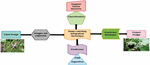
Initially, diseases are captured and classification can be done by Support Vector Machine then the illness are classified. The classified images are given to predict the diseases using Convolutional Neural Network Algorithm. This algorithm can be used to testing and training of the dataset based on deep learning. Figure 1 decipher the block diagram of the deep learning integration technique is given below,
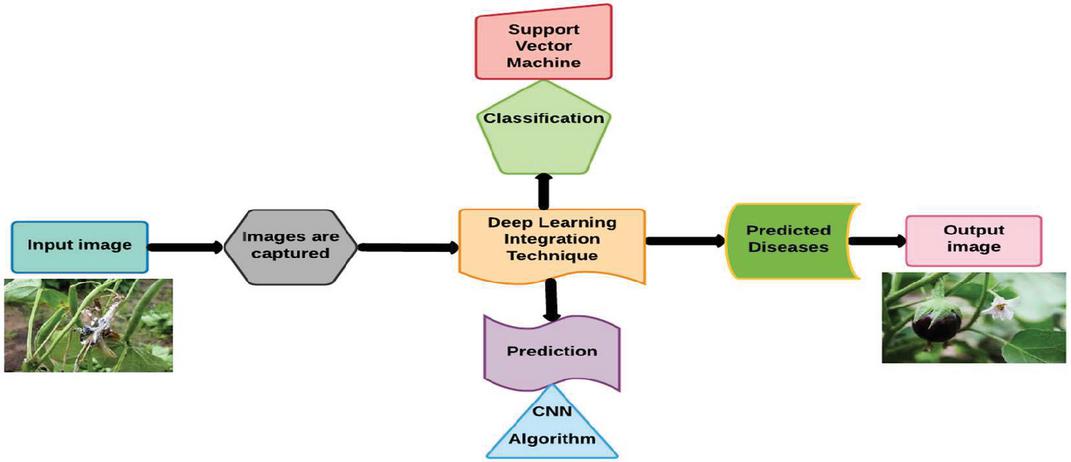
Figure 1 Block diagram of the deep learning integration technique.
In DLI technique, Support Vector Machine can be utilized for classification in brinjal plant illness based on deep learning can be discuss in the below section.
3.1 Support Vector Machine Classifier
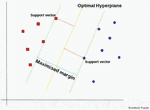
The binary classifier that also employs use of the hyper-plane which is also called as the judgment border among two of the categories called as Support Vector machine (SVM). The mapping of linear data from nonlinear input data offers a strong high dimensional space classification in SVMs. The average gap between the various classes is maximized via SVM. The classes are divided by numerous kernels. SVM is mainly a binary classifier that divides the hyperplane into two types. Between the hyperplane and the two groups, the border line is achieved. When establishing the hyper plane, the specimens closest to the border are called support vectors. A higher proportion of support vectors of labeled data is taken into consideration. The conventional SVM system was designed for concerns with two classes. In actual world scenarios, unfortunately, more than two classes must often be separated simultaneously. SVM can be expanded from binary issues to multi-classification issues for m classes where m 2 are present. There are two methods, the one against the one strategy and the one against the whole strategy. Multi-class SVM in essence transforms a number of binary challenges into a set of data. For instance, binary SVM is trained for the construction of a decision-making function for every two categories of information. Therefore, the m-class problem contains m (m1)/2 decision features. Assume m 15, that you need to train 105 binary classifiers. This shows much time for training. A voting procedure is adopted in the classification phase when the test point is assigned to be in a class with the greatest number of votes. The voting procedure refers to the ‘Max Wins approach.’ For each class, a binary SVM will be used to segregate participants of one class from the other class in a one against whole method.
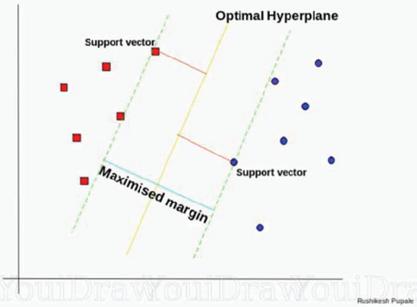
Figure 2 SVM classifier.
Algorithm 1 Support vector machine algorithm
1: Select the foremost values for the criterion utilized MAX WINS, forecast the greatest evaluator and or outcome.
2: M: matrix with characteristic to train, x: vector of labels, hyper parameters (n-neighbors, weights, metrics)
3: function MAX WINS (n-neighbors, weights, metrics)
4: Construct a dictionary with , kernel, decision functions values to endeavor
5: Utilize MAX WINS on hyper parameters
6: return greatest evaluator
7: practice SVM_Classifier(M_train, x_train, m_test, x_test)
8: Utilize MAX WINS to acquire the greatest evaluator
9: Appropriate the model with M_train, x_train
10: Classify labels for m_test
11: return classified values *outcome can be procured by using x_test
12: Disease Classified results
The plant disease is classified then to predict the disease using CNN algorithm portrays in the below section.
3.2 Convolutional Neural Network Algorithm
The classified output is fed into the CNN model’s input after passing via the convolution layer. All characteristics are retrieved in the convolution layer by creating a feature vector, that is created by convolving an image matrix with a 3*3 convolution kernel. Convolution layer serves to predict the border and to smooth the image according to the filter kernel used to convert. Now it happens quite frequently that the filter is unsuitable for the picture matrix for which a padding approach arrives. In this way, either zeros may be added with the image matrix called zero-padding or the rest of the image matrix can be removed or dumped, the only region in that affected region is centered and the unneeded region may be removed. Utilize ReLU presently to provide image non-linearity. ReLU is a linear unit modified. Several procedures are also available to provide non-linearity, but ReLU effectiveness is significantly superior. The pixel value passes via the pooling layer after passing through the convolution layer. The redundant image characteristics have been decreased in the pooling layer. Max pooling is used for space pooling. The maximum value of the corrected map was selected in the max pooling process, and the matrix size was decreased to the matrix representing its input picture. Now the result picture of Max pooling layer is provided for a convolution layer in which the picture matrix is first flaked into the sequence and then a neural network is built, whereby a modeling feature such as softmax and sigmoid is called to predict the brinjal plant disease.
Algorithm 2 Convolutional neural network algorithm
1: Dataset with illness classified images
2: Step 1: Introduce requisite libraries
3: Step 2: Append Conv2D layer in the neural network
4: Step 3: Append max pooling layer in the neural network
5: Step 4: Append flaked layer
6: Step 5: Append fully connected layer with operation mission of ReLu
7: Step 6: Append dense layer with operation mission of Softmax
8: Step 7: Execute the Picture inflation by parallel roll, Perpendicular roll, illuminating
9: Step 8: Load the pictures as test and training sets also load them contrary elements
10: Step 9: Fix the information and train the model
11: Step 10: Test the accuracy on the test set model
12: Step 11: Predict the plant illness
13: Predicted plant illness
At last, the classification and prediction of brinjal plant disease by Deep Learning Integration Technique using Support Vector Machine and Convolutional Neural Network. The result section has been discussing in the below section.
4 Results
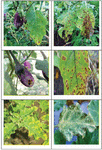
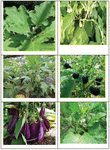
The proposed algorithm is developed using python tool and the sample image of the affected disease images and healty plant imaged collected from internet source are depicted in Figures 3 and 4. The data set collected from github and work carried out using Core i5 machine with 4GB RAM and Windows 8 Operating system.
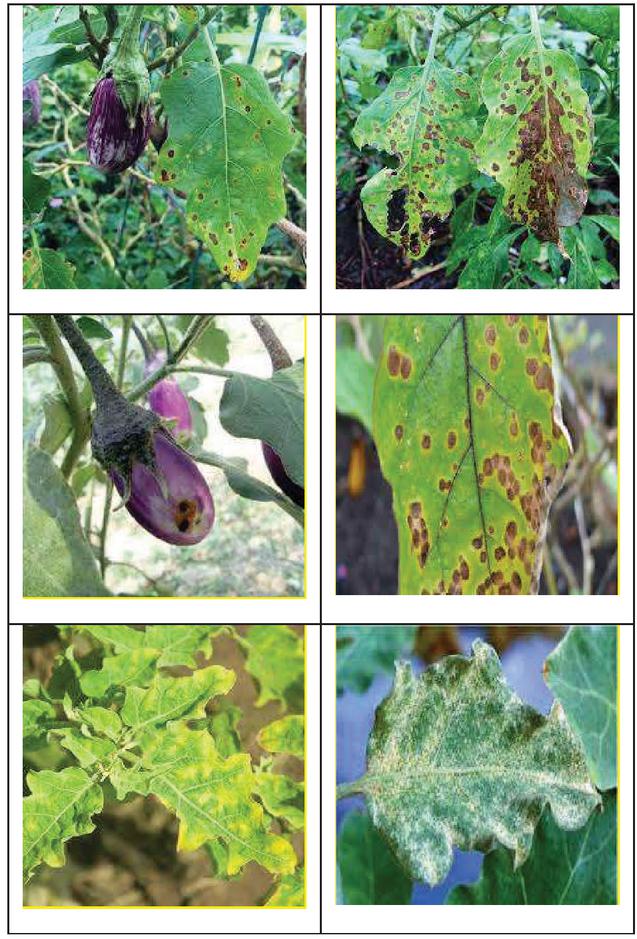
Figure 3 Sample images of diseased brinjal plant.
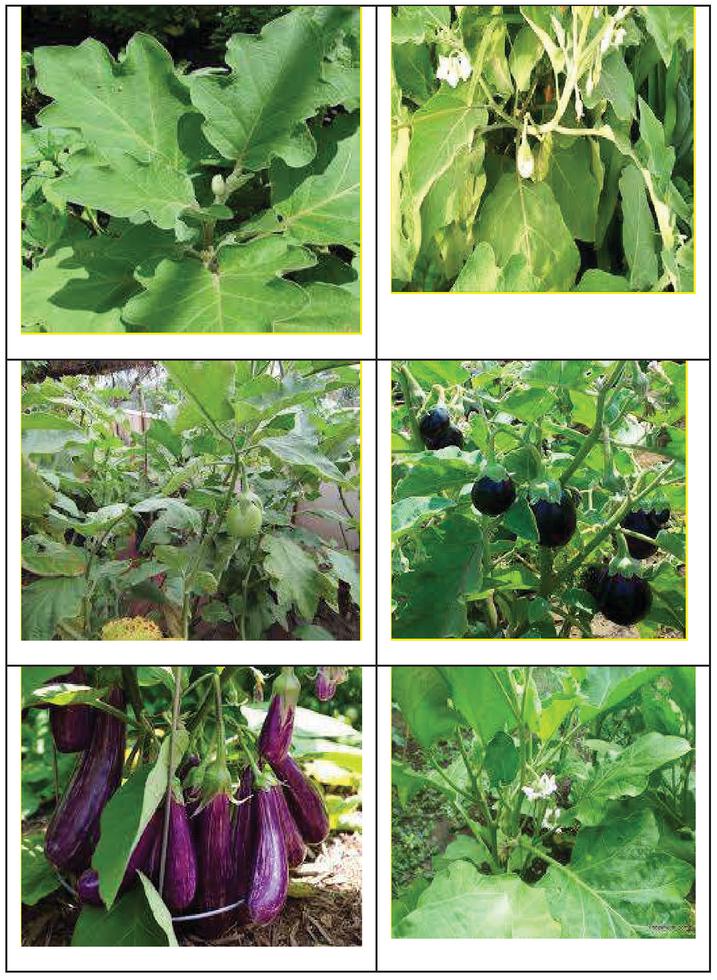
Figure 4 Sample images of healthy brinjal plant.
The outcomes of the proposed method are discussed by performance metrices and comparison results are given below.
4.1 Evaluation Metrics
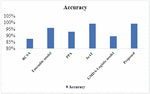
Accuracy: It is defined as the ratio of sum of true positive and true negative to the sum of true positive, true negative, false positive and false negative.
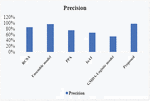
Precision: It is defined as the ratio of true positives to the sum of true positives and false positives.
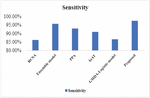
Sensitivity: It proclaimed as the proportion of positives accurately recognized via test out of the entire quantity of positive substantially evaluated.
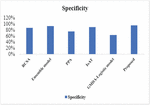
Specificity: It is denoted as the proportion of negatives adequately distinguished via test out of the whole amount of negative literally assessed.
F1 score: It is defined as the Harmonic mean of precision and recall
4.2 Comparison Results
The comparison results of Proposed method are compared with existing methodologies such as Rider-Cuckoo Search Algorithm (RCSA), Ensemble model, Probabilistic Programming approach (PPA), Internet of Agro-Things (IoAT) and GMDA-Logistic model.
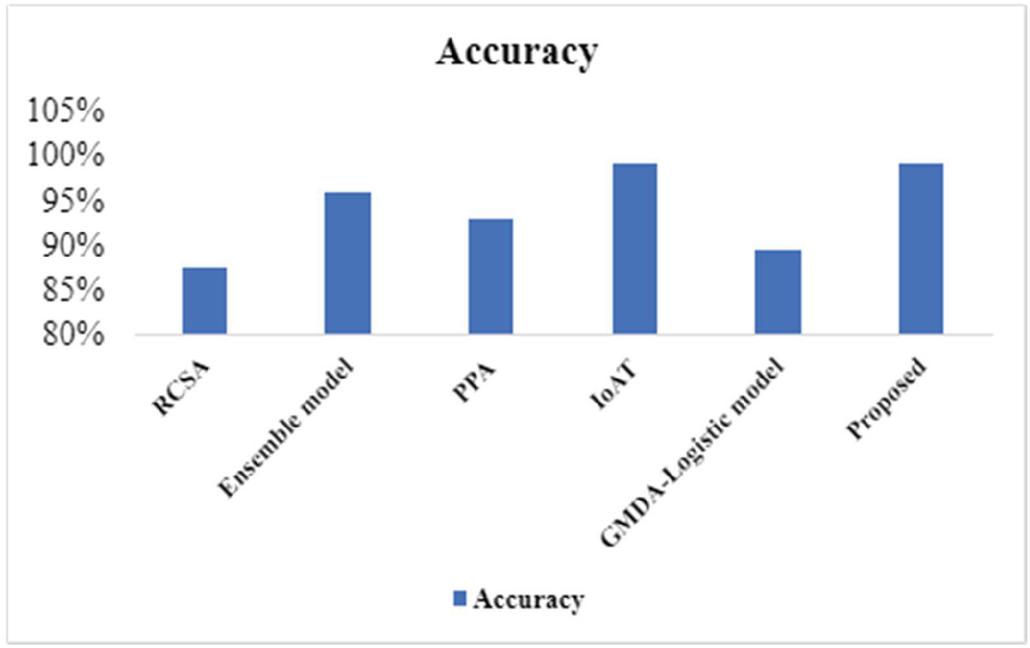
Figure 5 Accuracy of DLI technique.
The Accuracy of Rider-Cuckoo Search Algorithm is 87.77%, Ensemble model is 96.23%, Probabilistic Programming approach is 93.02%, Internet of Agro-Things method is 97.76% and GMDA-Logistic model is 86.76% and our Proposed Method is achieved 98.01%.
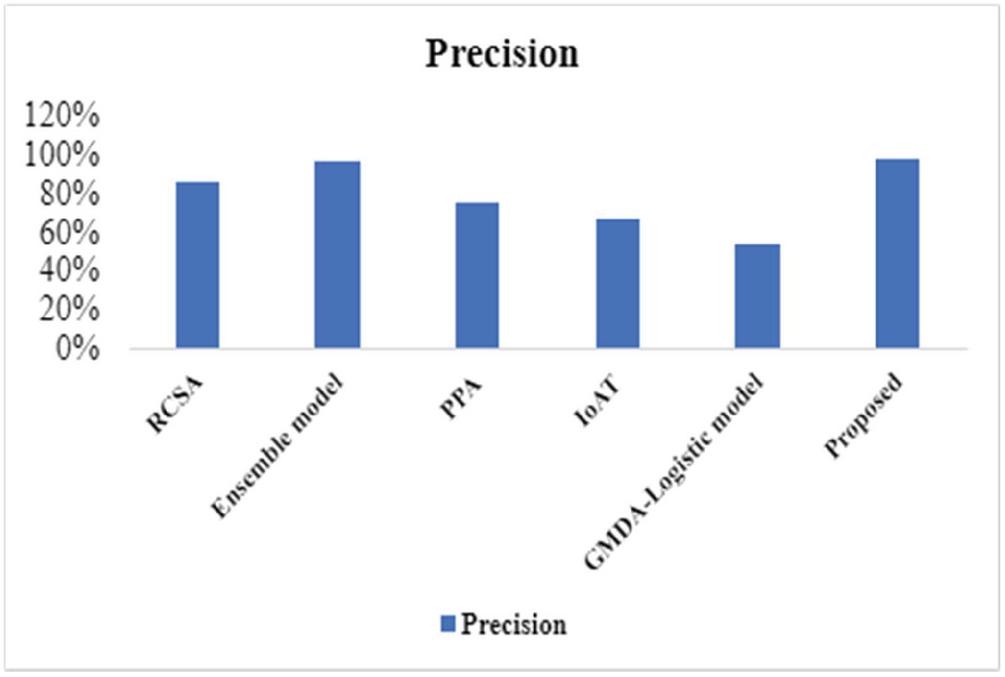
Figure 6 Precision of DLI technique.
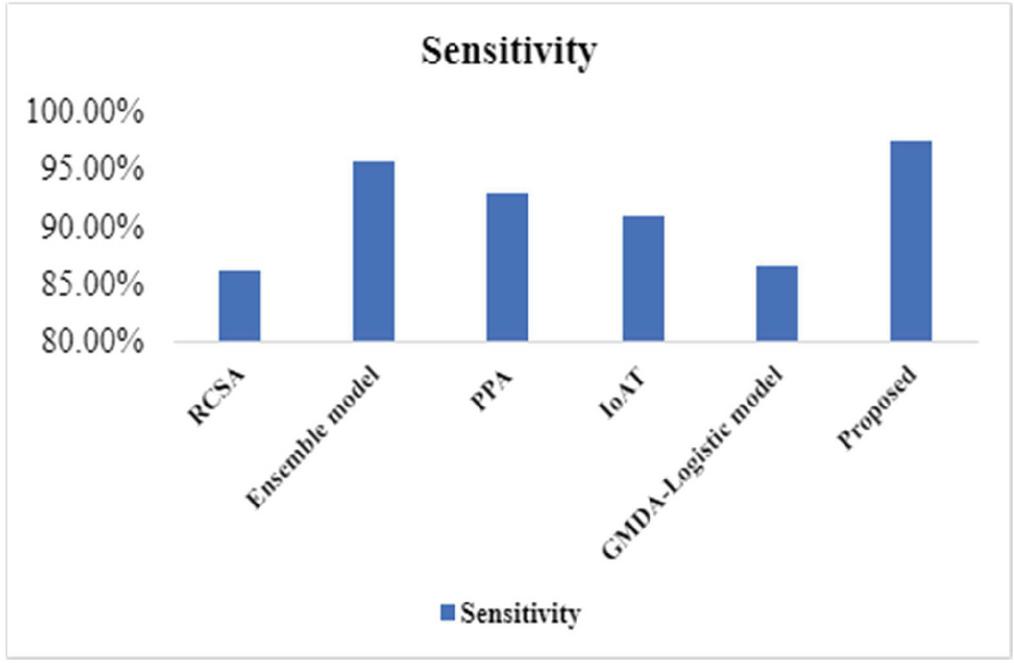
Figure 7 Sensitivity of DLI technique.
The Precision of Rider-Cuckoo Search Algorithm is 80.05%, Ensemble model is 92.05%, Probabilistic Programming approach is 79.15%, Internet of Agro-Things method is 69.15% and GMDA-Logistic model is 56.15% and our Proposed Method is achieved 93.51%. The Sensitivity of Rider-Cuckoo Search Algorithm is 85.14%, Ensemble model is 95.65%, Probabilistic Programming approach is 93.25%, Internet of Agro-Things method is 90.15% and GMDA-Logistic model is 87.85% and our Proposed Method is achieved 96.56%.
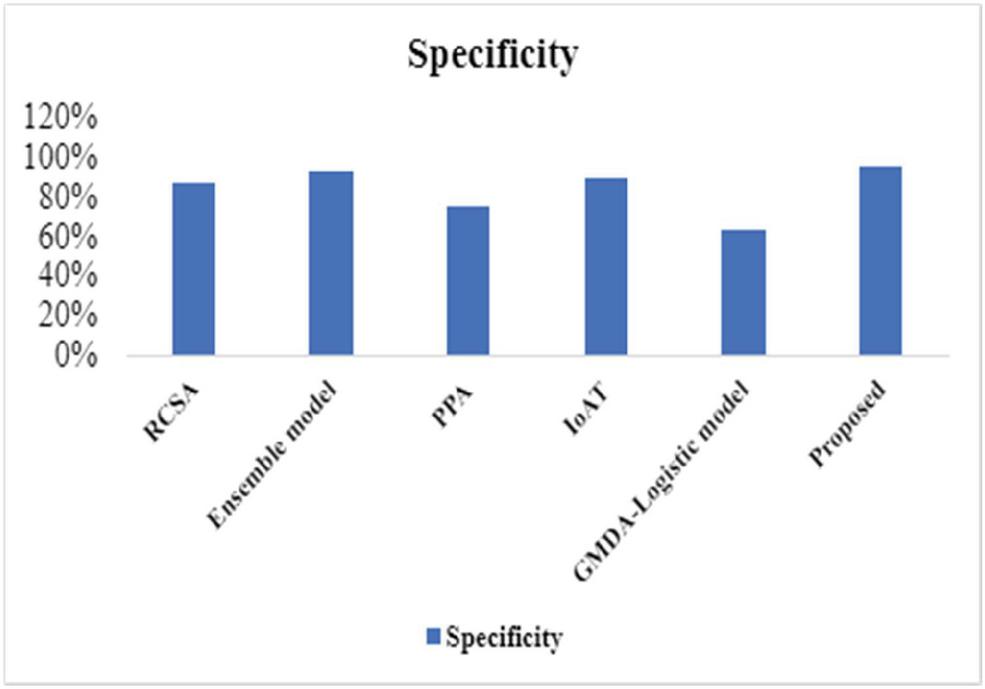
Figure 8 Specificity of DLI technique.
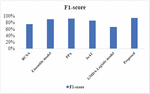
The Specificity of Rider-Cuckoo Search Algorithm is 81.15%, Ensemble model is 85.55%, Probabilistic Programming approach is 79.85%, Internet of Agro-Things method is 82.15% and GMDA-Logistic model is 71.15% and our Proposed Method is achieved 86.66%. The F1-Score of Rider-Cuckoo Search Algorithm is 78.15%, Ensemble model is 82.12%, Probabilistic Programming approach is 84.45%, Internet of Agro-Things method is 83.75% and GMDA-Logistic model is 86.76% and our Proposed Method is achieved 85.88%.
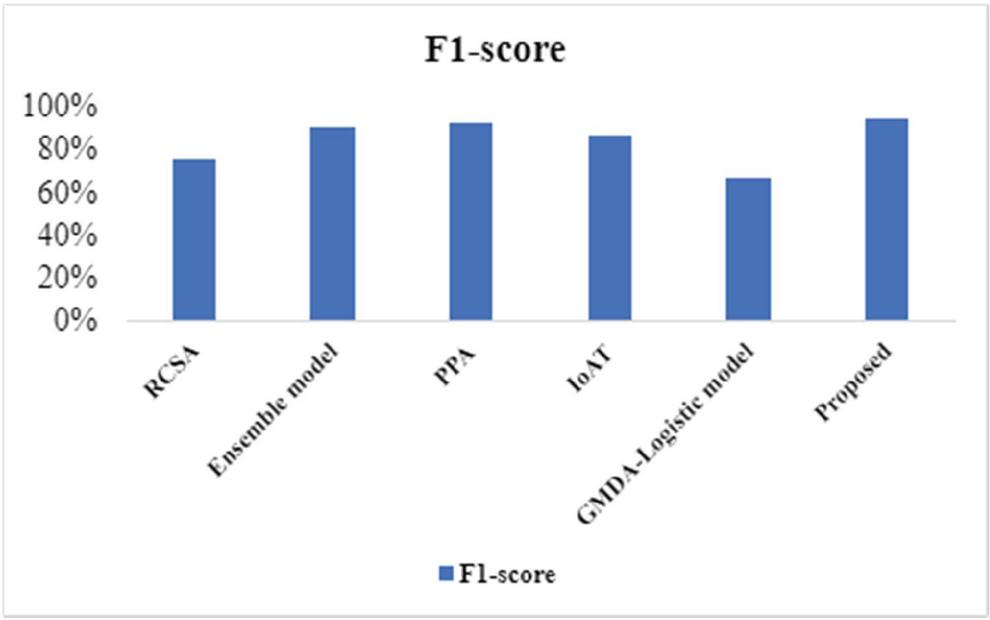
Figure 9 F1-score of DLI technique.
The evaluation metrices such as accuracy, precision, sensitivity, specificity and F1-score of the Proposed technique are achieved highly efficient for predict the brinjal Plant diseases when compared with prior techniques.
Table 1 Performance of proposed method
| Methods | Accuracy | Precision | Sensitivity | Specificity | F1-Score |
| RCSA | 87.77 | 80.05 | 85.14 | 81.15 | 78.15 |
| Ensemble Model | 96.23 | 92.05 | 95.65 | 85.55 | 82.12 |
| PPA | 93.02 | 79.15 | 93.25 | 79.85 | 84.15 |
| IOAT | 97.76 | 69.15 | 90.15 | 82.15 | 83.45 |
| GMDA Logistic Model | 86.76 | 56.15 | 87.85 | 71.15 | 74.75 |
| Proposed Model | 98.01 | 93.51 | 96.56 | 86.66 | 85.88 |
5 Conclusion
In Brinjal Plant Disease, the critical issue is White mold can be classified and predicted by Deep learning Integration Technique. In this technique, classification is done by Support Vector Machine (SVM) and Prediction is done by Convolutional Neural Network (CNN) Algorithm. The Proposed system are compared with existing methodologies are achieved with high accuracy of 99.4% and the infection predicted are highly effective. In future, forecast the plant disease using Artificial neural network based on application oriented.
References
[1] Wang, G., Sun, Y. and Wang, J., 2017. Automatic image-based plant disease severity estimation using deep learning. Computational intelligence and neuroscience, 2017.
[2] Lee, S.H., Goëau, H., Bonnet, P. and Joly, A., 2020. New perspectives on plant disease characterization based on deep learning. Computers and Electronics in Agriculture, 170, p. 105220.
[3] Chohan, M., Khan, A., Chohan, R., Hassan, S. and Mahar, M., 2020. Plant disease detection using deep learning. International Journal of Recent Technology and Engineering, 9(1), pp. 909–914.
[4] Chen, J., Chen, J., Zhang, D., Sun, Y. and Nanehkaran, Y.A., 2020. Using deep transfer learning for image-based plant disease identification. Computers and Electronics in Agriculture, 173, p. 105393.
[5] Saleem, M.H., Khanchi, S., Potgieter, J. and Arif, K.M., 2020. Image-based plant disease identification by deep learning meta-architectures. Plants, 9(11), p. 1451.
[6] Cristin, R., Kumar, B.S., Priya, C. and Karthick, K., 2020. Deep neural network-based Rider-Cuckoo Search Algorithm for plant disease detection. Artificial intelligence review, 53(7).
[7] Yousuf, A. and Khan, U., 2021. Ensemble Classifier for Plant Disease Detection. International Journal of Computer Science and Mobile Computing, Vol. 10, Issue 1.
[8] Hernández, S. and Lopez, J.L., 2020. Uncertainty quantification for plant disease detection using Bayesian deep learning. Applied Soft Computing, 96, p. 106597.
[9] Udutalapally, V., Mohanty, S.P., Pallagani, V. and Khandelwal, V., 2020. sCrop: A Internet-of-Agro-Things (IoAT) enabled solar powered smart device for automatic plant disease prediction. arXiv preprint arXiv:2005.06342.
[10] Chen, J., Yin, H. and Zhang, D., 2020. A self-adaptive classification method for plant disease detection using GMDH-Logistic model. Sustainable Computing: Informatics and Systems, 28, p. 100415.
[11] Yan Guo, Jin Zhang, Chengxin Yin, Xiaonan Hu, Yu Zou, Zhipeng Xue, Wei Wang, “Plant Disease Identification Based on Deep Learning Algorithm in Smart Farming”, Discrete Dynamics in Nature and Society, vol. 2020,
[12] Liu, J., Wang, X. Plant diseases and pests detection based on deep learning: a review. Plant Methods 17, 22 (2021).
[13] Vijai Singh, A. K. Misra, “Detection of plant leaf diseases using image segmentation and soft computing techniques”, Information Processing in Agriculture, Volume 4, Issue 1, 2017, Pages 41–49.
[14] Daniya, T., Vigneshwari, S. Deep Neural Network for Disease Detection in Rice Plant Using the Texture and Deep Features, The Computer Journal, 2021;, bxab022, https://doi.org/10.1093/comjnl/bxab022
[15] Daniya, T. and Vigneshwari, S. “A Review on Machine Learning Techniques for Rice Plant Disease Detection in Agricultural Research”, International Journal of Advanced Science and Technology, vol. 8, no. 13, 2020.
Biographies

Attada Venkataramana was born in 1977 and received his undergraduate and postgraduate degrees in Computer Science and Engineering from Andhra University, Visakhapatnam. He also received his Ph.D. from Andhra University under the supervision of Prof. S. Pallam Setty. He has having 21 years of teaching experience. He has been as a Professor at GMR Institute of Technology’s, Department of Computer Science and Engineering since 2004. Currently, he is heading the Department of CSE. He is a Member of sevaral professional bodies like ACM, CSI and ISTE. He has published more than 30 papers in various national and International Journals and Conferences. He is the reviewer of international journals indexed in SCI/Scopus. He received five best faculty awards at GMR Institute of Technology for his commendable performance in academics. He also received faculty excellence award from Infosys under Industry–Institute Partnership program. He serves as Board of studies member for reputed autonomous colleges. His research areas include Wireless Communication Networks, Internet of Things, Software Engineering and Data Analytics.

K. Suresh Kumar obtained his Master’s degree in Madurai Kamaraj University, and he also completed his Master of Technology in Information Technology from Sathyabama University and received PhD, in Computer Science & Engineering majoring in Web Security from Anna University, Chennai, Tamil Nadu, India. Currently, he is working as an Associate Professor in the Department of Information Technology at Saveetha Engineering College Chennai; with 17 years of teaching experience, he guided many undergraduate and Post Graduate projects. He has authored or coauthored over 23 articles in refereed international journals and conferences. He is the reviewer of international journals indexed in SCI/Scopus. He is a Life Member of CSI and ISTE. His specializations include web security, networking, and mobile computing. His current research interests are web security, Cloud Computing, and Image Processing.

N. Suganthi received her B.Tech. Degree in Information Technology from Pondicherry Engineering College, Pondicherry University, India in 2005 and M.Tech. Degree in Information Technology from Sathyabama University, Chennai, India in 2008. She completed her PhD in the area of Cognitive Radio Networks under Computer Science and Engineering from Sathyabama University, Chennai, India. She has 14 years of teaching experience at college level Currently, she is working as an Assistant Professor in the Department of Computer Science and Engineering at SRM Institute of Science and Technology, Ramapuram Campus, Chennai. She has published around 12 Papers in International Conference and Journal. Her research interest includes Cognitive Radio Network, Wireless Communication and Cloud Computing.

R. Rajeswari received her B.E degree in Electronics and Communication Engineering from Bharathidasan University, Tamil Nadu, India, in 1990 and an M.Tech degree in Quality Assurance Technology(1994), from Regional Engineering College, Thiruchirapalli. Tamil Nadu, India, in 1994.In 2004 she obtained M.E in Computer Science and Engineering from Annamalai University and a PhD degree in the Faculty of Information and Communication Engineering from Anna University, Chennai in 2012. She is currently working as Professor in the Department of Electronics and Communication Engineering at Rajalakshmi Institute of Technology, India. She has 25 years of teaching experience at college level. He is an active reviewer in the journals, IET image Processing etc. Her research area includes Medical Signal & Image processing, Speech processing. She is a member of IEEE, IET and life member of ISTE.
Journal of Mobile Multimedia, Vol. 18_3, 771–788.
doi: 10.13052/jmm1550-4646.18315
© 2022 River Publishers