Interoperability Issues and Challenges in 6G Networks
Shubhangi Kharche1,* and Prajakta Dere2
1Department of Electronics and Telecommunication, SIES Graduate School of Technology, Nerul, Navi Mumbai, Maharashtra
2Department of Electronics and Telecommunication, Ramrao Adik Institute of Technology, Nerul, Navi Mumbai, Maharashtra
E-mail: shubhangik@sies.edu.in; prajakta.papalkar@rait.ac.in
*Corresponding Author
Received 25 November 2021; Accepted 19 January 2022; Publication 05 April 2022
Abstract
Interoperability allows seamless data exchange among the heterogeneous networks and is a crucial problem for the growth of forthcoming 6G networks. The research has focussed on the interoperability issues in the Internet of Things (IoT) related to cross-domain and cross-platform applications. However, the future 6G communication networks are not limited to interoperating with IoT. The 6G networks must interoperate with the Wearable IoT (WIoT), brain abstracted Internet of Thinking (IoTk), Internet of Everything, and other space and undersea networks. The network softwarization, slicing, and intelligentization techniques are envisioned to support seamless data exchange between 6G and other heterogeneous networks. However, to successfully achieve the goal of global 360 connectivity in 3D space, interoperability issues with heterogeneous services, applications, protocols, networks, etc., must be solved. The integration and interoperability of 6G networks with all aforementioned heterogeneous networks are inevitable to realize the goals of 3D communication successfully. The paper proposes a taxonomy to provide deep insights into interoperability issues, challenges, and possible solutions for 6G interoperability with WIoT, IoTk, IoE, and other networks. Though the techniques mentioned above in 6G networks will allow interoperable solutions, the integration and interoperability issues persist due to heterogeneities in high-frequency bands, base stations, technologies, device identities, protocols, and interfaces. The paper summarizes significant challenges regarding interoperability issues in various areas related to 6G and highlights the broad scope to further research.
Keywords: Interoperability, 6G, Internet of Thinking (IoTk), heterogeneous, Wearable Internet of Things (WIoT).
1 Introduction
5G networks lack the adaptation of dynamic features, compatibility, and interoperability [1]. There is an urgent need to build suitable protocols at each protocol stack layer [2, 3] to make the personal wireless applications interoperable with 5G networks. There is also a need to integrate 5G, artificial intelligence, and blockchain [4]. The researchers are working to solve the issues in 5G and envisioning the sixth generation (6G) to be a highly potential cellular communication technology that will support a plethora of services, applications, and networks in global 3D space with 360 coverage. 6G will have to invest a gamut of networks such as Internet of Things (IoT), Internet of Thinking (IoTk) [5], Internet of Everything (IoE), etc., providing a large number of applications and services. 6G will converge with several vertical industries like healthcare that relies on the notions of Intelligent IoT (IIoT), Intelligent Internet of medical things (IoMT), Wearable IoT (WIoT), Intelligent WIoT (IWIoT), and IoTk. The convergence with various networks and industries will be possible upon overcoming the interoperability issues as seen in Figure 1.
The IoT has a plethora of applications. One of them is the flying Adhoc network (FANET) [6] that will need 6G support to interoperate with terrestrial, and undersea networks. In terrestrial IoT-based communication, the devices are energy constraint [7] and need an energy-efficient routing protocol like RPL [8, 9]. In FANET communication, unmanned aerial vehicles (UAVs) are battery-operated and need an energy-efficient routing protocol [6]. As the routing protocols are heterogeneous in IoT-based terrestrial and aerial communication, 6G should provide interoperable solutions. IoTk is a new paradigm [5] that network objects based on heterogeneous cognitive levels of thinking aiming to have 6G technological support for interoperable solutions. IoE proposed by Cisco Futurist in 2012, is being developed to integrate heterogeneous networks including IoT, Internet of Data (IoD), Internet of Processes (IoPr), and Internet of People (IoP). The upcoming 6G network infrastructure is said to be IoE compliant in the sense that the 6G advanced technologies like AI, Edge intelligence, and network function virtualization (NFV) will pave the way to provide interoperable solutions.
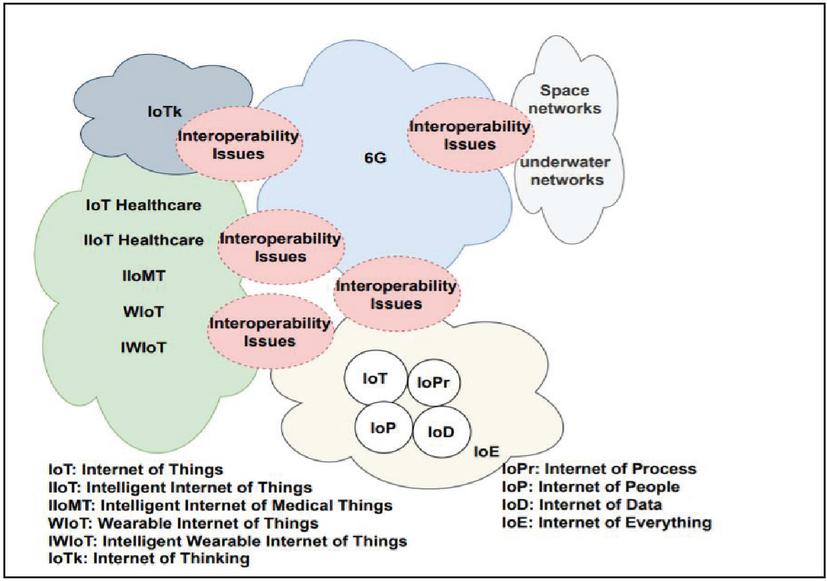
Figure 1 Interoperability issues in 6G.
The healthcare networks have heterogeneous requirements of sensors, devices, hardware and software platforms, technologies, interfaces, frequency bands, computational resources, services, and addresses. For example, to set communication among the heterogeneous devices/wearables in WIoT, dis-similar identities (or addresses) [10, 11] are required. Further, there are several interoperability challenges in WIoT [12, 13]. 6G communication network aims at providing seamless connectivity and exchange with heterogeneous networks like WIoT. However, heterogeneity prevents and makes it extremely difficult for seamless connectivity and data exchange in the networks. The 6G techniques like symbiotic radio (SR) [14], software-defined networking (SDN), NFV, and network slicing (NS) [15] are anticipated to support network agility and interoperability among heterogeneous networks. The symbiotic radio supports intelligent cooperation among heterogeneous wireless transmissions [14]. The SDN/NFV provides open interfaces that help generate network slices for any vertical application over the shared physical infrastructure [15] and support interoperability among different vendors. Though the techniques mentioned earlier solve the interoperability issues in 6G, they will not provide a complete solution to overcome several kinds of heterogeneities. Therefore, 6G should support interoperability in an intelligent, adaptive, and flexible manner. 6G will need to keep highly scalable and more advanced wearable IoT (WIoT) functionalities and services, including sensing, processing, data transfer, storage, and analytics. Apart from the interoperability issues in WIoT, 6G needs to solve the issue of seamless communication with other heterogeneous networks like the IoE, IoTk, satellite networks, aerial networks, underwater networks, etc. Also, 6G needs to solve the interoperability issues between the technologies, devices, platforms, interfaces, protocols, base stations, etc., within the network.
In 5G systems networking technologies like blockchain are limited in throughput (10 to 1000 transactions/second). Also, the blockchains in 5G lack smooth interoperability. The blockchain in 6G will use consensus algorithms to mitigate the interoperability issues [16]. 6G systems have far more and better features than 5G. The autonomous wireless systems in 6G demands interoperable processes. Based on the identified research gaps, the paper presents a detailed taxonomy depicting the interoperability issues within and outside the 6G networks. The paper elaborates on every interoperability issue listed in the taxonomy with examples. The paper sheds light on several interoperability issues and challenges related to the device, network, semantic, and syntactic in WIoT and between 6G and WIoT. Finally, the paper discusses the intra-6G and inter-6G network interoperability issues with solutions. Figure 2 shows the structure of the paper.

Figure 2 Structure of the current work.
2 Taxonomy for 6G Interoperability
Interoperability issues lie at various levels within a network and between the networks as seen in Figure 3.
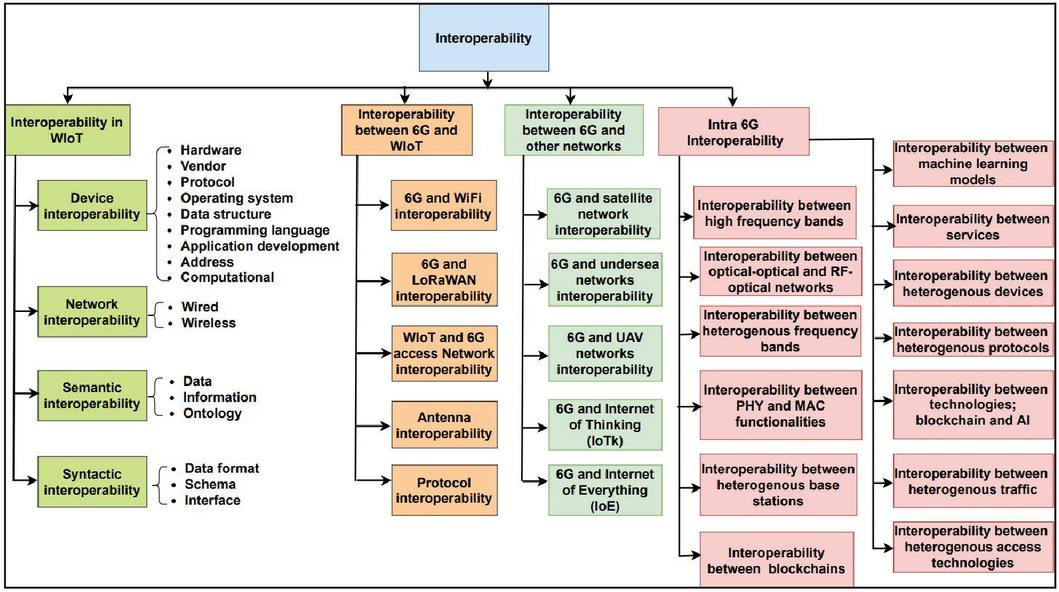
Figure 3 Taxonomy for Interoperability.
2.1 Interoperability in WIoT
The wearable Internet of Things (WIoT) based healthcare system comprises wearable devices that embed several sensors to sense the patients’ physical and biological health. The wearable devices are low cost and have low power processing and trans-receiving circuits. The sensors are used to monitor the (1) physical parameters, (2) to measure and characterize the chemical compounds, and (3) to measure and characterize the organic materials. Accordingly, the sensors are classified as physical sensors, chemical sensors, and biosensors. Most of the physical sensors have monitoring as well as diagnostic abilities. The health monitoring application has a reach from urban areas to rural areas [17]. The wearable sensors monitor the patients’ health status by gathering their physiological parameters and movement data. The sensors are deployed at various locations on the patient body as per the clinical application of interest. For example, a variety of headbands, wristwatches, and innovative jewelry are available to monitor heart and respiratory rates.
For movement data capturing, the sensors are usually available in smartwatches and phones. The intelligent sensors are microelectronics circuits capable of performing the functions of signal amplification, processing, and wireless transmission. For example, a wireless electrocardiogram (ECG) sensor has an amplifier circuit, a microcontroller, and a wireless transceiver with an antenna subsystem. With the advent of microelectromechanical systems (MEMS), the cost and size of sensors are significantly reduced. The sensors can be embedded in the textile with the help of electrodes to collect and print the ECG and Electromyography (EMG) data. Sensors are employed to monitor the physical data in two ways; first, the bodyworn sensors, and second, the integrated bodyworn and ambient sensors. The sensor readings are transferred to the data logging devices such as smartphones, laptops, PCs, and other PDAs using short-range wireless communication technologies. These technologies include Bluetooth, Bluetooth low energy (BLE), ZigBee standard, ZigBee Pro, ZigBee IP, ultra-wideband (UWB), near field communication (NFC), radio frequency identification (RFID), Wi-Fi, and 6LoWPAN. Bluetooth low energy (BLE) is the dominant communication technology for wearable sensors owing to its prolonged battery life, low cost, reduced power consumption, and bidirectional communication capability.
A patient carries several wearables capable of wireless communication for health monitoring purposes, forming a wireless body area network (WBAN). The wearables are available from a variety of vendors with the heterogeneous device hardware, platforms, operating systems, addressing, and computational capacities. Due to these heterogeneities’ interoperability issues are observed in the networks [18]. The WBANs are the stub networks connected to the Internet of Things forming the so-called WIoT.
2.1.1 Device interoperability
With the advent of 6G technologies, there will be a variety of 6G devices with diverse applications, intelligence, embedded hardware, processing capacities, size, energy consumption, and computational capabilities. In 6G-enabled-IoT, wearables are envisioned to be equipped with integrated SIM cards capable of communication at THz frequency bands. The wearables will be provided with extended reality (AR/VR/MR) and haptic feedback capabilities and will be capable of communication at THz frequency bands. The wearables will be highly secure with the advent of Blockchain (BC) technology. All these enhancements in wearables are associated with many issues, and challenges like embedding a transceiver module operating at THz frequency band due to the size and energy constraints of the devices. One of the biggest challenges foreseen in 6G wearables and devices is interoperability. The wearables with diverse capabilities exhibit heterogeneity in hardware, the vendors, the communication protocol, operating systems, data structures, programming languages, application development, physical addresses, and computational capabilities. These heterogeneities pave the way to interoperability issues. For example, the Apple Make smartwatch is equipped with s5 sip (64-bit dual-core-processor) [19], w3 wireless chip transceiver, and ios I3 operating system (OS) whereas Samsung Make smartwatch is equipped with Exynos 9110 (dual-core 1.15 GHz) [20] processor, a wireless module and Tizen wearable OS. Both the smartwatches are used for heart rate sensing and fall detection. Apple smartwatch supports wireless connectivity to WPAN, WLAN, and cellular networks using Bluetooth 5.0, Wi-Fi, and LTE/UMTS communication standards respectively. The Apple and Samsung smartwatches can communicate with each other if their protocol communication stacks within the OS are interoperable. The future 6G wearables should be interoperability with the legacy wearables capable of communicating with 3G/4G/5G.
The range of 6G-IoT devices (user equipment) will include wearables, handsets, computers, handheld devices, vehicles (cars, rockets, airplanes, drones), IoT devices (speakers, toaster, microwave oven, coffee maker, music player), PDAs, mobile terminals, tablets, USB dongles, smart and intelligent phones, laptop mounted equipment. These devices are capable of D2D communication, the device to gateway communication, and device to IoT communication, provided they have interoperability at both hardware and software levels. The device interoperability issues are solved to some extent at the edge nodes but the challenges still persist to solve the interoperability issues among the heterogeneous devices.
2.1.2 Operating system and address interoperability
A user can access the wristwatch hardware via lightweight operating systems like Fitbit OS, wear OS, RIOT OS, Free RTOS, Tizen OS, etc. OS interoperability means the protocol communication stack available in OS should be able to communicate with the protocol stack of another. For e.g., interoperability should be between RIOT OS and the Wear OS. A protocol stack in an OS may or may not support both the IPv4 and IPv6 addresses (logical addresses) for connection to the IoT. A particular device may be IPv4 enabled whereas another device may be IPv6 enabled. Moreover, every device has a physical address depending on the standard used at the MAC layer. To set the communication among the devices both the logical as well as the physical addresses must be interoperable. The wearables are identified and categorized for discovery using different solutions that generate unique addresses like the universal product code (UPC), electronic product code (EPC), uniform resource identifier (URI), and the IP address (IPv4 and IPv6). The interoperability issues among these addresses must be solved.
2.1.3 Programming language interoperability
The programming language interoperability arises as different wearables are programmed using other languages. For example, an Apple wristwatch is programmed using swift language, whereas the Samsung wristwatch is programmed using C.
2.1.4 Platform interoperability
The diverse nonuniform programming platforms available on wearables create problems to develop applications leading to cross-platform interoperability. Wearables should have an application to monitor the patient’s health parameters and the application, to sense the ambulance location in case of emergency. The 6G enabled wearables will be intelligent to proactively sense the health parameters with the help of ML-based algorithms. Heterogeneous intelligent algorithms in different wearables will challenge the interoperability issues between the machine learning (ML) models. The 6G-enabled wearables will be identified in IoT using supervised learning (SL) algorithms. Interoperability issues will arise between the device addresses learned using the SL and the actual physical and logical addresses. The wearables communicate the health parameters at dew sites for local computations and analysis via short-range communication RF and wireless optical technologies. The short-range RF communication standards include Zigbee std, Zigbee pro, Zigbee IP, Bluetooth 4.0, Bluetooth 5.0, BLE, NFC, 6LoWPAN, and ANT [21] whereas the optical wireless communication (OWC) technologies include LiFi, VLC, OCC, and FSO. These RF standards operate at different frequencies and rely on different MAC/PHY standards for communication and the OWC standards operate on frequency bands other than the RF bands. 6G is envisioned to deploy OWC technologies widely due to their outstanding advantages [16] over RF technologies. But the wearables enabled with the legacy RF communication standards will also exist. Due to this, there is a need to solve the interoperability between the RF and optical communication standards.
The dew sites mentioned earlier [22] are usually the WBAN sinks and gateways like RPi devices and smartphones. The local computations and analytics at dew sites solve the bandwidth, latency, and interoperability issues. The health records from the dew sites are forwarded to edge sites and further to fog and cloud for computations and analytics. 6G will integrate intelligence at each of these computational levels according to the availability of resources. Dew sites are constraint w.r.t energy, memory, and processing power resources whereas cloud sites are equipped with sufficient resources. The integration of complex AI/ML learning models at the computational levels is a challenge and the interoperability among heterogeneous AI/ML models is also a challenge due to the limitation of resources. The edge sites are the Wi-Fi routers and the local servers, the fog sites are the heterogeneous base stations in 6G and the cloud sites are the high-capacity virtual servers towards the Internet.
2.1.5 Network Interoperability
The network interoperability issues mainly arise due to the heterogeneous communication protocols and standards. The WIoT is interoperable with the backbone Internet in a way that its 6LoWPAN stack offers lightweight protocols like COAP that is interoperable with HTTP protocol. The WIoT should be interoperable with all stub networks like WBAN, WPAN (e.g., 6LoWPAN [23]), WLAN (e.g., Wi-Fi), LoRaWAN, WWAN (cellular networks), WMAN, optical wireless networks (OWC), wireless underwater sensor networks, wireless unmanned aerial networks, and wireless space networks. The 6G cellular network should be interoperable with all the above-listed stub networks. This poses a significant challenge for the researchers to solve the interoperability issues.
2.1.6 Semantic interoperability
It is a meaningful way of exchanging knowledge, data, and information via different applications, services, and agents [24] in online and offline mode from the web. In WIoT, for healthcare, the semantic interoperability issue occurs due to heterogeneity in data formats, models, and schemas. For example, developing a web server using IoT for supervising local networks. In an IoT environment, the data generated from heterogeneous sources may be dynamic and distributed. So semantic interoperability is necessary, which will allow the system to understand and collect data as it can handle different services, agents, and applications to exchange information in a scenario with different Internet connections. In such heterogeneous connections, additional requests of other protocols at different ports are handled by the server. Thus, Semantic interoperability is required in a flexible way to collect data [25]. The health parameters like temperature, heart rate, etc. measure differently and carry different information. Interoperability between various health measures is the data interoperability, whereas that between additional information is the information interoperability. These interoperability issues need to be solved to avoid ambiguity in different descriptions and operational procedures. Another example related to health is stress and sleep indicators which will assist teachers and learners in regulating their daily activities. For example, the analysis of sleep disorders includes handwriting analysis, facial expression analysis, and how frequently the patients consume tea and coffee. Here interoperability issues are regarding the collection of heterogeneous data from image sensors and their processing.
Ontology is concerned with the knowledge base related to a wearable device, a physical domain, and data, respectively known as device ontology, physical domain ontology, and estimation ontology. Ontology enhances interoperability by allowing data to be linked at the semantic level. Here information is first stored in simple language. Languages may be graphical or natural languages. For example, an electroencephalogram (ECG) data image on the sending side is encoded using a JPEG encoder. Further, the encoded information is exchanged by transforming it in the form that communication channels can send. At the receiving end, the data is interpreted. If there is a failure at any point in this process, then the information may get lost. If the receiver is using the Tiff decoder, then received data cannot be interpreted. If the sender and receivers are using different languages, then communication will not occur between sender and receiver. This is semantic heterogeneity. Software professionals can solve this semantic heterogeneity by taking proper care while designing the software [26]. Syntactic interoperability issues arise due to the heterogenous message formats, structures, and interfaces between users and devices. Interoperability between 6LoWPAN [23] devices is possible but the interoperability between a 6LoWPAN device and a standard Zigbee device or a 6LoWPAN device and a LoRaWAN device is not possible.
3 Interoperability Between 6G and WIoT
Several interoperability issues exist between 6G and WIoT due to the heterogeneity in operating frequency bands, devices, protocols, gateways, wireless technologies, data rates, and antenna techniques. The health parameters sensed via the wearable sensors and devices are routed to the gateway devices like the Wi-Fi access points, 6LoWPAN border routers, or the LoRaWAN gateways. Wi-Fi standard depends on IEEE802.11.1/b/g/n operating in MHz range and offers data rates up to 110 Mbps. The 6LoWPANs operate in license-free bands with usage limited to countries like Japan (950–956 MHz), China (779–787 MHz), Europe (868.0–868.6 MHz), North America (902–928 MHz), etc. and also operates in 2400–2483.5 MHz band worldwide. The 6LoWPANs offer data rates up to 250 Kbps and depend on IEEE802.15.4 for MAC/PHY layer specifications. The LoRaWAN supports the range up to 25 to 40 km depending on the radio modules used. It offers data rates up to 27 kbps [27] and depends on the LoRa modulation which is based on the chirp spread spectrum. The Wi-Fi, 6LoWPAN, and LoRaWAN gateway routers exhibit heterogeneity in hardware, frequency bands, communication range, transmit power, and protocol communication stack. So, an interoperability issue exists between the gateways and the 6G access network supporting THz frequencies. Intelligent sensing and spectrum sharing based on techniques like AI integrated blockchain, AI-enabled cognitive photonics, and various ML algorithms is envisioned for 6G access network. The WIoT gateway devices and the 6G base stations are deployed with heterogeneous antennas. The interoperability issues arise between WIoT and 6G as the WIoT gateways are equipped with single-input-single-output (SISO) antenna whereas the 6G is equipped with different antenna techniques like ultra-massive multiple-input-multiple-output (MIMO), spatially multiplexed (SM) MIMO, large intelligent-reflecting-surfaces (IRS) [28] and support antenna beamforming and holographic communication. Apart from the interoperability issues, the link between 6G and WIoT will have several security and privacy issues [29, 30].
4 Interoperability Between 6G and Other Networks
6G technology is foreseen to support 3D communication covering terrestrial-to-terrestrial (T2T), terrestrial to satellite (T2S), terrestrial to aerial (T2A), and terrestrial to undersea (T2U) communication. To achieve seamless information transfer between the different communication tiers the protocol interoperability issues must be solved. T2T communication needs to solve the protocol interoperability between RF-optical and RF-OWC networks. Interoperability among the various IEEE standards (IEEE 802.3, IEEE 802.6, etc.) for wired communication and the IEEE standards for wireless communication (IEEE 802.11, IEEE 802.15.1 to IEEE 802.15.7, IEEE 802.16, etc.) needs to be solved. Further, Interoperability issues between IEEE 802.15.thz [31] WPAN standard and IEEE 802.15.7 for OWC need to be solved.
4.1 Interoperability Between 6G and Space Networks
In T2S communication, the interoperability issue exists between the TCP/IP communication stack used for terrestrial communication and the SCPS (space communication protocol specific-TP) (extension for TCP/UDP) used for satellite communication. TCP/IP protocol is not suitable [32] for interoperability between terrestrial and non-terrestrial communication due to the heterogeneous requirements for bandwidth, delay, and throughput [33]. Though TCP is reliable it has a drawback of higher delay in communication which will not support the high-speed communication and ultra-low latency requirements of 6G. UDP/IP also cannot be the solution to satisfy high-speed communication in 6G as it also requires ultra-high reliability. New SCPS-TP [34] protocol or any new transmission protocol combined with 6LoWPAN enabled IP may solve interoperability issues in high real-time speed, ultra-low latency communication-based 6G satellite networks. The SCTP multihoming and multi-streaming transport protocol combined with 6LoWPAN enabled IP can also be tested to solve the interoperability issues between terrestrial and satellite communication. SCTP/IPv6 is a multihoming and multi-streaming protocol suitable for satellite communication concerning improved throughput [34], but it incurs extra overhead compared to TCP.
4.2 Interoperability Between 6G and Undersea Communication
There exists an interoperability issue between the traditional terrestrial networks and undersea networks [35]. The TCP/IP protocol stack used in conventional Internet is not suitable for underwater wireless networks as these are composed of limited computational capacity. The authors [36] proposed a lightweight communication stack based on 6LoWPAN for underwater wireless networks that are suitable for devices with computational limitations. The 6G wireless networks operating at THz frequency have interoperability issues with underwater communication occurring at acoustic frequency. A hybrid node is required that can convert the THz frequencies to the acoustic frequencies. OWC technology like VLC is one of the potential technologies for 6G that provides a secure, high data rate, ultra-low latency underwater communication as opposed to acoustic and RF communication [16].
4.3 Interoperability Between 6G and Aerial Networks
The aerial networks are composed of aerial vehicles like drones, UAVs, flying cars, flying auto, flying robots, flying base stations, etc. These aerial vehicles have the camera and sensing mechanism that fly autonomously and are used in various applications like healthcare, agriculture, surveillance, etc. for sensing, capturing, and processing the images, monitoring, and delivery of items. In a way, aerial vehicles provide a kind of interoperability in the planning and implementation of sectors like healthcare, agriculture, etc. [37]. 6G will support extremely high-speed high data rate (1Tbps) communication and ultra-low latency communication in the aerial networks. Together with the aerial networks, 6G will support extreme high coverage extension. Recently two standards are proposed by IEEE aerial communication WG (working group); IEEE P1920.1 and IEEE P1920.2. The IEEE P1920.1 [38] is based on cellular, wireless, and other communication standards that allow information exchange with collision avoidance among aerial vehicles in a self-organizing network. The IEEE P1920.2 is a protocol standard for information communication among unmanned aerial vehicles (UAVs). The challenge is that these protocol standards that are meant for aerial networks should establish seamless interoperability with the 6G communication protocols. Software-Defined-Networking (SDN) and Network-Function-Virtualization (NFV) are the two solutions to support interoperability between 6G and UAV networks [38].
4.4 Interoperability Among 6G, IoE and IoTk
Internet of Everything (IoE), proposed by Cisco Futurist in 2012 [39], is being developed to integrate IoT, Internet of Data (IoD), Internet of Processes (IoPr), and Internet of People (IoP). IoE is a much tightly kneaded fabric than IoT and establishes trillions of connections with enhanced sensing and processing power capabilities. The upcoming 6G network infrastructure is said to be IoE compliant [40] in the sense that the 6G advanced technologies like AI, Edge intelligence and NFV will pave the way to provide interoperable solutions. Internet of Thinking (IoTk) [5] is an attractive and exciting networking paradigm that forms an intelligent embryo of the broader cyber-enabled Internet-of-X (IoX) comprised of seamless interconnections among thinking, people, and entities. The IoX aims to establish ubiquitous connections among the heterogeneous spaces, including cyberspace, social space, physical space, and the thinking space. Each of these spaces has heterogeneity among its components and connections and is envisioned to have the issues of information exploding, link exploding, computational exploding, entity exploding, identity, services and applications, and relationships exploding. With the proliferation of these spaces and the Ubiquitous connectivity requirements, many interoperability issues will arise. For example, interoperability issues between heterogeneous links, heterogeneous identities, heterogeneous resources, etc. The thinking space is the brain abstracted Internet of Thinking (IoTk) comprised of heterogenous ideas, cognitions, intuitions, inferences, goals, and analysis.
Table 1 Interoperability challenges between 6G and other networks
| Year/Reference | Authors | Interoperability Issues | Challenges |
| 2019 [41] | Qingyue Long et. al | SDN and 6G | Performance verification for 6G-SDN integration |
| 2019 [42] | SYED JUNAID NAWAZ et. al. | 6G and its predecessors (1–5G) | Training of hybrid network under realistic channel conditions |
| 2020 [43] | Shanzhi Chen et. al | Terrestrial and satellite networks in 6G communication | protocol interoperability between terrestrial and satellite networks. To design of mobility management and new network core architecture is also a challenge in integrating terrestrial and satellite mobile communication networks |
| 2020 [44] | SYED JUNAID NAWAZ et. al. | 6G and heterogenous IoT nodes | To solve the interoperability issues among IoT nodes and heterogeneous requirements like eMBB, URLLC, and (mMTC), heterogeneous networks (IoT, cellular etc), heterogeneous data. |
The 6G paradigm supports wireless Brain-Computer Interface (WBCI) with the services of extended reality, ultra-low latency, extremely high data rates, etc. The 6G and IoX integration will enable B2X communication comprised of Brain to Computer (B2C), Brain to Brain (B2B), Brain to Entities (B2E), Brain to Things (B2T), Brain to Machine (B2M), Brain to cognitive level (B2Cl), Brain to People (B2P), etc. communications. Particularly 6G and IoTk integration will enable B2C and B2B communications with an associated set of interoperability challenges. The heterogeneity will be observed at each cognitive levels Viz., ideas, intuitions, goals, inferences, and analysis in IoTk. These cognitive levels, need to be researched for the various applications of AI and ML models, to solve the interoperability issues between 6G and IoTk.
Some researchers have discussed the interoperability issues between 6G and other networks (Table 1). Qingyue Long et al. [41] proposed the need to have proper orientation of software-defined network (SDN) under 6G framework and proposed a 5G/6G network based on SDN. However, the performance verification for 6G-SDN integration is still a challenge. Another work by Syed Junaid Nawaz et al. [42] discussed the need to have complete harmonization among the massively connected hybrid networks (1G to 6G). The authors proposed quantum computing and quantum machine learning techniques for real-time state information in a hybrid 16G network, however the training of a hybrid network under realistic channel conditions is a challenge. The authors in [44] discussed the need to have interoperability between 6G and heterogenous IoT nodes. The challenges proposed in this work are to solve the interoperability between IoT nodes and heterogenous service requirements like eMBB, URLLC and massive machine type communication (mMTC) in 6G networks.
5 Intra 6G Interoperability
6G is envisioned to support global ubiquitous and high connection density with its state-of-the-art technologies and services. To realize the 3D connectivity goals, 6G should provide several interoperable solutions. 6G operates on the THz frequency bands and OWC also depends on the high-frequency bands in the THz range. So, there should be interoperability between the high-frequency bands [45]. Interoperability should also be set between optical-optical and RF-optical networks [45]. Interoperability should be provided among the heterogeneous frequency bands covering mmWave, THz, and microwave communications. 6G will be fully compliant with IoT means it is envisioned to support interconnections with all the stub networks of IoT connected via the Internet backbone. The stub networks like 6LoWPANs, LoRaWANs, WSNs, WBANs, WMNs, optical wireless networks (OWNs), aerial networks, space networks, wireless underwater networks (WUWNs), wireless Internet of ships (WIoS), wireless vehicle networks, etc. All these stub networks operate on different IEEE protocol standards having heterogeneity at physical and MAC layer functionalities. For example, the PHY/MAC layer functionalities for 6LoWPANs depend on IEEE 802.15.4 whereas, for WBANs the functionalities depend on IEEE 802.15.6 standard. Interoperable solutions must be developed for interfaces, encoding formats, addressing (physical and logical both), hardware, operating systems, and many more to set seamless and ubiquitous connectivity between 6G and IoT stub networks. The ubiquitous global network formed by 6G will be composed of heterogeneous base stations (BS’s) like aerial flying base stations, terrestrial base stations, underwater base stations, flying robots, autonomous vehicles, etc. with different hardware (transceiver, encoder/decoder, amplifiers, etc.), various spectrum sensing and allocation mechanisms, various power control mechanisms, etc. To establish seamless interconnectivity among heterogenous BS’s interoperable solutions are required to be developed.
Table 2 Intra-6G Interoperability challenges
| Year/Reference | Authors | Interoperability Issues | Challenges |
| 2019 [46] | Khaled B. Letaief et al. | diversified mobile applications, heterogeneous and upgradable hardware, heterogenous network infrastructures, heterogeneous RF devices, heterogenous radio access [47] technologies, heterogenous computing and storage devices. | Challenging to allocate the neural network operations to heterogenous computing devices operating with heterogenous computing bandwidths, challenge in redesigning the system for different hardware settings, challenge to design an intelligent, flexible and adaptive architecture, challenge to establish intelligent communication using IoT devices owing to their constraints w.r.t. storage, computing power and energy. |
| 2020 [48] | Marco Giordani et al. | heterogeneous links (mmWave, sub-GHz, VLC or terahertz) | Challenging to meet stringent requirements of holographic communication, challenging to meet QoS requirements in eHealth |
| 2019 [49] | Nurul Huda Mahmood et al. | Multi-operator systems | one important design challenge will be posed by seamless interoperability among various systems within the same vertical. |
| 2020 [50] | Onur Dizdar et al | heterogenous QoS, heterogenous traffic (unicast, multicast, broadcast). | Challenge to verify the performance of RSMA in real 6G network |
Table 2 lists the intra-6G interoperability challenges stated by the researchers. To solve the interoperability issues, Khaled B Letaief et al. [46] discussed a need for more advanced IoT functionalities viz; sensing, data collection, data processing, storage, and analytics. The authors proposed potential AI-based methodologies and technologies for 6G applications and network design optimization. Marco Giordani et al. [48] discussed the need to have heterogeneous 6G network architectures to support 3D coverage among drones, satellites, and balloons. They proposed the use cases and technologies to suffice the need. Nurul Huda Mahmood et al. [49] discussed the need to involve different vertical sectors in 6G design and development to solve the interoperability issues among multi-operator systems and proposed their vision for machine-type communications in 6G. Onur Dizdar et al. [50] discussed the need for departing from the traditional interference management strategies, to efficiently cope with high reliability, throughput, heterogeneous QoS, and massive connectivity requirements in 6G future wireless networks and proposed a rate splitting multiple access (RSMA) technique to suffice the need.
5.1 Interoperability Between Blockchains
Different Blockchains use different platforms that find various applications in 6G networks. Thus, platform interoperability between Blockchains and application governance issues 6G networks [51]. BC-based interoperability between different upcoming businesses for IoE needs further research [52]. Complete interoperability is required between various BC ledgers and the increasing number of heterogeneous nodes in IoT/IoE. For 6G IoT integration, several interoperability issues need to be solved. Blockchain is one of the potential solutions for 6G IoT integration. But data interoperability in BC-based IoT is still a challenge due to the new data with the growing number of applications. Data interoperability is an issue in centralized infrastructure-based IoT wherein access to the centralized gateway nodes is limited for requests from the massive devices. Recently, this issue is resolved in decentralized infrastructure-based IoT by using decentralized ledger-based BC [53]. Moreover, unified authentication provided by BC helps improve interoperability among various IoT systems.
5.2 Interoperability Between ML Models
In 6G, Artificial Intelligence (AI) is envisioned for playing a vital role in both its access and the core network. The ML and DL models will be used for access control, spectrum sensing, spectrum allocation, authentication, and security in the access network. Whereas, in the core network, the models will be used for heterogeneous traffic classification, switching, routing, load balancing, traffic management, congestion control, traffic flow control, etc. A variety of ML and DL models are envisioned for the tasks in 6G networks as mentioned above. Some models will be used to classify, analyze, and predict the data from space networks, while others may do the same for underwater networks. In such scenarios, heterogeneity will exist in the data and the ML and DL models, leading to interoperability issues. Moreover, before the realization of 6G networks lot of research is expected on simulators which should have the integration of ML and DL models suitable to solve the interoperability issues among the heterogeneous data formats [54].
5.3 Interoperability Between Services
6G is expected to offer a plethora of services like ultra-reliability low latency communication (URLLC), enhanced massive broadband (eMBB), high reliability, high throughput, etc. Different services are needed in other 6G use cases like 6G-IoT, 6G-IoTk, 6G-IoE, etc. The complete integration of other use cases will need to solve the interoperability issues among the heterogeneous services.
5.4 Interoperability Between Blockchain and AI
In 6G IoT networks, Blockchain will primarily contribute to providing interoperability, security, privacy, scalability, and reliability in an improved manner. However, the integration of BC in tiny, memory constraint devices is challenging, similar to the integration of AI. Mainly, BC is applied for secure device-to-device (D2D) communication, device-to-network (D2N), network-to-network (N2N) communication, and efficient spectrum resource management in 6G. AI is envisioned for integration in the 6G-IoT networks. The integration of both BC and AI together in 6G networks is inevitable [55]. However, the interoperability between BC and AI is a challenge.
5.5 Interoperability Between Access Technologies
The access technologies in 6G will be wired and wireless, leading to heterogeneous network deployments capable of seamless interoperability and integrity. The interfaces in the heterogeneous networks should offer interoperability without the end-users knowing the radio access technologies (RATs) and the underlying technologies [56].
6 Conclusion and Future Scope
There is a need to support globally available high-speed technologies and services in various fields, to realize the goals of 6G. Several devices and technologies have to interoperate with one another to achieve the goals of 6G. Interoperability is a prime concern as several sensors/devices, networks, standards, and varied technologies have to work to achieve the desired results for offering various services and applications. 6G has to support an array of networks depending on the applications and services. Wearable devices used to measure different parameters related to human health are available from a variety of vendors. Standardization is needed to solve the interoperability issues among wearable devices. Platforms promoted by prominent vendors (Google, Apple, and Samsung) have attempted to unify the data collected from different devices. But still, significant differences exist among the variety of options available. Communication should exist between RIOT OS and wear OS with the help of various protocols and different IP addresses. Interoperability issues also arise due to other programming languages used by different vendors. So Cross-platform interoperability is an important issue. Interoperability issue between RF and OWC has to be solved. The semantic and ontology interoperabilities are also a challenge to be solved. Heterogeneous AI/ML models also pose a challenge. Interoperability between services and access technologies is also a significant concern. Interoperability between BC and AI is also a challenge in modern technologies. There is vast future scope to work upon interoperability issues in applications like space networks, Undersea networks, terrestrial communication networks, aerial networks, and 6G. With the emergence of cyber-enabled Internet-of-X (IoX), many more interoperability issues will arise. The paper summarizes prime challenges regarding interoperability issues in various areas related to 6G and highlights the broad scope for further research.
Acknowledgements
The authors would like to offer thanks to the anonymous editors and reviewers of this manuscript for spending their valuable time and providing valuable reviews and insightful remarks.
References
[1] Li, S., Da Xu, L. and Zhao, S., 2018. 5G Internet of Things: A survey. Journal of Industrial Information Integration, 10, pp. 1–9.
[2] Lazaridis, P.I., Swaminathan, J.N. and Mohan, S., 2021. 5G System Design Solutions for Wireless Personal Applications. Wireless Personal Communications, 120(3), pp. 1923–1928.
[3] Dahat, P.A. and Das, S.S., 2020. Device-to-device communications under transceiver impairments in OFDMA cellular networks. Physical Communication, 40, p. 101058.
[4] Dhar Dwivedi A, Singh R, Kaushik K, Rao Mukkamala R, Alnumay WS. Blockchain and artificial intelligence for 5G-enabled Internet of Things: Challenges, opportunities, and solutions. Trans Emerging Tel Tech. 2021; e4329. https://doi.org/10.1002/ett.4329
[5] Ning, Huansheng, Feifei Shi, Shan Cui, and Mahmoud Daneshmand. ”From IoT to Future Cyber-Enabled Internet of X and Its Fundamental Issues.” IEEE Internet of Things Journal 8, no. 7 (2020): 6077–6088.
[6] Khan, I.U., Qureshi, I.M., Aziz, M.A., Cheema, T.A. and Shah, S.B.H., 2020. Smart IoT control-based nature inspired energy efficient routing protocol for flying ad hoc network (FANET). IEEE Access, 8, pp. 56371–56378.
[7] Kharche, S. and Pawar, S., 2016, November. Node level energy consumption analysis in 6LoWPAN network using real and emulated Zolertia Z1 motes. In 2016 IEEE International Conference on Advanced Networks and Telecommunications Systems (ANTS) (pp. 1–5). IEEE.
[8] Kharche, S. and Pawar, S., 2020. Improving network lifetime and speed for 6LoWPAN networks using machine learning. International Journal of Intelligent Systems Technologies and Applications, 19(4), pp. 307–321.
[9] Kharche, S. and Pawar, S., 2020. Optimizing network lifetime and QoS in 6LoWPANs using deep neural networks. Computers & Electrical Engineering, 87, p. 106775.
[10] Bkheet, S.A. and Agbinya, J.I., 2021. A Review of Identity Methods of Internet of Things (IoT). Advances in Internet of Things, 11(4), pp. 153–174.
[11] Cianca, E., Di Domenico, S., De Sanctis, M. and Rossi, T., 2019. EM-based drone-detection/identification for safety purposes.
[12] Singh K., Kaushik K., Ahatsham, Shahare V. (2020) Role and Impact of Wearables in IoT Healthcare. In: Raju K., Govardhan A., Rani B., Sridevi R., Murty M. (eds) Proceedings of the Third International Conference on Computational Intelligence and Informatics. Advances in Intelligent Systems and Computing, vol 1090. Springer, Singapore. https://doi.org/10.1007/978-981-15-1480-7\_67
[13] Kaushik, K., Dahiya, S. and Sharma, R., 2021. Internet of Things Advancements in Healthcare. In Internet of Things (pp. 19–32). CRC Press.
[14] Chen, S., Liang, Y.C., Sun, S., Kang, S., Cheng, W. and Peng, M., 2020. Vision, requirements, and technology trend of 6G: How to tackle the challenges of system coverage, capacity, user data rate, and movement speed. IEEE Wireless Communications, 27(2), pp. 218–228.
[15] Zhou, Y., Liu, L., Wang, L., Hui, N., Cui, X., Wu, J., Peng, Y., Qi, Y. and Xing, C., 2020. Service-aware 6G: An intelligent and open network based on the convergence of communication, computing, and caching. Digital Communications and Networks, 6(3), pp. 253–260.
[16] Chowdhury, M.Z., Shahjalal, M., Hasan, M. and Jang, Y.M., 2019. The role of optical wireless communication technologies in 5G/6G and IoT solutions: Prospects, directions, and challenges. Applied Sciences, 9(20), p. 4367.
[17] Patel, Shyamal, Hyung Park, Paolo Bonato, Leighton Chan, and Mary Rodgers. ”A review of wearable sensors and systems with application in rehabilitation.” Journal of neuroengineering and rehabilitation 9, no. 1 (2012): 1–17.
[18] Ometov, A., Shubina, V., Klus, L., Skibiñska, J., Saafi, S., Pascacio, P., Flueratoru, L., Gaibor, D.Q., Chukhno, N., Chukhno, O. and Ali, A., 2021. A survey on wearable technology: History, state-of-the-art, and current challenges. Computer Networks, 193, p. 108074.
[19] https://support.apple.com/kb/SP808?locale=en\_US accessed online on November 16, 2021
[20] https://www.samsung.com/global/galaxy/galaxy-watch/specs/ accessed online on November 16, 2021
[21] Noura, M., Atiquzzaman, M. and Gaedke, M., 2019. Interoperability in the internet of things: Taxonomies and open challenges. Mobile Networks and Applications, 24(3), pp. 796–809.
[22] Ray, P.P., 2017. An introduction to dew computing: Definition, concept, and implications. IEEE Access, 6, pp. 723–737.
[23] Shelby, Z. and Bormann, C., 2011, 6LoWPAN: The wireless embedded Internet, volume 43. John Wiley & Sons.
[24] Lee, E., Seo, Y.D., Oh, S.R. and Kim, Y.G., 2021. A Survey on Standards for Interoperability and Security in the Internet of Things. IEEE Communications Surveys & Tutorials, 23(2), pp. 1020–1047.
[25] Amanda D. P. Venceslau, Rossana M. C. Andrade, Vânia M. P. Vidal, Tales P. Nogueira and Valéria M. Pequeno “IoT Semantic Interoperability: A Systematic Mapping Study”
[26] Bittner, Thomas & Donnelly, Maureen & Winter, Stephan. (2006). Ontology and Semantic Interoperability. 10.1201/9781420036282.pt3.
[27] Adelantado, F., Vilajosana, X., Tuset-Peiro, P., Martinez, B., Melia-Segui, J. and Watteyne, T., 2017. Understanding the limits of LoRaWAN. IEEE Communications Magazine, 55(9), pp. 34–40.
[28] Long, W., Chen, R., Moretti, M., Zhang, W., and Li, J., 2021. A Promising Technology for 6G Wireless Networks: Intelligent Reflecting Surface. Journal of Communications and Information Networks, 6(1), pp. 1–16.
[29] K. Kaushik and S. Dahiya, “Security and Privacy in IoT based E-Business and Retail,” 2018 International Conference on System Modeling & Advancement in Research Trends (SMART), 2018, pp. 78–81, doi: 10.1109/SYSMART.2018.8746961.
[30] Kaushik K., Singh K. (2020) Security and Trust in IoT Communications: Role and Impact. In: Choudhury S., Mishra R., Mishra R., Kumar A. (eds) Intelligent Communication, Control and Devices. Advances in Intelligent Systems and Computing, vol 989. Springer, Singapore.
[31] IEEE 802.15.thz WPAN Interest Group, http://www.ieee802.org/15/pub/IGthzOLD.html, IEEE (2016).
[32] Chen, S., Liang, Y.C., Sun, S., Kang, S., Cheng, W. and Peng, M., 2020. Vision, requirements, and technology trend of 6G: How to tackle the challenges of system coverage, capacity, user data rate, and movement speed. IEEE Wireless Communications, 27(2), pp. 218–228.
[33] Davoli, F., Kourogiorgas, C., Marchese, M., Panagopoulos, A. and Patrone, F., 2019. Small satellites and CubeSats: Survey of structures, architectures, and protocols. International Journal of Satellite Communications and Networking, 37(4), pp. 343–359.
[34] Lima, F.H., Vieira, L.F., Vieira, M.A., Vieira, A.B. and Nacif, J.A.M., 2019. Water ping: ICMP for the internet of underwater things. Computer Networks, 152, pp. 54–63.
[35] Schirripa Spagnolo, Giuseppe, Lorenzo Cozzella, and Fabio Leccese. “Underwater optical wireless communications: Overview.” Sensors 20, no. 8 (2020): 2261.
[36] Aggarwal, S., Kumar, N. and Tanwar, S., 2020. Blockchain-Envisioned UAV Communication Using 6G Networks: Open Issues, Use Cases, and Future Directions. IEEE Internet of Things Journal, 8(7), pp. 5416–5441.
[37] Shrestha, R., Bajracharya, R. and Kim, S., 2021. 6G Enabled Unmanned Aerial Vehicle Traffic Management: A Perspective. IEEE Access, 9, pp. 91119–91136.
[38] Oubbati, O.S., Atiquzzaman, M., Ahanger, T.A. and Ibrahim, A., 2020. Softwarization of UAV networks: A survey of applications and future trends. IEEE Access, 8, pp. 98073–98125.
[39] Evans, D., 2018. The Internet of Things, How the Next Evolution of the Internet is Changing Everything. Cisco Internet Business Solutions Group (IBSG), (2011).
[40] Nayak, S. and Patgiri, R., 2020. 6G communications: A vision on the potential applications. arXiv preprint arXiv:2005.07531.
[41] Long, Q., Chen, Y., Zhang, H., and Lei, X., 2019. Software-defined 5G and 6G networks: a survey. Mobile networks and applications, pp. 1–21.
[42] Nawaz, S.J., Sharma, S.K., Wyne, S., Patwary, M.N. and Asaduzzaman, M., 2019. Quantum machine learning for 6G communication networks: State-of-the-art and vision for the future. IEEE Access, 7, pp. 46317–46350.
[43] Chen, S., Liang, Y.C., Sun, S., Kang, S., Cheng, W. and Peng, M., 2020. Vision, requirements, and technology trend of 6G: How to tackle the challenges of system coverage, capacity, user data rate, and movement speed. IEEE Wireless Communications, 27(2), pp. 218–228.
[44] Syed, J.N., Sharma, S.K., Patwary, M.N., and Asaduzzaman, M., 2021. Enhanced URLLC-Enabled Edge Computing Framework for Device-Level Innovation in 6G.
[45] Saad, W., Bennis, M. and Chen, M., 2019. A vision of 6G wireless systems: Applications, trends, technologies, and open research problems. IEEE Network, 34(3), pp. 134–142.
[46] Letaief, K.B., Chen, W., Shi, Y., Zhang, J. and Zhang, Y.J.A., 2019. The roadmap to 6G: AI-empowered wireless networks. IEEE Communications Magazine, 57(8), pp. 84–90.
[47] Hung, S.C., Hsu, H., Cheng, S.M., Cui, Q. and Chen, K.C., 2018. Delay guaranteed network association for mobile machines in heterogeneous cloud radio access networks. IEEE Transactions on Mobile Computing, 17(12), pp. 2744–2760.
[48] Giordani, M., Polese, M., Mezzavilla, M., Rangan, S. and Zorzi, M., 2020. Toward 6G networks: Use cases and technologies. IEEE Communications Magazine, 58(3), pp. 55–61.
[49] Mahmood, N.H., Alves, H., López, O.A., Shehab, M., Osorio, D.P.M. and Latva-Aho, M., 2020, March. Six key features of machine-type communication in 6G. In 2020 2nd 6G Wireless Summit (6G SUMMIT) (pp. 1–5). IEEE.
[50] Dizdar, O., Mao, Y., Han, W. and Clerckx, B., 2020, July. Rate-splitting multiple access: A new frontier for the PHY layer of 6G. In 2020 IEEE 92nd Vehicular Technology Conference (VTC2020-Fall) (pp. 1–7). IEEE.
[51] Sekaran, R., Patan, R., Raveendran, A., Al-Turjman, F., Ramachandran, M. and Mostarda, L., 2020. Survival study on blockchain-based 6G-enabled mobile edge computation for IoT automation. IEEE Access, 8, pp. 143453–143463.
[52] Hewa, T., Gür, G., Kalla, A., Ylianttila, M., Bracken, A. and Liyanage, M., 2020, March. The role of blockchain in 6G: Challenges, opportunities, and research directions. In 2020 2nd 6G Wireless Summit (6G SUMMIT) (pp. 1–5). IEEE.
[53] Guo, F., Yu, F.R., Zhang, H., Li, X., Ji, H. and Leung, V.C., 2021. Enabling massive IoT toward 6G: A comprehensive survey. IEEE Internet of Things Journal.
[54] Wilhelmi, F., Carrascosa, M., Cano, C., Jonsson, A., Ram, V. and Bellalta, B., 2021. Usage of network simulators in machine-learning-assisted 5g/6g networks. IEEE Wireless Communications, 28(1), pp. 160–166.
[55] Xu, H., Klaine, P.V., Onireti, O., Cao, B., Imran, M., and Zhang, L., 2020. Blockchain-enabled resource management and sharing for 6G communications. Digital Communications and Networks, 6(3), pp. 261–269.
[56] Leinonen, M.E., Jokinen, M., Tervo, N., Kursu, O. and Pärssinen, A., 2020. Radio Interoperability in 5G and 6G Multiradio Base Station. In 2020 IEEE 92nd Vehicular Technology Conference (VTC2020-Fall) (pp. 1–5).
Biographies

Shubhangi Kharche pursued a Bachelor of Engineering in Electronics and Telecommunication Engineering from Government College of Engineering, Aurangabad, and a Master of Engineering in Electronics from Jawaharlal Nehru College of Engineering, Aurangabad, in 1999 and 2004 respectively from Dr. Babasaheb Ambedkar Marathwada University Aurangabad. In 2020, she pursued her Ph.D. from SNDT Women’s University, Mumbai. She has more than two decades of experience in academics and research. She has published more than 25 research papers in reputed conferences and Journals. She received the best paper award at IEEE ANTS Women in Engineering (WIE) conference, held at IISc Bangalore in 2016. She also received Women Researcher Award under International Scientist Awards on Engineering, Science, and Medicine at Coimbatore, India, in September 2021. Her research interest includes Computer Communication Networks, Mobile Cellular Networks, Wireless Sensor Networks, IPv6 Over Low Power Wireless Personal Area Networks, and Artificial Intelligence and Data analytics.

Prajakta Dere pursued a Bachelor of Engineering from the University of Amravati, Amravati, in 1992 and a Master of Engineering from Shivaji University in 2006. She has pursued Ph.D. from Nagpur University in 2021 and currently working as Assistant Professor in Department of Electronics and Communication, Ramrao Adik Institute of Technology, Navi Mumbai since 2007. Her main research work focuses on Image processing and Network-on-chip. She has 16 years of teaching experience and five years of research and development experience in the industry.
Journal of Mobile Multimedia, Vol. 18_5, 1445–1470.
doi: 10.13052/jmm1550-4646.1856
© 2022 River Publishers