A Novel Design of FANET Routing Protocol Aided 5G Communication Using IoT
Inam Ullah Khan1,*, Asrin Abdollahi2, Abdul Jamil3, Bisma Baig4, Muhammad Adnan Aziz1 and Fazal Subhan1
1Department of Electronic Engineering School of Engineering and Applied Sciences (SEAS), Isra University, Islamabad campus
2Department of Electrical Engineering, University of Kurdistan, Iran
3National University of Computer and Emerging Sciences, Peshawar Campus, Pakistan
4Department of Software Engineering/COMSATS University, Abbottabad Campus, Pakistan
E-mail: inamullahkhan05@gmail.com; asrin.abdollahi2961@gmail.com; jamil.zazai@yahoo.com; bismabaig007@outlook.com; m_adnanaziz@hotmail.com; fsubhan6@gmail.com
*Corresponding Author
Received 30 November 2021; Accepted 05 January 2022; Publication 05 April 2022
Abstract
Flying-Thing is a new promising area, while in last few years Unmanned Aerial Vehicles are emerged. UAVs are very efficient in completing tasks also organizing ad hoc behaviour of networks, thus making flying ad hoc networks. The formation of aerial nodes is not feasible until we use Mobility models for communication between UAV’s. Mobile ad hoc networks & wireless sensor networks are mostly static in behaviour but UAVs are dynamic and deployed in sky using mobility models. In flying ad hoc networks effective communication can be made possible using 5G networks while designing routing protocols. In this paper a comprehensive study is formally introduced covering routing protocols used in flying ad hoc networks, mobility models, heuristic computations, architecture and optimization techniques for improving parameters in flying ad hoc networks. This paper reflects and explains future challenges and help scientists, Researchers to discover more research gaps that have been discussed in the literature and need more investigation. Also, different applications of flying things can be used in IoT based forestry which includes forest mapping, management where optimal results can be obtained. The uniqueness of this research study is to provide heuristic computational algorithm called AntHocNet, Mobility models, drawbacks of traditional technologies, flying-things architecture will be the core interest of this research study.
Keywords: IoT, FANETs, 5G, MANETs, WSN.
1 Introduction
Nowadays, the number of the data center around the world will increase. Data-center IP traffic to the other data center is expected to quickly increase [1]. Nevertheless, the limited bandwidth and optical amplification are the limitations of the transmission system. The power from the fiber non- linearity is an increase in the transmission capacity. Currently, the standard of single-mode fiber (SMF) uses a single core fiber surrounded by 125 m [2–5] and cladding surrounded by additional coating with many additional layers of environmental protection. With the limited space of fiber cables [6], the researchers have provided an increase capacity in per-fiber and then have turned to expansion into the spatial domain [3, 4], which have used either multiple cores sharing with the same cladding or increasing the core diameter to allow the transmission of multiple modes. Future work on Ad Hoc mobile networks will involve incorporating the NPV Convention into high-level conventions, as well as extending it to a proactive global scene, useful in situations where each node needs to check its neighbours frequently [1]. VANET provides another system to review its protection against DDoS attacks [2]. In addition, in-vehicle cloud computing is one of the emerging responses to address the limitations of transportation network correspondence with new ones of semi-diversity and great resource accents for traffic and street safety managers for fast deployment. Use of vehicle resources [3] in recent years, however, extensive work has begun in these spaces, particularly with MANET and VANET. The ad hoc flight network includes small unmanned aerial vehicle (UAV), which has been the subject of much debate on (i) simplicity of accessibility, (ii) flexibility, (iii) universality, (iv) independence, and (v) simplicity. In addition, shipping procedures use FANETs architecture to advance the process. While UAVs programs are found in civil boarding, backfire identification, city inspections, surveillance, monitoring, nature detection, and many more. Due to lower maintenance and operating costs, an ad hoc network of small passenger aircraft (unmanned aerial vehicles) has operational priority over large UAVs. Multifunctional UAV systems shortened mission time which use to have equipment with additional customization and survival facilities. However, an ad hoc flight drone network finds traditional ad hoc network very much difficult. The “autonomy of sky-based-networks is a challenge for” skilled steering plans [4]. Aerial networks dealing with related professions in an ad-hoc multi-hop design [5]. Also flying-web-of-things repetitively change topological structure [6]. However, strong data communication using 5G is essential for drones to complete different flight missions in ad hoc networks (FANET). The question of determining between workstations transmission and dynamic mode of communication. Flying-web-of-things intelligently select and send transmission depending on the given direction of different drones during crowd topology setting. A dynamic coordination game model is planned that takes into account where both the current match condition and its future assets to allow a large number of drones to adjust the selection system with the change of topology [7]. However, we may also want to address the issue of high-power consumption in FANETs. Also, to solve these problems, with a new plan called EE-Hello which can significantly reduce power consumption. Although, the proposed plan is applicable with large replicas. The proposed EE-Hello plan tends to be run within existing protocols, or added as a standalone module. In recreation tests, we thought of a realistic 3D scenario for FANET and, using various measurements, while predicting the image graph using protocols with different plans by always making a negligible distinction on the network. Regarding energy efficiency, it uses to save 25% on normal energy and 23% on AODV and OLSR [8]. A new dual antenna communication strategy that combines position anticipation with target tracking has been proposed [9]. Regardless, the unique properties of FANETs, for example, high portability, low hub thickness, and repetition of high topology changes present difficulties with communication setup. In this sense, the management need FANETs in comparison with MANET or VANET [10]. Also, UAVs are having many applications in IoT based health care which include medical delivery and first aid supply. In addition, during Covid-19 every person can be monitored using unmanned aerial vehicle for strictly using mask. Apart from that the major contribution of this research paper are as under:
• UAV based routing protocols classes are discussed in detail.
• Related drawbacks are pointed in WSN, MANETs and VANETs.
• FANETs architecture using wireless networks are explained with the dynamic behaviour of UAVs.
• Unmanned aerial-AntHocNet is proposed and compared with contemporary routing protocols.
• Random waypoint mobility model is used in experimentation.
The main contribution of this research study consist of routing protocols. However, every field like MANET is having static nodes, therefore routing protocols will be different in comparison with VANETs and WSN. Flying ad hoc networks architecture is properly explained and novel routing technique unmanned aerial-AntHocnet is designed. Every UAV use to follow a specific flying pattern, due to that random waypoint mobility model is utilized in the experimentation.
2 Literature Review
The word ad hoc meaning temporary network with having centralized workstation for communication. In 1973, Defence Advanced Research Projects Agency started a research study on radio communications whereas in about 13 to 14 years, innovation & success was radio networks, while for the first-time routing protocols was introduced. Later in the 1990’s new technology has arrived called radio waves which commercialized the ad hoc networks. Then after eight years, wireless technology has got another major achievement of inventing Bluetooth, which was used for short range communication between different nodes.
Some inconsiderable technology applications having fixed structure using wired communication, while enhancing wireless technology well organized without wire-based behaviour is initiated, known as Mobile ad hoc networks. As MANET’s started the concept of Bluetooth, Wi-Fi, & IEEE standards like 802.11, 802.15, and 802.22 are used for without fixed substructure. Super coiling the unresolved issue is addressed physical structure repairing overhead troubles scientist suggest cluster head techniques to reduce size of routing table also adjust topological conducts [11]. There are numerous technological applications used in day-to-day life like war communications, catastrophe assistance, and rescue but there are so many problems related to mobile ad hoc networks like broadcast disorder, wireless transmission range, variation in structure of nodes, data rate, packet loss, power issues, also some security problems is measured recently. Due to these obstacles, vehicular ad hoc networks are having the features of both like sometimes static even so often dynamic in ground communications due to mobility patterns is clearly shown, due to this problem a novel algorithm is introduced which improve load balancing, cluster count, overhead, group time duration, also life time in vehicular communication [12]. Nowadays is the age of Drones, but without wireless technology it will be very difficult due to that 5th generation techniques are introduced even researchers are working on 6th generation communication computing which will revolutionize the area of flying ad hoc networks. Due to the zestful & mobile behaviour in nature, flying ad hoc networks must have the ability to overcome on sky-scraping strategies to acquire the effect of sky-based networks. This study represents the evolutionary computing-based hybrid algorithm know as E-ANTHOCNET, which is developed from the base computation ant colony optimization. Modified technique is having energy stabilizing framework which show better performance in terms of energy efficiency, average end to end delay, throughout also packet received ratio is much better than other traditional routing protocols [4]. Information communication between D2D (Drones to Drones) & D2B (Drones to Base Station), for this purpose a certificate less Key-Encapsulated Sign-cryption technique must be used for small UAV’s whereas technological advancement & computational complexity also construction of Hyper elliptic curve cryptography demonstrates better approach to be secured from different attacks [13]. As we know that wireless technology is very important for flying ad hoc networks, a dual radio dual band communication approach is used where ZigBee and Wi-Fi technology is engaged which show better results in terms of throughput & delay. In future how we do hybridization in standard routing protocols also this technique can be done in wireless communication technologies [14]. This research study briefly explains the mathematical modelling of received signal power using decision tree learning to improve signal potential in 2-D & 3-D framework [31]. Table 1 describes the related study of IoT based FANETs which include routing protocols and UAV architecture. Researchers worked on different routing protocols in IoT and FANETs for effective communication.
Table 1 Comparison study related flying ad hoc networks
| Reference | Routing Protocols | Area of Study | UAV-Architecture | Description |
| [27] | OLSR, P-OLSR | FANETs and IoT | NIL | In this paper, two routing protocols are compared. |
| [28] | jamming-resilient multipath routing protocol | FANETs | NIL | A novel routing protocol is designed which is named jarmRout. |
| [29] | OLSR, DSDV, AODV, ZRP, SHARP, MLHR, DCR, SUANET, PASER, BeeAdhoc | FANETs and IoT | FANET Architecture | This paper is basically a survey regarding FANETs |
| [30] | NIL | Unmanned Aerial Vehicles | Drone based Network Architecture | A novel architecture is proposed which is based on drone-based network architecture by software define networks |
| [31] | NIL | FANETs using wireless communication | NIL | This paper attempts to improve signal strength from base station to UAVs. |
3 Routing Protocols Classes
In unmanned aerial vehicles routing protocols plays main role during communication architecture, additionally protocols are classified in 6 prime subclasses. The paper also discusses some routing protocols used in the area of IoT based flying-things [15].
3.1 Reactive Routing Protocols
Prolonging or locating any route in aerial vehicle is called passive routing or on-demand data packets transmission. No metric value is pre-planned to calculate the cost of each route where there is no connection link between two aerial vehicles. So, when any route will be in use that will be refreshing for the new updates. While sending data from one UAV to another, two sub-types are route-request & route-reply basically broadcasting is initiated to find shortest & optimal path. RRP-UAV’s main benefit is bandwidth competence [16].
3.2 Static Routing Protocols
These routing protocols are also called IP-based routing, which comes at layer (3) and documented on 791 RFC.
3.3 Proactive Routing Protocols
Flying natured behavior field is introduced, which is now called flying ad hoc networks. Flying vehicles also make an active network topological structure in the sky where table guided routing technology is utilized elsewhere data packets is directly stored in each UAV. Proactive technique is used to keep the most recent updates of every route. The main feature in proactive strategy is motioning projection where updated information is sustained about the sky-based networks [17].
3.4 Hybrid Routing Protocols
HRP-UAV’s is basically having optimal features of both subclasses which will discover route path also will make control on data over-head. Only 100 or below unmanned aerial vehicles can easily be featured in this area, some hybrid routing protocols are E-ANTHOCNET [4], & zone routing protocol [17].
3.5 Geographical/Position Based Routing Protocols
These routing protocols are basically position or location based where each aerial vehicle can go through its own geographical location. This area faces some problems which are high dynamic structure, network disconnections, mobility predictions, delay constraints. Some routing protocols of this category are greedy perimeter stateless rating (GPSR) [18].
3.6 Hierarchical Routing Protocols
This is another sub class of routing protocols which divides the network in zones or clusters and gives some specific tasks to each zone. The main points behind every hierarchical routing protocol are cluster formation, cluster head selection, cluster head rotation which include some protocols like LEACH, TL-LEACH, E-LEACH, V-LEACH [19]. While deploying clustered based routing in unmanned aerial networks, where drones face some challenges due to design, which include low latency, variable communication links, base wireless technology, also network formation is the main issue in flying ad hoc networks [20].
4 Drawbacks of MANET, VANET & IoT Based WSN
Given their uses, the ad hoc networks are arranged into MANET, VANET, WSN and FANET. But to create the best for the difficulties in the coming days, scientists ought to think about the restrictions and disadvantages. Transfer speed imperatives restricted handling abilities, vitality requirements, storage constraints, versatility issues, variety in interface capacities are some of the limitations of the MANETs [21–24]. While by examining different routing protocol in VANET we have seen that further exhibition assessment is needed to check the execution of directing convention with other routing protocols dependent on different traffic situations. That implies the security of Vehicular Ad Hoc Networks (VANET) has generally coordinated the consideration of today research endeavors and the requirement for a vigorous VANET network is firmly subject to their security and protection highlights [25]. Also, with regards to WSN networks, they are not secure when contrasted with wired networks. Programmers can undoubtedly hack the network and the hubs should be charged at ordinary spans. The battery life of the hubs is extremely low, correspondence speed is nearly low than the wired network [26].
5 Flying-Things (FANETS)
However Flying nodes communicate with one another noticeable all around; move the information and signs between one another with no human specialists and with no physical availability between the nodes/hubs and claiming to the adaptability, adaptability, generally little working costly and simple establishment, the utilization of FANETs has pulled in more consideration and significance as of late in observation and reconnaissance for military and common purposes, business applications like debacle the executives, emergency the board and threatening condition and so forth [27–29]. In addition, hospital 4.0 concept is very much cost effective by using UAVs to save human lives. Therefore, medical drones can be utilized for the remote areas for equipment delivery.
6 Designing & Making of IoT Based FANET Architecture
Unmanned aerial vehicles referred to drones is having vast range of military and civilian applications, most of the aerial networks must have a communication infrastructure which relay on internet and satellite but the ground-based networks are sometimes fixed or either mobile due to this problem base-networks don’t have proper framework. So, for this purpose normally in every network, researchers utilize software define networks but as the discussion is revolving around flying vehicles due to that a novel architecture is introduced which based on drones known as software define drone networks. As the development in the area of technology, the information collected through satellite images are sometimes not so good, due to that flying vehicle takes very accurate data on the accident spot. Flying stations and efficient communication technologies having the base model of orthogonal frequency division multiplexing which enhance the capabilities of drone-based aerial networks. In software define networks normally interface programming is used where in aerial networks due to mobile natural dynamics the devices are controlled through centralized system. Integration of flying vehicles with software define networks shows the efficient and fast information environment. But due to less power issues, Software define drone network having some computing requirements, which can be resolved by re-configuring of link nodes, network’s structure should be very flexible where re-use ability is the key point, also energy aware-drones should be introduced. Drone aerial network management consist of flying vehicles competence which include generic storage, geographic location and also need requirement of different services [30].
7 Mobility Models
As we see the progressive evolutionary growth in smart cities, where aerial networks take part in futuristic cities infrastructure. Aerial vehicles forming a swarm or if the flying node is connected with the ground station, there must be a pattern which is known as mobility model. In this research study, we have used two different mobility structures to check the performance of different routing protocols. Implementation of routing techniques in the dynamic pattern is a very tough task, for this purpose Random-walk and Random-way-point mobility formation are utilized.
8 Proposed Scheme (UA-AntHocNet)
Unmanned aerial-AntHocNet is a strategy which can quickly change according to the environment. For the first time this method of knowledge is utilized in the field of unmanned-flying-things. In the above section routing classes are briefly elaborated, so this technique comes in the classification of hybrid list. The below Figure 3 show the procedure that how ant colony is used in the field of aerial-networks which consist of reactive path, where source-drone starts communicating with the target-drone. The broadcasting mechanism is employed in the behavior of ant-based drones where these flying-things will choose the path where the pheromone succession will be in high-probability, due to this process the ant-based-flying-things will easily choose the optimal path towards the target node.
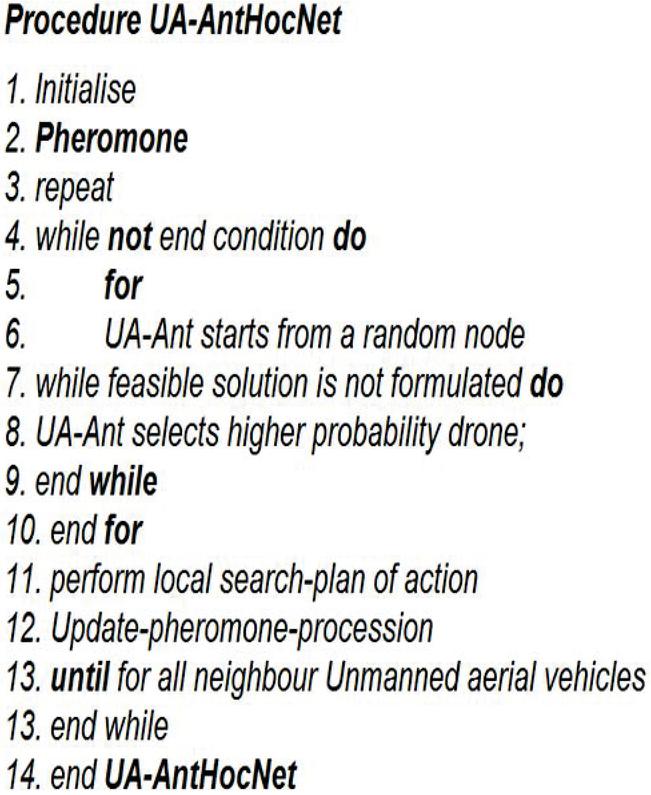
Figure 1 Mechanism of Unmanned Aerial-ANTHOCNET.
Figure 1 briefly explains the main working principal of unmanned aerial-anthocnet which starts from particle initialization, then when the ant starts moving from one place to another the concentration of pheromone can be evaluated, also some of the chemical can be evaporated easily, if the ants will not go on that route. Formation of feasible solution can find the higher probability in every path where local search-plan of action can be performed. In addition, updating pheromone process is the key method to find the neighbor nodes easily.
| (1) |
Equation (1) describes the ant movement in edge m & n.
| without vaporization | (2) | ||
| with vaporization | (3) |
Equations (2) & (3) demonstrates the route with vaporization and sometimes without.
| (4) |
Equation (4) is the main formula where, we can easily find the next hope neighbor.
9 Simulation Environment
Heuristic experimental feasible examination is conducted using network-simulator-2 through which conceptual scrutiny is executed to carry out pilot-study on some major protocols which include natured inspired ANTHOCNET and other traditional algorithms.
10 Experimental Results
Network topology consists of 30 drones and one base station for routing protocols. Simulation results briefly show optimal development of novel routing protocols investigation using random-way-point mobility pattern in field of flying-things.
10.1 Packet Drop Count (Random WayPoint)
Figure 2 elaborates the packet drop count using random waypoint mobility pattern, where anthocnet and zone routing protocol shows very less packet drop as compared to other routing techniques.
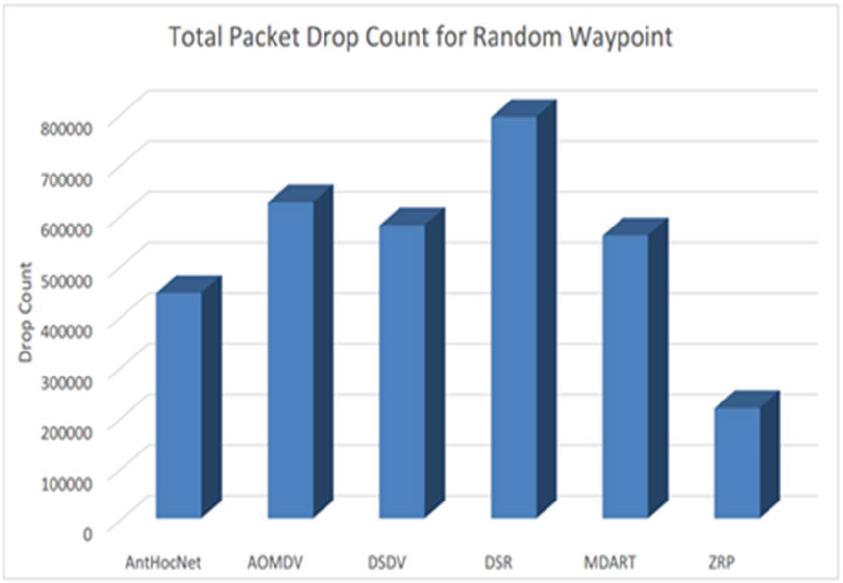
Figure 2 Packet drop count.
10.2 Packet Loss (Random WayPoint)
Figure 3 is about packet delivery in which two metrics like packet sent & packet received are evaluated where zone routing technique shows optimal results in terms of other protocols.
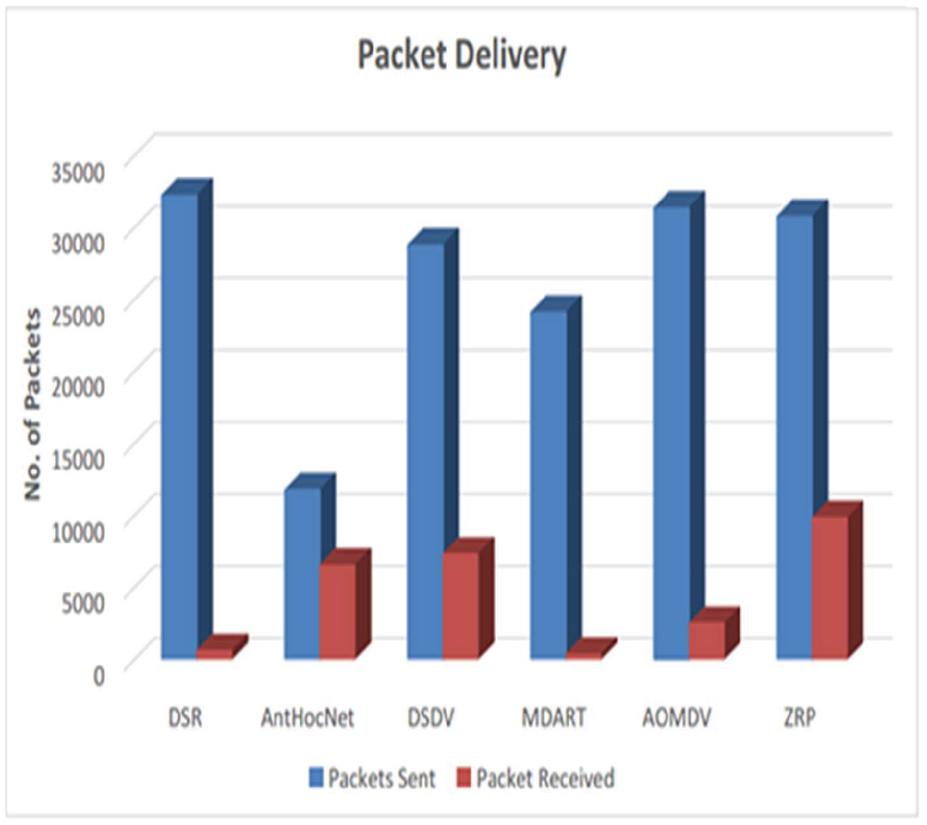
Figure 3 Packet delivery.
Table 2 express the packet loss ratio of the routing techniques used in the simulation, where in anthocnet only 6159 data packets are dropping while AOMDV is having higher packet loss ratio in contrast with other techniques.
10.3 Average End-to-End Delay (Random WayPoint)
Table 4 shows the information of end-to-end delay where destination sequenced destination vector routing protocol is having very less data packets in comparison with additional routing techniques.
Table 2 Packet loss (PL) for random waypoint
| Protocol | Packet Sent | Packet Received | Packet Loss |
| AOMDV | 29236 | 10770 | 18466 |
| AntHocNet | 14958 | 8799 | 6159 |
| MDART | 19583 | 1575 | 18008 |
| DSR | 27872 | 3937 | 23935 |
| DSDV | 24967 | 16070 | 8897 |
| ZRP | 28207 | 16385 | 11822 |
Table 3 Packet delivery ratio (PDR)
| Protocol | Packets Sent | Packet Received | PDR (%) |
| DSR | 32166 | 541 | 1.6819 |
| DSDV | 28712 | 7233 | 25.19156 |
| MDART | 24043 | 303 | 1.260242 |
| AntHocNet | 11696 | 6478 | 55.38646 |
| AOMDV | 31283 | 2417 | 7.726241 |
| ZRP | 30697 | 9756 | 31.78161 |
| Table 3 show the data configuration of Figure 3. |
Table 4 Delay using random waypoint
| Protocols | Average End-to-End Delay (ms) |
| DSDV | 1336 |
| DSR | 5168 |
| AOMDV | 6374 |
| MDART | 2317 |
| ZRP | 1483 |
| AntHocNet | 2042 |
11 Results and Discussion
Deployment of routing techniques using different aerial vehicles-based mobility pattern is used in the simulation. Nature influenced routing technique called AntHocNet is introduced in the field of IoT based FANETs using 5G networks which show great tendency in the parameters like throughput estimation and bandwidth utilization also as the jitter is calculated with the other traditional routing schemes Ant-Hoc-Net and zone-routing-protocol represents better results. While computing the estimation of packet loss, the proposed ant-based algorithm gives optimal sums as well as which improve a novel framework consideration that is Quality-of-Experience (QoE). Also, M-DART, ZRP & evolutionary computing-based strategy rule that is based on ant colony manifest very less packet drop count in comparison with other routing protocols.
12 Conclusion
Flying things is the newly emerged area in the revolutionary development of ad hoc networks which consist of single UAV or either multiple aerial vehicle. Commonly used technologies in IoT based FANETs are wireless communication technologies like IEEE 802.11 or 5G. Also routing protocols experience FANET frequently change the topology in three-dimensional environment. IoT based FANETs is the interconnectivity of aerial vehicles with the ground station using reliable communication links. This article proposes novel routing protocol which is based on evolutionary computing technique known as ant colony. AntHocNet is introduced for the first time in the field of IoT based FANETs which shows quality simulation results in terms of jitter, end-to-end-delay, packet loss, throughput, bandwidth utilization also packet delivery in comparison with traditional routing strategies like DSR, DSDV, ZRP, AOMDV, and M-DART. Also, the drone-communication-protocols are divided in about six categories which can be reactive, proactive, static, hybrid, position or hierarchical. This research study discusses the major draw-backs of the old technologies like mobile-ad-hoc-networks and V-A-NETS. Apart from that novel flying-web-of-things architecture is designed. The experimental work is demonstrated on random waypoint.
In future, other mobility model need to be used to improve communication standards in FANETs. Designing a novel mobility pattern for UAVs will be considered the optimal solution. Optimization techniques and artificial intelligence will give intelligent communication channels in between UAVs. Also, in near future 6G can be utilized to enhance the connectivity issues in flying ad hoc networks.
References
[1] M. Fiore, C. Ettore Casetti, C. Chiasserini and P. Papadimitratos, “Discovery and Verification of Neighbor Positions in Mobile Ad Hoc Networks,” in IEEE Transactions on Mobile Computing, vol. 12, no. 2, pp. 289–303, Feb. 2013.
[2] C. Guleria and H. K. Verma. “Improved Detection and Mitigation of DDoS Attack in Vehicular Ad hoc Network,” 2018 4th International Conference on Computing Communication and Automation (ICCCA), Greater Noida, India, 2018, pp. 1–4.
[3] K. Naseer Qureshi, F. Bashir and S. Iqbal. “Cloud Computing Model for Vehicular Ad hoc Networks,” 2018 IEEE 7th International Conference on Cloud Networking (CloudNet), Tokyo, 2018, pp. 1–3.
[4] I. U. Khan, I. M. Qureshi, M. A. Aziz, T. A. Cheema and S. B. H. Shah, “Smart IoT Control-Based Nature Inspired Energy Efficient Routing Protocol for Flying Ad Hoc Network (FANET),” in IEEE Access, vol. 8, pp. 56371–56378, 2020.
[5] M. A. Khan et al. “An Efficient and Provably Secure Certificateless Key-Encapsulated Signcryption Scheme for Flying Ad-hoc Network,” in IEEE Access, vol. 8, pp. 36807–36828, 2020.
[6] D. Kim and J. Lee. “Integrated Topology Management in Flying Ad Hoc Networks: Topology Construction and Adjustment,” in IEEE Access, vol. 6, pp. 61196–61211, 2018.
[7] D. Liu, J. Wang, Y. Xu, Y. Xu, Y. Yang and Q. Wu. “Opportunistic Mobility Utilization in Flying Ad-Hoc Networks: A Dynamic Matching Approach,” in IEEE Communications Letters, vol. 23, no. 4, pp. 728–731, April 2019.
[8] I. Mahmud and Y. Cho. “Adaptive Hello Interval in FANET Routing Protocols for Green UAVs,” in IEEE Access, vol. 7, pp. 63004–63015, 2019.
[9] B. Zeng, T. Song and J. An. “A Dual-Antenna Collaborative Communication Strategy for Flying Ad Hoc Networks,” in IEEE Communications Letters, vol. 23, no. 5, pp. 913–917, May 2019.
[10] D. Shumeye Lakew, U. Sa’ad, N. Dao, W. Na and S. Cho. “Routing in Flying Ad Hoc Networks: A Comprehensive Survey,” in IEEE Communications Surveys & Tutorials, vol. 22, no. 2, pp. 1071–1120, Second quarter 2020.
[11] M. Ahmad, A. Hameed, A. A. Ikram and I. Wahid. “State-of-the-Art Clustering Schemes in Mobile Ad Hoc Networks: Objectives, Challenges, and Future Directions,” in IEEE Access, vol. 7, pp. 17067–17081, 2019.
[12] Ahmad, M., Ikram, A.A., Wahid, I. et al. Optimized clustering in vehicular ad hoc networks based on honey bee and genetic algorithm for internet of things. Peer-to-Peer Netw. Appl. 13, 532–547 (2020).
[13] M. A. Khan et al.. “An Efficient and Provably Secure Certificateless Key-Encapsulated Signcryption Scheme for Flying Ad-hoc Network,” in IEEE Access, vol. 8, pp. 36807–36828, 2020.
[14] M. A. Khan, A. Khalid and F. Khanzada. “Dual-Radio Dual-Band Configuration for Flexible Communication in Flying Ad-hoc Network (FANET),” 2019 International Conference on Communication Technologies (ComTech), Rawalpindi, Pakistan, 2019, pp. 108-113.
[15] M. A. Khan, A. Safi, I. M. Qureshi and I. U. Khan. “Flying ad-hoc networks (FANETs): A review of communication architectures, and routing protocols,” 2017 First International Conference on Latest trends in Electrical Engineering and Computing Technologies (INTELLECT), Karachi, 2017, pp. 1–9.
[16] Khan, M.A.; Khan, I.U.; Safi, A.; Quershi, I.M. Dynamic Routing in Flying Ad-Hoc Networks Using Topology-Based Routing Protocols. Drones 2018, 2, 27.
[17] Souaad Boussoufa-Lahlah, Fouzi Semchedine, Louiza Bouallouche-Medjkoune, “Geographic routing protocols for Vehicular Ad hoc NETworks (VANETs): A survey”, Vehicular Communications Volume 11, January 2018, Pages 20–31.
[18] Syed Bilal Shah, Chen Zhe, Yin Fuliang, Inam Ullah Khan, Niqash Ahmad, “Energy and interoperable aware routing for throughput optimization in clustered IoT-wireless sensor networks”, Future Generation Computer Systems Volume 81, April 2018, Pages 372–381.
[19] M. Y. Arafat and S. Moh. “A Survey on Cluster-Based Routing Protocols for Unmanned Aerial Vehicle Networks,” in IEEE Access, vol. 7, pp. 498–516, 2019.
[20] Muralidhar, K., and K. Madhavi. “An Investigation into the Operational Limitations of Mobile Ad Hoc Networks.” IEEE Xplore, 22 Mar. 2017.
[21] J. H. Lee, M. Park and S. C. Shah. “Wi-Fi direct based mobile ad hoc network,”2017 2nd International Conference on Computer and Communication Systems (ICCCS), Krakow, 2017, pp. 116–120.
[22] Minseok Jang, Myong-Soon Park and S. C. Shah. “A mobile ad hoc cloud for automated video surveillance system,” 2017 International Conference on Computing, Networking and Communications (ICNC), Santa Clara, CA, 2017, pp. 1001–1005.
[23] B. Kim, D. G. Majengo, K. Kim, B. Roh and J. Ham. “Dynamic Timer Based on Expected Link Duration in Mobile Ad Hoc Networks,” 2019 IEEE 16th International Conference on Mobile Ad Hoc and Sensor Systems Workshops (MASSW), Monterey, CA, USA, 2019, pp. 158–159.
[24] W. Wang, F. Xie and M. Chatterjee. “Small-Scale and Large-Scale Routing in Vehicular Ad Hoc Networks,” in IEEE Transactions on Vehicular Technology, vol. 58, no. 9, pp. 5200–5213, Nov. 2009.
[25] W. Dargie. “A Quantitative Measure of Reliability for Wireless Sensor Networks,” in IEEE Sensors Letters, vol. 3, no. 8, pp. 1–4, Aug. 2019, Art no. 7500904.
[26] S. Rosati, K. Krużelecki, G. Heitz, D. Floreano and B. Rimoldi. “Dynamic Routing for Flying Ad Hoc Networks,” in IEEE Transactions on Vehicular Technology, vol. 65, no. 3, pp. 1690–1700, March 2016.
[27] C. Pu. “Jamming-Resilient Multipath Routing Protocol for Flying Ad Hoc Networks,” in IEEE Access, vol. 6, pp. 68472–68486, 2018.
[28] O. S. Oubbati, M. Atiquzzaman, P. Lorenz, M. H. Tareque and M. S. Hossain, “Routing in Flying Ad Hoc Networks: Survey, Constraints, and Future Challenge Perspectives,” in IEEE Access, vol. 7, pp. 81057–81105, 2019.
[29] M. Alharthi, A. M. Taha and H. S. Hassanein. “An Architecture for Software Defined Drone Networks,” ICC 2019 – 2019 IEEE International Conference on Communications (ICC), Shanghai, China, 2019, pp. 1–5.
[30] Inam Ullah Khan, Ryan Alturki, Hasan J. Alyamani, Mohammed Abdulaziz Ikram, Muhammad Adnan Aziz, Vinh Truong Hoang, Tanweer Ahmad Cheema, “RSSI-Controlled Long-Range Communication in Secured IoT-Enabled Unmanned Aerial Vehicles”, Mobile Information Systems, vol. 2021, Article ID 5523553, 11 pages, 2021.
Biographies

Inam Ullah Khan is the faculty member at department of computer science, SZABIST, Islamabad Campus, Pakistan. Also, he is the Founder of Internet of Flying Vehicles-Lab at AI-EYS and was a Lecturer at different universities in Pakistan which include Center for Emerging Sciences Engineering & Technology (CESET), Islamabad, Abdul Wali Khan University, Garden, Timergara Campus and University of Swat. Recently, he is selected as a visiting researcher at king’s college London, Uk. He completed his Ph.D. in Electronics Engineering from Department of Electronic Engineering, Isra University, Islamabad Campus, School of Engineering & Applied Sciences (SEAS). Also, he did his M.S. degree in Electronic Engineering at Department of Electronic Engineering, Isra University, Islamabad Campus, School of Engineering & Applied Sciences (SEAS). He had done undergraduate degree in Bachelor of Computer Science from Abdul Wali Khan University Mardan, Pakistan.Apart from that his Master’s thesis is published as a book on topic “Route Optimization with Ant Colony Optimization (ACO)” in Germany which is avaliable on Amazon.He is a research scholar; he has published some research papers at international level. More interestingly he recently introduced a novel routing protocol E-ANTHOCNET in the area of flying ad hoc networks. His research interest includes Network System Security, Intrusion Detection, Intrusion Prevention, cryptography, Optimization techniques, WSN, IoT, Mobile Ad Hoc Networks (MANETS), Flying Ad Hoc Networks, and Machine Learning. He has served international conferences as Technical program committee member which include, EAI International Conference on Future Intelligent Vehicular Technologies, Islamabad, Pakistan and 2nd International Conference on Future Networks and Distributed Systems, Amman, Jordan, June 26–27, 2018, International Workshop on Computational Intelligence and Cybersecurity in Emergent Networks (CICEN’21) that will be held in conjunction with the 12th International Conference on Ambient Systems, Networks and Technologies (EUSPN 2021) which is co-organized in November 1–4, 2021, Leuven, Belgium. Also, he was technical program committee member at international workshop on intelligent systems for sustainable smart cities, New Delhi, India, February 19–20, 2022. In addition, he served his first book as editor on title: “Computational Intelligence for Unmanned Aerial Vehicles Communication Networks”: Studies in Computational Intelligence at Springer. While, he is currently editing his 2nd book as editor on title: big data Analytics and Computational Intelligence for Cyber Security. In 2022, his third book as editor is accepted on topic “Machine Intelligence for Internet of Medical Things: Applications and Future Trends” at Bentham Science Publisher LTD.
Asrin Abdollahi is the founder of AI-EYS. She received the bachelor degree in Electrical Engineering from Urmia University, Iran, and the Master’s degree in Electrical Engineering from the Department of Electrical Engineering, University of Kurdistan, Iran. Recently she is working as Founder/member at Communication Technologies-LAB. She has published some research articles at international level. Her research interests include network system security, intrusion detection System, intrusion prevention, machine learning, wireless sensor networks, internet of things, and flying ad hoc networks (FANETS).

Abdul Jamil is a final year student of BS Electrical Engineering at the National University of Computer and Emerging Sciences. He is one of “Microsoft Learn Student Ambassadors”. He is also selected as “Google Developer Student Club Lead” for his university by Google for session 2021–2022. He has been continuously contributing to the open-source as well and was selected as GitHub Campus Expert by “GitHub”. His research interest areas are Cloud Computing, Internet of Things, Communication Technologies, Flying Ad hoc Networks, and Machine Learning.

Bisma Baig is the member of AI-EYS-LAB. She basically belongs from Sultanabad Gilgit. She is a final year student of BS Software Engineering from COMSATS University Islamabad, Abbottabad Campus. She is a writer and worked with different international and multi-national companies like Oxford Creative Hub, Google and OPTEC International on different professions. Apart from that some of her research work is accepted in international journals and springer books. Her research interest includes Internet of things (IoT), Flying Ad Hoc Networks and Machine Learning.

Muhammad Adnan Aziz received the B.S. degree in computer sciences from A.I.O.U., Islamabad, Pakistan, in 2002, the M.S. Degree in electronic engineering from Mohammad Ali Jinnah University, Islamabad, in 2008, and the Ph.D. Degree in electronic engineering from Isra University, Islamabad, in 2007. He has been working as an Associate Professor at Isra University, Islamabad Campus, since 2009. His research interests include soft computing, power optimization, and signal-processing.

Fazal Subhan received the MSc degree in electronics from the department of electronic engineering, School of Engineering and applied sciences (SEAS), Isra University Islamabad Campus, Pakistan in 2014. Where he is currently pursuing the PhD degree, and the MS degree in Electronic Engineering from the department of electronic engineering, faculty of engineering and technology, international Islamic university Islamabad, Pakistan in 2017. His research interest includes optimization techniques, control system, power electronics, and boundary value problems.
Journal of Mobile Multimedia, Vol. 18_5, 1333–1354.
doi: 10.13052/jmm1550-4646.1851
© 2022 River Publishers