Wi-Fi Evolution: The Path Towards Wi-Fi 7 and Its Impact on IIoT
Valerio Frascolla*, Dave Cavalcanti and Rahul Shah
Intel Corporation, Deutschland GmbH, Germany
E-mail: valerio.frascolla@intel.com; dave.cavalcanti@intel.com; rahul.c.shah@intel.com
*Corresponding Author
Received 30 April 2022; Accepted 31 May 2022; Publication 20 September 2022
Abstract
This paper provides an overview of the Wi-Fi technology and its evolution along the years, touching on its inception and then elaborating more in details on the latest three commercial releases, linking the Wi-Fi advancements with the parallel cellular technology evolution towards 6G. Finally, a glimpse on the novelties proposed by the currently under definition Wi-Fi 7 release and more specifically on Wi-Fi sensing, a promising usage of Wi-Fi, are taken as an example of the forthcoming benefits of Wi-Fi in the smart home and Industrial Internet of Things (IIoT) domains.
Keywords: Wi-Fi, wireless access, 5G, 6G, wireless system, standardization, Wi-Fi sensing, IEEE, 3GPP.
1 Introduction
Following the frantic pace of the continuous evolution of the wireless technology [1], just few quarters after the introduction of the 5th generation (5G), i.e., the latest commercially deployed generation of the telecommunication system, academia and industry are already discussing and aligning on which will be the capabilities and features of the forthcoming generation of the telecommunication system, known as 6G. Such discussions are happening in pre-standardization and pre-competitive arenas, e.g., in associations like the 6G Smart Networks and Services Industry Association (6G-IA) [2] in the European Union and the NextGenAlliance [3] in USA.
Indeed, what 6G will be, is going to be defined by a set of relevant standardization bodies, the most prominent of which will be the 3rd Generation Partnership Project (3GPP), the Institute of Electrical and Electronics Engineers (IEEE) and the European Telecommunications Standards Institute (ETSI). 6G standardization work is expected to start around 2025, with proprietary solutions to appear a couple of years later and first broad commercial deployments expected around 2030.
6G will be a game changer in numerous vertical markets, in the sense that, among other things, it will merge different wireless and wired access networks, so to provide the best possible Quality of Experience (QoE) to final users. 6G is to be therefore intended as a system of systems, where all wireless and wired access technologies will be managed in a much more power-aware, intelligent and effective manner than what it is currently possible to achieve [4].
As a matter of fact, regarding cellular wireless access, a system can be called 5G if it is compliant with the 3GPP set of features composing the so-called Phase 1, i.e., a set of functionalities defined by the 3GPP Release 15 specifications. Since the beginning of 2022, first equipment vendors announced the availability of networks updated with the more recent 3GPP Phase 2 (Release 16) set of features [5].
Indeed, according to the plan of 3GPP work groups, Release 17 is going to be completed by the end of 2022, and work has already started in parallel to define the so-called 5G Advanced systems, stemming from the 3GPP Release 18 onwards, thus providing a bridge toward the definition of the 6G specifications.
Among the key access technologies that will have to synergize to make 6G a reality, cellular and Wi-Fi are indeed the most important ones. In this paper we focus on a short survey of the evolution of Wi-Fi till its latest commercially available releases, and then we conclude providing an example of an application, Wi-Fi Sensing, that has the capability of being a game changer for several domains, e.g., Industrial Internet of Things (IIoT) and Smart Home.
2 Wi-Fi: WIreless FIdelity
Before entering in the details of the evolution of the WiFi technology, it is worth mentioning what Wi-Fi stands for and what it is.
There are several definitions of what Wi-Fi may mean, the most commonly agreed-upon one is ‘Wireless Fidelity’. Wi-Fi is a technology based on a set of wireless protocols that relate to the IEEE 802 broad family of standards [6]. Wi-Fi is a trademark of the Wi-Fi Alliance [7], the association in charge of driving global Wi-Fi adoption and evolution, which grants the usage of the ‘Wi-Fi CERTIFIED’ label to products that complete interoperability certification tests.
Wi-Fi specifications in the IEEE standards have a long story. The IEEE-802.11 work group started its operation back in 1990, with a very small number of delegates, today recognized as pioneers, taking care of the work (see Figure 1).

Figure 1 Start of the IEEE 802.11 working group (courtesy of IEEE).
As times passed by, the work group attracted an always growing attention from the international wireless community, more and more Wi-Fi specifications and related Wi-Fi certified products appeared in the market, and the number of attendees has been growing accordingly, as can be seen comparing Figure 1 with Figure 2.
Indeed 802 has ended up being one of the most attended work group of the IEEE family of standards, summing up to a hundred of delegates in face-to-face meetings, before the pandemic times.

Figure 2 Participants to a face to face meeting of the IEEE 802.11 working group, before the COVID-19 breakout (courtesy of IEEE).
As of 2022, the latest commercially available release of Wi-Fi is based on so called IEEE 802.11ax or 802.11ax-2021 specifications, and is branded as Wi-Fi 6 by the Wi-Fi Alliance, operating in license-exempt frequency bands at 2.4 GHz, 5 GHz, and 6 GHz. Wi-Fi 6E (E stands for ‘Extended’) is the label given to products capable of making use of the 6 GHz spectrum band.
Due to lack of room let’s skip the first 15 glorious years of Wi-fi releases and let’s analyze some of the key features introduced starting with 2007, i.e., in parallel to the definition phase of the Long-Term Evolution (LTE) generation of cellular systems, also known as 4G7.
2.1 Wi-Fi 4
In 2007, during the fierce fight between WiMAX and cellular technologies to be recognized as the first real worldwide standard for mobile wireless communication, Wi-Fi 4 appeared in the market, proposing the following main features:
– Max data rate: 1.2 Mbps
– Up to 44 Multiple Input Multiple Output (MIMO)
– 40 MHz channels
– 64-Quadrature Amplitude Modulation (QAM)
– Band operation in both 2.4 GHz and 5 GHz
Wi-Fi 4 was based on the 802.11n standard and gave raise to a huge improvement in wireless access capabilities, entering a world in which almost every personal computer at home was equipped with Wi-Fi 4, making it the ‘the facto’ standard for short range high bandwidth indoor communications.
In the same period also the so called ‘long-range Wi-Fi’ appeared in the market, which was a point-to-point computer network connection, considered a low-cost alternative to other types of connections like fixed wireless, cellular or even satellite access. One of the most interesting deployment took place in Peru, where a 450 Km long wireless connection network was put in commercial operation.
2.2 Wi-Fi 5
In 2013, once LTE managed to establish itself as the worldwide cellular network technology, Wi-Fi 5 appeared in the market. Several improvements made appealing the upgrade to the latest version, among which:
– Max data rate: 3.5 Gbps
– 88 MIMO
– 80 and 160 MHz channels
– Downlink Multi-Users (MU)-MIMO
– 256 QAM
– Operations allowed only in the 5 GHz frequency band
Wi-Fi 5 was based on the IEEE 802.11ac standard and it is worth noticing on the one hand the huge increase in max data rate when compared to Wi-Fi 4, and on the other hand the restricted operation only to the 5 GHz band.
2.3 Wi-Fi 6
In 2019, once the 5G cellular network discussion was in full swing and 3GPP was going to finalize the first set of specifications that would give raise to the 5G Phase 1 feature-set, Wi-Fi 6 was launched in the market.
Its main advancements can be listed as:
– Max data rate: 9.6 Gbps
– Uplink (UL) and Downlink (DL) MU-MIMO
– 1024 QAM
– Orthogonal frequency-division multiple access (OFDMA)
– Target Wake Time (TWT)
– Operations possible in the three bands 2.4 GHz, 5 GHz, and 6 GHz
– Enhanced security features like Wi-Fi Protected Access (WPA) 3
Under ‘Wi-Fi 6E’ specifications it was intended the support of the newly introduced 6 GHz spectrum band, a feature that was introduce at the beginning of 2021.
Wi-Fi 6 was based on the IEEE 802.11ax standard and it is worth noting that, in addition to the evolutionary enhancements to max data rates, QAM and improved MIMO capabilities, Wi-Fi 6 introduced two appealing features for industrial deployments, which are TWT and WPA3. The former allows to both reduce overall power consumption of Wi-Fi operations (key feature in IoT deployments), and a cleverer use of medium contention between Wi-Fi stations, which results in a more effectively use of the wireless medium. The latter is a 192-bit cryptography that replaces the older Pre-Shared Key (PSK) exchange security feature with the more effective Simultaneous Authentication of Equals (SAE) exchange feature. Indeed, lower power operations and shorter wake-up times, together with improved and new security features, are all key aspects that increased the appeal of Wi-Fi deployments in several commercial (home appliances) as well as industrial production environments.
Overall, it is measured in field tests that Wi-Fi 6, compared to Wi-Fi 5, manages to obtain a reduction of average latency of 75% and an enhancement of throughput of 400% [8].
An additional important aspect of Wi-Fi 6E deployments is the worldwide availability of 6 GHz spectrum to be allocated for unlicensed usage. At the end of 2021 several countries approved the usage of such band, allowing regulatory certifications to be finalized and products to be launched in numerous countries, among others South Korea, USA, Canada, UK, EU, UAE, Chile, Brazil, Peru, Guatemala, El Salvador and Honduras, and more will be added in the next quarters. Finally, it is worth mentioning the late start – if it will start at all – of freeing the 6GHz usage for Wi-Fi services in China, which at the moment seems has no plan at the moment to free 6 GHz bands for Wi-Fi, as it plans to make use of those frequency band for cellular access.
2.4 Wi-Fi 7
The forthcoming generation of Wi-Fi is Wi-Fi 7, also known as Wi-Fi Extreme High Throughput. As the name tells, big improvements on the available bandwidth are expected, but also other areas will be substantially improved, among which:
– Max data rate 46 Gbps
– 1616 MIMO
– Support for 320 MHz channels
– 4096 QAM
– Allocation of multiple resource units, e.g., groups of OFDMA tones
– 16 spatial streams can be handled in parallel
– Multi-Resource Unit (RU), also known as Puncturing, will allow to exploit non-contiguous frequency bands
– No new frequency bands are supposed to be supported, so again Wi-Fi 7 will operate in 2.4 GHz, 5 GHz, 6 GHz bands
– Multiple Access Point (Multi-AP) operations
– Deterministic low latency
Specifically the last two features are interesting for IIoT deployments, as even though Wi-Fi 6 can achieve single-digit ms latency, however worst-case latency is not assured, especially in highly congested environments, which can be considered shop floors or more in general manufacturing-related contexts. The addition of features like the Multi-link operations, 320 MHz channels and Multi-Access Points will definitely help in finally getting some level of determinism in Wi-Fi networks.
Finally, it is worth mentioning that Time Sensitive Networking (TSN) enhancements are planned to be integrated in Wi-Fi 7, leveraging on the experience that IEEE has gained thanks to the work of the TSN Task Group (IEEE 802 TSN) [9]. A comprehensive summary of planned Wi-Fi 7 features and expected related benefits can be found in [10] and [11], from where Figure 3 is taken, which shows the parallel work of standardization and certification work for the latest Wi-Fi releases. It is worth noticing that also Wi-Fi 7 will be composed of a set of features, which will be defined in specification following a two-staged approach (Release 1 and Release 2), similar to what has happened with the 5G feature set.
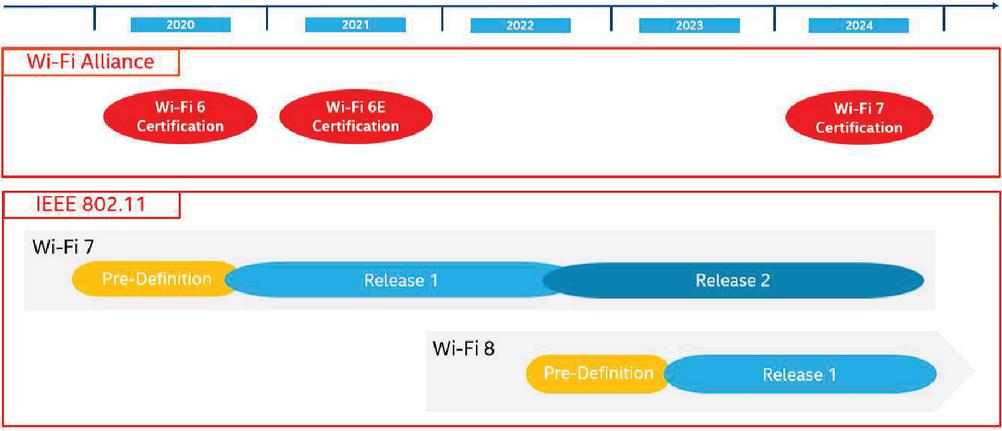
Figure 3 Wi-Fi 6/7 certification (Wi-Fi Alliance) and Wi-Fi 7/8 standardization (IEEE) timeline.
Wi-Fi 7 will be based on the IEEE 802.11be standard and work is progressing well in finalizing the specifications, with the Wi-Fi 7 compliant products to start appearing in the market in the 2024 -2025 timeframe, once the standard ratification will be concluded (2024). Of course, pre-standards proprietary chipsets could appear in the market even earlier, but broad and fully compliant deployments are not supposed to be mainstream before 2025.
The following figure well summarizes the main features and key differences in the evolution from Wi-Fi 4 till the planned Wi-Fi 7.
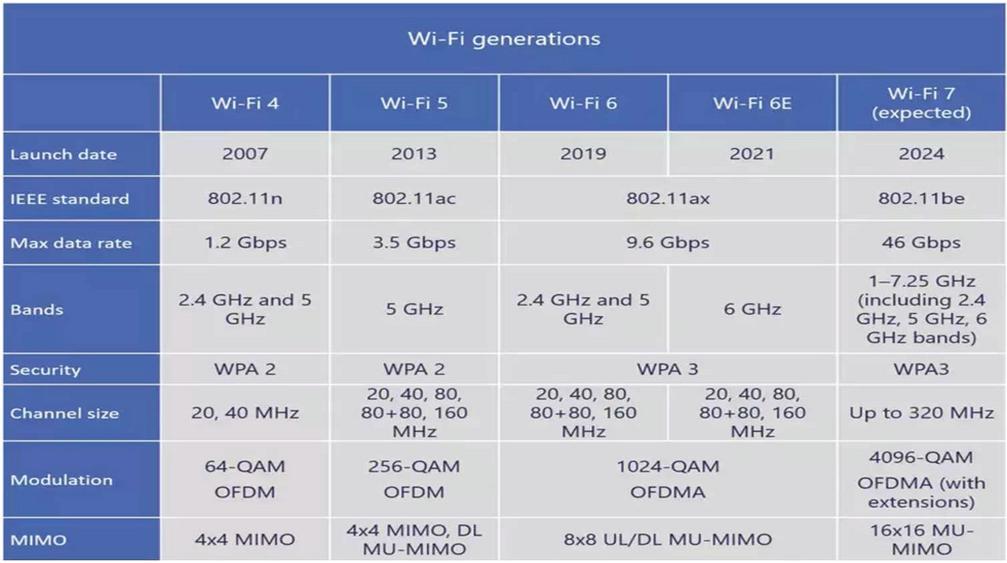
Figure 4 Comparison of Wi-Fi releases from Wi-Fi 4 to Wi-Fi 7 (courtesy of [12]).
2.5 TSN, Wired and Wireless Access Convergence for IIoT
Wireless connectivity is becoming more and more important in IIoT applications, as the benefit of mobility and higher data rates, together with a much higher security level, will be exploited in advanced manufacturing and will, if not replace, at least more and more gain market share from wired communications, which as of today is by far the most common communication medium in the industrial sector. Indeed, the planned enhancements in both cellular (5G Advanced) and Wi-Fi (Wi-Fi 7) wireless access will bring a lot of advantages and mutual complementarity for industrial applications.
However, there is another very important component that needs to be added to finally allow for the much looked for digital transformation of the industry, i.e., a full-fledged support of TSN features, among which one can mention enhanced reliability, proper time synchronization among different domains, and finally advanced traffic scheduling capabilities.
To smoothly include TSN into industrial domains and to bridge the gap between unlicensed technologies and IIoT application including TSN, Wi-Fi, being based on 802.11, interacts much more smoothly with the Ethernet protocol, therefore co-existence with the TSN protocols can be much better guaranteed than cellular-based protocols that are not natively supporting IEEE access
In summary, 5G access is not natively based on 802 LAN technology, however, 3GPP since Release 16 started looking into ways to better support TSN. On the other hand, Wi-Fi is based on 802 LAN technology and has the advantage of being natively closer to TSN, thus allowing an easier integration of TSN concepts and standards in future Wi-Fi releases (e.g., Wi-Fi 7), allowing to minimize worst case latency and meet stringent jitter requirements of IIoT applications.
3 Wi-Fi Sensing
Among the several useful applications of Wi-Fi, in this short paragraph we want to briefly elaborate on Wi-Fi Sensing, which is taken care of by the IEEE 802.11bf family of standards, chartered to establish a robust interoperability of wireless devices and enable a wide range of novel Wi-Fi applications based on sensing, especially in the Human-Computer Interaction HCI domain [13], useful in home as well as IIoT application. In what follows we make an example of how Wi-Fi sensing can help solving some of the problems of a fully digitalized future home environment.
Understanding activities of daily living in homes and other smart indoor environments is a prerequisite to develop features that can assist users, especially for applications such as aging in place and personal assistance (see Figure 5). To provide broad sensing coverage while minimizing privacy concerns, wireless sensing is one of the most suitable forms of sensing. Deployments of dozens of Wi-Fi devices in a typical home (i.e., good sensing coverage and lower deployment costs) plus the ability of wireless sensing to sense motion but not an “image” of the scene (i.e., lesser privacy concerns), plus fewer problems with field-of-view issues make this form of sensing very attractive [14].
Promising Joint Communication and Sensing Techniques (JCAS) can build on these strengths to be used for various indoor sensing applications, e.g., approximate localization (e.g., room level) of individuals, e.g., understand approach, or proximity or walk-away from devices, body motion, gesture detection, vitals monitoring, and fall detection. In certain settings such as schools, wireless sensing can further detect groups of people and better spot their ongoing activities, so to better understand group dynamics.
Wi-Fi sensing systems are already starting to be deployed for motion sensing/security applications, followed by uses around proximity detection, however, they are currently limited by systems optimized for communication that are being repurposed for sensing. JCAS systems can significantly enhance the sensing capability and jointly optimize both communications and sensing to enable a wider set of applications.

Figure 5 Exemplary Wi-Fi sensing applications at home.
Sensing systems compatible with Wi-Fi communications can demonstrate how it is possible and technically feasible to provide sensing capability suitable for understanding activities of daily living in homes, also thanks to the deployment scale of Wi-Fi to enable the vision of cheap, ubiquitous sensing in smart indoor and industrial environments.
References
[1] B. Raaf et al., “Key technology advancements driving mobile communications from generation to generation”, in Intel Technology Journal 18 (1), 2014.
[2] 6G-Industry Association. Available online at: https://6g-ia.eu.
[3] NextGAlliance website. Available online at: https://nextgalliance.org/.
[4] C. Bernardos et al., White Paper “European Vision for the 6G Network Ecosystem”, 5G-IA, June 2021. DOI: 10.13140/RG.2.2.19993.95849.
[5] V. Frascolla (2020) “What Are 3GPP 5G Phase 1 and 2 and What Comes After”. In: Thampi S. et al. (eds) Advances in Signal Processing and Intelligent Recognition Systems. SIRS 2019. Communications in Computer and Information Science, vol 1209. Springer, Singapore. DOI: https://doi.org/10.1007/978-981-15-4828-4\_32.
[6] IEEE Website. Available online at: www.ieee.org.
[7] Wi-Fi Alliance Website. Available online at: www.wi-fi.org.
[8] https://www.zdnet.com/article/next-generation-802-11ax-wi-fi-dense-fast-delayed.
[9] Time-Sensitive Networking (TSN) Task Group. Available online at: https://1.ieee802.org/tsn/.
[10] E. Khorov, et al., “Current Status and Directions of IEEE 802.11be, the Future Wi-Fi 7,” in IEEE Access, vol. 8, pp. 88664–88688, 2020, doi: 10.1109/ACCESS.2020.2993448.
[11] A. Garcia-Rodriguez, et al., “IEEE 802.11be: Wi-Fi 7 Strikes Back,” in IEEE Communications Magazine, vol. 59, no. 4, pp. 102–108, April 2021, doi: 10.1109/MCOM.001.2000711.
[12] TechUnwrapped. “Know the characteristics and speed of the new WiFi 7 or 802.11be” Available online at: https://techunwrapped.com/know-the-characteristics-and-speed-of-the-new-wifi-7-or-802-11be/.
[13] W. Abbasi et al., “Privacy vs Accuracy Trade-Off in Privacy Aware Face Recognition in Smart Systems,”, to appear in the 27th IEEE Symposium on Computers and Communications (IEEE ISCC 2022), Rhodes Island, Greece, 2022.
[14] R. Zhang, et al., “Wi-Fi Sensing for Joint Gesture Recognition and Human Identification from Few Samples in Human-Computer Interaction,” in IEEE Journal on Selected Areas in Communications, doi: 10.1109/JSAC.2022.3155526.
Biographies

Valerio Frascolla (MSc and PhD in Electronic Engineering) is Director of Research and Innovation at Intel and had been working in different roles at Ancona University, Comneon, Infineon, as reviewer for the European Commission and independent evaluator for both the Portuguese and the Romanian science foundations. He is in the advisory board of 6 international research projects and has played different roles in other 18. He represents Intel in European associations (6G-IA, TCI, AIOTI, the NetworldEurope ETP) being Board of Directors member of the BDVA association. Valerio has expertise in wireless systems architecture and protocols design, requirements management, standardization (3GPP, ETSI, IEEE), project and program management, mentoring and coaching. He is author of 75+ publications, his main research interest being 5G and beyond system design, with focus on spectrum management, AI, and edge technologies. He serves as reviewer for 40+ journals, has participated in the TPC of 80+ conferences, and has a track record as speaker and organizer of Special Sessions, Workshops, and Panels at key international venues.

Dave Cavalcanti is Principal Engineer at Intel Corporation where he develops next generation wireless connectivity and distributed computing technologies to enable autonomous, time-sensitive systems and applications. He received his PhD in computer science and engineering in 2006 from the University of Cincinnati. He leads Intel Lab’s research on Wireless Time-Sensitive Networking (TSN) and industry activities to enable time-critical systems and applications of wireless technologies, including Wi-Fi and beyond 5G systems. He is Senior Member of the IEEE and serves as the chair of the Wireless TSN working group in the Avnu Alliance, an industry group facilitating an ecosystem of interoperable TSN devices and deterministic networking across Ethernet, Wi-Fi and 5G technologies.

Rahul Shah is a Principal Engineer in the Intelligent Systems Research Lab in Intel Labs where he leads a team on developing multimodal and wireless sensing algorithms for context-aware devices and activity recognition. His background is in wireless communications and networking, and he has worked on sensor networks, mobile systems and ambient sensing. His current focus is on applied ML and innovative sensing techniques that enable smart devices to understand activities, intents, anticipate and collaborate effectively with people. Rahul completed his Ph.D. from UC Berkeley, and did his undergrad at IIT Kharagpur, India. He has served as reviewer and TPC member on multiple conferences and journals and has 30+ publications in peer-reviewed venues.
Journal of Mobile Multimedia, Vol. 19_1, 263–276.
doi: 10.13052/jmm1550-4646.19113
© 2022 River Publishers