Converging Towards Open Radio Access Networks – A Comprehensive Review
Yahya Sameen Junejo1,*, Faisal Karim Shaikh, Bhawani Shankar Chowdhry, Ali Akber Shah and Waleed Ejaz
1Department of Telecommunication Engineering, Mehran University of Engineering & Technology, Jamshoro, Sindh, Pakistan
2NCRA-CMS Lab, Mehran University of Engineering and Technology, Jamshoro, Sindh, Pakistan
3Department of Electrical and Computer Engineering, Lakehead University, ON, Canada
E-mail: 18phdiict05@students.muet.edu.pk; ysjunejo@lakeheadu.ca
*Corresponding Author
Received 01 February 2023; Accepted 11 September 2023; Publication 07 February 2024
Abstract
Radio Access Networks (RAN) have been an integral part of the cellular mobile communication systems since the deployment of Global System for Mobile Communication (GSM) networks and later for the legacy Universal Mobile Telecommunication Systems (UMTS) and Long Term Evolution (LTE) networks. However, due to increasing demands of the users, throughput, ultra-lower latency, virtualization of the network and to cater the seamless connectivity of millions of wireless devices with the cellular networks, the advent of RAN needs to be brought under consideration. In this paper the traditional RANs are discussed with the necessity for their transition into the Open RAN (ORAN), considering all its essential parameters. The constraints of the legacy RAN architectures are explored with an overview of the RAN intelligent controllers, ORAN and its types. This paper additionally examines the function of artificial intelligence in Common Public Radio Interface (CPRI), enhanched CPRI, and xApps in terms of use cases along with the challenges associated with their deployment. The paper also present challenges and future of ORAN.
Keywords: 5G RAN, 6G RAN, open RAN, cloud ran, GSM, front haul, O-RAN interfaces, O-RAN classification.
1 Introduction
The year 1970 has proved to be the advent of mobile cellular systems. In 80s analogue to digital transformation was carried [1, 2]. The third generation of mobile networks, which appeared in the late 1990s, made packet switch communication possible. Until 5G, all legacy generations shared some characteristics, which are mentioned in Table 1. The legacy technologies, i.e., Global System for Mobile Communication (GSM), Universal Mobile Telecommunication System (UMTS) and Long Term Evolution (LTE) were primarily designed for the consumer market. Their main goal was to deliver the voice and data services to the end users (UE). But due to increasing demand of real time services and requirement for lower latency which were not being handled by system of the existing technologies, the LTE-Advanced (LTE-A) was introduced which provided the functionality of Carrier Aggregation which offered the usage of five bands of each 20MHz at the same time summing up to a band width of 100MHz. [10, 11]. This review paper details the transformation of the radio access networks from GSM to UMTS and LTE by detailing the characteristics of the existing network architectures and their limitations/challenges and the reasons of this convergence towards the newer technology and their types. Later in this paper, the comparison and the challenges in the existing technologies are also discussed in detail and the need for the latest and upgraded Radio Access Networks which is known to be the Open RAN or ORAN due to its functionality of being openness to any vendor equipment and provide the feasibility of being deployed in any wireless and cellular network despite of and vendor lock-in. The characteristics and Open RAN classification along with its multiple interfaces has also been discussed in the paper.
The rest of the paper is organized as follows. Section 2 details RANs of different legacy technologies. The challenges in the existing architectures and need for ORAN is described in Section 3. Section 4 details the ORAN Architecture, ORAN Interfaces and its applications and use cases. The last Section 5 lists the challenges in detail and shows the future direction of the ORAN technology.
Table 1 Mobile communication characteristics
| Characteristics | 2G | 3G | 4G | 5G | 6G |
| [3, 4] | [5, 6] | [7] | [8, 9] | [10] | |
| Voice | YES | YES | VOLTe | VO-NR | NO |
| Data | YES | YES | YES | YES | YES |
| User Thpt: | 0.0038 | 14.4 | 100 | 1000 | 10000000 |
| (Mbps) | |||||
| Band width | 3 | 5 | 20 | 200 | Tera Hertz |
| (MHz) | |||||
| Latency | 100 | 20 | 10 | 0.1 | 0.01 |
| (ms) | |||||
| Site Distance | 15000 | 10000 | 1000 | 500 | 100 |
| (meters) |
2 Radio Access Networks
RAN is a basic component of a wireless communication system which connects an UE with the other parts of the networks such as transport and core. A RAN architecture consists of three main parts, i.e., Tx/ Rx antenna, radios and a base band unit.
In mobile networks, the most key component which links the UE and the core network in the cellular network is known as the base station (BS). The BS has basically two operations to perform. These operations are a) Base Band Processing (BBP): It includes coding, Fast Fourier Transformation (FFT) and modulation. b) Radio Functions (RF): It contains amplification, noise cancellation and signal processing [15].
In traditional architecture, BS has BBP and RF as part of it. This architecture has been applicable since the advent of 2G cellular network. With the pace of time, the RAN architecture have been modified with the increasing requirement according to the desired public needs and the specifications and limitations and with the new technologies such as; UMTS and LTE.
There are three main RAN architectures based on the evolution of cellular mobile communication. A traditional GSM RAN Architecture for the 2G network and UTRAN and EUTRAN for the legacy 3G and LTE networks.
2.1 Global System for Mobile Communications
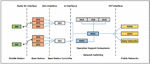
As shown in Figure 1, the GSM RAN Architecture consists of multiple elements starting from a SIM, a UE, BS Sub-systems, Network and Switching sub-systems and Operation and Support sub-systems. A BS Sub-system comprises of further elements of the architecture which are also considered to be mandatory parts such as a Base Transceiver Station (BTS) and a Base Station Controller (BSC). A BTS is controlled by a BS controller. The role of the Network Sub Systems (NSS) is also an integral part of the RAN Architecture and plays an important role in a GSM based cellular communication. It is further sub divided into its different parts of operation containing Mobile Switching Center (MSC), Home Location Register (HLR), Visitor Location Register (VLR), Authentication Centre (AUC) and Equipment Identity Register (EIR). This whole architecture is connected to the public networks like PLMN, PSTN, ISDN through a gateway MSC (GMSC).
(a) SIM: A SIM is a subscriber Identity Module i.e., a smart card chip that is used in the mobile handset.
(b) UE/MS: A UE/ MS is the user equipment or mobile station which is used by the end user i.e., mobile handset.
(c) BTS: A base transceiver station is a fixed radio station in a mobile GSM network. It consists of a transmitter and receiver antenna and plays a role of transferring user end data from a UE to the base station controller and is responsible for the conversion of radio signal to digital signal.
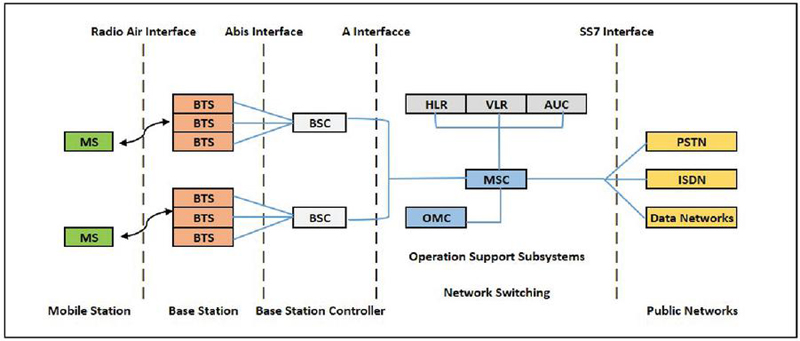
Figure 1 GSM radio access network architecture.
(d) BSC: An entity which controls multiple base transceiver station and monitors the signaling between the mobile handset and the mobile switching center. A BSC is directly connected to an MSC (mobile switching center).
(e) MSC: A Mobile Switching Center is the main entity which is responsible for the signaling between the MO (mobile originating) and MT (mobile terminating) entities in the transferring the voice and data and controls a multiple number of BSC at a time. It is directly interfaced with the PLMN networks. It also routes the calls between the users withing the network and calls between a mobile user and a PLMN user.
(f) HLR: A HLR (home location register) is responsible for the storing the user database and the subscription of a user entity including the location and routing functionalities. The data stored in this type of register is permanent.
(g) VLR: A virtual location register (VLR) is a register which stores a temporary data of a subscriber that uses roaming functions and are not within their parent HLR.
(h) EIR: This part of the GSM architecture is responsible for storing the data of handsets used by the subscriber i.e., an IMEI (International Mobile Equipment Identity) corresponding to the physical properties.
(i) AuC: Authentication center in the GSM network is responsible for the authentication of each SIM that wishes to enter or register in the core network of a GSM cellular network.
(j) GMSC: Gateway Mobile Switching Center is responsible for the routing of calls made outside the parent network. It connects calls from network A to network B.
2.2 Universal Mobile Telecommunication System
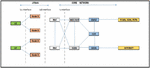
A UMTS is a Universal Mobile Telecommunication System which is also known the 3rd Generation networks. The UMTS Architecture consists of a UE, UTRAN and a Core Network. The UTRAN consists of a Node B and an RNC. Like GSM, a BTS and a BSC are replaced by a Node and an RNC. The Figure 2 shows a typical UMTS architecture, and the elements and the interfaces are discussed in detail below.
(a) Node B: It is a node or a base station in the UMTS architecture that connects and monitors signaling between an end user and the Radio Network Controller.
(b) RNC: A Radio Network Controller (RNC) is responsible for the controlling of multiple NodeBs at the same time. It is responsible for the resource management and control, air interface and security management and mobility management procedures.
(c) Uu Interface: Uu is the interface between a user equipment and the NodeB.
(d) IuB Interface: This is an internal interface which connects a NodeB to a radio network controller.
(e) Iu Interface: An external interface which connects the RNC to the core network.
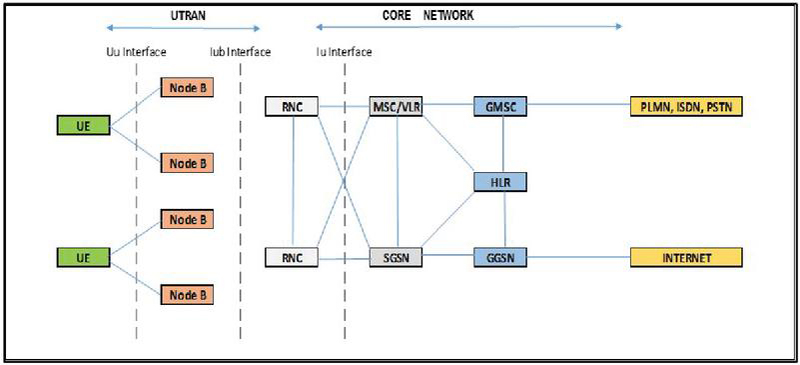
Figure 2 UTRAN architecture.
2.3 Long Term Evolution
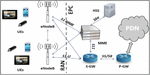
According to the 3GPP, the 4th Generation of cellular networks offering a wider bandwidth and a faster data experience with quite low latency which results on an average a good user perception. In the LTE architecture, the BSC, RNC has been replaced by the eNodeB itself which controls all functions of a controller as well as provide the Radio linkage directly to the user and is also knows as the evolved universal terrestrial radio access network (E-UTRAN) and an evolved packet core (EPC). Figure 3 elaborates the LTE architecture.
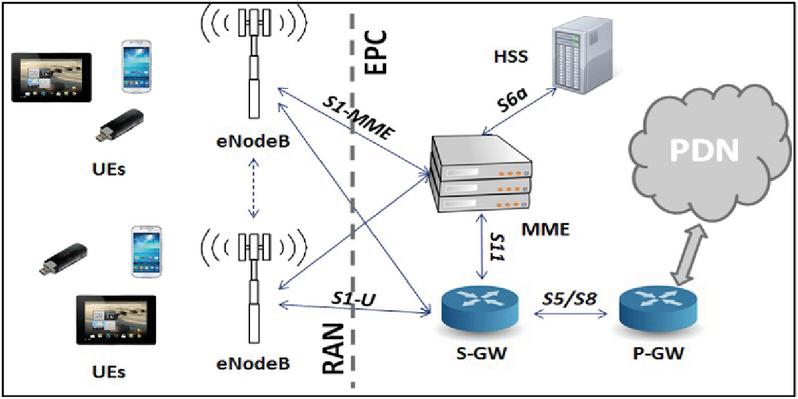
Figure 3 EUTRAN architecture.
2.4 5G Radio Access Network Architecture
By definition, a 5G RAN must be energy-efficient, exceedingly dependable, and capable of supporting approximately 1 million users per sq. kms. This strategy should make it possible to provide mobile/wireless services to industries, as well as private and corporate customers [12]. In the past, based on standardized reference architectures, attempts were made to deploy base stations in a constructed manner by multiple vendors per site. In the 3G era, Wideband Code-Division Multiple Access (WCDMA) splits the RAN between the RNC and the base station (named Node B), allowing one-to-many communications between those entities. LTE deployments, multi-vendor connectivity between RAN base stations (eNB), and core networks (CN) based on a standardized interface are all common features of the 4G. However, the RAN interfaces used by appropriate nodes are still proprietary. Despite the advancements and complexity of the mobile access network, mature solutions deployed in base stations are given by a single vendor, a phenomenon known as vendor lock-in. Even though the Third Generation Partnership Project (3GPP) has defined some interfaces and published public specifications, companies continue to implement proprietary technologies and interfaces. As a result, a single supplier has been able to deploy RAN networks in certain bands and geographic areas. A single-vendor monolithic approach to RAN (eNBs) deployed around the world right now, which means networks aren’t open across the entire protocol stack [13].
On the other hand, C-RAN appears to be a promising design for ensuring low costs, monolithic and energy efficiency, it has several problems that must be overcome to fully realize its benefits. A stable link with a high bandwidth capacity is required when multiple BBUs are co-located in a BBU (Baseband Unit) pool connected to RRHs. The BBU–RRH (Radio Remote Head) partnership must be structured in such a way that BBU resources are properly utilized while also meeting user requests. The real-time environment necessitates the use of effective base station mode switching methods [14].
Open RAN is a broad term that refers to the willingness of industry players (operators, vendors, neutral hosts, integrators, private businesses, and so on) to open the RAN architecture to make multi-vendor mobile radio access networks easier to deploy and integrate, as well as to remove potential roadblocks in future developments. The specification of adequate interfaces between logical nodes, as well as the introduction of new network parts capable of incorporating intelligence through the adoption of Artificial Intelligence/Machine Learning (AI/ML) and the data driven network paradigm, has ensured such openness. ORAN is also about the evolution of network element hardware (HW) and software (SW) decomposition[13], which, in practical, means:
(a) Many vendors may deliver solutions.
(b) Commercial off-the-shelf (COTS) hardware may be used.
(c) Products may be updated via software in an agile way.
2.5 6G Radio Access Network Architecture
6G is the next generation of mobile networks that will provide even faster and more reliable wireless connectivity than current 5G networks [10]. The architecture of 6G RAN is still in the research and development phase and there are multiple proposals on how it will be designed. However, some of the key features that are expected to be included in the 6G RAN architecture [11, 12] are
1. Use of advanced technologies such as artificial intelligence (AI), machine learning (ML), and network slicing to enable more efficient and flexible network operations.
2. Integration of multiple frequency bands to support a wider range of services and applications.
3. Use of new modulation and coding schemes to support higher data rates and improved signal quality.
4. Edge computing to enable low-latency and high-bandwidth services.
5. Use of advanced beamforming and massive MIMO (multiple-input and multiple-output) to improve coverage and capacity.
6. More extensive use of software-defined networking (SDN) and network function virtualization (NFV) to enable more dynamic and flexible network operations.
The 6G RAN consists of the below parts in general form, however, it depends on the requirement of the system.[13]
1. RAN Part
2. Core Network
3. Transport Network
4. Management and Control Plane
5. Security
6. Cyber security
Below are the few characteristics of 6G RAN networks which are still in the research and development phase[14].
1. Ultra-high speeds: 6G RAN is expected to provide data transfer speeds that are significantly higher than those of current 5G networks, potentially reaching terabits per second.
2. Extremely low latency: 6G RAN is expected to have latency as low as few microseconds, enabling new use cases such as tactile internet, and ultra-reliable communication.
3. Enhanced support for IoT and edge computing: 6G RAN will be designed to support a wide range of Internet of Things (IoT) devices and edge computing applications, with a focus on low-power and low-latency communication.
4. Advanced network slicing: 6G RAN is expected to use advanced network slicing techniques to enable more efficient and flexible network operations, allowing for the creation of customized and dedicated networks for specific use cases and applications.
5. Integration of multiple frequency bands: 6G RAN will likely use multiple frequency bands to support a wider range of services and applications, including millimeter wave and terahertz frequencies.
6. Advanced modulation and coding schemes: 6G RAN will likely use new modulation and coding schemes to support higher data rates and improved signal quality.
7. Advanced security: 6G RAN will have more advanced security mechanisms to protect against cyber attacks and unauthorized access.
8. More extensive use of AI and ML: 6G RAN will likely use advanced AI and ML technologies to enable more efficient and flexible network operations.
2.6 RAN with Distributed RRH/RRU
The architecture of the distributed RAN consists of BBU and RRH. The RRH is placed at the top of the BS whereas the BBU is located at an easily permissible location from the RRH. BBU and RRH are connected together using CPRI (Common Public Radio Interface) [16]. The function of the RRH is that of a transceiver which help the cellular subscriber to communicate with the base station whereas, BBU directs the mobile traffic towards the mobile core network using the backhaul link [17]. This RAN architecture is designed for 3G and 4G cellular.
2.6.1 Cloud RAN
In a Cloud RAN (C-RAN), the BBUs are reconfigured to virtualized BBU pool (centralized) from individual cell sites. The C-RAN is basically comprised of three key components, i.e.,
1. BBU Pool: It is the central data processing unit [18] that can stake multiple virtual BBUs in unison for allocating the resources associated with the dynamic user demand on the connected RRHs. These BBU pools are implemented from virtual machines using hyper V via X2 interfaces so that the system could be able to yield optimal performance [13, 14, 15, 19, 20].
2. RRHs: RRH is also referred to as cell sites or service area. RRH is used for providing cellular services to cellular subscribers. It acts as transceiver and is used for Analog to Digital Conversion, modulation, amplification and noise cancellation using the CPRI [21].
3. CPRI: It is basically a connection between BBU and RRHs and is also known as front haul link. This could be performed by using communication mediums such as optical fiber, microwave, etc.
China Mobile [15, 16] presents two ways for separating base station functionalities between BBU and RRH within a C-RAN. A C-RAN architecture can be classified into two types based on these factors: fully centralized and partially centralized.
1. Fully Centralized: Layer 1 functionalities such as sampling, modulation, resource block mapping, antenna mapping, and quantization are located in the BBU. Layer 2 functionalities such as transport-media access control and layer 3 functionalities such as radio resource control are located in the BBU [22]. It is capable of multi-standard operation, network coverage expansion, resource sharing optimization, and multi-cell collaborative signal processing. Despite the architecture’s many advantages, the load on the fronthaul connection is tremendous, and the bandwidth need is very high.
2. Partially Centralized: The RRH conducts radio operations as well as functions connected to layer 1 in this architecture. Meanwhile, the BBU continues to perform the functions of the higher layers, layer 2 and layer 3. In a partially centralized C-RAN, the bandwidth requirements between the BBU and the RRH become lower when baseband processing is transferred to the RRH from the BBU. It does, however, have certain disadvantages: because the baseband processing is integrated with the RRH, it is less up gradable and inconvenient for multi-cell collaborative signal processing [15].
However, the authors of [23] expanded this classification to three types by including a hybrid centralized design for C-RAN. A portion of the layer 1 functions are done in the RRH, while the rest are performed in the BBU in this architecture. The RRH is responsible for performing user- or cell-specific signal processing operations. This architecture demonstrates greater resource sharing flexibility as well as the ability to reduce a BBU’s energy usage and communication overhead.
2.6.2 Virtual RAN
Virtual RAN (V-RAN) is an evolved version of C-RAN which becomes flexible and efficient with the help of Software Defined Everything (SDx) and advance virtualization which overcomes existing challenges in improving interference and power consumption issues. V-RAN can also be defined as the decoupling of the software and hardware functionalities which helps in leveraging future technologies like massive machine access. V-RAN is comprised of two fundamental technologies over a virtual system i.e., [23].
2.6.3 Hypervisor based V-RAN
Hypervisor-based V-RAN refers to a specific implementation of V-RAN where a hypervisor is used to virtualize the radio access network components, such as the baseband unit (BBU) and remote radio head (RRH). This allows for the network to be more flexible, scalable, and cost-effective, as multiple virtualized network functions can run on a single physical hardware platform. In addition, it enables network functions to be deployed, updated, and removed without disrupting the operation of the underlying hardware.
It is an OS based virtual machine (VM) which is an efficient type of V-RAN but lacks in deployment and computational robustness [29]. Hypervisor based systems are required where multiple OS based applications are involved, and the functionalities are required at the cloud system. KVM and Xen are the famous hypervisor-based V-RAN technologies but this type lacs in a much larger size of VM imager due to libraries and dedicated guest OSx [30].
2.6.4 CLoud based V-RAN
Cloud-based V-RAN refers to a virtualized radio access network (V-RAN) that runs the network functions in a cloud computing environment. This type of V-RAN allows for centralized management and deployment of network functions, as well as improved scalability and cost-effectiveness. In cloud-based V-RAN, the network functions are abstracted from the underlying hardware and run as virtual machines in a cloud data center. This allows for multiple network functions to run on a single physical hardware platform, which can lead to improved resource utilization and reduced capital expenditures. Additionally, cloud-based V-RAN enables network functions to be deployed, updated, and removed without disrupting the operation of the underlying hardware, leading to improved network agility and faster time-to-market for new services. Overall, cloud-based V-RAN represents a shift towards a more software-defined and flexible approach to radio access network design and deployment.
2.7 Comparison and Challenges of Legacy RAN Architectures
This section of the paper divided in two parts, i.e., first we compare the existing types of RAN architectures and and later details the challenges being faced in the architecture of legacy network systems.
In a RAN architecture, there are mainly two parts, i.e., RRU/ RRH which is connected to the core network through the BBU part and is completely reliable on the hardware. The transition of the BBU part from hardware to software through the virtualization of network (VNF) is known as the vRAN. Where the BBU is decoupled from hardware to software (Non-Real Time functionality) in which the CU and DU parts are over the server platform which somehow helps in CAPEX and OPEX reduction [26]. The vRAN is the upgraded version of C-RAN architecture which helps in lower latency and is based on the combination of Software Defined Networks and Network Function Virtualization. Currently multi-access edge computing (MEC) is one type of vRAN which primarily operates for the lower latency and high bandwidth requiring applications and the next generation 5G cellular networks in future [27, 28]. However, in C-RAN, the BBU part is centrally located for several cell sites where it contains only the RF antenna and the RRU while the BBU is connected to the core network via a new interface known as fronthaul. Because in the traditional RAN architecture not all the resources of a BBU are utilized hence the need of pooling the BBUs is to utilize the vacant resources and make the network more efficient by connecting one RRH with multiple BBUs at a centralized location which is the reason the C-RAN is known to the Centralized RAN or Cloud RAN [29].
The V-RAN is the new flexible approach of centralizing the functionality of a BS part of the RAN architecture to share its resources through SDN/NFV based on network resources availability. It is also considered to be the evolved version of C-RAN. The deployment and the designing of the VRAN is challenging which is currently intensified by the multi-access computing technology, i.e., the enabling key technology for 5G networks [29]. Currently in the traditional RAN, CRAN and VRAN the operator/ or the customer is limited to the usage of a single vendor specific equipment or based on the closed network architecture. However, according to the ORAN alliance, the Open RAN architecture is designed in such a way that the specifications of the RRUs of different vendor companies are open to all resources and that the RRU-DU and DU-CU interfaces are open to all vendor components and that a customer can pick and choose components of different vendor companies being open to all resources [30, 31]. The ORAN architecture is the enhanced version of V-RAN where it is based on the functionalities of artificial intelligence AI and machine learning algorithms ML which makes it more robust and virtually centralized for the eMMB and ultra-lower latency applications for the real time IOT devices. The ORAN is designed in a way that the non-real time and real time functionalities are decoupled and are separated from the through the RIC near real time controller which helps in controlling the basic virtualization components [32, 33].
The main difference between C-RAN and ORAN is the architecture. C-RAN is a centralized network architecture, while ORAN is a decentralized network architecture. In C-RAN, the processing and management of the RAN is done in a central location and the data is transmitted to the remote radio units over a broadband network. In ORAN, the processing and management is distributed among multiple hardware and software components, which can be from different vendors. Another difference between the two is the level of vendor lock-in. Cloud RAN is often associated with vendor lock-in, as the customer is usually required to use a specific vendor’s hardware and software. In contrast, Open RAN is designed to be vendor-neutral and interoperable, allowing customers to choose components from different vendors.
In conclusion, both C-RAN and ORAN offer benefits for network operators, but Cloud RAN is a more centralized and proprietary solution, while Open RAN offers more flexibility and interoperability.
Every technology and the architecture has on one hand some advantages and benefits and on the other hand some limitations and challenges. Therefore, the existing RAN architectures also had some challenges which are discussed below in detail:
One of the main challenges in GSM radio access network architecture is the limited amount of radio frequency spectrum that is available for use by mobile networks. The demand for mobile data services is increasing rapidly and this is putting a strain on the available spectrum. As a result, mobile network operators must find ways to efficiently use the available spectrum to meet the growing demand for mobile data services.
Another challenge in GSM radio access network architecture is the need to support a wide range of mobile devices and services GSM networks must be able to support a diverse range of devices including smartphones tablets and other connected devices as well as a wide range of services such as voice text messaging and data services. This requires the network to be flexible and scalable and to be able to support the evolving needs of mobile users.
In addition, GSM radio access network architecture must also be able to support the increasing use of high data services such as 4G and 5G these advanced mobile technologies require significant investment infrastructure and network operators, and mobile network operators must carefully plan and implement these upgrades to support the increasing demand for high-speed data services.
Overall, the challenges in GSM radio access network architecture are primarily related to the need of efficiently used the available spectrum support a wide range of devices and services and support the increasing use of high-speed data services mobile network operators must carefully plan and manage their networks to meet these challenges and provide and provide reliable and high-quality mobile services to their users.
3G mobile network technology that allows for high-speed data and voice services. While it has many benefits there are also several challenges associated with its radio access network architecture.
One major challenge is the increased complexity of the network due to the use of multiple access technologies including code division multiple access CDMA time division Multiplex TDMA and frequency division multiple access FDMA. this can make it difficult to manage and maintain the network and can also increase the potential for interference and degradation of services another challenge is the need to support a wide range of devices and services including voice data and multimedia services this requires the network to have a higher degree of flexibility and scalability which can be difficult to achieve.
In addition, UMTS networks must support a higher level of mobility allowing users to move freely between different cells and access points without losing connectivity this requires the network to have efficient handover mechanisms which can be complex to implement and maintain.
Finally, UMTS networks must operate efficiently in a crowded radio spectrum which can be challenging due to the need of coexist with other wireless technologies and avoid interference. This requires careful planning and coordination of the network’s frequency allocation and resource allocation mechanisms.
One of the main challenges in EUTRAN evolved universal terrestrial radio access network architecture is the need to efficiently manage the allocation of radio resources. this is particularly important in situations where there is a high demand for data transmission as the network must be able to dynamically allocate resources to ensure that all users have sufficient bandwidth to maintain a high quality of service.
Another challenge in EUTRAN architecture is the need to support a wide range of devices and services. this includes the ability to handle different data rates and types of data as well as the ability to support a diverse range of application and services such as voice video and data.
Additionally, the EUTRAN architecture must be able to support a high level of mobility allowing users to move freely between cells without experiencing significant disruptions in service. this requires the use of advanced handover techniques to ensure that users maintain a stable connection as they move between cells.
Overall, the EUTRAN architecture must be able to support a wide range of devices and services while also being efficient and flexible enough to handle the dynamic demands of a modern wireless network.
The issues and challenges faced in the legacy architectures as discussed above took the attention of the researches to look for the more enhanced and advanced network architecture which can over come the need of millions of wireless devices seamless connectivity and the handling of such a massive data simultaneously offering ultra lower latency and much higher bandwith which could offer the openness in the integration process as well to improve the OPEX and CAPEX part. That technology is the Open Radio Access Network acrhitecture (O-RAN) which is still under the process of standardization between the O-RAN ALLIANCE and 3GPP in coordination with multiple vendor and operator companies. The Open Radio Network Architecture offers the openness in the integration part as well as support the latest technologies, i.e., SDN and virtualization automates the functionalities with the help of ML/AI simultaneously.
3 Open Radio Access Network Architecture
ORAN is a new approach to building and deploying wireless networks that is designed to address the challenges of traditional, proprietary RANs. The goal of ORAN is to create a more flexible, efficient, and cost-effective wireless network infrastructure by breaking the traditional vendor lock-in and enabling a multi-vendor ecosystem.
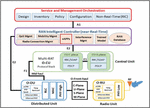
ORAN is based on open interfaces, standardized hardware components, and software-defined radio technologies. This allows network operators to choose from a wide range of hardware and software components from different vendors, and to easily integrate them into their networks. The open interfaces and standardized hardware components also enable interoperability among different vendors’ products, leading to greater competition and innovation in the market. 3GPP and O-RAN Alliance has been in coordination to set the standards of Open RAN architecture and are still in the process of finalising the standards which also includes the interfaces with the end user and the core network considering the integration of different vendor equipment and avoiding the vendor lock-ins [23, 24]. Figure 4 depicts a detailed view of the ORAN architecture.
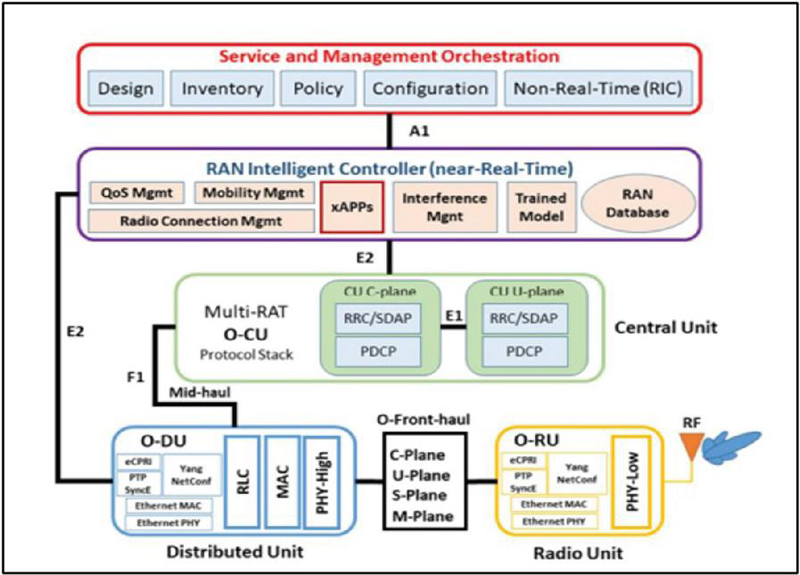
Figure 4 Open RAN architecture.
3.1 RAN Intelligent Controller and Types
RIC is implemented in ORAN running the optimization routine on a closed loop for assigning the tasks to it. It is known in literature that ORAN scope for data pipe lining and streaming the execution of Key Performance Measurements (KPMs) is structured using centralized and abstract point of view (PoV) employed for determining the network status on the existing infrastructure. The network infrastructure includes end users, servers, resources, switches, and router as well as the external physical devices that are connected to the network. These interrupts work on the priorities of performance tasks using AI and ML based algorithms for controlling the network program [34].
Thus, this makes the RIC an efficient source for optimizing and controlling the operations on the network by orchestrating the devices connected to the network in achieving optimal efficiency. The RIC used for ORAN are of two types [35], i.e.,
(i) Non-Real Time RAN Intelligent Controller
It optimizes the system based on the algorithms but with a time scale that is longer than 1 second.
(ii) Near-Real Time RAN Intelligent Controller
Whereas this type of RIC performs network optimization between a time scale of 10 milli-seconds to 1 second.
The detailed overview describing the tasks performed by each of these RIC types is mentioned as follows.
3.1.1 Non-real time RAN intelligent controller
Non-RT RIC performs network device management, error management, network life cycle handling, network optimization management, element management as well as fetches reports and analytics of the network utility. Almost all the elements connected with the RAN can be controlled and optimized by non-RT RIC automatically. Thus, Non-RT RIC is a major part of Services Management and Orchestration (SMO) [36].
The SMO is an automation tool for ORAN. It helps in RAN optimization by the implementation of non-RT RIC and rApps. Its functionalities and operations are defined by ORAN Alliance and is a vital component of Operation and Support Subsystem (OSS). It supports and executes various deployment options that are prioritized by the end users. The Non-RT RIC performs these tasks assigned by the SMO with a time frame longer than a second. The Non-RT RIC orchestrates the SMO by providing guidance and enriching information using machine learning models. As well as the Non RT RIC can interrupt the operations of SMO, thus making decisions and controlling the physical devices that are connected with the network [37]. Whereas, rApps are the applications that are operated on non-RT RIC by providing the network services for policy decision making that the non-RT RIC is bound to execute. As the RAN architecture is Open-Interface therefore the inter-operability between the SMO and functional entities of the RAN can be easily achieved making it easier for the Non-RT RIC in decision taking for the network optimization [38].
3.1.2 Near-real time RAN intelligent controller
Near RT RIC is embedded with the network-based edge devices and orchestrates their respective control loops with a time frame ranging between 10 milli-seconds to a second. The Near-RT RIC plays as a medium for communicating between Distributed Unit, Central Units and eNBs (evolved Node Bases) as well as it has connectivity with multiple RAN nodes so that it can be able to control Quality of Services of several user equipment [39].
Near RT RIC is operated by multiple applications supporting custom logic called xApps and supports the packages that are required for their execution. It works as a data acquisition unit for RAN and by machine learning based computations, it can control the RAN functionalities. This is made possible by the employing the mentioned below steps[40]:
(A) NEAR RT RIC includes a database containing all the relevant information related to RAN and its nodes.
(B) It shares this information with all the available xAPPs that are executed into multiple RAN nodes for the support of RAN data and elements.
(C) It performs termination for all the APIs and the open interfaces.
(D) To control the same RAN functionalities using multiple xAPPs.
3.2 ML/AI Based xAPPs Model Development
For the development of xApp, several ML and AI based algorithms are approached for supporting the custom logics in which RIC is set to operate. However, the steps implemented for the development of the ML and AI based xApps are the similar to the mentioned as below [41, 42]:
3.2.1 Data collection
This is main and most crucial step in the application development as this step involves the collection of data which will be employed for the training and testing to the AL/ML based model(s) that will be utilized in the functionality of the xApp. This data can be fetched from the live sensory network or in the form of the stored data in the CSV files.
3.2.2 Model design, training and testing
The model can be prepared after the data is collected from various sensors. Based on the data, the algorithm can be selected for performing the customized logics as the output(s). After the selection phase, the offline data is trained for computing the accuracy acquired from the algorithm. This process can be carried out by using GPUs, locally.
3.2.3 Deploying the model as an xAPP
After the training and testing of the algorithms, the ML based algorithm can be deployed in the RIC of the ORAN. The xApp templates can be modified as per the requirements of the RAN connected end devices.
3.2.4 Online model fine tuning
While in operation, xApp communicates with its respective base station through the nearby near-RT RIC and the E2 terminal. It performs this by sending a RIC subscription message and then generates KPMs reports by considering the usage of the end users from the base station. These reports are generated in the form if the RIC indication messages are implemented by the algorithm for fine tuning its functionalities due to their adaptive nature.
3.2.5 Controlling RAN
This is performed by the xApp by using RIC. This functionality of xApp enables the ML algorithms to take actions by controlling the RAN functionalities as per the user requirements.
3.3 ORAN Interfaces
The centralized BBU which is further subdivided into the distributed unit (DU) and the centralized unit (CU) and the radio unit. The virtualized BBU is operated by the GPP based commercial off the cost software the COTS which in terms of OPEX and CAPEX saves the cost for O-RAN 5G deployment in future as compared to the traditional current RAN architectures [43].
The radio unit (RU) handles the functionality of RF front haul, Digital Front haul, Ethernet Front haul transport layer and the synchronization and the lower physical layer of the virtualized BBU [44].
The distributed unit (DU) controls the vRLC, vMAC, vPhysical higher layer, the synchronization, and the operation of eCRPI along with the user data plane (UDP) and internet protocol (IP). The DU is also responsible for the connectivity of multiple radio units from the southbound and to the centralized unit from the northbound interface. It is also known as the centralized and virtualized BBU pool which can perform multiple functionalities which includes physical, MAC, RLC, synchronization, OAM, Ethernet, F1 Interface functions [43]. The centralized unit (CU) performs the layer 3 functions such as RRC, PDCP, SDAP, X2-U, F1-U, NG-U, S1-U, X2AP(X2-C), F1AP(F1-C). NGAP(NG-C), S1AP(S1-C) and the OAM [44].
The O-RAN architecture with different interfaces and their functionalities and their distribution amongst the three parts of the open RAN architecture which are illustrated below [45, 46, 47].
1. A1 Interface helps in communicating with the near real time services. It basically performs 3 services i.e., based on the machine learning (ML) and artificial intelligence (AI) algorithms for the Non-Real Time services which controls network and performance management actions.
2. The communication between the near real time RIC and gNB takes place by the O1 interface. Which include the O-RAN management, operational and software managed services and the physical network functions (PNF). While the O2 interface communicates with the O-Cloud and the management entities that support the O-RAN virtual network function (VNF) entities.
3. The E2 interface performs the functionalities of the Near RT RIC and O-CU services which are responsible for the handover, RRC, policy management and E2 setup, reset and general error reporting in the RAN architecture.
4. Open Fronthaul is the interface between the RRH and DU i.e., the O-DU and O-RU.
5. E1 Interface is the communication link between the logical nodes of gNB-CU-CP and gNB-CU-CP according to the 3GPP adopted interface.
6. F1-c is the fronthaul control plane interface, i.e., the communication link between the gNB-CU-CP and gNB-DU to perform interoperability functions.
7. F1-u is the fronthaul user plane interface, i.e., the communication link between the gNB-CU-UP and gNB-DU.
8. F2 Interface: The interface links the upper and lower parts of the physical layer known as F2-C and F2-U, i.e., the remote radio head in the physical layer. F2-U and F2-C are considered as the control and the user plane in the network.
9. Uu interface is the air interface between the gNB and the UE.
10. Ng Interface is the link between the O-RAN network interface functions and the core networks functions.
11. L1: This layer is the connection between the RU and the DU which is known as the lower layer split, i.e., the physical layer.
12. L2: This layer is the connection between the DU and the CU which is known as the Higher layer split, i.e., the data link layer.
13. L3: This layer is the connection between the DU and the CU which lies between the CU and the 5G core part, i.e., Network layer.
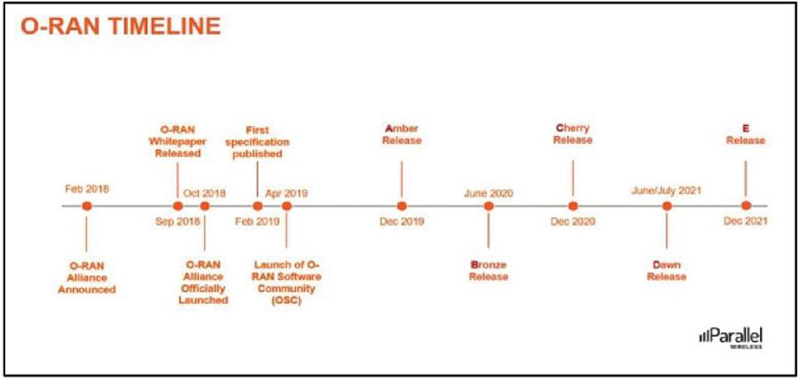
Figure 5 Open RAN timelines[46, 47].
The last three layers connect the Fronthaul, Midhaul and the backhaul layers.
3.3.1 Front haul interface of the ORAN architecture
The fronthaul is the interface which connects the O-DU and O-RU components according to the O-RAN organization. This interface consists of multiple hardware and software components. The front haul is also known to be the data communication distributer interface between the O-DU and O-RU by the O-RAN foundation. As a part of the architecture, fronthaul helps in connecting a single DU to multiple RUs covered by a single gNodeB.
3.3.2 Differentiating the CPRI and eCPRI
CPRI (Common Public Radio Interface) is the interface that carries data from the core to the air interface via RF antennas and vice versa with the help of baseband unit (BBU). It carries the data into fronthaul which requires much more bandwidth and latency in the CPRI and is the direct link between the BBU and RRH. However, in the eCPRI (evolved Common Public Radio Interface) which is the later enhanced version of the CPRI because of the increasing requirement in 5G and beyond networks to transport a massive data over the air interface. In 5G the BBU is split into the CU and the DU and in 5G the RRH is not directly connected to the DU but with the help of routers which is known to be the multipoint-to-multipoint connection. The eCPRI is almost 10 times more efficient and faster than the CPRI which carries much faster data through an IP protocol because in eCPRI the physical layer has been split into multiple layers. The lower layer which is the RRH and the Higher layer which is the BBU (DU) layer due to the reason of processing the data in much easier and robust way. The data transmits is IQ data which is a 16-bit -16-bit data. But in eCPRI the data is compressed to 9 bits with the help of multiple compression techniques for example: Block Floating Point (BFP) which is mainly being used by many organizations. The compression is done by scaling up the amplitude and the Tx and similarly scaled down at the Rx end which controlled/ processed by the CU plane in the distributed unit (DU) [48, 49].
The synchronization plan synchronizes the data between the DU and RRH via a fronthaul interface, i.e., a fiber cable. The management plan between the O-DU and O-RU manages the operational cost for the NRT functionalities. The table below shows some major differences in the use and requirement of CPRI and eCPRI [49, 50].
Table 2 Transformation of RAN to O-RAN summary
| No. | Parameters | RAN | C-RAN | V-RAN | O-RAN | References |
| 1 | (RU) | ✓ | ✓ | ✓ | ✓ | [51] |
| 2 | (DU) | ✓ | ✓ | [52] | ||
| 3 | (CU) | ✓ | ✓ | [52] | ||
| 4 | CPRI | ✓ | ✓ | ✓ | [53] | |
| 5 | eCPRI | ✓ | [54] | |||
| 6 | Baseband | ✓ | ✓ | ✓ | [55] | |
| Unit | ||||||
| 7 | Bandwidth | High | High | High | Low | [56] |
| Occupancy | ||||||
| 8 | Latency | High | Low | Low | Low | [56] |
| 9 | 2G | ✓ | ✓ | ✓ | [56, 57] | |
| 10 | 3G | ✓ | ✓ | ✓ | [56, 57] | |
| 11 | 4G | ✓ | ✓ | [56, 57] | ||
| 12 | SDN | ✓ | ✓ | [58] | ||
| 13 | NFV | ✓ | [58] | |||
| 14 | AI / ML | ✓ | [58] |
Table 3 Differentiation of CPRI and eCPRI
| No. | Categories | CPRI | eCPRI |
| 1 | Ports | Two Ports: | No Physical Port |
| Classification | Master and Slave | ||
| 2 | Logical | P2P and P2M | P2P, P2M and M2M |
| Connections | |||
| 3 | Network | Relies on REC and | eREC, eREs nodes |
| Topology | RE Functions | Transport, Fronthaul | |
| GM/ BC, EMS/ NMS |
The Evolution of RAN to Open RAN can be summarized in the Table 2 which clearly shows that how the RAN is evolved in terms of difference in the network architecture, bandwidth occupancy and latencies and the division of baseband unit (BU) into Distributed and Centralized unit i.e., DU and CU and the supported technologies and the algorithms such as Artificial Intelligence and Machine learning algorithms can be supported by the Open RAN with advanced functionalities of Software Defined Radio Networks and Near Field Virtualization.
3.4 Classification of Open RAN
The ORAN is classified into many different working and focus groups according to the nature of assignments and expertise. Below is a detailed information on all the working groups of ORAN:
Firstly, we would define what is the work of focus group and how they are divided into four areas. The standardization of the O-RAN and the coordination plans lies in the responsibility of the focus group 1 i.e., FG1.
Secondly the focus group FG2 is responsible for the testing and integration of the different strategies. The open-source releases, the planning and development and the preparation and establishment of ORAN lies under the focus group 3 and finally, the focus group 4 i.e., FG4 will be looking after for the security related issues in the O-RAN alliance. However, the O-RAN alliance has the working groups which are responsible for the different assigned tasks as mentioned in the table below[52, 53, 56].
Table 4 Classification of open RAN based on working groups
| WG No. | Responsibility |
| 1 | Architectural Planning, Use Cases Identification Proof of Concept |
| 2 | Non-Real Time AI functionalities, A1 Interfacing, Operational Supervision, iRRM Management |
| 3 | Near-Real Time AI functionalities, E2 Interfacing, Operational Supervision and iRRM Management. |
| 4 | Fronthaul Interfacing based on C-RAN, CPRI, eCPRI and xRANS. |
| 5 | Designing of O-CU Plane virtualization and functional splitting based on 3GPP specifications. |
| 6 | Specifying virtualization and decoupling NFVI, VNF and MANO. |
| 7 | Development of specifications and releasing of decoupled software and hardware platforms, |
| 8 | Software based architectural designing of O-CU, O-DU founded by ORAN and 3GPP. |
| 9 | Studies of physical medium, transport protocols of fronthaul, midhaul and backhaul. |
| 10 | Development of O1 OAM interfaces, architecture and data models. |
3.5 ORAN Use Cases
The ORAN use cases include the major below parts of ORAN i.e., In general the management of UE handover between the Nodes, the optimization of the network, traffic management and the resource sharing[60, 61].
(i) Optimization is related to provide the best QoE and QoS for the user specific services along the journey with the help of Artificial Intelligence (AI) which will be maintaining the quality of network throughout the network in the real time scenario.
(ii) MORAN is another use case of ORAN where the Radio part of two vendors where the resources are shared over the same platform and through the RIC it is being monitored by the other operator.
(iii) Traffic Steering is related to the management of sharing the traffic load within the network. Where with the help of AI, an intelligent system will work on prediction-based scenarios and will share the traffic where required. For example, load balance of highly loaded cell to the neighbor non loaded cell to improve the quality of service of the network.
(iv) Network slicing technique is one of the best examples for resource sharing where one operator will perform as a host and will have responsibility of network deployment. There they will require an open interface for the configuration and the control of the services. Also, the owner of the network deployed will offer free services to the guest operator users where the other operator will use the ORAN near RIC through VNF for resource sharing.
3.6 Applications of ORAN
(i) The telco RAN market has now been given access to new markets thanks to the Open Radio Access Network (Open RAN, or simply ORAN). The market competitiveness has been boosted, and operators now have more freedom and flexibility in their choice of vendors and deployment tactics.
(ii) The goal of ORAN is to define and develop RAN systems based on all-purpose hardware, open interfaces, and software that is vendor neutral. Businesses may employ the greatest technology for them at the lowest cost thanks to this integrated approach. Based on these statements, the most important advantage of ORAN.
(iii) As with its constantly growing ecosystem, ORAN has become a viable solution for reducing the overall cost of end-to-end next generation RAN in terms of network design, deployment, configuration, optimization, automation, and operations. As opposed to the one-size-fits-all strategy of legacy RAN, the choice of components and functionalities suited for the operator’s network contributes to the reduction in total cost of ownership (TCO) in ORAN.
(iv) Businesses can choose the best applications for them using the ORAN framework, which prevents them from spending money on features they don’t require. ORAN understands that every business is different and that its technical applications should be able to be tailored to certain operations.
(v) Beyond the effect on costs, ORAN supports intelligence through automation and orchestration, which are built on open-source projects themselves. Executives can save time and effort by automating certain processes, and the network’s data is more accurate overall. Real-time access to accurate information improves forecasting and planning.
4 ORAN Challenges and Future Directions
As amazing as the transition to ORAN is, it necessitates a cautious, expert, and well-planned strategy from the very beginning of design, engineering, testing, integration, and deployment. Resistance to new systems and doubts about their utility are constant responses to technological advancement. It is simple for some vendors to continue using the technology they are accustomed to rather than picking up new skills. The approach of Open RAN offers several benefits and increased flexibility and improved performance. However, there are at the same time some challenges in the implementation and deployment of the Open RAN architecture which are discussed below [13, 17, 32, 55, 57, 58, 59, 63, 64].
4.1 Compatibility and Interoperability
One of the main interoperability challenges in Open RAN is ensuring that different vendors’ hardware and software components are compatible and can communicate with each other effectively. This can be a complex task, as different vendors may use different protocols and standards for their components, which can make it difficult for them to work together. Another interoperability challenge in Open RAN is ensuring that different vendors’ components can be integrated and managed effectively in a single network. This requires the development of common interfaces and protocols that can be used by all vendors, as well as tools and processes for managing and maintaining a multi-vendor network. Overall, achieving interoperability in Open RAN requires collaboration and coordination among different vendors and industry stakeholders, as well as the development of common standards and protocols that can be used by all parties.
4.2 Security
Another key challenge in the Open RAN is the fact that it relies on openness and inter-operable components, which may not have the same level of security as proprietary ones. Because these components are developed and maintained by a variety of different vendor companies and organizations therefore there is a risk of vulnerabilities which could be exploited by hackers. Another challenge is the fact that Open RAN networks are likely to be more complex and dynamic than traditional networks, with a greater number of components and connections. This can make it more difficult to manage security and ensure that all components are secure and properly configured. Additionally, because Open RAN networks are designed to be more flexible and adaptable, they may be more vulnerable to changes in the threat landscape. For example, if a new security vulnerability is discovered in one of the open and interoperable components, it may be more difficult to quickly and efficiently patch or update the network to protect against it. Overall, ensuring the security of Open RAN networks will require careful planning and coordination among all stakeholders, including telecom operators, hardware and software vendors, and regulators. It will also require ongoing monitoring and management of the network to identify and address potential security risks as they arise.
4.3 Increased Complexity and Network Management
Open RAN (Open Radio Access Network) refers to a type of wireless network architecture that uses open, inter-operable hardware and software components from multiple vendors. One of the main benefits of Open RAN is that it allows for greater flexibility and innovation in the design and deployment of wireless networks. One of the main challenges of Open RAN is the increased complexity of the network, as it involves integrating and managing multiple hardware and software components from different vendors. This can make it more difficult to manage and maintain the network, as well as to troubleshoot and resolve issues that may arise. Another challenge of Open RAN is the need for effective network management tools and processes to ensure that the network is operating efficiently and reliably. This can involve coordinating the activities of different vendors and their respective components, as well as monitoring and optimizing network performance. Overall, the complexity and network management challenges of Open RAN highlight the importance of having robust and flexible tools and processes in place to support the deployment and operation of these networks.
4.4 Infrastructure Investment and Deployment
One of the main challenges with implementing an Open RAN network is integration with existing network infrastructure. This can involve compatibility issues between different hardware and software components as well as difficulties in managing and coordinating the various components of the network. Additionally, there may be challenges in ensuring that the open RAN network meets the performance and reliability requirements of different applications and services. Overall successful integration of open RAN technology requires careful planning and coordination between different stakeholders, including network operators, vendors, and regulators.
4.5 Highly Skilled Personnel
The availability and the cost of trained personnel to manage and maintain open RAN networks can be a challenge as there is currently a shortage of skilled workers in the market. This shortage is due to the relatively new nature of open RAN technology and the fact that it requires a specific set of skills and knowledge. To address this challenge, it may be necessary for companies and organizations to invest in training and education programs to help in building a skilled workforce. Additionally, partnerships and collaborations with the other organizations and academia can help to share the resources and expertise and to drive innovation in the field.
4.6 Timely Vendor Support
One approach to address the challenge is to prioritize interoperability and encourage the adoption of open standards. This can help to ensure that network equipment from different vendors can work together seamlessly, reducing the need for specialized support from any individual vendor. Another approach is to foster a community of experts and developers who are familiar with the technology and can provide timely support and assistance to organizations implementing O-RAN. Some organizations may find it helpful to work with a managed service provider who has expertise in implementing, troubleshooting, and managing the issue timely at one place.
4.7 Need for Continuous Research and development in ORAN Technology
One of the main challenges is ensuring that the different components of the open RAN system can work together seamlessly and efficiently. This requires the development of standards and protocols that can be adopted by all vendors, as well as the creation of test and certification programs to ensure compatibility. Another challenge is ensuring the security and reliability of open RAN networks. Because the network is built using a mix of components from different vendors, there is a greater potential for vulnerabilities and interoperability issues. This requires ongoing research and development to identify and address potential security threats, as well as to develop new technologies and solutions that can improve the reliability of the network. In addition, the open RAN technology is still in the early stages of development and deployment, so there is a need for continued research and development to improve its performance and capabilities. This includes developing new algorithms and techniques for managing and optimizing network traffic, as well as exploring the potential applications of the technology for new use cases such as Internet of Things (IoT) and 5G networks.
4.8 Increased cost for Network Operators and End Users
One potential solution to the increased cost for the network operators and users is to implement the cost-saving measures by reducing number of hardware equipment and replacing it with software defined solutions. This can help reduce the CAPEX and OPEX. Additionally, network operators can explore options for sharing infrastructure and resources, to further reduce the cost. It may also be helpful to engage with the regulatory authority and policy makers to ensure the necessary conditions and adoption of Open RAN, for example: Spectrum accessibility and interconnection support.
4.9 Limited Vendor Options and Lock-Ins
One potential solution to the challenge of limited vendor options and potential vendor lock-in is to use open-source components and software in the open RAN architecture. Which can ensure that there is a diverse ecosystem of vendors and that the customers are not locked to a single vendor. In addition to this, implementation of open standards for RAN equipment can help to promote interoperability and prevent vendor lock-ins. This can enable customers to easily switch between vendors and avoid being locked into a proprietary solution.
4.10 Dis-aggregation of RAN Components for FCAPS
FCAPS (Fault, Configuration, Accounting, Performance, Security) is a network management model that is used to manage the various aspects of a telecommunications network. Dealing with the dis-aggregation of RAN (Radio Access Network) components is one of the challenges that network managers face when implementing the FCAPS model. One approach to dealing with the disaggregation of RAN components is to use a network management system (NMS) that is specifically designed to handle the complexity of a distributed network. The NMS can monitor the performance of each RAN component and provide alerts when there are issues that need to be addressed. Additionally, the NMS can provide tools for configuring and managing the RAN components, allowing network managers to make changes quickly and easily to the network as needed. Another approach is to use virtualization technologies to create a virtual RAN (vRAN) that is more flexible and scalable than a traditional RAN. vRAN allows network managers to dynamically allocate network resources based on changing network conditions, making it easier to manage a disaggregated RAN. Overall, the key to effectively managing a dis-aggregated RAN is to have a robust network management system in place, as well as to make use of virtualization technologies when possible. By using these tools, network managers can ensure that their RAN is performing optimally, even in the face of complex and rapidly changing network conditions.
References
[1] W. R. Young, “Advanced mobile phone service: introduction, background, and objectives,” Bell Syst. Tech. J., vol. 58, no. 1, pp. 1–14, 1979.
[2] V. H. Mac Donald, “Advanced mobile phone service: The cellular concept,” Syst. Tech. J., vol. 58, no. 1, pp. 15–41, 1979.
[3] Skold J, Gudmundson B, Farjh J. Performance and Characteristics of GSM-based PCS. In 1995 IEEE 45th Vehicular Technology Conference. Countdown to the Wireless Twenty-First Century 1995 Jul 25 (Vol. 2, pp. 743–748). IEEE.
[4] Gu G, Peng G. The survey of GSM wireless communication system. In 2010 international conference on computer and information application 2010 Dec 3 (pp. 121–124). IEEE.
[5] Berruto E, Colombo G, Monogioudis P, Napolitano A, Sabatakakis K.em Architectural aspects for the evolution of mobile communications toward UMTS. IEEE Journal on selected areas in Communications. 1997 Oct;15(8):1477–87.
[6] Samukic A. UMTS universal mobile telecommunications system: development of standards for the third generation.IEEE transactions on vehicular technology. 1998 Nov;47(4):1099–104.
[7] Hyun J, Li J, Im C, Yoo JH, Hong JW. A VoLTE traffic classification method in LTE network. In The 16th Asia-Pacific Network Operations and Management Symposium 2014 Sep 17 (pp. 1–6). IEEE.
[8] Li X, Wei M, Xie W. Practical Performance Analyses of 5G Sharing Voice Solution. Electronics. 2022 Aug 2;11(15):2412.
[9] Liu G, Li X, Xie W. Voice Bearing Technology for Multi-Operator Shared 5G Network. In 2021 IEEE International Symposium on Broadband Multimedia Systems and Broadcasting (BMSB) 2021 Aug 4 (pp. 1–6). IEEE.
[10] M. Series, “Minimum requirements related to technical performance for IMT-2020 radio interface (s),” Report, p. 2410, 2017.
[11] C. D. Alwis et al., “Survey on 6G Frontiers: Trends, Applications, Requirements, Technologies and Future Research,” in IEEE Open Journal of the Communications Society, vol. 2, pp. 836–886, 2021, doi: 10.1109/OJCOMS.2021.3071496.
[12] www.6gflagship.com.
[13] Zhao Z, Du Q, Wang D, Tang X, Song H. Overview of Prospects for Service-Aware Radio Access towards 6G Networks. Electronics. 2022 Jan;11(8):1262.
[14] Soltani S, Shojafar M, Taheri R, Tafazolli R. Can Open and AI-Enabled 6G RAN Be Secured?. IEEE Consumer Electronics Magazine. 2022 Sep 8;11(6):11–2.
[15] Yang P, Xiao Y, Xiao M, Li S. 6G wireless communications: Vision and potential techniques. IEEE network. 2019 Jul 31;33(4):70–5.
[16] I. ITU, “2134, Requirements related to technical performance for IMT-Advanced radio interface (s),” Int. Telecommun. Union, 2008.
[17] J. Wang, H. Roy, and C. Kelly, “OpenRAN: the next generation of radio access networks,”Telecom Infra Proj., 2019.
[18] D. Wypiór, M. Klinkowski, and I. Michalski, “Open RAN—Radio Access Network Evolution, Benefits and Market Trends,” Appl. Sci., vol. 12, no. 1, p. 408, 2022.
[19] V. Q. Rodriguez and F. Guillemin, “Towards the deployment of a fully centralized Cloud-RAN architecture,” In 2017 13th International Wireless Communications and Mobile Computing Conference (IWCMC), 2017, pp. 1055–1060.
[20] A. Checko et al., “Cloud RAN for mobile networks—A technology overview,” IEEE Commun. Surv. tutorials, vol. 17, no. 1, pp. 405–426, 2014.
[21] G. Kardaras and C. Lanzani, “Advanced multimode radio for wireless and mobile broadband communication,” In 2009 European Wireless Technology Conference, 2009, pp. 132–135.
[22] T. Salman, “Cloud RAN: Basics, advances and challenges,” A Surv. C-RAN Basics Virtualization Resour. Alloc. Chall, pp. 1–16, 2016.
[23] S. Bhaumik et al., “CloudIQ: A framework for processing base stations in a data center,” In Proceedings of the 18th annual international conference on Mobile computing and networking, 2012, pp. 125–136.
[24] M. Peng, Y. Sun, X. Li, Z. Mao, and C. Wang, “Recent advances in cloud radio access networks: System architectures, key techniques, and open issues,” IEEE Commun. Surv. Tutorials, vol. 18, no. 3, pp. 2282–2308, 2016.
[25] M. Hadzialic, B. Dosenovic, M. Dzaferagic, and J. Musovic, “Cloud-RAN: Innovative radio access network architecture,” In Proceedings ELMAR-2013, 2013, pp. 115–120.
[26] F. Tonini, C. Raffaelli, L. Wosinska, and P. Monti, “Cost-optimal deployment of a C-RAN with hybrid fiber/FSO fronthaul,” J. Opt. Commun. Netw., vol. 11, no. 7, pp. 397–408, 2019.
[27] M. A. Habibi, M. Nasimi, B. Han, and H. D. Schotten, “A comprehensive survey of RAN architectures toward 5G mobile communication system,” IEEE Access, vol. 7, pp. 70371–70421, 2019.
[28] M. Mohsin, J. M. Batalla, E. Pallis, G. Mastorakis, E. K. Markakis, and C. X. Mavromoustakis, “On Analyzing Beamforming Implementation in O-RAN 5G,” Electronics, vol. 10, no. 17, p. 2162, 2021.
[29] S. Sirotkin, “5G Radio Access Network Architecture,” 2021.
[30] Gavrilovska, L., Rakovic, V., and Denkovski, D. (2020). From Cloud RAN to Open RAN. Wireless Personal Communications, 113(3), 1523–1539. https://doi.org/10.1007/s11277-020-07231-3.
[31] Bhardwaj, A., and Krishna, C. R. (2021). Virtualization in Cloud Computing: Moving from Hypervisor to Containerization—A Survey. Arabian Journal for Science and Engineering, 46(9), 8585–8601. https://doi.org/10.1007/s13369-021-05553-3.
[32] Disruption, M. and Rayal, F., 2016. RAN Virtualization.
[33] Garcia saavedra, A., Costa perez, X., Leith, D. J., and Iosifidis, G. (2018). FluidRAN-Optimized vRAN-MEC Orchestration. 2366–2374.
[34] Wang, J., and Hu, Y. (2020). Performance Analysis of 5G NR vRAN Platform and its Implications on Edge Computing. Proceedings – 2020 IEEE International Symposium on Performance Analysis of Systems and Software, ISPASS 2020, 215–217. https://doi.org/10.1109/ISPASS48437.2020.00037.
[35] Chabbouh, O., Rejeb, S. Ben, Nasser, N., Agoulmine, N., and Choukair, Z. (2020). Novel cloud-rrh architecture with radio resource management and qos strategies for 5g hetnets. IEEE Access, 8, 164815–164832. https://doi.org/10.1109/ACCESS.2020.3021948.
[36] Garcia-Saavedra, A., Iosifidis, G., Costa-Perez, X., and Leith, D. J. (2018). Joint optimization of edge computing architectures and radio access networks. IEEE Journal on Selected Areas in Communications, 36(11), 2433–2443. https://doi.org/10.1109/JSAC.2018.2874142.
[37] Singh, S. K., Singh, R., and Kumbhani, B. (2020). The Evolution of Radio Access Network Towards Open-RAN: Challenges and Opportunities. 2020 IEEE Wireless Communications and Networking Conference Workshops, WCNCW 2020 - Proceedings. https://doi.org/10.1109/WCNCW48565.2020.9124820.
[38] LinI, B.-S. P. (2021). Toward an AI-Enabled O-RAN-based and SDN/NFV-driven 5G and IoT Network Era. Network and Communication Technologies, 6(1), 6. https://doi.org/10.5539/nct.v6n1p6.
[39] L. Bonati, S. D’Oro, M. Polese, S. Basagni, and T. Melodia, “Intelligence and learning in O-RAN for data-driven NextG cellular networks,” IEEE Commun. Mag., vol. 59, no. 10, pp. 21–27, 2021.
[40] L. Bonati, M. Polese, S. D’Oro, S. Basagni, and T. Melodia, “OpenRAN Gym: An Open Toolbox for Data Collection and Experimentation with AI in O-RAN,” in 2022 IEEE Wireless Communications and Networking Conference (WCNC), 2022, pp. 518–523.
[41] R. Shafin, L. Liu, V. Chandrasekhar, H. Chen, J. Reed, and J. C. Zhang, “Artificial intelligence-enabled cellular networks: A critical path to beyond-5G and 6G,” IEEE Wirel. Commun., vol. 27, no. 2, pp. 212–217, 2020.
[42] H. Donertasli and M. Medithe, “Disaggregated Near-RT RIC Control Plane with Unified 5G DB for NS, MEC and NWDAF Integration,” in 2022 7th International Conference on Computer Science and Engineering (UBMK), 2022, pp. 1–6.
[43] A. S. Abdalla, P. S. Upadhyaya, V. K. Shah, and V. Marojevic, “Toward Next Generation Open Radio Access Networks–What O-RAN Can and Cannot Do!,” IEEE Netw., 2022.
[44] S. S. Pereira, L. Almeida, A. S. R. Oliveira, N. B. Carvalho, and P. P. Monteiro, “Multi-band, Multi-technology Remote Unit (RU) Based on RFSoC,” in 2020 50th European Microwave Conference (EuMC), 2021, pp. 148–151.
[45] L. Bonati, M. Polese, S. D’Oro, S. Basagni, and T. Melodia, “OpenRAN Gym: AI/ML Development, Data Collection, and Testing for O-RAN on PAWR Platforms,” arXiv Prepr. arXiv2207.12362, 2022.
[46] Yang, M., Li, Y., Jin, D., Su, L., Ma, S., and Zeng, L. (2013). OpenRAN: A software-defined RAN architecture via virtualization. Computer Communication Review, 43(4), 549–550. https://doi.org/10.1145/2534169.2491732.
[47] Bonati, L., D’Oro, S., Polese, M., Basagni, S., and Melodia, T. (2021). Intelligence and Learning in O-RAN for Data-Driven NextG Cellular Networks. IEEE Communications Magazine, 59(10), 21–27. https://doi.org/10.1109/mcom.101.2001120.
[48] Masur, P. H., and Reed, J. H. (2021). Artificial Intelligence in Open Radio Access Network. 1–9. Retrieved from http://arxiv.org/abs/2104.09445.
[49] Abdalla, A. S., Upadhyaya, P. S., Shah, V. K., and Marojevic, V. (2021). Toward Next Generation Open Radio Access Network–What O-RAN Can and Cannot Do. 1–8. Retrieved from http://arxiv.org/abs/2111.13754.
[50] Wicaksana, A. (2016). Open RAN. https://medium.com/@arifwicaksanaa/pengertian-use-case-a7e576e1b6bf.
[51] O-RAN ALLIANCE. (2021). O-RAN Minimum Viable Plan and Acceleration towards Commercialization. (June). https://static1.squarespace.com/static.
[52] Perez, G. O., Lopez, D. L., and Hernandez, J. A. (2019). 5G New Radio Fronthaul Network Design for eCPRI-IEEE 802.1CM and Extreme Latency Percentiles. IEEE Access, 7, 82218–82230. https://doi.org/10.1109/ACCESS.2019.2923020.
[53] Li, L., Bi, M., Xin, H., Zhang, Y., Fu, Y., Miao, X., … Hu, W. (2019). Enabling flexible link capacity for ECPRI-based fronthaul with load-adaptive quantization resolution. IEEE Access, 7, 102174–102185. https://doi.org/10.1109/ACCESS.2019.2930214.
[54] Kiet, D. T., Hieu, T. M., Hung, N. Q., Van Cuong, N., Van, V. T., and Cuong, P. N. (2020). Research and Implementation of eCPRI Processing Module for Fronthaul Network on FPGA in 5G-NR gNodeB Base Station. Proceedings - 2020 4th International Conference on Recent Advances in Signal Processing, Telecommunications and Computing, SigTelCom 2020, 1–5. https://doi.org/10.1109/SigTelCom49868.2020.9199019.
[55] Bhattacharjee, S., Schmidt, R., Katsalis, K., Chang, C. Y., Bauschert, T., and Nikaein, N. (2020). Time-Sensitive Networking for 5G Fronthaul Networks.IEEE International Conference on Communications, 2020-June. https://doi.org/10.1109/ICC40277.2020.9149161.
[56] Da Silva, I., El Ayoubi, S.E., Boldi, O.M., Bulakci, Ö., Spapis, P., Schellmann, M., Monserrat, J.F., Rosowski, T., Zimmermann, G., Telekom, D. and Tesanovic, E.M., 2016. 5G RAN architecture and functional design. METIS II white paper.
[57] Niu, H., Li, C., Papathanassiou, A. and Wu, G., 2014, April. RAN architecture options and performance for 5G network evolution. In 2014 IEEE wireless communications and networking conference workshops (WCNCW) (pp. 294–298). IEEE.
[58] Abdalla, A.S., Upadhyaya, P.S., Shah, V.K. and Marojevic, V., 2021. Toward Next Generation Open Radio Access Network–What O-RAN Can and Cannot Do!. arXiv preprint arXiv:2111.13754.
[59] Tognisse, I.S., Kora, A.D. and Degila, J., 2021, July. Cloud-RAN And Coverage Gap in Rural Areas. In 2021IEEE International Conference on Communication, Networks and Satellite (COMNETSAT) (pp. 329–336). IEEE.
[60] Polese, M., Bonati, L., D’Oro, S., Basagni, S. and Melodia, T., 2022. Understanding O-RAN: Architecture, interfaces, algorithms, security, and research challenges. arXiv preprint arXiv:2202.01032.
[61] https://www.o-ran.org/about.
[62] Brik, B., Boutiba, K. and Ksentini, A., 2022. Deep learning for B5G open radio access network: Evolution, survey, case studies, and challenges. IEEE Open Journal of the Communications Society, 3, pp. 228–250.
[63] Klement F, Katzenbeisser S, Ulitzsch V, Krämer J, Stanczak S, Utkovski Z, Bjelakovic I, Wunder G. Open or not open: Are conventional radio access networks more secure and trustworthy than Open-RAN? arXiv preprint arXiv:2204.12227. 2022 Apr 26.
[64] W. Azariah, F. A. Bimo, C.-W. Lin, R.-G. Cheng, R. Jana, and N. Nikaein, “A Survey on Open Radio Access Networks: Challenges, Research Directions, and Open Source Approaches,” 2022, [Online]. Available: http://arxiv.org/abs/2208.09125.
Biographies

Yahya Sameen Junejo received the Masters from The University of Leeds, UK in 2011. He has a diversified experience of over 11 years in the field of cellular mobile communication engineering and has been part of multinational companies like Huawei, Telenor Pakistan and Nokia Solutions and Networks Pakistan. He is currently enrolled as a PhD Student at the Department of Telecommunication Engineering, Mehran University of Engineering and Technology (MUET), Jamshoro Sindh, Pakistan. His research areas include 5G and beyond cellular communication. During his PhD he has worked in collaboration with Politecnico Di Milano, Italy and currently he is enrolled at WCN research group Lakehead University, ON, Canada as a Visiting Research Graduate Student.

Faisal Karim Shaikh is working as a Professor at Department of Telecommunication Engg., MUET, Jamshoro. He received Ph.D. in Computer Science from the Technische Universität Darmstadt, Germany. His research areas include Internet of Things (IoT), Wireless Sensor Networks, Vehicular Adhoc Networks, Smart Homes and Cities, Body Area Networks, and Underwater Sensor Networks. He is a founder of IoT Research Laboratory at MUET. He has published more than 125 refereed journal, conference, and book chapters. He is a senior member of IEEE, IEEE COMSOC, IEEE Computer Society and life member of PEC.

Bhawani Shankar Chowdhry is a Distinguished National Professor and the former Dean Faculty of Electrical Electronics and Computer Engineering at MUET, Jamshoro, Pakistan. He is member of various professional bodies including: immediate past Chairman IEEE Karachi Section, Region10 Asia/Pacific, Fellow IEP, Fellow IEEEP, Senior Member IEEE Inc. (USA), SM ACM Inc. (USA).

Ali Akbar Shah is a PhD Student in Electronics Engineering, MUET, Jamshoro. He holds a ME in Mechatronics Engineering and a BE in Electronics Engineering from MUET, Jamshoro. Currently he is working as a exchange student at Dublin City University during his PhD.

Waleed Ejaz is working in the Department of Electrical Engineering at Lakehead University, Barrie, ON, Canada. He received the B.Sc. and M.Sc. degrees in Computer Engineering from the University of Engineering and Technology, Taxila, Pakistan and the National University of Sciences and Technology, Islamabad, Pakistan, and the Ph.D. degree in Information and Communication Engineering from Sejong University, Republic of Korea. His current research interests include IoT, energy harvesting, 5G and beyond networks, and mobile edge computing.
Journal of Mobile Multimedia, Vol. 20_1, 49–86.
doi: 10.13052/jmm1550-4646.2013
© 2024 River Publishers