A Review of Miscellaneous Spectrum Sensing Algorithms in 5G Ultra-dense Networks
Antoni Ivanov* and Ivaylo Bozhilov
Faculty of Telecommunications, Technical University of Sofia, bul. Kl. Ohridski 8, Sofia 1000, Bulgaria
E-mail: astivanov@tu-sofia.bg; ibojilov@tu-sofia.bg
*Corresponding Author
Received 26 June 2023; Accepted 25 July 2023; Publication 11 August 2023
Abstract
The continual development of advanced networks within the Fifth Generation (5G) of wireless systems, and beyond, has seen the rise of multiple important research directions. These include cognitive radio (CR) and ultra-dense networks (UDNs), which are the focus of this article. The CR systems rely on an accurate assessment of the radio environment, which is provided by the spectrum sensing functionality. A review of such algorithms that are characterized by the detection of miscellaneous features of the received signal, together with their performance comparison, is presented. In addition, the application of a simple and adequate solution is assessed through its probability of detection, for a relevant UDN system model under the critical density limitation for the access point (AP) deployment
Keywords: 5G, densification, cognitive radio, miscellaneous spectrum sensing, network coexistence, spectrum sharing, ultra-dense networks.
1 Introduction
As the scientific community advances the current telecommunications with more complex technologies and use cases toward the convergence of various types of networks in beyond 5G, several research directions have been focused upon [1–4]. These include Reconfigurable intelligent surfaces (RIS), CR, UDN, unmanned aerial vehicles (UAVs) and satellite communication nodes, multiple-input multiple-output (MIMO), and beamforming which aim to provide an increased spectrum efficiency, lower energy consumption, network coexistence, higher throughput and user density for terrestrial, marine, aerial and space communications [3, 5]. To this end, the design of future resource management algorithms necessitates their incorporation into integrated solutions. Thus, the implementation of CR into UDN for user-centric wireless access (the network is focused on the user and their mobility as its access points have much higher density than that of the users) has been explored to facilitate their deployment together with existing networks in the most common portions of the frequency spectrum (below 6 GHz) [6, 7]. In order to achieve accurate resource allocation, a crucial aspect is the adequate spectrum characterization provided via spectrum sensing, which provides dynamic assessment of the radio environment by discovering the portions of underutilized spectrum. Thus, the UDN nodes are allowed to operate in the available channels as secondary users (SUs) for a limited time without creating significant interference to the incumbent users. This paper presents a review of the spectrum sensing methods that are characterized by a diverse set of features, which are not classified by the traditional categories of energy, cyclostationary, eigenvalue and matched filter detection of the primary user (PU) signal [8]. Their performance in terms of probability of detection of the PU, is compared for the relevant parameters such as signal-to-noise ratio (SNR) and number of samples . On this basis, design considerations for the further development of such algorithms are given. Additionally, a simulation of a CR-based UDN for the critical density of deployment of APs is executed to show the detection performance of a miscellaneous spectrum sensing method as compared to a standard Gaussian energy detection (GED). It is shown to be effective in detecting the PU in the condition of noise uncertainty.
The rest of this paper is organized as follows. Section 2 details the characteristics of the reviewed miscellaneous spectrum sensing methods. Then, Section 3 describes the system model and its parameters used in the simulations, as well as the results. Finally, the conclusions and lessons learned from the review, are given in Section 4.
2 Review on Miscellaneous Spectrum Sensing Algorithms
Hereby the miscellaneous spectrum sensing methods are reviewed, which use either a combination of standard detectors, or some miscellaneous features while still requiring a priori knowledge of the PU signal, (thus they can be deemed non-blind), most often assuming it as Gaussian) as they determine the decision threshold in order to differentiate between the zero () and the alternative hypothesis () [8]. A structured summary of the reviewed spectrum sensing methods is provided in Table 1.
Table 1 Summary of the characteristics of miscellaneous detection-based spectrum sensing algorithms
| Robustness to | Modelling of | ||
| Noise and | the PU Signal | ||
| Fading | and Noise’s | Notes on the | |
| Reference | Conditions | Distributions | Method’s Performance |
| [9] | Moderate | Gaussian | at dB for |
| [10] | Moderate | Gaussian | at dB for and |
| [11] | Moderate | Gaussian | at dB for , and dB |
| [12] | High | Gaussian | at dB for and dB |
| [13] | Moderate | Gaussian | at dB for |
| [14] | High | Gaussian | at dB for empirically determined FL rules |
| [15] | Low | Gaussian | at dB for empirically determined FL rules |
| [16] | Moderate | Gaussian | at dB for and dB |
| [18] | Moderate | Gaussian | at dB for |
| [19] | Moderate | Non-Gaussian | at dB for ; PU power level discrimination at dB |
| [20] | Low | Non-Gaussian | at GSNR 25 dB for |
Two-stage spectrum sensing algorithms are often devised to improve the performance of more traditional detectors. The authors in [9] propose the usage of a sequential energy detector (ED) in high SNR levels, which defines an upper and lower thresholds (for a traditional ED). The ED processes the collected samples in segments sequentially, until it can reach a test statistic (TS) that is either below the lower, or over the upper thresholds. If its decision is uncertain, a symmetric CAF method is employed, which use the symmetry property of the cyclic autocorrelation function (CAF):
| (1) |
i.e. that for a fixed time delay (measured in number of samples), the norm of the CAF for a cyclic frequency (CF) is equal to the same for its mirror CF . This property is retained for a signal processed via compressed sampling which decreases the method’s complexity. For different signal types, this method achieves of 0.9 at dB, and probability of false alarm . In a similar fashion, the authors in [10] evaluate a combination of the standard ED and eigenvalue-based detectors. Simulations show that the latter two exhibit the same performance, reaching of 0.9 at dB for , and noise uncertainty of 2 dB. In addition, they do not have a much higher computational complexity in comparison to the same methods in the case of smaller smoothing factor . Another two-stage solution [11] is applied in a receive antennas receiver, based on standard ED, utilizes fixed-threshold ED in high-SNR levels, and a secondary ED with a threshold adapted with , when the former step has a non-determinate decision. The proposed method achieves at dB for , and . A variant of this approach in [12] employs the traditional ED, and Akaike information criterion (AIC) applied in the frequency domain. The AIC-based TS for the frequency is defined as:
| (2) |
where is the -th eigenvalue at the -th frequency , computed from the singular value decomposition (SVD) of the covariance matrix of , and while the maximum number of filter taps should be smaller than . If the TS is negative, the hypothesis is established, and the alternative – in the opposite case. The proposed method achieves of 0.9 at dB for and dB. Potential improvement in this type of methods is investigated in [13] by the hybridization of these two stages of detection. The authors propose a two-branch decision logic, in the first branch of which, a sequential decision from an ED and maximum-minimum eigenvalue (MME) is taken (standard procedure), whereas in the second - both of these detectors are implemented, and their decisions are considered to obtain the conclusion for this branch. The absence of a PU signal is established only if all decisions of both branches conclude the zero () hypothesis. Simulations show that this approach achieves at dB for and .
Spectrum sensing based on Fuzzy Logic (FL) is proposed in [14], which performs energy, cyclostationary and matched filter detection (thus, requiring knowledge of the relevant features), and combines the resulting decisions using FL to quantify their importance. The rules of FL (which categorize the received SNR to determine the presence of the PU signal), as well as the decision threshold, are empirically determined which corresponds to knowledge of the PU’s signal’s characteristics but their application improves the performance of all three standard detection methods. Simulations show nearly perfect empirical at dB. Alternatively, the method proposed in [15] utilizes the measured SNR and mean received signal power to define the FL rules, in a real-time experiment based on a transceiver hardware platform. A standard constant detection rate ( being fixed to 0.9) energy detection algorithm complements the FL detector, with the decision threshold, as well as the SNR levels for the corresponding FL rules, being determined empirically. The inclusion of FL increases the over 90% for dB and .
A spectrum sensing method which extracts high order statistics (HOS), kurtosis in this case, from the received signal, to determine spectrum occupancy, is proposed in [16]. The kurtosis is expressed as:
| (3) |
Thus, the TS combines the kurtosis’ real and imaginary parts: . Standard expressions for and under the central limiting theorem (CLT) are assumed [17]. Simulations using recorded TV broadcast signals, have shown at dB for , and dB. The Jarque-Bera TS, based on the kurtosis and skewness of (thus, leading to higher computational complexity) for spectrum sensing is applied in [18]:
| (4) | ||
| (5) |
Gaussian distribution is assumed for the TS, and the decision threshold is empirically determined. Considering recorded TV broadcast signals, this method achieves and at dB for , with very small gain from increasing . Applying larger FFT size yields about 2 dB of performance gain. The authors in [19] employ multiple high order cumulants (MHOC) to perform both spectrum sensing, and recognition of the PU’s transmission power (when the PU signal is present). The received samples vector with length is characterized with time lags (comprising the vector ) and the same number of -th order cumulants , defined thus:
| (6) |
where the set denotes the partitions of (the set denoting all possible orders of the cumulant, being the largest), being the size of each partition (assumed constant). The corresponding moment of -th order for each partition, is calculated as:
| (7) |
Thus, the cumulants form the vector which is used for the TS derivation:
| (8) |
where is the covariance matrix of (which is also the feature, extracted by this method), and contains the cumulants (computed in an analogical way) of the PU signal . Using these parameters, expressions for and are derived. The proposed method achieves of 0.9 at dB for in correlated noise and uncertainty in.
The authors in [20] propose a spectrum sensing method for the impulse noise case (most often described via a Cauchy distribution, the probability density function (PDF) of which is expressed as ) through differential entropy, which is estimated for the histogram estimate of the PDF with bins (i.e. the number of distinct values of ). Thus, the differential entropy-based TS is expressed as:
| (9) |
where is the PDF estimate for the -th bin. The decision threshold is defined as the differential entropy for , i.e. ). Due to the assumption of Cauchy distribution, the general SNR definition is not applicable, thus leading to evaluating the detector for generalized SNR (GSNR):
| (10) |
The proposed spectrum sensing method achieves of 0.9 at dB for and .
3 Low-complexity Miscellaneous Spectrum Sensing in UDN
The system model developed in [21] that consists of a cellular network defined by the area of coverage of a macro-base station (BS) that provides the services to its own incumbent users (which are the PUs), distributing the available channels of the overall bandwidth (BW) between all PUs at random (it is assumed that more than half of the overall number of channels will be allocated to the PUs). The cognitive APs (or CAPs) are also distributed within the same area, and together with their associated users (SUs) they define the CR-based UDN. Their access to the time-varying spectrum availability is provided through the CR interweave mode [22], with the CAPs assessing the available channels, and allocating them to their respective SUs. The channel distribution is done by allocating two of the available channels for the operations of each CAP, while each SU is associated with two distinct CAPs (those closest to it). The PUs and SUs move at random direction and speed for each iteration, with the whole simulation being comprised of 50 episodes, each with length of 500 iterations. Standard distance-dependent and probabilistic path-loss is considered for the channels between the cellular PUs and the UDN users, respectively [21]. The simulation parameters are as follows. The simulation area is 1 km, the minimum distance between every two CAPs is 30 m, while that between every two users is 0.3 m. The considered bandwidth is 20 MHz, with each channel 180 kHz wide, while the carrier frequency is 2 GHz. The CAPs’ sampling rate is 360 kSps and their spectrum sensing time is 0.5 ms. The average probability of a channel being occupied by a PU is 53%, while the transmission power of the CAPs and the macro-BS is 24 and 43 dBm, respectively.
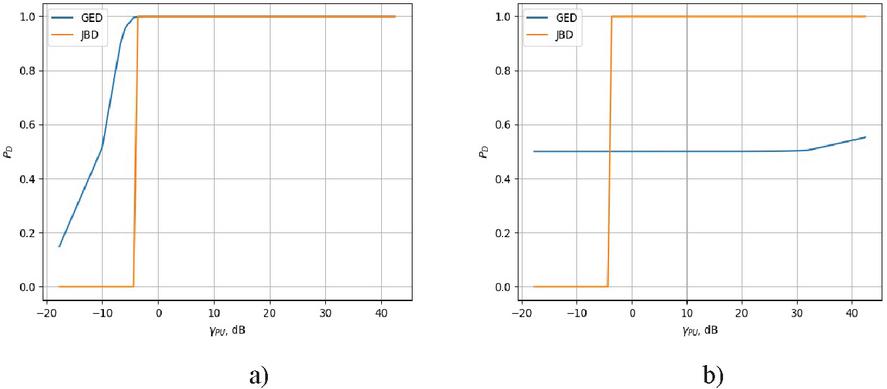
Figure 1 Probability of detection against the PU SNR at the CAPs for the GED and JBD in (a) AWGN environment (b) AWGN environment with noise uncertainty.
The Jarque-Bera detector (JBD) [18] is selected to be compared in the presented simulation environment, to the standard Gaussian energy detection (GED) in Figure 1. The simulation results show that in the case of additive white Gaussian noise (AWGN) only channel (Figure 1a), the JBD has either zero or maximum efficiency for SNR of 5 dB, while the GED has a gain of about 2 dB for probability of detection of 0.9. Its performance declines in close to an exponential manner. In the presence of noise uncertainty of 1 dB, however, the GED is unable to provide certain accuracy as its PD is close to 0.5 for the whole SNR range (Figure 1b). In contrast, the JBD retains its efficiency without increasing its computational complexity. It is unaffected by the change in noise variance, thus showing the detector’s stability for the chosen decision threshold value under the CAP critical density. This result is advantageous in the case of densely-deployed urban environments.
4 Conclusions
The various miscellaneous spectrum sensing methods reviewed in this paper, lead to two main research directions, namely: (1) Reduction of sensing time by applying an adaptive multi-stage detection process, and (2) Achieving higher performance through non-standard feature extraction. Considering the overall pursuit of decreasing the number of samples in the design of many modern spectrum sensing algorithms, it can be seen that combining traditional detectors which assume Gaussian distribution for the PU signal under the CLT, may be limiting both in terms of efficiency and computational complexity gains. Current multi-stage and FL-based detectors (such as [9, 12, 13, 15]), however, give hints to how different spectrum sensing algorithms with small number of samples (N 100) can be incorporated together to yield potentially higher probability of detection. On the other hand, the application of non-standard feature extraction approaches (such as computing HOS [16, 18, 20]), despite its advantage of not requiring the knowledge of any PU signal parameters, still involves pre-processing which may incur significant computational complexity. There is, therefore, a sufficient argument for exploring the statistical properties of the wireless signals employed in modern communications for the application of contemporary machine learning and deep learning approaches for improvement in miscellaneous spectrum sensing [23]. The latter will also benefit of such analysis to increase the interpretability of these methods and their design [24].
Acknowledgements
This research is supported by the Bulgarian Ministry of Education and Science under the National Program “Young Scientists and Postdoctoral Students – 2”.
References
[1] C.X. Wang, X. You, X. Gao, X. Zhu, Z. Li, C. Zhang, H. Wang, Y. Huang, Y. Chen, H. Haas, and J.S. Thompson, “On the road to 6G: Visions, requirements, key technologies and testbeds,” IEEE Communications Surveys & Tutorials, 2023.
[2] W. Saad, M. Bennis, and M. Chen, “A vision of 6G wireless systems: Applications, trends, technologies, and open research problems,” IEEE Network, vol. 34, no. 3, pp. 134–142, 2019.
[3] H. Tataria, M. Shafi, A.F. Molisch, M. Dohler, H. Sjöland, and F. Tufvesson, “6G wireless systems: Vision, requirements, challenges, insights, and opportunities,” Proceedings of the IEEE, vol. 109, no. 7, pp. 1166–1199, 2021.
[4] M. Giordani, M. Polese, M. Mezzavilla, S. Rangan, and M. Zorzi, “Toward 6G networks: Use cases and technologies,” IEEE Communications Magazine, vol. 58, no. 3, pp. 55–61, 2020.
[5] A. Sufyan, K.B. Khan, O.A. Khashan, T. Mir, and U. Mir, “From 5G to beyond 5G: A Comprehensive Survey of Wireless Network Evolution, Challenges, and Promising Technologies,” Electronics, vol. 12, no. 10, p. 2200, 2023.
[6] S. Chen, F. Qin, B. Hu, X. Li, and Z. Chen, “User-centric ultra-dense networks for 5G: Challenges, methodologies, and directions,” IEEE Wireless Communications, vol. 23, no. 2, pp. 78–85, 2016.
[7] F.H. Tseng, H.C. Chao, and J. Wang, “Ultra-dense small cell planning using cognitive radio network toward 5G,” IEEE Wireless Communications, vol. 22, no. 6, pp. 76–83, 2015.
[8] F. Awin, E. Abdel-Raheem, and K. Tepe, “Blind spectrum sensing approaches for interweaved cognitive radio system: A tutorial and short course,” IEEE Communications Surveys & Tutorials, vol. 21, no. 1, pp. 238–259, 2018.
[9] A. Nafkha, M. Naoues, K. Cichony, A. Kliks, and B. Aziz, “Hybrid spectrum sensing experimental analysis using gnu radio and usrp for cognitive radio,” in 2015 International Symposium on Wireless Communication Systems (ISWCS). IEEE, 2015, pp. 506–510.
[10] K. Srisomboon, A. Prayote, and W. Lee, “Two-stage spectrum sensing for cognitive radio under noise uncertainty,” in 2015 Eighth International Conference on Mobile Computing and Ubiquitous Networking (ICMU). IEEE, 2015, pp. 19–24.
[11] A. Bagwari and G. S. Tomar, “Two-stage detectors with multiple energy detectors and adaptive double threshold in cognitive radio networks,” International Journal of Distributed Sensor Networks, vol. 9, no. 8, p. 656495, 2013.
[12] P. P. Anaand and C. Charan, “Two stage spectrum sensing for cognitive radio networks using ed and aic under noise uncertainty,” in 2016 international conference on recent trends in information technology (ICRTIT). IEEE, 2016, pp. 1–6.
[13] A. R. Mohamed, A. A. A. El-Banna, and H. A. Mansour, “Multi-path hybrid spectrum sensing in cognitive radio,” Arabian Journal for Science and Engineering, pp. 1–8, 2021.
[14] W. Ejaz, N. ul Hasan, S. Aslam, and H. S. Kim, “Fuzzy logic based spectrum sensing for cognitive radio networks,” in 2011 Fifth International Conference on Next Generation Mobile Applications, Services and Technologies. IEEE, 2011, pp. 185–189.
[15] A. Ivanov, A. Mihovska, V. Poulkov, and R. Prasad, “Hybrid accuracy time trade-off solution for spectrum sensing in cognitive radio networks,” International Journal of Mobile Network Design and Innovation, vol. 9, no. 1, pp. 1–13, 2019.
[16] A. Subekti, S. N. Rachmana, A. B. Suksmono et al., “A HOS based spectrum sensing for cognitive radio in noise of uncertain power,” in 2014 2nd International Conference on Information and Communication Technology (ICoICT). IEEE, 2014, pp. 511–514.
[17] H. Urkowitz, “Energy detection of unknown deterministic signals,” Proc. IEEE, vol. 55, no. 4, pp. 523–531, Apr. 1967.
[18] A. Subekti, N. S. Rachmana, A. B. Suksmono et al., “A Jarque-Bera test based spectrum sensing for cognitive radio,” in 2014 8th International Conference on Telecommunication Systems Services and Applications (TSSA). IEEE, 2014, pp. 1–4.
[19] D. Wang, N. Zhang, Z. Li, F. Gao, and X. Shen, “Leveraging high order cumulants for spectrum sensing and power recognition in cognitive radio networks,” IEEE Transactions on Wireless Communications, vol. 17, no. 2, pp. 1298–1310, 2017.
[20] S. Gurugopinath, R. Muralishankar, and H. Shankar, “Spectrum sensing in the presence of cauchy noise through differential entropy,” in 2016 IEEE Distributed Computing, VLSI, Electrical Circuits and Robotics (DISCOVER). IEEE, 2016, pp. 201–204.
[21] A. Ivanov, K. Tonchev, P. Koleva, and V. Poulkov, (2022). “Influence of Density on Throughput Performance in Cognitive Ultra-dense Networks,” Journal of Mobile Multimedia, 19(01), 29–46. https://doi.org/10.13052/jmm1550-4646.1912.
[22] Sharma, S.K., Bogale, T.E., Chatzinotas, S., Ottersten, B., Le, L.B. and Wang, X., 2015. Cognitive radio techniques under practical imperfections: A survey. IEEE Communications Surveys & Tutorials, 17(4), pp. 1858–1884.
[23] M.C. Park and D.S. Han, “Deep learning-based automatic modulation classification with blind OFDM parameter estimation,” IEEE Access, vol. 9, pp. 108305–108317, 2021.
[24] L. J. Wong, W.H. Clark IV, B. Flowers, R.M. Buehrer, A.J. Michaels, and W.C. Headley, “The RFML ecosystem: A look at the unique challenges of applying deep learning to radio frequency applications,” arXiv preprint arXiv:2010.00432, 2020.
Biographies

Antoni Ivanov received the PhD degree in Communication Networks and Systems from the Technical University of Sofia (TUS), Bulgaria in 2020. He holds a Master degree in Innovative Communication Technologies and Entrepreneurship from TUS, and Aalborg University, Denmark in 2016. He is currently a Postdoctoral researcher at the “Teleinfrastructure Lab”, Faculty of Telecommunications, TUS. His research interests include cognitive radio networks, adaptive algorithms for dynamic spectrum access, deep learning-based solutions for cognitive radio applications, volumetric spectrum occupancy assessment, and graph signal processing for resource allocation in current and future wireless networks.

Ivaylo Bozhilov is a PhD student at the Technical University of Sofia (TU Sofia), focusing on telecommunications. He earned his Bachelor’s and Master’s degrees in the same field in 2021 and 2022 respectively. Currently, he is part of the Teleinfrastructure Research Laboratory at TU Sofia. His research interests include holographic communication, computer vision, and artificial intelligence, aiming to bring innovative perspectives to these areas.
Journal of Mobile Multimedia, Vol. 19_5, 1357–1370.
doi: 10.13052/jmm1550-4646.19510
© 2023 River Publishers