Dynamic Spectrum Management and Spectrum Sharing Techniques in 5G Networks: A Survey
Sonali Mondal1,*, Manash Pratim Dutta2 and Swarnendu Kumar Chakraborty1,*
1Department of Computer Science & Engineering, National Institute of Technology Arunachal Pradesh, India
2Department of Computer Science & Information Technology, Cotton University Assam India
E-mail: sonalimondal707@gmail.com; manashpdutta@gmail.com; swarnendu@nitap.ac.in
*Corresponding Authors
Received 06 December 2023; Accepted 15 October 2024
Abstract
The enormous developments of gaming devices as well as mobile apps have increased the demand of bandwidth. Development of wireless applications has been affected because of the insufficient spectrum resources in the 3G and 4G network. This spectrum scarcity is the main limitation of 3G and 4G networks, which leads to the revolution of the 5G technology. Spectrum scarcity is a great challenge in wireless communication. There are two significant research areas that need to be explored such as, searching spectrum resource and maximum spectrum utilization. To address spectrum insufficiency, consistent research is needed to find out spectrum band and share the spectrum resource. In this work, complete Spectrum management framework is discussed as well as spectrum sharing techniques are classified. We have conducted a thorough survey on various spectrum sharing schemes. The literature survey has been classified based on some significant sharing techniques depending on spectrum access method, network architecture, spectrum allocation behavior etc. We have also summarized contribution as well as limitation of recent spectrum sharing approaches. To enhance 5G technology, related spectrum sharing surveys are studied and future research directions are also discussed here.
Keywords: 5G, spectrum management framework, spectrum sensing, spectrum sharing, cognitive radio.
1 Introduction
As licensing cost and dearth for accessible spectrum is very high, ever-growing and predictable requirement of huge data rates as well as network capacity poses significant problems to existing mobile networks. The spectrum requirement to deploy huge number of Internet of Things (IoT) devices is predicted to be lowered from 76 GHz to 19GHz utilizing dynamic spectrum management (DSM) [1]. Radio spectrum access is controlled by some government agencies, like the Infocomm Development Authority (IDA) of Singapore, Federal Communications Commission (FCC) in United States and the Office of Communications (Ofcom) in United Kingdom (UK). Regulatory authorities use the fixed spectrum access (FSA) policy to assign different areas of the radio-frequency spectrum having specific bandwidth for various services such as GSM-1800 has exclusive use of the 1805–1880MHz band in Singapore, and other services are not permitted to use it at any time [2]. Based on International Telecommunication Union (ITU) standards, a number of 5G application services are identified. URLLC, mMTC, eMBB and fixed fibre-like wireless access are some renowned 5G application services.
Radio spectrum is an essential enabler for wireless communication. As the massive expansion of wireless traffic the spectrum resource is becoming scarce. It has been observed that due to adopting traditional static spectrum allocation method, the radio spectrums are used inefficiently, hence it remains underutilized. This issue leads to the evolution of spectrum allocation policy from static manner to dynamic. To mitigate such spectrum shortage problem, DSM is evolved. User who doesn’t have a license are called secondary user (SU) in DSM, whereas those who have a license, i.e., authorized users, are known as primary users (PU). If the PU is idle and the primary spectrum is unutilized then SU can access that spectrum without causing any interference. During this access, the services of PU should be safeguarded. In this technique, SU got transmission opportunity without having its own dedicated spectrum. This type of spectrum access technique is called DSA [2]. Three different operating bands are specified for 5G in accordance with the LTE frequencies that can be taken advantage of using time division duplex (TDD) and frequency division duplex (FDD) technologies for sharing the spectrum. The three spectrum bands are: Low-band, Mid-band and High-band [3].
Table 1 summarizes the merits and demerits of the three spectrum bands.
| Low-Band | Mid-Band | High-Band |
Advantage: (i) Excellent wall penetration capacity (ii) Vast coverage area Disadvantage: (i) Maximum data speed upto 100 Mbps |
Advantage: (i) Lower latency than low-band spectrum (ii) It provides faster speed Disadvantage: (i) Maximum data rate upto1Gbps (ii) Cannot penetrate buildings as efficiently as low-band spectrum |
Advantage: (i) Maximum data speed upto 10Gbps (ii) Extremely low latency Disadvantage: (i) Building penetration capacity is very poor (ii) Low coverage area |
As spectrum is very precious, so it is very important to properly utilize it. Cognitive radio (CR) technique has demonstrated a significant result to improve spectrum utilization [4]. It is an intelligent tool that senses its electromagnetic environment. It can adjust as well as configure its radio operating parameters with dynamism [5]. To overcome spectrum scarcity issue this CR concept came into existence. Here it utilizes the unused or underutilized spectrum band [6]. This is how SU can opportunistically get the chance to access PU’s spectrum band, while PU’s spectrum is unoccupied. In CR approach, without possessing any dedicated spectrum SU gains the opportunity to transmit, maintaining PU’s transmission uninterrupted.
The PU signal is received at SU and the signal quality is degraded due to multi-path fading, [7] and shadowing [8, 9]. This leads to incorrect sensing decision about PU’s presence or absence. Sometime due to the hidden node problem SU is unable to receive PU’s signal. The geographical constraint is solely responsible for this hidden node problem. The concept of collaborative spectrum sensing came into existence to overcome this problem. It can improve the sensing performance [10, 11]. some key roles of CR like, channel-state estimation, transmitted power control, radio scene analysis & spectrum management etc. are identified by Haykin et al. [12]. After studying a number of review articles related to spectrum sharing, it is found that most of them only discussed the contribution as well as focus. But discussion on limitations of those approaches was lacking, also their technique, approach along with key features was highly desirable.
The key contributions of this study are mentioned below:
• In the first section spectrum management framework along with system model for spectrum sensing is presented. Also different categories of spectrum sharing are mentioned.
• Spectrum sharing related surveys conducted from 2014 to 2023 is studied and contributions and focus of these studies are summarized and presented in a table.
• Different spectrum sharing techniques are reviewed. Summary of prior spectrum sharing approaches, including their technique, approach, key features are compiled and presented in a table.
• These studies are categorized into some important spectrum sharing techniques like, spectrum access method, network architecture and spectrum allocation behavior. Contributions as well as limitations of each spectrum sharing approaches are also discussed.
• Some recent blockchain based schemes to address security issues in spectrum sharing are studied. Different Artificial Intelligence based approaches are also discussed.
• Future research directions in spectrum sharing are also discussed.
The paper is systematically organized as follows: In Section 1, introduction of this study is presented. Section 2 describes the spectrum management framework along with system model for spectrum sensing. Also different category of spectrum sharing is mentioned here. In Section 3, previous survey papers on spectrum sharing are reviewed, their focus and contributions are compiled in a tabular form. In Section 4, different research work on spectrum sharing techniques are mentioned also, prior spectrum sharing work including their technique, approach, key features are summarized in a table. Contributions as well as limitations of those approaches are discussed in this section. For better communication and to support 5G advancement, future research directions are discussed in Section 5. Finally Section 6 concludes this study.
2 Spectrum Management Framework
At present, researchers should focus on increasing the spectrum utilization. CR technology is capable to provide intelligent spectrum management techniques to satisfy the rising demand for spectrum band. Figure 1 represents a complete framework for spectrum management; also the main functionalities of a cognitive radio network (CRN), like, spectrum sensing, spectrum sharing, spectrum decision, spectrum mobility, are shown [13].
(a) Spectrum sensing: PUs might be inactive during some time slots, frequency bands or geographic directions because of its unpredictable transmission nature. The frequency bands where it is inactive are termed as “spectrum holes”. For detecting the spectrum holes and monitoring primary spectrum periodically, SUs perform spectrum sensing. Detection of PU signal is very important for maximum spectrum utilization. In CR spectrum sensing is a vital task.
(b) Spectrum sharing: In wireless communication various SUs used to try to access the available spectrum band. So it may cause collision among SUs. Coordination between SUs is very important to run the communication smoothly.
(c) Spectrum decision: In this phase according to the user’s QoS requirement spectrum is analyzed and also decided. Hence the appropriate vacant spectrum band is chosen. After analysis, it is decided to use these unoccupied spectrum band.
(d) Spectrum mobility: The most important purpose of mobility is managing the connection and spectrum handoff. While the PU arrives at that moment SU have to release the spectrum hole and switch to some other spectrum band. Connection management used to take care of continuous data transmission.
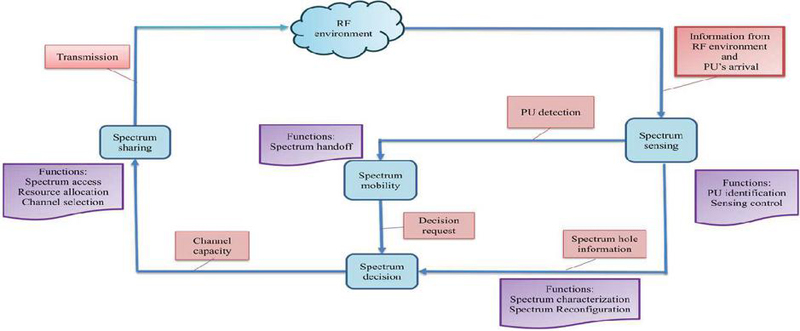
Figure 1 Spectrum management framework for CR network [13].
A channel is called spectrum opportunity if it is unused by the PU. According to several studies, the nature of spectrum sensing is co-operative also it is used when multiple SUs exist to improve the sensing accuracy [14–19]. Probability of false alarm (PFA) and probability of detection (PD) are two important metrics to estimate sensing performance. Traditional sensing approaches have some drawbacks because of PFA and PD, These constraints hamper spectrum utilization. PFA is the probability of finding PUs’ presence when they are inactive. PD is the probability of PUs’ presence when they are really active. This is why it denotes the amount of protection to the PUs. High PD indicates better PUs’ security. Low PFA implies that there is more transmission opportunities which the SUs can utilize. In this way, SUs’ efficiency is improved and this is how it achieve higher throughput. A good sensing approach must have increased PD along with reduced PFA. Generally, these two metrics are contradictory. High PFA minimizes SUs’ scope to access the spectrum. A lot of effort has been proposed [20–24] to enhance spectrum sensing performance, by inventing new detection techniques or granting many SUs to collaboratively implement the spectrum sensing.
2.1 System Model for Spectrum Sensing
Sensing of spectrum can be considered as binary hypothesis [25]. Presume that is the received signal at detector input, here is the amount of noise signal and is the transmitted signal.
| (1) | |
| (2) |
: Primary User is inactive and channel is idle : Primary User is active and channel is occupied : Sample index
2.2 Spectrum Sharing Categorization
Depending on the parameters as given in Figure 2, spectrum sharing categorization can be separated into three components [26]:
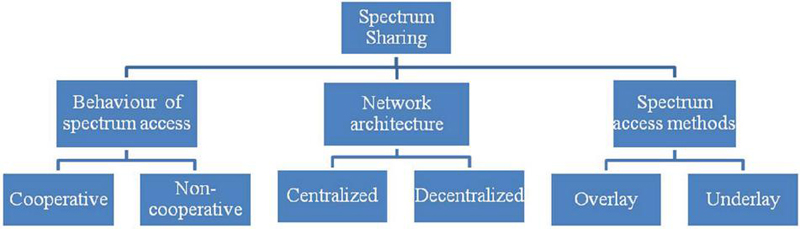
Figure 2 Spectrum sharing categorization.
Firstly, depending on the spectrum access behavior, spectrum sharing can be classified as cooperative and non-cooperative spectrum sharing [26].
Cooperative spectrum sharing:
In this approach, to optimize spectrum utilization, CR users used to exchange information by coordinating cognitive network’s functionality.
Non-cooperative spectrum sharing:
This technique is also termed as non-collaborative sharing approach. Here, CR users do not take any responsibility to coordinate the cognitive functionality with other users.
The key difference between the two approaches is, the cooperative spectrum sharing requires a common control channel for information exchange, whereas in the second technique CR users used to execute the network functions by themselves. In non-cooperative approach, collaboration with any other user is not required.
Secondly, based on the network architecture spectrum sharing can be categorized as: centralized and decentralized spectrum sharing.
Centralized spectrum sharing:
This is an efficient spectrum sharing solution where a centralized entity used to control the allocation of spectrum band. In a distributed-centralized technique, every node in CRN provides information to the centralized entity. This information is necessary to prepare spectrum allocation map. Hence, every node takes part in spectrum allocation.
Decentralized spectrum sharing:
It is also known as distributed spectrum sharing. This type of sharing approach is adopted while the infrastructure is not sufficient. Every node has the responsibility to allocate spectrum. Generally the spectrum access depends on local (or perhaps global) policy.
Based on the spectrum access method, spectrum sharing is classified as: overlay and underlay technique.
Overlay spectrum sharing:
It utilizes the opportunistic approach (e.g., OSA) for accessing the spectrum hole. During PU’s absence, without hampering PU’s transmission, the spectrum band is frequently monitored to discover any unused band to be utilized by SU. In this technique the spectrum band is sensed and if PU is found inactive then only the vacant channel will be used. Spectrum overlay is also termed as opportunistic spectrum access (OSA). Some necessary pre-coding at the transmitter end is essential for minimizing interference at the receiver end. So it is very important to have good understanding about other existing signals in the same spectrum band.
Underlay spectrum sharing:
To find out spectrum holes, cognitive users periodically monitor the spectrum band to use the unused band for data transmission. In this approach, CR user starts its communication while the spectrum allocation map is ready. Although PU is present, spectrum underlay technique utilizes the benefits of spectrum band maintaining the interference minimum. For achieving this, spread spectrum techniques are employed. It causes a signal having a high bandwidth but low spectral power density that can exist side-by-side with the primary consumers. The issue of intervention between users still persists. It requires high bandwidth than overlay method.
3 Early Survey on Spectrum Sharing
In this section, previous survey papers on spectrum sharing including their focus and contributions are summed together and given in Table 2.
Table 2 Summarizes prior spectrum sharing-related survey/review publications, including their focus and contributions
| Problem | Author, Reference, | |
| Addressed | Findings of the Study | Year of Publication |
| Difficulties and solutions for converting the existing network to a heterogeneous mobile network. | Combined three main convergences (device convergence, service convergence and protocol convergence). Studied Coordinated multipoint (CoMP) and machine-to-machine (M2M) integration for future study. | Jo et al. [27], 2014 |
| Difficulties of developing future CR research in 5G. | Explained how quickly and trustworthy reconfigurable hardware, adaptable prediction algorithms, dynamic spectrum allocations, seamless connectivity are all significant parts of cognitive terminal difficulties. | Rodriguez [28], 2014 |
| Investigate the underlying real-world radio spectrum state (RSS), both expected and unpredictable. | (i) Determined when and where there exist spectrum holes. (ii) Fano inequality and Statistical entropy measures are used to calculate the level of predictability underlying real-world spectrum measurements. | Ding et al. [29], 2015 |
| Identify spectrum sharing techniques which are centralized solutions and distributed solutions. | A typical probable 5G cellular network architecture is proposed, where it is shown that IoT, D2D, network cloud and small cell access points can be a part of it. | Gupta [30], 2015 |
| Examine the significance of spectrum sharing and identify the gaps in order to create and implement the most effective sharing schemes. | (i) A study on different licensed spectrum sharing mechanisms for cellular networks was conducted. (ii) Studied different spectrum sharing techniques with various network topologies and explored their characteristic features, feasible use cases and challenges. | Tehrani et al. [31], 2016 |
| Focused on contemporary attempts to employ database-driven techniques to manage the shared co-existence of users with heterogeneous access, interference protection rights and discussed some research issues. | In future DSA models, spectrum sharing can be done along various technical dimensions such as frequency, time, space, and direction. It can be utilized for different contexts like new/legacy, government or commercial, licensed/unlicensed, or numerous classes of spectrum rights holders. | Bhattarai et al. [32], 2016 |
| Investigated the issues to set up each single spectrum sharing technique as well as the integrated edition of those techniques in 5G networks. | (i) In-band FD communication NOMA, CR, D2D communication and LTE-U integration issues are addressed. (ii) Since CR necessitates a wider bandwidth search, the energy-efficient spectrum sensing technique is crucial in 5G networks. | Zhang et al. [33], 2017 |
| Study the viable future research scopes on exclusive-use CR model. | (i) Present overview of spectrum trading solution for using exclusively and challenges on trading model viability assessment. (ii) Examine the three most prevalent dynamic sharing approaches: common, exclusive use and shared usage. | Hassan et al. [34], 2017 |
| Identify research advancement in sharing based on four important scenarios of spectrum management such as sensing, allocation, access and handoff. | (i) Based on different types of applications spectrum sharing schemes are categorized into different categories like, wider-coverage, low-latency, massive-connectivity and capability. (ii) Studied key enabling technologies which are closely related to 5G, such as auction based spectrum allocation, full-duplex spectrum sensing, carrier aggregation based spectrum access, spectrum-database based spectrum sensing. | Hu et al. [35], 2018 |
| Current legal restrictions and trial activity for sharing schemes (e.g., LSA, SAS and LAA) were explored from the inter-operator sharing and virtual network topology perspective. | (i) Discuss critical issues such as service differentiation, information sharing and the need for new network functions. (ii) Proposed a highly flexible architecture to virtualize the spectrum sharing techniques along with associated abstractions, which is suitable for inter-operator spectrum sharing in virtualized 5G network. | Ahmed et al. [36], 2019 |
| Explore spectrum sharing related issues and challenges and the future research scope. | (i) Discuss on spectrum management, assignment and allocation. (ii) For ensuring the quality of spectrum sharing method, various performance evaluation parameters are presented. | Mishra et al. [26], 2019 |
| Study latest 5G enabling technologies and spectrum sharing techniques towards 5G development. | i) Various 5G-enablers, such as URLLC, HetNets, ultra-lean design, spectrum sharing and flexibility, mMTC, mMIMO, mmWave, NM, convergence of access and backhaul are discussed. The study will address significant challenges in implementing 5G applications successfully. | Ahmad et al. [37], 2020 |
| To present an apparent idea for designing spectrum efficient scheme for 5G as well as B5G network. | Machine learning (ML) and Artificial Intelligence (AI) based technique would be helpful for spectrum sensing in ultra-dense heterogeneous environment. | Nidhi et al. [3], 2021 |
| Suggested future ML based approach for next generation communication technology and also uncovered some open research issues. | (i) Different ML based algorithms in DSS and CSS domain are discussed. (ii) Authors have justified the application of unsupervised, supervised and reinforcement ML techniques in the CSS domain as well as for solving DSS issues. | Janu et al. [13], 2021 |
| Study the basic principles of NOMA and the notion of CR. | Combination of CR and NOMA can match 5G standards for low latency, high efficiency and good connectivity. | Hassan et al. [38], 2021 |
| Identify security challenges from the physical layer and consequent ML based protective techniques. | Author discussed two standard spectrum sensing attacks such as Spectrum Sensing Data Falsification (SSDF) and Primary User Emulation (PUE). Also addressed two common attacks occurring during transmission and wireless access in perspective of spectrum sharing such as jamming and eavesdropping. | Wang et al. [39], 2022 |
| Study the necessity of cooperation and coexistence between AI/ML-based radio resource management (RRM) and distributed techniques. | (i) Federated Learning (FL) and Mobile edge computing (MEC) potentially solve multi parameter type of the problem and improves user key performance indicators (KPIs). (ii) In each occurrence by applying corresponding metrics the problems are explored as either regression or classification type. | Bartsiokas et al. [40], 2022 |
| Study the modern CR-based NOMA network design and various design issues regarding practical implementation. | Various enabling technologies integrated with CR-based NOMA systems can improve spectrum utilization. Such technologies include hybrid NOMA, terahertz communications, unmanned aerial vehicles, intelligent reflecting surfaces, machine learning etc. | Salameh et al. [41], 2023 |
4 Related Work on Spectrum Sharing Techniques
In this article we have presented different research work on spectrum sharing techniques. It can be classified into some significant approaches like, spectrum access method, network architecture and spectrum allocation behavior.
Many authors proposed different techniques based on spectrum allocation behavior [45–48, 64, 65, 74, 79, 80, 83]. Various spectrum access method based sharing strategy is also discussed [49–92, 72, 87]. For efficient spectrum sharing network architecture is another important approach. Different network architecture is discussed [42–44, 66, 73, 91]. SAS is a promising spectrum sharing model that is presently gaining attention [56, 57, 70]. There is some security issues but Blockchain based techniques can efficiently resolve [67, 81, 83]. Introduction of AI based approach [72, 77], Reinforcement Learning (RL) based strategy [84, 87] and Deep Reinforcement Learning (DRL) schemes [92, 93] have done massive improvement in spectrum sharing. In Table 3, prior spectrum sharing work including their technique, approach, key features are summarized.
Table 3 Summary of prior spectrum sharing approaches, including their technique, approach, key features
| Author, Reference & Year of Publication | Spectrum Sharing Technique | Spectrum Sharing Approaches | Key Features |
| Akhtar et al. [42], 2016 | Centralized | Network architecture | Reduced influence of inconsistent quality of signal |
| Jiang et al. [43], 2017 | Centralized and distributed | Network architecture | Multi-user, spatial white space |
| Zhang et al. [44], 2017 | Decentralized | Network architecture | Game theory, interference graph |
| Yang et al. [45], 2016 | Cooperative | Spectrum allocation behavior | Interference (SINR) |
| Wang et al. [46], 2017 | Cooperative | Spectrum allocation behavior | Interference graph, multi-user |
| Bairagi et al. [47], 2018 | Cooperative | Spectrum allocation behavior | Game theory, Quality of Experience (QoE) |
| Rattaro et al. [48], 2018 | Non-cooperative | Spectrum allocation behavior | Multi-resource |
| Mach et al. [49], 2017 | Overlay and underlay | Spectrum access method | Energy efficient |
| Zappone et al. [50], 2017 | Overlay and underlay | Spectrum access method | Energy efficient, D2D |
| Gandotra et al. [51], 2018 | Simultaneous (overlay or underlay) | Spectrum access method | Green, D2D, EE, multi-user |
| Zhou et al. [52], 2017 | Underlay shared | Spectrum access method | TV white space (TVWS), v-D2D |
| Lv et al. [53], 2018 | Overlay and underlay NOMA | Spectrum access method | Successive interference cancellation (SIC), outage probability |
| Zeng et al. [54], 2018 | NOMA | Spectrum access method | Multi-user, QoS, Energy efficient |
| Ali et al. [55], 2019 | NOMA | Spectrum access method | Multi-user, successive interference cancellation (SIC) |
| Jayawickrama et al. [56], 2018 | SAS | Spectrum access method | Scalable SAS, mMTC |
| Grissa et al. [57], 2018 | SAS | Spectrum access method | TVWS, database assisted |
| Kalidoss et al. [58], 2018 | Hierarchical | Spectrum access method | Improve overall interference, multi-user |
| Jiang et al. [59], 2018 | Hierarchical | Spectrum access method | QoS |
| Jia et al. [60], 2018 | Opportunistic | Spectrum access method | Spatial throughput, cache-hit probability, interference to protect primary transmission |
| Rebato et al. [61], 2017 | Exclusive | Spectrum access method | mmWave |
| Lin et al. [62], 2017 | Dynamic | Spectrum access method | QoE |
| Zhang et al. [63], 2018 | Dynamic | Spectrum access method | Allow SU interference, reduce WiFi interference, TVWS, QoS |
| Liu et al. [64], 2017 | Clustering method | Spectrum management mechanism | Double auction |
| Movassaghi et al. [65], 2018 | Opportunistic | Spectrum Allocation | Smart Channel Assignment (SCA) |
| Amraoui et al. [66], 2019 | Opportunistic | Multi-agent spectrum access architecture | Coalition formation and multicriteria decision making |
| Alhosani et al. [67], 2020 | Decentralized | Permission less blockchain based system for Spectrum Sharing | Features related to reliability and security, blockchain based solution |
| Sangdeh et al. [68], 2020 | Underlay CRN | Spectrum sharing scheme | Blind interference cancellation (BIC), Blind beamforming (BBF) |
| Qian et al. [69], 2020 | Massive access | Multi-operator spectrum sharing | Stackelberg pricing game, massive IoT devices |
| Matsuno et al. [70], 2020 | SAS | Dynamic frequency sharing | Area protection, point protection |
| Kim et al. [71], 2020 | Opportunistic | Spectrum sharing | Flexible HD/FD communications, OP-map based random MAC |
| Challita et al. [72], 2021 | Deep reinforcement learning (RL) algorithm based on Monte Carlo Tree Search (MCTS) | Split the bandwidth | Improves system-level performance |
| Barb et al. [73], 2021 | MIMO | NSA and SA architecture | Extra dedicated bandwidth for NR systems is not needed |
| Bhandari et al. [74], 2021 | Decentralized cooperative | Dynamic channel allocation technique | Reduced sensing time and reduced allocation time |
| Xin et al. [75], 2021 | MBSFN subframe based method, Rate Matching | Spectrum utilization | Flexible scheduling, evasion between LTE CRS signals and NR data channel |
| Sofia et al. [76], 2021 | OFDM and Filter Bank Multi Carrier (FBMC), Overlay mode | Spectrum sharing | Finding the best spectral hole accurately |
| Ibrahim et al. [77], 2021 | underlay | low-complexity data-centric spectrum sharing | Repetition coding |
| Wang et al. [78], 2022 | Dynamic | Interference Avoidance for dynamic spectrum sharing (DSS) | Collision avoidance, DSS |
| Kim [79], 2022 | Hierarchical | Spectrum Allocation | Dual bargaining game model, cooperative game theory |
| Qiu et al. [80], 2022 | opportunistic spectrum access | Spectrum allocation | Loosely-coupled CRN, sensing-based interference recording |
| Zhang et al. [81], 2022 | distributed | Spectrum sharing | Blockchain enhanced distributed spectrum sharing, Proof of Strategy (PoG) |
| Grey et al. [82], 2022 | LAA-Wi-Fi coexistence, Shared use | Spectrum sharing | Pareto frontier, bi-criteria problem, |
| Zuguang et al. [83], 2022 | Blockchain | Spectrum sharing and allocation | Blockchain enabled spectrum management, bilateral confirmation protocol |
| Pakzad et al. [84], 2022 | Geo-location database, TVWS | Spectrum sharing | Menu driven interface (MDI), reinforcement learning |
| Khurshid et al. [85], 2022 | HetNet | Radio resource sharing | spectrum trading, Load-Based Leased Spectrum Pool (LLSP), Load-Based Shared Spectrum Pool (LSSP), |
| Xiao et al. [86], 2022 | relay-assisted cooperative CRN (RA-CCRN) with NOMA | Security-aware spectrum sharing | Energy harvesting, discrete-time Markov chain, secrecy outage probability (SOP) |
| Dong et al. [87], 2022 | multi-agent deep RL | Dynamic spectrum access as well as sharing | multi-agent deep RL |
| Schilling et al. [88], 2022 | code-selective method for 5G | Dynamic spectrum sharing | Frequency selective method, code-selective method |
| So et al. [89], 2023 | excluded channel selection technique | Channel selection | Improve throughput and latency, reduce transmission delay |
| Sultan [90], 2023 | enhanced-artificial-bee-colony (EABC) | NOMA-based Spectrum sharing | Constrained optimization problem to enable primary communication |
| Ibrahem et al. [91], 2023 | Underlay cooperative system | Network architecture | Cognitive relay network, Rayleigh distribution, Nakagami-m fading distribution |
| Liu et al. [92], 2023 | Opportunistic | Resource allocation | Deep Recurrent Q-Network, Deep Q-Network |
| Feng et al. [93], 2023 | Dynamic | Spectrum utilization | Hidden-mode Markov Decision Process (HMMDP) |
4.1 Contribution as well as Limitation of Recent Spectrum Sharing Approaches
Related works on spectrum sharing techniques are presented in this section. These techniques are classified into different sharing approaches based on Network architecture, Spectrum allocation behavior, Spectrum access method, schemes to handle security issues, AI based approaches, RL based techniques etc. Also some limitations of the proposed approaches are discussed.
4.1.1 Network architecture
Akhtar et al. [42] proposed a centralized network architecture consisting of an SDN controller, distributed sensing devices and a BS, to reduce the influence of inconsistent quality of signal. A Harmonized SDN enabled approach (HSA) is utilized by taking input of availability of spectrum. But this proposed scheme has not been tested in a real world testbed. This is why its applicability and viability is questionable. Any channel assignment algorithm is not specified. Still at the edge of the access network the base stations (BSs) employed database-assisted spectrum management. Jiang et al. [43] proposed a network architecture where the spatial focusing impact is investigated depending on the tendency of using mMIMO and time reversal. Here the spatial white space spectrum sharing idea is intended to allow simultaneous multi-user spectrum sharing without allocation of orthogonal resource. Security, admission control, handover etc are some important aspects which should be taken care of. Some other problems regarding MAC layer need to be explored again.
Zhang et al. [44] suggested a game theoretic and interference graph strategy to attain joint optimization on decentralized spectrum sharing. For reducing overhead and complexity two decentralized solution ie. spatial adaptive play iterative (SAPI) and concurrent best-response iterative (CBSI) algorithms are proposed. Energy harvesting technique is used at small base stations (SBSs) to improve energy efficiency. At this point of time QoE of the user can be affected because of sporadic advent of renewable energy. This issue should be addressed. Amraoui et al. [66] proposed opportunistic multi agent spectrum access network architecture for multi-criteria decision making. In CRN for spectrum sharing, the Coalition Secondary User (CSU) and Coalition Primary User (CPU) agents have been introduced. CPU and CSU agents act like an intermediary between PU and SU in CRN. It is presumed that in physical level spectrum detection is already accomplished. So the aspect of spectrum detection is not explored here. The concentration was given on spectrum management part. Here generally talking about the physical level means talking about hardware.
Barb et al. [73] proposed a NSA and SA architecture. This approach enables operators to provide both NR and LTE services can use the same frequency bands, but in an interleaved manner. Cost reduction and spectrum efficiency improvement are achieved. The decline in DSS throughput was greater as the sharing ratio increased. In the proposed method some amount of loss in throughput is observed. Because of DSS, decrease in throughput is experienced. LTE will access those resources which are available and the remaining few resources will be accessible to the NR. In their literature, Ibrahem et al. [91] investigated a cognitive relay network having interference restriction from PU with a mobile end user. In the suggested scheme, a half-duplex mode of communication is employed between a distinct PU and SU. Along with this, amplify and forward (AF) relaying method is applied between the source and destination SU. Depending upon the maximum signal-to-noise (SNR) ratio, this proposed approach dynamically selects the best suitable relay to transmit. To achieve diversity, selection combiner is deployed at the SU destination. There are some limitations like, the system model is tested at the user level (only a single PU and SU). More number of PU and SU should be considered to check its efficiency. Here only amplify and forward (AF) relay technique is used, to study the impact, other relay technique like, decode and-forward should be considered. As all the relays are not in use, In future the proposed system should allow the relays so that more than one SU could be served by the relays.
4.1.2 Spectrum allocation behavior
Yang et al. [45] have done a survey on cooperative and cognitive advanced spectrum sharing from a technological and economic standpoint, as well as multi-level spectrum sharing differentiation classes. In this study, authors proposed a spectrum flowing system for 5G cognitive heterogeneous cellular networks that proficiently enhances energy as well as spectral efficiency. But due to combining co-primary sharing and licensed shared access some other variety of cognition such as traffic cognition and spectrum resource reserving technique, should be investigated. Wang et al. [46] introduce a hybrid spectrum sharing system which combines auction and negotiation called Size-Negotiable Auction Mechanism (SNAM). This approach constructs a blended interference graph capable of quantifying up to five levels of interference. Here, the main obstacles for spectrum sharing in mobile network operators are spatial efficiency, economic property, partial information etc.
Bairagi et al. [47] studied the spectrum allocation behavior, especially on local thermal equilibrium on unlicensed band. In this study, authors suggested a game-theory based technique ie. a virtual coalition formation game (VCFG) with two parts: time sharing and resource allocation, which are resolved by means of the Kalai-Smorodinsky bargaining solution and the Q learning algorithm, respectively. Here, authors mainly focused on system-level design and analysis. This is why a better coexistence technique between uRLLC and eMBB traffic is desirable. Subsequent research should concentrate to address Resource Block (RB) allocation problem and resource scheduling problem of URLLC and eMBB. Rattaro et al. [48] studied spectrum allocation behavior for non-cooperative spectrum sharing and proposed a paid-sharing model in which SU pays for spectrum utilization, but PUs take precedence over SUs. Reimbursement for affected SUs implies that the PUs service provider will incur some costs. In the proposed approach at some point interference is incurred. Extensive feature extraction is not supported. By means of some specific benchmarked technique the solution of the system is less optimal.
Liu et al. [64] proposed a double auction based clustering method for wireless spectrum management. In the suggested approach, high-speed spectrum market game technique and a model named macrocell low speed spectrum allocation are used to allocate resources. The scheme of cognitive user categorization before resource allocation has been introduced and also a model of double pricing has been designed to rent out unused resources at a reduced cost to the cognitive users. The proposed scheme has realized even distribution of spectrum resource and cluster topology simulation. It should be applied to the actual user scene for checking its suitability in real life scenario. Movassaghi et al. [65] conducted a study on opportunistic spectrum allocation technique. In this study a novel spectrum allocation technique called Smart Channel Assignment (SCA) is presented to maximize resource utilization and transmission speed. To achieve SCA, partially orthogonal channel assignment design is deployed between coexisting Wireless Body Area Networks (WBANs) while also offers a convenient trade off between transmission rate, outage and spectral reuse efficiency. To stay away from spectrum overlap some sort of mechanisms compel devices toggle the channel. If the total number of devices increases significantly, then it will be very tough to find out unoccupied channel for using. This may degrade the efficiency of the proposed technique.
Bhandari et al. [74] studied decentralized cooperative dynamic channel allocation technique to reduce sensing as well as allocation time. This channel allocation technique is based on modified energy detection and sensing the power spectral density (PSD) of the unused spectrum bands or spectrum hole. When compared to the traditional OSA model, this model is more efficient. It is expected that proposed model can be enlarged to tackle complex spectrum sharing systems which can consider versatile parameters such as interference management and energy efficiency. Game theoretic approaches have shown a significant improvement in spectrum allocation. In a recent study, Kim [79] proposed a cooperative game theory based scheme named Dual bargaining game model, to improvise spectrum allocation. Considering the dynamic fluctuation of 4G/5G network, a cooperative game theory based resource allocation algorithm is proposed. It is a two-level dual bargaining model that act mutually for sharing limited wireless spectrum resource and can efficiently control the overhead as well as minimize complexity. For attaining more spectrum efficiency this method can be explored for very dense network environment. Spectrum slicing can be applied to ensure data demand at each 5G BS. Self-interference mitigation algorithm should be employed.
Qiu et al. [80] studied spectrum allocation behavior and suggested a sensing-based interference recording technique. In the proposed approach active interference-avoiding technique (AIA) and past channel information is used for instructing the BS to decide which channel should be allocated. For minimizing interference between various loosely-coupled CRNs, two approaches are proposed. A capacity matrix is used for recording historical data related to interference. This information accompanied with annealing algorithm is applied to diminish the complexity of channel allocation algorithm and to increase the capacity. Power allocation is not considered in the proposed approach. Here concentration is given only on one-way transmission, from end-user (EU) to base station (BS). In DSS, as the number of channel increases, it takes longer time for observation. This causes increase in latency and reduction in throughput. So et al. [89] investigated a channel selection technique for improving latency and throughput as well as reducing transmission delay. In their study, authors proposed a channel selection technique, where all the channels are observed initially, expect the channels with high channel occupancy rate (COR). Hence the observation time is reduced. Here high, low and severe these three interference patterns are used for generalized evaluation in an environment, where sovereign control systems using Carrier Sense Multiple Access with Collision Avoidance (CSMA/CA) are mixed. While the least amount of CORs are equal, UE throughput is deteriorated due to the possibility of choosing channel having lesser difference between CORs decreases.
4.1.3 Spectrum access method
Mach et al. [49] proposed an energy efficient spectrum access method. Here the Energy-aware DSS (EDSS) algorithm is used to choose the most optimal downlink mode for each particular small cell (SC) base stations. For reducing complexity and signalling overhead of the centralized scheme authors propose a distributed algorithm. Spectrum sharing can be hampered due to limited transmission power. It may affect transmission efficiency and data rate. Spectrum resource sharing is not incorporated with caching for attaining high performance and system delivery capacity. In their study, Zappone et al. [50] suggested two overlay algorithms that strike a balance between complexity and optimality claims for overlay. By using a suitable reformulation of the original non-convex fractional issue, we can find the best resource allocation policy for the secondary system for underlay. Here, the secondly proposed approach is very less optimal. Further study is needed to increase its optimality.
Gandotra et al. [51] studied energy efficient, multi user spectrum access method and proposed a spectrum sharing strategy that complies with green communication by building D2D communication links with many PRs utilizing a zonal approach with primary transmitter (PT). In this technique an iterative strategy is implemented to determine the best transmission power consumption for each PR in each zone. This proposed technique paid very less attention to the mobile device aspect. The flexibility of the primary transmitter can save more power. This is why to permit the mobility of the primary transmitter it is essential to develop an energy efficient system. In their article, Zhou et al. [52] explored on structural design for both licensed and unlicensed spectrum. Their study was mainly focused on vehicle communication using spectrum sharing to achieve immerse experience which implemented dedicated short-range communication. In 5G system, mmWave is a promising technology. Here authors could not concentrate on the viability of utilizing this method in the mmWave system.
Lv et al. [53] discussed the up-to-date cognitive NOMA structures (CR-NOMA, underlay & overlay NOMA). Authors proposed cooperative reliance ways to increase reception dependability and cost of installing relays in cognitive NOMA. In the proposed method, successive interference cancellation (SIC) method is used to achieve an efficient spectrum access method. Cognitive NOMA technology show potentially efficient result in spectrum utilization. Research is needed to investigate some cost efficient techniques. Zeng et al. [54] proposed multi-user, energy efficient spectrum access method to maintain the QoS. Here the simulation was done on a clustered MIMO-NOMA system with numerous users. In this study the most effective power allocation (PA) technique was designed for resolving the EE maximization challenge. But In this study, for multiuser MIMO-NOMA systems no work has been done on downlink beam forming design to increase EE.
In their literature, Ali et al. suggested a multi-user Spectrum access method using successive interference cancellation (SIC) technique also designed three models for NOMA users’ clustering [55]. In this suggested method, performance can be improved prominently by efficient UE clustering schemes which select UEs having good interference condition. Here not a single effort has been observed to performance analysis in large scale dense networks with stochastic geometry tools. NOMA clustering is a process that hinders the efficient deployment of NOMA. Jayawickrama et al. studied spectrum access method and proposed a scalable spectrum access system (SAS) platform that can manage the mMTC on a large scale [56]. There are issues with location confidentiality where SUs are required to disclose their location. For reducing overhead the proposed approach avoids location reporting for mMTC networks. As huge numbers of nodes are present, a probable distribution will signify mMTC network correctly. The current SAS framework does not support this.
Grissa et al. have done a study on database assisted spectrum access method and suggested a private access to spectrum databases using a multi-server private information retrieval (PIR) [57]. Authors proposed a new approach which can safeguard SUs’ location confidentiality in database driven CRNs. These types of CRNs include multiple spectrum databases that share the similar content and controlled by different service providers. It suffers from location privacy issue of mobile SUs. In this proposed technique location privacy is a prominent problem in database-driven DSA promoted by CR technology. In 5G NR, Kalidoss et al. found a solution to interference and boost performance [58]. The proposed method uses a multilayer hierarchical structure to identify a solution to a complex problem based on collection of pair-wise comparison matrix. According to the value of priority vector spectrum band is allocated. In this proposed approach user having higher priority vector attains the right to access unlicensed spectrum.
For wireless network virtualization, Jiang et al. [59] conducted a study and utilized a two-time scale hierarchical model. Here all the techniques (time-slot sub channel, large-time-period frequency allocation and power scheduling) use Lyapunov optimization. The proposed method is very proficient in terms of power allocation (PA) optimization and delay. Spectrum band is divided into sections for different types of users like, PU, SU and tertiary users. But fairness amidst user in every section is not yet explored. Jia et al. [60] used opportunistic spectrum access to safeguard primary transmission from unexpected secondary interference. This suggested technique is able to enhance spectrum accessibility of SUs. In this approach, while tackling the shortage of spectrum band by means of CR technique, only traffic congestion can be reduced. But in case of limited backhaul the strain is not diminished.
Rebato et al. [61] implemented a novel hybrid spectrum access technique, which have separation between mmWave band scheme using exclusive access. For benchmarking, comparison was done with the suggested system and exclusive only as well as pooled only systems. Spectrum handoff uncovers extra handoff delay which immensely impacts on 5G low-latency communication. Hence it is necessary to reduce delay and probability of spectrum handoff in spectrum sharing system. Lin et al. [62] conducted a study on dynamic advanced spectrum sharing technique and proposed a spectrum access method for public as well as dedicated user. The system is designed using finite state Markov chain for analysis of the state transition model. For implementing efficient spectrum management improved learning proficiency is needed. For 5G spectrum sharing the radio environment, like interference levels, PU’s traffic patterns etc should be learnt efficiently.
Zhang et al. [63] have a study on spectrum access method to allow SU interference, and for reducing WiFi interference. Here, spectrum sharing and spectrum accumulation are utilized on enhanced CR networks (E-CRNs) to share authorized TVWS spectrum, LTE time division duplexing (TDD) band and accumulate the unauthorized spectrum bands. The framework ECRNs are embedded with water-filled algorithm and DSM for accessing the available spectrum dynamically. Aggregations of unlicensed spectrum band and DSM for licensed spectrum sharing are included by E-CRN framework. The proposed approach can efficiently control the detrimental interference but with a trade-off between aggregation and sharing efficiency.
4.1.4 Spectrum sharing schemes to address security issues
Reliability and security issue is a great threat in spectrum sharing. Alhosani et al. [67] proposed a decentralized permission-less blockchain based system for spectrum sharing that can address reliability and security challenges. It provides a reasonably simple and free method for each user to select what best meets their needs, without the requirement of any third party interactions. Here the test has been conducted in artificially simulated environment. It should be planed to set up and test this suggested approach on a real unauthorized blockchain network simulating CSP environments, to check its accuracy.
Consensus issue is one of the crucial challenges in spectrum management. Zhang et al. [81] implemented a blockchain based multi-operators multi-APs distributed spectrum management technique to share unlicensed spectrum. A lightweight consensus mechanism called “Proof of Strategy” is proposed to resolve consensus issue. Here spectrum sharing problem is considered as consensus puzzle and fraction of unlicensed spectrum is treated as ‘fee’ of miners. A non-cooperative game strategy analyzes the miner’s activity. A symmetric Bayesian Nash equilibrium is derived under uniformly distributed cost estimation for mining. Intelligent control mechanism and blockchain based applications can be implemented for the distributed spectrum management.
To handle miscellaneous resources efficiently as well as safeguard the confidentiality of interconnected devices is a great challenge. Presence of several trustless network operators, under highly dynamic network topology makes it more challenging. Zuguang et al. [83] designed a blockchain based framework for the space-air-ground integrated network (SAGIN). Realizing the benefits of software defined network (SDN) and blockchain a DSM strategy is explored here. Here lower-tier SDN controller manages spectrum access and upper-tier SDN controller manages the inter-slice spectrum sharing. To manage the intra-slice spectrum assignment, author proposed graph coloring algorithm for assigning channel. Here real blockchain platform is not used for evaluation. To test its efficiency the proposed method should be evaluated with real blockchain platform.
Xiao et al. [86] proposed secure spectrum sharing technique for CRN, when within the scope of primary receiver (PR) there is a probable eavesdropper (PE), the primary transmitter (PT) wants to transmit private signal to PR by helping secondary transmitter (ST). Here the secondary transmitter (ST) realizes spectrum sharing while it gathers sufficient amount of energy. For this it needs to collect energy from numerous continuous transmission slots. In secrecy energy efficiency perspective this approach is lagging behind from zero-forcing (ZF) technique. But simplicity in deployment, better secrecy rate, cost efficiency are some of its advantages.
4.1.5 Artificial Intelligence based approaches for spectrum sharing
Introduction of Artificial Intelligence (AI) based approach in spectrum management have improved spectrum utilization. For LTE and NR, Challita et al. [72] proposed AI based DSS scheme that boosts the overall system performance. The controller can intelligently split bandwidth among LTE and NR whilst accounting for future network situations like multicast broadcast single frequency network (MBSFN) subframes and high interference levels, resulting in better performance. Further study is needed so that the proposed approach can learn from the observations.
Machine learning (ML) based approaches have shown a significant improvement in spectrum sharing as well as spectrum utilization. Ibrahim et al. [77] proposed low complexity, unsupervised learning-based data driven spectrum sharing method which is based on “repetition coding” that allows SU for reliable transmission on the same channel which is already occupied by the PU without any CSI and cross-network coordination. Here, without affecting PU’s detection performance, the secondary transmitter simply transmits signal two times at very nominal power, maintaining the resultant interference adjacent to its noise level. Applying canonical correlation analysis (CCA) the secondary signal can be detected. It necessitates more space as well as sophisticated transmission and reception scheme to accommodate many PU and SU.
Spectrum sharing is of supreme priority in television white space (TVWS) wireless communications. SU should guarantee that its operation in any TV channel should not create any interference to the transmission of the PUs and other SUs. Pakzad et al. [84] suggested a reinforcement learning algorithm. Here, a menu driven interface (MDI) is proposed that a SU inquirer uses to find out available TV channels. For this a RL-based algorithm and an interference indicator is used. For presenting exact information regarding the channel availability this algorithm uses some parameters like location, time and receiving antenna parameters. A wideband analog antenna is deployed to check interference between Pus. The proposed MDI can be developed to check the availability of frequencies without affording any extra cost in comparison with the existing systems with a corresponding cost.
Deep Reinforcement Learning (DRL) based strategy has opened up a new era in efficient spectrum sharing. Dong et al. [87] investigated a multi-agent deep RL algorithm to access and share the spectrum band dynamically. Here SU is unaware of the spectrum usage by the PU. Due to inconsistency in warnings from PU and amount of SINR at the receiver end, the SU becomes accustomed and develops deep reinforcement learning based technique for better spectrum utilization. A multi-agent DRL algorithm is adapted by multiple SU under some special condition. Actor-critic deep deterministic policy gradient algorithm is used by the SU to address the issues of large state and action space in RL with continuous-valued actions. More research is needed for DSA and DSS issues with more switching patterns as well as random channel usage. Moreover convergence speed and robustness of Twin delayed deep deterministic policy gradient (TD3) algorithm should be investigated.
In CR systems multi-dimensional resource allocation is a great challenge. Liu et al. [92] implemented a DRL algorithm for addressing this issue. Here deep learning and reinforcement learning techniques are combined to facilitate agents for solving complicated issues. In the proposed approach SUs are designed as agents, along with this SU’s channel selection and transmission utilization are considered as their actions. According to the quality of communication and collision existence status, the reward is modelled. Here, Deep Q-Network along with Deep Recurrent Q-Network structure is applied to design neural networks. The proposed scheme significantly reduces collision, also improves reward.
In non-stationary environments SUs and PUs used to function over a collection of shared orthogonal channels. Time-varying activity of PU also coupled channel access techniques of different SUs cause non-stationary issue of DSA. Feng et al. [93] studied the DSA issue and proposed a mechanism for non-stationary environments to minimize the collisions in transmission for the SUs. It will increase the total number of collision-free transmission. Here, to address the DSA problem, hidden-mode Markov Decision Process (HMMDP) is suggested. It is disintegrated into several MDPs under distinct modes. In this literature an integrated approach is proposed where DRL and long short-term memory (LSTM) is combined to achieve a solution so that SU can access the channel proficiently. To resolve the MDP under a given mode, a DRL framework is designed. Then for predicting the active mode, a LSTM based scheme is suggested for every time slot.
5 Future Research Direction
Sangdeh et al. [68] have designed a feasible strategy for enabling crystal clear method for sharing the spectrum for undersized CRN by using modern improvements in MIMO technology has been introduced. Here, Blind interference cancellation (BIC), Blind beamforming (BBF) techniques are used. The suggested approach lets SUs to use the spectrum band without creating interference to PUs’ throughput. When mutual knowledge, fine-grained synchronization and inter-network coordination are not present; the two techniques named BBF and BIC facilitate SUs to alleviate cross-network interference. In this approach SINR is comparatively high at the secondary receiver. Radio-telescopes, weather radar are some scientific instruments which is very sensitive. Practically it is very tough to protect such type of susceptible instruments while it acts like PU. It relies on such assumption which is very crucial to meet, like availability of cross-channel information at the SU.
To facilitate the cohabitation of huge IoT devices and cellular users, researchers looked into a multi-operator spectrum sharing issue. Qian et al. [69] proposed Stackelberg pricing game technique based Multi operator spectrum sharing scheme for massive IoT devices. Specifically, this framework is based on 3GPP’s active radio access network (RAN) sharing design. It is a viable resolution for mobile network operators looking to maximize resource consumption while reducing operational and deployment costs. All the devices produce massive data traffic. In future this will transform today’s IoT into massive IoT. This type of future massive IoT networks necessitates very good connectivity for sharing data between vastly connected devices. Matsuno et al. [70] proposed dynamic frequency sharing scheme to enhance area protection, point protection. The proposed algorithm can estimate the position of the existing systems both outside as well as inside mobile networks. It only requires the information regarding location and received power. The sliding vector’s size is nearly similar to sub-region. So the overlapping area is very little. It causes rapid gradient change. Due to its low reliability, this abrupt change in gradient is considered as false detection which is not desirable.
Kim et al. [71] studied Opportunistic Spectrum sharing scheme and a unique spectrum sharing MAC is designed to facilitate large connectivity in 5G/B5G networks. This was built on an opportunistic architecture where a probabilistic representation of spectrum consumption technique is used. In single and multi-node environments, the proposed approach outperformed the deterministic MAC. In the proposed approach author has considered scenarios of indoor systems, having some issues in geometric approach because of large number of walls. Xin et al. [75] studied the DSS mechanism between LTE and NR. This dynamic allocation of spectrum causes interference. To reduce interference M subframe and rate matching technique is used, this may cause addition spectrum overhead. In the proposed approach, the first 12 OFDM symbols in the MBSFN subframe are used for LTE transmission, whereas the rest 1213 OFDM symbol is held in reserve for broadcast services and is not utilized for transmitting data by different LTE user. As a result, NR signals like RMSI, SSB, and others can utilize the remaining OFDM symbols. DSS performance is greatly affected by co-frequency interference. In future well organized technique is needed which can cancel the interference.
Sofia et al. [76] discussed an efficient spectrum sharing scheme in CR to find the best spectral hole accurately. In the suggested method, the FBMC can run in real time on commercial off-the-shelf (COTS) laptops, as everything is done by deep learning; no hand tuning is required to find the best spectral hole accurately. In comparison with OFDM method in the overlay mode of spectrum sharing, it is found that FBMC is well suited to 4G and 5G applications. Different classification techniques should be applied for better performance. Wang et al. [78] described an overall precept on DSS between NR and LTE, also the physical layer implementation for this was explained thoroughly. Here, flexibility in configuring the NR physical layer offer the scope to formulate FDD LTE and NR exist side-by-side in the dedicated carriers. Based on the NR physical layer’s flexible configuration for both time domain and frequency domain, consequent collision avoidance principle is proposed. In the proposed approach the simulation has been conducted and focused only on single cell. But in reality wireless environment is very complex and density of the cells is too close. For commercial deployment intercell interference avoidance is utmost essential.
Bi criteria problem is an important issue in LAA-Wi-Fi coexistence and spectrum sharing. Grey et al. [82] suggested a dimension minimization technique. Here performance, of two mobile network operators (MNOs) that share limited unlicensed spectrum bands, is optimized simultaneously. For this the Pareto frontier of parameter sets (traces) are continuously estimated. The proposed dimension minimization technique called active subspaces is used. The reduced-dimension convex issue consequences in estimation which lead random grid search. Inclusion of another low-dimensional approximation accompanied with both subspace unions as well as Grassmannian mixing is needed. This will make the trace even better. More research may help to facilitate spectrum sharing for various wireless communication models over unlicensed band by employing simple wireless network architecture along with operation.
To achieve high data rate spectrum sharing between two MNO is one technique. Khurshid et al. [85] investigated spectrum trading strategy between two MNOs with unequal traffic loads in the heterogeneous network. For open-air small cells of two MNOs having unequal traffic loads, author proposed two inter operator spectrum trading base approaches like, spectrum sharing and spectrum leasing called Load-Based Shared Spectrum Pool (LSSP) and Load-Based Leased Spectrum Pool (LLSP) respectively. It is observed that leasing is more favourable when the interference is higher. In the aspect of the satisfaction of user and throughput, both leasing and sharing improve operator’s performance without disturbing collaborators’ routine. Here this approach is considered only for two MNO. It should be explored for multiple MNOs having mobile as well as immobile users. Spectrum trading models can be explored analytically as a purpose of load discrepancy.
Schilling et al. [88] conducted a good research on spontaneous and maximum RF exposure with DSS approach. The proposed code-selective technique for 5G was employed and checked DSS. It is observed that only the implementation of code-selective technique can make it feasible to exclusively allocate maximum contact to particular cells and BS. Near future due to huge development and 5G framework, it is compulsory to selectively measure 5G. During assigning exposure contributions to BS, frequency selective results may cause errors in exposure assessment. Due to deep shadowing, primary transmitter-receiver pair cannot communicate directly which is a great issue in spectrum sharing. Sultan et al. [90] investigated a spectrum sharing scheme to handle constrained optimization problem to enable primary communication. In the literature, a novel NOMA-based system is designed for sharing spectrum resource. Also a power allocation method based on enhanced-artificial-bee-colony (EABC) technique, is suggested to reduce the power consumption needed by secondary NOMA.
Ivanov et al. [94] have done a thorough study on feature detection based probabilistic spectrum sensing, they found that majority of the spectrum sensing approaches are operational only in two dimensions such as, time and frequency domain. Those techniques only operate within a terrestrial network. These approaches cannot generate accurate result for those types of systems where height as well as depth dynamically changes like, drone or satellite-based communications, underwater operation etc. By incorporating the probabilistic methods of signal detection along with the novel machine learning-based signal detection technique, the optimization of spectrum assessment is possible. The issue of degradation of sensing performance at SNR 0, still persists. Sayed et al. [95] studied that, though the DNN based approaches have enhanced the detection performance, still the computational complexity of those models are very high. Due to the necessity of huge amount of training data, the offline training time for such DNN based models increases. For reducing the training time, more study is needed to enhance the detection performance using limited amount of training data. It was also observed that, generally, the training is required occasionally while the sensing condition changes. Any well-trained model can quickly generate the predicted result. In their literature review, authors also found that, while the SNR is high the DNN based models show significantly good performance, but at low SNR, drastic performance deterioration is observed. In traditional machine learning based approaches feature extraction is done manually. Conventional techniques suffer from PFA and PUs’ missed detection.
6 Conclusions
In this study, we have presented an overview of major technical initiatives that lead to more flexible, dynamic approaches to manage as well as share spectrum resources. Maximum legacy spectrum policies are very static and inflexible that makes it complicated to efficiently utilize the spectrum to its maximum potential. Mainly we have focused on recent techniques to implement the co-existence of users having heterogeneous access along with interference rights. In future more efficient, dynamic models should be implemented for spectrum sharing so that spectrum resources can be shared among various technical dimensions like, time, space, frequency and direction. Also it can be utilized for different usage contexts. One of the vital problems with 5G is the huge number of devices connected together in a UDN using the same frequency band. The goal of this research is to find a quick solution to this problem. The most significant obstacles to 5G developments are interference and energy efficiency. Multi-user interference in dense networks, particularly in licensed bands, is a critical problem. Research challenges and issues in dynamic spectrum sharing are also highlighted. Future research directions in spectrum sharing and related problems are included. ML based spectrum sharing approach resolved some issues like security, energy efficiency, throughput etc. 5G advancement challenges related to interference and energy efficiency is taken into account. Interference fluctuation and propagation losses need to be taken care of at hardware level. This extensive study will assist researchers in precisely resolving significant problems in creating effective 5G applications. Here recent approaches along with some limitations are discussed. These limitations can open future research direction. GPU-enabled computing is highly admired. Large scale complex data are accessible now. More efficient training algorithms are also developed. Deep learning (DL) has become more promising direction to build up an intelligent wireless communication system. DL has most important function in predictive analysis. Researchers have incorporated artificial intelligence as well as machine learning based techniques in spectrum sharing. Reinforcement Learning based strategies are also developed. Still some more study is necessary to improve energy efficiency, spectral efficiency. Observing the present scenario, development of DL algorithm is becoming very essential for intelligent wireless communication systems.
References
[1] L. Zhang, Y.C. Liang, M. Xiao, ‘Spectrum sharing for Internet of Things: A survey’, IEEE Wireless Communications, vol. 26, no. 3, pp. 132–139, 2019. https://doi.org/10.1109/MWC.2018.1800259.
[2] Y.C. Liang, ‘Dynamic spectrum management: From cognitive radio to blockchain and artificial intelligence’, Springer Nature. pp. 166, 2020. https://doi.org/10.1007/978-981-150776-2.
[3] A. Mihovska, R. Prasad, ‘Spectrum sharing and dynamic spectrum management techniques in 5G and beyond networks: A survey’, Journal of Mobile Multimedia. pp. 65–78, 2021. https://doi.org/10.13052/jmm1550-4646.17133.
[4] J. Mitola, G.Q. Maguire, ‘Cognitive radio: Making software radios more personal’, IEEE Personal Communications. vol. 6, pp. 13–18, 1999. https://doi.org/10.1109/98.788210.
[5] T.R. Rasethuntsa, S. Kumar, ‘An integrated performance evaluation of ED-based spectrum sensing over -- and ---extreme fading channels’, Transactions on Emerging Telecommunications Technologies. 30(5), e3569, 2019. https://doi.org/10.1002/ett.3569.
[6] P. Yadav, S. Kumar, R. Kumar, ‘A comprehensive survey of physical layer security over fading channels: classifications, applications, and challenges’, Transactions on Emerging Telecommunications Technologies. vol. 32, no. 9, e4270, 2021. https://doi.org/10.1002/ett.4270.
[7] A. Sahai, R. Tandra, S.M. Mishra, N. Hoven, ‘Fundamental design trade off sin cognitive radio systems’, Paper presented at: TAPAS’06: Proceedings of the first international workshop on Technology and policy for accessing spectrum; Boston, MA, 2006. https://doi.org/10.1145/1234388.
[8] D. Cabric, S.M. Mishra, R.W. Brodersen, ‘Implementation issues in spectrum sensing for cognitive radios’, Conference Record of the Thirty-Eighth Asilomar Conference on Signals, Systems and Computers. Pacific Grove, CA; IEEE. vol. 1, pp. 772–776, 2004. https://doi.org/10.1109/ACSSC.2004.1399240.
[9] M. Kaur, R.K. Yadav, ‘Performance analysis of Beaulieu-Xie fading channel with MRC diversity reception’, Transactions on Emerging Telecommunication Technology. vol. 31, no. 7, e3949, 2020. https://doi.org/10.1002/ett.3949.
[10] S. Kumar, P.S. Chauhan, P. Raghuwanshi, M. Kaur, ‘ED performance over --/IG and --/IG generalized fading channels with diversity reception and cooperative sensing: a unified approach’, AEU – International Journal of Electronics and Communications. vol. 97, pp. 273–279, 2018. https://doi.org/10.1016/j.aeue.2018.10.027.
[11] S. Kumar, M. Kaur, N.K. Singh, K. Singh, P.S. Chauhan, ‘Energy detection based spectrum sensing for gamma shadowed –– and –– fading channels’, AEU - International Journal of Electronics and Communications. vol. 93, pp. 26–31, 2018. https://doi.org/10.1016/j.aeue.2018.05.031.
[12] S. Haykin, ‘Cognitive radio: Brain-empowered wireless communications’, IEEE journal on selected areas in communications. vol. 23, no. 2, pp. 201–220, 2005. https://doi.org/10.1109/JSAC.2004.839380.
[13] D. Janu, K. Singh, S. Kumar, ‘Machine learning for cooperative spectrum sensing and sharing: A survey’. Transactions on Emerging Telecommunications Technologies, vol. 33, no. 1, e4352, 2022. https://doi.org/10.1002/ett.4352.
[14] R. Ahmed, Y. Chen, B. Hassan, ‘Deep learning-driven opportunistic spectrum access (OSA) framework for cognitive 5G and beyond 5G (B5G) networks’, Ad Hoc Networks. vol. 123, pp. 102632, 2021. https://doi.org/10.1016/j.adhoc.2021.102632.
[15] J. Miao, Y. Li, X. Jing, F. Zhang, J. Mu, ‘Spectrum sensing based on adversarial transfer learning’, IET Communications. vol. 16, no. 17, pp. 2059–2069, 2022. https://doi.org/10.1049/cmu2.12459.
[16] V. Mohanakurup, V. S. Baghela, S. Kumar, P. K. Srivastava, N.V. Doohan, M. Soni, H. Awal, ‘5G Cognitive radio networks using reliable hybrid deep learning based on spectrum sensing’, Wireless Communications and Mobile Computing. vol. 2022, 2022. https://doi.org/10.1155/2022/1830497.
[17] M. Xu, Z. Yin, Y. Zhao, Z. Wu, ‘Cooperative spectrum sensing based on multi-features combination network in cognitive radio network’, Entropy. vol. 24, no. 1, pp. 129, 2022. https://doi.org/10.3390/e24010129.
[18] R. S. Koteeshwari, B. Malarkodi, ‘Compressive spectrum sensing for 5G cognitive radio networks–LASSO approach’, Heliyon. vol. 8, no. 6, e09621, 2022. https://doi.org/10.1016/j.heliyon.2022.e09621.
[19] A. A. Radhi, H. A. Akkar, H. N. Abdullah, ‘SDR-based intelligent cooperative spectrum sensing for cognitive radio systems’, Engineering and Technology Journal. vol. 41, no. 2, pp. 1–11, 2023. https://doi.org/10.30684/etj.2023.136258.1306.
[20] Z. Quan, S. Cui, H. V. Poor, A. H. Sayed, ‘Collaborative wideband sensing for cognitive radios’, IEEE Signal Processing Magazine. vol. 25, no. 6, pp. 60–73, 2008. https://doi.org/10.1109/MSP.2008.929296.
[21] T. Yucek, H. Arslan, ‘A survey of spectrum sensing algorithms for cognitive radio applications’, IEEE communications surveys & tutorials. vol. 11, no. 1, pp. 116–130, 2009. https://doi.org/10.1109/SURV.2009.090109.
[22] J. Ma, G. Y. Li, B. H. Juang, ‘Signal processing in cognitive radio’, Proceedings of the IEEE. vol. 97, no. 5, pp. 805–823, 2009. https://doi.org/10.1109/JPROC.2009.2015707.
[23] K. B. Letaief, W. Zhang, ‘Cooperative communications for cognitive radio networks’, Proceedings of the IEEE. vol. 97, no. 5, pp. 878–893, 2009. https://doi.org/10.1109/JPROC.2009.2015716.
[24] I. F. Akyildiz, B. F. Lo, R. Balakrishnan, ‘Cooperative spectrum sensing in cognitive networks: A survey’, Physical communication. vol. 4, no. 1, pp. 40–62, 2011. https://doi.org/10.1016/j.phycom.2010.12.003.
[25] S. Solanki, V. Dehalwar, J. Choudhary, M. L. Kolhe, K. Ogura, ‘Spectrum Sensing in Cognitive Radio Using CNN-RNN and Transfer Learning’, IEEE Access. vol. 10, pp. 113482–113492, 2022. https://doi.org/10.1109/ACCESS.2022.3216877.
[26] S. Mishra, S. S. Singh, B. S. P. Mishra, ‘A comparative analysis of centralized and distributed spectrum sharing techniques in cognitive radio’, Computational Intelligence in Sensor Networks, Springer, Berlin, Heidelberg. pp. 455–472, 2019. https://doi.org/10.1007/9783-662-57277-1\_19.
[27] M. Jo, T. Maksymyuk, R. L. Batista, T. F. Maciel, A. L. De Almeida, M. Klymash, ‘A survey of converging solutions for heterogeneous mobile networks’, IEEE Wireless Communications. vol. 21, no. 6, pp. 54–62, 2014. https://doi.org/10.1109/MWC.2014.7000972.
[28] O. Adigun, M. Pirmoradian, C. Politis, ‘Cognitive radio for 5G wireless networks’. Jonathan Rodriguez (Eds.), Fundamentals of 5G Mobile Networks, 1st edn. Wiley Telecom. pp. 149–163, 2015. https://doi.org/10.1002/9781118867464.ch6.
[29] G. Ding, J. Wang, Q. Wu, Y. D. Yao, R. Li, H. Zhang, Y. Zou, ‘On the limits of predictability in real-world radio spectrum state dynamics: From entropy theory to 5G spectrum sharing’, IEEE Communications Magazine. vol. 53, no. 7, pp. 178–183, 2015. https://doi.org/10.1109/MCOM.2015.7158283.
[30] A. Gupta, R. K. Jha, ‘A survey of 5G network: Architecture and emerging technologies’, IEEE access. vol. 3, pp. 1206–1232, 2015. https://doi.org/10.1109/ACCESS.2015.2461602.
[31] R. H. Tehrani, S. Vahid, D. Triantafyllopoulou, H. Lee, K. Moessner, ‘Licensed spectrum sharing schemes for mobile operators: A survey and outlook’, IEEE Communications Surveys & Tutorials. vol. 18, no. 4, pp. 2591–2623, 2016. https://doi.org/10.1109/COMST.2016.2583499.
[32] S. Bhattarai, J.M.J. Park, B. Gao, K. Bian, W. Lehr, ‘An overview of dynamic spectrum sharing: Ongoing initiatives, challenges, and a roadmap for futureresearch’, IEEE Transactions on Cognitive Communications and Networking. vol. 2, no. 2, pp. 110–128, 2016. https://doi.org/10.1109/TCCN.2016.2592921.
[33] L. Zhang, M. Xiao, G. Wu, M. Alam, Y. C. Liang, S. Li, ‘A survey of advanced techniques for spectrum sharing in 5G networks’, IEEE Wireless Communications. vol. 24, no. 5, pp. 44–51, 2017. https://doi.org/10.1109/MWC.2017.1700069.
[34] M. R. Hassan, G. C. Karmakar, J. Kamruzzaman, B. Srinivasan, ‘Exclusive use spectrum access trading models in cognitive radio networks: A survey’, IEEE Communications Surveys & Tutorials. vol. 19, no. 4, pp. 2192–223, 2017. https://doi.org/10.1109/COMST.2017.2725960.
[35] F. Hu, B. Chen, K. Zhu, ‘Full spectrum sharing in cognitive radio networks toward 5G: A survey’, IEEE Access. vol. 6, pp. 15754–15776, 2018. https://doi.org/10.1109/ACCESS.2018.2802450.
[36] F. Ahmed, A. Kliks, L. Goratti, S. N. Khan, ‘Towards spectrum sharing in virtualized networks: a survey and an outlook’, Cognitive Radio, Mobile Communications and Wireless Networks, Springer, Cham. pp. 1–28, 2019. https://doi.org/10.1007/978-3-319-910024\_1.
[37] W.S.H.M.W. Ahmad, N. A. M. Radzi, F. S. Samidi, A. Ismail, F. Abdullah, M. Z. Jamaludin, M. Zakaria, ‘5G technology: Towards dynamic spectrum sharing using cognitive radio networks’, IEEE Access, vol. 8, pp. 14460–14488, 2020. https://doi.org/10.1109/ACCESS.2020.2966271.
[38] M. Hassan, M. Singh, K. Hamid, ‘Survey on NOMA and Spectrum Sharing Techniques in 5G’, 2021 IEEE International Conference on Smart Information Systems and Technologies (SIST) IEEE, pp. 1–4, 2021. https://doi.org/10.1109/SIST50301.2021.9465962.
[39] Q. Wang, H. Sun, R. Q. Hu, A. Bhuyan, ‘When machine learning meets spectrum sharing security: Methodologies and challenges’. IEEE Open Journal of the Communications Society, vol. 3, pp. 176–208, 2022. https://doi.org/10.1109/OJCOMS.2022.3146364.
[40] I. A. Bartsiokas, P. K. Gkonis, D. I. Kaklamani, I. S. Venieris, ‘ML-Based Radio Resource Management in 5G and Beyond Networks: A Survey’, IEEE Access, vol. 10, pp. 83507–83528, 2022. https://doi.org/10.1109/ACCESS.2022.3196657.
[41] H. B. Salameh, S. Abdel-Razeq, H. Al-Obiedollah, ‘Integration of Cognitive Radio Technology in NOMA-Based B5G Networks: State of the Art, Challenges, and Enabling Technologies’, IEEE Access, vol. 11, pp. 12949–12962, 2023. https://doi.org/10.1109/ACCESS.2023.3242645.
[42] A. M. Akhtar, X. Wang, L. Hanzo, ‘Synergistic spectrum sharing in 5G HetNets: A harmonized SDN-enabled approach’, IEEE Communications Magazine, vol. 54, no. 1, pp. 40–47, 2016. https://doi.org/10.1109/MCOM.2016.7378424.
[43] C. Jiang, B. Wang, Y. Han, Z. H. Wu, K. R. Liu, ‘Exploring spatial focusing effect for spectrum sharing and network association’, IEEE Transactions on Wireless Communications, vol. 16, no. 7, pp. 4216–4231, 2017. https://doi.org/10.1109/TWC.2017.2694832.
[44] N. Zhang, S. Zhang, J. Zheng, X. Fang, J. W. Mark, X. Shen, ‘QoE driven decentralized spectrum sharing in 5G networks: Potential game approach’, IEEE Transactions on Vehicular Technology, vol. 66, no. 9, pp. 7797–7808, 2017. https://doi.org/10.1109/TVT.2017.2682236.
[45] C. Yang, J. Li, M. Guizani, A. Anpalagan, M. Elkashlan, ‘Advanced spectrum sharing in 5G cognitive heterogeneous networks’, IEEE Wireless Communications, vol. 23, no. 2, pp. 94–101, 2016. https://doi.org/10.1109/MWC.2016.7462490.
[46] H. Wang, D. N. Nguyen, E. Dutkiewicz, G. Fang, MD. Mueck, ‘Negotiable auction based on mixed graph: A novel spectrum sharing framework’, IEEE Transactions on Cognitive Communications and Networking, vol. 3, no. 3, pp. 390–403, 2017. https://doi.org/10.1109/TCCN.2017.2729546.
[47] A. K. Bairagi, S. F. Abedin, N. H. Tran, D. Niyato, C, S, Hong, ‘QoE enabled unlicensed spectrum sharing in 5G: A game-theoretic approach’, IEEE Access, vol. 6, pp. 50538–50554, 2018. https://doi.org/10.1109/ACCESS.2018.2868875.
[48] C. Rattaro, P. Bermolen, P. Belzarena, ‘Multi-resource allocation: Analysis of a paid spectrum sharing approach based on fluid models’, IEEE Transactions on Cognitive Communications and Networking, vol. 4, no. 3, pp. 607–617, 2018. https://doi.org/10.1109/TCCN.2018.2845409.
[49] P. Mach, Z. Becvar, ‘Energy-aware dynamic selection of overlay and underlay spectrum sharing for cognitive small cells’, IEEE Transactions on Vehicular Technology, vol. 66, no. 5, pp. 4120–4132, 2016. https://doi.org/10.1109/TVT.2016.2601121.
[50] A. Zappone, B. Matthiesen, E. A. Jorswieck, ‘Energy efficiency in MIMO underlay and overlay device-to-device communications and cognitive radio systems’. IEEE Transactions on Signal Processing, vol. 65, no. 4, pp. 1026–1041, 2016. https://doi.org/10.1109/TSP.2016.2626249.
[51] P. Gandotra, R. K. Jha, S. Jain, ‘Prolonging user battery lifetime using green communication in spectrum sharing networks’, IEEE Communications Letters, vol. 22, no. 7, pp. 1490–1493, 2018. https://doi.org/10.1109/LCOMM.2018.2818679.
[52] H. Zhou, W. Xu, Y. Bi, J. Chen, Q. Yu, X. S. Shen, ‘Toward 5G spectrum sharing for immersive-experience-driven vehicular communications’, IEEE Wireless Communications, vol. 24, no. 6, pp. 30–37, 2017. https://doi.org/10.1109/MWC.2017.1600412.
[53] L. Lv, J. Chen, Q. Ni, Z. Ding, H. Jiang, ‘Cognitive non-orthogonal multiple access with cooperative relaying: A new wireless frontier for 5G spectrum sharing’, IEEE Communications Magazine, vol. 56, no. 4, pp. 188–195, 2018. https://doi.org/10.1109/MCOM.2018.1700687.
[54] M. Zeng, A. Yadav, O. A. Dobre, H. V. Poor, ‘Energy-efficient power allocation for MIMO-NOMA with multiple users in a cluster’, IEEE Access, vol. 6, pp. 5170–5181, 2018. https://doi.org/10.1109/ACCESS.2017.2779855.
[55] K. S. Ali, M. Haenggi, H. ElSawy, A. Chaaban, M. S. Alouini, ‘Downlink non-orthogonal multiple access (NOMA) in Poisson networks’, IEEE Transactions on Communications, vol. 67, no. 2, pp. 1613–1628, 2018. https://doi.org/10.1109/TCOMM.2018.2877328.
[56] B. A. Jayawickrama, Y. He, E. Dutkiewicz, MD. Mueck, ‘Scalable spectrum access system for massive machine type communication’, IEEE Network, vol. 32, no. 3, pp. 154–160, 2018. https://doi.org/10.1109/MNET.2017.1700149.
[57] M. Grissa, B. Hamdaoui, A. A. Yavuz, ‘Unleashing the power of multi-server pir for enabling private access to spectrum databases’, IEEE Communications Magazine, vol. 56, no. 12, pp. 171–177, 2018. https://doi.org/10.1109/MCOM.2018.1701341.
[58] R. Kalidoss, M. Saravanan, K. Manikannan, ‘Analytic hierarchy processes for spectrum sharing in 5G new radio standard’, Wireless Personal Communications, vol. 103, no. 1, pp. 639–655, 2018. https://doi.org/10.1007/s11277-018-5467-1.
[59] H. Jiang, T. Wang, S. Wang, ‘Multi-scale hierarchical resource management for wireless network virtualization’. IEEE Transactions on Cognitive Communications and Networking, vol. 4, no. 4, pp. 919–928, 2018. https://doi.org/10.1109/TCCN.2018.2878028.
[60] C. Jia, X. Song, X. Meng, ‘Fog-aided cognitive radio networks with guard zone and interference cancellation based opportunistic spectrum access’, IEEE Access, vol. 6, pp. 59182–59191, 2018. https://doi.org/10.1109/ACCESS.2018.2875596.
[61] M. Rebato, F. Boccardi, M. Mezzavilla, S. Rangan, M. Zorzi, ‘Hybrid spectrum sharing in mmWave cellular networks’. IEEE Transactions on Cognitive Communications and Networking, vol. 3, no. 2, pp. 155–168, 2017. https://doi.org/10.1109/TCCN.2017.2707551.
[62] S. Lin, L. Kong, Q. Gao, M. K. Khan, Z. Zhong, X. Jin, P. Zeng, ‘Advanced dynamic channel access strategy in spectrum sharing 5G systems’, IEEE Wireless Communications, vol. 24, no. 5, pp. 74–80, 2017. https://doi.org/10.1109/MWC.2017.1700091.
[63] W. Zhang, C. X. Wang, X. Ge, Y. Chen, ‘Enhanced 5G cognitive radio networks based on spectrum sharing and spectrum aggregation’, IEEE Transactions on Communications, vol. 66, no. 12, pp. 6304–6316, 2018. https://doi.org/10.1109/TCOMM.2018.2863385.
[64] Y. N. Liu, X. W. Wang, J. Li, M. Huang, ‘A Wireless Spectrum Management Mechanism Based on the Theory of Double Auction in Cognitive Cellular Networks’, Proceedings of the 2017 International Conference on Wireless Communications, Networking and Applications, pp. 16–23, 2017. https://doi.org/10.1145/3180496.3180601.
[65] S. Movassaghi, D. B. Smith, M. Abolhasan, A. Jamalipour, ‘Opportunistic spectrum allocation for interference mitigation amongst coexisting wireless body area networks’, ACM Transactions on Sensor Networks (TOSN), vol. 14, no. 2, pp. 1–22, 2018. https://doi.org/10.1145/3139257.
[66] A. Amraoui, B. Benmammar, ‘Towards A three layer architecture for dynamic spectrum access in cognitive radio networks’, Proceedings of the Arab WIC 6th Annual International Conference Research Track, pp. 1–6, 2019. https://doi.org/10.1145/3333165.3333171.
[67] H. Alhosani, M. H. ur Rehman, K. Salah, C. Lima, D. Svetinovic, ‘Blockchain-based solution for multiple operator spectrum sharing (MOSS) in 5G networks’, In 2020 IEEE Globecom Workshops (GC Wkshps), IEEE, pp. 1–6, 2020. https://doi.org/10.1109/GCWkshps50303.2020.9367561.
[68] P. K. Sangdeh, H. Pirayesh, A. Quadri, H. Zeng, ‘A practical spectrum sharing scheme for cognitive radio networks: Design and experiments’, IEEE/ACM Transactions on Networking, vol. 28, no. 4, pp. 1818–1831, 2020. https://doi.org/10.1109/TNET.2020.2994134.
[69] B. Qian, H. Zhou, T. Ma, K. Yu, Q. Yu, X. Shen, ‘Multi-operator spectrum sharing for massive IoT coexisting in 5G/B5G wireless networks’, IEEE Journal on Selected Areas in Communications, vol. 39, no. 3, pp. 881–895, 2020. https://doi.org/10.1109/JSAC.2020.3018803.
[70] H. Matsuno, Y. Kunisawa, T. Hayashi, ‘Detection and Location Estimation of Transmitter Using the Gradient of the Power Gravity Point for Dynamic Spectrum Sharing’, In IEEE 2020 International Conference on Wireless Communications Signal Processing and Networking (WiSPNET), pp. 78–83, 2020. https://doi.org/10.1109/WiSPNET48689.2020.9198466.
[71] S. M. Kim, J. Kim, H. Cha, M. S. Sim, J. Choi, S. W. Ko, S. L. Kim, ‘Opportunism in spectrum sharing for beyond 5G with sub-6 GHz: A concept and its application to duplexing’, IEEE Access, vol. 8, pp. 148877–148891, 2020. https://doi.org/10.1109/ACCESS.2020.3015762.
[72] U. Challita, D. Sandberg, ‘Deep reinforcement learning for dynamic spectrum sharing of LTE and NR’, ICC 2021-IEEE International Conference on Communications, IEEE, pp. 1–6, 2021. https://doi.org/10.1109/ICC42927.2021.9500325.
[73] G. Barb, F. Alexa, M. Otesteanu, ‘Dynamic spectrum sharing for future LTE NR networks’, Sensors, vol. 21, no. 12, pp. 4215, 2021. https://doi.org/10.3390/s21124215.
[74] S. Bhandari, S. Joshi, ‘A modified energy detection based dynamic spectrum sharing technique and its real time implementation on wireless platform for cognitive radio networks’, Indian Journal of Engineering and Materials Sciences (IJEMS), vol. 27, no. 5, pp. 1043–1052, 2021.
[75] J. Xin, S. Xu, L. Zhang, ‘Dynamic Spectrum Sharing for NR-LTE Networks’, In 2021 2nd Information Communication Technologies Conference (ICTC) IEEE, pp. 161–164, 2021. https://doi.org/10.1109/ICTC51749.2021.9441612.
[76] D. S. Sofia, A. S. Edward, ‘Overlay dynamic spectrum sharing in cognitive radio for 4G and 5G using FBMC’, Materials today: Proceedings, vol. 80, pp. 2781–2785, 2021. https://doi.org/10.1016/j.matpr.2021.07.038.
[77] M. S. Ibrahim, N. D. Sidiropoulos, ‘Blind Carbon Copy on Dirty Paper: Seamless Spectrum Underlay via Canonical Correlation Analysis’, In ICASSP 2021-2021 IEEE International Conference on Acoustics, Speech and Signal Processing (ICASSP) IEEE, pp. 8123–8127, 2021. https://doi.org/10.1109/ICASSP39728.2021.9414621.
[78] J. Wang, D. Mu, ‘A Comprehensive Analysis on Interference Avoidance for Dynamic Spectrum Sharing between FDD LTE and NR’, Wireless Communications and Mobile Computing, vol. 2022, pp. 1–11, 2022. https://doi.org/10.1155/2022/7382225.
[79] S. Kim, ‘4G/5G coexistent dynamic spectrum sharing scheme based on dual bargaining game approach’, Computer Communications, vol. 181, pp. 215–223, 2022. https://doi.org/10.1016/j.comcom.2021.10.025.
[80] Z. Qiu, L. Zhang, ‘Interference-Avoid Based Spectrum Sharing Approach for Loosely-Coupled Cognitive Radio Networks’, In Journal of Physics: Conference Series, IOP Publishing, vol. 2221, no. 1, pp. 012045, 2022. https://doi.org/10.1088/17426596/2221/1/012045.
[81] H. Zhang, S. Leng, Y. Wei, J. He, ‘A Blockchain Enhanced Coexistence of Heterogeneous Networks on Unlicensed Spectrum’, IEEE Transactions on Vehicular Technology, vol. 71, no. 7, pp. 7613–7624, 2022. https://doi.org/10.1109/TVT.2022.3170577.
[82] Z. J. Grey, S. Mosleh, J. D. Rezac, Y. Ma, J. B. Coder, A. M. Dienstfrey, ‘Bi-Criteria Radio Spectrum Sharing With Subspace-Based Pareto Tracing’, IEEE Transactions on Communications, vol. 70, no. 5, pp. 3512–3525, 2022. https://doi.org/10.1109/TCOMM.2022.3161516.
[83] Z. Li, W. Wang, J. Guo, Y. Zhu, L. Han, Q. Wu, ‘Blockchain-Empowered Dynamic Spectrum Management for Space-Air-Ground Integrated Network’, Chinese Journal of Electronics, vol. 31, no. 3, pp. 456–466, 2022. https://doi.org/10.1049/cje.2021.00.275.
[84] A. E. Pakzad, X. F. B. Asuncion, J. V. G. Ligayo, R. M. C. Manuel, J. S. K. Uy, L. Materum, ‘A Menu-driven Interface for a Geolocation Database for Wireless Spectrum Sharing’, Journal of Communications, vol. 17, no. 1, pp. 56–62, 2022. https://doi.org/10.12720/jcm.17.1.56-62.
[85] H. A. Khurshid, F. Aziz Bhatti, K. Mehmood, S. Jangsher, A. Habib, ‘Traffic Load-Based Spectrum Trading between Two Mobile Network Operators in HetNets Using Interference Management Technique’, Wireless Communications and Mobile Computing, vol. 2022, 2022. https://doi.org/10.1155/2022/4080110.
[86] F. Xiao, X. Li, K. Tang, ‘Security-aware spectrum sharing for NOMA in cognitive networks with discrete-time energy harvesting’. Computer Communications, vol. 183, pp. 83-95, 2022. https://doi.org/10.1016/j.comcom.2021.11.017.
[87] L. Dong, Y. Qian, Y. Xing, ‘Dynamic spectrum access and sharing through actor-critic deep reinforcement learning’, EURASIP Journal on Wireless Communications and Networking, vol. 2022, no. 1, pp. 1–25, 2022. https://doi.org/10.1186/s13638-022-02124-4.
[88] L. M. Schilling, C. Bornkessel, M. A. Hein, ‘Analysis of Instantaneous and Maximal RF Exposure in 4G/5G Networks With Dynamic Spectrum Sharing’, 2022 16th European Conference on Antennas and Propagation (EuCAP) IEEE, pp. 1–5, 2022. https://doi.org/10.23919/EuCAP53622.2022.9769680.
[89] H. So, H. Soya, ‘Excluded Channel Selection Scheme for Dynamic Spectrum Sharing in Various Interference Environments’, IEEE Access, vol. 11, pp. 69798–69806, 2023. https://doi.org/10.1109/ACCESS.2023.3292837.
[90] K. Sultan, ‘Computational-Intelligence-Based Spectrum-Sharing Scheme for NOMA-Based Cognitive Radio Networks’, Applied Sciences, vol. 13, no. 12, pp. 7144, 2023. https://doi.org/10.3390/app13127144.
[91] L. N. Ibrahem, M. F. Al-Mistarihi, M. A. Khodeir, M. Alhulayil, K. A. Darabkh, ‘Best Relay Selection Strategy in Cooperative Spectrum Sharing Framework with Mobile-Based End User’, Applied Sciences, vol. 13, no. 14, pp. 8127, 2023. https://doi.org/10.3390/app13148127.
[92] S. Liu, C. Pan, C. Zhang, F. Yang, J. Song, ‘Dynamic Spectrum Sharing Based on Deep Reinforcement Learning in Mobile Communication Systems’, Sensors, vol. 23, no. 5, pp. 2622, 2023. https://doi.org/10.3390/s23052622.
[93] M. Feng, W. Zhang, M. Krunz, ‘Dynamic Spectrum Access in Non-stationary Environments: A DRL-LSTM Integrated Approach’, In 2023 International Conference on Computing, Networking and Communications (ICNC) IEEE, pp. 159–164, 2023. https://doi.org/10.1109/ICNC57223.2023.10074454.
[94] A. Ivanov, K. Tonchev, V. Poulkov, A. Manolova, ‘Probabilistic spectrum sensing based on feature detection for 6G cognitive radio: A survey’, IEEE Access, vol. 9, pp. 116994–117026, 2021. https://doi.org/10.1109/ACCESS.2021.3106235.
[95] S. N. Syed, P.I. Lazaridis, F. A. Khan, Q. Z. Ahmed, M. Hafeez, A. Ivanov, V. Poulkov, Z. D. Zaharis, (2023) ‘Deep neural networks for spectrum sensing: a review’, IEEE access, vol. 11, pp. 89591–89615, 2023. https://doi.org/10.1109/ACCESS.2023.3305388.
Biographies

Sonali Mondal received her M.Tech. degree from University of Calcutta (CU), West Bengal, India in 2012. At present, she is a research scholar in the Department of Computer Science & Engineering at National Institute of Technology, Arunachal Pradesh, India. Her area of interest includes dynamic spectrum management in 5G networks, spectrum sensing, spectrum sharing, and deep learning.

Manash Pratim Dutta received his Ph.D. in Computer Science & Engineering from the National Institute of Technology, Arunachal Pradesh, in 2017, whereas, received his M.Tech. degree from Sikkim Manipal Institute of Technology (SMIT), Sikkim, India in 2012. Currently, he is working as an Associate Professor in the Department of Computer Science & Information Technology, Cotton University, Assam India. Earlier he served as an Assistant Professor in the Department of Computer Science and Engineering at the National Institute of Technology, Arunachal Pradesh. His research activities are mainly focused on wireless communication, information security, bioinformatics and machine learning. As the main author or co-author, Dr. Manash has published more than 12 papers in international refereed journals and also contributed more than 15 papers in the referred international conference too. Currently, two Ph.D. scholars are working under his guidance.

Swarnendu Kumar Chakraborty received his Ph.D. in Computer Science & Engineering from the National Institute of Technology, Arunachal Pradesh, in 2015, whereas, received his M.Tech. degree from IIEST Shibpur (BESU), West Bengal, India in 2009. He is currently working as an Associate Professor in the department of Computer Science & Engineering at National Institute of Technology, Arunachal Pradesh, India. He has more than 10 years of teaching experience and has been guiding PG and PhD scholars since 2016. He is an author of more than 40 peer-reviewed publications. His area of research includes advanced error control, cryptography, network and information security etc.
Journal of Mobile Multimedia, Vol. 20_5, 997–1038.
doi: 10.13052/jmm1550-4646.2052
© 2024 River Publishers