Component Analysis for Driving Factors of Social Media Usage in Elderly Tourism
Rossukon Suwannakoot1 and Worapat Paireekreng2,*
1College of innovative Technology and Engineering, Dhurakij Pundit University, Bangkok, Thailand
2King Mongkut’s Institute of Technology LadkrabangBangkok, Thailand
E-mail: 65140012@dpu.ac.th; worapat.pa@kmitl.ac.th
*Corresponding Author
Received 03 December 2024; Accepted 28 March 2025
The mobile users have become the paradigm shift of the people communication since the social media application on mobile phone has been introduced. It has been widely used among people, especially, elderly. There is a variety of use in social media application. In addition, the important area used by elderly is tourism. This study analyses the components of factors influencing social media usage in the tourism industry among the elderly. This is to understand, engaging, and user-friendly while inspiring travel. Mobile applications are also essential tools that make it easier for elderly individuals to access tourism information. By utilizing mobile applications, travel routes, accommodation information and points of interest can be presented in ways that help elderly individuals prepare more effectively before traveling. Presenting tourism information through mobile applications also allows elderly individuals to explore destinations in advance, reducing concerns and increasing confidence in travel planning. Moreover, social media helps the elderly feel confident and fully informed before visiting a destination on their own. The research sample consisted of elderly individuals aged 60 years and older who have used social media for tourism in Thailand. The sample was selected using a multi-stage random sampling method, and the sample size was calculated using Yamane’s (1973) formula at a 0.95 confidence level and a 0.5 acceptable error rate. The social platforms empower elderly individuals to feel confident and well-informed before visiting destinations in person. Nevertheless, the driving factors to encourage elderly usage over the tourism social media are needed to provide the appropriate features on the application. Therefore, this research studied the component analysis which the results reveal that the influence of social media usage through mobile applications significantly impacts elderly participation in online tourism platforms. Notably, enjoyment in sharing experiences, such as interacting with others, accounts for 30.041% of data variance; ease of communication, such as using social media to search for information and contact service providers, accounts for 27.238% and collaborative learning, such as using social media with friends or within online groups, accounts for 21.77%. The study highlights that multimedia usage among the elderly in the tourism industry with Facebook and YouTube as primary platforms on mobile applications holds strong potential within elderly communities. Multimedia serves not only as a vital source of information but also as a tool to build confidence, provide enjoyment and foster connections between the elderly and online communities.
Research on factors influencing social media use in elderly tourism, particularly in Thailand, is limited. This study explores factors affecting elderly use of mobile applications, including enjoyment of sharing experiences, communication convenience, and collaborative learning in online groups – areas not thoroughly examined in existing studies. Additionally, the use of multimedia on platforms like Facebook and YouTube in elderly tourism contexts remains understudied. This research addresses this gap by providing a detailed exploration of social media use among the elderly and the role of mobile technology in promoting tourism within this demographic.
Keywords: Component analysis, social media usage, tourism, elderly.
The digital era has revolutionized the way people communicate, interact, and share information, with social media emerging as a defining feature of this transformation. Platforms like Facebook, Instagram, Twitter, LinkedIn, and TikTok have become integral parts of daily life, offering users a space to connect, express themselves, and engage with a global audience. Social media transcends geographical barriers, enabling real-time interactions and fostering a sense of community among individuals separated by distance. This unprecedented connectivity has reshaped personal relationships, professional networking, marketing strategies. Social media’s rapid evolution has not only redefined how people consume and disseminate information but has also created new opportunities for innovation, collaboration, and self-expression. In this context, understanding the role of social media in the digital era requires a nuanced exploration of its benefits, challenges, and broader implications for individuals and society at large.
The mobile users have become the paradigm shift of the people communication since the social media application on mobile phone has been introduced. It has been widely used among people, especially, elderly. There is a variety of use in social media application. However, the important area used by elderly is tourism. This area should be explored. Thailand is the one of the famous tourists’ destinations and a lot of information related to tourism has been searched. Not only foreigners need to visit Thailand, but also local people need to visit tourists’ places including elderly.
Thailand is undergoing a demographic shift characterized by a declining proportion of children and working-age population, while the proportion of elderly individuals is increasing, leading to an aging society. An aging society is defined as having over 10% of the population aged 60 and above. According to the National Statistical Office, in 2022, Thailand had an elderly population of 12,519,926 people, accounting for 18.94% of the total population. This comprised 5,512,223 males and 7,007,703 females. Among the elderly, individuals aged 60–69 years constitute 56.25%, those aged 70–79 years account for 29.52%, and those aged 80 and above represent 14.23% of the elderly population [1].
This demographic shift has accelerated Thailand’s transition into an aging society. Simultaneously, social media has emerged as a highly influential tool impacting decision-making and behavior across various domains, including tourism. This trend is especially pronounced among the elderly population, which is steadily increasing. According to United Nations projections, by 2050, people aged 60 and above will comprise 22% of the global population [2–5].
The usage of social media among elderly individuals in Thailand and globally is on the rise. Research on digital media reveals that approximately 246 million people in the United States were active on social media as of January, representing 72.5% of the U.S. population. YouTube leads among social media platforms, with 246 million users in early 2023. Other widely used platforms include LinkedIn, Facebook, Instagram, and TikTok, especially popular among elderly individuals with higher education and socioeconomic status [6–8].
Social media does not represent a cohesive or strictly defined collection of methods and thus its diverse applications and potentials must be considered in specific contexts such as in this research. From a technological perspective social media platforms and their features vary (Twitter posts are limited to 140 characters) affecting how people engage with these platforms and associated applications (bloggers typically post no more than once daily, with posts generally about one page in length) [9–11]. Several general types of social media applications can be identified [12], such as wikis (Wikia, Confluence) blogs (WordPress) microblogs (Twitter) social networking sites (Facebook, LinkedIn, Yammer), content-sharing platforms (YouTube, SlideShare, Flickr) social bookmarking services (Delicious) and virtual social environments (Second Life) [13].
Lietsala and Sirkkunen [14] suggest using “social media” as an umbrella term encompassing a range of distinct cultural practices associated with online content and individuals engaging with that content. Certain behaviors are more stable, such as participation in wikis, blogging and social networking while others, like microblogging, continue to evolve. However, there are numerous challenges associated with using social media for internationally distributed knowledge management tasks, including business-to-business (B2B) contexts.
In the tourism context, elderly individuals use social media through mobile applications to search for information, plan trips and share travel experiences [15]. Social media on mobile applications serves not only as a source of information but also as a platform where elderly individuals can exchange opinions and experiences, fostering a community that supports learning through shared interactions with others [16]. Research on social media usage among the elderly indicates that technology enhances confidence in travel safety, reduces risks and facilitates access to relevant information.
Analysing the factors influencing social media usage on mobile applications [17] in the tourism industry for the elderly is essential for developing a deeper understanding of their characteristics and behaviors in this context [18]. Such insights will enable the public and private sectors to establish strategies and infrastructure that effectively address the tourism needs of the elderly. Designing age-friendly platforms on mobile applications, creating accessible and user-friendly content, and promoting the digital literacy skills necessary for social media use will empower elderly individuals to better engage with social media platforms.
The study of factors influencing the use of social media in the tourism industry for the elderly particularly in the context of Thailand, has been limited. This research focuses on understanding and assessing various factors that affect the use of mobile applications by the elderly such as the enjoyment of sharing experiences communication convenience and collaborative learning within online groups which have not been thoroughly explored in existing studies. Additionally, the use of multimedia on popular platforms such as Facebook and YouTube has not been studied in a context specifically related to elderly tourism. This research thus addresses the research gap by providing an in-depth exploration of social media usage among the elderly and the application of mobile technology to promote tourism in this demographic.
This research contributes to enhancing the competitiveness of the tourism industry by focusing on tourism strategies that align with the needs of elderly individuals in the digital era. The findings highlight the importance of utilizing multimedia for tourism among the elderly on mobile applications, with popular platforms such as Facebook and YouTube identified as key factors. This approach has the potential to improve the quality of life and social engagement of personalised elderly. Multimedia on mobile applications serves not only as a crucial information source but also as a tool to build confidence, provide enjoyment, and foster connections between the elderly and online communities.
Xiang and Gretzel [19] emphasizes the crucial role of online media in information search and travel planning. Most tourists rely on platforms such as TripAdvisor, Booking.com, and Google Maps to obtain information about tourist attractions, accommodations, and restaurants. Furthermore, [20] highlight that user reviews and recommendations on online media significantly impact visitors’ decision-making processes.
The elderly, mostly, use the online media in terms of tourism in 2 dimensions, which are information search and service booking. Elderly individuals can use various applications and websites to search for information about tourist attractions, hotels, and interesting activities. This helps them plan their trips more efficiently [21]. Moreover, elderly people can also use online media for booking services. This online media allows seniors to conveniently book flight tickets, hotels, or other services without having to travel to physical locations.
Social media serves as an easily accessible and immediate communication medium, facilitating easy storage of information and social interaction. It functions as a communication tool within online social networks, enabling continuous connection and engagement [22]. Currently, specific content such as tourism also utilizes social media. Focusing on popular social media platforms that align with the target audience can increase an organization’s acceptance. Therefore, organizations strive to communicate their content through social media as a two-way communication, including commenting on that content. Tourism also uses social media as a primary tool for driving business [23, 24].
The Technology Acceptance Model (TAM) is a concept developed by Fred Davis in 1989 to explain influent factors individual acceptance and use of technology. TAM identifies Perceived Usefulness and Perceived Ease of Use as key factors determining attitudes and intentions to use technology [25]. TAM proposes that Perceived Usefulness and Perceived Ease of Use are crucial influent factors attitudes and intentions to use technology. This theory has been widely accepted and applied in studies of technology acceptance across various contexts [26, 27].
The user’s perception towards technology is major factors for technology acceptance. The one of important factors is perceived usefulness which plays a crucial role in determining the intention to use technology. If users believe that the technology they are using will help them work more efficiently, they are more likely to accept and use that technology. Moreover, perceived usefulness is related to perceived ease of use, and both these factors influence attitudes and intentions towards using technology [28].
Perceived ease of use is another important factor that plays a vital role in determining the intention to use technology. If users feel that the system or technology is easy to use, they are more likely to use that technology. Additionally, studies have shown that perceived ease of use affects perceived usefulness, and both these factors influence attitudes and intentions towards using technology [29].
The population used in this research was 13,064,929 elderly people [30] who used online media for tourism in Thailand. Therefore, the sample group in the research was elderly people aged 60 years and over who had used social media for tourism in Thailand. The sample group used a multi-stage random sampling method and determined the sample size using the calculation formula of (Yamane, 1973) at a confidence level of 95% and an acceptable error level of 5%. The sample size was people.
The population for this research comprises 13,064,929 elderly people [30] who utilize online media for tourism purposes in Thailand. Therefore, the sample for this study consists of 405 participants, specifically the elderly who employ online media for tourism in Thailand. These participants have accessed online content related to tourism through various platforms, including websites and social media channels.
This study employs a quantitative research approach, utilizing an online questionnaire as the primary data collection instrument. The sample group responded to the questionnaire via Google Forms. The survey instrument is structured into four distinct sections:
Section 1: general information about the respondents (6 items)
Section 2: social media usage for domestic tourism among the elderly, a case study of Thailand (42 items)
Section 3: influent factors towards social media usage for domestic tourism among the elderly (25 items)
Section 4: Additional suggestions and comments
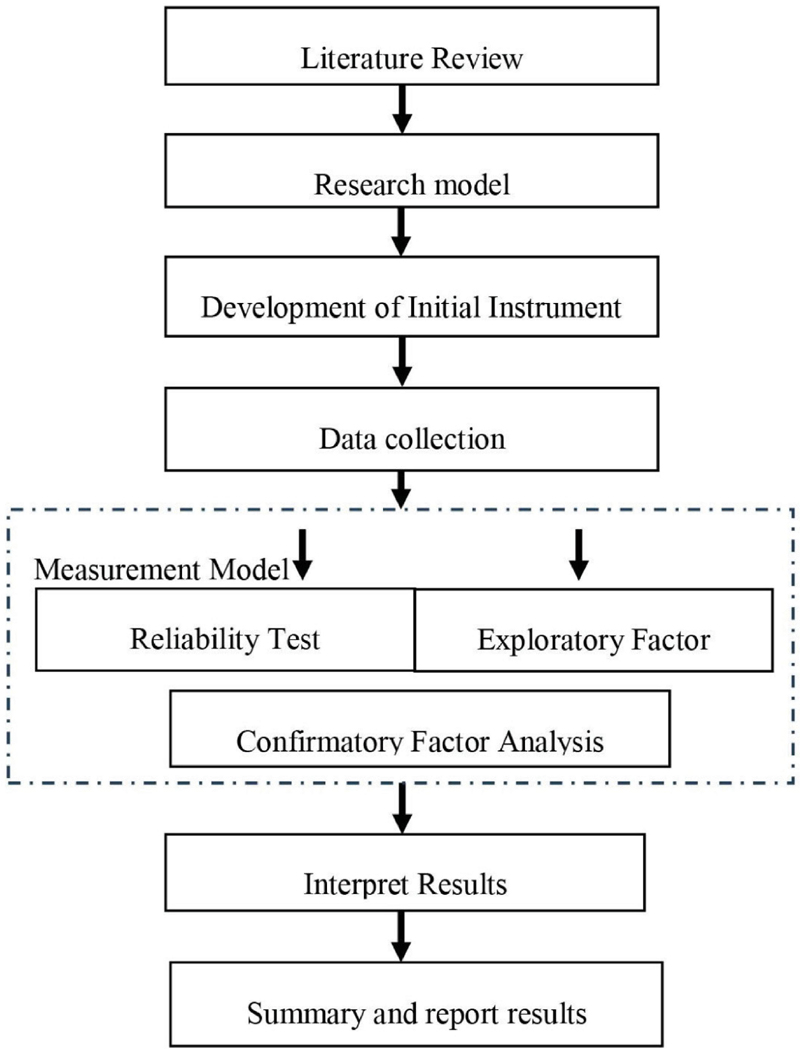
Figure 1 Research design process.
The online survey via website has been used through online questionnaire. After the data has been collected, the process of data cleansing was implemented for completeness and correctness for the data. Then, the dataset of respondents is entered into the statistical analysis program for data analysis as the following:
3.2.1 Descriptive statistics were used to analyze general information related to respondents, including percentages and frequencies.
3.2.2 The opinions regarding the influent factors of the use of social media for tourism among the elderly were analyzed using the mean and standard deviation.
3.2.3 Exploratory factor analysis using principal component analysis (PCA) and orthogonal factor rotation with the Varimax method to extract variables was performed. KMO and Bartlett’s Test [31] was used to assess the reliability of the data for factor analysis techniques. This is to obtain appropriate variables, ensuring that the factor loadings of each indicator are not less than 0.4. This is related to the component weights of each indicator which are calculated [31].
The conceptual research framework was shown in Figure 2. The influent factors of social media usage for tourism can be divided into 5 categories which are as following: Perceived Ease of Use (PEOU), Collaborative Learning (COL), Perceived Enhanced Communication (PEC), Perceived Enjoyment (PEJ), and Recourse Sharing (RES).
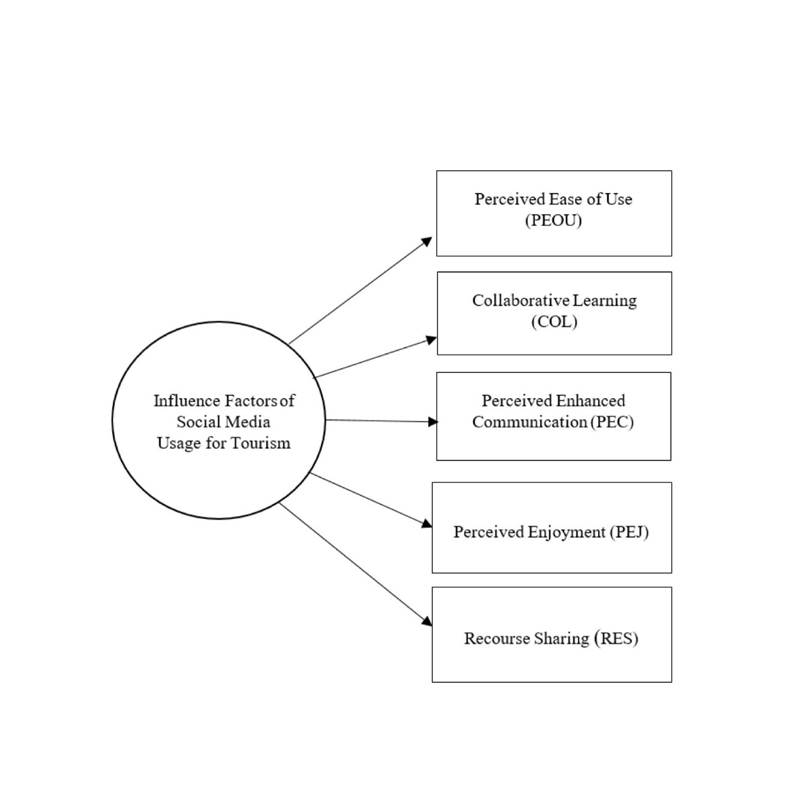
Figure 2 Research conceptual framework.
The results of a structural model of the influent factors towards the use of social media for tourism in elderly, a case study of Thailand, yielded the following findings. This also showed the study of general information on the use of social media for traveling among the elderly group in Thailand.
The majority of respondents were 214 males (52.80 percent) and 191 females (47.20 percent), aged between 60 and 69 years, with status and sound, formal education, and a career in private business. The surveyed group has a monthly income of 10,001–30,000 baht.
The results of social media usage patterns were shown in Table 1.
Table 1 Comparison of online media usage percentages for tourism, categorized based on preferred types of online media used before, during, and after travel (n 405)
| Online Media Type | Before The Trip | During the Trip | After the Trip |
| 84.00% | 84.20% | 84.00% | |
| YouTube | 40.00% | 26.20% | 5.70% |
| Line | 39.80% | 43.00% | 28.90% |
| TikTok | 36.80% | 38.30% | 45.40% |
| 20.50% | 28.10% | 33.80% | |
| Online travel media for specific groups | 19.00% | 6.20% | 7.20% |
| OTA (Online Travel Agency) e.g. Agoda, Expedia, Booking, Traveloka | 6.20% | 3.70% | 1.20% |
| www.wongnai.com | 5.40% | 4.90% | 2.50% |
| www.pantip.com | 4.70% | 9.90% | 4.90% |
| 4.40% | 6.20% | 10.40% | |
| 4.20% | 3.20% | 7.90% | |
| www.chillpainai.com | 3.20% | 4.90% | 5.20% |
From Table 1, the most frequently used media type for tourism purposes in this surveyed samples are Facebook, YouTube and LINE respectively. The results was corresponding in all categories which are before, during, and after their trips. Facebook remains the preferred platform, with TikTok and LINE closely following. Elderly people tend to use these platforms more after traveling compared to other social media platforms. They used Facebook to exchange information, mostly within travel-focused interest groups, and to disseminate travel-related news to their friends. The elderly rarely uses websites like www.wongnai.com and www.chillpainai.com, which are popular platforms for Thai cuisine and travel. The major purpose is to gather information on tourist attractions, hotels, and accommodation prior to their visits.
The results of the exploratory factor analysis of the variables influencing the use of social media for tourism among the elderly in Thailand, based on 405 samples, were used to calculate basic statistics, including the mean and standard deviation. (Standard deviation: S.D.) Table 2 demonstrated the 25 variables.
Table 2 Shows the mean and standard deviation of 25 variables
| Variable | Code | Mean | Std. Deviation |
| (1) Do you feel that using social media to search for travel information is easy | Fac01 | 4.09 | .918 |
| (2) You can view travel itineraries from social media. | Fac02 | 4.10 | .974 |
| (3) You can easily use social media to communicate with travel service providers. | Fac03 | 4.05 | .827 |
| (4) Do you think the language used in social media is easy to understand | Fac04 | 4.08 | .910 |
| (5) You can easily find tourist attractions through social media. | Fac05 | 4.18 | .835 |
| (6) Have you ever learned to use social media for travel together with friends | Fac06 | 3.97 | .917 |
| (7) Have you ever participated in online groups or communities to learn how to use social media together for travel | Fac07 | 4.10 | .811 |
| (8) Do you feel that collaborative learning in groups or online communities is beneficial for using social media for tourism | Fac08 | 4.00 | .956 |
| (9) You feel fond of learning to use social media together | Fac09 | 3.96 | .934 |
| (10) Have you ever encountered difficulties in learning to use social media collaboratively | Fac10 | 3.86 | .927 |
| (11) Do you think the travel-related information you’ve received through social media communication is clear | Fac11 | 3.91 | .818 |
| (12) Do you feel that social media helps you communicate with travel service providers more conveniently | Fac12 | 4.19 | .912 |
| (13) Do you feel confident in the information and responses from travel service providers on social media | Fac13 | 4.03 | .876 |
| (14) Do you feel that communication through social media helps you make better decisions about travel | Fac14 | 4.16 | .889 |
| (15) Do you feel that communication through social media is safe and reliable | Fac15 | 3.95 | .820 |
| (16) You feel that using social media to search for travel information is enjoyable. | Fac16 | 4.25 | .807 |
| (17) You feel that sharing your travel experiences through social media is enjoyable and a way to relieve stress. | Fac17 | 4.09 | .905 |
| (18) Do you think that social media can enhance your happiness and enjoyment in planning your travels | Fac18 | 4.25 | .788 |
| (19) You have interacted (such as liking or commenting) with others on social media, which makes you feel positive and enjoy yourself | Fac19 | 4.18 | .817 |
| (20) Using social media allows you to learn and gain new perspectives on travel | Fac20 | 4.25 | .875 |
| (21) Do you feel that social media is a beneficial channel for seeking advice and assistance regarding travel planning | Fac21 | 4.20 | .929 |
| (22) Do you feel that social media is a beneficial channel for seeking advice and assistance regarding travel planning | Fac22 | 4.15 | .984 |
| (23) Have you ever received assistance or given advice to others about travelling through social media | Fac23 | 4.14 | .879 |
| (24) Do you feel that being a member of an online group or community helps you receive information and assistance | Fac24 | 3.97 | .929 |
| (25) You are pleased to share your travel experiences to help others | Fac25 | 4.04 | .903 |
Furthermore, Table 2 provided the suitability of using factor analysis and determined whether obtained data contains sufficient relationships for factor analysis. This involves considering the preliminary data adequacy measures, specifically the KMO [32] (Kaiser-Meyer-Olkin) statistic and Bartlett’s Test.
Table 3 Shows the KMO value and Bartlett’s test
| Kaiser-Meyer-Olkin Measure of Sampling Adequacy | .922 | |
| Bartle’s Test ofSphericity | Approx. Chi-Square | 14598.334 |
| df | 300 | |
| Sig. | .000 | |
From Table 3, it can be seen that the KMO value is 0.922, which is close to 1, indicating that all data and various variables are highly correlated. This allows for the analysis of components according to the research objectives. The Bartlett’s Test shows that the variables influencing the use of social media for tourism among the elderly in Thailand have an approximate Chi-Square distribution of 14598.334 with a significance value of .000, which is less than .05. Therefore, indicating that the 25 variables are sufficiently correlated to be analyzed as components, as shown in Table 3.
Finding communalities: The calculation of initial communalities using the Maximum Likelihood method will determine that the initial communalities will indicate whether a variable is a beneficial variable or not in comparison to other variables.
The Extraction Communality value of the variables, after factor extraction, revealed that the Extraction Communality value for the variable named Fac 20 is the lowest at 0.639, which is not low enough to warrant its removal. The variable with the highest extraction community is named Fac 05, with a value of 0.917.
Table 4 The statistical values for each component
| Initial Eigenvalues | Extraction Sums of Squared Loadings | Rotation Sums of Squared Loadings | |||||||
| % of | % of | % of | |||||||
| Component | Total | Variance | Cumulative % | Total | Variance | Cumulative % | Total | Variance | Cumulative % |
| 1 | 16.351 | 65.403 | 65.403 | 16.351 | 65.403 | 65.403 | 7.510 | 30.041 | 30.041 |
| 2 | 2.218 | 8.872 | 74.275 | 02.218 | 08.872 | 74.275 | 6.809 | 27.238 | 57.278 |
| 3 | 1.195 | 4.780 | 79.055 | 01.195 | 04.780 | 79.055 | 5.444 | 21.776 | 79.055 |
| 4 | .689 | 2.755 | 81.809 | ||||||
| 5 | .645 | 2.581 | 84.391 | ||||||
| 6 | .551 | 2.204 | 86.595 | ||||||
| 7 | .516 | 2.064 | 88.659 | ||||||
| 8 | .413 | 1.654 | 90.313 | ||||||
| 9 | .388 | 1.550 | 91.863 | ||||||
| 10 | .302 | 1.208 | 93.071 | ||||||
| 11 | .260 | 1.039 | 94.111 | ||||||
| 12 | .227 | .906 | 95.017 | ||||||
| 13 | .204 | .816 | 95.833 | ||||||
| 14 | .186 | .743 | 96.575 | ||||||
| 15 | .151 | .602 | 97.177 | ||||||
| 16 | .129 | .517 | 97.694 | ||||||
| 17 | .114 | .454 | 98.148 | ||||||
| 18 | .102 | .407 | 98.556 | ||||||
| 19 | .076 | .302 | 98.858 | ||||||
| 20 | .071 | .282 | 99.140 | ||||||
| 21 | .058 | .231 | 99.371 | ||||||
| 22 | .051 | .205 | 99.576 | ||||||
| 23 | .043 | .172 | 99.749 | ||||||
| 24 | .036 | .143 | 99.891 | ||||||
| 25 | .027 | .109 | 100.000 | ||||||
From Table 4, the calculation of Total Variance Explained from the analysis can classify the variables into three components. Each component has an eigenvalue ranging from 1.167 to 16.374, with a cumulative variance percentage of 78.841. Component 1 can explain 65.495 of the total variance, Component 2 can explain 8.679, and Component 3 can explain 4.667.
From Figure 3, the Scree Plot is a graph that plots the Eigenvalues of each component, arranged from highest to lowest. This allows for consideration of the Eigenvalues that decrease rapidly. When focusing only on the components with Eigenvalues greater than 1, three components can be extracted from the analysis.
The Maximum Likelihood method with Varimax rotation was used to rotate the component axis. Table 5 shows that the factor loadings were different after the rotation compared to before the rotation.
From Table 5, the Varimax rotation, the values correspond to the correlation coefficients between the variables and the rotated components. We found that the variables have the following factor loadings for each component.
The variables Fac17, Fac16, Fac19, Fac18, Fac21, Fac20, Fac22, Fac25, Fac24, and Fac13 combine to form Component 1, also known as “the aspect of perceived enjoyment for sharing experiences.”
The variables Fac01, Fac04, Fac03, Fac05, Fac02, Fac11, Fac06, and Fac12 combine to form Component 2, also known as “the aspect of perceived ease of communication through social media.”
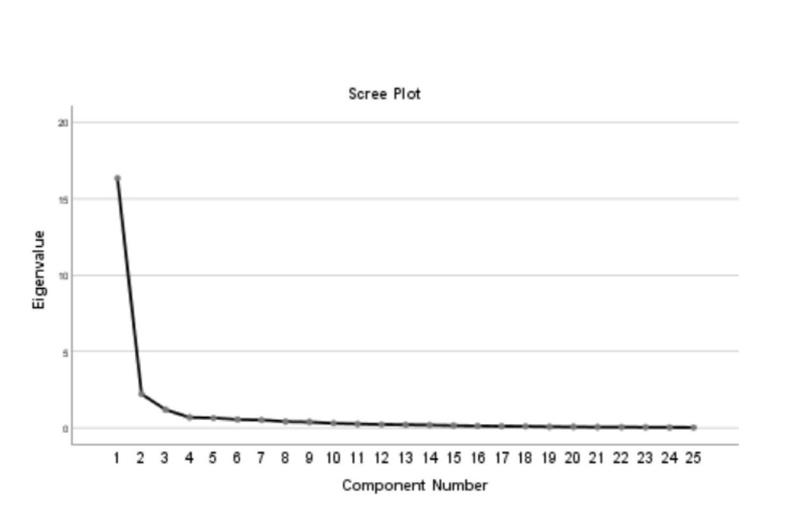
Figure 3 Eigenvalues scree plot.
Table 5 Shows the rotated factor matrix
| Factor | |||
| 1 | 2 | 3 | |
| Fac17 | .858 | ||
| Fac16 | .855 | ||
| Fac19 | .810 | ||
| Fac18 | .799 | ||
| Fac21 | .761 | ||
| Fac20 | .749 | ||
| Fac22 | .656 | ||
| Fac25 | .646 | ||
| Fac24 | .587 | ||
| Fac13 | .575 | ||
| Fac01 | .855 | ||
| Fac04 | .807 | ||
| Fac03 | .806 | ||
| Fac05 | .791 | ||
| Fac02 | .711 | ||
| Fac11 | .700 | ||
| Fac06 | .644 | ||
| Fac12 | .583 | ||
| Fac07 | .803 | ||
| Fac09 | .789 | ||
| Fac10 | .766 | ||
| Fac08 | .722 | ||
| Fac23 | .630 | ||
| Fac15 | .573 | ||
The variables Fac07, Fac09, Fac10, Fac08, Fac23, and Fac15 combine to form Component 3, which we could name “Collaborative Learning through Social Media.”
The three components explain 79.055% of the variance of the original variables. Component 1 accounts for 30.041%, whereas 2 accounts for 27.238%, and whereas 3 accounts for 21.776%. Organizing the various variables into components led to the identification of three components, as shown in Table 6.
Table 6 Determining the group of components
| Variable | |
| Component Name | (Issue) |
| Component 1: The aspect of perception of enjoyment for sharing experiences. | 10 |
| Component 2: Perception of Ease in Online Social Media Communication | 08 |
| Component 3: Collaborative Learning Using Social Media | 06 |
| Total | 24 |
From Table 6, 3 groups of components can be determined, consisting of Component 1, the aspect of perception of enjoyment in sharing experiences, with 10 variables; Component 2, the aspect of perception of ease of social media communication, with 8 variables; and Component 3, the aspect of learning together to use social media, with 6 variables.
This study analyzed the factors influencing social media use for tourism among the elderly in Thailand, highlighting how social media can enhance the travel experience for this demographic. The research identified three key components that influence the use of social media: enjoyment of sharing experiences ease of communication, and collaborative learning.
The first component, “Enjoyment of Sharing Experiences” includes variables related to the satisfaction gained from sharing travel experiences, finding travel information, interacting with others, and receiving support from online communities. These factors contributed to 30.041% of the variance reflecting how social media platforms such as Facebook, provide not only travel information but also emotional satisfaction and entertainment during travel planning. This aligns with existing research on the role of online media in tourism decision-making which demonstrates that social media makes information sharing and access easier, thus enriching the travel experience.
The second component, “Ease of Communication” addresses the convenience of using social media for accessing travel-related information and contacting service providers. With 27.238% of the variance explained, this component underscores how the simplicity of using social media-whether for finding tourist attractions, viewing maps or obtaining clear information-encourages the elderly to use these platforms for tourism planning. This is consistent with findings from previous studies, which show that social media enhances the convenience of contacting tourism service providers and gathering information.
The third component, “Collaborative Learning” involves using social media for learning about tourism with friends and in online communities. The variables include sharing learning experiences and receiving or giving advice through social media, contributing to 21.776% of the variance. Collaborative learning in online communities has been shown to increase the elderly’s confidence in using social media for tourism, making it a beneficial method for accessing support and information.
This research highlights the significant role of multimedia and social media platforms on mobile applications in enhancing the elderly’s travel experience. These platforms not only make travel information more accessible but also empower the elderly to explore destinations with greater confidence and security. Furthermore, this research contributes to enhancing the competitiveness of the tourism industry by focusing on strategies that address the needs of elderly travelers in the digital age. The findings emphasize the importance of using multimedia on mobile applications, with Facebook and YouTube identified as key platforms. This approach can greatly improve the quality of life and social engagement for elderly individuals, helping them stay connected with the broader online community.
Beyond Thailand, the implications of this study can be applied globally, particularly in countries facing similar demographic shifts towards an aging population. As many countries are experiencing rapid aging, understanding the elderly’s use of digital tools for tourism can inform strategies to improve their social participation and travel opportunities. By recognizing the benefits of social media in tourism, these insights can be utilized to enhance the tourism industry and provide elderly populations worldwide with accessible, engaging, and supportive platforms for travel.
The analysis of the factors influencing the use of social media for tourism among the elderly in Thailand focused on how social media can enhance the elderly’s travel experience. The research identified three main factors that influenced the use of social media: perceived enjoyment in sharing experiences, ease of communication, and collaborative learning. Through exploratory and confirmatory factor analyses, the study revealed that these factors influenced the elderly’s engagement with online platforms for tourism purposes.:
Component 1: Perception of Enjoyment in Sharing Experiences is composed of 10 variables. Sharing travel experiences on social media is fun and relieving, using social media to find travel information is enjoyable, interacting (such as liking or commenting) with others on social media makes user feel good and entertained, social media can enhance user’s happiness and enjoyment in planning the trip, sharing travel experiences on social media benefits others, using social media allows user to learn and gain new perspectives on travel, social media is a great channel for seeking advice and assistance in travel planning, feeling happy to share user’s travel experiences to help others, being a member of online groups or communities helps user receive information and support, and confidence in the information and responses from travel service providers through social media. These can explain 30.041% of all original variables’ variance. This is in line [33] with the results of research studying the acceptance and use of online media that affects tourists’ decision to choose tourist attractions in Bangkok. It was found that using online media such as Facebook allows users to access information and share experiences more easily, which is consistent with their enjoyment of travel planning.
The second component, the perception of ease of social media communication, consists of 8 variables: using social media to search for travel information is easy, the language used in social media is easy to understand, being able to use social media to communicate with tourism service providers easily, being able to search for tourist attractions from social media easily, being able to view travel maps from social media, being able to obtain clear information from social media communication about tourism, having learned to use social media for tourism with friends, and being able to communicate with tourism service providers conveniently. The variance of all the original variables can be explained by 27.238 percent, which is consistent with the research results on searching for tourism information via social media, [34] which found that users find it convenient to search for information and contact tourism service providers, and find it easy to search for information to contact service providers.
The third component, collaborative learning on social media, consisted of 6 variables: having learned to use social media for tourism together with friends, enjoying learning to use social media together, having experienced problems learning to use social media together, learning together in groups or online communities is beneficial to using social media for tourism, receiving assistance or giving advice to others about tourism via social media, and communicating via social media is safe and reliable. It can explain the variance of all the original variables by 21.776 percent, which is consistent with the research results on the use of social media in tourism planning. It found that users tend to learn in online media usage together with friends for receiving assistance from friends and convenience in contacting tourism service providers.
This research contributes the significant role of multimedia and social media platforms on mobile applications in enhancing the travel experience for the elderly. These platforms make information more accessible, enabling elderly individuals to explore various destinations with greater confidence and safety. Additionally, this research contributes to the competitiveness of the tourism industry by focusing on strategies that address the needs of elderly travellers in the digital era. The findings highlight the importance of using multimedia on mobile applications for tourism among the elderly, identifying Facebook and YouTube as key platforms on mobile applications. This approach has substantial potential to improve the quality of life and social engagement of elderly individuals. Multimedia serves not only as a vital source of information but also as a tool to build confidence, provide enjoyment, and foster connections between the elderly and online communities.
The findings of this research offer valuable insights into how social media and mobile applications can be leveraged to enhance the travel experiences of elderly individuals. In the future, tourism platforms could further expand their services by incorporating more interactive and user-friendly features specifically designed for older users. These platforms should prioritize accessibility, ensuring that the elderly can easily navigate and engage with the content. Additionally, integrating augmented reality (AR) and virtual reality (VR) features could provide virtual tourism experiences, allowing elderly individuals to explore destinations remotely before traveling, thus reducing anxiety and boosting confidence. With the increasing reliance on technology among the elderly, social media platforms can also serve as an avenue for promoting social connections, where elderly users can interact with peers, share experiences, and gain advice, ultimately improving their overall travel experience and quality of life.
To maximize the potential of mobile applications and social media for elderly tourism, it is important for developers and tourism businesses to focus on the specific needs of older users. Future research should explore the long-term impacts of using social media on elderly travelers’ psychological well-being, including factors like self-esteem and social isolation. Further studies could also assess how different cultures and geographical contexts influence the use of social media for tourism among the elderly, providing a more global understanding of these trends. In addition, it is recommended that tourism platforms collaborate with healthcare providers to offer tailored travel packages that ensure the health and safety of elderly travelers. Such collaborations would be essential in addressing both the physical and emotional well-being of elderly tourists, making travel more accessible and enjoyable for this demographic.
[1] Statistical Yearbook Thailand 2023 “Flipping Book” 10 September, 2024; https://www.nso.go.th/public/e-book/Statistical-Yearbook/SYB-2023/6/.
[2] M. Cheng, “Sharing economy: A review and agenda for future research,” Int. J. Hosp. Manag., vol. 57, pp. 60–70, 2016.
[3] “Social Media and Destination Branding in Tourism: A Systematic Review of the Literature.” 10 September, 2024; https://www.researchgate.net/publication/364730976\_Social\_Media\_and\_Destination. Branding in Tourism A Systematic review of the Literature.
[4] “Influencer Marketing for Tourism Destinations: Lessons from a Mature Destination,” 10 September, 2024; https://www.researchgate.net/publication/337989085\_Influencer\_Marketing\_for\_Touris\_Destinations\_Lessons\_from\_a\_Mature\_Destination.
[5] United Nations, “High-level Summits and Conferences 2022,” 10 September, 2024; https://www.un.org/en/content/summits2022/.
[6] “Digital 2023: Global Overview Report,” DataReportal – Global Digital Insights. 10 September, 2024; https://datareportal.com/reports/digital-2023-global-overview-report.
[7] F. House, “Freedom on the net 2022,” 10 September, 2024; https://freedomhouse.org/country/united-states/freedom-net/2022.
[8] L. Labudová, “Current Leading Social Media Platforms Used by Marketers and its Benefits,” In European Conference on Social Media. Vol. 11, No. 1, pp. 394-401, 2024.
[9] J. J. Jussila, H. Kärkkäinen, and M. Leino, “Benefits of social media in business-to-business customer interface in innovation,” in Proc. 15th Int. Acad. MindTrek Conf.: Envisioning Future Media Environments, Tampere, Finland, Sep. 2011, pp. 167–174, 2011.
[10] T. L. Tuten, Social Media Marketing. SAGE Publications, 2023.
[11] M. D. and Services, “Digital Labs, Mastercard Data and Services,” 10 September, 2024; https://www.mastercardservices.com/en/capabilities/digital-labs.
[12] K. Lietsala and E. Sirkkunen, “Social media. Introduction to the tools and processes of participatory economy,” 2008,” 10 September, 2024; https://trepo.tuni.fi/handle/10024/65560.
[13] M. D. and Services, “Digital Labs,” Mastercard Data and Services,” 10 September, 2024; https://www.mastercardservices.com/en/capabilities/digital-labs.
[14] J. Jussila, H. Aramo-Immonen, and E. Pettersson, “Social Media Utilization in B2B Networks Organizational Learning – Review and Research Agenda Proposal,” J. Mob. Multimed., vol. 10, pp. 218–233, 2014.
[15] T. Stefanov, S. Varbanova, M. Stefanova, and Y. Tsenkova, “Mobile Applications for Cultural Tourism–Past, Present, and Future. Criteria for a Successful Mobile App,” International Journal of Interactive Mobile Technologies, 17(24). 2023.
[16] R. Suwannakoot and W. Paireekreng, “Utilizing Social Media for Travel Among Elderly People in Thailand,” in 2024 5th Technology Innovation Management and Engineering Science Int. Conf. (TIMES-iCON), Jun. 2024, pp. 1–6. 2024.
[17] F. Seker, G. Kadirhan and A. Erdem, (2023). “The factors affecting tourism mobile apps usage,” Tourism & Management Studies, 19(1), 7–14. 2023.
[18] H. Xiong and S. Lv, “Factors affecting social media users emotions regarding food safety issues: Content analysis of a debate among Chinese Weibo users on genetically modified food security,” In Healthcare., Vol. 9, No. 2, p. 113.
[19] A. Correia and S. Dolnicar, “Role and Impact of Social Media in Tourism – Contributions by Ulrike Gretzel,” Sep. 2021. 10 September, 2024; https://uq.pressbooks.pub/tourismknowledge/chapter/role-and-impact-of-social-media-in-tourism-contributions-by-ulrike-gretzel/.
[20] E. Christou, M. Sigala, and U. Gretzel, “Social Media in Travel, Tourism and Hospitality; Theory,” Practice and Cases. 2012.
[21] F. Shafiqa and S.-A. Abdul-Latif, “The Use of Social Media for Trip Planning Process: A Study on Domestic Tourists to Pahang,” 2019.
[22] “gs581130093.pdf.” 10 September, 2024; ithesis.swu.ac.th/dspace/bitstream/123456789/834/1/gs581130093.pdf.
[23] Utkarsh and M. Sigala, “A bibliometric review of research on COVID-19 and tourism: Reflections for moving forward,” Tour. Manag. Perspect, vol. 40, p. 100912, 2021.
[24] S. Taborosi, A. Kovaèeviæ, and B. Maljugiæ, “The Role of Social Media in the Decision-Making Process,” 2022.
[25] F. Davis, “Perceived Usefulness, Perceived Ease of Use and User Acceptance of Information Technology,” MIS Q, vol. 13, p. 319, 1989.
[26] S. Park, E. Rabinovich, C. S. Tang, R. Yin, and J. J. Yu, “Technical Note: Should an Online Seller Post Inventory Scarcity Messages,” Decis. Sci, vol. 51, no. 5, pp. 1288–1308, 2020.
[27] M. N. Yakubu, S. I. Dasuki, “Factors affecting the adoption of e-learning technologies among higher education students in Nigeria: A structural equation modelling approach”. Information Development, pp. 492–502, 2019.
[28] I. de S. Pool, “Handbook of Communication,” Rand McNally College Publishing Company, 1973.
[29] F. D. Davis, “Perceived Usefulness Perceived Ease of Use and User Acceptance of Information Technology,” MIS Q, vol. 13, no. 3, pp. 319–340, 1989.
[30] Elderly statistics. Accessed: Oct. 16, 2024. 10 September, 2024; http://www.dopgo.th/th/know/side/1/1/2449.
[31] “KMO and Bartlett’s test of sphericity,” Analysis INN. Accessed: Oct. 16, 2024. 10 September, 2024; https://www.analysisinn.com/post/kmo-and-bartlett-s-test-of-sphericity/.
[32] J. F. Hair, and J. F. Hair, “Multivariate Data Analysis,” Prentice Hall, 2010.
[33] “Acceptance and use of online media that affect the decision to choose a tourist destination of tourists in Bangkok.” Accessed: Sep. 23, 2024. 10 September, 2024;
[34] X. Xu and A. Athit Kawin, “Social media marketing and technology adoption influence decision making of Chinese tourists traveling to Beijing China,” Panyapat Soc. Sci. J., vol. 6, no. 2, Art. no. 2, Jun. 2024, Accessed: Sep. 23, 2024. 10 September, 2024; https://so06.tci-thaijo.org/index.php/JSSP/article/view/268326.

Rossukon Suwannakoot received her master’s degree in Computer and Information Technology from King Mongkut’s University of Technology Thonburi, Thailand, in 2007. She obtained her Master of Industrial Education and Bachelor of Business Administration in General Management from Maejo University. Prof. 2547 She is a PhD student at the College of Innovation and Engineering, Dhurakij Pundit University, Bangkok, Thailand. Her research fields include Information Technology and the Application of Information Technology. She has published numerous research articles in both domestic and international publications.

Worapat Paireekreng, Ph.D., received his Ph.D. in Information Technology from Murdoch University, Australia, in 2013. He earned his M.Sc. in Information System Management with honors from the National Institute of Development Administration (NIDA) in 2000 and his B.B.A. in Management Information Systems from Thammasat University in 1997. He is currently a faculty member at King Mongkut’s Institute of Technology Ladkrabang, Bangkok, Thailand. His research areas include data mining, data analytics, information technology, and its applications. He has published numerous research articles in both national and international journals.
Journal of Mobile Multimedia, Vol. 21_2, 197–220.
doi: 10.13052/jmm1550-4646.2121
© 2025 River Publishers