Genetic Algorithm Optimization of the Link Layer for Throughput Improvement in 5G NR Networks
Sulekha Pateriya1, Shuvabrata Bandopadhaya1, Soumya Ranjan Samal2, Antoni Ivanov2,* and Vladmir Poulkov2
1School of Physical Sciences, Banasthali Vidyapith, Rajasthan, India
2Technical University of Sofia, Sofia, Bulgaria
E-mail: astivanov@tu-sofia.bg
*Corresponding author
Received 13 March 2025; Accepted 08 May 2025
With the proliferation of the fifth generation (5G) wireless communications, adaptive resource allocation in various deployment scenarios remains a significant research topic. In this paper we propose a genetic algorithm (GA) based optimization of network-link layer parameters to improve the throughput in 5G New Radio (NR) networks. For achieving optimal system throughput while maintaining stringent quality of service (QoS) requirements for the block error rates (BLER) and signal-to-noise ratio (SNR), this work develops a mathematical model that incorporates the SNR, modulation and coding schemes (MCS), and hybrid automatic repeat request (HARQ) processes. This solution provides a robust foundation for the implementation of 5G NR networks in dynamic environments and arbitrary channel conditions. As a result, throughput of up to 240 Mbps is achieved. Multi-objective optimization, including energy efficiency and latency parameters, may be considered as future directions for exploration.
Keywords: 5G NR, Genetic Algorithm, Network-link layer, Parameter optimization, Throughput maximization.
The 5G New Radio (NR) being the global standard for fifth generation wireless communications and is the backbone of the transformative applications in the contemporary cyber ecosystem [1]. Designed to support wide range of various quality of service (QoS) requirements, 5G enables enhanced Mobile Broadband (eMBB) for high-speed internet, Ultra-Reliable Low-Latency Communication (URLLC) for critical tasks like autonomous vehicles, and massive Machine-Type Communication (mMTC) for IoT devices. Among the 5G NR’s key technologies are millimeter-wave (mm-Wave) and sub-6 GHz bands, flexible numerology, multi-tier networks, advanced beamforming, etc [2, 3]. The combination of the physical layer and the medium access control (MAC) layer comprises network-link layer in 5G-NR protocol stack that plays an important role in providing reliable communication between the user equipment (UE) and base stations (denoted as gNodeB in the 5G-NR standard). This layer is responsible for high-speed data transmission, high-reliability, and low-latency communications to support diverse services and applications [4]. The key functions integrated with the link layer that enable 5G NR to deliver high-speed, reliable communication are Hybrid Automatic Repeat Request (HARQ), dynamic resource allocation, and adaptive modulation and coding schemes (MCS) [5]. HARQ process ensures reliable transmission over challenging channel conditions by combining error correction and retransmission processes [6]. To optimize the bandwidth usage while meeting the QoS requirements, the network-link layer dynamically allocates the resource blocks (RBs) to UEs in order to adjust the data rate for the particular use case and channel conditions [7, 8]. Some traditional optimization techniques used in 4G-LTE and 5G-NR are given hereby. The Water-Filling Algorithm is one of the traditional approaches for maximizing system throughput by allocating power across subcarriers in the orthogonal frequency division multiple access (OFDMA) systems based on channel quality [9]. Kwan et. al. [10] have proposed a proportional fair scheduling technique that allocates resources based on the ratio of instantaneous to average data rates for each user to maintain balance between throughput maximization and fairness among users. In [11] the authors discuss round-robin scheduling that allocates resources equally among users in a cyclic manner irrespective of their channel conditions. Though this technique ensures fairness, it does not improve the throughput significantly. In high-traffic conditions, low latency for delay-sensitive applications is ensured while maintaining the throughput requirements through a max-weight scheduling method [12]. The resource allocation is based on the highest product of achievable data rate and queue backlog. A greedy approach is proposed in [13], which assigns resources iteratively to maximize the system throughput at each step. This approach fails to reach global optimality despite being computationally efficient. Zheng et al. have explored a frequency-domain packet scheduling, widely used in LTE systems to improve spectral efficiency, which allocates resources based on frequency domain information, considering channel conditions and user QoS requirements [14]. Game theoretic approaches are also used for optimizing resource allocation by modeling user interactions as a game, ensuring fair sharing, and maximizing utility through techniques like Nash equilibrium [15]. The recent advancement of deep learning-based optimization approaches has proven highly effective within complex wireless architectures, such as 5G. Due to its dynamic adaptability and faster convergence, AI-based approaches are preferred for exploration of large solution spaces, outperforming the traditional optimization methods for complex, non-linear, and multi-objective problems such as throughput and BLER optimization in diverse 5G NR scenarios [16]. A comprehensive overview, including various challenges and technological advancements in resource management within 5G networks, is discussed in [17, 18] and the references therein. In [19] to enhance the network performance, an DL framework is proposed for resource utilization in an Open Radio Access Network (O-RAN). The authors of [20] optimize resource utilization while meeting the strict latency requirements for eMBB and URLLC use cases through a deep reinforcement learning (DRL) method. Predictive analytics in optimizing resource distribution based on historical network data has been introduced in [21] to enhance resource allocation in 5G networks based on ML models like linear regression, support vector machines (SVM), and k-nearest neighbor (KNN). To ensure robust performance across heterogeneous slices in 5G networks, a genetic algorithm-based optimizer is introduced in [22] for inter-slice resource management. A significant improvement in system throughput and spectral efficiency is registered in dense 5G environments by using traffic pattern prediction by combining Graph Convolution Networks (GCN) and Long Short-Term Memory (LSTM) models [23]. For 5G multi-tier radio access network planning, the authors of [24] discuss applications of various evolutionary algorithms. A genetic algorithm-based resource allocation and user association scheme presented in [25] for 5G integrated terrestrial and non-terrestrial networks, achieving up to 10% higher throughput. Further, GA is also used for frequency allocation between a macro and a femto cell within a heterogeneous terrestrial network [26]. Up to 42% increase in throughput compared to a heuristic algorithm is obtained. The authors of [27] apply GA for channel allocation in the context of a terrestrial cognitive radio network. Through varying the number of generations, the method’s robustness to interference is retained, while up to 40% improvement in throughput is delivered. The study in [28] extends this work in the scenario of cognitive sensor networks for Internet of Things, achieving up to 10% higher throughput (up to 70 Mbps for 10 UEs) than the ant colony algorithm.
In multi-carrier wireless systems, there are some traditional resource allocation schemes discussed in literature that served as fundamental baselines in wireless communication systems for resource allocation and user scheduling [29, 30]. Round-Robin technique is the most fair resource allocation technique allocating equal time and frequency resources to all users in a cyclic fashion, independent of their channel conditions. It does not exploit multi-user diversity or prioritize users with better instantaneous channel gains, which results in suboptimal throughput in realistic wireless environment. In water filling scheme, to maximize total capacity under a power constraint, the transmission power is optimally distributed across sub-channels favoring channels with higher gains. Though simplistic approach, this technique depends heavily on the assumption of perfect channel state information in the transmitter side and due to its static allocation nature, it underperforms in fast-fading or dynamic environments.
Due to their faster convergence and adaptability to dynamic conditions, the AI-based optimization approaches like evolutionary algorithms, ML, deep learning and reinforcement algorithms are considered as potential candidates for implementing complex networks, such as 5G. In the dynamic radio environment, it is critical to optimize the system throughput and block error rate (BLER) to achieve the QoS requirements for diverse use cases. This paper addresses the challenge by building an adaptive resource allocation mechanism for maximizing network performance while maintaining stringent QoS requirements. The contribution is summarized as follows:
• We define an optimization problem that maximizes the network throughput while adhering to quality-of-service (QoS) requirements for diverse 5G use cases by using a mathematical model for evaluating the network throughput by incorporating the SNR, MCS and HARQ processes. The genetic algorithm (GA) uses the RB allocation, modulation order, coding rate, and the desirable SNR threshold to maximize the throughput under dynamic network conditions. Throughput of up to 240 Mbps is achieved.
The proposed solution provides a robust operation of the 5G-NR network in dynamic environment. The organization of the paper is as following: the mathematical modeling for throughput evaluation and formulation of the optimization problem is given in Section 2, the proposed GA solution is given in Section 3, the simulation results and discussion presented in Section 4, and Section 5 concludes the paper.
This Section presents the theoretical foundation for analyzing the performance of the 5G New Radio (5G-NR) network link layer. The mathematical model is developed for the transmission-reception system, incorporating the resource allocation based on modulation type and coding rate, to improve the throughput and BLER, while ensuring reliability through the derived optimization problem.
Consider a 5G-NR network that schedules a UE to be served by a gNodeB. The amount of successfully transmitted data per unit time is referred by the system’s throughput that is influenced by spectral efficiency allocated bandwidth and the BLER. The spectral efficiency refers to the data transmitted per unit bandwidth, expressed as:
| (1) |
where , with representing the number of bits in a symbol of the modulation scheme (2 for QPSK, 4 for 16 QAM), is the coding rate (ratio of information bits and total transmitted bits), is the number independent layers (spatial streams) in the multiple-input multiple-output (MIMO) system. The bandwidth allocated by the network scheduler to the UE is expressed as [2, 31]:
| (2) |
where is the number of RBs allocated to the UE, is the number of subcarriers per RB, which is fixed as 12 for 5G-NR, and is the sub-carrier spacing (SCS) in a single orthogonal frequency division multiplexing (OFDM) symbol, the values of which are standardized.
The BLER is another important parameter that adversely affect the network throughput, defined as the probability that a transmitted block would not be correctly decoded. The key aspects that determine the BLER are the SNR and the MCS, which define the modulation order and the coding rate. is the signal () to noise power () ratio, with denoting the noise power spectral density (). For a given SNR, the probability of bit error is given as , where is proportionality constant depending on MCS [32, 33]. The BLER can be approximated as function of the block length () and in the following way . Assuming small error probability (), . By encapsulating the effects of , and channel conditions into a single proportionality constant , determined by the MCS, we obtain . The minimum SNR required for achieving meaningful reduction in BLER, i.e. below which BLER approaches to 1, is denoted as the threshold value of SNR () [34]:
| (3) |
With implementation of hybrid automatic repeat request (HARQ) process, the effective BLER considering maximum retransmissions, is given by:
| (4) |
The block error reduces the throughput due to retransmission or packet loss for given BLER. The expression for throughput for system with HARQ process considering spectral efficiency, bandwidth and block error rate is given as [5, 35]:
| (5) |
Substituting equation (1), (2) and (3) in (6),
| (6) |
The aim of this optimization problem to maximize the system throughput () while ensuring reliability and resource constraints [31]:
| (7) | |
In this Section the GA that maximizes the throughput in a 5G NR system considering the constraints of BLER, bandwidth, QoS, and SNR, is detailed. The process aims to find the best configuration of system parameters to maximize the throughput and reliability across diverse environments and use cases. This optimization is performed via GA, which is a heuristic, the workflow of which is given below:
• Step 1: Population Initialization: The initial population of a candidate solution is created in a chromosome form set of random values for decision variables: number of RBs: ; modulation order: ; coding rate: .
• Step 2: Fitness Evolution: For a candidate solution, the fitness function is evaluated as:
| (8) |
If the result is below the optimization constraint, it is considered as an infeasible solution. A penalty function is applied with such solution to reduce the function’s fitness score, making it less likely to be selected for reproduction in the next generation of the GA. The penalty function is evaluated based on the amount of its constraint violation,
| (9) | ||
where are penalty coefficients for BLER violation, bandwidth violation and minimum throughput violation, respectively. They control the seventy of the penalty based on how significant the constraints violations are. If a solution does not violate any constraints, . The adjusted fitness score used for selection in the GA, is given by,
| (10) |
• Step 3: Selection: The probability of selecting a chromosome for reproduction is given by:
| (11) |
where, is the total number of chromosomes present in the population and represents -th chromosome in the population.
• Step 4: Crossover: In this step the genetic material of two-parent chromosomes (and ) are combined to produce one or more offspring ( and ) with the inherent characteristics from both parents. Let the parent individuals are denoted with and . A random crossover point is chosen, and offspring are created by swapping the genetic material after point . For , the new offspring is:
| (12) |
This operation is used to increase the population diversity, exploring new solutions by combining features of useful individuals.
• Step 5: Mutation: To prevent premature convergence to sub-optimal solution, the mutation process is executed that introduces random changes to a chromosome’s genetic materials that introduce additional diversity. For a chromosome , this process randomly alters one or more of its decision variables within their allowed ranges producing mutated individuals.
| (13) |
Now, the old population is replaced by the new generation of the offspring that includes the results obtained from both crossover and the mutation processes.
• Step 6: Convergence of the GA: Let is the optimum threshold of the desired fitness function (the fitness function being the system’s throughput). Best fitness at generation is given as:
| (14) |
where is the current generation’s number. The algorithm averages or terminates by meeting given condition:
| (15) |
where is the maximum number of generations allowed. The pseudocode for the proposed optimization procedure is provided in Algorithm 1.
Algorithm 1 Algorithm for the proposed optimization procedure
The evaluation of the proposed method is performed via a simulation environment for the 5G NR network. We analyze the relationship between the modulation schemes, coding rates, SNR, and resource allocation in achieving optimal throughput while maintaining reliability. In the simulation, different MCS are considered with modulation schemes like QPSK, 16-QAM, 64-QAM, 256-QAM and coding rates of 1/2, 3/4 or 5/6. The values of all parameters used in simulation are tabulated in Table 2. The value of for different modulation and coding schemes used in the simulation for evaluating BLER (3) are summarized in Table 3 [34].
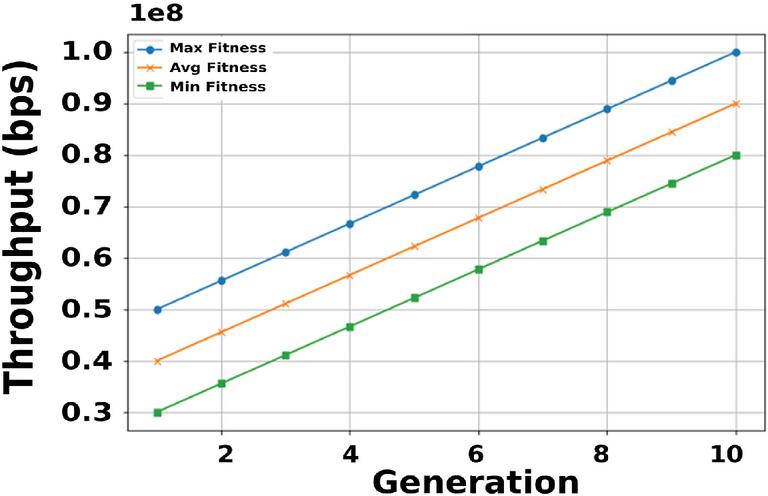
To ensure throughput improvement, the GA selects combinations of parameters that satisfy the constraints of BLER, QoS, and bandwidth. GA is initialized with a random population. Then it follows the steps of evaluating the fitness functions for throughput, penalizing infeasible solutions, followed by selection, crossover, and mutation. The process iterates until reaching a maximum generation limit (set as 10 in the simulation). The SNR value ranges from 5 to 30 dB. For all combinations of MCS, the throughput and BLER are evaluated. The GA exhibits rapid improvement in the throughput (fitness) reaching maximum within 10 generations, as exhibited in Figure 1. An improved performance is realized across the population as both average and minimum fitness values are also consistently increasing.
Table 2 Value of for different modulation and coding schemes [34]
| Modulation | Coding Rate | Value of |
| QPSK | 1/2 | 0.9 |
| QPSK | 3/4 | 1.2 |
| QPSK | 5/6 | 1.5 |
| 16QAM | 1/2 | 1.0 |
| 16QAM | 3/4 | 1.4 |
| 16QAM | 5/6 | 1.7 |
| 64QAM | 1/2 | 1.3 |
| 64QAM | 3/4 | 1.7 |
| 64QAM | 5/6 | 2.0 |
| 256QAM | 1/2 | 1.6 |
| 256QAM | 3/4 | 2.0 |
| 256QAM | 5/6 | 2.4 |
Figure 1 Throughput results across the GA generations.
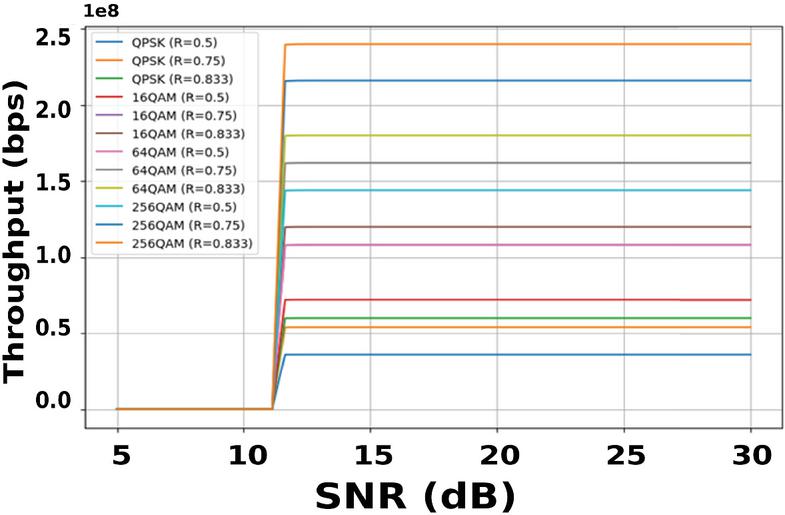
Figure 2 Throughput vs. SNR for various configurations of modulation, coding rates, and RB allocation.
In Figure 2, throughput vs. SNR for various configurations of MCS (i.e. ) and RB allocation, is provided. Improvement in throughput is observed as the SNR increases due to reduced BLER and higher spectral efficiency. For SNR higher than 11 dB, the best throughput is obtained with 256-QAM and 5/6 coding rate as the amount of information bits in a block is high and there is less repetition of transmissions due to loss of data, i.e. has a high value. In lower SNR, due its robustness against noise, the lower order modulations such as QPSK with low ensures that the BLER will be maintained. With the increase in the number of RBs, the throughput increases proportionally until the bandwidth constraint is reached. It is also to be noted that the constraints cannot be satisfied in dB.
The total computational cost of the proposed GA based method may be approximated as . Here, is the population size, is the number of generations and is the cost to evaluate the fitness per chromosome given as , where , , and are the number of UEs, number of resource block allocated per UE, and number of layers for MIMO, respectively. Hence, the overall complexity of the proposed GA based method is approximately . It is compared with other traditional base line techniques for a realistic wireless channel in Table 3.
Table 3 Comparative analysis of proposed GA based methods with traditional base line techniques.
| Average | Spectral | BLER | |||
| Method | Throughput | Efficiency | (%) | Fairness | Complexity |
| Round-Robin [29] | Low | Low | Medium | High | Low |
| Water-Filling [30] | Medium | High | Low | Low | Medium |
| GA-Based | High | Very High | Very Low | Medium | High |
This paper has proposed a GA-based optimization of 5G NR network-link layer parameters for throughput improvement in dynamic environments. A mathematical model describes the relationship between the network throughput and the modulation schemes and coding rates for the allocation of resources. Afterwards, a throughput optimization problem is formulated, which is constrained to the following QoS requirements: BLER, minimum SNR, and minimum throughput within the available bandwidth. The GA is utilized to optimize the network parameters on a real-time basis under dynamic network conditions. The modulation schemes like 64-QAM and 256-QAM offer superior throughput but require high SNR levels to maintain acceptable BLER. On the other hand, in low SNR conditions, the system naturally reduces the throughput by employing QPSK with lower coding rates. The system throughput and reliability are also greatly affected by the choice of coding rate, with higher coding rates improving throughput but are only viable in high SNR levels to avoid compromising transmission robustness. While the simulation results demonstrate the robust applicability of the proposed solution, its real-time deployment may face significant scalability problems with increasing the UE count, allocated recourse blocks and number of MIMO layers, and the computational overhead rises linearly with population size and generations. For practical deployment in 5G networks, real-time adaptation can be achieved through parallelized fitness evaluation, pre-trained GA configurations, or hybrid GA and machine learning methods. These steps may result in significant speeding up in convergence while retaining optimization flexibility. Investigation with multi-objective optimization, incorporating energy efficiency and latency constraints may be considered as future direction of research. This research may be extended for transmission in integrated space terrestrial network scenarios.
This work was funded by the European Union NextGenerationEU, through the National Recovery and Resilience Plan of the Republic of Bulgaria, BG-RRP-2.005 – “Twinning” with Project No. BG-RRP-2.005-0002 titled “Twinning for Excellence in Research in Sustainable Future Communication Networks in the Context of a Green Economy – GREENBEAT”.
[1] J. G. Andrews and et al., “What will 5G be?,” IEEE Journal on Selected Areas in Communications, vol. 32, no. 6, pp. 1065–1082, 2014.
[2] A. Ghosh and et al., “5G evolution: A view on 5G cellular technology beyond 3GPP release 15,” IEEE Access, vol. 7, pp. 127639–127651, 2019.
[3] E. Dahlman, S. Parkvall, and J. Sköld, 5G NR: The Next Generation Wireless Access Technology. Academic Press, 2018.
[4] 3GPP, “NR; physical channels and modulation (release 16),” Technical Specification TS 38.211, 3rd Generation Partnership Project (3GPP), Dec. 2020.
[5] 3GPP, “NR; physical layer procedures for data (release 16),” Technical Specification TS 38.214, 3rd Generation Partnership Project (3GPP), Dec. 2020.
[6] M. Shafi and et al., “5G: A tutorial overview of standards, trials, challenges, deployment, and practice,” IEEE Journal on Selected Areas in Communications, vol. 35, no. 6, pp. 1201–1221, 2017.
[7] P. Popovski and et al., “Wireless access for ultra-reliable low-latency communication: Principles and building blocks,” IEEE Network, vol. 32, no. 2, pp. 16–23, 2019.
[8] F. Boccardi and et al., “Five disruptive technology directions for 5G,” IEEE Communications Magazine, vol. 52, no. 2, pp. 74–80, 2014.
[9] G. Bansal, M. J. Hossain, and V. K. Bhargava, “Optimal and suboptimal power allocation schemes for ofdm-based cognitive radio systems,” IEEE Transactions on Wireless Communications, vol. 7, no. 11, pp. 4710–4718, 2008.
[10] R. Kwan, C. Leung, and J. Zhang, “Proportional fair multiuser scheduling in LTE,” IEEE Signal Processing Letters, vol. 16, pp. 461–464, June 2009.
[11] W. Zhou, W. Chen, Z. Tan, S. Chen, and Y. Zhang, “A modified RR scheduling scheme based CoMP in LTE-A system,” in IET International Conference on Communication Technology and Application (ICCTA 2011), (Beijing, China), pp. 176–180, 2011.
[12] M. G. Markakis, E. Modiano, and J. N. Tsitsiklis, “Max-weight scheduling in queueing networks with heavy-tailed traffic,” IEEE/ACM Transactions on Networking, vol. 22, no. 1, pp. 257–270, 2013.
[13] K. Lee, Y. Yi, J. Jeong, H. Won, I. Rhee, and S. Chong, “Max-contribution: On optimal resource allocation in delay tolerant networks,” in 2010 Proceedings IEEE INFOCOM, pp. 1–9, 2010.
[14] K. Zheng and et al., “Optimal frequency-domain packet scheduling for LTE uplink,” in IEEE GLOBECOM 2009, 2009.
[15] Z. Han and H. V. Poor, “Coalitional game theory for cooperative spectrum sensing in cognitive radio networks,” IEEE Transactions on Wireless Communications, vol. 9, no. 3, pp. 745–755, 2010.
[16] D. C. Bikkasani and M. R. Yerabolu, “Ai-driven 5g network optimization: A comprehensive review of resource allocation, traffic management, and dynamic network slicing,” 2024.
[17] T. O. Olwal, K. Djouani, and A. M. Kurien, “A survey of resource management toward 5G radio access networks,” IEEE Communications Surveys and Tutorials, vol. 18, no. 3, pp. 1656–1686, 2016.
[18] E. E. Agbon, A. C. Muhammad, C. A. Alabi, A. O. Adikpe, S. T. Tersoo, A. L. Imoize, and S. N. Sur, “AI-driven traffic optimization in 5G and beyond: Challenges, strategies, solutions, and prospects,” in International Conference on Communication, Devices and Networking, (Singapore), pp. 491–510, Springer Nature Singapore, 2024.
[19] A. Tripathi and et al., “End-to-end O-RAN control-loop for radio resource allocation in SDR-based 5G network,” in MILCOM 2023 – 2023 IEEE Military Communications Conference (MILCOM), (Boston, MA, USA), pp. 253–254, 2023.
[20] R. M. Sohaib, O. Onireti, Y. Sambo, R. Swash, S. Ansari, and M. A. Imran, “Intelligent resource management for eMBB and URLLC in 5G and beyond wireless networks,” IEEE Access, vol. 11, 2023.
[21] N. Shukla, A. Siloiya, A. Singh, and A. Saini, “Xcelerate5G: Optimizing resource allocation strategies for 5G network using ML,” in 2024 IEEE International Conference on Computing, Power and Communication Technologies (IC2PCT), vol. 5, pp. 417–423, IEEE, February 2024.
[22] B. Han, J. Lianghai, and H. D. Schotten, “Slice as an evolutionary service: Genetic optimization for inter-slice resource management in 5G networks,” IEEE Access, vol. 6, pp. 33137–33147, 2018.
[23] X. Gao, J. Wang, and M. Zhou, “The research of resource allocation method based on GCN-LSTM in 5g network,” IEEE Communications Letters, vol. 27, no. 3, pp. 926–930, 2022.
[24] H. Ganame, L. Yingzhuang, A. Hamrouni, H. Ghazzai, and H. Chen, “Evolutionary algorithms for 5G multi-tier radio access network planning,” IEEE Access, vol. 9, pp. 30386–30403, 2021.
[25] D. J. Birabwa, D. Ramotsoela, and N. Ventura, “Service-aware user association and resource allocation in integrated terrestrial and non-terrestrial networks: A genetic algorithm approach,” IEEE Access, vol. 10, pp. 104337–104357, 2022.
[26] G. Sahu and S. S. Pawar, “Resource allocation using genetic algorithm in heterogeneous network,” in 2019 IEEE Pune Section International Conference (PuneCon), pp. 1–7, IEEE, 2019.
[27] J. Elhachmi and Z. Guennoun, “Cognitive radio spectrum allocation using genetic algorithm,” EURASIP Journal on Wireless Communications and Networking, vol. 2016, pp. 1–11, 2016.
[28] M. Xu, J. Zhou, and Y. Lu, “A chaotic hybrid immune genetic algorithm for spectrum allocation optimization in ICRSN,” Journal of Sensors, vol. 2020, no. 1, p. 8827512, 2020.
[29] M. Einhaus, O. Klein, and B. Walke, “Comparison of ofdma resource scheduling strategies with fair allocation of capacity,” in 2008 5th IEEE Consumer Communications and Networking Conference, pp. 407–411, IEEE, 2008.
[30] M. Selvi, L. Sherya, E. Srinivasan, and E. Devasrimathi, “Comparative analysis of water-filling and round-robin algorithms in resource allocation for multi-user ofdma systems,” in 2025 International Conference on Electronics and Renewable Systems (ICEARS), pp. 357–364, IEEE, 2025.
[31] 3GPP, “NR; physical layer procedures for control (release 16),” Technical Specification TS 38.213, 3rd Generation Partnership Project (3GPP), Dec. 2020.
[32] 3GPP, “NR; multiplexing and channel coding (release 16),” Technical Specification TS 38.212, 3rd Generation Partnership Project (3GPP), Sept. 2020.
[33] 3GPP, “Study on channel model for frequencies from 0.5 to 100 GHz (release 16),” Technical Report TR 38.901, 3rd Generation Partnership Project (3GPP), Dec. 2019.
[34] D. Tse and P. Viswanath, Foundations of Wireless Communication. Cambridge University Press, 2005.
[35] 3GPP, “NR; user equipment (UE) radio access capabilities (release 16),” Technical Specification TS 38.306, 3rd Generation Partnership Project (3GPP), Sept. 2020.

Sulekha Pateriya is currently working as a Research Scholar at the 5G Lab, Banasthali Vidyapith, Jaipur, where she has been pursuing her Ph.D. in Electronics and Communication Engineering since July 2022. Her doctoral research, focuses on throughput optimization, signal processing, wireless communication systems, and network reliability in 5G NR. She has done M.Sc.. in Electronics and Communication (2009) from DAVV University, Indore, a B.Ed. in Physics and Mathematics (2018), and a B.Sc. in Physics, Chemistry, and Mathematics (2007). With over 13 years of academic and mentoring experience, she has contributed to reputed institutions including Unacademy and Shiv Jyoti Group, Kota. Her research interests include AI-integrated wireless systems, 5G network optimization, and emerging communication technologies.

Shuvabrata Bandopadhaya is currently working as an associate professor in the department of electronics at the School of Physical Sciences, Banasthali Vidyapith, Rajasthan. He has received his M.Tech. and Ph.D. degrees in communication systems specialisation from KIIT University, Bhubaneswar, India. He has nearly 20 years of experience in teaching and research at various reputed institutes and universities in India. His areas of research interest include wireless communication and networks, Internet of Things, and AI.

Soumya Ranjan Samal received his Ph.D. degree in Communication Networks, Faculty of Telecommunications from Technical University of Sofia at Sofia, Bulgaria. He received his B.Tech. degree in Electronics & Instrumentation Engineering from Biju Patnaik University of Technology, India in 2004. Soumya then went on to pursue his M.E. in Computer Science & Engineering from the Utkal University of Bhubaneswar, India in 2009. He, as an Associate Professor in Silicon University, India has acquired a solid experience about 18 years of teaching in Communication Engineering. Soumya also worked as a Project Engineer in Indian Institute of Technology, Bombay, India in 2005. His research area of interest includes, Interference Management in 5G cellular network, Green Communication movement to develop Energy Efficient solutions through antenna parameters and IoT.

Antoni Ivanov received the PhD degree in Communication Networks and Systems from the Technical University of Sofia (TUS), Bulgaria. He holds a Master degree in Innovative Communication Technologies and Entrepreneurship from TUS, and Aalborg University, Denmark in 2016. He is currently a Postdoctoral researcher at the “Teleinfrastructure Lab”, Faculty of Telecommunications, TUS. His research interests include cognitive radio networks, adaptive algorithms for dynamic spectrum access, deep learning-based solutions for cognitive radio applications, volumetric spectrum occupancy assessment, and graph signal processing for resource allocation in current and future wireless networks.

Vladimir Poulkov has received the M.Sc. and Ph.D. degrees from the Technical University of Sofia (TUS), Sofia, Bulgaria. He has more than 30 years of teaching, research, and industrial experience in the field of Telecommunications. He has successfully managed numerous industrial, engineering, R&D and educational projects. He has been Dean of the Faculty of the Telecommunications at TUS and Vice Chairman of the General Assembly of the European Telecommunications Standardization Institute (ETSI). Currently the Head of the “Teleinfrastructure” R&D Laboratory at TUS and Chairman of Cluster for Digital Transformation and Innovation, Bulgaria. He is Fellow of the European Alliance for Innovation; Senior IEEE Member. He has authored many scientific publications and is tutoring BSc, MSc, and PhD courses in the field of Information Transmission Theory and Wireless Access Networks.
Journal of Mobile Multimedia, Vol. 21_2, 343–362.
doi: 10.13052/jmm1550-4646.2126
© 2025 River Publishers