Knowledge Conversion Dynamics in Multicultural LEGO® SERIOUS PLAY® Learning Environments: SECI Model and Constructionism Integrative Study
Pitipong Yodmongkol and Manissaward Jintapitak*
College of Arts, Media and Technology, Chiang Mai University, Chiang Mai 50200, Thailand
E-mail: pitipong.y@cmu.ac.th; manissaward.j@cmu.ac.th
*Corresponding Author
Received 19 February 2026; Accepted 28 May 2026
Abstract
Multicultural learning environments are increasingly prevalent in higher education; however, empirical understanding of how cultural context shapes knowledge conversion during collaborative, hands-on learning remains limited. This study examines how knowledge conversion unfolds within LEGO® SERIOUS PLAY® (LSP) activities by integrating Nonaka and Takeuchi’s SECI (Socialization, Externalization, Combination, Internalization) model with constructionist learning principles and multimodal interaction theory. A qualitative comparative case-study design was employed. Two graduate cohorts – Thai learners (, Thai-medium instruction) and International learners from East and Southeast Asian backgrounds (, English-medium instruction) – participated in an identical LSP-based Smart City design workshop under controlled conditions. Data were collected from group presentation videos, individual reflection recordings, and instructor observations, and analysed using a hybrid deductive–inductive coding framework with frequency counts of Smart City-related coded episodes as a structured basis for cross-cohort comparison. The findings suggest distinct, culturally patterned knowledge-conversion trajectories. Thai learners appeared to demonstrate tacit synchrony, metaphor-first externalization, holistic combination, and experiential–emotional internalization. International learners appeared to exhibit explicit verbal coordination, verbal-first externalization, analytical combination, and cognitively oriented internalization. These patterns suggest that SECI processes may not operate uniformly across cultural contexts but appear to be mediated by communication styles, cognitive orientations, and culturally situated meaning-making practices. Based on these findings, the study proposes the Multicultural SECI Flow Model, which explains how constructionist artefacts may function as intercultural mediating objects that support convergence toward shared understanding across divergent cultural learning pathways. The study contributes to Knowledge Management scholarship and provides practical implications, including facilitation guidelines and a practitioner checklist, for culturally responsive LSP-based learning in higher education, corporate training, and digital collaboration contexts.
Keywords: Knowledge management, SECI model, knowledge conversion, constructionism, LEGO® SERIOUS PLAY®, multimodal learning, active learning, multicultural learning, intercultural communication.
1 Introduction
Knowledge creation has long been recognized as a central driver of innovation, learning, and organizational development. Polanyi’s foundational distinction between tacit and explicit knowledge highlights that human understanding is partly codifiable yet deeply rooted in embodied experience, intuition, and action [1]. Later organizational interpretations of these ideas demonstrate how this duality has shaped the evolution of Knowledge Management (KM) and influenced how learning environments mobilize and cultivate human expertise [2]. Building on this foundation, Nonaka and Takeuchi proposed the SECI Model – Socialization, Externalization, Combination, Internalization – as a dynamic cycle through which tacit and explicit knowledge continuously interact and expand [3]. Subsequent scholarship further illustrates how SECI processes underpin knowledge creation across organizational, educational, and professional practice settings [4]. Despite extensive adoption of this framework, comparatively limited empirical work has examined how multicultural learning environments shape the real-time flow and transformation of knowledge within the SECI cycle, leaving a gap that the present study addresses.
Emerging research indicates that knowledge-sharing behaviours vary across blended learning contexts, where the interplay between online and face-to-face interaction influences how tacit insights become explicit representations [5]. Studies of collaborative design suggest that learners’ cognitive orientations – such as holistic versus analytic reasoning – may shape how they interpret problems, generate ideas, and integrate diverse perspectives during collective construction [6]. These culturally grounded cognitive tendencies appear to affect how tacit knowledge is exchanged and how explicit models, diagrams, and explanations are produced during group work. Intercultural communication research further reveals systematic tendencies in how cultural groups use contextual cues, relational signals, and degrees of directness, with some cultures relying more on implicit, context-dependent communication while others prioritize explicit verbal expression [7]. Cultural dimensions such as collectivism, power distance, and uncertainty avoidance have also been associated with differences in group dynamics, communication style, and collaborative behaviour [8]. Together, these perspectives suggest that multicultural classrooms may exhibit distinct patterns in the sharing, articulation, and internalization of knowledge – though the precise mechanisms through which cultural context mediates SECI processes remain underexplored.
LEGO® SERIOUS PLAY® (LSP) provides a particularly suitable environment for examining these dynamics. As a structured methodology that integrates physical model-building, metaphor generation, narrative explanation, and reflective dialogue, LSP operates as a multimodal interactive system in which verbal, visual, and tactile channels of meaning-making converge [9]. This multimodal character closely aligns with constructionist learning principles, which hold that individuals deepen understanding when internal ideas are externalized into shareable objects that can be collectively interpreted, questioned, and refined [10]. Whereas constructivism emphasizes internal cognitive construction, constructionism foregrounds the epistemic value of creating external representations – making LSP especially relevant to SECI processes, where tacit knowledge becomes explicit through metaphorical expression and collaborative dialogue. A growing body of research highlights LSP’s potential to facilitate tacit articulation through metaphors [11], enhance collaborative ideation [12], strengthen team knowledge integration [13], and support reflective internalization [14]. Yet comparatively few empirical studies have explored how cultural communication patterns shape LSP-mediated knowledge conversion across the SECI modes, particularly in controlled, side-by-side comparisons of culturally distinct learner groups.
This study addresses this gap by examining two graduate-level cohorts – an International cohort (English-medium instruction) and a Thai cohort (Thai-medium instruction) – who participated in an identical LSP-based Smart City design activity. Because facilitation, time allocation, instructions, and assessment were held constant across both groups, observed differences in knowledge-conversion behaviours can more plausibly be attributed to cultural–linguistic learning patterns rather than instructional variation, though the qualitative nature of the design warrants interpretive caution. Drawing on SECI theory, intercultural communication scholarship, and constructionist learning principles, the study analyses presentation videos, reflective recordings, and in-class observations to reveal how knowledge moved through the SECI cycle in meaningfully different ways across the two cohorts. Building from these findings, the study proposes the Multicultural SECI Flow Model – a hybrid conceptual–empirical framework illustrating how cultural context mediates transitions between tacit and explicit knowledge within constructionist learning environments. This contribution enriches current KM discourse and advances active learning pedagogy by illuminating how culturally diverse learners construct meaning, articulate insights, and internalize understanding through hands-on, collaborative processes such as LSP.
2 Literature Review
2.1 SECI Knowledge Conversion Theory
Research on tacit and explicit knowledge has developed along several distinct lines, each illuminating different dimensions of how knowledge is held, shared, and transformed – while also leaving gaps that the present study seeks to address.
The foundational strand originates with Polanyi’s [1] formulation that “we know more than we can tell,” positioning tacit knowledge as intuitive, experiential, and embodied – encompassing skills, practical judgment, and the implicit know-how accumulated through action. This perspective established the epistemological distinction between tacit and explicit knowledge that has since underpinned decades of KM scholarship. Its enduring strength lies in grounding knowledge in embodied human experience rather than treating it as purely propositional. Later organizational interpretations extended Polanyi’s framework by mapping tacit knowing onto workplace expertise, mental schemas, and context-bound practices, while characterizing explicit knowledge as structured, codifiable, and transferable through language, symbols, and digital forms [2]. The strength of this organizational line is its practical applicability to institutional settings; its limitation is that it tends to treat tacit and explicit knowledge as relatively stable properties of individuals, without fully accounting for how social interaction and cultural context shape the conversion between the two modes.
A second strand addresses implicit knowledge as a category distinct from both tacit and explicit knowledge. Frappaolo [15] conceptualizes implicit knowledge as an experience-shaped layer of cognition that guides action without conscious reasoning, residing in routines, patterned behaviours, and automatic responses formed through repeated engagement rather than formal instruction. Unlike explicit knowledge – which is fully articulated and teachable – and tacit knowledge – which is deeply personal but in principle articulable – implicit knowledge may never surface to conscious awareness without deliberate intervention. The value of this distinction is that it refines understanding of why knowledge-sharing in collaborative tasks is often incomplete: what appears as unwillingness or inability to articulate may instead reflect the pre-reflective, automatized nature of implicit knowing. However, this strand has largely been developed within individual cognitive frameworks and has not been adequately extended to examine how social or cultural contexts moderate whether implicit knowledge remains submerged or becomes available for collaborative exchange.
A third strand directly addresses the cultural and relational conditions under which tacit knowledge is shared. Suppiah and Sandhu [16] demonstrate that organizational culture – particularly dimensions of relational cohesion, openness, and shared interpretive context – influences whether individuals communicate tacit insights indirectly through gestures, action, and embodied cues, or favour explicit verbal articulation. This line of research is particularly relevant to the present study because it suggests that the tacit–explicit boundary is not fixed but is socially negotiated and culturally inflected. Its strength is in linking individual knowledge behaviour to group and cultural dynamics; its limitation is that it has been developed primarily in organizational management contexts, with comparatively little attention to how these dynamics play out in structured active learning activities such as LSP, or across culturally diverse learner groups engaged in a shared task.
Building on these three strands, Nonaka and Takeuchi [3] proposed the SECI model – Socialization, Externalization, Combination, Internalization – as a dynamic cycle through which tacit and explicit knowledge continuously interact and expand. Subsequent scholarship has demonstrated how SECI processes may underpin knowledge creation across organizational, educational, and professional practice settings [4]. The model’s strength lies in its integrative architecture, which positions knowledge conversion as a social and iterative process rather than a one-directional transfer. However, the SECI framework has most often been presented and applied as a culturally neutral mechanism, with limited empirical examination of whether its four modes operate consistently across learner groups with different communication norms and cognitive orientations. This gap – the absence of a culturally contextualized account of SECI dynamics – provides the primary motivation for the present study.
2.2 The SECI Model: Conditions, Contexts, and Limitations
Research examining the conditions under which SECI processes operate has developed along several complementary lines, progressively extending the model beyond its original organizational framing while simultaneously revealing important boundaries in its applicability. An early and influential strand focuses on the contextual and leadership conditions required to activate SECI modes. Ichijo and Nonaka [17] argue that moving through Socialization, Externalization, Combination, and Internalization is not automatic but depends on enabling conditions – including mutual trust, shared language, and leadership that supports open knowledge exchange. Their analysis highlights a fundamental strength of the SECI framework: it is not merely a descriptive model but implies normative conditions for knowledge creation to succeed. However, this strand has been developed primarily within large Japanese and Western multinational corporations, and the enabling conditions it identifies – particularly relational trust and leadership culture – may not transfer uniformly to educational settings or to groups characterized by cultural and linguistic diversity. The implicit assumption that “openness” and “shared context” operate similarly across cultural groups remains largely unexamined within this line of research.
A second strand examines how collaborative tools and shared representational systems support SECI processes, particularly Combination and Internalization. Alavi and Leidner [18] demonstrate that KM systems and collaborative technologies strengthen the integration and internalization of explicit knowledge in group-based settings by providing shared repositories and representational scaffolds. The strength of this contribution lies in its attention to the material and technological conditions of knowledge work, showing that SECI is not a purely cognitive or social process but is also mediated by the artefacts and systems groups use. Its limitation, however, is that it treats representational tools as relatively neutral with respect to the users who employ them, without addressing how different learner groups may engage with shared representational objects – such as physical models or diagrams – in culturally distinct ways. This is a significant gap given that LSP explicitly uses physical artefacts as shared representational anchors for collaborative knowledge construction.
A third and more recent strand has applied the SECI model in educational and active learning contexts, extending it beyond organizational settings. Studies of blended and collaborative learning environments indicate that the interplay between online and face-to-face interaction influences how tacit insights become explicit representations [5], while research in higher education suggests that LSP-based activities can strengthen team knowledge integration and reflective internalization by engaging learners across multiple SECI modes simultaneously [13, 14]. The strength of this educational strand is in demonstrating the model’s applicability beyond its original corporate context and in identifying LSP as a particularly rich environment for observing SECI dynamics. Its limitation is that most empirical studies have been conducted within relatively homogeneous learner groups, leaving it unclear whether and how SECI processes manifest differently when learners bring culturally distinct communication orientations to the same collaborative task.
Across these three strands, a consistent pattern emerges: the SECI framework has been progressively enriched through attention to enabling conditions, material tools, and educational applications, yet it has rarely been examined in contexts where cultural diversity is itself a variable. The present study addresses this gap directly by observing SECI processes in a controlled comparative setting in which cultural–linguistic background, rather than instructional variation, is the principal factor differentiating two cohorts of learners engaged in an identical LSP activity.
2.3 Cultural Influences on Knowledge Conversion
Research on the relationship between cultural background and knowledge-sharing behaviour has developed along three principal lines, each contributing distinct theoretical and empirical insights while also leaving important gaps regarding how cultural context mediates real-time knowledge conversion in collaborative learning settings. The first and most extensively developed strand concerns intercultural communication styles and their implications for meaning making. Ting-Toomey and Chung [7] distinguish between high-context cultures, in which communication tends to be implicit, relationally attuned, and dependent on shared situational awareness, and low-context cultures, in which interaction prioritizes direct verbal expression, clarity, and explicit articulation. The strength of this framework is its capacity to predict broad patterns of communicative behaviour across cultural groups and to explain why collaborative tasks may unfold very differently depending on the cultural composition of a group. Its limitation, however, is that it operates at a high level of abstraction, treating cultural communication style as a relatively stable individual trait rather than as a dynamic orientation that may shift depending on task demands, group relationships, and the nature of the representational tools available. As a result, it does not readily explain the specific mechanisms by which high-context or low-context orientations shape movement between tacit and explicit knowledge during collaborative meaning-making.
A second strand approaches cultural influence through structural dimensions and cognitive style. Hofstede’s [8] work on cultural value dimensions – particularly collectivism versus individualism, power distance, and uncertainty avoidance – provides a framework for explaining how group-level cultural norms shape communication preferences, coordination patterns, and the willingness to share knowledge across organizational and educational settings. Complementing this, Markus and Kitayama’s [19] self-construal theory links interdependent orientations to holistic reasoning and sensitivity to social context, while independent orientations are associated with analytic reasoning and individual expression. Nisbett’s [6] research on cognitive styles further specifies these differences, showing that holistic thinkers attend to relationships and contextual information whereas analytic thinkers focus on discrete objects, categories, and linear causal relationships. Collectively, this strand’s strength lies in offering fine-grained accounts of how cultural background shapes the cognitive processes underlying knowledge exchange. Its limitation is that most studies in this tradition rely on survey or experimental methods, and few have examined how holistic or analytic orientations manifest behaviourally in real-time collaborative tasks – particularly in environments where physical artefacts mediate meaning-making alongside verbal exchange.
A third and more applied strand examines how cultural tendencies interact with specific learning and organizational environments. Research on blended learning contexts suggests that the combination of digital and face-to-face modalities shapes how learners from different backgrounds tacit insights and articulate emerging understanding [5], though findings vary depending on the degree of cultural distance between collaborators and the extent to which bridging strategies are employed [20]. More recently, scholarship on KM in organizational settings has suggested that cultural mediation of knowledge conversion extends beyond formal education into professional and organizational learning contexts, shaping how individuals adopt and internalize knowledge-sharing practices across diverse team environments. The strength of this applied strand is its attention to contextual and environmental moderators; its limitation is that it has rarely examined these dynamics in controlled comparative designs that hold instructional conditions constant while allowing cultural variation, which limits the conclusions that can be drawn about cultural influence per se.
Across these three strands, the evidence suggests that cultural background may shape knowledge-sharing and conversion in systematic ways, yet the mechanisms through which cultural orientations translate into specific patterns of tacit and explicit knowledge exchange during collaborative, artefact-mediated learning remain insufficiently understood. No study has directly compared high-context and low-context learner groups undertaking an identical constructionist task under controlled conditions and traced the resulting differences across all four SECI modes. The present study addresses this gap by examining how Thai and International graduate learners navigate SECI processes within the same LSP-based activity, using a comparative qualitative design that enables culturally mediated patterns to be identified with greater specificity than has been possible in prior work.
2.4 Constructionism and the LEGO® SERIOUS PLAY® Method
Research on constructionism and the LSP methodology has developed along three distinguishable lines of inquiry – foundational theoretical work, empirical studies in higher education and organizational settings, and emerging work on LSP as a multimodal interactive system – each offering important contributions while also leaving gaps that the present study is positioned to address. The foundational strand establishes constructionism as a learning philosophy in which the act of making is epistemically central. Papert [10] argued that learning is most generative when individuals create external, shareable artefacts that externalize internal understanding – a claim that extends Piagetian constructivism by foregrounding the material and social dimensions of knowledge construction. Papert and Harel [11] further developed this position by emphasizing that the creation of artefacts is not merely a vehicle for demonstrating understanding but is itself the mechanism through which understanding is built, shared, and refined. The strength of this theoretical strand lies in its capacity to explain why physical making – rather than verbal explanation alone – is a productive epistemic activity: it makes tacit mental models visible, creates shared objects for collaborative negotiation, and enables iterative refinement of understanding through material engagement. Its limitation, acknowledged by later scholars, is that foundational constructionist theory was developed largely in the context of individual or small-group computing activities and did not explicitly address how cultural background shapes the relationship between making, meaning-making, and knowledge representation. Whether learners from different cultural contexts engage with constructionist artefacts in systematically different ways has remained undertheorized within this tradition [21].
A second strand applies constructionist principles empirically to LSP in higher education and organisational learning contexts. Jintapitak and Yodmongkol [22] demonstrate that LSP enhances systems thinking and teamwork in higher education by enabling learners to externalise complex conceptual relationships, negotiate meaning collectively, and build coherent group understanding through physical models – processes closely aligned with the Externalisation and Combination modes of the SECI framework. Cherapanukorn and Jintapitak [12] similarly show that, in organisational settings, LSP fosters reflective dialogue and tacit knowledge articulation, creating conditions in which implicit assumptions can be surfaced and integrated into shared understanding, corresponding to the Socialisation and Internalisation modes. More recently, design-based research applying constructionist principles in mobile and digital contexts has demonstrated that character-based interaction and gamification mechanics can support culturally grounded knowledge acquisition, suggesting that the epistemic value of constructionist making extends into digital environments when tasks are designed around authentic cultural meaning-making [30]. The collective strength of this empirical strand is in establishing LSP’s practical effectiveness across multiple SECI modes and in connecting constructionist learning to real-world educational and organisational outcomes. Its limitation is that most studies have been conducted with relatively homogeneous participant groups, and few have systematically examined whether the specific pathways through which learners use physical artefacts to externalise, combine, and internalise knowledge differ across cultural contexts.
A third and emerging strand positions LSP explicitly as a multimodal interactive system – one in which verbal, visual, physical, and symbolic channels of meaning-making operate concurrently and interdependently. From a knowledge-management perspective, Davenport and Prusak [9] argue that effective knowledge sharing requires transforming personal, experiential understanding into communicable representations that others can interpret and build upon; LSP’s physical models serve precisely this function, operating as shared cognitive anchors that reduce ambiguity and structure collaborative dialogue. More recently, research on multimodal knowledge practices in artefact-rich learning environments has shown that the combination of discourse, embodied action, and material manipulation produces qualitatively different forms of collective understanding than any single channel alone [24], and that the temporal interplay between verbal and nonverbal modalities shapes how shared meaning emerges during collaborative tasks [25]. The strength of this emerging strand is that it provides a theoretically richer account of why LSP facilitates knowledge conversion: it is not simply because learners build models, but because the simultaneous availability of multiple meaning-making channels enables diverse learners to contribute through the modality most natural to them. Its limitation – and the gap the present study addresses – is that this multimodal perspective has not yet been integrated with a systematic account of how cultural communication orientations determine which channels different learner groups prioritize during LSP, and how these preferences shape movement through the SECI cycle.
Taken together, the three strands establish strong theoretical and empirical grounds for examining LSP as a site of culturally differentiated knowledge conversion. What they collectively leave unaddressed is the intersection of constructionist artefact-mediation with cultural diversity: specifically, whether learners from high-context and low-context cultural backgrounds navigate constructionist making, sharing, and reflecting in systematically different ways, and whether these differences produce distinct trajectories through the SECI cycle. This question – unaddressed in prior research – forms the central empirical focus of the present study.
2.5 Multimodal Interaction in Digital and Collaborative Learning Environments
Research on multimodal interaction in collaborative learning has advanced along several distinct yet complementary lines, each contributing important insights while also revealing limitations that the present study seeks to address. A foundational strand of inquiry examines multimodal knowledge practices in physical, artefact-mediated learning environments. Kajamaa and Kumpulainen [24], working from a sociocultural perspective in a school-based makerspace, demonstrated that collaborative knowledge construction is mediated not through verbal exchange alone but through the simultaneous interplay of discourse, physical materials, embodied actions, and spatial arrangements. Their study’s strength lies in its granular, video-based analysis of how tangible artefacts function as epistemic objects – making tacit understanding visible and collectively actionable. However, this line of research has focused primarily on children in formal schooling contexts, leaving open questions about how similar multimodal dynamics operate among adult learners in higher education and whether cultural background modifies the relative weight of each channel. Sung and Nathan [25] extend this direction into technology-enhanced settings, showing that verbal and nonverbal modalities interact in temporally entangled ways during collaborative mathematics tasks – neither modality alone accounts for how shared meaning emerges. While their analytic framework captures temporal dynamics with precision, it does not address how cultural communication norms shape whether learners prioritize verbal or nonverbal channels, a gap the present study directly confronts.
A second and rapidly growing strand concerns multimodal learning analytics (MMLA), which uses computational methods to capture and interpret multimodal data streams – video, audio, physiological signals, interaction logs – to understand complex collaborative processes. Yan et al. [26] conducted a two-year longitudinal MMLA study in healthcare education and found that multimodal data provided richer evidence of collaborative dynamics, including communication patterns and prioritisation behaviours, than any single-modality source. The study’s strength is its ecological validity and longitudinal scope; its limitation is that MMLA predominantly treats multimodal patterns as objective behavioural outputs, without sufficiently accounting for how culturally situated interpretive frameworks shape what different modalities mean to different learners. In adaptive digital learning contexts, research has similarly shown that systems sensitive to learners’ emotional and cognitive states can better support diverse knowledge-creation pathways [27], but existing adaptive systems have rarely been designed around cultural differences in modality preference – a distinction the Multicultural SECI Flow Model proposed in this study helps to theorise. A third strand focuses on multimodal interaction in organizational and collaborative digital environments. Research in this area suggests that how individuals engage with digital tools and interfaces during knowledge transfer is not uniform but shaped by contextual, cultural, and situational factors. Kongrit and Kiattisin [28] further demonstrated that interactive multimedia platforms shape engagement and knowledge-sharing behaviour through multiple simultaneous channels – visual, auditory, and participatory – with effects mediated by the social context of use. The strength of these organizational studies is their attention to real-world deployment and scalability; their limitation is that they rarely examine the intersection of multimodal channel use with cultural communication styles in the present study does. Reviews of multimodal interaction in remote and hybrid education, such as that by Guo et al. [29], confirm that cross-modal integration of speech, gesture, and visual feedback enriches learning engagement, but also note that the design of effective multimodal environments remains constrained by insufficient understanding of how learner backgrounds shape modality preferences.
Taken together, these three strands converge on a shared insight: effective collaborative knowledge construction depends on the integration of multiple communicative channels, and the relationship between those channels is neither fixed nor culturally neutral. What they leave underexplored, however, is the specific mechanism by which cultural communication orientations – high-context versus low-context, embodied versus verbal – determine which multimodal pathways learners preferentially use to move through tacit-to-explicit knowledge conversion. This gap motivates the present study’s examination of LSP as a multimodal interactive system and its proposal of the Multicultural SECI Flow Model as a framework for understanding culturally differentiated multimodal trajectories through the SECI cycle.
3 Research Methodology
This study adopted a qualitative comparative case-study design to examine how two culturally distinct graduate cohorts – a Thai cohort (Thai-medium instruction, ) and an International cohort (English-medium instruction, ) – engaged in SECI knowledge-conversion processes while completing an identical LSP learning activity. The central aim was to develop and empirically ground the Multicultural SECI Flow Model: a conceptual–empirical framework explaining how cultural context mediates the movement between tacit and explicit knowledge within constructionist learning environments. By holding instructional conditions, time allocation, facilitation, and assessment procedures constant across both cohorts, the design enabled observed differences in knowledge-conversion behaviours to be attributed primarily to cultural–linguistic variation rather than instructional disparities.
Data were collected from three complementary sources: group presentation videos, individual reflection recordings, and systematic instructor observations. These sources were analysed using a hybrid deductive–inductive coding framework informed by SECI theory, intercultural communication research, and constructionist learning principles. To further strengthen analytical transparency, the coding process involved two researchers working through iterative cycles of independent review and collaborative consensus, with frequency counts of behavioural instances per SECI mode used to supplement qualitative interpretation. The overall methodological approach aligns with established guidance for exploration qualitative inquiry in educational research, which underscores the importance of context-sensitive, interpretive analysis when studying complex cognitive and social processes [23]. The following subsections describe each component of the methodology in detail.
3.1 Participants and Context
Two graduate-level cohorts enrolled in a course on Knowledge and Innovation Management at a university in northern Thailand served as participants in this study. The first cohort comprised 10 International students representing East and Southeast Asian cultural backgrounds, all pursuing their studies in an English-medium instructional context. These learners were divided into three LSP sub-groups of three to four members each. The second cohort included nine Thai students who engaged with the course in a Thai-medium instructional setting and were likewise organized into three LSP sub-groups, each consisting of three members. Participants across both cohorts were graduate students aged approximately 22–27 years, enrolled in the same program and at a comparable stage of their academic studies.
Importantly, neither cohort had prior experience with the LSP methodology before participating in this study. This equivalence in methodological familiarity is a significant design consideration, as it ensures that observed differences in knowledge-conversion behaviours can be more plausibly attributed to cultural–linguistic orientations rather than to differential comfort or prior expertise with the LSP process itself.
Although the cohorts attend separate class sessions, both groups completed the same LSP activity under identical instructional, temporal, and procedural conditions. The same facilitator conducted both sessions, and identical time allocations, task instructions, LEGO® brick sets, and assessment criteria were applied across both cohorts. This parallel structure ensured that any differences observed in SECI-related behaviours or knowledge-conversion patterns could be attributed primarily to cultural–linguistic variation rather than to disparities in facilitation, resources, or learning environment. Table 1 provides a summary of participant characteristics across both cohorts.
Table 1 Summary of participant characteristics
| Characteristic | Thai Cohort | International Cohort |
| Number | 9 | 10 |
| Instructional medium | Thai | English |
| Cultural background | Thai (high-context orientation) | East and Southeast Asian (diverse) |
| Number of LSP sub-groups | 3 members each | 3–4 members each |
| Age range | approx. 22–27 years | approx. 22–27 years |
| Programme level | Graduate | Graduate |
| Course | Knowledge and Innovation Management | Knowledge and Innovation Management |
| Prior LSP experience | None | None |
| Session language | Thai | English |
3.2 Learning Intervention and Smart City LSP Workshop
The instructional design followed the classical LSP facilitation sequence described in established facilitator manuals and prior methodological studies [9, 12, 14], comprising six phases delivered across a three-hour workshop. The Smart City theme was selected as the design challenge because it requires learners to integrate knowledge across multiple interconnected domains – including transportation, environmental management, public services, energy systems, and community development – thereby creating rich conditions for observing movement between tacit and explicit knowledge across all four SECI modes. Table 2 provides an overview of each phase, its duration, and the SECI mode most directly engaged.
Table 2 LSP workshop phases, activities, and SECI mode alignment
| Primary | |||
| Phase | Activity | Duration | SECI Mode |
| 1. Skill Building & Warm-Up | Basic construction tasks to familiarise learners with LEGO® bricks as a representational medium(Instructor observation) | 20 min | Socialization |
| 2–4. Iterative Cycles (multiple rounds) | Individual Model Building, Sharing & Externalization and Collaborative Model Integration, repeated across facilitator-guided rounds to deepen thinking and progressively develop group ideas (Presentation video) | 100 min | Externalization to Combination (iterative) |
| Phase 2: Individual Model Building | Each student constructs a personal model depicting their vision of a Smart City (Presentation video) | within cycles | Externalization |
| Phase 3: Sharing & Externalization | Learners articulate the meaning of their models through storytelling, metaphors, and analogies (Presentation video) | within cycles | Externalization |
| Phase 4: Collaborative Model Integration | Each group co-constructs and progressively refines a shared Smart City model by integrating and negotiating individual contributions across rounds (Presentation video) | within cycles | Combination |
| 5. Presentation | Groups produce a short video explaining the key features and rationale of the final city model (Presentation video) | 30 min | Combination/ Externalization |
| 6. Reflection | Individual video reflections on challenges encountered, insights gained, teamwork dynamics, and learning outcomes (Reflection video) | 30 min | Internalization |
A defining structural feature of the workshop was the iterative cycling of Phases 2 through 4 – Individual Model Building, Sharing and Externalization, Collaborative Model Integration – across multiple facilitator-guided rounds. Rather than progressing through these phases once in linear sequence, learners revisited and refined their models and ideas across successive cycles, with the facilitator prompting deeper reflection and more complex integration at each iteration. This iterative design reflects established LSP facilitation principles [9, 14] and is particularly significant for the present study because it created conditions in which knowledge-conversion processes – especially Externalization and Combination – could be observed as dynamic, evolving trajectories rather than discrete, one-time events. The final two phases, Presentation and Reflection, were conducted once at the conclusion of the iterative cycles, providing opportunities to observe Externalization, Combination, and Internalization in their more consolidated forms.
The six-phase structure, including the number of iterative cycles, was held constant across both cohorts in terms of task instructions, time allocation, available LEGO® brick sets, and facilitation approach. This controlled design ensured that the sequence and nature of knowledge-conversion opportunities were equivalent for both groups, so that any differences in how learners moved through the SECI cycle could be more confidently attributed to cultural–linguistic factors rather than to variations in the learning structure itself. The multimodal nature of the workshop – engaging learners simultaneously through physical construction, verbal narration, and reflective recording – positions LSP as a particularly suitable environment for examining how culturally distinct groups externalise, combine, and internalise knowledge through different channels, as elaborated in the theoretical framework presented in Section 2.
3.3 Data Sources
Three complementary data sources were employed to enable robust triangulation across behavioural, verbal, and reflective levels of analysis. Each source was selected to capture evidence of specific SECI modes and to provide multiple perspectives on how knowledge-conversion processes unfolded within and across the two cohorts. Table 3 provides an overview of the data sources, the type of data collected, and the SECI modes each source primarily addressed.
Table 3 LSP workshop phases, activities, and SECI mode alignment
| Primary | ||||
| Data Source | Data Type | Collected From | Volume | SECI Mode |
| Group presentation videos | Video recordings of group presentations with verbal explanation of Smart City models | 6 groups (3 Thai, 3 International) | 6 videos | Externalization, Combination |
| Individual reflection videos | Video recordings of individual reflections on learning experience, teamwork, and insights | 19 participants | 19 videos | Internalization |
| Instructor observations | Systematic field notes on nonverbal coordination, role distribution, and collaborative behaviours during LSP sessions | 6 groups across 2 sessions | 6 group observation records | Socialization |
3.3.1 Group presentation videos: externalization and combination
The group presentation recordings provided direct evidence of how learners articulated and organised their emerging ideas during the final stages of the LSP activity. These videos captured explicit knowledge produced by each team, including the conceptual structures embedded in their Smart City models, the accompanying verbal explanations, and the ways groups negotiated coherence in their shared narrative. This material served as a key indicator of how tacit insights were transformed into explicit representations through Externalization and Combination processes. Specifically, the presentation videos enabled analysis of the language, metaphors, and structural logic through which each group made their model publicly interpretable – providing a window into the explicit knowledge outputs of the collaborative construction process.
3.3.2 Individual reflection videos: internalization
The individual reflection recordings offered insight into how learners made sense of the activity on a personal level. Participants were asked to reflect on the challenges they encountered, the insights they gained, their experience of teamwork dynamics, and their overall learning outcomes. These reflections revealed which concepts or experiences became personally meaningful, how students interpreted their group interactions, and what elements of the activity were integrated into individual understanding. Such material provided evidence of Internalization, showing how explicit knowledge from group discourse and constructed models began to settle into personal intuition, affective responses, and future-oriented perspectives – a distinction that proved particularly salient in comparing the experiential–emotional internalization observed in the Thai cohort with the cognitive–systemic internalization characteristic of the International cohort.
3.3.3 Instructor observations: socialization
Systematic observations during both LSP sessions captured subtle, often unspoken, aspects of group interaction that would not be visible in video or reflection recordings alone. Field notes were recorded separately for each of the six groups across both sessions, documenting nonverbal coordination patterns, role distribution behaviours, the use of gesture and gaze during model building, and the flow of shared attention across group members. This group-level observation structure enabled direct comparison of collaborative dynamics across groups within each cohort, as well as between cohorts.
3.4 Analytical Framework
A hybrid deductive–inductive coding procedure was applied to the three data sources described in Section 3.3 [23, 31]. Deductive codes were derived from SECI theory [3], intercultural communication and cultural cognition research [6–8, 19], and constructionist learning principles [10, 11], while inductive codes emerged from patterns identified directly within the data during iterative analysis. The coding unit was defined as a meaningful episode – a bounded segment of interaction, verbal utterance, or observed behaviour that expressed a discernible knowledge-conversion action, communicative orientation, or constructionist practice. Episodes ranged from a single utterance or gesture to a sequence of related actions within a phase and were identified through repeated viewing of video recordings and systematic review of observation field notes [31]. To ensure analytical focus, only episodes whose content related directly to the Smart City theme – including the conceptualization, construction, or explanation of Smart City components, systems, or design decisions – were retained for coding (e.g., a student explaining the rationale for a transport zone, or a group negotiating the placement of a shared infrastructure component). Purely procedural exchanges, such as requests for materials or time management, were excluded as they did not constitute knowledge-conversion acts related to the learning topic.
3.4.1 Deductive codes
Three categories of deductive codes structured the primary analytical framework, each grounded in a distinct theoretical tradition. Table 4 presents the full deductive coding scheme, including code names, definitions, and indicators of the type of evidence through which each code was applied across the three data sources.
Table 4 Deductive coding framework: SECI, cultural, and constructionist categories
| Indicator/ | |||
| Code Category | Code Name | Definition | Type of Evidence |
| SECI – Socialization | Tacit synchrony | Nonverbal, intuitive coordination between group members without explicit negotiation | Observed nonverbal cues: gaze, gesture, spontaneous brick exchange, silent task distribution – captured in group observation records |
| SECI – Socialization | Explicit alignment | Verbal coordination and negotiated role assignment prior to joint action | Verbal turn-taking, role assignment statements, clarifying questions – captured in observation records |
| SECI – Externalization | Metaphor-first construction | Physical model building precedes and mediates verbal articulation of tacit insights | Sequential pattern: model built then meaning explained verbally after construction – captured in presentation videos |
| SECI – Externalization | Verbal-first articulation | Explicit verbal reasoning and conceptual framing precede physical model construction | Sequential pattern: verbal consensus reached then model built to match – captured in presentation videos |
| SECI – Combination | Holistic blending | Multiple functions or concepts merged into unified, relationally coherent spatial arrangements | Multipurpose zones, fluid boundaries, relational language in presentation – captured in presentation videos |
| SECI – Combination | Analytic structuring | Explicit categorisation and systematic organisation of ideas into distinct zones or layers | Labelled zones, layered structure, reference to external frameworks – captured in presentation videos |
| SECI – Internalization | Experiential–emotional internalization | Learning expressed through affective, relational, or embodied terms | Affective language, relational references, embodied metaphors – captured in reflection videos |
| SECI – Internalization | Cognitive–systemic internalization | Learning expressed through conceptual restructuring or improved analytical strategies | Conceptual language, systems thinking, problem-solving references – captured in reflection videos |
| Cultural | High-context communication | Reliance on implicit, contextual, and nonverbal cues in meaning-making [7] | Co-occurrence with tacit synchrony and metaphor-first codes across data sources |
| Cultural | Low-context communication | Prioritisation of explicit verbal expression and negotiated meaning [7] | Co-occurrence with explicit alignment and verbal-first codes across data sources |
| Cultural | Holistic cognitive style | Attention to relational context, fluid boundaries, and integrated meaning-making [6] | Evidenced in multipurpose zone construction and fluid model transitions |
| Cultural | Analytic cognitive style | Focus on discrete categories, systematic differentiation, and linear causal reasoning [6] | Evidenced in layered structure, labelled zones, and external framework references |
| Constructionist | Metaphor richness | Density and complexity of symbolic meaning embedded in physical model elements [11] | Diversity of metaphorical associations articulated during presentation |
| Constructionist | Narrative coherence | Integration of model elements into a logically structured and conceptually aligned story [10] | Logical consistency and thematic integration across presentation narrative |
| Constructionist | Reflective depth | Degree to which reflection reveals transformation of explicit knowledge into personal understanding [14] | Specificity, abstraction level, and future orientation of reflective commentary |
3.4.2 Inductive codes
In addition to the deductive framework, four categories of emergent themes were identified inductively across all data sources during iterative coding cycles [31]. These themes captured dimensions of group interaction and cultural expression that were not anticipated by the deductive framework but recurred consistently across multiple groups and data sources. Table 5 summarises the inductive code categories, their definitions, and the primary data sources from which they emerged.
Table 5 Inductive code categories
| Inductive Code | Definition | Primary Data Source |
| Teamwork patterns | Recurring patterns of task coordination, mutual support, and leadership emergence within groups | Observation records, reflection videos |
| Communication preferences | Consistent reliance on verbal, nonverbal, or metaphorical expression across workshop phases | Observation records, presentation videos |
| Conflict negotiation | Strategies used to resolve disagreements or reconcile differing perspectives during model integration | Observation records |
| Identity expression | Ways in which individual or cultural identity was embedded in model elements or articulated during group discussion | Presentation videos, reflection videos |
3.4.3 Reliability and consensus process
To support the reliability of the analysis, coding was conducted through several iterative cycles, with analytic memos used throughout to document evolving interpretations, decision points, and reflections on potential researcher bias [31]. This iterative and reflexive approach aligns with established guidelines for maintaining rigour in qualitative inquiry [23].
To further enhance methodological transparency, the analysis involved two researchers working through a structured three-cycle consensus process [32]. In the first cycle, Researcher 1 independently coded all data sources using the full deductive and inductive framework described above. In the second cycle, Researcher 2 independently reviewed a subset of coded episodes – comprising one group observation record, two presentation videos, and four reflection videos sampled to represent both cohorts – and applied codes independently without reference to Researcher 1’s coding decisions. In the third cycle, areas of agreement and disagreement were examined through analytic dialogue, during which coding decisions were discussed, code definitions refined where ambiguity was identified, and final codes agreed upon by consensus. This structured process of independent review followed by collaborative reconciliation aligns with recommended practices for qualitative inter-rater reliability in interpretive research [23, 32], in which team coding supports definitional clarity, reflexivity, and the trustworthiness of the analytical process. Convergence was high across the core SECI and cultural code categories, with the primary areas of discussion concerning boundary cases between Externalization and Combination, and between high-context communication and tacit synchrony codes.
To supplement the qualitative analysis, simple frequency counts of coded episodes per SECI mode were tallied for each cohort. These counts were not used as the basis for inferential claims but served as a transparent indicator of the relative prominence of each knowledge-conversion mode across groups, and as a cross-check on the consistency of the qualitative interpretation.
3.5 Cross-Cultural Comparison Approach
The cross-cohort comparison was conducted across four analytical dimensions, each designed to capture a distinct aspect of how cultural context shaped knowledge-conversion processes within the LSP activity. These dimensions were applied systematically to both cohorts and across all three data sources described in Section 3.3, enabling triangulated comparison at behavioural, verbal, and reflective levels.
The first dimension examined SECI mode prominence, operationalized through the frequency counts of coded episodes per SECI mode described in Section 3.4. For each cohort, the relative distribution of Socialization, Externalization, Combination, and Internalization episodes was tallied and compared, providing a transparent, cross-cohort overview of which knowledge-conversion modes were most prominently evidenced in each group’s data. These frequency counts were used not for inferential statistical purposes but as a structured basis for qualitative comparison – identifying patterns of emphasis and sequence that characterized each cohort’s trajectory through the SECI cycle.
The second dimension examined communication style and coordination patterns, focusing on whether group members relied primarily on nonverbal, embodied, or spatial cues during collaborative construction, or on explicit verbal negotiation and deliberate role assignment. These patterns were identified through systematic review of group observation records and cross-referenced with presentation video data to assess consistency across phases.
The third dimension examined externalization sequences and metaphor use, comparing the order in which learners moved from tacit understanding to physical representation and verbal articulation, and assessed the density and complexity of metaphorical meaning embedded in model elements. This dimension was particularly sensitive to the Externalization and Combination modes and enabled comparison of whether physical construction preceded or followed verbal conceptualization in each cohort.
The fourth dimension examined internalization orientation, comparing the types of understanding and insight reported in individual reflection videos – distinguishing between affective, relational, and embodied forms of internalization on the one hand, and cognitive, analytical, and systemic forms on the other. This dimension was assessed through the reflective depth code described in Section 3.4 and enabled direct comparison of how each cohort absorbed and personalized the learning experience.
Taken together, these four dimensions provided the empirical basis for the cross-cohort contrasts summarised in Section 4 and for the Multicultural SECI Flow Model proposed in Section 5. Because instructional conditions were held constant across both cohorts, differences identified across these dimensions can be interpreted as reflecting culturally mediated patterns of knowledge conversion rather than artefacts of instructional variation.
4 Results
Results are presented across the four SECI modes, highlighting the cultural patterns observed in the two cohorts. Following the episode definition established in Section 3.4, only interactions whose content related directly to the Smart City theme were retained for analysis. Table 6 presents the frequency of coded episodes per SECI mode for each cohort, used as a structured basis for qualitative comparison rather than for inferential statistical purposes.
Table 6 Frequency of smart city-related coded episodes per SECI mode by cohort
| SECI Mode | Thai Cohort (n 9, 3 groups) | International Cohort ( = 10, 3 groups) |
| Socialization | 15–18 | 10–12 |
| Externalization | 12–14 | 16–18 |
| Combination | 10–12 | 13–15 |
| Internalization | 11–13 | 11–14 |
| Note: Episode counts reflect Smart City-related knowledge-conversion interactions only. Purely procedural exchanges – such as requests for materials or time management – were excluded. Counts are presented as ranges reflecting the qualitative nature of episode boundary decisions during coding. Internalization episodes derive from individual reflection videos (9 Thai, 10 International participants); remaining modes derive from group-level observation records and presentation videos (3 groups per cohort). | ||
4.1 Socialization
Socialization can be defined as the movement of tacit understanding through shared experiences and nonverbal interaction. Cultural distinctions appeared between the Thai and International cohorts within the Socialization mode, as reflected in the higher episode count for the Thai cohort in Table 6 (15–18 episodes, compared with 10–12 for the International cohort). The Thai cohort displayed what appeared to be a pronounced form of tacit synchrony – a pattern commonly observed in communication cultures that rely heavily on implicit meaning and contextual attunement [7]. During collaborative construction, students tended to depend on shared assumptions and required little verbal explanation. Coordination occurred through subtle nonverbal cues – short glances, brief gestures, and seamless exchanges of LEGO® pieces – while the division of labour unfolded intuitively rather than through explicit negotiation. One observed episode illustrative of this pattern involved a student silently placing a green block to represent a green space zone, with other group members responding through nods and immediate continuation of construction, without any verbal confirmation.
Instructor observations noted an immediate sense of “silent cohesion,” reflecting unspoken mutual alignment that facilitated smooth collaboration. This pattern aligns with findings showing that collectivist or relationally oriented environments may support implicit forms of coordination, where individuals draw on shared context and nonverbal cues rather than overt discussion [16]. The Socialization behaviours of the Thai cohort therefore appear to illustrate a culturally influenced mode of tacit-to-tacit knowledge sharing shaped by norms that privilege indirectness and contextual sensitivity to others’ actions.
In contrast, the International cohort displayed interaction patterns more typical of low-context communication styles, as reflected in their comparatively lower Socialization episode count. Collaboration was driven by explicit discussion, with members frequently asking clarifying questions and using dialogue to establish shared understanding before proceeding. Participants openly considered alternative design options, compared component strengths, and articulated the rationale behind their choices. Sub-tasks were organized through verbal negotiation, with roles and next steps agreed upon explicitly. This form of interaction corresponds with research indicating that learners from low-context backgrounds tend to draw on analytic reasoning, verbal articulation, and explicit negotiation during collaborative problem-solving [6]. These contrasting patterns were subsequently synthesized into a qualitative comparison highlighting differences in reliance on tacit cues, explicit discussion, and early-stage collaboration approaches during the LSP activity.
Table 7 Qualitative comparison of socialization patterns in Thai and International cohorts
| Thai Cohort | International Cohort | |
| Dimension | (High Tacit Synchrony) | (Explicit Alignment) |
| Primary communication mode | Reliance on implicit, nonverbal exchange | Frequent verbal clarification and explicit discussion |
| Coordination style | Intuitive division of labour; silent cohesion | Negotiated roles, steps, and responsibilities |
| Interaction cues | Eye contact, gestures, smooth handovers | Questions, verbal checking, explicit decision-making |
| Knowledge exchange pattern | Tacit mutual understanding guides collaboration | Shared meaning established through explicit articulation |
| Cultural alignment | Implicit communication orientation, collectivist interaction [7, 16] | Explicit communication orientation, analytic orientation [6] |
As Table 7 suggests, each cohort appeared to enter the collaborative process with culturally distinct approaches to knowledge sharing. The Thai cohort’s reliance on tacit, nonverbal coordination enabled a seamless form of collective engagement, while the International cohort built shared understanding through explicit articulation and negotiated alignment. These contrasting Socialization patterns offer preliminary insight into the ways cultural cognition may shape the early stages of knowledge conversion within the SECI framework.
4.2 Externalization
Externalization can be defined as the articulation of tacit insights into explicit ideas through language, metaphor, or model-building. Among the Thai cohort, tacit insights were frequently externalized first through the construction of metaphorical models before being expressed verbally, as reflected in their comparatively lower Externalization episode count in Table 6 (12–14 episodes). This pattern aligns with constructionist learning principles, which emphasize “thinking with the hands” as a means of transforming intuitive understanding into tangible symbolic forms [10]. It also reflects interaction tendencies described in intercultural communication research, where implicit-oriented communication privileges shared situational cues, embodied meaning-making, and nonverbal coordination before verbal explanation emerges [7].
The models created by Thai students often included symbolic features – such as colour gradations representing environmental zones, architectural motifs signifying community spaces, and interconnected structures illustrating mobility systems. Once these physical representations were established, verbal articulation became clearer and more structured, indicating a sequential movement from tacit intuition to physical representation and subsequently to explicit language. One observed episode illustrative of this sequence involved a student constructing a layered structure to represent an innovation hub within the Smart City model, and only after completing the physical form explaining to the group: “This part is the innovation hub – I put it high because ideas should flow down to everything else.”
In contrast, the International cohort tended to externalize their thinking through verbal reasoning before engaging in model construction, as reflected in their higher Externalization episode count (16–18 episodes). Group members discussed key concepts – such as transportation nodes, sustainability features, and digital service components – prior to deciding how these ideas should be encoded in physical form. Consensus was formed through explicit verbal negotiation, after which the group transitioned into building the model. A representative episode involved the group agreeing verbally that the Smart City’s transport system should occupy a central position before any physical construction began, with one participant stating: “Let’s decide the layout first – transport hub in the middle, then we build around it.”
This comparison suggests a distinct difference in externalization sequences across the two cohorts. Thai learners commonly appeared to move from tacit understanding to physical representation and then to verbal articulation, whereas International learners progressed from verbal articulation to physical representation. Such culturally patterned sequencing aligns with research noting that collectivist, relationally oriented groups may rely on implicit and embodied expression during knowledge sharing [16], while learners from analytic-oriented cultural contexts tend to privilege explicit verbal reasoning as the initial step in constructing meaning [6].
A further illustrative episode from the Thai cohort reinforces the metaphor-first pattern: one student began assembling a spiralling blue-and-green tower without speaking, and only after completing it explained to the group, “This is our city’s water and nature cycle – I didn’t know how to say it, but the shape came first.” This episode exemplifies metaphor-first Externalization, in which physical construction serves as a cognitive scaffold enabling verbal meaning to crystallise only after the representational object exists. A contrasting episode from the International cohort illustrates verbal-first Externalization: before any construction began, a student proposed, “We should represent digital infrastructure as a separate grid layer so the connections are visible – let’s agree on the placement first.” The group then built the section according to the verbally established plan. Together, these paired episodes further support the cohort-level sequencing distinction documented in Table 8.
To further clarify these contrasting tendencies, the qualitative behaviours associated with Externalization were synthesized into a comparative matrix. Table 8 highlights how each cohort differed in preferred modes of expressing emerging ideas, negotiating meaning, and translating tacit insights into explicit forms during the LSP activity.
Table 8 Qualitative comparison of externalization patterns in Thai and International cohorts
| Dimension | Thai Cohort | International Cohort |
| Primary mode of externalization | Physical modelling as the first channel of expression | Verbal reasoning used before constructing the model |
| Symbolic representation | Meaning embedded in colours, forms, spatial metaphors | Meaning negotiated explicitly through discussion |
| Sequence of expression | Tacit understanding progressing into physical representation, which then develops into verbal articulation | Verbal articulation developing into shared conceptual framing, which is subsequently embodied as physical representation |
| Coordination pattern | Implicit, intuitive, and contextually shared | Explicit, negotiated, and analytically structured |
| Cultural interpretation | High-context, implicit-oriented communication & constructionist embodiment [7, 10] | Low-context, explicit-oriented communication & analytic reasoning [6, 16] |
| Resulting communication flow | Clarity emerges after building the model | Clarity precedes the construction process |
As Table 8 suggests, the Thai cohort tended to initiate Externalization through hands-on construction, allowing meanings to emerge through embodied interaction with the materials before shifting into verbal explanation. The International cohort, by contrast, relied primarily on verbal reasoning to establish conceptual clarity prior to constructing their models. These divergent pathways reflect broader cultural communication tendencies: high-context orientations appear to emphasise implicit, embodied, and situationally grounded expression, whereas low-context orientations appear to prioritise explicit verbal articulation and analytical clarity [7]. The patterns identified in this comparison correspond with established findings in intercultural communication and cross-cultural cognition and provide empirical grounding for the Multicultural SECI Flow Model introduced in the following section.
4.3 Combination
Combination can be defined as the integration, reorganization, and synthesis of explicit knowledge into more complex conceptual structures. Within the Combination mode, the two cohorts demonstrated distinct approaches to integrating explicit knowledge, as reflected in the episode counts presented in Table 6 (Thai: 10–12 episodes; International: 13–15 episodes). The International cohort appeared to engage in a form of analytical synthesis. Their discussions frequently involved categorizing city components, structuring the physical model into clearly defined layers, and labelling zones to clarify functions and boundaries. Participants often referenced external frameworks – such as sustainability principles or urban systems models – to support the organization of ideas. This pattern corresponds with analytic cognitive tendencies that emphasize differentiation, categorization, and systematic reasoning [6]. A representative episode involved the group explicitly debating which layer of the Smart City model digital infrastructure should occupy, with one participant proposing: “Digital infrastructure should be its own layer – it connects everything, so it needs to be clearly separated.”
In contrast, the Thai cohort combined explicit ideas in a more holistic and integrative manner, as suggested by their comparatively lower Combination episode count. Rather than segmenting components into discrete categories, they tended to merge multiple functions within shared spatial areas, producing multipurpose zones that simultaneously addressed several community needs. Transitions between model elements were fluid and interconnected, reflecting a preference for relational coherence rather than structural segmentation. Their approach appeared to emphasize collective meaning-making and group harmony, aligning with interdependent self-construal patterns and holistic reasoning styles commonly observed in high-context cultural settings [19]. One observed episode illustrative of this tendency involved the group placing transport, green space, and community facilities within a single interconnected zone, with a participant explaining: “Everything here supports each other – we don’t need to separate them.”
A further episode from the International cohort illustrates analytical synthesis during Combination: after assembling individual sections, one participant proposed, “I think we should colour-code the energy, transport, and digital layers – it makes the system logic visible to our audience.” The group reorganised three adjacent zones into colour-differentiated layers and explicitly referenced a sustainability framework discussed in a prior lecture to justify the categorisation. This episode demonstrates Combination operating through deliberate analytical structuring, external knowledge reference, and systematic re-categorisation. A contrasting episode from the Thai cohort illustrates holistic blending: when a new community-centre concept was introduced late in the session, the group wove it seamlessly into an existing transport-hub area without disrupting the surrounding structure. One student explained, “The community space fits here – transport and community naturally share the same energy; we don’t need to separate them.” This fluid absorption of a new concept into an established relational zone exemplifies Combination guided by contextual harmony rather than categorical differentiation, consistent with the holistic blending pattern documented in Table 9. To further clarify these culturally patterned differences in explicit-knowledge integration, the observed behaviours of both cohorts were synthesized into a qualitative comparison. This comparative matrix summarizes how each group organized explicit concepts, structured their models, and generated coherence during collaborative construction.
Table 9 Qualitative comparison of combination patterns in Thai and International cohorts
| Thai Cohort | International Cohort | |
| Dimension | (Holistic Blending) | (Analytical Synthesis) |
| Approach to organizing ideas | Ideas blended into multipurpose or integrated spaces | Ideas organized through categorization and explicit structuring |
| Model structure | Fluid, interconnected, and relationally coherent | Layered, segmented, and functionally separated |
| Use of references | Emphasizes contextual fit and group-shared interpretations | Incorporates external frameworks (e.g., sustainability, systems) |
| Cognitive tendency | Holistic, interdependent meaning-making [19] | Analytic, differentiation-oriented thinking [6] |
| Overall pattern | Conceptual coherence emerges through integrative relationships | Conceptual clarity emerges through structural separation |
As Table 9 suggests, cultural cognition appears to shape how learners engage in the Combination mode of SECI. The International cohort’s analytical structuring reflects a cognitive style that prioritizes segmentation and categorization, whereas the Thai cohort’s holistic blending aligns with relational and context-sensitive forms of reasoning. These differing pathways of integration provide additional evidence that knowledge conversion within LSP settings may be culturally mediated, thereby reinforcing the rationale for the Multicultural SECI Flow Model.
4.4 Internalization
Internalization can be defined as the absorption of explicit concepts into personal intuition, embodied practice, or experiential understanding. Within the Internalization mode, differences appeared in how learners from the two cohorts absorbed and personalized knowledge generated during the activity. As shown in Table 6, episode counts for this mode were comparable across cohorts (Thai: 11–13; International: 11–14), reflecting similar levels of Smart City-related reflective content. However, the nature of internalization differed markedly in character rather than quantity – a distinction that Table 6 alone does not capture and which the qualitative analysis below addresses.
The Thai cohort expressed internalization primarily in experiential and emotional terms. Their reflection videos tended to emphasize feelings of collaboration, a sense of harmony within the group, and confidence gained through the shared process of building the Smart City model. Several students described an emotional resonance with the final model, suggesting that their learning was grounded in embodied participation and relational connection. This form of internalization reflects a perspective in which knowledge becomes meaningful through collective experience and affective engagement. One participant reflected: “I felt proud because we built it together – the model belongs to all of us, and that made the learning feel real to me.”
In contrast, the International cohort framed their internalization in cognitive and systemic terms. Their reflections highlighted strengthened conceptual understanding, enhanced analytical perspectives on Smart City design, and improvements in problem-solving strategies. Several learners noted that the activity supported clearer articulation of ideas and more structured reasoning about how urban systems interconnect. This pattern aligns with reflective traditions in which internalization occurs through cognitive restructuring, explicit self-regulation, and the deliberate abstraction of principles derived from hands-on engagement. One participant noted: “The activity helped me understand how transport, energy, and digital systems in a Smart City depend on each other – I can now apply this kind of systems thinking to other design problems.”
To clarify these contrasting internalization patterns, the dominant themes from the reflection videos were synthesized into a qualitative comparison. This matrix highlights how affective orientations shaped internalization among Thai learners, whereas cognitive orientations played a central role for the International cohort. The comparison illustrates that the Internalization mode within SECI is also culturally mediated, influenced by learners’ preferred ways of making meaning from experience.
Table 10 Qualitative comparison of internalization patterns in Thai and International cohorts
| Thai Cohort | International Cohort | |
| (Experiential–Emotional | (Cognitive–Systemic | |
| Dimension | Internalization) | Internalization) |
| Primary focus in reflection | Feelings of collaboration, group harmony | Enhanced conceptual understanding, systemic reasoning |
| Nature of insight | Confidence gained through shared building experience | Development of structured problem-solving strategies |
| Relationship to the model | Emotional connection and group resonance | Analytical extraction of design principles |
| Learning orientation | Embodied, relational, affective | Cognitive, reflective, self-regulatory |
| Cultural alignment | Interdependent, experience-centred meaning-making | Independent, cognition-cantered reflection |
As Table 10 suggests, internalization appeared to be shaped by distinct cultural orientations despite similar episode frequencies across the two cohorts. Thai learners tended to absorb knowledge through shared emotional experience and relational engagement, whereas International learners internalized knowledge through cognitive interpretation and systematic analysis of Smart City design principles. These differences reinforce the argument that knowledge-conversion processes are culturally mediated and provide additional support for the Multicultural SECI Flow Model proposed in the subsequent section.
A further episode from the Thai cohort reinforces the experiential–emotional Internalization pattern: one participant reflected, “When I held the piece that represented the green area, I felt connected to our idea – like the city became ours. That feeling stays with me more than any theory.” This example illustrates how tactile, embodied engagement with the physical model mediated a deeply personal and affective form of knowledge absorption, consistent with interdependent, experience-centred meaning-making [19]. A contrasting episode from the International cohort illustrates cognitive–systemic Internalization: one student reflected, “Building the model made me realise that in real Smart City design you cannot optimise one system without understanding its effects on the others – I now approach urban problems using a systems lens.” This reflection frames learning as a transferable analytical principle derived from hands-on activity, consistent with the cognitive restructuring characteristic of independent, cognition-centred orientations [19]. These additional episodes, read alongside the existing examples and Table 10, further substantiate the claim that Internalization is culturally mediated in both character and orientation.
4.5 Cross-Cohort SECI Summary
To consolidate the key cultural patterns emerging from the analysis of Socialization, Externalization, Combination, and Internalization, this section presents a summary matrix that captures the primary distinctions observed between the two cohorts. Table 11 provides an integrated perspective on how cultural background appeared to shape the movement of tacit and explicit knowledge across the SECI modes, and synthesizes the overarching patterns identified through the four analytical dimensions described in Section 3.5. Together with the episode frequency data presented in Table 6, Table 11 illustrates how each cohort’s trajectory through the SECI cycle was coherent, culturally patterned, and consistently distinct – forming the empirical foundation for the Multicultural SECI Flow Model proposed in Section 5.
Table 11 Overall cross-cultural SECI pattern comparison
| Thai Cohort | International Cohort | |
| (High-Context/ | (Low-Context/ | |
| SECI Mode | (Holistic Orientation) | Analytical Orientation) |
| Socialization (Tacit-to-Tacit) | Collaboration appeared to be guided by tacit synchrony and unspoken coordination. Group members interacted through intuitive division of labour, subtle gestures, and shared situational awareness around Smart City zone planning. Mutual understanding tended to develop without extensive verbal negotiation. | Interaction relied on explicit alignment through discussion. Participants frequently clarified intentions, verbalized plans, and negotiated meaning before acting. Collaboration emphasized explicit reasoning and articulated task coordination. |
| Externalization (Tacit-to-Explicit) | Tacit insights were typically expressed first through physical model-building. Meaning appeared to crystallize through metaphors, spatial arrangements, and embodied actions before verbal explanation emerged. The sequence generally followed tacit understanding progressing into physical representation and subsequently verbal articulation. | Tacit ideas were first expressed verbally through analytic framing. Participants articulated Smart City concepts, defined structure, and reached shared conceptual clarity before constructing models. The sequence typically progressed from verbal articulation into shared conceptual framing and later physical representation. |
| Combination (Explicit-to-Explicit) | Explicit ideas tended to be integrated holistically. Functional zones were blended, transitions were fluid, and relational harmony appeared to guide the structuring of the Smart City model. Multiple concepts were merged into unified spatial arrangements that emphasized interdependence among city systems. | Explicit ideas tended to be integrated analytically. Participants categorized Smart City components, structured models in layers, labelled zones, and referenced external conceptual frameworks. Integration emphasized systematic organization and logical segmentation of model elements. |
| Internalization (Explicit-to-Tacit) | Reflection tended to emphasize experiential and emotional internalization, including feelings of collaboration, confidence gained through shared building, and emotional resonance with the Smart City model. Learning was described in relational and affective terms. | Reflection tended to emphasize cognitive and systemic internalization, including conceptual clarity about Smart City systems, improved problem-solving approaches, and more structured articulation of design principles. Learning was described in analytical and metacognitive terms. |
As Table 11 suggests, the Thai cohort appeared to follow a predominantly tacit-driven, holistic pathway through the SECI cycle, whereas the International cohort appeared to engage in an explicit-driven, analytical pathway. These contrasting trajectories – consistently observed across all four SECI modes and across all three data sources – provide the empirical grounding for the Multicultural SECI Flow Model proposed in Section 5 and suggest that cultural reasoning styles may systematically influence the flow and form of knowledge conversion within LSP environments.
5 Discussion
The findings suggest that cultural–linguistic context shapes how learners navigate the SECI knowledge-conversion cycle during LSP activities. Although both cohorts engaged in identical constructionist tasks, their pathways for moving between tacit and explicit knowledge diverged in culturally patterned ways. These patterns align with intercultural communication research indicating that cultural cognition may influence how individuals manage implicit and explicit meaning, negotiate understanding, and engage in reflective practices during collaboration [6–8, 19].
Most importantly, the results suggest that the SECI cycle is not culturally neutral. Its four modes – Socialization, Externalization, Combination, Internalization – appeared to manifest differently depending on communication preferences, epistemic norms, and cultural orientation. The constructionist nature of LSP provided a shared medium through which learners from different backgrounds could externalize and negotiate meaning via physical artefacts; however, the pathways through which they reached these articulations reflected culturally patterned reasoning and interaction styles.
5.1 Multicultural SECI Flow Model
To explain how cultural communication styles mediate knowledge conversion in LSP activities, this study introduces the Multicultural SECI Flow Model, as illustrated in Figure 1. The model synthesizes three theoretical strands – SECI knowledge-creation theory [3], intercultural communication and cultural–cognitive theory [7, 8, 20], and constructionist learning principles [10, 11] – with the qualitative and episode-frequency evidence presented in Section 4. It recognizes that movement between tacit and explicit knowledge is shaped by culturally situated meaning-making practices, communicative preferences, and cognitive styles.
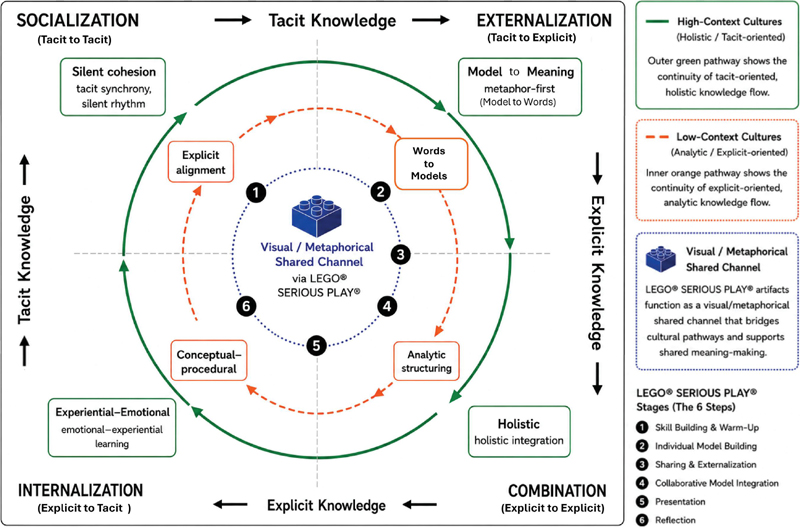
Figure 1 Multicultural SECI Flow Model integrating high-context and low-context learning pathways within LEGO® SERIOUS PLAY® activities.
As illustrated in Figure 1, the model overlays two culturally distinct learning pathways onto the SECI spiral, each operating through distinct interaction channels. The high-context pathway is characterised by tacit synchrony, metaphor-first model building, holistic integration of ideas, and experiential–emotional internalization – operating primarily through physical and embodied channels, consistent with the patterns observed in the Thai cohort (Table 6: Socialization 15–18 episodes; Internalization 11–13 episodes). The low-context pathway emphasises explicit alignment, verbal-first articulation, analytic structuring, and conceptual–procedural internalization – operating primarily through verbal and analytical channels, consistent with patterns observed in the International cohort (Table 6: Externalization 16–18 episodes; Combination 13–15 episodes). Across both pathways, visual and metaphorical channels serve as a shared medium through LSP artefacts, which make tacit reasoning visible, stabilize emerging ideas, and support the collaborative formation of shared understanding across cultural boundaries.
Figure 1 explicitly labels three interaction channels operating within the model: the Embodied/physical channel (high-context pathway, outer green ring), the Verbal/analytical channel (low-context pathway, inner dashed orange ring), and the Visual/metaphorical shared space (LSP artefact zone at the centre, where both pathways converge). The high-context pathway is rendered as a continuous solid green line; the low-context pathway as a continuous dashed orange line. Both are distinguished by colour and stroke pattern simultaneously to support accessibility.
The model extends prior SECI scholarship [3] by demonstrating that the four modes do not operate uniformly across cultural contexts. It also advances constructionist theory [10, 11] by showing how physical artefacts function not merely as learning tools but as intercultural mediating objects that bridge divergent communicative styles. Compared with existing frameworks that treat SECI as culturally neutral [3] or that address cultural variation only at the organizational level [20], the Multicultural SECI Flow Model offers a learner-level, activity-grounded account of how cultural context shapes knowledge-conversion trajectories in real collaborative settings.
5.2 Implications for Knowledge Management
The findings of this study offer several contributions to contemporary KM theory and practice. First, the results suggest that the SECI model – often presented as a universally applicable framework – may operate in culturally specific ways. The movement between tacit and explicit knowledge does not appear to unfold uniformly but is mediated by communication norms, cognitive orientations, and culturally situated habits of meaning-making. This underscores the need to contextualize SECI theory when applied in diverse learning or organizational environments, particularly in multinational teams, cross-cultural innovation projects, and global corporate training programmes.
Second, the study provides evidence that tacit knowledge sharing varies across cultural groups, supporting arguments that tacit exchange is shaped by culturally grounded expectations regarding communication, relational norms, and collaborative behaviour. Within the LSP environment, these differences became visible through contrasting reliance on implicit, embodied coordination versus explicit verbal negotiation. By examining these patterns within a structured constructionist activity, the study extends prior work by illustrating how LSP can both surface and moderate culturally embedded tendencies in tacit knowledge exchange – offering organizations a practical tool for making culturally diverse knowledge visible and negotiable.
Third, the results highlight the mediating function of constructionist artefacts in bridging tacit and explicit forms of knowledge across cultural boundaries. Physical models proved especially valuable for learners from high-context backgrounds, who tended to externalize meaning metaphorically or nonverbally before articulating their ideas verbally. In organizational settings, this finding suggests that artefact-based knowledge practices – such as visual mapping, physical prototyping, or model-based workshops – may support more inclusive knowledge articulation in culturally mixed teams, including those operating in corporate training, innovation workshops, and cross-cultural project environments.
Fourth, the Multicultural SECI Flow Model offers a practical framework for anticipating and interpreting how culturally diverse groups navigate knowledge-conversion processes. Table 12 translates the model’s key insights into a structured set of design principles for KM practitioners working with multicultural teams.
Table 12 Design principles for knowledge management practitioners based on the multicultural SECI flow model
| SECI Mode | High-Context Teams | Low-Context Teams | Mixed-Culture Teams |
| Socialization | Allow time for nonverbal coordination and shared rhythm before task assignment | Structure early dialogue with explicit role clarification | Pair nonverbal warm-up activities with brief verbal check-ins |
| Externalization | Use artefact-first activities; prompt verbal articulation after physical expression | Provide verbal framing prompts before construction begins | Offer both physical and verbal entry points for idea expression |
| Combination | Encourage holistic mapping before categorization | Support layered structuring and explicit labelling | Use hybrid templates that allow both fluid and structured organization |
| Internalization | Provide reflective prompts that invite emotional and relational responses | Provide reflective prompts that invite analytical and systemic responses | Offer multiple reflection modes – written, verbal, and visual |
Finally, the model’s applicability extends beyond the classroom. In digital and hybrid learning environments – including AI-supported collaboration platforms, virtual innovation labs, and smart learning systems – the culturally patterned pathways identified in this study suggest that knowledge-conversion tools should be designed to accommodate both implicit, embodied interaction styles and explicit, verbal-analytical approaches. As organizations increasingly operate across cultural boundaries through digital platforms, the Multicultural SECI Flow Model offers a theoretically grounded basis for designing culturally adaptive KM systems that support diverse teams in converting, sharing, and internalizing knowledge effectively.
More specifically, the Multicultural SECI Flow Model offers actionable design guidance for five categories of future digital and AI-supported learning systems. In collaborative platform design, the model suggests that platforms supporting multicultural knowledge work should provide dual interaction modes: structured verbal channels for low-context Externalization, alongside embodied or spatial interaction modes for high-context Externalization. In mobile learning systems, culturally adaptive applications should allow learners to self-select their preferred modality – tactile-first or verbal-first – and scaffold knowledge conversion accordingly. In AI-supported teamwork environments, AI facilitation agents could monitor team interaction traces, detect underrepresented SECI modes, and generate culturally responsive prompts. In MMLA systems [26], the model provides a cultural interpretive layer for multimodal data streams, enabling analysts to distinguish culturally patterned SECI trajectories from individual-level variation. Finally, in virtual or hybrid LSP environments, effective digital adaptation must preserve the embodied/physical affordances central to high-context learners while providing verbal structuring tools for low-context learners. Across all five system types, a shared design principle emerges: culturally responsive systems should be adaptive rather than prescriptive, dynamically adjusting interaction modes, scaffolding, and reflection prompts in response to observed learner behaviour and communication patterns, rather than assigning fixed pathways based on assumed cultural background alone.
5.3 Implications for Pedagogy and LSP Facilitation
The findings carry important implications for pedagogy and for the facilitation of LSP in multicultural learning environments. Three dimensions of facilitation practice appear particularly relevant: instructional strategy, reflective design, and session pacing.
Regarding instructional strategy, facilitators may strengthen learning outcomes by aligning facilitation approaches with the cultural communication patterns of learners. For high-context students, Externalization can be supported through structured verbal scaffolding that gradually assists learners in articulating meaning after the physical model has taken shape – for example, prompting students to narrate the story of their model after construction rather than before. Low-context learners, by contrast, may benefit from visual, symbolic, or metaphorical prompts that encourage a shift from verbally driven reasoning toward embodied construction – for example, inviting participants to “build first, explain later” as an explicit facilitation instruction.
Regarding reflective design, differences in internalization patterns underscore the need for culturally responsive reflection prompts. High-context learners tended to express learning outcomes in emotional and relational terms, while low-context learners emphasized conceptual clarity and analytical reasoning. Offering multiple reflective pathways – one inviting affective and relational responses (e.g., “How did building together make you feel about the Smart City concept?”) and another inviting cognitive and systemic responses (e.g., “What principles of Smart City design did this activity clarify for you?”) – can support deeper and more culturally authentic internalization across diverse learner groups.
Regarding session pacing, variations in SECI mode emphasis have direct implications for instructional design. The episode frequency data in Table 6 suggest that high-context learners generated more Socialization episodes (15–18) relative to Combination (10–12), indicating a tendency to invest more heavily in early-stage tacit coordination. Low-context learners showed the inverse pattern, generating more Externalization (16–18) and Combination (13–15) episodes. These patterns suggest that facilitators working with high-context groups may benefit from allocating additional time in the Socialization phase to allow intuitive coordination and shared rhythm to develop, while those working with low-context groups may find extended time in the Combination phase more productive for analytical integration and knowledge synthesis.
Beyond the classroom, these pedagogical insights apply to a range of professional and organizational learning contexts. In corporate training programmes, the Multicultural SECI Flow Model can inform the design of cross-cultural team-building workshops where tacit knowledge transfer is a primary goal. In innovation workshops involving participants from diverse cultural backgrounds, facilitators can use the model to anticipate divergent externalization sequences and design activities that accommodate both metaphor-first and verbal-first approaches to idea generation. In online and hybrid learning environments – including virtual LSP adaptations, AI-supported collaboration tools, and remote team facilitation platforms – the model’s culturally adaptive principles suggest that digital tools should offer both embodied and verbal modes of interaction to support knowledge conversion across cultural styles. To support practitioners in applying these insights, Table 13 presents a facilitation checklist derived from the Multicultural SECI Flow Model, organized by SECI mode and applicable across classroom, corporate, and digital learning contexts.
Table 13 Facilitation checklist for multicultural LSP and knowledge-conversion activities
| SECI Mode | Facilitation Action | Context |
| Socialization | Allow 15–20 minutes of unstructured collaborative warm-up before verbal task briefing | Classroom/Corporate |
| Socialization | In virtual settings, use shared digital building tools (e.g., virtual LEGO, Miro) before verbal discussion | Online/Hybrid |
| Externalization | Prompt high-context learners to narrate model meaning after construction | Classroom/Corporate |
| Externalization | Prompt low-context learners with “build first, explain later” instructions | Classroom/Corporate |
| Combination | Offer both open spatial layouts (for holistic blending) and structured templates (for analytical organization) | All contexts |
| Combination | In digital settings, provide both free-form and structured digital canvases | Online/Hybrid |
| Internalization | Use dual reflection prompts: affective (“How did this feel?”) and cognitive (“What did you learn about the system?”) | All contexts |
| Internalization | Allow individual and group reflection modes to accommodate both relational and independent processing styles | All contexts |
5.4 Limitations
This study has several limitations that warrant consideration. First, the analysis was based on two relatively small cohorts ( Thai; International), which limits the generalizability of the findings despite the consistency of the observed patterns across all four SECI modes and three data sources. Future studies involving larger samples and additional cultural groups would enable broader cross-validation of the Multicultural SECI Flow Model.
Second, the Smart City design task may have influenced how learners expressed, structured, and combined ideas. The urban planning theme may have particularly favoured analytical structuring and spatial reasoning, potentially amplifying the Combination episode advantage observed in the International cohort. Alternative task domains – social problem-solving, product design, narrative construction – might yield different SECI trajectories and should be explored in future work.
Third, although instructional conditions were held constant across both cohorts, relying on a single facilitator introduces the possibility that facilitation style, tone, or responsiveness differentially affected group interaction in ways that are difficult to fully control or measure.
Fourth, variation in English proficiency within the International cohort may have shaped the patterns of Externalization and verbal articulation documented in the results. Learners with stronger English fluency may have been more inclined toward verbal-first externalization, which could partially account for the higher Externalization episode count observed in that group (16–18 episodes; Table 6).
Fifth, the episode coding process, while conducted through a structured three-cycle consensus procedure (Section 3.4), remains inherently interpretive. Although convergence was high across core SECI and cultural code categories, the qualitative nature of episode boundary decisions means that the frequency counts in Table 6 should be understood as indicative rather than definitive. The ranges reported reflect this uncertainty and are used as a basis for qualitative comparison rather than statistical inference.
Finally, this study does not address how the Multicultural SECI Flow Model might operate in online or hybrid learning environments, where the physical and embodied dimensions of LSP – central to both Socialization and Externalization – may be substantially altered. Investigating digital adaptations of LSP and their implications for culturally mediated knowledge conversion represents an important direction for future research.
6 Conclusion and Future Work
6.1 Conclusion
This study suggests that cultural–linguistic context shapes how tacit and explicit knowledge circulate through the SECI cycle during LEGO® SERIOUS PLAY® activities. Although both cohorts completed identical constructionist tasks under equivalent instructional conditions, their knowledge-conversion pathways appeared to reflect culturally patterned communication preferences and cognitive styles – as evidenced by the episode frequency distributions in Table 6 and the qualitative patterns documented across Tables 7–11.
The Thai cohort appeared to follow a high-context pathway characterised by tacit synchrony, metaphor-first externalization, holistic combination, and experiential–emotional internalization. The International cohort appeared to follow a low-context pathway characterised by explicit alignment, verbal-first externalization, analytical combination, and cognitive–systemic internalization. Despite these divergent trajectories, both cohorts converged through the mediating role of constructionist LEGO® artefacts, which made tacit reasoning visible and supported shared meaning-making across cultural boundaries.
Building on these findings, the Multicultural SECI Flow Model offers a hybrid conceptual–empirical framework explaining how cultural context may mediate Socialization, Externalization, Combination, and Internalization in collaborative learning environments. The model extends SECI theory [3] by demonstrating that knowledge-conversion pathways are culturally inflected at the learner level, advances constructionist theory [10, 11] by positioning physical artefacts as intercultural mediating objects and contributes to intercultural communication research [7, 8, 20] by grounding cultural cognition theory in an observable, activity-based context.
The research contributes to KM theory by situating SECI within multicultural learning contexts and demonstrating that cultural diversity shapes not only the outcomes but also the processes of knowledge conversion. It informs pedagogy and LSP facilitation practice by showing how culturally responsive strategies – including differentiated scaffolding, dual reflective prompts, and culturally adaptive pacing – can strengthen inclusion, dialogue, and collaborative knowledge creation across diverse learner groups. The practical guidelines and facilitation checklist presented in Tables 12 and 13 translate these insights into actionable tools for KM practitioners, educators, and organizational facilitators working in multicultural settings.
6.2 Future Work
Future research could extend these findings in several directions. First, studies involving additional cultural groups – such as East Asian, South Asian, or various European cohorts – would enable broader cross-validation of the multicultural SECI dynamics identified here and support further refinement of the Multicultural SECI Flow Model. Second, longitudinal designs could clarify how Internalization evolves over time in LSP-based KM training, and whether the affective–cognitive distinction observed in this study persists or converges across repeated collaborative activities.
Third, the Multicultural SECI Flow Model may be applied and tested in organizational contexts, particularly within innovation teams, corporate training programmes, and cross-cultural project groups where culturally mediated knowledge conversion is a central concern. Fourth, digital and hybrid adaptations of LSP – including virtual model-building platforms, AI-supported collaboration tools, and remote facilitation environments – represent an important frontier for investigating whether and how the culturally patterned SECI pathways identified in this study operate when the physical and embodied dimensions of LSP are mediated through technology.
Finally, mixed-methods approaches incorporating fine-grained behavioural observation, eye-tracking, discourse analysis, or MMLA [26] could offer deeper insight into the micro-processes through which tacit and explicit knowledge are converted across cultures – including the precise role of gesture, gaze, and spatial arrangement in Socialization, and the verbal–nonverbal interaction sequences that characterise Externalization in high- and low-context learning environments.
Acknowledgments
The authors would like to express their sincere appreciation to the master’s students from the Knowledge and Innovation Management program at the College of Arts, Media and Technology, Chiang Mai University, whose participation, model-building activities, and reflective contributions made this study possible. The authors also acknowledge the support provided by the program and the institution, which enabled the facilitation, data collection, and analysis required for this research. Their engagement and commitment were essential to the successful completion of this work.
References
[1] Polanyi, M. (1966) The Tacit Dimension. Doubleday.
[2] Polanyi, M. (2009) The tacit dimension. In Knowledge in Organisations (pp. 135–146). Routledge.
[3] Nonaka, I., and Takeuchi, H. (1995). The Knowledge-Creating Company. Oxford University Press.
[4] Nonaka, I. (2009). The knowledge-creating company. In The Economic Impact of Knowledge (pp. 175–187). Routledge.
[5] Hu, J., Lee, J., and Yi, X. (2023). Blended knowledge sharing model in design professional. Scientific Reports, 13, 16326. doi:10.1038/s41598-023-43505-z.
[6] Nisbett, R. E. (2010). The Geography of Thought: How Asians and Westerners Think Differently…and Why. Free Press.
[7] Ting-Toomey, S., and Chung, L. C. (2022). Understanding Intercultural Communication (3rd ed.). Oxford University Press.
[8] Hofstede, G. (2001). Culture’s Consequences: Comparing Values, Behaviours, Institutions, and Organizations Across Nations (2nd ed.). Sage Publications.
[9] Davenport, T. H., and Prusak, L. (2003). Working Knowledge: How Organizations Manage What They Know. Harvard Business School Press.
[10] Papert, S. (1980). Mindstorms: Children, Computers, and Powerful Ideas. Basic Books.
[11] Papert, S., and Harel, I. (1991). Situating constructionism. In S. Papert & I. Harel (Eds.), Constructionism. Ablex Publishing. http://www.papert.org/articles/SituatingConstructionism.html.
[12] Cherapanukorn, V., and Jintapitak, M. (2017). An organization learning with LEGO® SERIOUS PLAY®. In Proceedings of the 11th International Conference on Software, Knowledge, Information Management and Applications (SKIMA) 1–8.
[13] Benesova, N. (2023). LEGO® SERIOUS PLAY® in management education. Cogent Education, 10(2), Article 2262284. doi:10.1080/2331186X.2023.2262284.
[14] Kristiansen, S., and Rasmussen, P. (2014). Facilitating tacit knowledge through LEGO® SERIOUS PLAY®. Human Resource Development Quarterly, 25(2), 153–178.
[15] Frappaolo, C. (2008). Implicit knowledge. Knowledge Management Research & Practice, 6(1), 23–25. doi:10.1057/palgrave.kmrp.8500168.
[16] Suppiah, V., and Sandhu, M. S. (2011). Organisational culture’s influence on tacit knowledge-sharing behaviour. Journal of Knowledge Management, 15(3), 462–477.
[17] Ichijo, K., and Nonaka, I. (2007). Knowledge Creation and Management. Oxford University Press.
[18] Alavi, M., and Leidner, D. E. (2001). Review: Knowledge management and knowledge management systems: Conceptual foundations and research issues. MIS Quarterly, 25(1), 107–136. doi:10.2307/3250961.
[19] Markus, H. R., and Kitayama, S. (1991). Culture and the self: Implications for cognition, emotion, and motivation. Psychological Review, 98(2), 224–253. https://doi.org/10.1037/0033-295X.98.2.224.
[20] Gudykunst, W. B. (2004). Bridging Differences: Effective Intergroup Communication. Sage Publications. https://doi.org/10.4135/978145222970.
[21] Kafai, Y. B., and Resnick, M. (Eds.). (1996). Constructionism In Practice: Designing, Thinking, And Learning In A Digital World. Routledge. https://doi.org/10.4324/9780203053492.
[22] Jintapitak, M., and Yodmongkol, P. (2025). The enhancing system thinking and teamwork through LEGO® SERIOUS PLAY®: A case study in knowledge and innovation management. Asian Health, Science and Technology Reports, 33(1).
[23] Creswell, J. W. (2014). Research Design: Qualitative, Quantitative, And Mixed Methods Approaches (4th ed.). Sage Publications.
[24] Kajamaa, A., and Kumpulainen, K. (2020). Students’ multimodal knowledge practices in a makerspace learning environment. International Journal of Computer-Supported Collaborative Learning, 15(4), 411–444. https://doi.org/10.1007/s11412-020-09337-z.
[25] Sung, H., and Nathan, M. J. (2025). Unraveling temporally entangled multimodal interactions: investigating verbal and nonverbal contributions to collaborative construction of embodied math knowledge. International Journal of Educational Technology in Higher Education, 22, 8. https://doi.org/10.1186/s41239-025-00504-6.
[26] Yan, R., et al. (2024). Evidence-based multimodal learning analytics for feedback and reflection in collaborative learning. British Journal of Educational Technology, 55, 1900–1925. https://doi.org/10.1111/bjet.13498.
[27] Bala, M. M., Akkineni, H., and Srinivasulu, C. (2022). An approach for learner categorization based on emotions in intelligent adaptive e-learning environment. Journal of Mobile Multimedia, 18(06), 1709–1732. https://doi.org/10.13052/jmm1550-4646.18611.
[28] Kongrit, T., and Kiattisin, S. (2023). Live streaming contents influencing game playing behavior among Thailand gamers. Journal of Mobile Multimedia, 19(04), 1031–1048. https://doi.org/10.13052/jmm1550-4646.1946.
[29] Guo, Z., et al. (2025). A review of multimodal interaction in remote education: Technologies, applications, and challenges. Applied Sciences, 15(7), 3937. https://doi.org/10.3390/app15073937.
[30] Jintapitak, M. (2026). Gamified mobile edutainment for cultural heritage learning: A design-based research study of Tai ethnic cultures in Lanna. Journal of Mobile Multimedia, 22(01), 151–174. https://doi.org/10.13052/jmm1550-4646.2216.
[31] Saldaña, J. (2016). The Coding Manual for Qualitative Researchers (3rd ed.). Sage Publications.
[32] Miles, M. B., Huberman, A. M., and Saldaña, J. (2014). Qualitative Data Analysis: A Methods Sourcebook (3rd ed.). Sage Publications.
Biographies

Pitipong Yodmongkol is currently a senior lecturer in Knowledge and Innovation Management with the College of Arts, Media and Technology, Chiang Mai University, Thailand, where he teaches a range of strategic management, intellectual capital management, and knowledge management modules at both undergraduate and postgraduate levels. His research interests reflect his passion for bridging the gap between theory and practice. He has made significant strides in understanding the role of human capital in organizational development, intellectual capital management, and digital learning environments. His work regularly contributes to essential conversations on the future of education, technology integration in teaching, and the evolving role of learning organization and human capital management in business and academia.

Manissaward Jintapitak received her Ph.D. in Knowledge Management from Chiang Mai University, Thailand. She also received an M.Arch. in Architecture and an M.Ed. in Educational Technology from Chiang Mai University, and a B.F.A. in Interior Design (Second-Class Honors) from Bangkok University. She is currently a lecturer at the College of Arts, Media and Technology, Chiang Mai University. Her research interests include Knowledge and Innovation Management, Creative Communication, Collaborative Learning, Digital Edutainment, and Design-based Research in Technology-Enhanced Learning Environments.
Journal of Mobile Multimedia, Vol. 22_3, 293–340
doi: 10.13052/jmm1550-4646.2232
© 2026 River Publishers