Dynamic Cell Capacity Expansion Using Temporary UAV Landing Pads for Cellular Hotspot Environments*
Sung-Hwa Lim
Department of Multimedia, Namseoul University, Cheonan, South Korea
E-mail: sunghwa@nsu.ac.kr
Received 30 June 2026; Accepted 01 August 2026
Abstract
Sudden user concentration in cellular hotspot environments can significantly degrade the quality of service (QoS) due to the limited capacity of conventional ground base stations (BSs). Although unmanned aerial vehicles (UAVs) equipped with base station functionalities have recently emerged as a promising solution for temporary capacity enhancement, most existing studies assume that UAVs continuously provide services while hovering in the air. Such an approach suffers from severe energy consumption and limited service duration because of the high propulsion power required for hovering.
This paper proposes an energy-efficient dynamic cell capacity expansion scheme based on temporary UAV landing pads. The proposed approach divides a macrocell into multiple UAV sub-cells and deploys temporary landing pads at the center of each sub-cell. When a hotspot event occurs, a UAV equipped with a small base station or repeater function is dispatched to the corresponding landing pad and provides wireless services in a landed state. Since the UAV consumes propulsion energy only during movement and significantly reduces energy consumption during service provision, the proposed scheme substantially extends the service duration of UAV-assisted communications.
Performance evaluations considering UAV battery constraints demonstrate that the proposed landed UAV-BS scheme achieves approximately 87.7% energy savings and extends the UAV service duration by approximately 8.8 times compared with the conventional hovering UAV-BS scheme. Moreover, the proposed approach effectively reduces the blocking rate and maintains higher average throughput during prolonged hotspot situations.
Keywords: UAV base station, cellular hotspot, dynamic capacity expansion, UAV landing pad, energy efficiency, 5G/6G networks.
1 Introduction
The rapid evolution of wireless communication technologies from the fifth-generation (5G) to the sixth-generation (6G) era has led to an unprecedented increase in mobile data traffic. Emerging applications, such as the Internet of Things (IoT), autonomous vehicles, smart factories, and virtual/augmented reality (VR/AR) require high data rates, ultra-low latency, and massive connectivity [1, 2]. Consequently, future cellular networks are expected to support a tremendous number of users with diverse quality-of-service (QoS) requirements.
One of the major challenges in next-generation cellular networks is the occurrence of temporary hotspot environments in which a large number of pieces of user equipment (UE) becomes concentrated within a specific geographical area. Such situations frequently arise during sporting events, concerts, festivals, shopping activities, emergency scenarios, and disaster recovery operations [4]. Since the service capacity of a conventional ground base station (BS) is inherently limited, sudden user concentration may result in severe performance degradation, including reduced throughput, increased packet loss, prolonged access delay, and service blocking.
Traditional approaches to addressing this problem include base station densification, cell splitting, and small-cell deployment [5, 12, 13]. Although these approaches can effectively increase network capacity, they require substantial infrastructure investments and long deployment periods. Furthermore, because hotspot events are typically temporary and location-dependent, designing the network according to worst-case traffic conditions results in poor resource utilization and low cost-efficiency.
Recently, unmanned aerial vehicles (UAVs) have attracted significant attention as a promising solution for providing on-demand wireless services [6–9]. Due to their high mobility and flexible deployment capability, UAVs can rapidly move to areas experiencing excessive traffic demand and temporarily provide additional communication resources. UAV-assisted communications have therefore been considered an effective approach for enhancing network resilience in emergency situations and improving service quality during large-scale public events [4, 22].
However, most existing UAV-assisted communication studies assume that UAVs continuously provide wireless services while maintaining a hovering state [7, 9]. Although hovering UAV base stations (UAV-BSs) can dynamically respond to hotspot events, they suffer from excessive energy consumption because a substantial amount of propulsion power is required to sustain flight. Consequently, the operational lifetime of UAV-BSs is significantly limited by battery capacity constraints, making them unsuitable for long-duration hotspot scenarios.
To overcome this limitation, this paper proposes a dynamic cell capacity expansion scheme based on temporary UAV landing pads. The main idea is to partition a macrocell into multiple UAV sub-cells and deploy a temporary landing pad at the center of each UAV sub-cell. When a hotspot event occurs, a UAV equipped with a small base station or repeater function is dispatched to the corresponding landing pad. Instead of continuously hovering, the UAV provides wireless services in a landed state. As a result, propulsion energy consumption is significantly reduced during service provision, thereby extending the service duration and improving the practicality of UAV-assisted communications.
The major contributions of this paper are summarized as follows.
1. A temporary UAV landing pad deployment scheme is proposed for efficient hotspot coverage within a macrocell.
2. A dynamic UAV operation strategy is developed to selectively dispatch UAV-BSs to hotspot regions according to traffic demand.
3. The proposed landed UAV-BS architecture substantially improves energy efficiency by eliminating continuous hovering during service provision.
4. Performance evaluations considering UAV battery constraints demonstrate that the proposed approach effectively reduces the blocking rate while significantly extending UAV service duration compared with conventional hovering UAV-BS schemes.
The remainder of this paper is organized as follows. Section 2 reviews related studies on UAV-assisted cellular communications. Section 3 describes the system model considered in this work. Section 4 presents the proposed UAV landing pad deployment scheme and dynamic operation strategy. Section 5 evaluates the performance of the proposed approach through mathematical analysis and simulations. Finally, Section 6 concludes the paper and discusses future research directions.
2 Related Work
Research on UAV-assisted cellular communications can generally be categorized into four areas: UAV placement optimization, UAV trajectory optimization, energy-efficient UAV communications, and UAV-cellular network integration.
Studies on UAV placement optimization have primarily focused on determining the optimal locations of UAV-mounted base stations to maximize user coverage and improve network performance. Mozaffari et al. investigated the deployment of UAV-assisted mobile base stations and proposed an efficient coverage enhancement strategy based on optimal UAV positioning [6, 14]. Their work demonstrated that appropriate UAV placement can significantly improve the coverage performance of wireless networks. Alzenad et al. further investigated the three-dimensional placement problem of UAV base stations in urban environments while considering the effects of building obstructions [8]. Their study derived optimal UAV locations that maximize the number of covered users while satisfying QoS requirements. In addition, Lyu et al. addressed the placement optimization problem of UAV-mounted mobile base stations to enhance user admission capability under various traffic conditions [20].
Another important research direction involves the optimization of UAV trajectories. Since UAVs operate under strict battery constraints, several studies have attempted to improve communication performance while minimizing energy consumption. Zeng et al. developed an energy consumption model for rotary-wing UAVs and investigated energy minimization problems in UAV-enabled wireless communications [16]. Wu and Zhang proposed a joint trajectory and communication design framework for multi-UAV wireless networks, demonstrating that appropriate trajectory optimization can significantly improve system throughput and spectrum utilization [17]. Similarly, Zeng and Zhang investigated energy-efficient UAV communications through trajectory optimization techniques and showed that the communication performance of UAV-assisted networks can be substantially enhanced by carefully designing UAV flight paths [18].
Research efforts have also been devoted to integrating UAVs into existing cellular infrastructures. Merwaday and Güvenç proposed a UAV-assisted heterogeneous network architecture for public safety communications in disaster scenarios [4]. Their study demonstrated that UAVs can rapidly restore communication services when conventional infrastructures become unavailable. Bor-Yaliniz et al. analyzed the feasibility of integrating UAVs into 5G cellular networks and discussed key standardization challenges associated with UAV-assisted communications [15]. Furthermore, Fotouhi et al. investigated the applicability of UAV-mounted base stations for macro hotspot environments and showed that UAVs can effectively alleviate temporary traffic congestion in cellular systems [9].
In addition to application-oriented studies, several survey papers have comprehensively reviewed the state of the art in UAV communications. Fotouhi et al. provided an extensive survey of UAV cellular communications, addressing practical deployment issues, regulatory considerations, standardization efforts, and security challenges [24]. Shakhatreh et al. reviewed civil applications of UAVs and summarized major research challenges associated with UAV technologies [21]. These surveys highlighted the increasing importance of UAV-assisted communication systems in future wireless networks.
Despite the significant progress achieved by existing studies, most UAV-assisted cellular communication schemes assume that UAVs continuously provide services while maintaining a hovering state [7, 9]. Although hovering UAV base stations offer high deployment flexibility, they inevitably suffer from excessive energy consumption due to continuous propulsion requirements. Consequently, the operational lifetime of UAV-assisted communication systems is severely constrained by battery limitations.
Moreover, previous studies have primarily focused on optimizing UAV placement or flight trajectories [6, 8, 14], while relatively little attention has been paid to the development of landed UAV architectures capable of supporting long-duration communication services. Since hotspot events may persist for several hours in scenarios such as sports events, concerts, festivals, and emergency situations, improving the service sustainability of UAV-assisted networks remains an important research challenge.
To address these limitations, this paper proposes a temporary UAV landing pad-based dynamic cell capacity expansion scheme. Unlike conventional hovering UAV-BS approaches, the proposed scheme allows UAVs to provide wireless services after landing at predefined temporary landing pads. By eliminating continuous hovering during service provision, the proposed architecture significantly reduces energy consumption and substantially extends the operational lifetime of UAV-assisted communication systems. Furthermore, UAV deployment is selectively activated only when hotspot events occur, thereby enabling cost-effective and energy-efficient dynamic cell capacity expansion.
The comparison between the proposed scheme and existing UAV-assisted cellular approaches is summarized as follows:
1. The proposed scheme introduces a temporary UAV landing pad deployment strategy within a macrocell environment.
2. A dynamic UAV operation algorithm is developed to respond to hotspot events based on real-time traffic demands.
3. The proposed landed UAV-BS architecture significantly improves energy efficiency by removing continuous hovering during service provision.
4. Long-duration hotspot scenarios can be effectively supported through the substantial extension of UAV service time.
Therefore, the proposed approach provides a more practical, sustainable, and energy-efficient solution for dynamic cellular capacity expansion in future 5G/6G networks.
3 System Model
In this paper, we consider a single-cell cellular network environment consisting of a conventional ground BS and multiple pieces of UE. The ground BS is located at the center of the macrocell, while the pieces of UE are randomly distributed within the cell coverage area. It is assumed that both the number and locations of the pieces of UE vary dynamically over time according to user mobility and traffic demand.
The ground BS has a maximum service capacity denoted by , representing the maximum number of users that can be simultaneously supported without significant degradation of the QoS. As long as the number of users within the cell remains below , the ground BS can provide satisfactory communication services. When the number of users exceeds , network congestion occurs, resulting in reduced throughput, increased packet loss, and higher service blocking probability. For simplicity, the gradual performance degradation near is not considered in this paper.
To address such temporary traffic overload situations, this paper considers the use of UAV-assisted mobile base stations (UAV-BSs). UAVs equipped with small-cell base station functionalities or repeater capabilities are deployed to provide additional communication resources in hotspot regions where user concentration occurs.
Let R denote the service radius of the macrocell, and let r denote the coverage radius of a UAV-BS. Since the coverage area of a UAV-BS is generally smaller than that of the ground BS, the following relationship is assumed:
where is a positive integer representing the ratio between the macrocell radius and the UAV service radius.
Based on this relationship, the macrocell is partitioned into UAV sub-cells, each having an identical service area. The center of each UAV sub-cell is equipped with a temporary UAV landing pad, enabling UAVs to provide wireless services after landing.
Unlike conventional hovering UAV-BS architectures, the proposed system allows UAVs to remain stationary on the landing pads while delivering communication services. As a result, propulsion energy is consumed only during UAV movement between locations, significantly improving energy efficiency and extending operational duration.
The temporary landing pads are assumed to be deployed at elevated locations, such as building rooftops, streetlight poles, or traffic signal structures, in order to ensure favorable wireless propagation conditions. In addition, the landing pads may provide auxiliary functions such as UAV charging facilities or standby stations for rapid UAV deployment.
To simplify the analysis, the following assumptions are adopted throughout this study.
1. All UAVs are assumed to have identical battery capacities and communication capabilities.
2. Each UAV supports vertical take-off and landing (VTOL) operations.
3. A reliable backhaul connection between the ground BS and UAV-BSs is assumed to be available.
4. The ground BS can identify hotspot locations and estimate user concentrations in real time.
5. The travel time required for UAV deployment is assumed to be sufficiently shorter than the duration of hotspot events.
The objective of the proposed system is to dynamically expand the cell capacity during hotspot situations while minimizing the energy consumption of UAV-assisted communication services. By selectively dispatching UAV-BSs only when and where additional capacity is required, the proposed architecture aims to provide an energy-efficient and cost-effective solution for future 5G/6G cellular networks.
A key distinction between the proposed architecture and conventional hovering UAV-BS systems lies in the service mode of UAV operation. In conventional hovering UAV-BS systems, UAVs continuously consume propulsion energy throughout the service period to maintain flight stability. Consequently, the total energy consumption increases rapidly with service duration. In contrast, the proposed landed UAV-BS architecture consumes propulsion energy only during the deployment phase. During service provision, the UAV remains stationary on the landing pad, and only communication-related power consumption is incurred. Therefore, the proposed approach substantially reduces overall energy consumption and significantly prolongs UAV operational lifetime.
4 Proposed Scheme
The proposed scheme consists of two major components: (1) temporary UAV landing pad deployment and (2) dynamic UAV operation for hotspot mitigation. The overall objective is to dynamically expand the cellular capacity in hotspot scenarios while minimizing UAV energy consumption.
Unlike conventional UAV-BS architectures that continuously provide services in a hovering state, the proposed approach allows UAVs to deliver communication services after landing on pre-installed temporary landing pads. Consequently, propulsion energy consumption during the service period can be significantly reduced.
4.1 Temporary UAV Landing Pad Deployment Scheme
The first step of the proposed framework is the deployment of temporary UAV landing pads within a macrocell.
The landing pad locations are selected to satisfy the following requirements.
• Minimal radio signal blockage.
• Structural stability for UAV landing.
• Availability of power supply or charging facilities.
• Uniform service coverage across the entire macrocell.
Suitable deployment locations include building rooftops, streetlight poles, and elevated traffic infrastructures.
The landing pad deployment algorithm is described as follows.
Algorithm 1 Temporary UAV landing pad deployment.
Input: Macrocell radius , UAV service radius
Output: Set of UAV landing pad locations
1: Calculate the partition parameter :
2: Divide the macrocell into UAV sub-cells.
3: Determine the geometric center of each UAV sub-cell.
4: Select feasible elevated structures near the center points.
5: Install temporary UAV landing pads at the selected locations.
6: Store all landing pad coordinates in set .
Through this deployment strategy, hotspot areas can be efficiently served by UAV-BSs with reduced traveling distances.
4.2 Dynamic UAV Operation Strategy
The second component of the proposed scheme is the dynamic operation of UAV-BSs. The ground BS continuously monitors the number of active users and traffic load conditions. When the total number of users exceeds the service capacity of the ground BS, the system identifies the hotspot region and activates UAV-assisted communications.
Let denote the number of active users at time t. A hotspot event is detected when
Once the hotspot condition is satisfied, the corresponding UAV sub-cell containing the hotspot region is identified. Subsequently, the nearest available UAV is selected and dispatched to the landing pad associated with that sub-cell.
After landing, the UAV operates as a small-cell base station or wireless repeater to provide additional communication resources. The UAV service remains active until the hotspot condition disappears:
When this condition is satisfied, the UAV terminates its service and returns to its standby location. The detailed operational procedure is summarized in Algorithm 2.
Algorithm 2 Dynamic UAV operation strategy.
Input: User distribution , landing pad set , UAV set
Output: Dynamic UAV service activation
1: Monitor the number of active users in the macrocell.
2: Check whether
3: If the condition is false, continue monitoring.
4: Otherwise, identify the hotspot location.
5: Determine the corresponding UAV sub-cell.
6: Select the nearest available UAV from set .
7: Dispatch the selected UAV to the associated landing pad.
8: Activate UAV-BS communication services after landing.
9: Continuously monitor the hotspot condition.
10: If
terminate the UAV service and return the UAV to the standby position.
11: Resume normal monitoring operations.
4.3 Advantages of the Proposed Scheme
Compared with conventional hovering UAV-BS architectures, the proposed scheme offers several advantages.
1. Improved energy efficiency: since UAV propulsion energy is consumed only during deployment and retrieval, the proposed landed UAV-BS architecture substantially reduces total energy consumption.
2. Extended service duration: by eliminating continuous hovering during service provision, the operational lifetime of UAV-assisted communications can be significantly prolonged.
3. Cost-effective capacity expansion: the proposed approach activates UAV-BSs only when hotspot events occur. Therefore, additional communication resources are provided on demand without requiring permanent infrastructure deployment.
4. Enhanced service reliability: the ability to sustain UAV-assisted services over extended periods enables more reliable communications during prolonged hotspot scenarios, such as concerts, sporting events, and disaster recovery operations.
The proposed scheme thus provides an energy-efficient, practical, and scalable framework for dynamic cell capacity expansion in future 5G/6G cellular networks.
5 Performance Evaluation
5.1 Simulation Environment
To evaluate the effectiveness of the proposed scheme, simulations were conducted by comparing three different architectures:
1. Conventional ground BS without UAV assistance
2. Hovering UAV-BS scheme
3. Proposed landed UAV-BS scheme.
The simulation assumes a single macrocell environment in which temporary hotspot events occur. User density changes over time, and UAV-assisted services are activated whenever the traffic demand exceeds the service capacity of the ground BS. The performance evaluation was conducted using a custom discrete-time Monte Carlo simulation implemented in Python. The simulation framework was developed using NumPy for numerical computation and random-variable generation, while Matplotlib was used to visualize the simulation results. Table 1 summarizes the simulation parameters used throughout this study. We adopted the system parameters and assumptions used in [9, 16, 25, 26], with some modifications to suit the system model considered in this study.
Table 1 Simulation parameters
| Parameter | Value |
| Macrocell radius | 1000 m |
| Ground BS capacity | 100 users |
| UAV service radius | 250 m |
| Number of UAV sub-cells | 16 |
| UAV battery capacity | 300 Wh |
| UAV propulsion power (hovering) | 250 W |
| UAV communication power | 30 W |
| UAV traveling speed | 10 m/s |
| Average user data rate demand | 100 Mbps |
| Simulation duration | 24 h |
| Hotspot duration | 1–6 h |
| Number of simulation runs | 100 |
5.2 Performance Metrics
In this study, the main performance metrics are blocking probability, average throughput, UAV energy consumption. The blocking probability is defined as
where is the number of blocked users and is the total number of service requests. The average throughput is defined as
where is the number of served users, is the throughput achieved by user i.
The total UAV energy consumption of a UAV is
where and denote propulsion energy and communication-related energy, respectively.
In hovering systems, is proportional to hovering power and service duration , therefore . In contrast, for the proposed landed UAV-BS system, , since propulsion energy is consumed only during movement.
5.3 Results
Figure 1 illustrates the blocking rate under different hotspot durations. As the hotspot duration increases, the conventional BS experiences a significant increase in blocking probability because no additional communication resources are available. The hovering UAV-BS initially maintains a low blocking rate; however, the blocking probability gradually increases as the UAV battery becomes depleted. In contrast, the proposed landed UAV-BS scheme consistently maintains the lowest blocking rate because the UAV can continue operating for extended periods owing to reduced propulsion energy consumption.
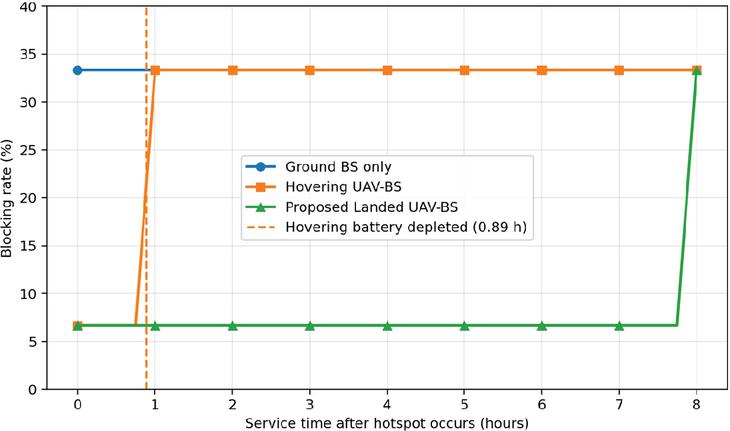
Figure 1 Blocking rate considering UAV battery depletion.
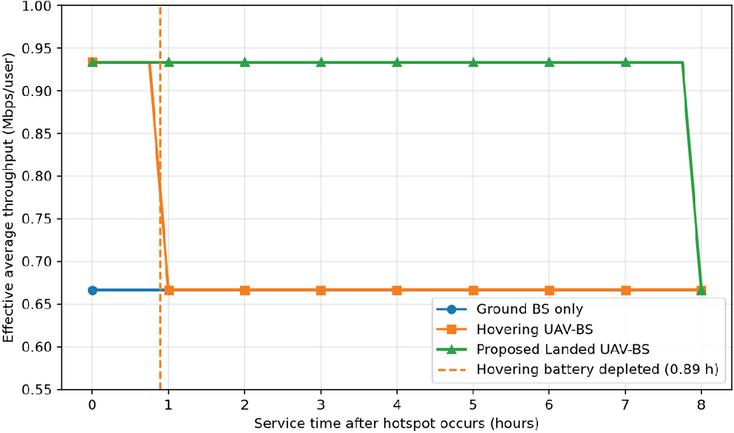
Figure 2 Average throughput considering UAV battery depletion.
Figure 2 compares the average user throughput. The conventional BS exhibits the lowest throughput due to severe congestion during hotspot periods. The hovering UAV-BS improves the throughput performance during the initial phase; however, its performance deteriorates once the UAV battery is exhausted. The proposed scheme achieves the highest average throughput because it can sustain additional communication services throughout prolonged hotspot events.
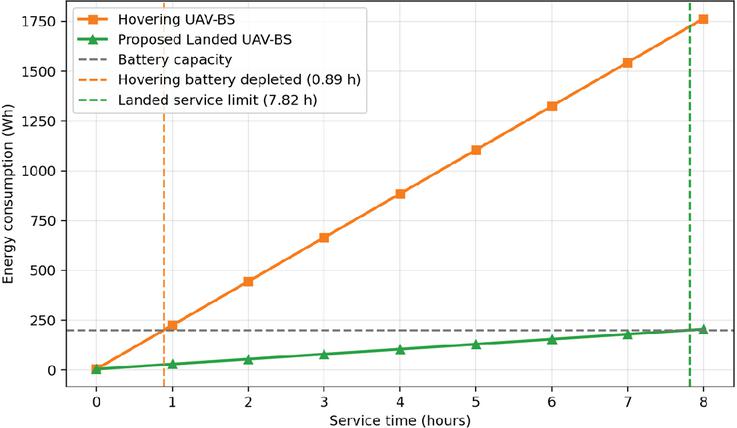
Figure 3 UAV energy consumption comparison.
Figure 3 presents the energy consumption characteristics of the two UAV-assisted schemes. Because hovering UAV-BSs continuously consume propulsion energy, their total energy consumption increases rapidly with service duration. By contrast, the proposed landed UAV-BS architecture consumes propulsion energy only during deployment and retrieval. Therefore, the proposed approach significantly reduces the overall energy expenditure. Simulation results indicate that the proposed scheme achieves approximately 87.7% energy savings compared with the hovering UAV-BS approach.
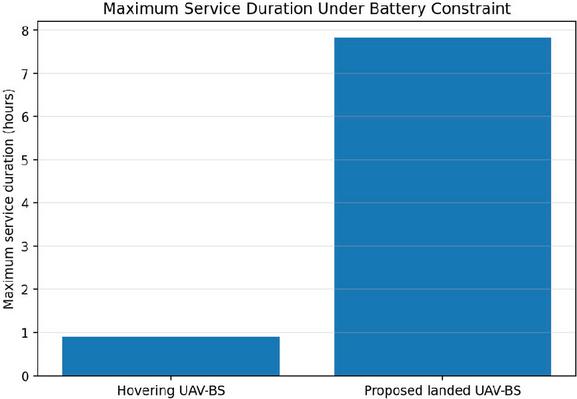
Figure 4 Maximum UAV service duration.
Figure 4 illustrates the achievable UAV service duration. The hovering UAV-BS can sustain communication services for only a limited period because of its substantial propulsion energy requirements. In contrast, the proposed landed UAV-BS substantially prolongs operational time by eliminating continuous hovering. Simulation results demonstrate that the proposed architecture extends UAV service duration by approximately 8.8 times compared with the conventional hovering UAV-BS scheme.
The performance evaluation results clearly indicate that the proposed landed UAV-BS architecture provides a practical solution for hotspot mitigation in future cellular networks. Unlike conventional hovering UAV-BS systems, the proposed approach effectively addresses one of the most critical limitations of UAV-assisted communications, namely, limited battery lifetime. By reducing propulsion energy consumption during service provision, the proposed scheme enables long-duration communication support while maintaining low blocking rates and high throughput performance. These characteristics make the proposed architecture particularly suitable for applications involving prolonged hotspot events, such as concerts, sporting events, large public gatherings, and disaster recovery scenarios.
6 Conclusion and Future Work
This paper proposed an energy-efficient dynamic cell capacity expansion scheme based on temporary UAV landing pads for mitigating hotspot situations in future cellular networks. Unlike conventional UAV-assisted communication architectures that rely on continuous hovering during service provision, the proposed approach enables UAVs equipped with a small-cell base station or repeater functionalities to provide wireless services after landing on predefined temporary landing pads.
To realize the proposed architecture, this paper introduced a temporary UAV landing pad deployment strategy that partitions a macrocell into multiple UAV sub-cells and places landing pads at their centers. In addition, a dynamic UAV operation algorithm was developed to selectively dispatch UAV-BSs to hotspot regions according to real-time traffic conditions. By activating UAV-assisted communications only when the number of users exceeds the service capacity of the ground base station, the proposed scheme effectively expands network capacity while maintaining cost efficiency.
Performance evaluations considering UAV battery constraints demonstrated the effectiveness of the proposed architecture. Compared with conventional hovering UAV-BS schemes, the proposed landed UAV-BS approach significantly reduced propulsion energy consumption by eliminating continuous hovering during service provision. Simulation results showed that the proposed scheme achieved approximately 87.7% energy savings and extended the UAV operational duration by approximately 8.8 times. Furthermore, the proposed architecture effectively maintained a low blocking rate and higher average throughput during prolonged hotspot situations.
These findings indicate that the proposed scheme provides a practical, scalable, and energy-efficient solution for dynamic cellular capacity expansion in future 5G/6G networks. The proposed approach is particularly suitable for applications involving temporary user concentration, such as concerts, sporting events, festivals, emergency situations, and disaster recovery scenarios.
Several research directions remain open for future investigation. First, the proposed framework can be extended to multi-UAV cooperative communication systems, in which multiple UAV-BSs jointly provide communication services in large-scale hotspot environments. Second, AI-based hotspot prediction algorithms can be integrated into the proposed architecture to proactively dispatch UAVs before severe traffic congestion occurs. Third, the deployment optimization of temporary UAV landing pads considering practical urban constraints, such as building density and line-of-sight availability, should be further investigated. Finally, experimental validation using real-world UAV platforms and 5G/6G testbeds would provide valuable insights into the practical feasibility and deployment requirements of the proposed system.
In conclusion, the proposed temporary UAV landing pad-based architecture represents a promising approach for overcoming the limitations of conventional hovering UAV-BS systems and enabling sustainable UAV-assisted communications in future wireless networks.
References
[1] ITU-R, IMT Vision – Framework and Overall Objectives of the Future Development of IMT for 2020 and Beyond, Recommendation ITU-R M.2083-0, Sep. 2015.
[2] A. Gupta and R. K. Jha, “A survey of 5G network: Architecture and emerging technologies,” IEEE Access, vol. 3, pp. 1206–1232, Jul. 2015.
[3] Cisco, Cisco Annual Internet Report (2018–2023) White Paper, Cisco Systems, San Jose, CA, USA, Mar. 2020.
[4] A. Merwaday and I. Güvenç, “UAV assisted heterogeneous networks for public safety communications,” in Proc. IEEE Wireless Communications and Networking Conference Workshops (WCNCW), New Orleans, LA, USA, Mar. 2015, pp. 329–334.
[5] H. Claussen, L. T. W. Ho, and L. G. Samuel, “An overview of the femtocell concept,” Bell Labs Technical Journal, vol. 13, no. 1, pp. 221–245, May 2008.
[6] M. Mozaffari, W. Saad, M. Bennis, and M. Debbah, “Mobile unmanned aerial vehicles (UAVs) for energy-efficient Internet of Things communications,” IEEE Transactions on Wireless Communications, vol. 16, no. 11, pp. 7574–7589, Nov. 2017.
[7] Y. Zeng, R. Zhang, and T. J. Lim, “Wireless communications with unmanned aerial vehicles: opportunities and challenges,” IEEE Communications Magazine, vol. 54, no. 5, pp. 36–42, May 2016.
[8] M. Alzenad, A. El-Keyi, F. Lagum, and H. Yanikomeroglu, “3-D placement of an unmanned aerial vehicle base station for maximum coverage of users with different QoS requirements,” IEEE Wireless Communications Letters, vol. 7, no. 1, pp. 38–41, Feb. 2018.
[9] A. Fotouhi, M. Ding, and M. Hassan, “Flying drone base stations for macro hotspots,” IEEE Access, vol. 6, pp. 19530–19539, Apr. 2018.
[10] J. G. Andrews, S. Buzzi, W. Choi, S. V. Hanly, A. Lozano, A. C. K. Soong, and J. C. Zhang, “What will 5G be?,” IEEE Journal on Selected Areas in Communications, vol. 32, no. 6, pp. 1065–1082, Jun. 2014.
[11] F. Boccardi, R. W. Heath Jr., A. Lozano, T. L. Marzetta, and P. Popovski, “Five disruptive technology directions for 5G,” IEEE Communications Magazine, vol. 52, no. 2, pp. 74–80, Feb. 2014.
[12] A. Checko, H. L. Christiansen, Y. Yan, L. Scolari, G. Kardaras, M. S. Berger, and L. Dittmann, “Cloud RAN for mobile networks—a technology overview,” IEEE Communications Surveys & Tutorials, vol. 17, no. 1, pp. 405–426, first quarter 2015.
[13] V. Chandrasekhar, J. G. Andrews, and A. Gatherer, “Femtocell networks: a survey,” IEEE Communications Magazine, vol. 46, no. 9, pp. 59–67, Sep. 2008.
[14] M. Mozaffari, W. Saad, M. Bennis, and M. Debbah, “Efficient deployment of multiple unmanned aerial vehicles for optimal wireless coverage,” IEEE Communications Letters, vol. 20, no. 8, pp. 1647–1650, Aug. 2016.
[15] I. Bor-Yaliniz, M. Salem, G. Senerath, and H. Yanikomeroglu, “Is 5G ready for drones: A look into contemporary and prospective wireless networks from a standardization perspective,” IEEE Wireless Communications, vol. 26, no. 1, pp. 18–27, Feb. 2019.
[16] Y. Zeng, J. Xu, and R. Zhang, “Energy minimization for wireless communication with rotary-wing UAV,” IEEE Transactions on Wireless Communications, vol. 18, no. 4, pp. 2329–2345, Apr. 2019.
[17] Q. Wu and R. Zhang, “Joint trajectory and communication design for multi-UAV enabled wireless networks,” IEEE Transactions on Wireless Communications, vol. 17, no. 3, pp. 2109–2121, Mar. 2018.
[18] Y. Zeng and R. Zhang, “Energy-efficient UAV communication with trajectory optimization,” IEEE Transactions on Wireless Communications, vol. 16, no. 6, pp. 3747–3760, Jun. 2017.
[19] H. Yan, Y. Chen, and S.-H Yang, “UAV-enabled wireless power transfer with base station charging and UAV power consumption,” IEEE Transactions on Wireless Communications, vol. 19, no. 2, pp. 1288–1300, Feb. 2020.
[20] J. Lyu, Y. Zeng, R. Zhang, and T. J. Lim, “Placement optimization of UAV-mounted mobile base stations,” IEEE Communications Letters, vol. 21, no. 3, pp. 604–607, Mar. 2017.
[21] H. Shakhatreh, A. H. Sawalmeh, A. Al-Fuqaha, Z. Dou, E. Almaita, I. Khalil, N. S. Othman, A. Khreishah, and M. Guizani, “Unmanned aerial vehicles (UAVs): A survey on civil applications and key research challenges,” IEEE Access, vol. 7, pp. 48572–48634, Apr. 2019.
[22] A. Fotouhi, M. Ding, and M. Hassan, “DroneCells: Improving spectral efficiency using drone-mounted flying base stations,” Journal of Network and Computer Applications, vol. 174, Art. no. 102895, Jan. 2021.
[23] C. T. Cicek, H. Gultekin, B. Tavli, and H. Yanikomeroglu, “UAV base station location optimization for next generation wireless networks: Overview and future research directions,” in Proc. IEEE International Conference on Communications (ICC), Shanghai, China, May 2019, pp. 1–6.
[24] A. Fotouhi, H. Qiang, M. Ding, M. Hassan, L. G. Giordano, A. Garcia-Rodriguez, and J. Yuan, “Survey on UAV cellular communications: practical aspects, standardization advancements, regulation, and security challenges,” IEEE Communications Surveys & Tutorials, vol. 21, no. 4, pp. 3417–3442, fourth quarter 2019.
[25] M. Alzenad, A. El-Keyi, F. Lagum, and H. Yanikomeroglu, “3-D placement of an unmanned aerial vehicle base station (UAV-BS) for energy-efficient maximal coverage,” IEEE Wireless Communications Letters, vol. 6, no. 4, pp. 434–437, Aug. 2017.
[26] N. Gao, Y. Zeng, J. Wang, D. Wu, C. Zhang, Q. Song, J. Qian, and S. Jin, “Energy model for UAV communications: experimental validation and model generalization,” in China Communications, vol. 18, no. 7, pp. 253–264, July 2021
Footnotes
*Funding for this paper was provided by Namseoul University.
Biography

Sung-Hwa Lim received B.S., M.S., and Ph.D. degrees in computer engineering from Ajou University, Republic of Korea, in 1999, 2001, and 2008, respectively. He was a postdoctoral researcher with the Coordinated Science Laboratory, University of Illinois at Urbana_Champaign (UIUC), from 2008 to 2009. He is currently an associate professor with the Department of Multimedia, Namseoul University. His research interests include mobile computing, the Internet of Things, power-aware computing, and real-time systems.
Journal of Mobile Multimedia, Vol. 22_4, 523–542
doi: 10.13052/jmm1550-4646.2245
© 2026 River Publishers