Sum Rate DL/UL Performance of Co-operative NOMA Systems Over Weibull Fading Channel
Rampravesh Kumar1,* and Sanjay Kumar2
1Birla Institute of Technology, Mesra, India
2Birla Institute of Technology, Mesra, Deoghar Campus, India
E-mail: rampraveshkumar6@gmail.com; skumar@bitmesra.ac.in
*Corresponding Author
Received 18 September 2020; Accepted 30 November 2020; Publication 26 January 2021
Abstract
This work evaluates the sum rate performance for dual user with full duplex co-operative non-orthogonal multiple access (FD-CNOMA) over Weibull fading channel environment. For this, we derived closed form expressions for sum-rate in various scenario in downlink and uplink both. One user always acts as decode and forward full duplex relay to help far users in each scenario. In the first scenario, no direct link exists between base station (BS) and far user. In second scenario, direct link exists between BS and far user. The main investigation is to study the effect of fading parameters in different channel condition on sum-rate performance. Since, Weibull Distribution (WD) has an advantage to model different fading condition using varying parameter it is more suitable to study impact of fading condition on different wireless techniques for next generation mobile cellular communication. Therefore, WD is used in this study for sum rate performance evaluation with derived expressions. Finally, simulations were conducted on MATLAB to evaluate the system performance under different fading parameters of Weibull fading channels.
Keywords: NOMA, FD-CNOMA, Weibull distribution, sum rate performance, DL, UL.
1 Introduction
A lot of attention has been paid to achieve higher spectral efficiency of the fifth generation (5G) mobile communication network, non-orthogonal multiple access (NOMA) is one of them [1]. NOMA’s key features are to allow multiple users to share the same resource elements (i.e., time/frequency/code) across different power levels. The successive interference cancellation (SIC) is done on the receiver side. In [2], the effect of user pairing with the NOMA system’s fixed power allocation was analyzed in depth.
However, in deep fade case, cooperative communication is a powerful technique to either expand network coverage or improve the reliability of communication [3]. Recent contributions to NOMA research in the field of cooperative communication discussed in [4–8] are as follows.
In [4], the authors explored the probability of decoding-and-forward (DF) relaying for NOMA. In [5] Nakagami-m fading channels addressed the outage performance of a variable gain amplify-and-forward (AF) relaying with NOMA. In addition, a cooperative NOMA definition was first suggested in [6], where near-users with better channel conditions were considered to be DF relaying to support the far-off users. As a further advancement with consideration of energy-related issues, simultaneous wireless information and power transfer (SWIPT) was used by close NOMA users, which was considered to be DF relays in [7]. While cooperative NOMA can improve performance gains for weaker users (not necessarily far-off users), it does bring additional slot costs to the systems. To avoid this problem, the implementation of full-duplex (FD) relay technology is a promising solution. FD relaying receives and transmits simultaneously in the same frequency band and time slot stimulated researchers ’ interest in exploring more effective spectral systems [8]. FD relay technology has recently been suggested as a promising technique for 5G networks in [9]. The authors tested the efficiency of the cooperative NOMA based on FD device-to-device in [10]. Nonetheless, only the weaker user’s outage performance was analyzed. In [11, 12] cooperative NOMA with FD relay has been used for finding the Sum rate and performance in closed form expressions, assuming Rayleigh fading channels. Note that the Rayleigh distribution is widely used to model the fading due to multi-paths in an urban environment, where radio waves are received via large number of paths. Therefore, the central limit theorem (CLT) is used to derive the Rayleigh model theoretically. Nevertheless, if the number of incoming radio paths is small, the Rayleigh distribution may not be a suitable fading model as the CLT’s validity conditions may not hold. Some evidence suggests that Weibull distribution may explain the signal amplitude in this situation. Experimental evidence is published in [13] supporting the appropriateness of the Weibull model and [14] considered its use as a basis for indoor fading channels.
1.1 Weibull Fading
The distribution of Weibull is useful for modelling the amplitude of multipath fading signals. Based on fading channel data from [15], in some cases the Weibull distribution can be used to model well outdoor multi-paths.
The Weibull distribution’s probability density function (PDF) [17] is given as
| (1) |
where, B is called the Weibull fading parameter and A is a positive scaling parameter. The Weibull fading parameter B can take values between 0 and . In the special case when , the Weibull distribution becomes an exponential distribution; when , the Weibull distribution specializes to a Rayleigh distribution. These all, inspires us to work on for the evaluation of various performance parameters for the next generation mobile cellular system in wireless environment. Sum rate performance, one of those parameters under NOMA with FD Relay over Weibull fading channels has been analyzed in this paper. Sum-rate is the sum of individual user rate.
This paper is organized as follows. Section 2 presents the proposed system model with related works done so far of our interest. This section highlights the processes involved at the transmitting and receiving ends in the FD-CNOMA System. Section 3 derives the generalized expressions for sum rate performance under the defined system model in various scenario where as Section 4 describes the simulation parameters taken according to formulated sum rate expressions on MATLAB over Weibull fading channel conditions. Section 5 interprets the obtained simulation results and finally, Section 6 concludes the sum rate performance of FD-CNOMA over conventional NOMA.in various scenario.
2 The System Model
Under this section, the system model in downlink (DL) channel and uplink channel (UL) with dual users in single cell along with relevant equations for different scenarios are discussed
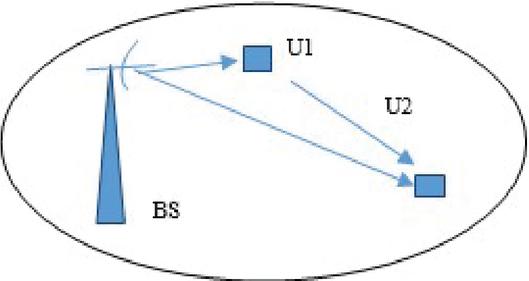
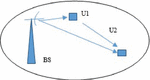
Figure 1(a) Single cell two users FD-CNOMA in DL channel.
2.1 Downlink Channel Model
We consider a FD cooperative NOMA system in downlink shown in the Figure 1(a) composed of one source (i.e. the base station (BS)) that intends to communication with the far user U2 under the assistance of the near user U1. Both no direct link and direct link scenarios between the BS and U2 are considered. U1 is regarded as user relaying and DF protocol is employed to decode and forward the information to U2. To enable FD communication, U1 is equipped with one transmit antenna and one receive antenna, while the BS and U2 are single-antenna device. All wireless links in the network are assumed to be independent non-selective block Weibull fading and are disturbed by additive white Gaussian noise with mean power . , , and are denoted as the complex channel coefficient of BS U1, U1 U2, and BS U2 links, respectively.
The channel power gains , and are subjected to Weibull random variables (RVs) with the parameter , , respectively. The residual loop self-interference (LI) is modelled as a Weibull fading feedback channel with coefficient and is the corresponding fading parameters . According to [15], U1 receives the superposed signal and loop interference signal simultaneously. The observation at U1 can be given by
| (2) |
where and are the normalized transmission powers at the BS and U1 respectively; and are the power allocation coefficient and x and x are the signal of U1 and U2, respectively; denotes loop interference signal. Without loss of generality, we assume that with .
Applying NOMA principle, successive interference cancellation (SIC) [16] is employed at U1. Therefore, the received signal to interference and noise ratio (SINR) at U1 to detect the U2’s message x is given by
| (3) |
where is transmit signal to noise ratio (SNR). Note that x and x are supposed to be normalized unity power signals, i.e. . Where denotes expectation operation. After SIC, the received SNR at U1 to detect its own message x is given by
| (4) |
In the FD mode, the received signal at U2 can be written as
| (5) |
However, the observation at U2 for the direct link can be written as
| (6) |
The received SINR at U2 to detect in non-direct link is given by
| (7) |
As in [17, 18], the relaying link from U1 to U2 corresponding to the direct link from BS to U2 has small time delay for any transmitted signals. Therefore, we assume that the signals from the relaying link and direct link can be combined by maximal ratio combining (MRC) at U2. The received SINR after MRC at U2 can be given by
| (8) |
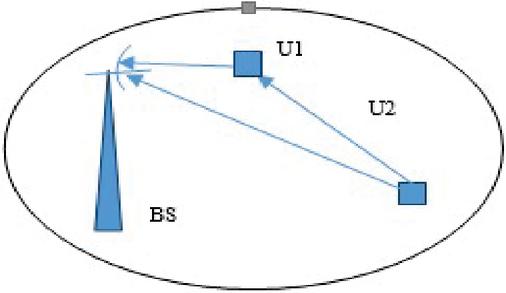
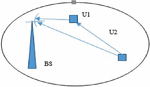
Figure 1(b) Single cell two users FD-CNOMA in UL channel.
2.2 Uplink Channel Model
We consider a FD cooperative NOMA system in Uplink shown in the Figure 1(b) similar to Downlink system shown in the Figure 1(a). Let , and indicate the channel coefficients of User1 to User2 (U1–U2) connection, User1 to BS (U1–BS) connection and User2 to BS (U2–BS) interface, separately. signifies the self-loop interference channel of User1 due to FD relaying. All these wireless connections in the network are thought to be autonomous Weibull fading channels same as Downlink channel model.
At time t, as per [19], the received signal at User1 is given by
| (9) |
where is the symbol transmitted from User2, indicates the self-interference signal at User1, and indicate the transmit power of User1 and User2, individually, denotes the additive white Gaussian noise (AWGN) at User1 with zero mean and variance . After that we can obtain the signal-to-interference plus noise ratio (SINR) for User1 to decode as
| (10) |
where and denote the transmit SNRs at User1 and User2, respectively. According to the NOMA protocol, Superimposed signal of the symbol and is forwarded to the BS by User1, where is the data signal from User2 that is decoded at User1 and is User1’s own data signal. We note that a processing delay is included because of the signal processing at User1 (e.g. decoding ), in spite of the fact that it works in the FD mode.
Following [20, 21], this work accepts that the processing delay is negligible comparative with the total transmission duration, while the two signals from User1 and User2 are completely resolvable at the BS because of the included delay . The BS gets uplink signals transmitted from User1 and User2. The received signal for the direct link from User2 at the BS is given by
| (11) |
The SNR for the BS to decode from the direct link is given by
| (12) |
In the interim, the received signal at BS from the cooperative link can be communicated as
| (13) |
where and are power allocation coefficients with at User1 for symbol & respectively. Based on the principle of the SIC-based NOMA, the BS first decodes the symbol by treating as interference. To this end, the MRC is embraced at the BS to combine the received signals and for decode [19]. Then the interference caused by the symbol will be subtracted from the received signals with SIC for decoding the symbol .
Therefore, the SINR for decoding and the SINR for decoding are, respectively, given by
| (14) | ||
| (15) |
where denotes the SINR at the BS for decoding from the cooperative link.
3 Sum Rate Performance Expressions
In this work, generalized sum-rate performance expressions for two users in NOMA and FD-CNOMA have been derived using the above set of equations as follows.
3.1 For Downlink Channel Model
A. User relaying in non-direct link
Sum Rate can be written as
| (16) |
B. User relaying in direct link
Sum Rate can be written as
| (17) |
C. User without relaying (NOMA)
SINR at U1, U2 and Sum Rate can be written respectively as
| (18) |
3.2 For Uplink Channel Model
A. User relaying in non-direct link
| (19) |
B. User relaying in direct link
| (20) |
C. User without relaying (NOMA)
SINR at U1, U2 can be written as
| (21) |
4 Simulation Setup
This study compares the sum-rate performance of NOMA and co-operative NOMA for direct and non-direct relay scenario for different channel fading condition derived from Weibull distribution. Initially, experiments were carried on to study Weibull distribution curve for different scaling and shape parameter A and B respectively.
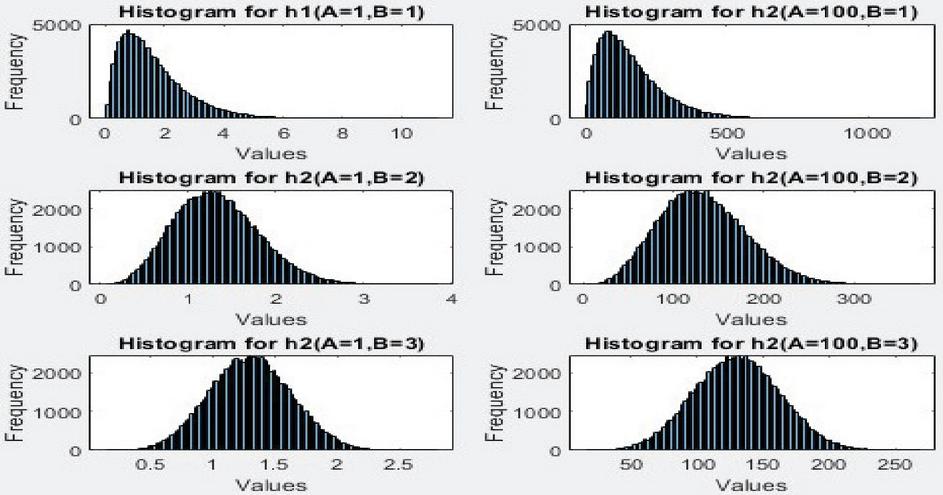
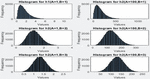
Figure 2 Histogram plot (Weibull distribution) for different A and B.
Figure 2 plots histogram for random variable x generated for different values of A and B. As clearly evident from the Figure 2, as value of A is increased from 1 to 100 keeping B constant, the magnitude of the data points increases by 100 times. Simultaneously, when value of B is changed from 1 to 3, shape changes from Exponential to Gaussian.
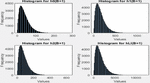
To simulate the experiment, four channels with different strength in every fading scenario have been simulated. The order of strength for the four channel conditions are: . Figure 3 plots the histogram for random vector generated for different channel condition satisfying the above stated strength condition. Power allocation factor and is selected to be of values 0.1 and 0.9 respectively. SNR is varied from 20 db to 20 db.
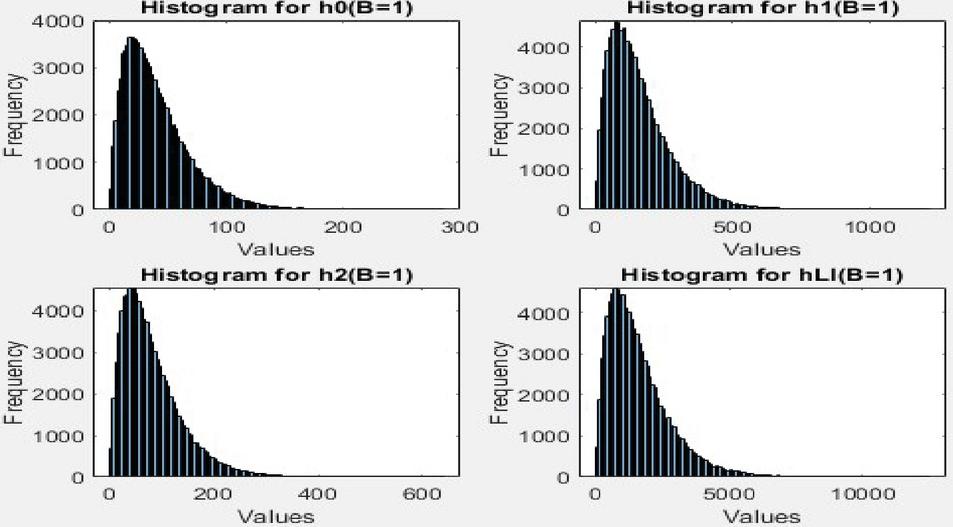
Figure 3 Histogram plot for different channel condition.
5 Numerical Simulations
Under this section sum rate performance for various conditions are discussed for Downlink channel as well as Uplink channel in a single cell with two users. we provide the numerical simulation results to valid the performance for the downlink and uplink FD-CNOMA system over Weibull fading distribution. In order to verify the accuracy of the aforementioned expressions in section III, we also provide Mont Carlo-simulated performance results in this section. Initially, sum rate performance for different values of B for Weibull distribution are observed individually for both NOMA and Full Duplex Relay Co-operative NOMA (FD-CNOMA). Further sum-rate comparative performance is observed.
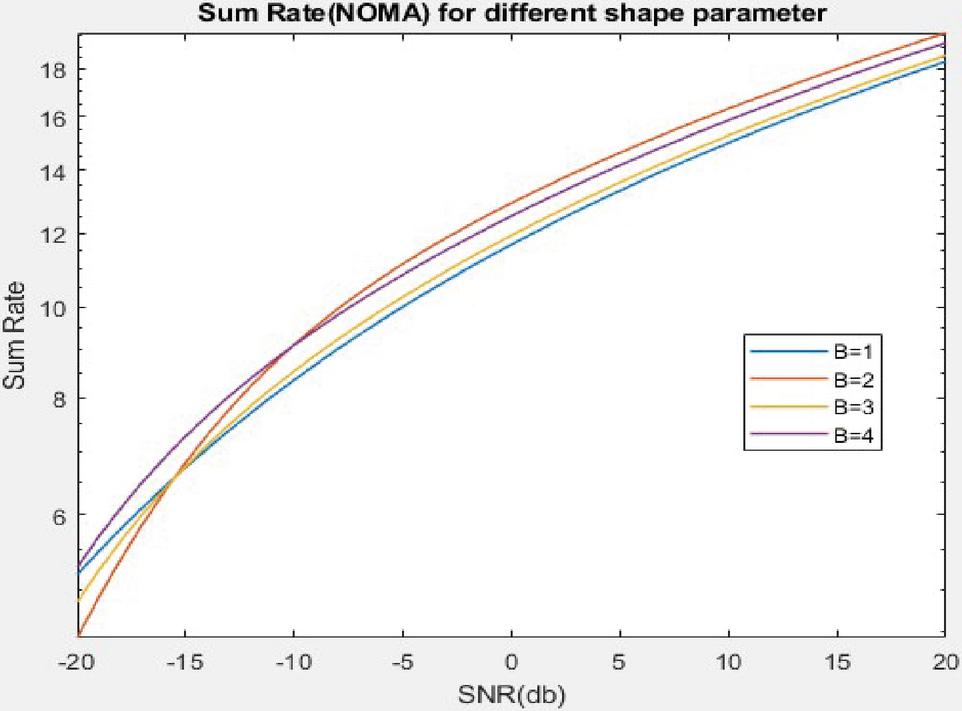
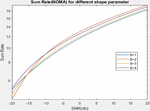
Figure 4 Sum Rate for NOMA in DL.
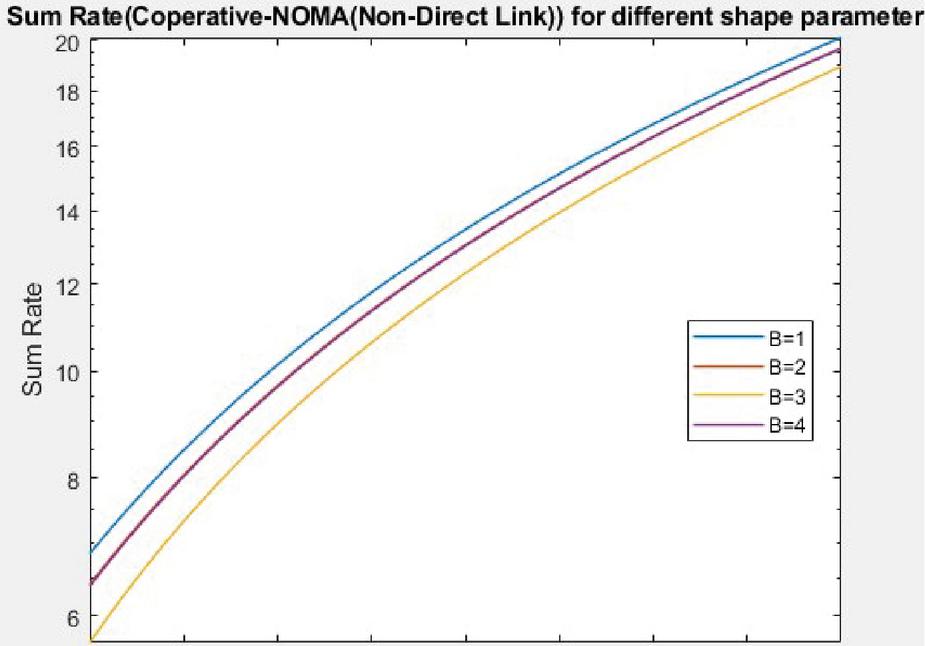
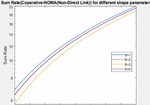
Figure 5 Sum Rate for Co-operative-NOMA (Non-Direct) in DL.
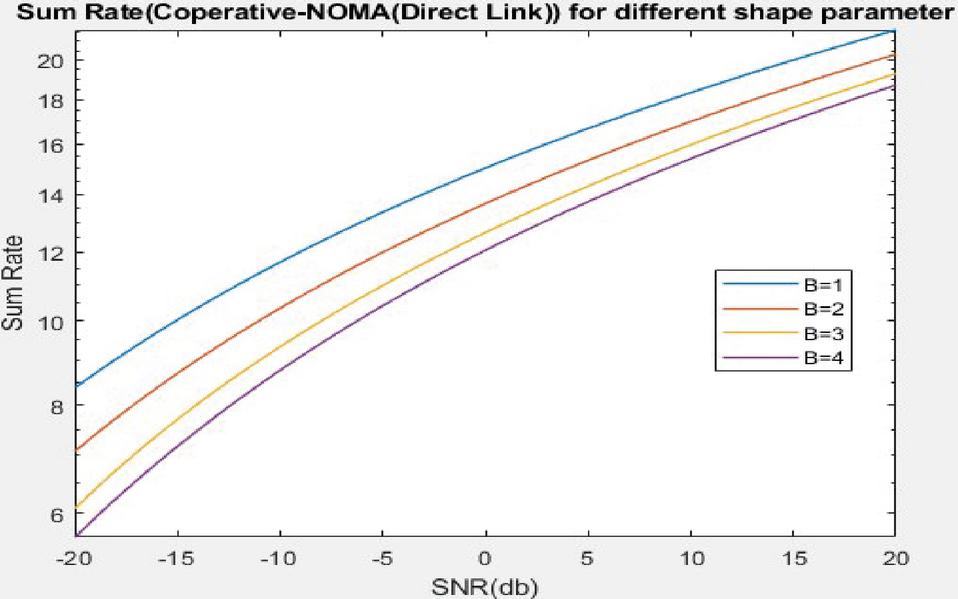
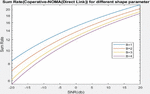
Figure 6 Sum Rate for Co-operative-NOMA (Direct) in DL.
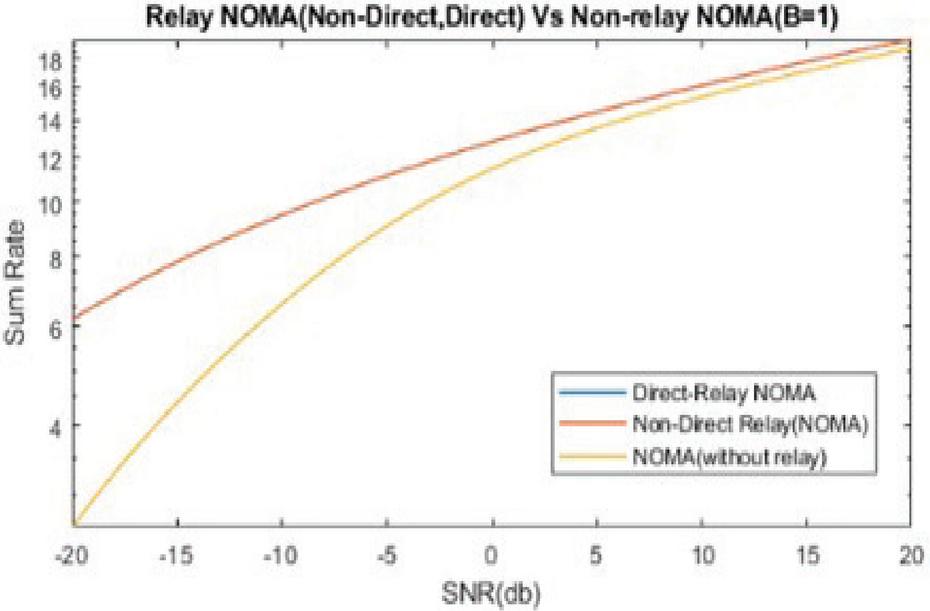
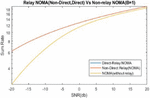
Figure 7(a) Sum Rate for in DL.
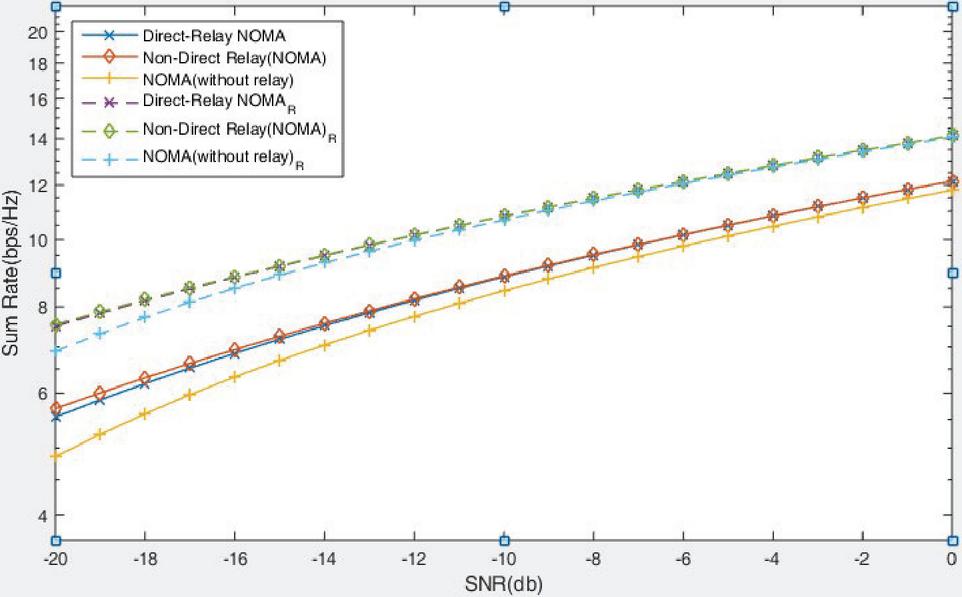
Figure 7(b) Sum Rate for vs (Rayleigh distribution) in DL.
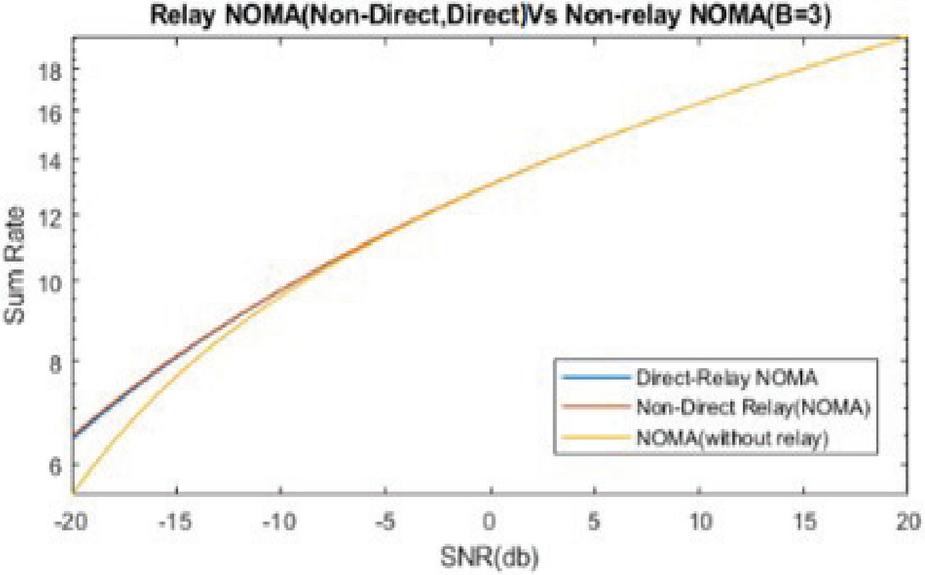
Figure 8(a) Sum Rate for in DL.
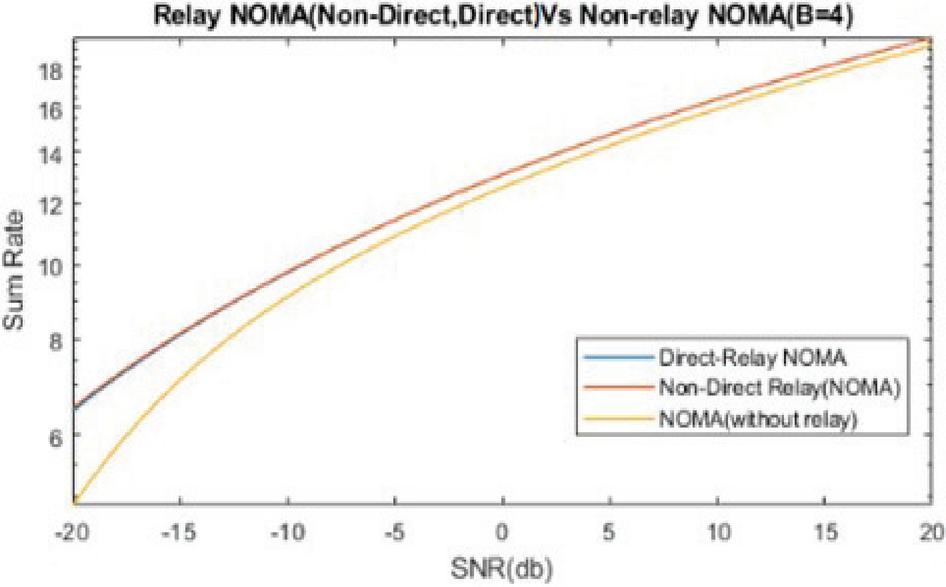
Figure 8(b) Sum Rate for in DL.
5.1 Downlink Channel Model Analysis
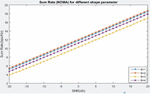
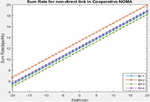
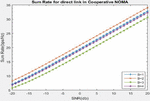
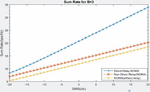
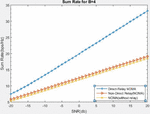
Figures 4–6 plots the experimental results of sum-rate obtained on varying SNR from db to db for different shape parameter for NOMA, FD-CNOMA (Non-Direct Link) and FD-CNOMA (Direct Link) in DL. In Figure 4, the sum-rate performance for i.e. Rayleigh distribution is comparatively superior to others, which has been also researched in [12, 13]. However, for noisy data (i.e. SNR 10 dB), sum rate performance of is found to be best.
5.1.1 Compared with NOMA over RAYLEIGH fading with relaying in DL
Rayleigh distribution is a special case of Weibull distribution for . Mont Carlo-simulated results for sum rate performance in Weibull distribution for almost matches with the performance for the same in Rayleigh fading in downlink as shown in the Figure 7(b). However, for FD-CNOMA, the sum-rate performance for is comparatively superior to others for all SNR condition for both direct and non-direct relay.
5.1.2 Comparison for different fading parameter in NOMA with relaying in DL
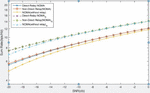
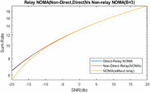
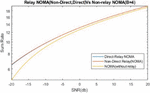
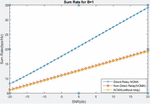
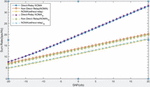
Figures 7(a), 7(b) and 8(a), 8(b) plot the results for different fading parameter for non-direct and direct FD-CNOMA. From both Figures 7 and 8, it is observed that the sum-rate performance of both direct and non-direct relay FD-CNOMA is identical for different values of B for higher SNR. As SNR is decreased to -20db, performance of non-direct relay FD-CNOMA is slightly better than direct relay FD-CNOMA. Moreover, sum-rate performance of both direct and non-direct relay NOMA is superior to conventional NOMA for all values of B. However, for higher SNR, the sum-rate performance values for both NOMAs converges for all values of B.
5.2 Uplink Channel Model Analysis
Figures 9–11 plots the experimental results of sum-rate obtained on varying SNR from db to db for different shape parameter for NOMA, FD-CNOMA (Non-Direct Link) and FD-CNOMA (Direct Link) in UL. In Figure 9, the sum-rate performance for i.e. Rayleigh distribution is comparatively superior to others which has been also researched in [22]. However, for FD-CNOMA, the sum-rate performance for is comparatively superior to others for all SNR condition for both direct and non-direct relay.
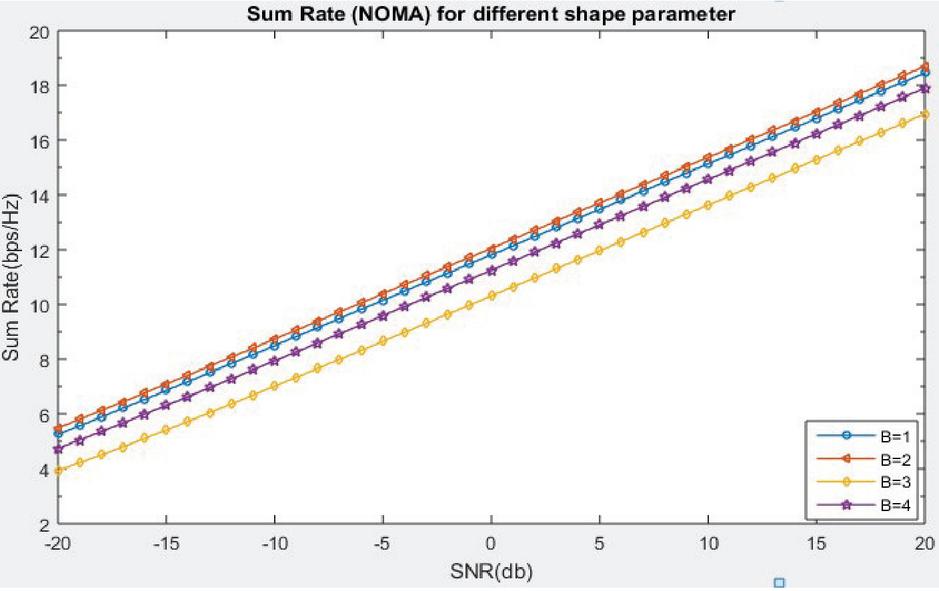
Figure 9 Sum Rate for NOMA in UL.
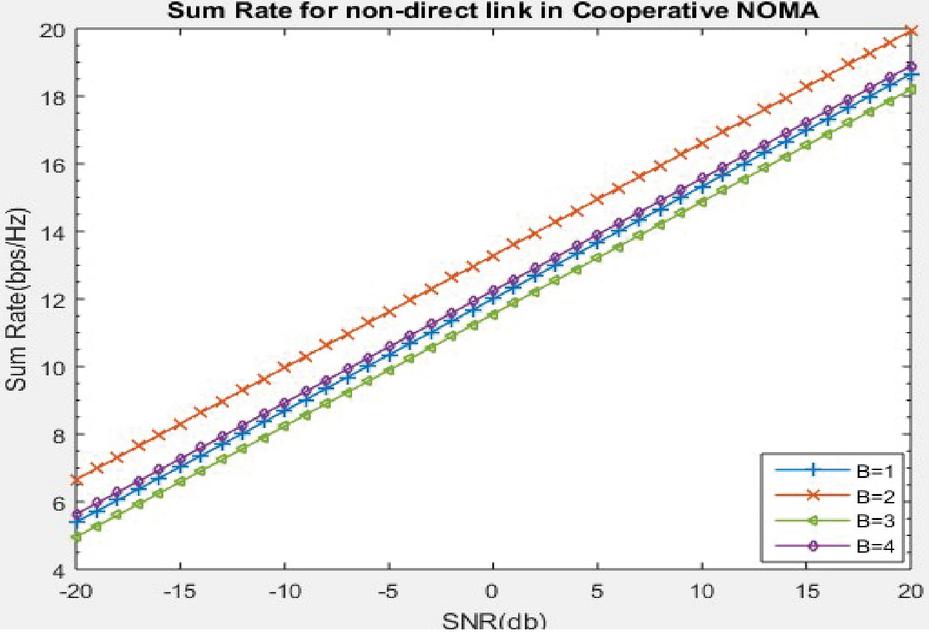
Figure 10 Sum Rate for Co-operative-NOMA (Non-Direct) in UL.
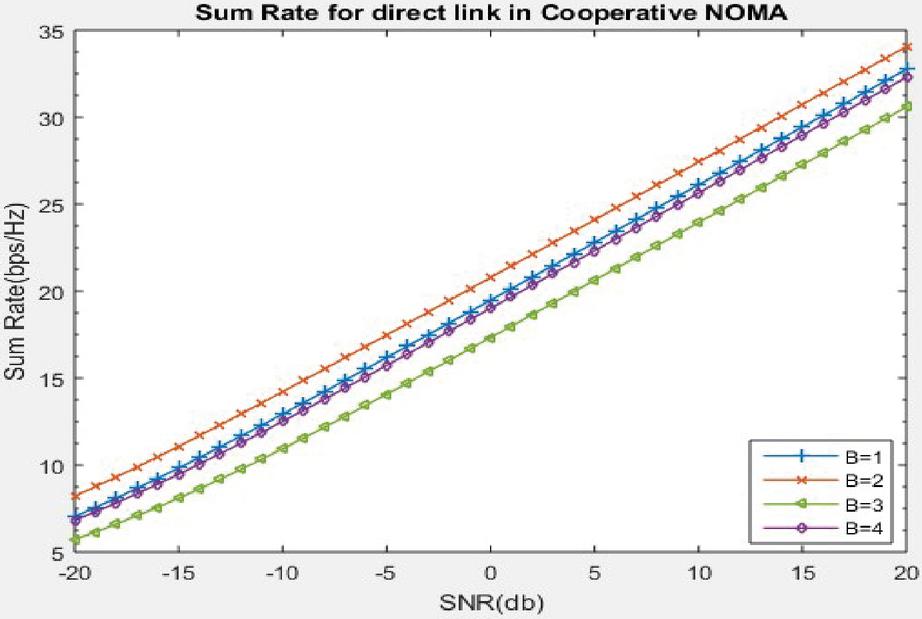
Figure 11 Sum Rate for Co-operative-NOMA (Direct) in UL.
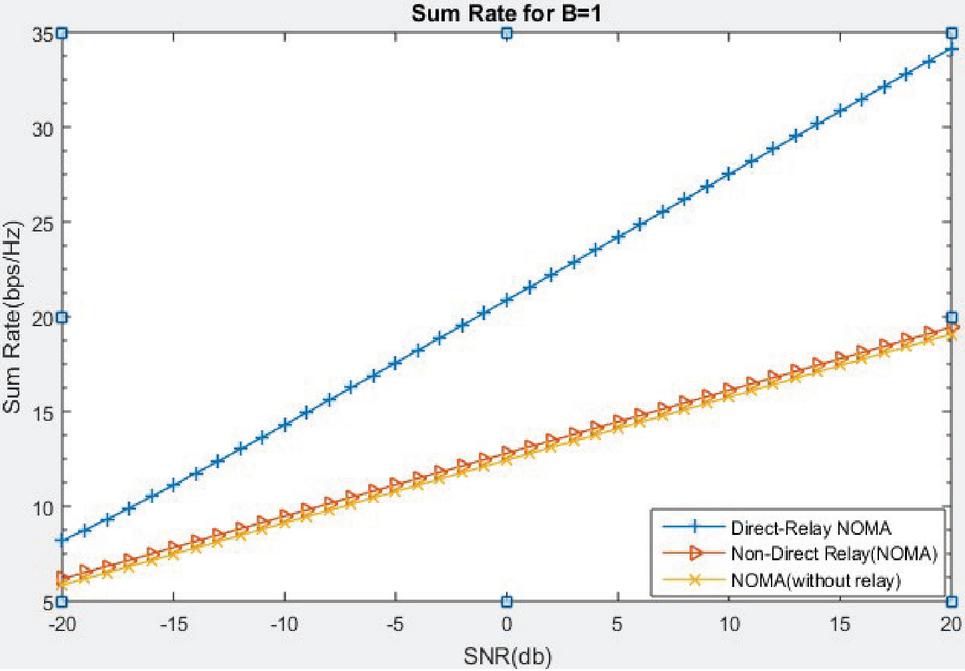
Figure 12 Sum Rate for in UL.
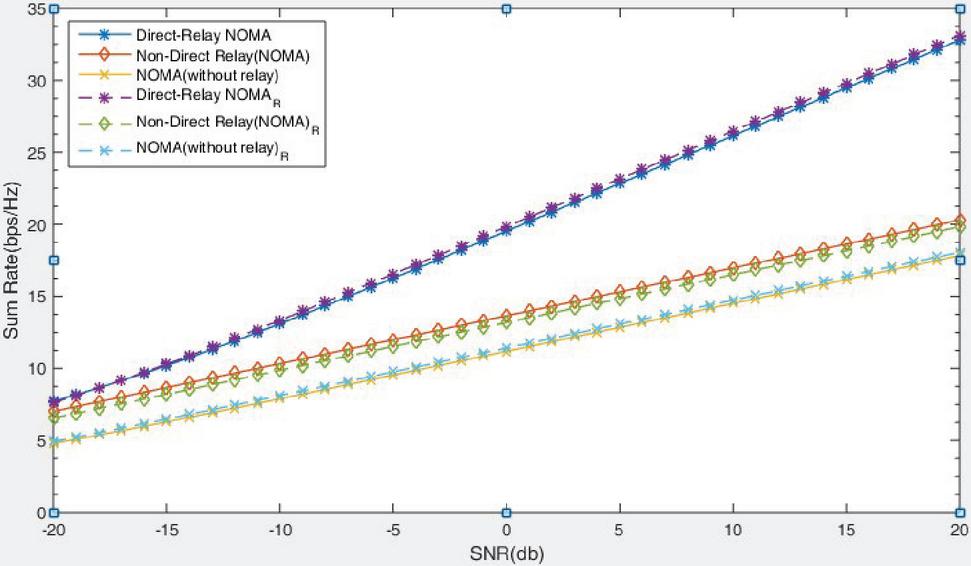
Figure 13 Sum Rate for vs Rayleigh distribution in UL.
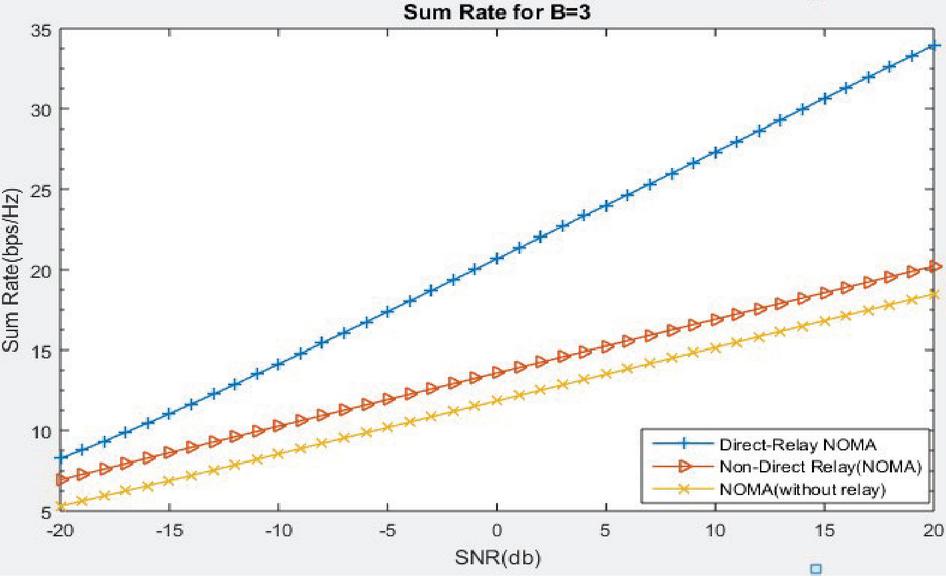
Figure 14 Sum Rate for in UL.
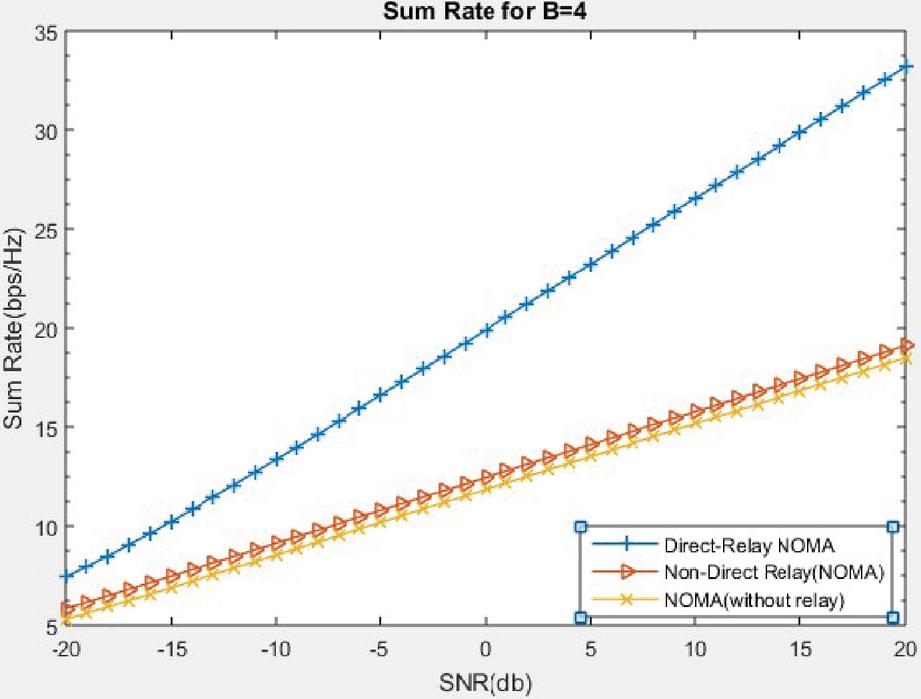
Figure 15 Sum Rate for in UL.
5.2.1 Compared with NOMA over RAYLEIGH fading with relaying in UL
Rayleigh distribution is a special case of Weibull distribution when . Mont carlo- simulated results for sum rate performance in Weibull distribution for almost matches with the performance for the same in Rayleigh fading in uplink as shown in the Figure 13.
5.2.2 Compared with different fading parameter in NOMA with relaying in UL
The next study is to observe the comparative variation in sum-rate performance for NOMA and FD-CNOMA with changing SNR for different values of B for UL. Figures 12 and 13 plots the results for the same for non-direct and direct FD-CNOMA in UL. From Figures 12–15, it is observed that the sum-rate performance of Direct relay NOMA is superior to both Non-Direct relay NOMA and NOMA without relay. Sum-rate performance of Non-Direct relay NOMA and NOMA without relay are almost equal to each other for all values of B.
6 Conclusion
This paper has investigated Weibull fading channel condition for varying scaling and shaping parameter for NOMA and FD-CNOMA for both downlink and uplink. For downlink, it is observed that the sum-rate performance of FD-CNOMA is superior to NOMA for all fading conditions obtained by varying B. For NOMA, best sum-rate performance is observed for B=2 for higher SNR. However, the performance for same degrades for lower SNR. In comparison of direct and non-direct relaying, best sum-rate performance is observed for . In terms of magnitude of sum-rate performance at -20db, best performance of 8.25 bps/Hz is observed for direct relaying, followed by 6.5 bps/Hz for non-direct relaying for FD-CNOMA and 5.75 bps/Hz for conventional NOMA.
In uplink, analogous to downlink, best sum-rate performance is observed for FD-CNOMA. For NOMA, Direct relay NOMA and Non-direct relay NOMA, best sum-rate performance is observed for . In terms of magnitude of sum-rate performance at db, best performance of 8.25 bps/Hz is observed for direct relaying, followed by 7.50 bps/Hz for non-direct relaying for conventional NOMA and 7.30 bps/Hz for FD-CNOMA.
Acknowledgement
I thank UGC for providing the NET-JRF fellowship in completing my work.
References
[1] Z. Ding, Y. Liu, J. Choi, Q. Sun, M. Elkashlan, C. L. I, and H. V. Poor, “Application of non-Orthogonal multiple access in LTE and 5G networks,” IEEE Commun. Mag., vol. 55, no. 2, pp. 185–191, Feb. 2017.
[2] Z. Ding, P. Fan, and H. V. Poor, “Impact of user pairing on 5G non-orthogonal multiple access downlink transmissions,” IEEE Trans. Veh Technol., vol. 65, no. 8, pp. 6010–6023, Aug. 2016.
[3] F. Gao, T. Cui, and A. Nallanathan, “On channel estimation and optimal training design for amplify and forward relay networks,” IEEE Trans. Wireless Commun., vol. 7, no. 5, pp. 1907–1916, May 2008.
[4] J. B. Kim and I. H. Lee, “Non-orthogonal multiple access in coordinated direct and relay transmission,” IEEE Commun. Lett., vol. 19, no. 11, pp. 2037–2040, 2015.
[5] J. Men, J. Ge, and C. Zhang, “Performance analysis of non-orthogonal multiple access for relaying networks over nakagami-m fading channels,” IEEE Trans. Veh. Technol., vol. PP, no. 99, pp. 1–1, 2016.
[6] Z. Ding, M. Peng, and V. Poor, H, “Cooperative non-orthogonal multiple access in 5G systems,” IEEE Commun. Lett., vol. 19, no. 8, pp. 1462–1465, 2014.
[7] Y. Liu, Z. Ding, M. Elkashlan, and H. V. Poor, “Cooperative non-orthogonal multiple access with simultaneous wireless information and power transfer,” IEEE J. Sel. Areas Commun., vol. 34, no. 4, pp. 938–953, April 2016.
[8] H. Ju, E. Oh, and D. Hong, “Improving efficiency of resource usage in two-hop full duplex relay systems based on resource sharing and interference cancellation,” IEEE Trans. Wireless Commun., vol. 8, no. 8, pp. 3933–3938, August 2009.
[9] J. Men and J. Ge, “Full deplex techniques for 5G networks: self-interference cancellation, protocol design, and relay selection,” IEEE Commun. Mag., vol. 53, no. 5, pp. 128–137, 2015.
[10] Z. Zhang, Z. Ma, M. Xiao, Z. Ding, and P. Fan, “Full-duplex device-to-device aided cooperative non-orthogonal multiple access,” IEEE Trans. Veh. Technol., vol. PP, no. 99, pp. 1–1, 2016.
[11] J. Kim and I. Lee, “Capacity Analysis of Cooperative Relaying Systems Using Non-Orthogonal Multiple Access,” in IEEE Communications Letters, vol. 19, no. 11, pp. 1949–1952, Nov. 2015.
[12] L. Zhang, J. Liu, M. Xiao, G. Wu, Y. Liang and S. Li, “Performance Analysis and Optimization in Downlink NOMA Systems With Cooperative Full-Duplex Relaying,” in IEEE Journal on Selected Areas in Communications, vol. 35, no. 10, pp. 2398–2412, Oct. 2017.
[13] N. H. Shepherd, “Radio wave loss deviation and shadow loss at 900 MHz,” IEEE Trans. Veh. Technol., vol. 26, pp. 309–313, Nov. 1977.
[14] H. Hashemi, “The indoor radio propagation channel,” Proceedings of the IEEE, vol. 81, pp. 943–968, July 1993.
[15] G. Tzeremes and C. G. Christodoulou, “Use of Weibull distribution for describing outdoor multipath fading,” Antennas and Propagation Society International Symposium, vol. 1, pp. 232–235, 2002.
[16] T. Riihonen, S. Werner, and R. Wichman, “Hybrid full-duplex/half-duplex relaying with transmit power adaptation,” IEEE Trans. Wireless Commun., vol. 10, no. 9, pp. 3074–3085, September 2011.
[17] D. P. M. Osorio, E. E. B. Olivo, H. Alves, J. C. S. S. Filho, and M. Latva-aho, “Exploiting the direct link in full-duplex amplify-and forward relaying networks,” IEEE Signal Process. Lett., vol. 22, no. 10, pp. 1766–1770, Oct 2015.
[18] I. S. Gradshteyn and I. M. Ryzhik, Table of Integrals, Series and Products, 6th ed. New York, NY, USA: Academic Press, 2000.
[19] Zhang, Z., Ma, Z., Xiao, M., et al.: ‘Full-duplex device-to-device-aided cooperative nonorthogonal multiple access’, IEEE Trans. Veh. Technol., 2017, 66, (5), pp. 4467–4471.
[20] Liu, G., Chen, X., Ding, Z., et al.: ‘Hybrid half-duplex/full-duplex cooperative non-orthogonal multiple access with transmit power adaptation’, IEEE Trans. Wirel. Commun., 2018, 17, (1), pp. 506–519.
[21] Ding, Z., Peng, M., Poor, H.V.: ‘Cooperative non-orthogonal multiple access in 5G systems’, IEEE Commun. Lett., 2015, 19, (8), pp. 1462–1465.
[22] Y. Zhang, Z. Yang, Y. Feng and S. Yan, “Performance analysis of a novel uplink cooperative NOMA system with full-duplex relaying, ” in IET Communications, vol. 12, no. 19, pp. 2408–2417, 2018.
Biographies

Rampravesh Kumar is a Research scholar under UGC-NET JRF at B.I.T, Mesra, India, pursuing Ph.D in wireless communication under the department of Electronics and Communication Engineering since spring 2017. He received his B.E in ECE from RGPV, Bhopal in 2010 and M.Tech in ECE from CMJU, Shillong in 2012. After that, he worked as NSS Engineer in Nokia Siemens Networks Pvt. Ltd. from 2012 to 2014. During 2015 to 2016, he worked as Part-time Lecturer in department of Electrical and Electronics Engineering, NCE Chandi, Bihar. His Ph.d work centers on Cooperative cognitive communication in improving the next generation cellular system performance.

Sanjay Kumar has received MBA from Pune University in 1994, M. Tech. in Electronics and Communication Engineering from Guru Nanak Dev Engineering College, Ludhiana in 2000, and PhD in Wireless Communication from Aalborg University, Denmark in 2009. He is an Associate Professor at the Department of Electronics and Communications Engineering at Birla Institute of Technology Mesra, Deoghar Campus, India. During 2006 to 2009 he was a Guest Researcher at Aalborg University, Denmark, where he worked in close association with Nokia Siemens Networks. During 2007 to 2008 he worked as Part-time Lecturer in department of Electronic Systems, Aalborg University, Denmark. Before joining teaching and research he served the Indian Air Force from 1985 to 2000 in various technical capacities. He has nearly 35 years of teaching, research and work experience in the field of Wireless Communication. He is an Editorial Board Member of the International Journal, “Wireless Personal Communications” published by Springer.
Journal of Mobile Multimedia, Vol. 17_1-3, 361–384.
doi: 10.13052/jmm1550-4646.171319
© 2020 River Publishers