Collaborative Strategies and Socio-dynamic cues (SDC) Insights for Assistive Healthcare Technology Applications
Sadia Anwar*, Peter Lindgren and Ramjee Prasad
Department of Business Development and Technology, Aarhus University, Herning, Denmark
E-mail: sadia@btech.au.dk; peterli@btech.au.dk; ramjee@btech.au.dk
*Corresponding Author
Received 18 September 2020; Accepted 30 November 2020; Publication 26 January 2021
Abstract
Healthcare assistive Technologies has made many complicated/complex tasks within patient care, care plan therapy implementation and use of electronic health or medical records into more quickly handled tasks only by the use digital tools. Digitals tools provide systemic, real-time and reliable task handling. Data is thoroughly put, investigated in real-time with the accepted solutions/protocols in the health care settings. The paper highlights how important is for the digital tools for their acceptance and adaptation to look into the SDC variance among cultures and difference in sectors working environment as a research question and highlight its usefulness by a Danish case “assistive digital healthcare software failure” in Copenhagen hospital. The article also provides few recommendations to those technology providing businesses to modify their current business model canvas in specific areas by highlighting the example of Danish Case and learnt experience. The paper also emphasizes for looking a technological device which is easy to use by patients, healthcare professionals and customized to avoid a rush of multiple products launch in the market after failure without realization of the failure cause as well as value generation for the sustainability of a specific marketed product for a more extended period.
Keywords: Socio-dynamic cues (SDC), technology adaptation and acceptance, business model (BM), business model canvas (BMC), business dimensions, BeeStar.
1 Introduction
Energy efficiency Today we have a well-described definition of patient empowerment by the World Health Organization (WHO), which says, “Patient empowerment is a method that assists people to gain control over their own lives and enhances their capacity to act on issues that they define as important” [1].
Quality of life of patient moving through different chronic diseases can be enhanced by the use of assistive healthcare technology, mHealth (mobile-based) apps and customized therapy plans. Today with all the technologies accessible and keeping track of one personal health profile is much easier and more straightforward than it ever was. Modern technologies and their quick availability have made an ordinary person more conscious about their health and fitness. Empowered and proactive patients have a modest understanding of the latest methods of treatment and medication therapy. For example, wearable smart devices, along with smartphones, have made it easier for people to use various sensors with the ability to check and predict their health status continuously. Information associated with different diseases and healthcare conditions is easily accessible today by using mobile apps. Several mobile apps can suggest over the condition, precaution and cure-to various diseases. A lot of competition is available for assistive technology-based medical devices since they are producing Software and tools for patients or customers. In 2016, 12,000 applications were received to get the patents for assistive technology devices, 41% of applications came from Europe. The data also shows that in 27,000 assistive technology-based companies, 95% were small and medium enterprise (SMEs) [2].
The European Commission has already approved many projects in the line of assistive technology and rehabilitation. Many SMEs take part besides research organizations and Universities for the development of products and its use in clinical trials to check the efficacy of the developed product to acquire valuable data. Several EU projects have been accomplished in the area of assistive technology to improve consumer/patient quality of Life (QoL), and many are ongoing projects [3].
The persuasion to stick with the therapy, performing the suggested tasks and behavioural changes can be achieved through different digital tools for example virtual coaches, the wireless diagnostic sensor to send and receive the iterated data, lifestyle modification applications to motivate and adhere patient to the advised therapy plans. Similarly, (Sawesi et al., 2016) systemically reviewed and analyzed the effectiveness of information technology for patient engagement with health care process and behavioural change to stick with the therapy with positive results. Still, they mentioned that while reviewing and moving through different research articles, they highlighted the absence of a common framework for behavioural change, therapy plan adherence, health-related outcomes, and not using the specific behaviour theories [4].
Aligning with that, (Anwar & Prasad, 2020) highlighted the need for analysis and importance of the SDC variance in a particular group of people/regions/countries all around the globe to motivate them to engage with the treatment plans while utilizing those digital tools and therapy plans [5]. Social Dynamics refers to the behaviour of groups that results from the interactions of individual group members as well to the study of the relationship between individual interactions and group level behaviours [6, 7]. Many eHealth applications or Software have diagnostics, medication adherence plans, documentation/record-keeping, lifestyle modification facilities based on the general views or common doings that have been observed by the observers, however, cultural specificity and SDC variance has not been highlighted for assistive healthcare technologies.
With that, Different countries have different health care ecosystem that varies from Government policies or plans to administration to the managerial hierarchy of the hospital staff, handling admitted patients’ cases, medication purchase and access. There are also different legislations for prescription over-medication and the counter medication purchase by the public and hospital. Similarly, other rules and regulations exist for pharmaceutical companies for their promotion. The system varies not only by the parameter mentioned above, but also it profoundly penetrates in culture and language variation.
According to the (Thies et al., 2017) effectiveness of many mHealth applications are unclear. They evaluated the eHealth applications for clinical outcomes for hypertension and diabetic patients with hospital staff involvement. Still, they saw many inconsistencies in software demand in Case of use, building interest and fulfilling the needs of the end-users.[8] The other main factors as highlighted by the (Anwar et al., 2020) is eHealth literacy of the healthcare staff and end-user, technology itself adaptation and acceptance by the user, socio-dynamic cues variance among cultures and among different group of people, choices regarding selecting an assistive healthcare technology device or eHealth application. Also, the analytical skills of the end-user to distinguish between what is right and wrong regarding information available on the internet and different applications can affect treatment adherence [9].
There is a need for improvisation of the Business model used by different assistive healthcare technology companies to deep dig into SDC and variance of technology use among different regions of the globe to avoid product failure. A significant change to have a complete shift from the current product-based models would be critical as sudden traditional model changes will disrupt and put a financial burden which would not be a healthy or sustainable way. Therefore, a sustainable strategy for a dynamic business model is required. The need comes as technology is moving fast and the selection of technology-based devices of a particular brand is very likely dependent on customer behaviour which is also changing day by day since they are becoming more aware. The other factor is the difference that exists in the healthcare ecosystem. The sustainable approach would be to make a business model to cope with and predict the upcoming disruption and provide the suggestions for suitable adaptation within the framework and changes in the existing product-oriented models [9].
The paper presents a case example for an assistive digital healthcare software failure and highlights the difference between the SDC and healthcare system variance. The article recommends some solutions for assistive healthcare technology applications where a product is customized according to the needs of the users. The article also suggests business “TO BE” while developing those products so that business is not ended up with a failed device /device that can cost a lot in finance as well as associated business values. The paper also highlights the importance of collaborative strategies among stakeholders while deploying those products.
2 Assistive Digital Healthcare Software Failure: Danish Hospital Case
The Case is original, and it is related to the problem countered by the Copenhagen Hospital in for assistive healthcare technological device. Its case description has been taken from the website (Lost in Translation: Epic Goes to Denmark - POLITICOBack ButtonSearch IconFilter IconArrow, n.d.) A grant from the Commonwealth Fund supported the case story through the Association of Health Care Journalists [10] and by a thesis report (Learnings from the Implementation of Epic, n.d.) [11].
The Case highlights the importance of SDC, variance in the healthcare ecosystem and one solution for all can vary among different regions. It also suggests or needs to explore or change of business model by following different strategy which is more aligned with the customized solutions. The discussion on the Case does not suggest that the assistive digital healthcare software is a complete failure or to down the reputation of the company or being sponsored by other companies. However, it highlights the significance of SDC and suggestions that can enhance the marketing for the product of companies associated in a similar business. Information about the Case, as mentioned above, is available on the internet with the given references.
2.1 Background
The Case is about digital health software failure in the Danish healthcare system. Epic Systems, a business that has done many software implementations, provides the reasons, Danes chose the Epic digital health software. Danish health authorities in 2016 spent around 2.8 billion DKK on the Epic software implementations in 18 hospitals in an area with approximately 2.8 million residents. On May 20, Epic launched in the first hospital.
The efforts for its installation are made by Gert Galster, who is a doctor and having a PhD in informatics. He tried to convert the Software into the workable hospital management system for Copenhagen as well as in the surrounding regions for three years, and 45,000 clinicians in eastern Denmark were plunged into the system.
2.2 Expectations
The expectation was that the Software would make it easier for doctors to work in the health care system, exchange patient information and handling cost.
2.3 Problem Encountered
The problem that occurred includes the translation of the medical terms and relying on the google translator. The design of the Software was very hardcoded for the USA system that it was not very easy to disintegrate to make it appropriate for the use in the Danish Healthcare ecosystem. Others differences that have been seen include, for example, C-section is not a medical emergency procedure in the Danish version. Still, it is in the USA, as well as speech and language pathologist does not exist in Denmark. It was a considerable financial loss because they felt that it would work the same way and be successful as with other countries.
It was observed and highlighted by many professionals working in the hospital and who were engaged with the assistive healthcare technology software use that although we as people move through the same diseases, same medical books, similar diagnosis, However, the use of IT system where collaboration is needed among users depends on the culture where the particular system and collaboration happens. The problem does not suggest that problem was in the device but its use and integration into a specific system.
The other problem that has been faced, for example, nurses in Denmark in an emergency can prescribe medication, and they can explain the reason for its use and prescription in a later period. In Epic Software, any effort to practice a prohibited role made a rejection. That shows how different healthcare system exists throughout the globe although having similarities. Denmark has a system of socialized medicine and its very similar in other Scandinavia countries where you don’t pay for bills and insurances.
However, in the US healthcare sector, the physicians bill the patient very efficiently by bought digital records, and in their system, the value of care comes in the latter part. The other differences are, for instance, the physician and nurses in Denmark dispense medication while in the USA, it is done by the pharmacist. A similar procedure has been followed in many Asian countries where pharmacist dispenses medicine like the USA. In the mid of 2018, a report was published in which it is found that Epic deployment led the 57 per cent of patients to wait for more than 30 days just for taking the appointments, however in the area where Epic was not deployed it was 4 per cent. The reason again the same of the difference in the hierarchical structure and associated roles. The satisfaction for using the Epic decrease to 12 per cent by the physician in Feb 2019 and 60 per cent came with a very high level of dissatisfaction because of difficultly in coping with the things applied by the Software.
In Copenhagen, 71 physicians signed a petition to remove Software from the hospital system in 2018. Afzal Chaudhry, who is the chief information officer of Addenbrooke’s Hospital in Cambridge, England, said that they implemented the epic system successfully in the year 2015 and encountered very few problems. He also quoted that he visited Copenhagen many times to help out Danish for Epic implementation. He also added that you couldn’t push people and for this, you need a mindset of acceptance among the management as well as a clinical team which allows.
However, in the UK, Epic launched live at Cambridge University Hospitals in the year of 2014. While in Denmark, Epic launched live at Herlev and Gentofte Hospital in the year of 2016. After the launch of the Epic in the UK they have also reported some experiences and problems like incomplete approach to patient medical history, disruptions in the delivery of pathology test results, inconsistency in care and care plans with 20 per cent t drop in the performance of the emergency department and patient productivity decrease in large numbers. The inspection reports that came showed the CUH hospital itself services were inadequate and report mentioned for improvement while the second assessment report showed positive results with Epic and CUH. The other reason that was said that staff got the familiarity as well as the integration of patient administrative and necessary clinical information Norway is going to have an implementation plan in 2021. Many important deductions can be learnt through the Danish and UK experiences for Epic [12].
It highlights that apart from SDC, acceptance of technology, mindset, and its usability are also important. eHealth literacy places a significant role in that area. With that, it also shows that Epic is a very reputable software solution company, and that’s why they all were motivated to install the Software and launched a big project with lots of investment. However, the failure also highlights critical factors that need for business model change and customized solutions so that technology integration would be accessible without significant changes in the system.
Conclusion after case analysis the above Case highlights many disparities which are related to cultural difference, SDC variance, mindset (technology adaptability and acceptability), One device cannot provide a solution for all and puts the importance of the collaborative strategies among different stakeholders. Many medical devices or assistive health care technology software are coming into the market. Still, few get the success that signifies the importance of sustainable and collaborative strategies throughout the globe.
3 Tools for Analysis for Epic Business Model
To analyze the digital health software failure and Epic Systems case, Business Model Canvas have been used as business modelling tools to see how Epic as a business is working for software development to help people stay well with better health. The information for making a Business model canvas has been collected through the Epic Systems website (Epic Systems, 2016a) to analyze their business model and necessary gap findings [13]. Before going into the analysis, a small description of the BeeStar is as follows
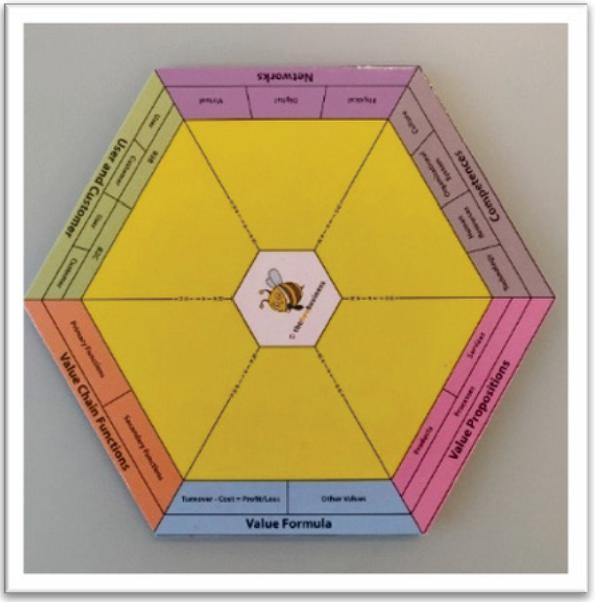
Figure 1 BeeStar.
3.1 BeeStar
BeeStar is a visual tool developed by Prof. Peter Lindgren (Peter, 2018) to describe a business model. BeeStar simplifies the complexities of a business model and illustrates any business model in “As Is” or “To Be” state. In BeeStar, all the business models have seven dimensions [14]. These dimensions are:
Table 1 BeeStar seven dimensions
| 1 | Value Propositions |
| 2 | User or Customer |
| 3 | Value Chain Functions |
| 4 | Competencies |
| 5 | Network |
| 6 | Value Formula |
| 7 | Relations |
3.2 Business Model Canvas (BMC)
Business Model Canvas is a graphic tool developed by Alexander Osterwalder (Business Model Generation, n.d.) to represent any business model on a single sheet of paper. [15] Business Model Canvas has nine building blocks that are
Table 2 Business model canvas blocks
| 1 | Key Partners |
| 2 | Key Activities |
| 3 | Value Proposition |
| 4 | Customer Relationship |
| 5 | Customer Segment |
| 6 | Key Resource |
| 7 | Distribution Channel |
| 8 | Cost Structure |
| 9 | Revenue Stream |
4 Analysis
The analysis has been made by using BeeStar, and Business Model Canvas and suggestions would be made for the sustainable business model after the analysis that can assist assistive healthcare technology product-based companies to review their business model for sustainable solutions with collaborative strategies for product success. BeeStar tool and Business model Canvas will be utilized to explore the business model of Epic Systems. Deductions will be presented at the end of the analysis.
4.1 BeeStar – A digital health software failure (Denmark Case)
Every dimension of a BeeStar has specific values that represent the given dimension. The values in all the Dimensions are linked to some other values in other dimensions by a seventh value called Relations. The digital health software failure, Denmark case would be analyzed by disintegrating the BM into the BeeStar to define “As is” and “To be” business model for Epic Systems by taking information through different internet sources as Epic Systems is not being contacted. The analysis has only been done just to give some ideas by seeing Danish Case as an example which is implementable and provide values to the business and Customer.
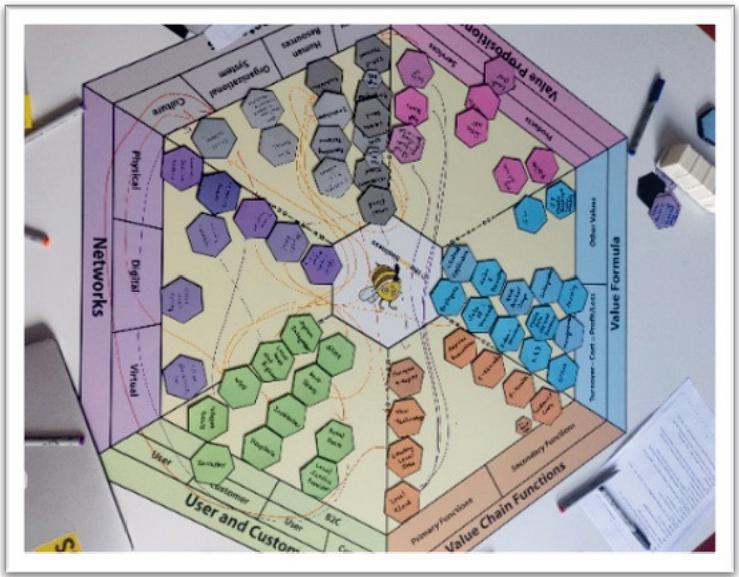
Figure 2 Represents how to use a BeeStar as a tool to dismantle and analyze a business model in seven dimensions, and example has been given from the Bluetown business case (Singh et al., 2019) [16].
The “To be” business can be used by any business having the same or similar Business model so that their product remains in the market and not being ended up as a failure product just as happened in the Danish Case. Epic systems were established in 1970 with dollars 70,000 investments, and currently, it has offices in the UK, Denmark, Netherlands, United Arab Emirates, Finland, Melbourne and in many other countries. Epic systems are privately owned and make Software for the healthcare industry. (History of Epic Systems Corporation – FundingUniverse, n.d.) [17]. Epic Systems is a technological leader and have expensive products with installation price.
Table 3 Epic systems BeeStar dimensions
| Dimensions | Categories | Values |
| User & Customer | B2B B2C | Hospitals, Clinics, ambulatory surgical centres, Healthcare maintenance organizations (HMOs) (Epic Systems, 2016b) [13] Clinical area, includes the district hospitals, rehabilitation centres, local clinics, educational, medical centres as well as practice which are done. Patients have the accessibility to the Software by their mobile devices as well as in their home care settings. [18] (10 Things need to Know about Epic, n.d.) |
| Network | Physical Digital Virtual | NorthShore (University health system) (Jr, 2015) [19] Premise Health and Mayo Clinic (EHRIntelligence, 2017) [20] Apple for new mHealth application (Apple Partners With Epic, Mayo on New Health App Platform, n.d.) [21] Partners Healthcare (http://pages/hit-consultant-llc/302199219847409, 2012) [22] Offices in the UK, Denmark, Netherlands, United Arab Emirates, Finland, Melbourne and in many other countries. (History of Epic Systems Corporation – FundingUniverse, n.d.) [17] |
| Competences | Technology Human Resource Organizational Culture | One of the leading HER vendor, Software IT platform for medical records Hospitals and supporting hospital functions Cooperate culture (Epic Decoded: An Inside Look at Life and Corporate Culture at the Center of the Health IT World, n.d.) [23] EPIC HRMS (provides automation paper-based HR) (EPIC Software Corporation, n.d.) [24] |
| Value Chain Function | Primary Function Secondary Function | Health and Information Technology electronic health records and medical health records, customer care, advisory (What Is Epic Systems?, n.d.) [25] training material for installation, Technical support for installation, consultation |
| Value Formula | Cost Revenue | Manufacturing, research and development, installation, consultation, |
| Value Proposition | Product Service Process | HER/EMR Software and education/training material, Applications support functions related hospitals Ecosystem, Installation and advisory, cloud hosting service for customers |
Above given table shows all the dimensions, categories and values of Epic systems on a BeeStar and helps us better understand the digital health software failure case.
4.2 Business Model Canvas – Epic Systems
The data has been taken from an internet source (Epic Systems, 2016b) [13] and presented in the form of a table below and it represents the Epic Systems on Business Model Canvas and its nine building blocks
Table 4 Epic systems BMC building blocks
| Key Partners |
• NorthShore (University health system) (Jr, 2015) [19] • Premise Health and Mayo Clinic (EHRIntelligence, 2017) [20] • Apple for new mHealth application (Apple Partners With Epic, Mayo on New Health App Platform, n.d.) [21] • Partners Healthcare (http://pages/hit-consultant-llc/302199219847409, 2012) [22] • Offices in the UK, Denmark, Netherlands, United Arab Emirates, Finland, Melbourne and in many other countries. (History of Epic Systems Corporation – FundingUniverse, n.d.) [17] • National and International |
| Key Activities | EMR solutions for hospitals and ambulatory clinics. Scheduling and registration of patients, care providers including physician, nurses, pharmacist, laboratory technologist, emergency personnel, radiologist and billing system for people with insurances. |
| Key Resources | Technical Solution, Business Model, EMR/EHR products and solutions, its human resources which create and make those products. |
| Value Proposition | Multi Faced System, an excellent reputation, voted top overall software suite in the 2015/2016 Best in KLAS awards, best-selling electronic health records system. |
| Customer Relationship | Dedicated personal-assistance nature type, Employee from Epic interact with the Customer during or after the sale, hands-on help |
| Channels | International offices and by website, It does not have social media platforms, No significant spending on marketing, Customer reach out to Epic Systems |
| Customer Segment | Hospital and clinics, Ambulatory surgical centres, Healthcare maintenance organizations (HMOs) |
| Cost Structure | Considerable money is spent on EMR, and little cash on sales and marketing as Customer directly access the Epic Systems |
| Revenue Streams | Epic makes its revenue through a mixture of upfront fees for the implemented Software and ongoing upgrade, support, consultation and service fees. |
5 Deductions from the Above Analysis Business Model Analysis
After analyzing the Epic System business model through BeeStar and Business Model Canvas, the following analysis has been made. The analysis can be assistive for sustainable solutions and collaborative strategies in similar business model-based companies.
5.1 “AS IS”
After analyzing the Epic Systems BM using BeeStar and BMC, it is clear that Epic Systems needs to look into new solutions for its technology acceptance and adaptation seeing the Danish Case. The Case has also put some major concerns as well as upgrading the strategies towards customer satisfaction, Socio-dynamic cues variance and its difference among cultures and different group of people.
5.2 “TO BE”
After analyzing the Danish Case, it has been deduced that Epic Systems needs some new business model under pre and postmarking of products that can be added to the Epic Systems current portfolio of value propositions and channel building block by analyzing the present BMC. After doing research online, some of the recommended solutions that can be integrated are as follows:
(i) Post Marketing surveillance strategy
For continuous product innovation, it is essential to get the data after the product is launched in the market that will reveal what the problematic area to be addressed to avoid product failure is. As mentioned in the BMC for Epic System that the spending is less for marketing the product and requires a dedicated team as the BMC shows only buying and sale of the product between Customer and employee and this would also indicate the less availability of the post-marketing surveillance reporting.
(ii) Customized product and customer satisfaction
Before introducing any product, it is essential to check the flexibility to adopt different systems, especially the software-based healthcare technology. The marketing and sale team can work on hiring those people that can easily perceive the customer demand and then check the feasibility of the product to adopt the customer requirement. They should do a comprehensive customer interview/counselling regarding the needs as well as the system where it is going to be deployed. In the Danish Case, the Software was complicated to understand and change according to the hospital requirement. A business should not only be involved in revenue generation by sale but also be interested in value creation through deep digging in the needs of a customer.
(iii) Collaborative Approach and country-specific data availability
Epic System can also collect the data before marketing a product from key partners or major countries to increase product use for example in the health care system, their specific infrastructure needs, SDC and cultural values and sector hierarchy. The consideration will make the marketed product as a universal product that can be deployed with ease. Danish Case used google translator to translate many terms from the deployed Software, and many procedures were invalid as well as roles and hierarchy of the professionals who are working in the hospital. As Epic System is a significant healthcare technology vendor, they should consider those strategies as part of product development to sustain their reputation in the market. A dedicated team can easily break those terminologies, Socio-dynamic cues variance, cultural and system difference before marketing. Product success demonstrates that there is no one solution for all. The one answer should be flexible for acceptability and adoptability under customer needs and satisfaction.
6 Conclusions
Digital tools and assistive healthcare applications are still evolving. There is a lot to be evaluated to avoid thousands of products in the market with less value and quick replacement. The example of Epic systems and Danish Case puts emphasis and provide an example for others companies to go for an integrated, collaborative strategical approach in digital solution marketing. Epic systems have unique technology for HER/EMR. The above-mentioned suggestion considering the highlighted case, may increase the value of the product in the market with a less financial loss. However, there is a need and space for a lot of research for product sustainability and marketing customized solutions.
References
[1] “European Patient Forum, Patient empowerment campaign, 20-21 May 2015 ‘http://www.eu-patient.eu/campaign/PatientsprescribE/’
[2] K. Khosla, “The Best MedTech Startups in Europe.” [Online]. Available: https://www.valuer.ai/blog/the-best-medtech-startups-in-europe. [Accessed: 20-Apr-2020].
[3] trinoma, “EU-funded research projects into technologies for accessibility,” Shaping Europe’s digital future - European Commission, 13-Dec-2018. [Online]. Available: https://ec.europa.eu/digital-single-market/en/eu-funded-research-projects-technologies-accessibility. [Accessed: 20-Apr-2020].
[4] Sawesi, S., Rashrash, M., Phalakornkule, K., Carpenter, J. S., & Jones, J. F. (2016). The Impact of Information Technology on Patient Engagement and Health Behavior Change: A Systematic Review of the Literature. JMIR Medical Informatics, 4(1), e1. https://doi.org/10.2196/medinform.4514
[5] Anwar, S., & Prasad, R. (2020). Connections of Chronic Diseases and Socio-dynamic Cues for Integrating ICT with Care Plan Adherence. Wireless Personal Communications. https://doi.org/10.1007/s11277-020-07299-x
[6] Social dynamics. (2020). In Wikipedia. https://en.wikipedia.org/w/index.php?title=Social_dynamics&oldid=964929325
[7] Skyrms, B. (2014). Social Dynamics. Oxford University Press.
[8] Thies, K., Anderson, D., & Cramer, B. (2017). Lack of Adoption of a Mobile App to Support Patient Self-Management of Diabetes and Hypertension in a Federally Qualified Health Center: Interview Analysis of Staff and Patients in a Failed Randomized Trial. JMIR Human Factors, 4(4), e24. https://doi.org/10.2196/humanfactors.7709
[9] Anwar, S., Prasad, R., & Chowdhry, B. S. (2020). Literacy and Socio-dynamics Cues Insights Decision Analytics for Care Plan Adherence. Wireless Personal Communications. https://doi.org/10.1007/s11277-020-07400-4
[10] Lost in translation: Epic goes to Denmark—POLITICOBack ButtonSearch IconFilter IconArrow. (n.d.). Retrieved July 8, 2020, from https://www.politico.com/story/2019/06/06/epic-denmark-health-1510223
[11] Jensen, S. M. (n.d.). Learnings from the implementation of Epic Benefits, issues, causes and recommendations.
[12] M. Hertzum and G. Ellingsen, “The implementation of an electronic health record: Comparing preparations for Epic in Norway with experiences from the UK and Denmark,” International Journal of Medical Informatics, vol. 129, pp. 312–317, Sep. 2019, doi: 10.1016/j.ijmedinf.2019.06.026.
[13] Epic Systems. (2016, August 22). Cleverism. https://www.cleverism.com/company/epic-systems/
[14] Peter, L. (2018). The Multi Business Model Innovation Approach. River Publishers.
[15] Business Model Generation: A Handbook for Visionaries, Game Changers, and Challengers | Wiley. (n.d.). Wiley.Com. Retrieved July 9, 2020, from https://www.wiley.com/en-dk/Business+Model+Generation%3A+A+Handbook+for+Visionaries%2C+Game+Changers%2C+and+Challengers-p-9780470876411
[16] Singh, K., Kumar, A., Anwar, S., & Gupta, S. N. (2019). Technology oriented value propositions for Bluetown Case. 2019 22nd International Symposium on Wireless Personal Multimedia Communications (WPMC), 1–5. https://doi.org/10.1109/WPMC48795.2019.9096206
[17] History of Epic Systems Corporation – FundingUniverse. (n.d.). Retrieved July 9, 2020, from http://www.fundinguniverse.com/company-histories/epic-systems-corporation-history/
[18] 10 things to know about Epic. (n.d.). Retrieved July 9, 2020, from https://www.beckershospitalreview.com/healthcare-information-technology/10-things-to-know-about-epic.html
[19] Jr, H. M. K. (2015). Becoming the Best: Build a World-Class Organization Through Values-Based Leadership. John Wiley & Sons.
[20] EHRIntelligence. (2017, May 16). Epic EHR Interoperability at Center of New Partnership. EHRIntelligence. https://ehrintelligence.com/news/epic-ehr-interoperability-at-center-of-new-partnership
[21] Apple Partners With Epic, Mayo on New Health App Platform. (n.d.). Retrieved July 9, 2020, from https://www.beckershospitalreview.com/healthcare-information-technology/apple-partners-with-epic-mayo-on-new-health-app-platform.html
[22] http://pages/hit-consultant-llc/302199219847409. (2012, May 20). Partners Healthcare Considers Epic Systems for EHR. https://hitconsultant.net/2012/05/20/partners-healthcare-considers-epic-systems-for-integrated-statewide-system/
[23] Epic decoded: An inside look at life and corporate culture at the center of the health IT world. (n.d.). Retrieved July 9, 2020, from https://www.beckershospitalreview.com/healthcare-information-technology/epic-decoded-an-inside-look-at-life-and-corporate-culture-at-the-center-of-the-health-it-world.html
[24] EPIC Software Corporation. (n.d.). Retrieved July 9, 2020, from http://www.epic-soft.com/epic-hrms.php
[25] What is Epic Systems? - Definition from WhatIs.com. (n.d.). SearchHealthIT. Retrieved July 9, 2020, from https://searchhealthit.techtarget.com/definition/Epic-Systems-Corp
Biographies

Sadia Anwar received her degree in Doctor of Pharmacy in 2011 form Government College University, Pakistan. Currently, she is working as a Research Assistant in Skagen Uddannelses- og Udviklingscenter where she is deploying her skills and experience for SET II Project for ports. She is also jointly collaborating with research groups CGC (CTIF global Capsule) and CET (Center for Energy Technology) in Aarhus University, Denmark. She had worked for three years as a community pharmacist. She also served as a Hospital Pharmacist and Drug information consultant. She arrived in Denmark, December 2015 and started working as a Guest Researcher at CTiF in the department of electronic systems, Aalborg University under the supervision of Professor Ramjee Prasad. She served for Interdisciplinary area specifically more focused in 4 sections: Medicine, Telecommunication, Big data and economics. She joined Aarhus University in December 2016 in Department of Business Development and Technology as Research Scientist for seven months. She worked as a Research Assistant in the same department from October 2017-September 2019. Her research interests were based on the interdisciplinary area of health care technology. She worked with a EU project vCare (Virtual Coaching Activities for Rehabilitation in Elderly) – EU Horizon 2020 Research and Innovation funding programme. She was also involved in administrative and managerial tasks. She has produced many research articles for the International conferences and Journals as an Author and co-Author. She also has been part of three EU Horizon H2020 projects proposals preparation and submission process.

Peter Lindgren holds a full Professorship in Multi business model and Technology innovation at Aarhus University, Denmark – Business development and technology innovation and is Vice President of CTIF Global Capsule (CGC). He is Director of CTIF Global Capsule/MBIT Research Center at Aarhus University – Business Development and Technology and is member of Research Committee at Aarhus University – BSS.He has researched and worked with network based high speed innovation since 2000. He has been head of Studies for Master in Engineering – Business Development and Technology at Aarhus University from 2014–2016 and member of the management group at Aarhus University Btech 2014–2018. He has been researcher at Politechnico di Milano in Italy (2002/03), Stanford University, USA (2010/11), University Tor Vergata, Italy (2016/2017) and has in the time period 2007–2011. He has been the founder and Center Manager of International Center for Innovation www.ici.aau.dk at Aalborg University, founder of the MBIT research group and lab – http://btech.au.dk/forskning/mbit/ – and is cofounder of CTIF Global Capsule – www.ctifglobalcapsule.org. He has worked as researcher in many different multi business model and technology innovations projects and knowledge networks among others E100 – http://www.entovation.com/kleadmap/, Stanford University project Peace Innovation Lab http://captology.stanford.edu/projects/peace-innovation.html, The Nordic Women in business project – www.womeninbusiness.dk/, The Center for TeleInFrastruktur (CTIF), FP7 project about “multi business model innovation in the clouds” – www.Neffics.eu, EU Kask project – www.Biogas2020.se, Central Project, Motor5G, Recombine, Greenbizz. He is cofounder of five startup businesses amongst others – www.thebeebusiness.com, www.thedigibusiness.com, www.vdmbee.com. He is author to several articles and books about business model innovation in networks and Emerging Business Models. He has an entrepreneurial and interdisciplinary approach to research. His research interests are multi business model and technology innovation in interdisciplinary networks, multi business model typologies, sensing-, persuasive- and virtual- business models.

Ramjee Prasad is a Professor of Future Technologies for Business Ecosystem Innovation (FT4BI) in the Department of Business Development and Technology, Aarhus University, Denmark. He is the Founder President of the CTIF Global Capsule (CGC). He is also the Founder Chairman of the Global ICT Standardization Forum for India, established in 2009. GISFI has the purpose of increasing of the collaboration between European, Indian, Japanese, North-American and other worldwide standardization activities in the area of Information and Communication Technology (ICT) and related application areas. He has been honored by the University of Rome “Tor Vergata”, Italy as a Distinguished Professor of the Department of Clinical Sciences and Translational Medicine on March 15, 2016. He is Honorary Professor of University of Cape Town, South Africa, and University of KwaZulu-Natal, South Africa. He has received Ridderkorset af Dannebrogordenen (Knight of the Dannenberg) in 2010 from the Danish Queen for the internationalization of top-class telecommunication research and education. He has received several international awards such as: IEEE Communications Society Wireless Communications Technical Committee Recognition Award in 2003 for making contribution in the field of “Personal, Wireless and Mobile Systems and Networks”, Telenor’s Research Award in 2005 for impressive merits, both academic and organizational within the field of wireless and personal communication, 2014 IEEE AESS Outstanding Organizational Leadership Award for: “Organizational Leadership in developing and globalizing the CTIF (Center for TeleInFrastruktur) Research Network”, and so on. He has been Project Coordinator of several EC projects namely, MAGNET, MAGNET Beyond, eWALL and so on. He has published more than 30 books, 1000 plus journal and conference publications, more than 15 patents, over 140 PhD Graduates and larger number of Masters (over 250). Several of his students are today worldwide telecommunication leaders themselves. Under his leadership, magnitudes of close collaborations are being established among premier universities across the globe. The collaborations are regulated by guidelines of the Memorandum of Understanding (MoU) between the collaborating university.
Journal of Mobile Multimedia, Vol. 17_1-3, 205–224.
doi: 10.13052/jmm1550-4646.171311
© 2020 River Publishers