An Overview of Intelligent Transport System (ITS) and Its Applications
P. S. M. Tripathi1, Ambuj Kumar2 and Ashok Chandra3
1Ministry of Communications, Government of India, New Delhi, India
2Department of Business Development and Technology, Aarhus University, Aarhus, Denmark
3(Former) Wireless Adviser to the Government of India, New Delhi, India
E-mail: psmtripathi@gmail.com; ambuj@btech.au.dk;
drashokchandra@gmail.com
*Corresponding Author
Received 05 October 2020; Accepted 06 November 2020; Publication 26 January 2021
Abstract
Since last decades world, predominantly urban areas, is experiencing huge voluminous road traffic growth, resulting in heavy congestion, air pollution, accidents, and poor efficiency. Many people every day are the victims of this poor management of tremendous traffic. Since many years, there had been some automation in managing the traffic namely Electronic Toll Collection (ETC), Electronic parking payment, normal traffic information etc. However, there are little efforts for making the system more advanced. Recently, several kinds of research are being launched by many countries to develop Intelligent Transport System (ITS), with the objectives to minimize congestion, ensure better safety, reduce air pollution etc. ITS are planned to establish robust communication between vehicle to vehicle (V2V), vehicle to pedestrian (V2P), vehicle to infrastructure (V2I), and vehicle to network (V2N). Initially, for communication links ITS, deploys Wi-Fi network, but because of limited capacity and huge requirement, some links use 5.8 GHz radio frequency for such purposes. IEEE, International Telecommunications Union (ITU) and other advanced research organisations are studying 700 MHz band and mm frequency bands for advanced ITS. ITS is poised to use Information & Communication Technology (ICT) networks for such purposes. ITU has established Study Groups/study questions for addressing ITS issues. The World Radio Conference (WRC-2019) has made a Recommendation 208 regarding harmonization of frequency bands for ITS applications. This paper presents a comprehensive overview of ITS, its applications and analysis etc. The radio frequency spectrum aspects and role of 5 G in ITS are also described in detail.
Keywords: Intelligent transport system (ITS), international telecommunications union (ITU), road traffic, information and communication technology (ICT), world radio conference (WRC), radio spectrum, 3GPP, IEEE, 5 G.
1 Introduction
The explosive growth in human population during the last 4–5 decades has resulted in increasing vehicles and pedestrians on roads causing congestion. The congestion is basically running of additional vehicles beyond the capacity of road infrastructure, causing breakdown in traffic flow. The dense populated urban cities all over the world normally experience heavy traffic congestion leading to progressive reduction in traffic speeds and sometimes accidents. The congestion is very much responsible for reduced vehicle efficiency, high fuel consumption, air pollution including surge in travel time etc. Congestion also impacts on city’s economic efficiency, since it imposes extra costs that make all activities more expensive and put a damper on development [1]. Poor traffic management not only increase the congestion on the road but also major cause of road accidents. As per World Road Statistics 2018 [2], highest numbers of road accident happened in the USA (2,711,439) followed by Japan (499,232) India (467,044) and Germany (308,145). The incidence of accidents per million peoples in USA, Japan, India and Germany is 68.4, 39.3, 3.6 and 37.4 respectively. India rank first in the number of road accident deaths followed by USA and China [3]. In EU in 2019, 22,660 people lost their lives on roads i.e. translated into 51 road deaths per million inhabitants in the EU in 2019 [4].
In earlier days, traffic management was under control due to less number of vehicles. Right now, almost every country of the world is facing problems in the management of transportation facilities. Three dimensions; safety, mobility and environment continue to have serious challenges in front of today’s traffic management. One way to improve the traffic management is to augment the existing road infrastructure; and on the other way is to best utilise the existing infrastructure. The first option is highly expensive whereas the second option is less expensive. Therefore, the focus of the countries all over the world is now towards better utilisation of road infrastructure instead of augmentation of road infrastructure. For the better utilisation of the available transportation infrastructure, Intelligent Transport System (ITS) is being developed [5]. The Intelligent Transport System (ITS) offers solutions for traffic congestion and a synergy of new information technology for simulation, real-time control, and communications networks. It aims to achieve traffic efficiency by minimizing traffic problems. Intelligent Transport Systems are expected to bring socio-economic benefits, mainly efficient traffic management, road safety, fuel consumption, reduction in road accidents and better efficiency.
As for the benefits are concerned, the National Highway Traffic Safety Administration (NHTSA) of the USA estimates that two applications alone, Intersection Movement Assist (IMA) and Left Turn Assistance (LTA) will prevent 400,000 to 600,000 crashes, 190,000 to 270,000 injuries and save 780 to 1,080 lives each year when implemented across the entire fleet. Even more lives can be saved if we take other safety applications into account. Altogether, these applications could possibly prevent or reduce the intensity of upto 80 percent of non-alcohol-related crashes [6]. Regarding economic benefits, a study was conducted for EU in 2016 on five categories namely, road safety, fuel consumption, CO emission, CO/NO/VOC/PM emissions and traffic efficiency, wherein it was estimated that the net benefits of deploying ITS services in EU would be between 4 billion and €13 billion by 2030 [7]. Another study conducted in UK, estimated that overall economic benefits of deploying ITS in UK could be around 62.5 billion in 2025, out of which larger portion is attributed to the automotive sector [7].
In this paper, an overview of ITS will be presented. This paper is structured as follows. The concept of ITS is introduced in Section 2. Section 3 focuses on the technologies i.e. IEEE802.11p and C-V2X available for ITS. In Section 4, the role of 5G in ITS is presented. Benefits of V2X technology is discussed in Section 5. Radio spectrum requirements for ITS is discussed in Section 6. Section 7 provides the latest status of work at ITU on ITS. Lastly, the paper is concluded in Section 8.
2 Intelligent Transport System
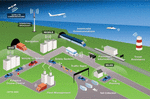
Intelligent transportation system (ITS) is a system that covers a broad range of communication, control, vehicle sensing and electronics technologies to improve safety, mobility and efficiency [8]. With the help of ITS, activities that were traditionally undertaken through human intervention can be automated such as toll collection, traffic management at intersection and parking management etc. Therefore, ITS is system to facilitate movement of goods and humans with the use of ICT in order to efficiently and safely use the transport infrastructure as visualized in Figure 1 [9].
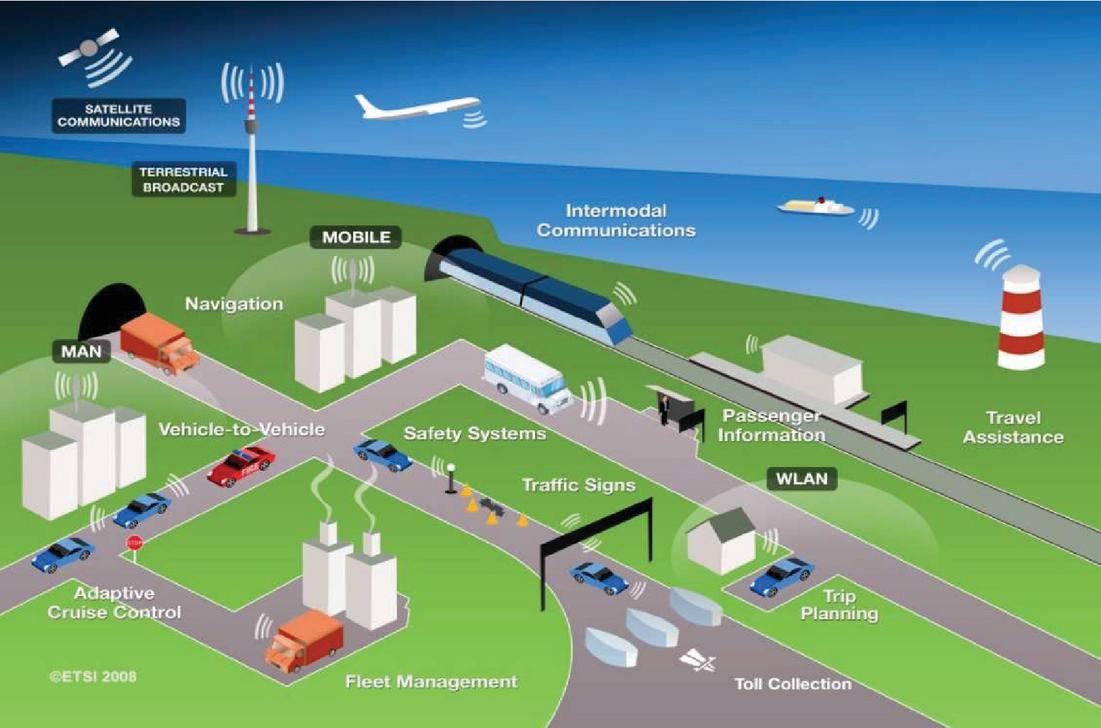
Figure 1 Intelligent transport systems (ITS) usage [9].
The function of ITS system can be categorized as data acquisition, data processing and distribution of information to the uses. Data acquisition can be done by monitoring of traffic using several means such as short range radar, video image detector, CCTV, GPS etc. Data collected from these traffic sensor is sent to data processing centre, where collected data is processed along with the previous collected data. Thereafter, traffic and other related information is distributed in sucha way that improve transportation efficiency, safety, and environmental quality.
2.1 Application of ITS
Applications can be broadly divided into four categories namely, Road safety, Traffic efficiency, Infotainment and Others [10].
2.1.1 Road Safety Applications
The goal of this application is to reduce the road accidents, and numbers of traffic death. It has further been divided into five categories namely, Vehicle status warning (e.g. emergency break light, failure of car condition), Vehicle type warning (e.g. emergency vehicle, VIP vehicle, slow moving, movement of pedestrian etc.), Traffic hazard warning (e.g. wrong lane driving, stationary vehicle, road work, signal violation etc.), Dynamic vehicle warning (wrong overtake, lane changing, frontal collision etc.) and Collision risk warning (e.g. across traffic collision, merging traffic, hazardous location notification etc.). System performance for road safety applications are latency time less than 100 ms, transmission frequency 1-10 Hz, and data rates of 1 to 10 kbps [10].
2.1.2 Traffic Efficiency Applications
Applications related to improvement of the traffic flow and its management such as regulatory speed limit, traffic light optimisation, advisory regarding traffic jam or any severe condition on the road, intersection management and detour information etc. Such information is generally broadcasted by traffic management authority. System performance for traffice efficiency applications are latency less than 200 ms (in most of the cases less than 500 ms), transmission frequency between 1 and 10 Hz, and data rates of one to tens of kbps [10].
2.1.3 Infotainment Applications
Applications which increase the passenger comfort like video streaming, music, video games etc. through internet services. System performance for infotainment applications are latency less than 500 ms, transmission frequency of 1 Hz, and data rates depending upon the contents varying from few kbps to several hundreds of kbps [10].
2.1.4 Other Applications
ITS can also be utilised for facilitating automatic parking access, SOS services, solving vehicle theft cases, remote diagnosis, updated local information, maps, and space and/or time-related messages etc.
3 Implementation of ITS
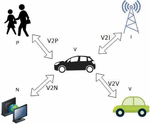
The implementation of ITS can be divided into two parts; legacy ITS (already available and deployed) and advanced ITS (shortly deployed or in deployment phase) [9]. Legacy ITS refers those functionalities which are already available for several years such as Electronic Toll Collection (ETC), Electronic parking payment, normal traffic information etc. The advanced ITS is basically those functionalities, which are either being deployed shortly or under deployment. Most of the ITS applications, as mentioned in Section 2, have not yet been implemented. These unimplemented applications are part of the advance ITS. The applications are divided into four categories namely, communication between vehicle to vehicle (V2V), vehicle to pedestrian (V2P), vehicle to infrastructure (V2I) and vehicle to network (V2N) as shown in Figure 2 [9, 11, 12].
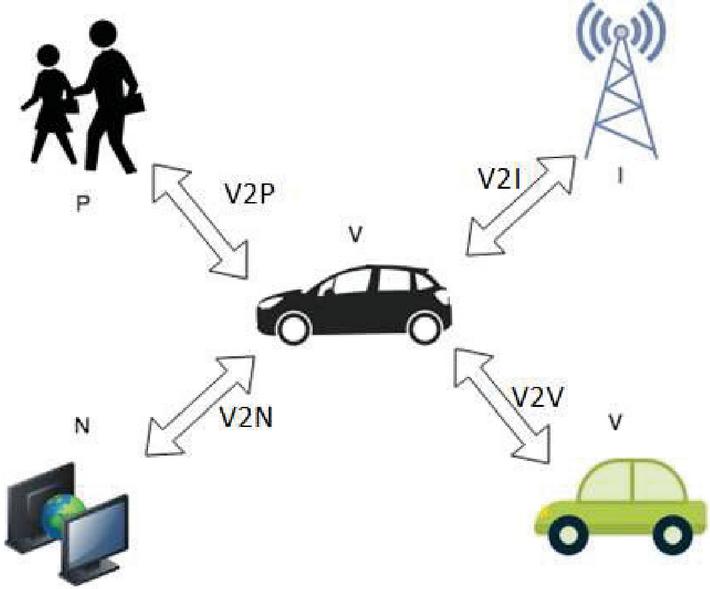
Figure 2 ITS applications.
WAVE (IEEE 802.11p) and LTE based V2X are the two major interfaces which are being used worldwide for advance ITS [9, 11, 12]. Details of these interface are given below.
3.1 IEEE 802.11p (WAVE)
Wireless Access Vehicular Environments(WAVE) is a dedicated mobile radiocommunication system for providing non-voice communications among vehicles moving on roads, rails and between vehicles and transportation infrastructure. This is first Wi-Fi based standard made for vehicular communications. IEEE802.11p is an extension of IEEE802.11a (Wi-Fi), operating in an ad-hoc network mode without the need of a Wi-Fi ‘base station’. IEEE 802.11p uses Orthogonal Frequency Division Multiplex (OFDM) access with 48 useful and four pilot subcarriers at the PHY layer, and, carrier sensing multiple access with collision avoidance (CSMA/CA) at the MAC layer with a channel bandwidth of 10 MHz [13]. The 802.11p support:
• relative velocities up to 200 km/hr,
• response times of around 100 msec, and
• communication range of up to 1000 m.
It has been optimized for mobile conditions in presence of obstructions, handling fast-changing multi-path reflections and Doppler shifts generated by relative speeds as high as 200 km/h [14].
The key benefits of IEEE 802.11p are very low latency around 5 milliseconds (ms) and its off the shelf availability. It caters mainly two applications, namely communication between vehicle to vehicle (V2V) and vehicle to infrastructure (V2I). It is an ad-hoc based communication and doesn’t depend on network infrastructure services. Thousands of cars with IEEE 802.11p facility are already on the road and several manufacturers have already announced for rollout of 802.11p equipped cars [15].
WAVE is being implemented in the USA to improve traveller safety, decrease traffic congestion, reduction of air pollution, and conservation of fuels. WAVE interface works in the frequency band 5.8–5.9 GHz [9].
Cooperative ITS communication (C-ITS) is an interoperable wireless ad-hoc communication systems based on the IEEE802.11p interface. C-ITS is being implemented in Europe in the frequency band 5.9 GHz. Worldwide, several standardisation organisation are involved in the standardisation of C-ITS [9].
3.1.1 IEEE 802.11bd (Advance Version of IEEE802.11p)
In order to improve the performance of IEEE802.11p, make it comparable to 5G NR V2X , a new Study Group IEEE 802.11 Next Generation V2X, formed in March 2018, followed by formation of IEEE Task Group 802.11bd (TGbd) in Jan. 2019 [16, 17]. The scope of the TGbd is as follows [13]:
• Modifications to Medium Access Control layer (MAC) and Physical Layers (PHY) of IEEE 802.11 interface for Vehicle-to-Everything (V2X) communications for 5.9 GHz band and, optionally, in the 60 GHz frequency band (57 GHz to 71 GHz).
• To achieve a minimum of 2 times higher throughput than as in IEEE802.11p operating at maximum mandatory data rate as defined in the 5.9 GHz band (12 Mb/s in a 10 MHz channel), in high mobility channel environments at vehicle speeds up to 250 km/h (closing speeds up to 500 km/h);
• To provide following support:
∘ Interoperability and Co-existance – IEEE802.11p devices to be able to decode at least one mode transmission from 802.11bd, and vice-versa
∘ Backward compatibility – IEEE802.11bd devices must have at least one mode in which they can interoperate with IEEE802.11p devices
∘ Fairness – IEEE802.11p devices to have the same opportunities as IEEE802.11bd devices to access the channel in co-channel case
3.2 LTE Based V2X (3GPP Release 14)
The Third General Partnership Project (3GPP) is working on development of standards for the cellular based Vehicle-to-Everything (V2X). 3GPP, in its Release 14 [18], has provided details about V2X interface which enables the use of LTE mobile networks to provide connectivity for V2X communication use cases. The use cases are divided into four types of applications i.e. between vehicles to vehicle (V2V), between vehicle to roadside infrastructure (V2I), vehicle to pedestrians (V2P) and vehicle to network (V2N).
(A) Vehicle-to-Vehicle (V2V)
It includes exchange of information between vehicles directly or via network supporting V2X service. V2V application is predominantly broadcast. The amount of data exchanged in this mode may not be very high but very low latency is required. This mode of operation will be mainly used for road safety information such as control loss warning, forward collision warning, overtaking warning, emergency vehicle warning etc. [19–21].
(B) Vehicle-to-Infrastructure (V2I)
It is the communication between vehicle and Roadside Unit (RSU), installed along the road. The RSU received information from vehicles and also transmit information to vehicles on various transmission mode such as unicast, broadcast or multicast. Communication between RSU and vehicle may take place both ways i.e. through network or without network presence. V2I is used for Traffic management and infotainment such as intersection management, road safety information, streetlights to share traffic signal change notice, automatic parking speed limit warning, bad road condition warning and pedestrian crossing information etc. [19–21].
(C) Vehicle-to-Pedestrian (V2P)
V2P is the communication between vehicles and pedestrians or cyclists through or without infrastructure mainly for road safety messages. Vehicles communicate with pedestrians and vice-versa to protect pedestrian while crossing the road or approaching the road by pedestrian under low visibility conditions [19–21].
(D) Vehicle-to-Network (V2N)
V2N is the communication between a vehicle and application servers in the telecom network. V2N also facilitates communicate between vehicles that are not within the communication range of each other. In this case, RSU may not be required. However, RSU can be utilised as repeater/forwarding node to extend the range of transmission of the signal received from vehicle. Traffic flow management, calling SOS services and remote diagnostic and repair are some of the examples of V2N communication. These applications may require high throughput, but latency requirements are not as strict as V2V or V2P [19–21].
3.2.1 Applications
3GPP defines 27 use cases for V2X services in Release 14 that can be divided into safety and non-safety services [21]. The non-safety services can further be divided into traffic management and infotainment services.
(A) Safety Services
The aim of safety services is to reduce road accidents and to protect the property and life. High reliability and short delay are the basic criteria for safety services use cases. Safety related messages are of two types’ i.e. periodic transmission and event-triggered transmission. The periodic transmission messages are short broadcast message periodically transmitted among V2V to provide the information about their position, presence, speed, and directions among vehicles. Event-triggered messages are short broadcast messages and non-periodic in nature, used to alert road users about road status. Both periodic transmission and event-triggered transmission can be operated over the LTE-Uu and the PC5 interfaces [19, 21].
(B) Non-Safety Services
Traffic management application, congestion control, traffic efficiency, and entertainment etc are categorised as non-safety services. It is utilised to make driving more comfortable, enjoyable and efficient. Traffic advisory such as detour information, speed limit, congestion at intersection are some of the example under traffic management services. The entertainment video, maps, and updated local information etc are under infotainment services. The non-safety services have no strict requirements on reliability and latency [12, 19].
3.2.2 Mode of Operation
As per 3GPP Release 14, there are two mode of operations for V2X communications: Uu interface (i.e. Cellular interface) and PC5 interface [18, 19]. The Uu interface supports vehicle-to-infrastructure communications, whereas PC5 interface supports V2V communications based on direct LTE sidelink.
(A) Uu Air Interface
It provides communication between the cellular network, road infrastructure, pedestrians and vehicles using uplink and downlink via eNB. Uu interface works only when vehicle is under the network coverage. The Uu interface always use centralised scheduling which means that communication between V2X always take place through the base station (eNB) i.e base controls medium access and radio resource management. Centralised scheduling works on the frequencies used for IMT services in FDD or TDD duplexing. A vehicle can communicate with locally installed V2X application server over LTE-Uu interface through uplink mode. The V2X Application Server delivers the V2X messages to vehicles via eNB in the targeted area using unicast and/or MBMS (Multimedia Broadcast/Multicast Service) delivery system [18].
(B) PC5 interface
It provides direct communication among vehicles and road infrastructure with and without network assistance. The PC5 interface supports centralise as well as distributed scheduling. Centralised scheduling function is similar to Uu interface function i.e. communication takes place through base station, when UE is within the network coverage. Under the distributed scheduling, each vehicle on its own determines the suitable time and frequency resources from a pre-configured resource pool for transmissions. Distributed scheduling in PC5 interface can operate both inside and outside cellular coverage. It supports only broadcast transmissions. Distributed scheduling works at 5 855-5 925 MHz frequency band in TDD duplexing with fixed 10 MHz or 20 MHz bandwidth.
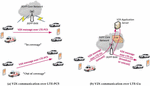
3GPP Release 14 introduces two new communication modes (modes 3 and 4) specifically designed for V2X communications under PC5 interface[13,18,22]. Mode 3 is defined for the scenarios where cellular network (e.g. eNodeB) coverage is available, however, it cannot operate in absence of cellular network. In mode 3, the cellular network selects and manages the radio resources used by vehicles for their direct V2X communications. It is centralized distribution in which cellular network will select channel over vehicle will communicate with other vehicles in the vicinity. In mode 4, vehicles autonomously select the radio resources for their direct V2X communications without cellular network assistance. It can operate with or without cellular coverage; therefore, it is considered as the basic V2X mode. V2X communication over LTE-PC5 interface and LTE-Uu interface is given in Figure 3.
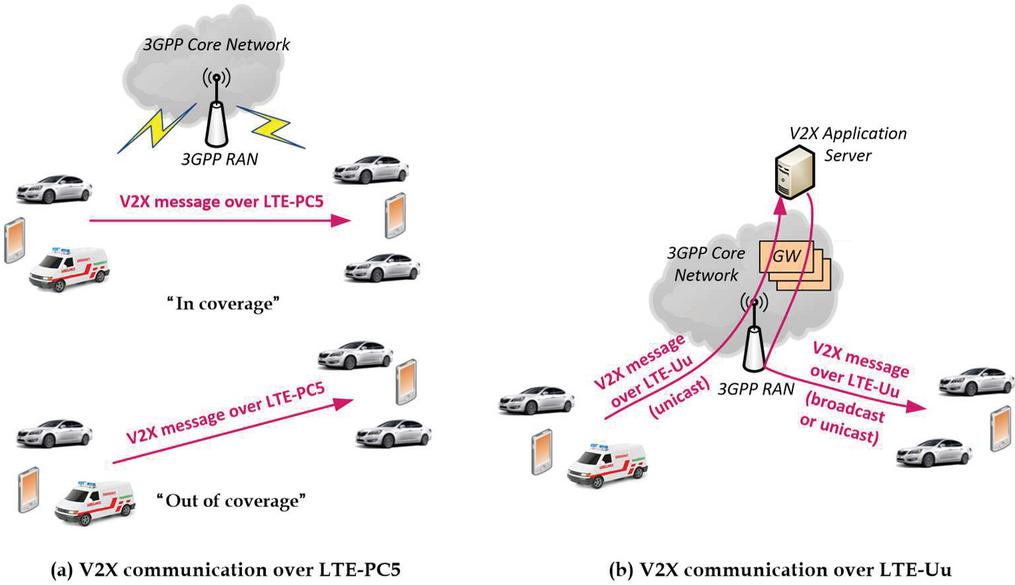
Figure 3 V2X communication over LTE-PC5 interface and LTE-Uu interface [18].
3GPP Release 15 onwards will facilitate advanced features such as enhanced safety use cases at high vehicle speeds, challenging road conditions with its improved reliability, extended range, lower latency, and enhanced non-line-of-sight (NLOS) capabilities.
3.3 ITS Connect
ITS Connect is a dedicated mobile radiocommunication system for V2X communication and is being implemented in Japan in the frequency band 755.5-764.5MHz (700 MHz band). The main use of ITS connect is use to identify the undetected objects, which on board sensor of a vehicle unable to detect. The other important use of ITS connect is receiving traffic signal information and vehicle location information at junction in advance for safe crossing the junction [9].
4 Role of 5G in ITS (3GPP Release 15)
The 5th generation mobile communication (5G) system has been introduced in 3GPP Release 15 as 5G New Radio(NR)[23]. 5G system covers a wide range of applications, namely enhanced Mobile Broadband (eMBB), Ultra-reliable and Low Latency Communications (URLLC) and massive Machine Type Communications (mMTC). The eMBB is an extension of 4G/LTE network and URLCC and mMTC are new features. The specifications for these three components bring a huge difference in the driving experience by delivering peak data rate (upto 20 Gbps at up to 500 km/h speed), latency (1 ms at up to 500 km/h speed), and connection density (up to 1,000,000 connected cars and devices). These are the specifications that autonomous driving system demands. The most important function of the 5G network is flexible network operation which derived through network slicing, network capability exposure, scalability, and diverse mobility. A number of technologies such as NFV/Software Defined Networking (SDN), Control-User Plane Separation (CUPS), Multi-access edge computing (MEC), network slicing, automation and Development and Operations (DevOps) and high end applications such as High resolution video, Virtual Reality (VR) and Augmented Reality (AR), Internet of Things (IoT), wearable devices, mission critical applications, Vehicle-related Communications (V2X), industrial control, and industrial automation etc. are the main features of the 5G system. These features make 5G system to meet various requirements of ITS services. For execution of such vast functionalities, additional spectrum will be required. Accordingly, the World Radio Conference (WRC-2019), in addition to already assigned spectrum for IMT services, has earmarked 24.25-27.5 GHz, 37-43.5 GHz, 45.5-47 GHz, 47.2-48.2 and 66-71 GHz for the International Mobile Telecommunications (IMT), for 5G applications [24].
The 3GPP in Release 14 supports V2X services mostly to provide data transport service for basic road safety. Further, 3GPP in its Release 15 facilitates the extended support for V2X cases with additional facilities such as vehicle platooning, advanced driving, extended sensors and remote driving. The additional supports as defined in Release 15 (5G NR) are given below:
(A) Vehicle Platooning
Vehicle platooning is a group of vehicles that travel together very closely and safely just like a coordinated train wherein each vehicle of the platoon can communicate with other vehicles. Lead vehicle in the platoon control the operation and remaining vehicles follow the instruction of the lead vehicle such as timing of applying break, maintaining speed and direction etc. In platooning, vehicles move in a close knit with reduced inter-vehicle distance, thus increasing road capacity and efficiency. It also improves fuel efficiency, reduces accident rate and enhances productivity. The 3GPP system supports reliable V2V communications and secure message exchange between a vehicles supporting V2X applications to ensure effective and safe platooning operation. The following are some V2V communication requirements to supporting platooning [11, 25]:
• Latency: 25 ms among a group of vehicles with lower degree of automation and 10 ms for highest degree of automation.
• Message reliability: 90% for lower degree of automation and 99.99% for highest degree of automation.
• Relative longitudinal position accuracy of less than 0.5 m.
(B) Advanced Driving
Advanced Driving talks about semi-automated or fully automated driving. Advanced driving is regarded as driving a vehicle based on the real-time and reliable information received from on-board sensors (radar, cameras etc.) and RSUs. In general, RSUs receive data from the local sensors and vehicles in proximity. After processing, RSU holds complete information about traffic and road condition under its area in real time. Vehicles on the road share their trajectories with RSU. Based on trajectory of a vehicle and real time information already available with RSU, RSU issue direction/advice for the vehicle. Besides sharing data with RSU, each vehicle also shares its driving information with other vehicles in proximity, which facilitate safe travelling, collision avoidance, and improve traffic efficiency. The aspect of automated driving is defined through Level of Automation (LoA). LoA is basically measure of requirements and functional aspects in automation systems. The LoA has been coined by the Society of Automobile Engineer (SAE) to provide a common framework for automated driving, and it consists 6 levels namely, Level 0 – No automation; Level 1: Driver assistance; Level 2: Partial automation; Level 3: Conditional automation; Level 4: High automation; and Level 5: Full automation. Automated driving system starts with level 3 and will be in fullest form at level 5, where no human intervention at all will be required. At present, we are between level 2 and level 3. The 3GPP V2X system provides necessary information and technological support expected for all levels of automation [11, 25].
The major requirements between two vehicles employing advanced driving system are (25):
• High bandwidth to support burst transmission of large quantities of data.
• End-to-End latency: 25 ms for lower degree of automation and 10 ms for highest degree of automation.
• Message reliability: 90% for lower degree of automation and 99.99% for highest degree of automation.
(C) Extended Sensors
Extended Sensors refers to the ability of a vehicle to obtain information about the objects around them beyond the capacity of its own on-board sensor. For example, in case on-board sensor of vehicle ‘A’ could not be able to detect some obstacles on the road but another vehicle ‘B’ in the vicinity may be able to detect the same. The sensor of vehicle ‘B’ will broadcast the information about that obstacle. Vehicle ‘A’ will receive this message and after processing, it will be able to identify that obstacle, which nits own could not be able to see. Extended sensor exchange information between local sensors or live video data among vehicles, RSUs, devices of pedestrians and V2X application servers. The main communication requirements are [11, 25]:
• High bandwidth to support burst transmission of large quantities of data.
• End-to-End latency: 50 ms for lower degree of automation and 10 ms for the highest degree of automation.
• Message reliability: 90% for lower degree of automation and 99.99% for the highest degree of automation.
(D) Remote Driving
Remote driving is basically controlling your vehicle on the road while you are sitting at home. It enables a remote driver/V2X application to operate vehicle remotely through cloud-based applications via V2N communication. Remote driving is best suited for public transportation because routes are pre-decided, and variations on the route are limited. Remote driving on the road is somewhat like to driverless metro train, where route and variations on the track is very well known. The following are some potential V2X requirements for supporting remote driving:
• Data rate: Up to 1 Mbps downlink and 25 Mbps at uplink.
• Message Reliability: 99.999 percent or higher.
• End-to-End latency: 5 ms between the V2X application server and the vehicle.
• Vehicular speed of up to 250 km/h.
4.1 3GPP Release 16
3GPP Release 16 [26], introduces additional capacity to various aspects of 5G NR, specifically in terms of short range direct communication, increasing bandwidth and reducing latency further. V2X is one of the focus areas of Release 16, providing advanced support.
Release 16 further enhance the quality of services support to the vehicle. For example, improvement in cooperative decision to reduce the vehicle collision, maintaining of inter-distance vehicle in platooning based on the variation in communication packet error. There are two types of sidelink (PC5) exist in V2X communication: the LTE based sidelink, and the NR based sidelink. A vehicle may use either type of PC5 sidelink or both for V2X communication depending on the services the vehicle supports. Release 16 adds the option of V2X communication over NR based sidelink when vehicle is in-coverage, out of coverage and partial coverage on various spectrum band such as ITS dedicated band as well as all NR frequency bands. V2X communication over NR based sidelink supports broadcast mode, group-cast mode and unicast mode. NR based sidelink support Hybrid Automatic Repeat Request (HARQ) – and Acknowledgement (ACK) for sidelink unicast and group-cast services for improved reliability [26, 27].
3GPP release 16 has not yet been released. It is likely to be released by December 2020. First deployments using Release16 may be expected in 2023. Although the physical radio layers of LTE releases and 5GNR are very different but backward compatibility of 3GPP releases guarantees that all vehicles equipped with at least Release 14 chipsets will be able to communicate using direct communications.
5 Benefits of V2X Technology
IEEE802.11p has already been implemented in various countries. C-V2X has now entered in the market. Debate is underway which technology is better in long run. In [12], and [28] performance comparison between C-V2X and IEEE802.11p based WAVE has been complied and stated that WAVE performs in well in sparse network condition and its performance deteriorates with increase of traffic density and vehicular speed whereas C-V2X perform better in high traffic density and high vehicular speed and provide better Coverage. C-V2X provides better performance in terms of scaling, latency, range and reliability as compared to IEEE802.11p WAVE. Some other benefits are itemized below [29]:
No separate infrastructure across the road is required for V2X technology. Existing LTE or 5G NR based telecom tower will provide necessary infrastructure whereas IEEE 802.11p requires the installation of many new access points (APs) and gateways, which increase time and capital cost for full deployment. It might be possible that user may be charged heavy amount in the name of subscription to recover the investment. Therefore, Capital expenditure wise V2X is better technology.
Being a part of telecom network, upgradation of V2X technology will be taken up along with development of next generation of cellular technology. For example, 3GPP release 14 provides only basic safety applications. New applications have been added with next 3GPP release 15 and onwards. However, no such development can be expected with IEEE802.11 series. Moreover, integration of IEEE802.11p with cellular technology is not possible.
V2P functionalities may be needed for automated vehicles. Implementation of V2P is easy with V2X as no separate equipment will be required to carry by pedestrian. Existing mobile set will suffice to take care of V2X also. However, pedestrian will have to carry a separate instrument while moving on the road in the case of IEEE802.11p. Therefore, implementing V2P functionalities is bit difficult in IEEE802.11p.
The 5G system enabled road will not look differently but it will drastically change the way of thinking about transport network. The 5G road will equipped with several sensors, cameras and other smart devices [30]. The information received from these devices will provide a real time interaction between the infrastructure and vehicles. Transport bodies will be able to manage road network in real time, traffic light, traffic flow and congestion etc. They would also be able to forecast traffic hazards and safety instructions well before the time. The low latency feature provides better accident-prevention capabilities especially in non-line of sight conditions.
The concept of automated vehicles is increasingly becoming a reality only after emergence of 5G and development in this regard is widely reported all over the world. Autonomous vehicles will reduce drivers’ stress and increase their productivity allowing passengers to rest or work while travelling. IEEE forecasted that 75% of all vehicles will be automated by 2040 [31]. In the USA, it is predicted that 50 to 75% of the vehicle fleet will be automated vehicle by 2050 [32]. A study on autonomous vehicles in the UK estimated that level 4/5 automation vehicle production would start from 2025 at a level of 4% and is expected to increase to 25% by 2030 [32]. Besides vehicle safety and other aspects, 5G also provides passengers to enjoy the video streaming or online gaming over enhanced Mobile Broadband and facilitates downloading a sophisticated 3D map in near real time. 5G network has been considered as ‘ubiquitous connectivity’, therefore, it will cater all the needs of vehicle uniformly irrespective of location.
5.1 Stakeholders of V2X
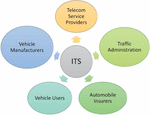
The stakeholders of C-V2X are vehicle manufacturers, telecom service providers, entertainment providers, traffic administration (mobility management), automobile insurers and vehicle users[34] as shown in the Figure 4.
(A) Vehicle Manufacturers: They are biggest stakeholders as V2X equipped vehicles will provide new revenue opportunities. The revenue opportunities will increase with the level of automation.
(B) Telecom Service Providers: ITS would provide a new market to telecom service providers.3GPP release 14 onwards is coming with V2X functionalities. In future vehicles will come with pre-installed sim, owner will have to subscribe services any of the telecom service providers for vehicle similar to a mobile connection for self. The Telecom Service Providers would be considered as second beneficiary after the vehicle manufacturers.
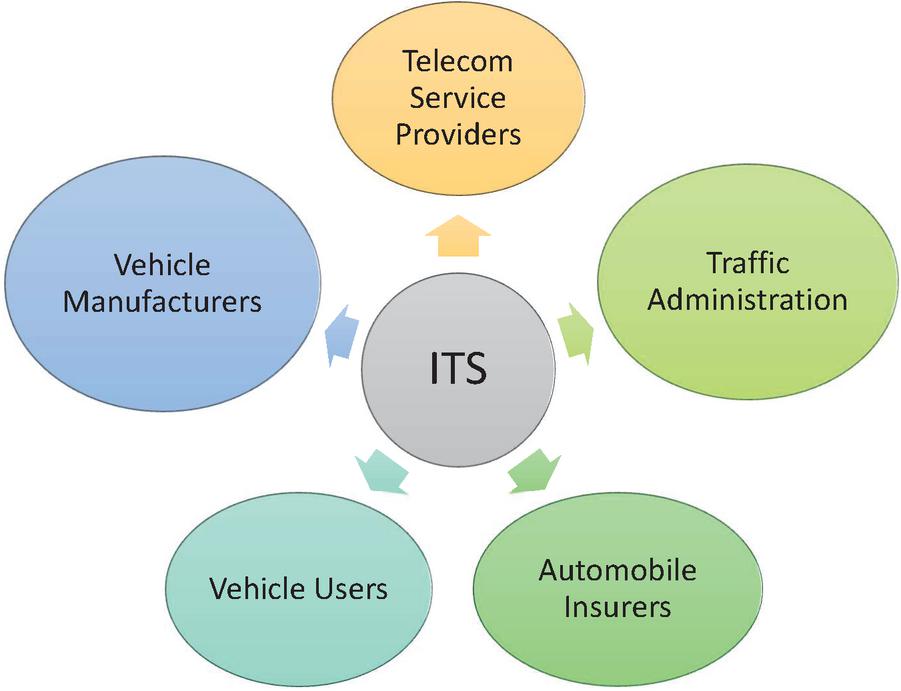
Figure 4 Stakeholders of ITS.
(C) Entertainment Providers: Normally, we use to listen entertainment programme, aired by various FM channel, while seating in car. Vehicles equipped with V2X facilities would facilitates passengers to enjoy the video streaming or online gaming over enhanced Mobile Broadband. The market segment of over the top (OTT) content providers will be extended to vehicles also.
(D) Traffic Administration/Mobility Management Service: Mobility management is an entity which can process and analyse the data received from the various sources and provide a complete trajectory in real time to vehicle. It is a central server for data analysis. An agency would be required to maintain the central server. This agency could be traffic administration itself or any other agency hired by them. The central server can be accessed through Uu interface by telecom network. Further, localised server can also be installed at various locations to make the analysis faster and to broadcast the safety messages. Traffic related specific services can also be provided as per the requirement of user. Traffic administration may charge some amount for providing such services.
(E) Automobile Insurers: Business opportunity of automobile insurers will increase by offering extended coverage to V2X apparatus and applications.
For implementation of 5G system in the automotive industry, a group 5G Automotive Association (5GAA) [34] has been constituted by leading wireless and automotive companies. The 5GAA has set up seven working groups (WG1 to WG7) to study the various aspects of implementation of 5G system and has adopted 3GPP procedures to deliver on its mission.
6 Radio Spectrum Requirements for ITS Applications
Radio spectrum at international level is regulated by the International Telecommunications Union (ITU), a specialized agency of the United Nations for all global telecommunication matters. ITS system works through sensing of identified/unidentified objects. Therefore, spectrum earmarked for short range radar can be utilised for ITS system. Radio spectrum in 5.8-5.9 GHz band and 76-81 GHz band is being used for ITS.
6.1 Frequency Band 5.9 GHz
Dedicated Short Range Communications (DSRC) [9], refers to communication between a roadside infrastructure unit (RSU) and vehicles or mobile platforms for ITS applications. It has two major components; on-board equipment (OBE) installed in the vehicle and roadside equipment unit (RSU) installed above or alongside the road. With the use of radio spectrum, both the components of DSRC system exchange data between them. DSRC system operates at 5.8–5.9 GHz frequency band. Various standardisation agencies have proposed 5.8 GHz band for vehicle-to-vehicle (V2V) and vehicle-to-infrastructure (V2I) communications. The major deployed ITS in the 5.8 GHz are classified as electronic toll collection, automotive radar, and vehicle information and communication.
IUU-R in its recommendation ITU-R M2121-0 recommended to designate 75 MHz band in 5850-5925 MHz for ITS in all regions worldwide [37]. Most of the countries have already designated the same or a similar amount of spectrum in the 5.9 GHz band for V2X communications.
In Region 1, European Union designated parts of the 5 855-5 925 MHz band in 2008 for the use of ITS applications for road safety and traffic efficiency [38,39].
• ITS-5GA: 5.875 GHz to 5.905 GHz (30 MHz) for safety related applications.
• ITS-5GB: 5.855 GHz to 5.875 GHz (20 MHz) for non- safety applications.
• ITS-5GD: 5 905 MHz to 5 925 MHz (20 MHz) for future ITS applications
CEPT in its report 71 [40], stated that the frequency band 5875-5925 MHz is designated for all safety related ITS applications (Road ITS and Urban Rail ITS) and the frequency band 5925-5935 MHz is designated for safety-related Urban Rail ITS applications and proposed 5875-5915 MHz (40 MHz) for road ITS applications in place of earlier designated 5875-5905 MHz (30 MHz), and also proposed sharing possibilities between 5915-5925 MHz (10 MHz) with Urban Rail ITS application subject to Road ITS application is limited to V2I. Further, 5915-5925 MHz will be extended for V2V applications when solutions ensuring protection of Urban Rail ITS become available [40]. Study as per CEPT is being carried out by ETSI.
Countries in Region 2 designated frequency band 5850-5925 MHz (75 MHz) for ITS application[41]. Out of 75 MHz spectrum, first 5 MHz (5850-5855) has been kept reserved as guard band and the remaining 70 MHz spectrum has been divided into 7 blocks of 10 MHz each with three types of channels: control channel, shared channels and aggregated channels of 20 MHz bandwidth. The two aggregated channels are used to support multi-channel operations [11, 14].
Recently, Federal Communications Commission (FCC), USA, in view of slow adoption of DSRC, has proposed to reallocate frequency band 5850–5925 MHz (total of 75 MHz) into two parts: (a) frequency band 5.850–5.895 GHz (lower 45 MHz) for unlicensed operations, and (b) frequency band 5.895–5.925 GHz (upper 30 MHz) for ITS purposes, either exclusively for C–V2X or sharing between C–V2X and DSRC technologies [42].
Region 3 countries identified the bands 755.5–764.5 MHz, 5 770-5 850 MHz and/or 5 855-5 925 MHz for the use by ITS applications. Most of Region 3 countries designated approximately 70 MHz spectrum in 5.9 GHz band including Australia (70 MHz), Korea (70 MHz), Singapore (50 MHz), India (50 MHz). Japan currently allocated 9 MHz of spectrum exclusively for transportation safety communications in 700 MHz band (755.5–764.5 MHz) and additional 80 MHz in 5.9 GHz band (5 770-5 850 MHz) for other functionalities such as electronic toll collection [41].
It is noted that most of the countries worldwide have designated the frequency band of 5 850–5 925 MHz, or parts thereof, for the deployment of ITS. Therefore, this frequency band is the most harmonised band for ITS application. The Table 1 presents the allocation of spectrum in the frequency band 5.8–5.9 GHz for ITS applications in various regions/countries:
Table 1 Frequency allocation for ITS in 5.8 GHz band [37]
| Country or Group | Frequency Bands |
| Region 1 | |
| CEPT | 5 855-5 925 MHz |
| United Arab Emirates (UAE) | 5 855-5 925 MHz |
| Region 2 | |
| Country or Group | Frequency bands |
| Canada | 5 850-5 925 MHz |
| United States (US) | 5 850-5 925 MHz |
| Region 3 | |
| Country or Group | Frequency bands |
| Australia | 5 855-5 925 MHz |
| China | 5 905-5 925 MHz |
| Japan | 755.5-764.5 MHz 5 770-5 850 MHz |
| Korea | 5 855-5 925 MHz |
| Singapore | 5 855-5 925 MHz |
| India | 5 875-5 925 MHz |
In accordance with ITU’s table of frequency allocation (TFA), the allocation of 5.8–5.9 GHz band in all the three regions for various radiocommunication services, is given in the Table 2 below. This table along with footnotes has been taken from Radio Regulation of ITU [36].
Table 2 Frequency Allocation Table for 5725–5925 MHz [36]
| Region 1 | Region 2 | Region 3 |
| 5 725–5 830 FIXED-SATELLITE (Earth-to-space) RADIOLOCATION Amateur | 5 725-5 830 RADIOLOCATION Amateur | 5 725-5 830 RADIOLOCATION Amateur |
| 5 830–5 850 FIXED-SATELLITE (Earth-to-space) RADIOLOCATION Amateur Amateur-satellite (space-to-Earth) | 5830-5 850 FIXED-SATELLITE (Earth-to-space) RADIOLOCATION Amateur Amateur-satellite (space-to-Earth) | 5830-5 850 FIXED-SATELLITE (Earth-to-space) RADIOLOCATION Amateur Amateur-satellite (space-to-Earth) |
| 5 850–5 925 FIXED FIXED-SATELLITE (Earth-to-space) MOBILE | 5 850-5 925 FIXED FIXED-SATELLITE (Earth-to-space) MOBILE Amateur Radiolocation | 5 850-5 925 FIXED FIXED-SATELLITE (Earth-to-space) MOBILE Radiolocation |
It may be seen from the Table 2, Fixed Satellite Services (FSS) has been earmarked as primary services in all the three regions. Sharing study reveals that FSS earth station may possibly cause harmful interference to ITS receivers. However, interference from ITS devices to FSS space receivers is negligible. This shows that there is a need to take up exhaustive sharing studies while ITS applications are planned in this band for ensuring an interference free environment.
It may also be seen that besides FIXED SATELLITE, other services such as FIXED, FIXED SATELLITE, RADIOLOCATION, Amateur including MOBILE are allocated on primary and co-primary basis in the frequency sub bands. Hence, while making provision for introduction of IT’S under MOBILE service allocations, sharing studies with other radio services would need to be thoroughly carried out.
6.2 Frequency Band 76-77 GHz and 77-81 GHZ
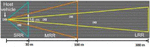
The automotive radar (AR) system, consisting transmitter and receiver, is installed in the vehicle to detect the objects such as pedestrians, bicycles and other objects in close proximity of vehicle. It works on the principle of measurement of relative velocity through phase difference between the transmitted signal and the received signal[43]. AR is broadly categorized into long range (for measuring the distance and speed of other vehicles) upto 300 meters, medium range (for detecting objects within a wider field of view) upto 100 meters and short range (for sensing in the vicinity of the vehicle required for parking or identifying any obstacle) upto 30 meters as shown in the Figure 5. Based on frequency bands and bandwidth, usage can be separated in two categories:
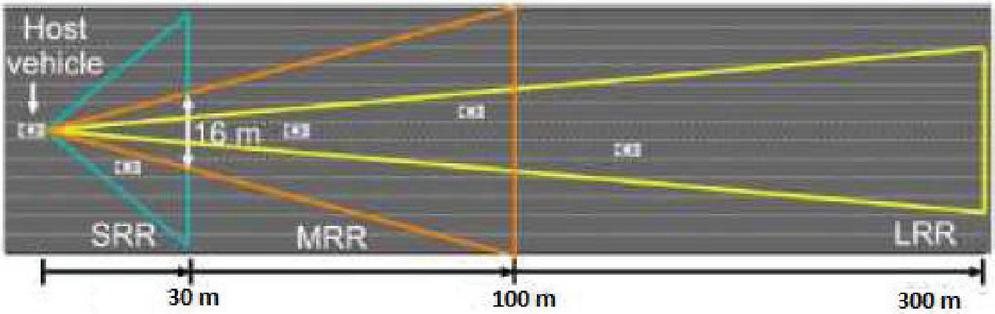
Figure 5 Range of automotive radar [44].
Category 1: Long range Radar (76–77 GHz)
Adaptive Cruise Control (ACC) and Collision Avoidance (CA) radar are operated for measurement ranges up to 300 metres with a maximum continuous bandwidth of 1 GHz and EIRP of 55 dBm [45]. ACC/CA system helps in longitudinal control of vehicle while driving. It controls the accelerator, vehicle breaks and engine powertrain to maintain a desired time gap (speed and distance) to the vehicle ahead of it [46]. It is called as type ‘A’ radar and fitted at front end of the vehicle. ACC is now available in almost all luxury, as well as less expensive cars. ACC radar is shown in Figure 6.
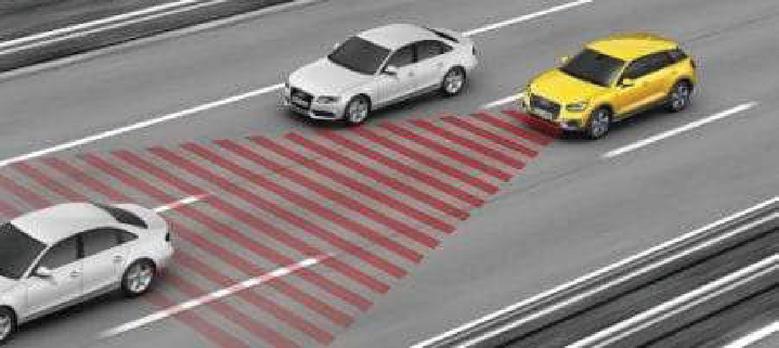
Figure 6 Adaptive cruise control radar [47].
Category 2: Medium and Short-Range Radar (77–81 GHz)
Sensors deployed in this frequency band is used for high resolution applications, such as Blind Spot Detection (BSD), Lane-Change Assist (LCA) and Rear-Traffic-Crossing-Alert (RTCA), detection of pedestrians and bicycles in close proximity to a vehicle. The measurement ranges is up to 100 metres and required bandwidth is 4GHz. The wide bandwidth facilitates to identify objects that are closely spaced. Such add to the passive and active safety of a vehicle which use to improve traffic safety such as autonomous emergency braking, active blind spot assistance, automated parking applications and lane change assistance etc. This category has four types of radar for different functions [48]:
(a) Radar B: Automotive high-resolution radar for front applications
(b) Radar C: Automotive high-resolution radar for corner applications
(c) Radar D: Automotive high-resolution radar
(d) Radar E: Automotive high-resolution radar for very short-range applications
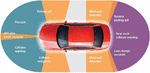
As per the specifications, Radar B, C and E operate at maximum of 33 dBm EIRP and Radar D can operate at maximum of 45 dBm EIRP [45]. To meet the requirements of car safety, and depending on the application, one or more ‘A’ type radar systems can be combined with B, C, D, and E of category 2 type radars in a vehicle. These radars are fitted at front and back ends of the vehicle as shown in Figure 7 [48].
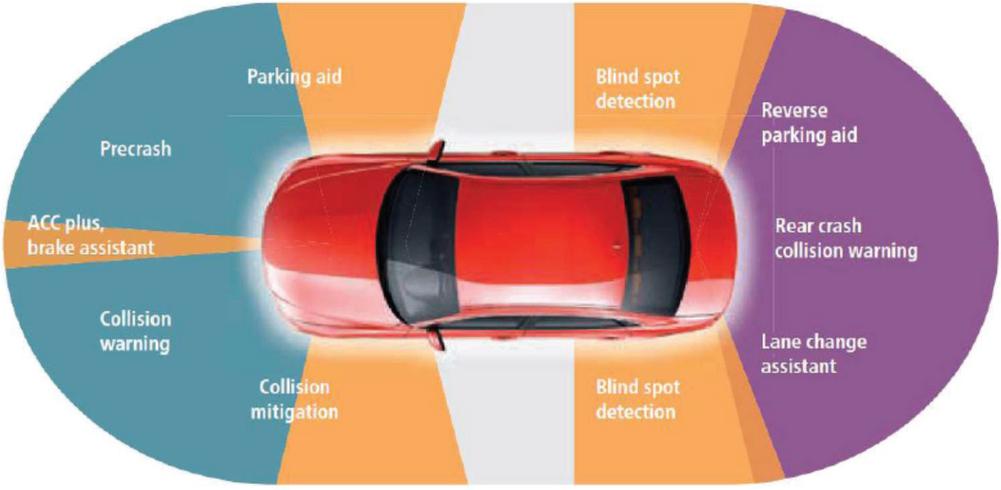
Figure 7 Automotive radar applications [9].
It may also be noted that the globally harmonised 24 GHz ISM band (24.00–24.25 GHz) plays an import role, especially for affordable vehicles. Automotive radars can be used in this band without any time limitation. However, the narrow bandwidth of 250 MHz limits the radar’s ability to resolve objects that were close to one another. Due to shortage of bandwidth in 24 GHz band, this band is being replaced with 76–77 GHz and 77–81 GHz bands. 76–77-GHz band radars offer 1 GHz of bandwidth, while 77–81-GHz band radar systems allow up to 4 GHz of bandwidth. These wider bandwidths will increase detection range and velocity resolution and make possible to use smaller antennas and other components. The improvement in range resolution allows for detection of bicyclists next to cars, people walking with pets, etc. [49]. For global harmonization of ITS, most of the countries are considering frequency bands 76–77 GHz and 77–81 GHz as a permanent band.
The Federal Communications Commission (FCC) and the Ministry of Internal Affairs and Communications (MIC) in Japan have designated 76–77 GHz band for automotive radar. MIC, Japan has also recommended introduction of high-resolution radar in 77–81 GHz band for safety related applications. The European Conference of Postal & Telecommunications (CEPT) has designated the band 77–81 GHz for automotive radars [9]. The European Telecommunications Standards Institute (ETSI) has adopted the harmonized standard in the frequency band 77–81 GHz for the applications of short range radars [50]. FCC has also allowed 77–81 GHz band for vehicular radar operations aligning with rest of the world. Countries in Asia Pacific Region have also designated 76–77 GHz and 77–81 GHz bands for short range automotive radar application for ITS. Therefore, the frequency bands 76–77 GHz and 77–81 GHz are globally harmonised bands for short range automotive radar applications.
In Region 3, some of the APT countries are utilising frequency bands of 24, 60, 76 and 79 GHz for ITS[9]. After WRC-15 decision, frequency band 76–81 GHz band has been designated for short-range high-resolution automotive radar applications, administrations are aligning ITS applications in 76–81 GHz band.
The status of the frequency band 76–81 GHZ with regard to allocation for various radiocommunication services in accordance with Radio Regulation of ITU, is given in the Table 3 below:
Table 3 Frequency Allocation Table for Frequency Band 76–81 GHz [36]
| Region 1 | Region 2 | Region 3 |
| 76-77.5 RADIO ASTRONOMY RADIOLOCATION Amateur Amateur-satellite Space research (space-to-Earth), |
||
|
77.5–78 AMATEUR AMATEUR-SATELLITE RADIOLOCATION Radio astronomy Space research (space-to-Earth), |
||
|
78–79 RADIOLOCATION Amateur Amateur-satellite Radio astronomy Space research (space-to-Earth), |
||
|
79–81 RADIO ASTRONOMY RADIOLOCATION 5.559B Amateur Amateur-satellite Space research (space-to-Earth), |
||
The Table 3 shows that more than radio service such as Radiolocation, Radio astronomy, Amateur, Amateur-satellite, Space research are allocated on primary and co-primary basis. RADIO ASTRONOMY and RADIOLOCATION services are allocated as primary basis in the frequency band 76–77.5 GHz and 78–81 GHz band whereas AMATEUR, AMATEUR-SATELLITE and RADIOLOCATION services are primary services in the frequency band 77.5–78 GHz. The radio astronomy service is a passive service that receives radio waves from space to understand our universe and installations are generally remotely located to provide interference protection from active services. Amateur service is for exchange of non-commercial messages between its users for experiment, self-training, and emergency communication purposes. It is noted that application of automotive radar comes under the Radiolocation service, which is a primary service in all the frequency sub-bands. Sharing/compatibility studies between automotive radar and other radiocommunication services in this band must be undertaken for providing interference free operations
ITU-R, in its Report ITU-R M.2322-0 [51], conducted sharing and compatibility study between automotive radar (radiolocation service) and amateur and amateur satellite services. The study indicates that the allocation of the band 77.5–78 GHz to the radiolocation service is not causing any harmful interference to the radio amateur service. The report is also said that the possibility of interference to radio astronomy service(RAS) from automotive radars is very low and practically, a minimal interference potential to RAS operations. As regard, sharing study in adjacent frequency bands 76–77.5 and 78–81 GHz are concerned, there is already a primary allocation to Radiolocation service, no sharing study is required. However, it is expected that any potential cases of interference between automotive radars and incumbent services could be addressed by mitigation factors [51].
7 International Telecom Union (ITU) on ITS
Considering and recognizing the need of harmonized radio spectrum and uniform international standards to facilitate deployment of ITS radiocommunications, the World Radio Conference (WRC)-2019 has adopted a new Resolution on Intelligent Transport Systems Applications [24] to encourage administrations to use globally and regionally harmonized frequency bands for ITS applications. Through this Resolution, ITU has invited ITU-R to carry out studies on technical and operational aspects of evolving ITS implementation using existing mobile-service allocations, and also administrations & stake holders to contribute actively to the ITU-R studies.
WRC-19 has also framed a study question, ITU-R 205-6/5 on Intelligent Transport Systems [52] under which study on requirement of spectrum for ITS and other related aspects will be undertaken during the current study cycle i.e. 2019 to 2023 and response will be discussed during the next WRC which is schedule in 2023. The results of these studies shall be in form of ITU’s Recommendations, Reports or Handbooks.
8 Conclusion
It can be easily envisaged that Vehicle safety and traffic efficiency can be ensured with the use of radio spectrum. At present, approximately 70 MHz spectrum in 5.9 GHz band has exclusively been assigned for ITS in most of the countries. The frequency band 5.9 GHz facilitate vehicles, roadside infrastructure, and pedestrian, to exchange messages, image, and other sensor data between them without relying on cellular network and provide benefits such as less travel time, saving energy, and reducing emissions to the users. To enhance the safety functionalities, 5 GHz spectrum in the frequency band 76-81 GHz has also been proposed mainly for communication between vehicles. With the integration of V2X communication with cellular mobile platforms, traffic efficiency and vehicle safety will be improved drastically. The frequency bands available for IMT services will now be available for ITS. However, with the advancement of transportation system, RSUs will have to exchange more and more data with vehicles and central unit which in turn would require more spectrum. Therefore, additional spectrum at 5.9 GHz band would be required to handle additional data demand between vehicles and RSUs. Finally, efficient utilisation of resources would facilitate substantial economic benefits to administrations, automobile industry and users.
References
[1] Traffic Congestion: Alberto Bull. https://repositorio.cepal.org/bitstream/handle/11362/37898/LCG2199P_en.pdf
[2] Global status report on road safety 2018. https://www.who.int/violence_injury_prevention/road_safety_status/2018/GSRRS2018_Summary_EN.pdf?ua=1
[3] Road Accident in India(2018). https://morth.nic.in/sites/default/files/Road_Accidednts.pdf
[4] 14th Annual Road Safety Performance Index (PIN) Report. https://etsc.eu/14th-annual-road-safety-performance-index-pin-report/
[5] Bhupendra Singh, Ankit Gupta. Recent trends in intelligent transportation systems: a review. Journal of Transport Literature, 9(2), 30–34, Apr. 2015.
[6] NHTSA V2V Communication Technology fact sheet. https://www.nhtsa.gov/sites/nhtsa.dot.gov/files/documents/v2v_fact_sheet_101414_v2a.pdf.
[7] Socio-Economic Benefits of Cellular V2X. Analysys Mason. https://5gaa.org/wp-content/uploads/2017/12/Final-report-for-5GAA-on-cellular-V2X-socio-economic-benefits-051217_FINAL.pdf
[8] Tom V. Mathew, Intelligent Transportation System – I. https://www.civil.iitb.ac.in/~vmtom/nptel/591_ITS_1/web/web.html
[9] ITU-R M.2445-0 Intelligent transport systems (ITS) usage. https://www.itu.int/dms_pub/itu-r/opb/rep/R-REP-M.2445-2018-PDF-E.pdf
[10] ETSI TR 102 638 V1.1.1. Intelligent Transport Systems (ITS); Vehicular Communications; Basic Set of Applications; Definitions
[11] Xuyu Wang, Shiwen Mao, Michelle X. Gong. An Overview of 3GPP Cellular Vehicle-to-Everything Standards. https://dl.acm.org/doi/abs/10.1145/3161587.3161593
[12] Padma Panchapakesan, Overview of LTE Based Cellular V2X Communication, Telecom Business Review Volume 10 Issue 1.
[13] G. Naik, B. Choudhury and J. Park, “IEEE 802.11bd & 5G NR V2X: Evolution of Radio Access Technologies for V2X Communications,” in IEEE Access, vol. 7, pp. 70169-70184, 2019, doi: 10.1109/ACCESS.2019.2919489.
[14] Alessio Filippi, Kees Moerman, Vincent Martinez and Andrew Turley IEEE802.11p ahead of LTE-V2V for safety applications
[15] Kees Moerman. Next Generation Vehicular Networks: IEEE802.11bd. https://docbox.etsi.org/Workshop/2019/201903_ITSWS/SESSION04/NXP_MOERMAN.pdf
[16] P802.11bd. http://www.ieee802.org/11/PARs/P802_11bd_PAR_Detail.pdf
[17] Hameed Mir, Z., Filali, F. LTE and IEEE 802.11p for vehicular networking: a performance evaluation. J Wireless Com Network 2014, 89 (2014). https://doi.org/10.1186/1687-1499-2014-89
[18] 3GPP Release 14, https://www.3gpp.org/release-14
[19] 5G Americas White Paper: Cellular V2X Communications Towards 5G. https://www.5gamericas.org/wp-content/uploads/2019/07/2018_5G_Americas_White_Paper_Cellular_V2X_Communications_Towards_5G__Final_for_Distribution.pdf
[20] How 5G Will Influence Autonomous Driving Systems. Keysight Technologies. https://www.keysight.com/in/en/assets/7018-06173/white-papers/5992-2998.pdf
[21] 3GPP TS 22.185. (2016). Service requirements for V2X services, Stage 1.
[22] N. Bonjorn, F. Foukalas and P. Pop, “Enhanced 5G V2X services using sidelink device-to-device communications,” 2018 17th Annual Mediterranean Ad Hoc Networking Workshop (Med-Hoc-Net), Capri, 2018, pp. 1–7, doi: 10.23919/MedHocNet.2018.8407085.
[23] 3GPP Release 15. https://www.3gpp.org/release-15
[24] Final Acts. World Radiocommunication Conference 2019(WRC-19). https://www.itu.int/dms_pub/itu-r/opb/act/R-ACT-WRC.14-2019-PDF-E.pdf
[25] 3GPP TS 22.186. (2016). Service requirements for enhanced V2X scenarios
[26] 3GPP TR 21.916. Technical Specification Group Services and System Aspects; Release 16 Description
[27] 5G evolution: 3GPP releases 16 & 17 overview. https://www.ericsson.com/en/reports-and-papers/ericsson-technology-review/articles/5g-nr-evolution
[28] Hameed Mir and Filali. LTE and IEEE 802.11p for vehicular networking: a performance evaluation EURASIP Journal on Wireless Communications and Networking 2014, 2014:89 http://jwcn.eurasipjournals.com/content/2014/1/89
[29] Cost–benefit analysis on cellular vehicle to everything (C-V2X). https://5gaa.org/wp-content/uploads/2017/12/Cost-benefit-analysis-on-cellular-vehicle-to-everything-draft-presentation-221117.pdf
[30] Why 5G smart roads are the future of transport. https://www.raconteur.net/technology/5g-2019/5g-smart-roads
[31] You won’t need a driver’s license by 2040. https://site.ieee.org/itss/2014/09/15/you-wont-need-a-drivers-license-by-2040/
[32] T L Robinson, C Wallbank & A Baig. Automated Driving Systems: Understanding Future Collision Patterns. https://trl.co.uk/sites/default/files/PPR851\%20-\%20Automated\%20Driving\%20Systems\%20-\%20Understanding\%20Future\%20Collision\%20Patterns\%20Report\%20v2.pdf
[33] M. A. Lema et al., “Business Case and Technology Analysis for 5G Low Latency Applications,” in IEEE Access, vol. 5, pp. 5917–5935, 2017, doi: 10.1109/ACCESS.2017.2685687.
[34] 5GAA Automotive Association. https://5gaa.org/
[35] World Radiocommunication Conferences (WRC). https://www.itu.int/en/ITU-R/conferences/wrc/Pages/default.aspx
[36] Radio Regulation (RR) of ITU. https://www.itu.int/pub/R-REG-RR/en
[37] Recommendation ITU-R M.2121-0. Harmonization of frequency bands for Intelligent Transport Systems in the mobile service. https://www.itu.int/dms_pubrec/itu-r/rec/m/R-REC-M.2121-0-201901-I!!PDF-E.pdf
[38] ETSI EN 302 571. Intelligent Transport Systems (ITS); Radiocommunications equipment operating in the 5 855 MHz to 5 925 MHz frequency band; Harmonised Standard covering the essential requirements of article 3.2 of Directive 2014/53/EU
[39] Report ITU-R M.2228-1. Advanced intelligent transport systems radiocommunications. https://www.itu.int/dms_pub/itu-r/opb/rep/R-REP-M.2228-1-2015-PDF-E.pdf
[40] CEPT Report 71 to to study the extension of the Intelligent Transport Systems (ITS) safety-related band at 5.9 GHz. https://www.ecodocdb.dk/download/19a361a9-d547/CEPTRep071.pdf
[41] Report ITU-R M.2444-0. Examples of arrangements for Intelligent Transport Systems deployments under the mobile service. https://www.itu.int/dms_pub/itu-r/opb/rep/R-REP-M.2444-2019-PDF-E.pdf
[42] Use of the 5.850-5.925 GHz Band. ET Docket No. 19-138. https://docs.fcc.gov/public/attachments/DOC-360940A1.pdf
[43] Millimeter-Wave Automotive Radar Testing Must be Flexible. https://www.mwrf.com/technologies/test-measurement/article/21849107/millimeterwave-automotive-radar-testing-must-be-flexible
[44] Range of Automotive Radar Maria S. Greco. http://www.iet.unipi.it/m.greco/esami_lab/Radar/automotive_radar.pdf
[45] Recommendation ITU-R M.2057-1. Systems characteristics of automotive radars operating in the frequency band 76-81GHz for intelligent transport systems applications https://www.itu.int/dms_pubrec/itu-r/rec/m/R-REC-M.2057-1-201801-I!!PDF-E.pdf
[46] Dang R., et al: Coordinated cruise control system with lane change assistance. IEEE Transaction on Intelligent Transportation System, vol. 16, no. 5, pp. 2373–2383, 2015.
[47] What is Intelligent Transportation System?, https://theconstructor.org/transportation/intelligent-transportation-system/1120/
[48] Recommendation ITU-R M.2057-1. Systems characteristics of automotive radars operating in the frequency band 76-81 GHz for intelligent transport systems applications. https://www.itu.int/dms_pubrec/itu-r/rec/m/R-REC-M.2057-1-201801-I!!PDF-E.pdf
[49] Millimeter-Wave Automotive Radar Testing Must be Flexible. https://www.mwrf.com/technologies/test-measurement/article/21849107/millimeterwave-automotive-radar-testing-must-be-flexible
[50] Recommendation ITU-R M.1452-2. Millimetre wave vehicular collision avoidance radars and radiocommunication systems for intelligent transport system applications. https://www.itu.int/dms_pubrec/itu-r/rec/m/R-REC-M.1452-2-201205-I!!PDF-E.pdf
[51] Report ITU-R M.2322-0. Systems characteristics and compatibility of automotive radars operating in the frequency band 77.5 78 GHz for sharing studies. https://www.itu.int/dms_pub/itu-r/opb/rep/R-REP-M.2322-2014-PDF-E.pdf
[52] ITU-R Study Question SG05.205-6/5. https://www.itu.int/pub/R-QUE-SG05.205
Biographies

P. S. M. Tripathi is currently Deputy Wireless Adviser in in Wireless Planning & Coordination (WPC) Wing of Department of Telecommunications, Ministry of Communications, Government of India. Presently, he has been posted at Regional Licensing Officer, Guwahati. Earlier, he was associated with radio spectrum management and planning and engineering activities for telecom services in India especially for telecom services in 900 MHz, 1800 MHz and 2100 MHz bands and also associated with spectrum auction held in India since 2010 onwards. He has more than 20 years of experience in management, strategy in Radio Spectrum Management and Radio Spectrum Monitoring Sector including implementation of a very prestigious World Bank Assisted Project on “National Radio Spectrum Management and Monitoring System (NRSMMS)” in the WPC Wing.
He was graduated from M M M Technical University, Gorakhpur (India). He worked as Research fellow at Center for Tele-infrastructure (CTIF), Italy, Department of Electronics, University of Tor Vergata, Rome, Italy. He was selected in the year 2010 under Erasmus Mundus “Mobility for Life” scholarship programme of European Commission for doing Ph.D. at Department of Electronic Systems, Aalborg University, Denmark. The Degree of Doctor of Philosophy has been awarded in the 2014.

Ambuj Kumar has hands-on experience of more than 20 years in Telecom Industry and Academia. He received Bachelor of Engineering (BE) in Electronics & Communications Engineering (ECE) from Birla Institute of Technology (BIT), Ranchi, India in the year 2000. As a part of the Bachelor programme, he underwent an extensive Internship Training in 1999 at the Institut für Hochfrequenztechnik (IHF), Technical University, (RWTH), Aachen (Germany). After graduation, Ambuj Kumar worked at Lucent Technologies Hindustan Private Limited, a vendor company, during the period 200–2004. His major responsibilities were the Mobile Radio Network Design, Macro and Microcell planning, and Optimization for the GSM-and the CDMA-based Mobile Communication Networks. There, he was involved in pan-India planning and optimizing the MCNs of various service providers for both the green field and the incumbent deployments. During the period 2004 to 2007, he worked with Hutchison Mobile Services Limited (now Vodafone-Idea Limited), a service provider company, where he was involved in planning, deployment, and optimization of the Hutch’s rapidly expanding GSM-and Edge networks across India. Afterwards, he joined Alcatel-Lucent, New Delhi in 2007 and continued until 2009. He worked for three months in the year 2009 as Research Associate at the Centre for TeleInFrastruktur (CTIF), Department of Electronic Systems, Aalborg University, and his research area was on ‘Identification of Optimization parameters for Routing in Cognitive Radio’. Ambuj Kumar was awarded research scholarship under European Commission -Erasmus Mundus “Mobility for Life” programme for doing PhD and joined CTIF, Department of Electronic Systems, Aalborg University, Aalborg, (Denmark), in the year 2010. Ambuj Kumar has also worked as a Collaborative Researcher at the Vihaan Networks Limited (VNL), India. The work of PhD research was conceptualized at VNL; there he developed test-bed facilities for experimental studies on ‘Advanced Alternative Networks’. He had worked as Research Assistant in the eWall Project, funded by the European Commission, at the Faculty of Science and Engineering (Department of Electronic Systems) during 2015-2016. He was awarded Doctor of Philosophy (PhD) in 2016 by the Aalborg University (Denmark) on his thesis titled “ACTIVE PROBING FEEDBACK BASED SELF CONFIGURABLE INTELLIGENT DISTRIBUTED ANTENNA SYSTEM for Relative and Intuitive Coverage and Capacity Predictions for Proactive Spectrum Sensing and Management”. Currently, Dr. Ambuj Kumar is working as PostDoc in the Department of Business Development and Technology, School of Business & Social Sciences, Aarhus University (Denmark) since February, 2017. Currently, he is playing a key role in three European projects. He is a key person in EU’s project titled “Capacity building and ExchaNge towards attaining Technological Research and modernizing Academic Learning (CENTRAL)”. He has more than 30 research publications including four book chapters in these thematic areas. As the first author, he has contributed more than 12 research papers, including journals such as Wireless Personal Communications (WPC), and International Telecommunication Union (ITU), scientific magazines such as IEEE AESS, and conferences such as Wireless Personal Multimedia Communications (WPMC), Global Wireless Summit (GWS), and in Wireless World Research Forum (WWRF). He is reviewer of several journals, conferences, and scientific publishers, namely Wireless Personal Communications, IEEE Communications Magazine, IEEE AESS, CONASENSE, River Publishers, Mesford publishers, Global Wireless Summit (GWS), Wireless Personal Multimedia Communications. His research interests are radio wave propagation, cognitive radio, visible light communications, radio resource management, drones, IoT, AI, distribute antenna systems, and business innovation modeling etc.

Dr. Ashok Chandra, is PhD in Electronics and Doctorate of Science (D.Sc.) in Radio Mobile Communications. He joined Ministry of Communications & Information Technology, Government of India in 1977. He has worked as Guest Scientist on DAAD Fellowship at the Institute of High Frequency Technology, Technical University (RWTH), Aachen, Germany and at Bremen University, Bremen (Germany), where he undertook a series of research studies in the area of radio mobile communications. Dr. Ashok Chandra is having Technical Experience of over 35 years in the field of Radio Communications/Radio Spectrum Management including about 7 years of experience dealing with Institutes of Higher Learning in Technical Education. He has contributions of over 30 research papers at various International Conferences/Journals in the areas of EMI, Radio Propagation etc. He had played a key role in the establishment of new Indian Institutes of Technology, Indian Institute of Management and Indian Institutes of Information Technology. Dr. Chandra was instrumental in the implementation of Government of India’s “Technology Development Mission” scheme. Dr. Chandra is registered with ITU as an Expert on “Radio Spectrum Management”.
He had visited various technical Institutions and Universities abroad and took several lectures in the area of radio mobile communications. He has chaired various Technical Sessions at the International Conferences on Wireless Communications.
During his tenure as the Wireless Adviser, he had played a key role in preparing necessary documents for the auction of radio spectrum for 3 G and BWA applications in the year 2010. This spectrum auction, is one of the most successful spectrum auctions in the world. Further, he was also involved in finalization of modalities of auction, coordination with other Ministries including release of spectrum for 2G, 3G & BWA etc.
Dr. Chandra superannuated from the post of Wireless Adviser to the Government of India. In his responsibility as Wireless Adviser, he was associated with spectrum management activities, including in spectrum planning and engineering, frequency assignment, frequency coordination, spectrum monitoring, policy regarding regulatory affairs for new technologies and related research & development activities, etc. He was Project Director of a prestigious World Bank Project on “National Radio Spectrum Management and Monitoring System (NRSMMS)”.
He served as a Vice-Chairman, Study Group 5 of International Telecommunications Union (ITU)-Radio Sector. He has represented India to a large number of ITU meetings including World Radio Conferences (WRC). He served as Councillor from Indian Administration in the ITU Council.
Dr. Chandra was Adjunct Professor for three years from February 2013 at the Indian Institute of Technology (IIT), Bombay. He was TPC Executive Chair of Global Wireless Summit (GWS) 2015. Dr. Chandra was Guest Professor at the National Institute of Technology (VNIT), Nagpur (India). He had organized several ‘Short-term Training Programmes on Radio Spectrum Management’.
Journal of Mobile Multimedia, Vol. 17_1-3, 79–114.
doi: 10.13052/jmm1550-4646.17134
© 2020 River Publishers