The Green Multi Business Model Innovation Brain
Peter Lindgren
CGC – Aarhus University, Business Development and Technology, Denmark
E-mail: peterli@btech.au.dk
Received 13 October 2020; Accepted 30 November 2020; Publication 26 January 2021
Abstract
Advanced Green technologies integrated in Business Models and Green Multi Business Model Innovation processes introduce a new leadership and management agenda of Green Business Models. Fast innovation of sensing, persuasive and virtual Business Modelling that can operate autonomously and dynamically primarily lead by machines. Green Multi Business Model Innovation Brains will soon be the state of the art in Business that want to become Green – but also for businesses that want to do circular and/or sustainable business modelling.
Businesses will build Green Multi Business Model Innovation competence and advanced Green Multi Business Models Innovation Brains capable to innovated and operate Green Business Models to all kinds of Business Model Ecosystems. This will open up to new Green Multi Business Model Innovation potential and create a new generation or archetypes of Business Models, new practice of Multi Business Model Innovation.
The paper is a second articles and extension of a conceptual paper on Multi Business Model Brains. First paper was presented at the BIT Sindri IEEE Conference 2020 conceptualizing on how a Multi Business Model Brain could be constructed and would operate supported by advance sensor technologies, artificial intelligence technologies, deep learning, persuasive technologies, Multi Business Model Innovation pattern analysis and libraries of BM archetypes. In combination they will all be important supporting tools to the Multi Business Model Innovation Brain – but now also to the Green Multi Business Model Innovation Brain. 8 case examples shows how Green Multi Business Model Innovation Brains can work in different contexts – in physical, digital, virtual and combined Business Model ecosystems.
Keywords: The green multi business model innovation brain, advanced green business modelling, AI, deep learning, green business model innovation, sensors, persuasive technologies, physical, digital, persuasive and virtual green business models.
1 Introduction
Artificial Intelligence (AI) and Deep Learning (DL) [1] in a world of persuasive business models (BM) [2] will in future be able to offer and propose all possible archetypes of Green BM’s (GBM) to their users and customers. Green Multi Business Model Innovation (GMBMI) Processes and corresponding interaction archetypes patterns of any GBM interactions can be carried out with [3]
1. Pure Human Intermediary GBM Interaction
2. Pure Machine Intermediary GBM Interaction
3. Mix of Human and Machine Intermediary GBM Interaction
GMBMI patterns analysis, GMBMI Library combine with AI and DL will be able to support the GMBMI Brain in its leadership and management of businesses GBM’s and perform GMBMI in any Business Model Ecosystem (BMES) and interrelated GBM interaction process. The GMBMI Brain will be able to collaborate, do coopetion [4] and share agile, dynamic and fast its knowledge with other MBMI Brains in a network of BM’s. Network slicing [5] of BMES will hereby be much easier to carry out to businesses.
A GMBMI Brain embedded, supported and operated with AI, DL, GMBMI pattern analysis, MBMI Library and advanced sensor technology will have great strategic potential and importance in “greening” our society. It will soon be a basic business competence to any business – that want to participate in future Global Green BMES vision. Many businesses are trying these days to construct different kinds of “MBMI BRAINS”. AMAZONE, FACEBOOK, GOOGLE, APPLE, TIK TOK are all good examples. However, the majority of businesses today are only able to “seeing”, “sensing” and realizing GMBMI with classical human based MBMI leadership and management forms.
Some businesses are mainly – compared to the above mentioned – capable of using very simple or even no MBMI tools and frameworks – often “of and from the past” or just copies of linear Business Model tools [6, 7]. This puts them into a very critical position in risk of marginalization in the Green Business Model Innovation process in a world of Global Green Business Model Innovation. When GMBMI processes expectedly speeds up in the future and larger and larger part of GMBMI processes are taken over by “sensing intelligent GMBMI machines” and machines especially faster than human brains can work, it will be very difficult to access BMES that are Green (GBMES), gain shares of these GBMES and/or gain/protect GBMES leader position. Those businesses having the fastest and most intelligent GMBMI Brains will eventually harvest the majority of the GBMES’s – and leave only very small bits and pieces – often non profitable behind.
These businesses are in risk of marginalization as their GMBMI approaches and tools seems not capable and able to “tailor made” GMBMI fast, flexible and dynamic enough – especially in an exponential evolving world of 5G and 6G. Sensing data can – by these advanced technologies – be collected within smaller areas, more precise, deeper and in real time. Businesses that do not adapt to these new technologies and setups soon enough – will have very large difficulties to interact with BMES’s and BM’s that demand green and change with internet speed and/or “clock speed” [8]. They are in other words not prepared to lead BM’s and MBMI into the future of green business [9] – meeting BMES competition with continuously changing, persuasive and virtual GBM’s. They will not be advanced enough to create, capture, deliver, receive and consume the potentials of GMBMI and related GBMES [8] in the right time, to the right cost and at the right performance [10]. They will not be able to do continuous improvement (CIM), Continuous innovation (CI) and Learning (L) fast enough.
2 A Conceptual Model for GMBMI Brain Interaction with BM’s and BMEs
A conceptual model for The MBMI Brain’s and their environment were earlier described in our articles – Advanced Business Model Innovation Supported by Artificial Intelligence, Deep Learning, Multi Business Model Patterns and a Multi Business Model Library [8] and The Multi Business Model Brain [3]. In this paper the approach and documentation are increased by more case studies exemplifying more details and variants of how MBMI Brains works. The findings shows further how a combination of digital, virtual and physical representations of more BM’s supported by MBMI Brains works and hereby shows the value network of multi business models in action.
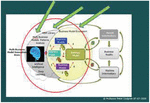
The paper on The Multi Business Model Brain [3] conceptualized on the perspectives to construct and implement a MBMI Brain, in this context explaining the vision of the MBMI Brain construction. How it will be able to create, capture, deliver, receive and operate BM’s with a mix of human and/or machine interaction physically, digitally, virtually, simultaneously and autonomously. The MBMI Brain’s were expectedly – at an optimum – proposed to operate any BM in any BMES, anytime, anywhere to anybody and anything. A conceptual model in Figure 1 was shown explaining how the MBMI Brain was working in its Business Model Ecosystem (BMES) together with MBMI AI, MBMI Machine Learning and MBMI Deep Learning. MBMI Library and MBMI Pattern analysis were argued to support and continuously update BM’s archetypes and combination of BM’s based on the “learning” gained through their continuous interaction with BMES’s and related BM’s. In this case – Green Business Model archetypes and Green Business Model Patterns together with combinations of GBM’s will be part of the MBMI Brain.
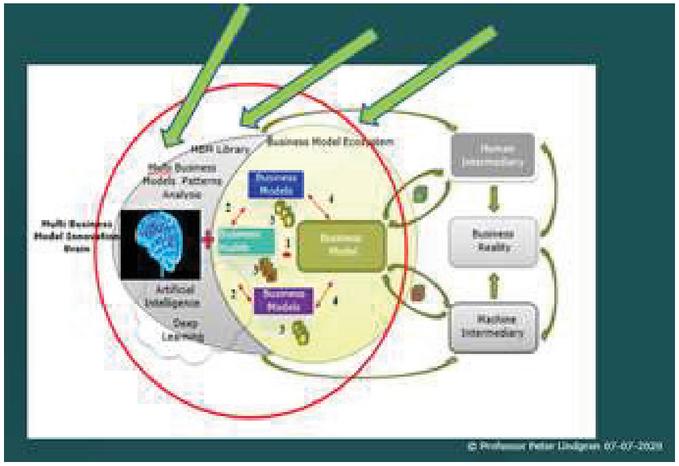
Figure 1 The GMBMI Brains Interaction with Business Model Ecosystems with Human and Machine interaction inspired by [1, 3, 8, 10].
3 The GMBMI Brain
The GMBMI Brain is proposed to be supported by GMBMI Artificial Intelligence (AI), GMBMI Machine Learning, MBMI Deep Learning (DL), a GMBMI Library and GMBMI Patterns analysis. These parts of the GMBMI Brain are expected to be special “centers” with “tools” placed outside the core GMBMI Brain. Human and/or machine based sensors interacting in the BMES business reality – “at the frontend” in the BMES – as indicated in Figure 1 with the red circle continuously operating known GBM’s [11, 12] and “learning” new GBM’s. Sensors adapt and transmit sensor data to the MBMI Brain through tangible and intangible relations. These parts lays outside the core GMBMI Brain and the GMBMI Brain operate now on behalf of these data transmitting backwards and forwards through the GMBMI’s Brains relations to the Business GBM’s in the respective BMES’s. MBMI AI, ML and DL algorithms help to optimize and suggest change of existing GBM’s and help propose new GBM’s directly to the responsible person or/and machine in the business to pass on to e.g. the user and/or customer and/or network. Based on knowledge about other GBM’s in other BMES’s GMBMI AI, ML and DL algorithms will support implementing of change into the business reality based on its GMBMI Brain analysis carried out together with the GMBMI pattern analysis and available GBM’s and knowledge of combination of GBM’s in the GMBMI library.
3.1 GMBMI Artificial Intelligence (AI)
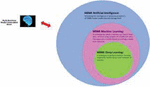
MBMI Artificial Intelligence was define [3] as a broader umbrella under which MBMI Machine Learning and MBMI Deep Learning come. In Figure 2 we sketchs how we expected MBMI AI, MBMI Machine Learning and MBMI Deep Learning are related with each other and interact with the MBMI Brain. Inspired by Poole [13] AI can in relation to MBMI be defined as the study of “intelligent MBMI agents” and any MBMI device that perceives its BMES and takes actions to maximize its chance of successfully achieving its Business objectives”. Inspired by Russell [14] and Kaplan [15] we further developed AI related to MBMI by characterizing MBMI AI as “a MBMI system’s ability to interpret external data from the BMES and learn from such data to use those learnings to achieve specific objectives and tasks through flexible adaptation of the offered BM’s”.
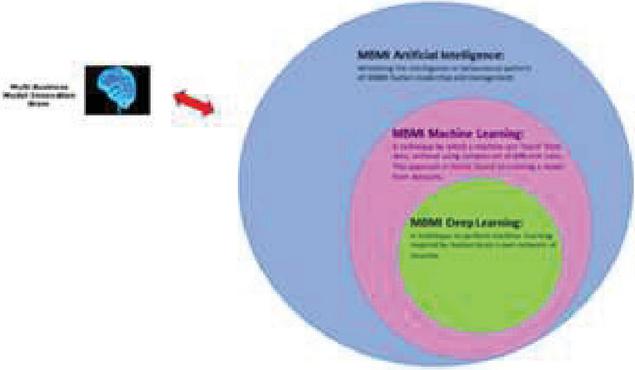
Figure 2 The GMBMI Brains Interaction with GMBMI AI, GMBMI Machine Learning and GMBMI Deep Learning inspired by [1, 3, 8, 10].
Artificial Intelligence related to MBMI can be called MBMI machine intelligence in contrast to the MBMI Human intelligence displayed by managers responsible and caring out MBMI. The term MBMI AI can be used to describe machines (or computers) that mimic “cognitive” functions that humans associate with the human mind, such as “learning” and “problem solving” related to MBMI [3, 14]. As machines increasingly become capable of operating GMBMI, tasks human based “GMBMI intelligence” are increasingly removed from human GMBMI Managers to machines. True GMBMI AI can hereby be defined as
“whatever GBM and combination of GBM’s that hasn’t been proposed and introduced to any BMES yet”
and then is moved to machines based GMBMI operations. Inspired by McCorduck [17] “the GMBMI AI effect” is yet extremely difficult to machines to carry out 100% as it includes elements that still distinguish humans to other species and machines. Inspired by our previous paper [3] – we divide GBMI AI into three different types:
(A1) Analytical GMBMI AI
(A2) Human-inspired GMBMI AI
(A3) Humanized GMBMI AI
The big challenges of GMBMI AI research include however GMBMI – reasoning, knowledge representation, planning, learning, language processing, perception and the ability to change and manipulate BM’s and combination of BM’s – including persuasive multi business modelling [18]. GMBMI intelligence is among the GMBMI Brains field’s long-term goals [19] including GMBMI statistical methods and patterning, computational GMBMI intelligence, and traditional GMBMI symbolic AI. Many tools is expected to be used in future GMBMI AI, including versions of advanced search and advanced mathematical GMBMI optimization, artificial MBMI neural networks, and GMBMI methods based on statistics, probability and economics – including both monetary, nonmonetary and mix of such value propositions and value formulas. The GMBMI AI field is therefore expected to be based on a cross interdisciplinary field and will draw upon computer science, information engineering, business mathematics, business psychology, business linguistics, business philosophy, business intelligence and many other fields related to GMBMI.
The field of GMBMI AI is found on the assumption that human GMBMI intelligence can be so precisely described that a machine or more machines together can be created to simulate humans “GMBMI Intelligence” [3]. The effects of GMBMI AI can be tremendous also meaning higher unemployment to humans [20].
GMBMI Deep learning can be defined inspired by [14, 21, 22] as deep GMBMI structured learning or hierarchical GMBMI learning and can be regarded as part of a family of GMBMI machine learning methods based on GMBMI artificial neural networks. GMBMI Learning can be supervised, semi-supervised or unsupervised. Deep learning GMBMI architectures such as deep GMBMI neural networks, deep GMBMI belief networks, recurrent GMBMI neural networks and convolutional neural GMBMI networks can be expected in the future to be applied to all fields including GMBMI machine based vision, audio, speech, taste, smell, sound and feel recognition [44]. GMBMI language processing, GMBMI social network filtering, GMBMI machine translation, GMBMI bioinformatics, GMBMI design, GMBMI medical image analysis, GMBMI material and service inspection, where they will continuously produce GBM proposals and combination of GBM proposals comparable to and in some cases superior to human GMBMI managers [22, 23].
GMBMI Artificial Neural Networks can be inspired by information processing and distributed communication nodes as in biological systems. GMBMI brains could have various differences from biological brains. Specifically, GMBMI neural networks tend to be able to be static and symbolic, while the biological GMBMI brains of most living physical Businesses and BMES was proposed in our earlier paper [3] to be formed as dynamic and analog inspired by [24, 25].
3.2 The GMBMI Library
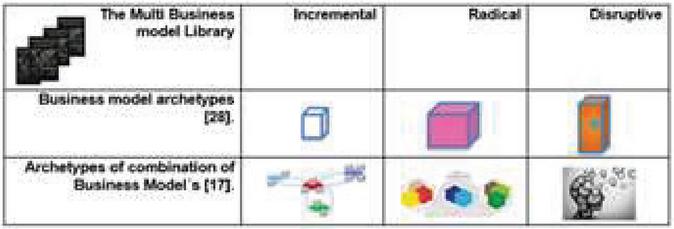
The Green Multi Business Model Library is proposed to consist of two parts
(B1) A library of Green Business Model Archetypes
(B2) A library of Archetypes of combination of Green Business Models
divided again into 3 categories
1. Incremental – small changes in GBM dimensions and combinations of GBM’s [5]
2. Radical – Radical changes in GBM Dimensions and combinations of GBM’s [5]
3. Disruptive – Disruptive changes in GBM Dimensions and combinations of GBM’s [5].
Table 1 The green multi business model library [5]
 |
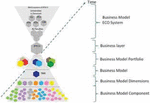
The Green Multi Business Model library is expected to host or be a memory like a “GMBMI knowledge home” including all previous known GBM archetypes and combination of GBM and their construction related to BMES, Business, BM portfolio, BM, BM dimension and BM component level as shown in Figure 3 beneath.
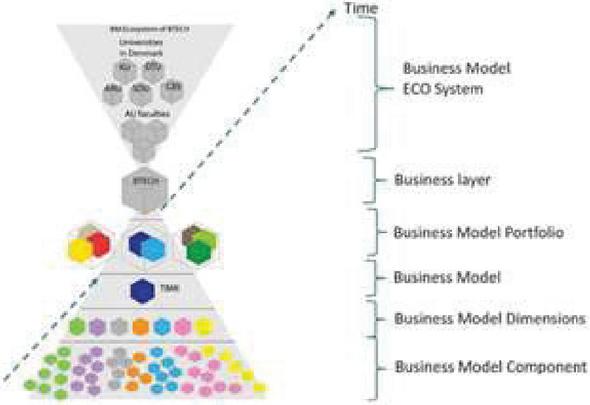
Figure 3 Levels of GMBMI and combination of GBM’s Inspired by Andersen et al. [26] and Lindgren [3].
The GMBMI Library will continuously “learn” and adapt new archetypes of GBM’s and new archetypes of combinations of GBM’s [19]. There is still very little research on lifetime of GBM and combination of GBM’s over lifetime related to BMES context. The choice of generic GBM and combination of GBM in a certain life stage of a GBM, combination of GBM and BMES is therefore highly interesting to investigate further.
3.3 The Green Multi Business Model Patterns Analysis
The Green Multi Business Models Patterns Analysis is expected to consist of:
C1. Existing known GMBM pattern typologies [3]
C2. GMBMI process typologies [3, 10, 27].
GMBM and GMBMI pattern analysis are continuously investigated and filed in this part of the GMBMI brain.
3.4 GMBMI Brain’s Construction
7 basic characteristics vital to be present inside a GMBMI Brain are described here inspired by our previous articles [3]. The GMBMI Brain must have:
A. ability to sense data, operate and make decisions on behalf of these data, which it receives from where the GBM’s meet and interact with other BM’s in their respective BMES as shown in the conceptual model Figure 1.
B. ability to act on – what is really going on in the BMES and how the GBM is performing.
C. tangible and intangible relations to sensors embedded in the BMES and GBM’s to be able to send and receive data – “values” – from the sensors.
D. ability to work with the data and create new data to the GBM’s. These data have to be delivered back to the GBM’s again through the tangible and intangible relations so they can be received and consumed by BM dimensions.
E. ability to download, see and sense GMBMI data in real time.
F. ability to be “creative” and be able to create and capture new or changed data to later value its business GBM’s in the respective BMES’s.
G. ability to ” act and do” on behalf of its GMBMI Brain process and let the solution and related data be transmitted and communicated back to the GBM’s in the BMES.
The complete GMBMI process that the GMBMI Brain must theoretically be able to take care of and operate was shown in our previous articles [3] inspired by Andersen et al. [28]. We now turn to some case examples to show the GMBMI Brain process in operation in different BMES and business context.
4 MBMI Brain Cases in Practice
The GMBMI Brain Cases are elected examples from GMBMI Brain Cases we have studied. They are in some cases anonymized because of confidentiality requirement.
4.1 Case 1. – The LY Case – A Human and Machine Based GMBMI Brain Operation and Process (Physical and Digital MBMI Brain Process)
LY delivers complete advanced baggage-, library book storage-, ecommerce packaging-handling systems for large businesses in different BMES.
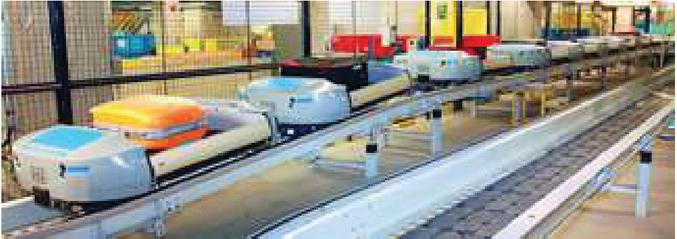
Picture 1 Airport sorting system.
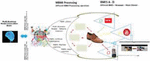
The sales and buying process in such BMES is extremely complicated, long and involves a multitude of people inside and outside the selling and buying center. It is critical and necessary to get early and continuous information on existing and new projects well in advance and up to 5–10 years before the project starts to be formed and sketched. In BM cases like these, it is not enough any longer to have contact to the purchase manager of the project and business people responsible for the project. All kinds of information sources is vital and critical – internet based service responses from users and customers, hints and comments from production and service employees related to existing operating business installations, service experience on existing installations and many more information. However, it is very difficult to get access to these information and people inside the organization to get first hand information. Therefore it was necessary for LY management to establish a “team key account management system” [29] where sales and marketing people together with production, service people and internet search employees “learned” in combined physical meetings, digital advanced internet, sensing and searching the potential customers wants, needs and demands related to BM’s. LY build up a smart Business Intelligence system with a Key Account Manager as “the MBMI Brain” in the center. A sketch of the complex buying system combined with the LY MBMI Brain System is illustrated in Figure 4.
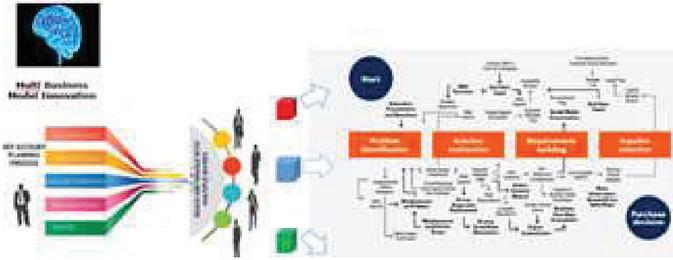
Figure 4 MBMI Brain System combine with MBMI BRAIN for B2B complex systems like LY case business [29].
Based on the Key Project Framework and individual cases, the key account manager develop a deep understanding of the business positioning as a strategic partner for winning the next project. In this process the MBMI Brain found that it was necessary to amend existing BM’s with GBM. A clear commitment of the new European Green Deal call [30] is that “transport should become drastically less polluting”, highlighting in particular the urgent need to reduce greenhouse gas emissions (GHG) in aviation. transport. In aviation, traffic volumes are expected to increase significantly by 2050 and the sector is already generating 14% of the EU GHG emissions from transport. In this context, airports play a major role, both as inter-connection points in the respective transport networks, but also as major multimodal nodes, logistics hubs and commercial sites, linking with other transport modes, hinterland connections and integrated with cities. As such, green airports, as multimodal hubs in the post COVID-19 era for sustainable and smart mobility have a great potential to immediately contribute to start driving the transition towards GHG-neutral aviation and wider multimodal mobility already by 2025. This topic therefore address the customers of LY to create innovative GBM concepts and solutions in order to urgently reduce transport GHG emissions and increase their contribution to mitigating climate change.
The LY MBMI Brain system in the LY Case was operated as a combined Human and Machine based MBMI Brain overviewing conventional MBMI process and projects “using the Brains and sensors” of a multitude of humans and machines to seek, create, capture, receive, deliver, consume and analyse data and following act-do and lead the sales and marketing process of LY’s BM’s. The MBMI Brain of LY functioned both in the physical and digital part of the BMES and had an overview of human based MBMI Brain leadership. When the Green Deal application came out the MBMI Brain at LY had to be changed and adapt GBM, combinations of GBM and BM’s together with GBM Patterns to be able to offer and compete for future tenders om Airport sorting systems. As many of these GBM’s was new to LY and its MBMI Brain a lot of new knowledge had to be transferred to the LY MBMI Brain to make it a GMBMI Brain.
4.2 Case 2. The Plastix Case – Radical and Disruptive Green Business Modelling – A Mainly Pure Human Machine Based GMBMI Brain Operation and Process – (Mainly Physical and little Digital GMBMI Brain Process)
Plastix provide sustainable solutions for cleaner environments and cleaner oceans. Plastix in Lemvig, Denmark transform fishing nets, fibres and rigid plastic waste fractions into high quality plastics raw materials. Plastix have the fishermen bring broken and used fishing nets from sea to harbor and to recycling. Plastix technology transforms an extensive disposal/deposit problem – discarded fishing nets and other post-use plastic waste fractions – into valuable recycled HDPE and PP plastics raw materials. Plastix creativity for solutions derives from the imagination, designs, Business Model innovation, strategies and collective implementation methodologies that meet the diverse needs of customers and networks. Through the use of advanced technology Plastix provide treatment methods that have the ability to effectively recycle plastics and metals from net and trawl without downgrading the quality and thereby loose valuable resources. With recycling technology, the used maritime materials can be recycled 100% in a closed loop. Plastic waste and recycling of plastic will create horizontal and maybe diversified new BMES, which will need and be able to take advantage of future wireless technology BM’s development. One large challenge is however documentation of the plastic. As fishing nets contains a mix of different plastics, these different plastic fragments have to be sorted, which today is done manually with high resource consumption and labor costs. Advanced wireless technology can support identification and sorting different plastic types. Then Plastix will be able to come closer to producing 100% documented clean plastix. This will enable Plastix to enter the BMEs for water pipes and other plastic BMES that due to strict EU standards requires clean plastic. In Figure 5 a sketch of some of the GBM’s offered during a lifecycle of a recycle fishernet is shown.

Figure 5 Green Business Modelling with Plastix.
Plastix GMBMI Brain is mainly a human based GMBMI Brain process embedded with different pieces of service, equipment and software that can “sense” the quality of the rawmaterial – recycle fish net and later the material while it is passing production. If a fishnet does not match the specific formats for a fishnet then the MBMI Brain reacts to the quality controller by informing automatically what parts of the fishnet do not match and proposing the manufacturing team to make extra processes to secure quality of resources taken into the production.
Plastix mainly focus on circular part of GBM and reusing fish net that either is floating at sea or are broken under fishing at sea. Plastix have a special partnership with fishermen and harbor’s so all fishnet from sea are brought to the harbor and transported to plastix factory.
4.3 Case 3. The Kitchen Case – The Mix Human Bond and Machine Based MBMI Brain and Process – (Physical, Digital MBMI Brain Process)
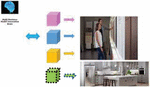
The Kitchen business serves the British Kitchen BMES with kitchens in all ranges and price classes. About 30% of their kitchens are sold through retailers and another 40% through construction and kitchen design businesses. The Kitchen businesses uses instore software to support sales of kitchens, when customers and sales people discuss design and buy of kitchen. The Kitchen business MBMI system is integrated with internal system that through colors and hidden text messages embedded in the sales software indicate on the computer screen to the sales people, which fridge, dishwasher, table e.g. is best to sell to the customer. It means that the Kitchens MBMI brain continuously pushes information out to the sales person and sales process indicating by colors and hidden messages which BM’s the sales person should try to sell. This is also seen often in e-commerce sites but here it is used as a Human Bond and machine based MBMI brain process. The MBMI Brain hereby “persuade” the sales person to sell those BM’s that have the largest earning for the business. The system can also be integrated with the physical kitchen shopping interiors. The Kitchen MBMI Brain system is easy to navigate, interactive, and well-organized to the sales person and the customer. The Kitchen pricing and ordering software is a powerful solution that kitchen retailers can rely on and have their BM’s value formula’s and ordering system in one place, while being able to work and service simultaneously with multiple users, create impactful proposals, compare different vendors and styles, and generate orders instantly. The Kitchen MBMI Brain system offer an advanced solution, custom-tailored for the Kitchen Retailers needs, centralize, streamline, simplify their sales processes and help sales people to close more sales faster, with ease. In Figure 6 a sketch of such system is shown.
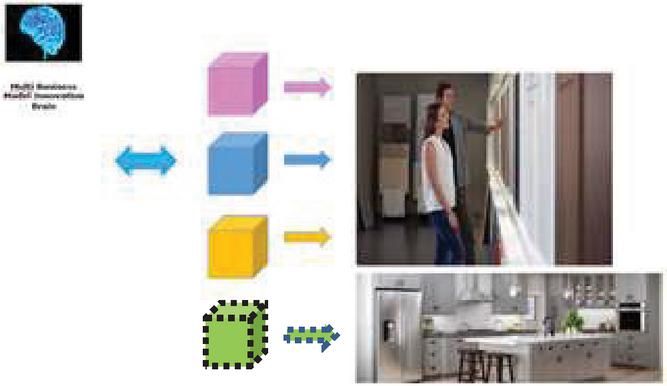
Figure 6 A combined human and machine based MBMI process embedded with a MBMI Brain behind.
In 2017 the Kitchen Business already began to get information and request from customers that wanted to buy “green Kitchens”. In late 2019 the Kitchen business began innovating green kitchen BM concept and began to change existing MBMI brain to adapt MBMI brain to develop part of it to become a GMBMI. Focus on GBM parameters were use of environmental friendly materials and less use of materials, resources and material waste reduction and recycling of packing and materials.
4.4 Case 4. The Care of Carl Case – The Mix Human Bond and Machine Based MBMI Brain and Process – (Physical, Digital and Virtual)
The Swedish business Care of Carl focus on offering clothing for men. Care of Carl BM’s focus on high quality, sustainability, design, price and selectiveness. Care of Carl distributes through an E-commerce web shop combined with physical shops. Care of Carl even take care of repairing Care of Carl clothing throughout the whole lifecycle of a BM. Hereby the clothing last longer, use material from sustainable resources and suppliers that focus on producing sustainable. Care of Carl also work on a new concept on recycling old clothing from customers.
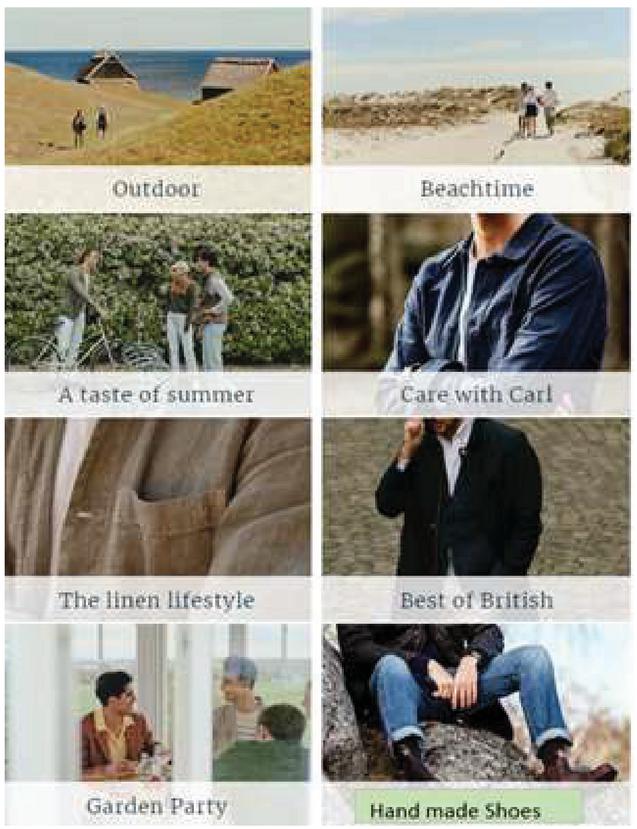
Figure 7 Care of Carl BM Portfolio’s 2020
A Mix Human Bond and Machine base GMBMI Brain and process is the basis for Care of Carl serving customers with Physical, Digital and Virtual BM offering anytime, anywhere during the whole BM lifecycle of a Care of Carl BM. The GMBMI Brain at Care of Carl is still primarily lead by humans but by its increasing present on internet and digitalization of products and service the machine based GMBMI Brain takes over more and more. The GMBMI Brain of Care of Carl has by origin been partly green and offered sustainable value proposition embedded but now adapt most GBM’s approaches – environmental issues as addressing no pollution, sustainable resource and material use, reduction of waste, circular focus on Business Modelling, GBM operation and initiative on all levels of Business Model Innovation.
4.5 Case 5. A Pure Machine Based MBMI Process Embedded with Augmented Reality and AI is Shown
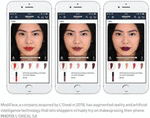
L’Oreal implemented a new MBMI Brain praxis as it expanded in 2019 its Virtual Try-On Service BM to adapt the trend to become among several of the first cosmetics businesses turning to augmented reality and artificial intelligence to boost sales and its BM’s value proposition.
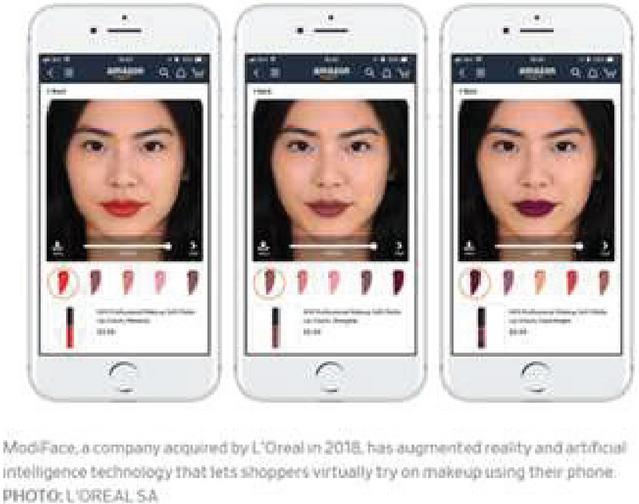
Figure 8 A pure machine based MBMI process embedded with Augmented reality and AI is shown.
L’Oréal’s U.S. rolled out this BM that lets shoppers use their phone’s camera to simulate various hair-color shades from L’Oréal products Garnier Nutrisse and Garnier Olia using augmented reality technology. Using the Google Lens image-recognition mobile app, made by Google Inc., shoppers can point their phone cameras at the hair-color boxes to activate the virtual try-on service. The application identifies the product and color and then activates the virtual try-on service, powered by technology from ModiFace, a business that L’Oréal acquired in 2018 for an undisclosed amount. Customers can use the feature anywhere the two Garnier products are sold, but 500 participating Walmart Inc. stores will have signs near the products demonstrating on how the virtual try-on service can be used [31]. The last showing an example of a mix physical, digital and virtual value proposition output of a mix human- and machine based MBMI Brain operation and process.
When online and in-store customers use the Lóreal system, the MBMI Brain supported by advanced technologies lets the customers virtually try on in this case beauty products before purchasing them. L’Oréal have seen three times the rate of customers purchasing their BM’s. L’Oréal has been working with Modiface’s augmented reality technology since 2012, and decided to buy the business after coming to appreciate its potential and considering this technology to be a critical MBMI competence to have for L’Oréal in the future.
Embedded in this MBMI Brain is now also L’Oréal’s Green BM’s Garnier – a green beauty initiative that will see the brand produce all of its products with zero virgin plastic, use only reusable, recyclable or compostable packaging and ensure all industrial sites are carbon neutral. In line with L’Oréal’s sustainability targets, the brand promise that its industrial sites will be 100 percent carbon neutral by 2025, that all plant-based and renewable ingredients will be sustainably sourced by 2022 and all new products will have an improved environmental profile by 2025, as well as be packaged in reusable, recyclable or compostable materials containing zero virgin plastic.
“We realized that AR, AI and Green would really change the consumer experience and demand for L’Oréal and the BMES,” L’Oréal Chief Digital Officer Lubomira said. “We decided that partnership was not enough. We really wanted to source that competence and capability internally” [31]. Another example of how we can expect business at the core business level to be changed on the competence level.
“It is difficult to determine how certain products, especially hair color, will look on a person until they try them on. There’s a real advantage to guiding your consumer to find the right color,” Ms. Rochet said.
And while retailers may offer makeup samples in stores, customers might not have time to try on multiple shades and wipe them off, or they might not want to experiment with samples that have already been used. ’Oréal is among several cosmetics businesses turning to augmented reality and MBMI AI to boost sales. Cosmetics retailers that offer similar virtual try-on services include Ulta Beauty Inc., which recently acquired two startups that specialize in augmented reality and AI, and Sephora, owned by LVMH Moët Hennessy Louis Vuitton SE.
Sales for L’Oréal between January and September of 2019 were about €22 billion, up by about 8% compared to the same period in 2018. The business said in October that one of the main drivers of growth was increased e-commerce sales, which grew about 49% during the first half of 2019 compared to the same period last year. In other words growth in sales is in both the physical and the Digital BMES of the cosmetic BMES. Shoppers are spending more on L’Oréal products online, partly thanks to ModiFace’s technology.
A customer using the ModiFace tool typically tries on more than 20 different shades of makeup, Ms. Rochet said. Clicking a “try on” icon next to a product lets the app use the customer’s laptop or phone camera to generate a preview. Simulations of makeup and hair color have gotten more true-to-life with advancements in quality of the camera on smartphones, as well as processing power in the phones, said Parham Aarabi, chief executive of ModiFace, “It took a long time for the technology to get better,” Mr. Aarabi said.
Websites such as Amazon.com Inc. and Sephora also allow shoppers to virtually try on L’Oréal makeup products including lipstick, eye shadow and foundation using ModiFace’s technology, Mr. Aarabi said. The same feature is also offered on in-store tablets at bricks-and-mortar stores including Sephora.
The ModiFace technology uses an AI system called a neural network technology to automatically identify parts of the user’s face and apply the right shade of makeup on the right part of the face. Mr. Aarabi said. The AI systems also analyze the background lighting to simulate the makeup color correctly. Neural networks are composed of layers of interconnected artificial “neurons” that automatically learn about the features of a specific object based on large amounts of training data.
5 Case 6.: GMBMI Brain in Swedspan GMBMI Operation and Process
Swedspan A/S BM’s from all kinds of recycling paper materials and has a strong focus on green economy, circular economy, green production and reduction of water consumption and waste. Swedspan has a turnover of about 20 mio. EUR and employs about 100 employees. Swedspan A/S produces by order high quality products to the european industry. Swedspan A/S have build up several quality systems so all products can meet precise, measurable and well defined quality demands. Swedspan A/S continuously invest in greener and more sustainable technologies. Swedspan A/S has in 2019 finish a large rebuild of the production and installed software to manage recycling production. Production capacity is expected to increase by 2021 10–12 %, which means that energy consumption and CO2 emission is expected to raise if Swedspan A/S do not invest heavily in new technology. In table II some of the key figures related to the GBM measurements are shown.
Table 2 Swedspan A/S green business model approaches
| Yearly Figures Within Swedspan A/S | ||||
| Green Business Model Approaches | 2018 | 2019 | 2020 Budget | 2021 Goal |
| Specific Energy Consumption kwh/netto ton | 1613,5 | 1685 | 1576 | 1450 |
| Supply af heat in MWh to local community | 74402 | 72900 | 80000 | 84000 |
| CO2 emmision from production ton | 1235 | 1951 | 1600 | 1650 |
| Water consumption m2 | 407528 | 437481 | 410000 | 400000 |
Swedspan A/S focus on becoming green on more areas as seen in Table 1. Energy consumption will be reduced, local supply of heat to the municipalities small towns will be increased, CO2 emission will be reduced and water consumption too. However, as can be seen CO2 emmision is expected to rise in 2021 due to business growth, increased production and expected political change in emission calculation from government side. In Denmark the carbon footprint calculation related to renewable energy sources are politically decided each year – latest calculation is from 2018 [32] This means that the business on some GBM parameters will turn more green, but on others as e.g. the CO2 parameter in table II “black”. If they use an renewable energy source that is not political prioritized positively related to CO2 and subsidies a paradox turns up related to the GBM. In some cases it could be more preferable to increase electricity and water consumption.
Another issue is that GBM’s impact on CO2 e.g. are measured in absolute numbers – ton of CO2 reduction. In relative measurements more can however be produced with less resources and less “carbon foodprint” from the business – but this is not valued in the emission calculation. Further the measurements on Energy Consumption, CO2, water consumption, waste water production are all calculated and visualized for the individual business – not for the business entire vertical Business Model Ecosystem [33] (suppliers, users, customers and other businesses). All business models that are included and contribute to the business model are not taken into the green calculation – so a case of “green washing” [34] can easily be established – and the business can still be classified as green. Green washing or Green Sheen is a form of marketing spin in which green PR (green values) and green marketing are deceptively used to persuade the public that an organization’s products, aims and policies are environmentally friendly and therefore ‘better’; appeal to nature. Common examples present in the marketing of food products, alternative medicine and natural medicine. It means that some businesses can be considered having GBM’s, where as suppliers at the same time might supply raw material produced with e.g. “black energy”. Customers might buy GBM’s to be combined with “black” BM’s. Case of Green Washing is continuously coming up in the GBM BMES debate where businesses by buying CO2 quotes can be allowed to do CO2 emmision. Swedspan A/S is not using this practice but it shows that the classification of GBM’s becomes even more complex when Green is considered for the whole value network. The GMBMI Brain would with advanced sensors be able to prevent Greenwashing as it would be possible to measure GBM’s anywhere and anytime.
Another example is windmill’s that are generally considered being GBM’s as they are producing green energy. Many wings from windmills have to be taken down, brought to shore by ship and transported to deposition. Recycling is often not possible as the material used for the wings cannot be recycled yet because it contains a mix of materials and used materials. Further the heavy steel towers, gears and nacelles are produced with much energy consumption – often “black Energy” – which makes the Lifecycle analysis (LCA) in a CO2 and material recycling perspective very hard to measure. A GMBMI Brain supported by advanced sensors, AI and Deep Learning would be able to help measure GBM better.
6 Case 7.: MBMI BRAIN of German Lloyd Shoe Business
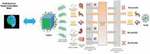
In Figure 9 and illustration of how the MBMI BRAIN of German Lloyd business push BM value propositions through newspaper BMES (BT) e-newspaper, music channel (Youtube BMES) webpages, E – Shopping Mall (Boost.com – BMES) and direct through own loyalty E-commerce site (Lloyd.com).
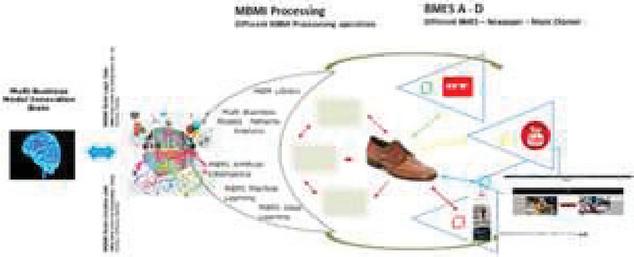
Figure 9 Illustration of MBMI Brains working in different BMES.
In this case the Lloyd business MBMI Brain follows the customer via advanced sensor technology anywhere and anytime through the customers BM lifecycle. The MBMI Brain continuously offers the customers new BM offers as the customer “touch” upon Lloyd’s sensors. At the moment the digital and virtual MBMI Brain at Lloyd is the most developed but soon the shops will follow. Another business Benetton in the same BMES have for several years experimented with sensing shop interiors.
Competence and Network GBM Dimension – LLOYD is an active member of the CADS initiative [35], which aims to pass on knowledge to manufacturers and suppliers in order that these avoid using harmful substances in the production of shoes. Within the scope of toxic substance management, LLOYD pursues a much stricter regulation of chemical substances than required by the law. The suppliers selected see to it that no toxins are created within the scope of mineral-based tanning. The process of mineral or plant-based tanning is necessary in order to make the leather processed more durable and to enable it to be processed further. LLOYD’s production locations in Sulingen (Germany), Valea Lui Mihai (Romania) and Vellore (India) have all been built according to consistent LLOYD GBM standards. LLOYD’s management has made the quality of processes, products and services the company’s highest goals. Employees work in a climate that supports and honours an open mindset, one which is ready for change and takes responsibility, is customer-centric, quality-and green conscious. To ensure employees can act with quality in mind, contribute improvements and realise these, they are trained and qualified in these needs and requirements.
Network GBM Dimension – For speedy availability and short transport routes, a majority of the suppliers selected are within Europe, such as Italy. To guarantee high quality standards, LLOYD work together with suppliers with whom they have cultivated business relations over many years. As people are also always in focus at LLOYD, businesses which use child or forced labour, or which allow discrimination of all kind, in terms of race, gender or political views, will not be a partner of LLOYD.
The leather used by LLOYD comes mainly from Europe (Italy, Germany, Poland and Portugal). Additionally, LLOYD works with select tanners in south-east Asia who follow the product- and process-based LLOYD standards. Network partners must meet the requirements of LLOYD’s Code of Conduct (social and environmental regulations), the CADS List of Restricted Substances in Shoes, and the European chemicals regulation REACH.
High quality is what characterizes LLOYD and that’s why LLOYD place great value on the condition and quality of materials which are used in making shoes. To guarantee the materials meet LLOYDS standards, employees are regularly on-site at the suppliers’ facilities and ensure that the leather is suitable for further processing.
LLOYD is an active member of the CADS init. LLOYD continuously strives to reduce energy consumption and that’s why the electricity for the production site in Sulingen as well as their own retail shops comes from hydropower. By this 1,562 metric tons of carbon emissions in total were saved in 2018 according to LLOYD. The lighting system in the production, administration, warehouse and adjoining outlet at the Sulingen site has been exchanged since 2015 to save energy.
Sustainability is an important topic for the shoe industry and LLOYD. It is a topic of absolute interest and but when talking footwear, sustainability and GBM is a very broad subject: it touches on various aspects that impact businesses along the entire supply chain from raw materials to consumption. LLOYD’s opinion of sustainability is balance between two aspects:
1. Create an effective story telling capable of attracting the attention of consumers;
2. Provide a scientific and quantitative basis for the story.
LLOYD believe the era of green washing is over and the time has finally come to address the issue of sustainability in the footwear sector with a serious and precise approach. LLOYD’s think it is necessary to elevate the discussion and focus on methodologies based on LCA (Life Cycle Assessment) which have the objective to investigate, measure and accurately describe the environmental impact of products and footwear organizations. In case try to achieve two goals:
1. Aggregate all the articles on the theme of sustainability that describe case histories ranging from development of materials to projects of sustainable shoes and that talk about businesses and events that focus on GBM and sustainability.
2. Produce articles similar to white papers that can help to understand in a simple but not trivial way the theme of sustainability in the footwear sector.
In this case the last initiative have been around the Biodegradable shoes – What means putting the shoe into the soil, wait a little while and in the end humans can’t find it anymore because it has turned into something else.

Picture 2 The Biodegradable shoe [36].
6.1 Case 8:: Pure Machine Based MBMI Brains that can Sense with all 5 Senses
Still we have not identified pure machines based “MBMI brain’s” that are able to sense like with all 5 senses. Smell, taste and touch is still a challenge but several research labs are experimenting with these sensors to be built in to BM’s. In Figure 10. we show an example on how we conceptual expect future GMBMI brains to operate including all senses sensing green in the near future.
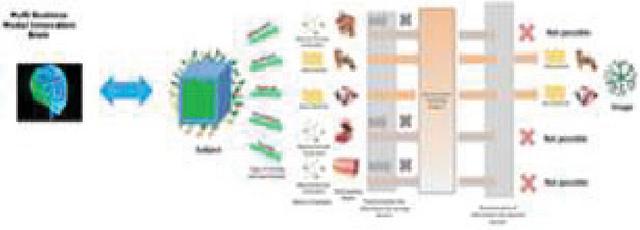
Figure 10 Machine supported GMBMI brain process with a mix of human and machines based GMBMI leadership, management and advanced sensor technologies that can create, capture, deliver, receive and consume/analyze 5 different green sensor data inspired by [31–33].
The GMBMI Brain is expected as illustrated with the green color in Figure 10 as being part of the business general MBMI Brain. When advanced it can heighten the visual, sound, smell, taste and touch components of a BM creating a compelling and memorable user and customer experience. Many customers like disruption to get noticed and experience new GBM’s or different use of AS IS GBM’s. In the three-dimensional world of physical retail, one form of disruption is one that challenges the customer existing Green perceptions, and to effectively do that, one or all of the senses must be engaged.
Seeing is the most obvious sense associated with Green retail. In a cluttered green retail landscape, cut-through is key to grabbing the customers’ green attention. Galeries Lafayette on the Champs Elysees in Paris, France have done that in style with their entrance- a glowing tunnel of light that not only gets cut-through but arouses curiosity to the green customer. It serves as a “decompression zone” between the busy, noisy streetscape and the wonders inside- and is a great Instagram green moment.
Sound has long been known to be an essential in stores- if it’s right, customers tend not to notice it, but it enhances their emotional state. If it’s wrong, you notice it, and it jars to the point where it’s uncomfortable. If it’s not there at all, it’s as if the store was closed. Perfumer Miller Harris in London’s Coal Drops, UK yard has uniquely combined sound and smell with the MBMI Brain leading the exposure.
Sound or noise in GBM is also proposed to be related to GBM’s. If a BM creates noise either it is possible to hear by humans or it is low frequency noise or very low noise – windmills as an example or electrical wires from powerstations – we propose that this is also related to the green term environmental pollution. This has not been included in most GBM frameworks – neither sustainable and circular BM [12] but directly or indirectly influence humans, species hereunder maybe also plants. In other words if a BM pollutes or influence environmentally negatively these then we propose it is not green – or only partly green if the BM meets green requirements on other parameters.
Taste can be exposed as when a Record-shop-like listening booths provide an aroma and a sound associated with it. Woodland sounds with a fresh forest based scent. Both smell and sound are hugely evocative- combining them both is an interesting and powerful tools for future GBM Innovation. This add with intense colors in-store create a sensuous environment around the buying process.
In the same way as sound and noise if a BM creates a negative experience to taste measure against normal taste then we propose the BM not to be categorized as green.
The same we propose to tactile and feelings. Retail experiences are tactile or feelings. Experience shows that touching a product is one step towards buying it. The sink is a prominent feature in all skincare environments. L’Occitane in their London flagship, UK shows the sink resembling the centerpiece of a village square in Provence.
Tasting the product would seem to be the province of food retailers- chocolatiers, cheese and sausage for example. L’Occitane on the Champs Elysees, Paris, France have added taste to their multi sensual experience by incorporating a Pierre Hermé macaroon bar with a full dessert menu. Desserts and skin care might not be an obvious combination, but it appeals to a tourist-based customer audience in the center of Paris, and the place is packed.
In L’Occitane on London’s Regent Street, UK the five senses come together. It’s a hugely colour packed environment, with lighting that enhances the colours of Provence. In store, music harmonises with the visual environment. The architecture itself is built partly from L’Occitane’s natural ingredients. There are columns of lavender, lemons, and almonds. There is the aroma of all the natural ingredients and the merchandise itself, and the flavour of the delights of the Pierre Hermé café. Customer can feel the running water on their hands that takes them back to the squares in Provence, France.
Humans senses combined with a GMBMI Brain can contribute to customers emotions for Green. In a business environment the future business will be of stimulating as many of the customers senses as possible and try to do it in new and innovative ways, combining two or more senses to provide personal and intimate communication with customers — something they can’t find just physical, just online, just virtual – but in a combination of physical, digital and virtual world lead by a GMBMI Brains.
7 Constructing the GMBMI Brain
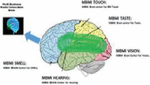
The Human Brain make the human and the body act and do through relations and make the body live its life as it “strategically moves” along its life. The human sensors measurement systems helps continuously the human brain to measure the human bodies performance – “downloading” and “seeing” – let it interacts according to and with the environment, machines, spices and humans around – “sensing” and “act and do”. This is “at first glimpse” a perfect competence and capability to adapt 1 to 1 into the construction of a future MBMI Brain – in this context a future GMBMI Brain. As an inspiration an illustration of the human brain is shown in Figure 11, showing the brains 5 critical senses – smell, hearing, touch, vision and taste as referred to in our previous paper [3], we propose that the GMBMI will be a part of the MBMI – as we do not expect all BM in a Business will be Green.
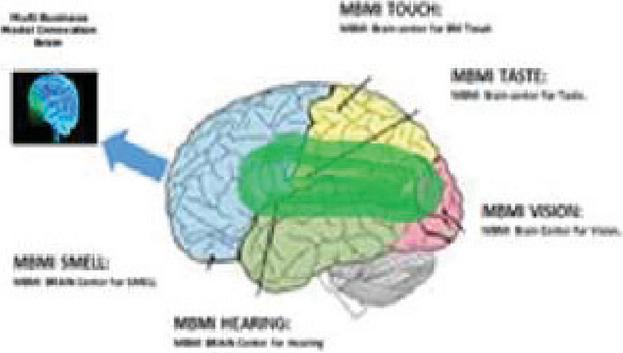
Figure 11 The GMBMI human brain and its 5 sensing centers [33].
A manifold and different types of “human sensor centers” receives GBM data from sensors placed different strategical places in the human body and support the Human Brain with performance measurements – e.g. data for touch, taste, vision, hearing, smell of green. The human brains sensor centers and the sensors collaboration enables the brain to “understand” and “react” on all kinds of green sensor data. The GMBMI Brain together with its sensors would at optimum be constructed more advanced to become more intelligent and different than a regular Human based MBMI Brain. In other words overcoming the barriers, weaknesses, threats and limits of the human based MBMI brain – combining the advantage of the human and the machines competences and capabilities in the aim of creating, capturing, relating, delivering and consuming GBM’s.
A proposed future GMBMI Brain construction will at least have the same sensors, sensor centers and communication systems, competences and capabilities built into the GMBMI Brain construction as the human brain. With its 5 sensor centers, that will be able each to receive, capture, translate, analyze, create and deliver sensor data from both human and machine based sensors. It will allow the GMBMI brain to have more advanced sensor functionality, than a pure Human based MBMI Brain. It would be able to access more data and faster as a human based MBMI brain have capacity, capability to and can access. When supported by quantum computers and 6G technology [38] that is expected to provide and have the GMBMI Brain to be able to operate faster than a pure human MBMI brain in an MBMI process.
With GMBMI Brain’s sensor centers it will be able each to receive, capture, translate, analyze, create and deliver sensor data from a mix of human and machine based sensors it will allow the GMBMI brain to have more advanced sensor functionality than a pure Human based GMBMI Brain ever can achieve.
One of the core difference to humans compared to other species and yet also machines is that humans can be creative [39]. Humans have a litle expansion of the coretex part in front of its brain and human brain got a lot more of it than other species. That let to more space between input and output, which means that humans take more time to work with the in and out data – “thinking” – about the data in- and output before it act. Other species are much more reflective.
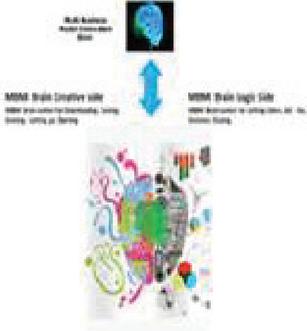
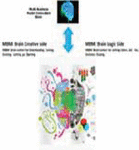
Figure 12 The creative and the logic side of the GMBMI Brain embedded inspired by Reebooble.com [40] and Saghaug et al. [41].
The Human Brain enables humans “to unhook from time and think about future” – “simulate What IFs”. Humans are constantly rehearsing, trying out and predicting possibilities. This enables humans to let their hypothesis to die in their heads [39].
“Creativity is the humans biological mandate” [39]
And is up to today its main advantage related to a machine based brain. In future GMBMI Brain its needed to develop a platform that enables the MBMI Brain to do both the creative and the logic GMBMI processes. This means firstly the creative part of finding new (TO BE BM) and changing AS IS BM – even AS IS GBM. Secondly the logic part of GMBMI – innovating GBM and combinations of GBM’s that address the green other value formula’s and the monetary value formula’s.
However, there is no easy route to the best GMBMI Brain construction and superior BM’s. Much energy has to be provided to power the GMBMI Brain processes. Measuring the brain activity in the GMBMI brain when sensing or working with something new or different shows clearly that MBMI Brain activity requires access to energy – and much energy. This is very much opposite to the vision and requirements of a GBM. Businesses therefore have to consider from where and how to power the GMBMI brain. A GBM does not make sense if the GMBMI Brain leading the GBM uses more and much energy. This challenge has to be solved to make GBM grow.
When we continuously keeps on learning the GMBMI Brain our past and “feed” it with both the human and machines knowledge one basic fundament or platform for creativity and creating “bobbles”, ideas, concepts, prototypes is established. MGBMI Knowledge – and most bobbles and ideas for GBM’s are created generously out of past GBM knowledge – and learning. New bobbles and ideas does however not come out of “the blue sky”. Every bobble, idea, concept and prototype evolves and have a history to it – are based on learning and can be triggered by the GMBMI Brain proactively by
1. GMBMI Brain set up a GBM challenge to be solved
2. GMBMI Brain trigger users and customers to innovate bobles, ideas, concepts and prototypes on GBM’s
3. GMBMI Brain trigger network to innovate bobles, ideas, concepts and prototypes on GBM’s
4. GMBMI Brain triggers employees to innovate bobles, ideas, concepts and prototypes on GBM’s.
That’s why it is important that the GMBMI Brain can “download” the business vital data and its related GBM’s history and context to create the fundament for the new or different GBM and also “see” from the “outside in” perspective its history and impact on other GBM’s. It is the basic for GMBMI learning – “the raw material” to all GMBMI.
“What we do with machines is that when we stuff data into them they come out later with data on that” [39]
The human brain is however nothing like that [39] and a future GMBMI Brain should not be constructed just as a machine that continuously is “stuffed” with GMBMI data and just come out with data on behalf of these data. It should be in optimal be more advanced than the human GMBMI brain and definitely todays machines GMBMI brain. Sensors embedded in any GBM’s with anything, anyone, anybody, any place, any time, any context inspired by [37–39] combined with AI, machine learning and deep learning can learn more and come closer to being intelligent. The GMBMI Brain has however to communicate, navigate and sense continuously through tangible and intangible relations enabling the GMBMI Brain to receive and deliver data. The relations are however maybe the most important and vital to the construction of the GMBMI Brain. The GMBMI Brain must be able to receive and deliver data – and value to the different GBM’s though relations. GMBMI Brain and its related GBM’s constructed with autonomous and intelligent sensors that are able and allowed to act autonomously will be able to offer Green BM value proposition capturing, creation, delivering, receiving and consumption processes that can operate decentralized and/or autonomous to the GMBMI Brain through relations. GMBMI brain’s can save time and can focus more on strategic changes of GBM and change of combination of GBM’s and BM’s. GMBMI Brain can use more time to strategic leadership of MBMI than human management and operation of GMBMI ever can be able to do.
Advanced GMBMI Brains will through continuous GMBMI learning be able to take over more and more GMBMI tasks and even strategic tasks of GMBMI from the human management responsible for GMBMI. Thereby advanced dynamic, persuasive and virtual GMBMI tasks. This will increase the speed of changing or innovating GBM’s and combination of GBM’s even more. Human’s will be challenges on GMBMI to keep up with speed of GMBMI but also to think out strategic best choice of a GBM construction and/or combination of BM’s. GMBMI practice will face a situation equal to when big blue won the chess game against the world champignon chess player Mr. Garry Kasparov 22 years ago. Bigdata, GMBMI AI, GMBMI ML, and GMBMI DL in combination with GMBMI library and GMBMI Pattern analysis lead by a strong, rigid, un human like commitment to cold, hard logic in a GMBMI Brain have already begun to demonstrate human creative style of thinking and learning [33]. The application of GMBMI simple brain rules on a grand scale seems already to have been reached in some businesses and BMES as seen in our previous mentioned cases – especially in ecommerce and social media BMES. As more and more business will realize and accept that GMBMI has to be carried out differently and to use GMBMI constructions with GMBMI Brains – future GMBMI will expectively become quite disruptive, more dynamic, agile and faster related to previous GMBMI forms and types. This will eventually adapt more risk to the businesses [5]. However the risk of GMBMI will become less if the different GMBMI Brains commence to act with incremental GMBMI [28] under controlled forms. However if the GMBMI Brains begins to act autonomously then the GMBMI process can in worst case fall out of control for the business. In these case a GMBMI brain could fall into corrupting GBM ethics, trust and security – which could lead to increased Greenwashing [34] – just because it is smart and gives profit.
8 Discussion
Sensors, wireless, persuasive, AR and Virtual technologies in businesses everyday MBMI will change BM and BMES – and will continue to develop exponentially [3] and create new types of MBMI. Numerous software and sensor innovations attempt to enhance the MBMI creating, capturing, delivery, receiving and consumption process and capability. When an internet user googles some BM of interest – shoes, sailboat, house for sale – the MBMI Brains have already for several years analyzed the data received from the sensors and few seconds later pushed promotion not just on the first website – first BMES – entered by the user but also to several other websites – BMES’s – that the user enterers afterwards.
How will these frameworks, tools and persuasive BM’s impact and enable managers responsible of GMBMI to do better and more strategic GMBMI in the future? When advanced technologies [6] and advanced GMBMI Brains “melt” and work together – meaning that GBMs will act anywhere with anybody, anything, anytime and in any BMES – either physical, digital or virtual. Hereby the potential for business GMBMI Brain increase tremendously because the individual GBM’s value proposition becomes more tailor made to the user, customer, network partner and not least the Business and society.
By the introduction of a GMBMI Brain construction that is a part of the business total MBMI Brain, it will be possible to play more and more advanced “games” and strategies of GMBMI – and faster GMBMI games. The GMBMI Brain would be able to combine the business different GBM’s and play them together in the best value formula combination in the preference of the business. This has previously been carried out by managers responsible for GMBMI – like a football manager setting the team and shifting the players through the game in accordance to how they perform, how they performed together, how the opposite team played the game and how the game proceeds.
A GMBMI Brain would change the GMBMI game from purely human controlled to machine based controlled – or even a combination of human and machine based GMBMI leadership. One effect of implementing a GMBMI Brain is that the potential to the individual business increase as it is now able to offer the business GBM’s to a larger group of users and customers in the BMES – but even also to vertical and horizontal BMES [33]. If different GMBMI Brains collaborate – complement each other even also including competitors acting together [4] – acting in coordinated swarms of GBM’s – then the user, customers and network will be able to experience better, more advanced and more precise value propositions. In other words “the cake” becomes larger and the BMES increases or even melt together.
The GBM community will definitely be pushed to adapt MBMI Brains and related advanced technologies to be able to act faster, change strategic mindset more often and technological GMBMI setup within split seconds. While the advance GMBMI technologies grows mature, businesses will be more and more dependent on their GMBMI Brains setup. That will enable them quickly to get a deep understanding of how GBM’s and BMES really works and is expected to work in near future – and do the GMBMI Pattern analysis together with choosing the most suitable GBM archetype.
Businesses have continuously to know how their GBM’s are operating (AS IS GBM’s) and how they should be constructed (TO BE GBM’s) and this makes business very dependent on the relations to the GBM’s and the sensors embedded in their GBM’s. That is the reason why we see heavy investments in advanced sensor technologies integrated with wireless technology systems [42]. Businesses have to continuously know how and what their GBM’s really can “do and act”. Simulations of GBM’s and combinations of GBM’s becomes hereby important GMBMI support tools together with AI, DL, GMBMI Pattern analysis and GMBMI library.
The proposed conceptual model consists of the GMBMI AI, GMBMI ML and GMBMI DL section, which represents the interaction between GMBMI DL patterns analysis, the GBM and combinations of GBM’s, the humans and the machines. The Multi Business Model Library will over time, consist of all existing known Business model Typologies, typologies of combination of GBM’s and typologies of GMBMI processes within the business – a “Knowledge Home” for GMBMI. This is equal to the chess player Mr. Kasparov or Deep Blue computer from IBM – who and which based their play on their knowledge in the human brain and Deep Blues knowledge.
A GMBMI Brain will become required competences of many Businesses in the future and when fulfilling this requirement – also eventually become a core competence to some businesses [43]. The Multi Business Model library, The Green Multi Business Model pattern analysis, GMBMI AI, GMBMI ML and GMBMI DL systems surrounding the GMBMI Brain will continuously adapt new types of business models and combination of GBM’s. They will be “learning” GMBMI as they operate.
From the above mentioned the conceptual model for the construction of a GMBMI Brain must have 4 key supporting sections as described above:
1. “Green Artificial Intelligence
2. “Green Deep Learning”
3. “Green Business Models patterns analysis
4. “Green Multi Business Model Library”
The GMBMI Brain – inside the GMBMI Brain – must also have “sensor center” or more sensor centers. System(s) taking care of the reception and processing of sensory information. Information – received through “the GMBMI Brains relations” in the conceptual model, and directly to the centers of the brain exposed to the values running forwards and backwards through the relations to the GBM’s and between GBM’s.
The GMBMI brain will be able to receive, interpret and deliver information from its special senses responsible for vision, smell, hearing, taste and touch. However, the GMBMI Brain is challenged as it has to deal not just with one sensor signal, but with mix motor and sensory signals. These have to be integrated and understood by the GMBMI Brain as the GMBMI brain will receive data and has to send data back coordinated from and to a mix of GBM’s. The last “bit” is challenging – and would expectedly also be why one GMBMI Brain could be developed to be more intelligent than another one – and hereby perform core competence to one business related to other businesses.
9 Conclusions
GMBMI Brains supported by AI, DL and advanced sensor technologies are and will be increasingly developed and become more advanced in the future. They will be integrated in Businesses GBM’s and GMBMI operation and this will happen both on strategic, tactical and operative GMBMI level. This will create not just a new generation of GBMs but also new combination of GBM’s – an advancement of the multi business model approach. With the support of GMBMI Brains businesses will be able to find GBM’s archetypes and combinations of GBM’s not seen before.
The GMBMI Brain will allow development of GBMs operating and innovating autonomously in all types of physically, digitally and virtually layers of the business, BM, combination of BM, MBMI processes and BMES. Hereby the agenda and practice of GMBMI will change disruptively and humans and machines will come to play a very different role together in GMBMI – with much more power to the machines and GMBMI Brains.
The paper in this context elaborated on our conceptual model for how a generic GMBMI Brain could be constructed and look like presented in our articles The Multi Business Model Brain [3]. Different examples, illustrations and analogies to human brain and other brain constructions were discussed in this paper and in present paper we show more cases on how we experience and expect future GMBMI Brain and operations to be constructed and operate. As seen there is already many first attempts to GMBMI Brain constructions but they are still very simple constructions especially related to taking up the multi business model approach.
The paper describes via the new case in more details the importance of the relations of the GMBMI Brain – relation between the GMBMI Brain, its expected sensor centers and its supporting tools, knowledge centers, GBM’s and The GMBMI Library, The GMBMI Pattern Analysis center, AI, ML and DL.
The GMBMI Brain is expected to be “the central organ” – or “spider” – of any business in the future. It will be the vital part of the GMBMI’s “nerve system”. With the manifold of tangible and intangible relations forming the value transformation system in “the business internal and external nerve system” the GMBMI Brain strategically will lead all GMBMI activities of the business. The GMBMI Brain will take care of all GMBMI processing, integrating and coordination of the information it receives from related sensors. The GMBMI Brain will analyze, create and deliver value back to each GBM’s dimensions and components – either it is human and/or machine based GBM’s and make decisions as to the instructions sent to the rest of the business.
10 Further Research
In our review of the current GMBMI and the previous proposed conceptual we found a gab in current body of knowledge on business model literature, even the current understanding of the GMBMI process have not been investigated to its full extent related to the MBMI Brain. We propose a deeper study, supported by advanced technology and combined with GMBMI Knowledge in our Global spread CGC Lab’s. This to increase our understanding of GMBMI Brains, their BMES and their success factors and challenges, before extending the GMBMI process with any further digitalization factors. Secondly, we propose to use the output of the previously suggested study in conjunction with the proposed GMBMI conceptual model [1, 2, 19] and extend the GMBMI process with further digitalization in the areas of interaction archetypes and interaction archetypes patterns of the conceptual model. We will in the next coming time further investigate the impact of the exponential growth of these GBM’s and advanced GMBMI technologies discussed in our future research at the MBMI and Technology research lab at CGC.
References
[1] Valter, P., Lindgren, P., and Prasad, R. (2017) Artificial intelligence and deep learning in a world of humans and persuasive business models, GWS 2017 Proceedings IEEE Explorer, (in press).
[2] Valter, P., Lindgren, P., and Prasad R. (2018) The consequences of artificial intelligence and deep learning in a world of persuasive business models. IEEE Aerospace and Electronic Systems Magazine, 33, 80–88.
[3] Lindgren Peter (2020) The Multi Business Model Brain Proceedings BIT Sindry IEEE Conference February 2020 River Publishers.
[4] Nalebuff Barry, Adam M. Brandenburger (1996) Coopetition Crown Business Publishers.
[5] Lindgren P. (2018) Disruptive, Radical and Incremental Multi Business Model Innovation Conference Paper November 2018. DOI: 10.1109/GWS.2018.8686679 Conference: 2018 Global Wireless Summit (GWS).
[6] Wirtz, B.W., Pistoia, A., Ullrich, S., Gottel, V., 2016. Business models: origin, development and future research perspectives. Long. Range Plan. 49, 36e54. https://doi.org/10.1016/j.lrp.2015.04.001.
[7] Foss, N.J., Saebi, T., 2017. Fifteen years of research on business model innovation. Manag. 43, 200e227. https://doi.org/10.1177/0149206316675927.
[8] Fine, Charles H. (1999) Clockspeed : Winning Industry Control in the Age of Temporary Advantage Perseus Books, Massachusetts.
[9] Summer, Alex (2012) Managing Green Business Model Transformations Springer Verlag.
[10] Taran, Y., Harry Boer, Peter Lindgren A business model innovation typology 2015, I : Decision Sciences. 46, 2, s. 301–331 31 s.
[11] Gassmann Oliver, Karolin Frankenberger, Roman Sauer, A. Rechtschaffen and A. Kales, “Leading Business Model Research The Seven Schools of Thought”, chapter from Exploring the Field of Business Model Innovation: New Theoretical Perspectives, Springer 2016.
[12] Pieroni, Marina P.P., Tim C. McAloone, Daniela C.A. Pigosso (2019) Business model innovation for circular economy and sustainability: A review of approaches Journal of Cleaner Production.
[13] Poole, David; Mackworth, Alan; Goebel, Randy (1998). Computational Intelligence: A Logical Approach. New York: Oxford University Press. ISBN 978-0-19-510270-3.
[14] Russell, Stuart J.; Norvig, Peter (2003), Artificial Intelligence: A Modern Approach (2nd ed.), Upper Saddle River, New Jersey: Prentice Hall, ISBN 0-13-790395-2.
[15] Marblestone, Adam H.; Wayne, Greg; Kording, Konrad P. (2016). “Toward an Integration of Deep Learning and Neuroscience”. Frontiers in Computational Neuroscience. 10: 94. doi:10.3389/fncom.2016.00094. PMC 5021692. PMID 27683554.
[16] Russell, Stuart J.; Norvig, Peter (2009). Artificial Intelligence: A Modern Approach (3rd ed.). Upper Saddle River, New Jersey: Prentice Hall. ISBN 978-0-13-604259-4.
[17] McCorduck, Pamela (2004), Machines Who Think (2nd ed.), Natick, MA: A. K. Peters, Ltd., ISBN 1-56881-205-1.
[18] Lindgren P. and Katharina Wuropulos (2017) Secure Persuasive Business Models and Business Model Innovation in a World of 5G Wireless Personal Communications October 2017, Volume 96, Issue 3, pp. 3569–3583.
[19] Lindgren P, (2019) Advanced Business Model Innovation Supported by Artificial Intelligence, Deep Learning, Multi Business Model Patterns and a Multi Business Model Library Wireless Personal Communications DOI: 10.1007/s11277-019-06260-x.
[20] Prasad Neili (2019) AI a job creator or job killer 4 in 1 conference Key note speech at CGC Denmark.
[21] Schmidhuber, J. (2015). “Deep Learning in Neural Networks: An Overview”. Neural Networks. 61: 85–117. arXiv:1404.7828. doi:10.1016/j.neunet.2014.09.003. PMD 25462637.
[22] Bengio, Yoshua; LeCun, Yann; Hinton, Geoffrey (2015). “Deep Learning”. Nature. 521 (7553): 436–444. doi:10.1038/nature14539. PMID 26017442.
[23] Ciresan, Dan; Meier, U.; Schmidhuber, J. (June 2012). “Multi-column deep neural networks for image classification”. 2012 IEEE Conference on Computer Vision and Pattern Recognition: 3642–3649. arXiv:1202.2745. doi:10.1109/cvpr.2012.6248110. ISBN 978-1-4673-1228-8.
[24] Marblestone, Adam H.; Wayne, Greg; Kording, Konrad P. (2016). “Toward an Integration of Deep Learning and Neuroscience”. Frontiers in Computational Neuroscience. 10: 94. doi:10.3389/fncom.2016.00094. PMC 5021692. PMID 27683554.
[25] Bengio, Yoshua; Lee, Dong-Hyun; Bornschein, Jorg; Mesnard, Thomas; Lin, Zhouhan (2015-02-13). “Towards Biologically Plausible Deep Learning”. arXiv:1502.04156 [cs.LG].
[26] Andersen, G.K., Susan Durst, Per Valter and Peter Lindgren (2019) Collaborative knowledge sharing and knowledge generation in Multi Business Model Innovation processes – A three-dimensional Knowledge Ecosystem Proceedings IFKAD Conference 2019.
[27] Martins, L. L., Rindova, V. P., & Greenbaum, B. E. (2015). Unlocking the hidden value of concepts: A cognitive approach to BMI. Strategic Entrepreneurship Journal, 9, 99–117.
[28] Andersen, G, Peter Lindgren, Jane Flarup (2019) Business Model Innovation Process Management in a Business Model Innovation Continuum Wireless Personal Communications WIRE-D-19-00379 ISSN 0929-6212.
[29] Gartner 2019 https://www.gartner.com/en/sales/insights/b2b-buying-journey
[30] H2020 ID: LC-GD-5-1-2020 Green airports and ports as multimodal hubs for sustainable and smart mobility – https://buff.ly/3mDvV8U.
[31] World Street Journal (2019) https://www.wsj.com/articles/loreal-expands-virtual-try-on-service-11576776586?mod=hp_minor_pos4 20-12-2019.
[32] Center for Energy https://ens.dk/sites/ens.dk/files/CO2/standardfaktorer_for_2019.pdf.
[33] Lindgren, P & Ole Horn Rasmussen (2016) The Business Model Ecosystem Journal of Multi BMI, River Publisher I. S.
[34] Delmas, M. A., Burbano, V. C. (2011). The drivers of greenwashing. California Management Review, 54, 64–87.
[35] CADS – https://arsutoriamagazine.com/what-is-cads/.
[36] https://arsutoriamagazine.com/biodegradable-shoes/.
[38] https://blog.retail.org.au/newsandinsights/sensing-a-successful-store-design
[39] Englemann David https://www.youtube.com/watch?v=8tN3J_V-J5w.
[40] https://www.redbubble.com/people/dang3r/works/32417758-analytical-and-creative-brain?p=poster.
[41] Saghaug, K. F. 2015. Revelation and Innovation of Value- Interactions between Revelatory Theology, Artistic Creativity and Small Business Owners in a Business Model Innovation Context. PhD Dissertation. Aalborg: Aalborg University Press.
[42] Ligthart, Leo P. and Ramjee Prasad Towards Future Technologies for Business Ecosystem Innovation CONASENSE, The Netherlands River Publishers ISBN: 9788793609778 eBook ISBN: 9788799923700.
[43] Prahalad, C.K. and Hamel, G. (1990) “The core competence of the corporation Archived 2014-07-14 at the Wayback Machine”, Harvard Business Review (v. 68, no. 3) pp. 79–91.
[44] Prasad, R. (2016) Knowledge home. 2016 International Conference on Advanced Computer Science and Information Systems (ICACSIS), IEEE Explorer.
Biography

Peter Lindgren holds a full Professorship in Multi business model and Technology innovation at Aarhus University, Denmark – Business development and technology innovation and is Vice President of CTIF Global Capsule (CGC). He is Director of CTIF Global Capsule/MBIT Research Center at Aarhus University – Business Development and Technology and is member of Research Committee at Aarhus University – BSS.He has researched and worked with network based high speed innovation since 2000. He has been head of Studies for Master in Engineering – Business Development and Technology at Aarhus University from 2014–2016 and member of the management group at Aarhus University Btech 2014–2018. He has been researcher at Politechnico di Milano in Italy (2002/03), Stanford University, USA (2010/11), University Tor Vergata, Italy (2016/2017) and has in the time period 2007–2011. He has been the founder and Center Manager of International Center for Innovation www.ici.aau.dk at Aalborg University, founder of the MBIT research group and lab – http://btech.au.dk/forskning/mbit/ – and is cofounder of CTIF Global Capsule – www.ctifglobalcapsule.org. He has worked as researcher in many different multi business model and technology innovations projects and knowledge networks among others E100 – http://www.entovation.com/kleadmap/, Stanford University project Peace Innovation Lab http://captology.stanford.edu/projects/peace-innovation.html, The Nordic Women in business project – www.womeninbusiness.dk/, The Center for TeleInFrastruktur (CTIF), FP7 project about “multi business model innovation in the clouds” – www.Neffics.eu, EU Kask project – www.Biogas2020.se, Central Project, Motor5G, Recombine, Greenbizz. He is cofounder of five startup businesses amongst others – www.thebeebusiness.com, www.thedigibusiness.com, www.vdmbee.com. He is author to several articles and books about business model innovation in networks and Emerging Business Models. He has an entrepreneurial and interdisciplinary approach to research. His research interests are multi business model and technology innovation in interdisciplinary networks, multi business model typologies, sensing-, persuasive- and virtual- business models.
Journal of Mobile Multimedia, Vol. 17_1-3, 27–64.
doi: 10.13052/jmm1550-4646.17132
© 2020 River Publishers