VR Tools – A Free Open-source Platform for Virtual and Augmented Reality Applications on the Web
Lucas Diniz da Costa, Paulo Victor de Magalhães Rozatto, André Luiz Cunha de Oliveira and Rodrigo Luis de Souza da Silva*
Computer Science Department, Federal University of Juiz de Fora
E-mail: lucasdinizcosta@ice.ufjf.br; paulo.rozatto@ice.ufjf.br; andreoliveira@ice.ufjf.br; rodrigoluis@gmail.com
*Corresponding Author
Received 08 April 2021; Accepted 26 May 2021; Publication 02 August 2021
Abstract
This paper aims to introduce a free educational web platform that offers a repository for viewing interactive content, using Computer Graphics (CG), Augmented Reality (AR) and Virtual Reality (VR) resources. The platform provides curatorship for third party and copyright projects. Within the scope of this research, two projects of the platform were subject to a qualitative evaluation. The evaluation carried out focused on the analysis of the motivating potential of using the platform during the distance teaching-learning process. It was possible to collect positive evidence about its viability for use in supporting both presential and remote learning.
Keywords: Virtual reality, augmented reality, educational platform.
1 Introduction
With the arrival of the year 2020, the world witnessed the outbreak of the pandemic of COVID-19, a disease caused by the new coronavirus (Sars-Cov-2), which forced society to adopt new practices, among them, social distancing and consequently, the closure of educational institutions to prevent the uncontrolled spread of the disease, the increase in deaths and the collapse of health systems in the world. In just a few weeks, around 1.4 billion students were out of school in more than 156 countries. The challenging scenario has led to a rush by educational institutions to adapt their activities to the online environment, and the gap in social inequality has become even more evident.
It became clear that educational challenges have multiplied and the role of information technology in education has become, more than ever, paramount. According to the International Labor Organization (ILO), in the coming years, the extinction of jobs that require low qualification will increase and a much smaller number of jobs that require high qualification will be opened [1]. In an increasingly technological and globalized world, the pressures for highly qualified educational training are intensifying. And if, on the one hand, there is a growing need for qualification, on the other hand, there is a growing lack of motivation among students, which in turn is one of the causes of poor performance in the learning process [2].
In order to address the problem of lack of motivation, Virtual Reality (VR) and Augmented Reality (AR), which are currently being used in various areas, play a special role in the educational sector [3]. The aforementioned techniques have the necessary resilience to go beyond classroom learning, and also be able to support distance learning scenarios.
The expansion of the use of technologies such as AR and VR involves several actors. Firstly, we have young students, digital natives. These students, in general, accept more naturally the use of new technologies, influenced mainly by the technological advances experienced by society. We also have consumers, potential users of these technologies with the expansion of their use in commerce, mainly consuming virtual and augmented reality advertisements. Finally, we have the academy, with great potential to make these technologies a means to make their teaching methods more attractive, consequently increasing the students’ engagement in their respective disciplines and training better-prepared professionals. All of these actors can benefit from the use of these technologies as long as they are accessible.
The main question we aimed to answer in this study was if it is possible to develop a web platform, using only free APIs, where educational experiments applying CG, VR and AR could be freely available to the public. We also wanted to measure the motivational potential of using this platform during the distance teaching-learning process.
Therefore, this work aimed to present a web platform that offers a free, open source repository of educational projects for viewing interactive content, using Computer Graphics, Augmented Reality, and Virtual Reality resources. On this platform, a curatorship was established organizing consolidated projects available for free on the internet and authorial projects, developed in our research team. Thus, it is expected that the platform will be a viable and accessible way to positively support students’ motivation during the teaching-learning processes through the use of AR and VR resources, even considering distance learning scenarios. To collect evidence about the platform, qualitative research, with an emphasis on analyzing the platform’s motivating potential in the chosen themes, was conducted during the pandemic. Among the results obtained, 90% of the participants indicated the platform’s potential to increase motivation in studies. All participants were in a context of social distancing.
This article is distributed as follows. In Section 2, related works will be presented. Section 3 will present the proposed platform with a description of the current projects developed in our research team. Section 4 will present the preliminary evaluation of the platform and a qualitative analysis. Finally, in Section 5, the conclusions and indications to future work will be presented.
2 Theoretical Assumptions
Several studies promote the benefits of using VR and AR to support traditional teaching methods. Recent research indicates that the use of immersive VR in the study of sciences proved to be more motivational when compared to traditional teaching, using the same words and images in both media [4]. In this study, two groups studying the same content were separated, one group using traditional study techniques and the other using immersive VR. After the evaluation through questionnaires, it was found that the second group was more engaged, happy, and motivated to learn the studied content.
In the complex scenario in which we live nowadays, the use of new technologies can be useful in the teaching-learning process when using VR and AR in order to maintain student engagement in certain subjects. There is evidence that the use of new technologies in distance learning, going beyond the use of videos and discussion forums, seems to be a possibility to be explored [5].
For these initiatives to be successful, especially in this period where social isolation is recommended, users must have a period of adaptation to the use of VR and AR techniques. This is important to prevent these new media from causing cognitive overload resulting, ultimately, in impaired learning [6].
Finally, in [7] the authors investigated the motivation on using virtual learning environments. The evaluated environment was a virtual tourism experience of the Maasai Mara Basecamp in Kenya, within the virtual world of Second Life, and 198 users participated in the experiment. They evaluated competence to use the virtual environment, autonomy, intrinsic motivation, positive emotions and emotional involvement. From the perspective of educational professionals, the results of the findings in this work were important in explaining the value of 3D virtual reality technology as an educational application that contributes to the overall enhancement of the learner’s motivation and learning experience.
Up to our knowledge, there is no free open-source platform or portal that makes it easy for teachers and students to access CG, VR and AR content without using expensive equipment. Therefore, this work intend to present a platform easily accessible, with the potential to demonstrate to students, teachers, and professionals, the potential use of virtual and augmented reality in the most varied contexts.
3 VR Tools Portal
The main goal of the VR Tools1 portal is to serve as a web platform that provides means to introduce the usage of Augmented Reality and Virtual Reality technologies in academic and professional projects in an accessible way, which involves making use of equipment such as low-cost HMDs (Head-Mounted Displays) and requiring no dedicated hardware or specific operating systems. In practical terms, the platform focus is to bring the environments of Virtual and Augmented Reality as support for distance learning, though it may also be used in classroom learning. It is hoped that the initiative presented in this paper will provide a means to support the democratization of access to good quality AR and VR educational content, thus being part of the construction of motivating and innovative educational practices.
3.1 About the Portal
As was formerly described, the portal has the goal of promoting the usage of AR and VR in education. To do so, the platform provides a selection of links for well-established apps that make use of low-cost smartphones and low-cost HMDs. In this paper we focus on the projects developed by our research team for the community.
3.2 Platform Design
Regarding the design of the proposed platform, as the whole idea was defined in advance, we applied the waterfall methodology, mainly because there was no need to use any agile approaches.
We spent the first six months to refine the idea and craft the analysis and the design of the platform. Then, once the base of the platform was ready, we started the development of the first CG/VR/AR projects. All the projects were developed using Three.js, A-frame and AR.js and all these frameworks are free and open source.
Basic instructions on how to develop projects using the same technologies used in our experiments were added to the platform. In these instructions we indicate how each API was used in our experiments, where they can be downloaded and how they can be used in other projects. It is worth noting that all codes used on our platform are available for download and can be freely used.
3.3 Projects
The proposed platform provides educational projects based on CG, AR and VR. In the following subsections, these initiatives are presented in detail.
3.3.1 Platonic solids
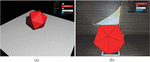
The first app developed is about the visualization of platonic solids (Figure 1).
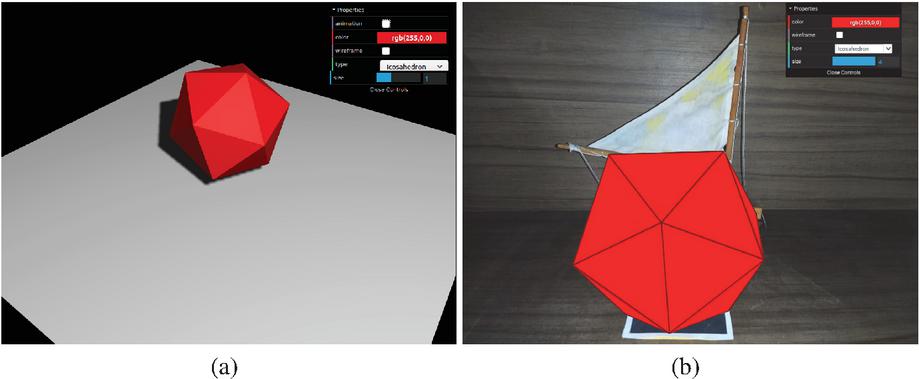
Figure 1 Platonic Solids project. Visualization of an icosahedron in the web browser (a) and in Augmented Reality (b).
This application addresses the content of Platonic Solids, also known as regular polyhedra. According to the analysis in [8], Platonic Solids are structures composed of identical faces made of regular polygons, and the number of competing faces in each vertex is always the same. This group of structures has only five elements which are the Tetraedron (4 faces), Cube or Hexahedron (6 faces), Octaedron (8 faces), Dodecaedron (12 faces), and Icosaedron (20 faces).
Figure 1(a) illustrates the icosaedron representation in the web interface via browser and Figure 1(b) illustrates the icosahedron representation in the Augmented Reality interface.
3.3.2 Solar system
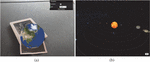
The second project developed deals with the study of our Solar System (Figure 2). The Solar System, according to the description in [9], is a set of celestial bodies – planets, asteroids, comets, etc – that orbit the Sun.
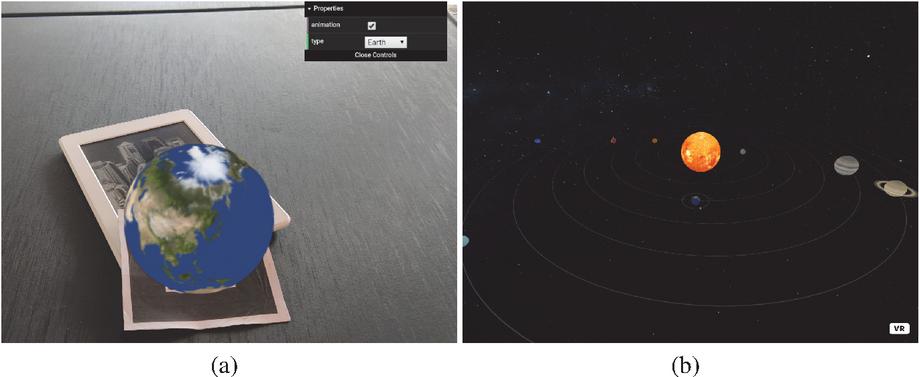
Figure 2 Solar System visualization project in Augmented Reality (a) and Virtual Reality (b).
The most important elements of this system are its eight planets: Mercury, Venus, Earth, Mars, Jupiter, Saturn, Uranus, and Neptune (in the modern designation, Pluto is a dwarf planet). All the eight planets can be visualized via a browser with default or high resolution textures. The project has a CG, AR (Figure 2(a)) and VR (Figure 2(b)).
3.3.3 Inclined plane
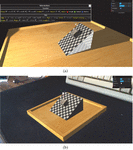
This project covers an inclined plane physics exercise and has a CG, VR and AR modes. Figures 3(a) and 3(b) show the main CG interface and the AR version of the project.
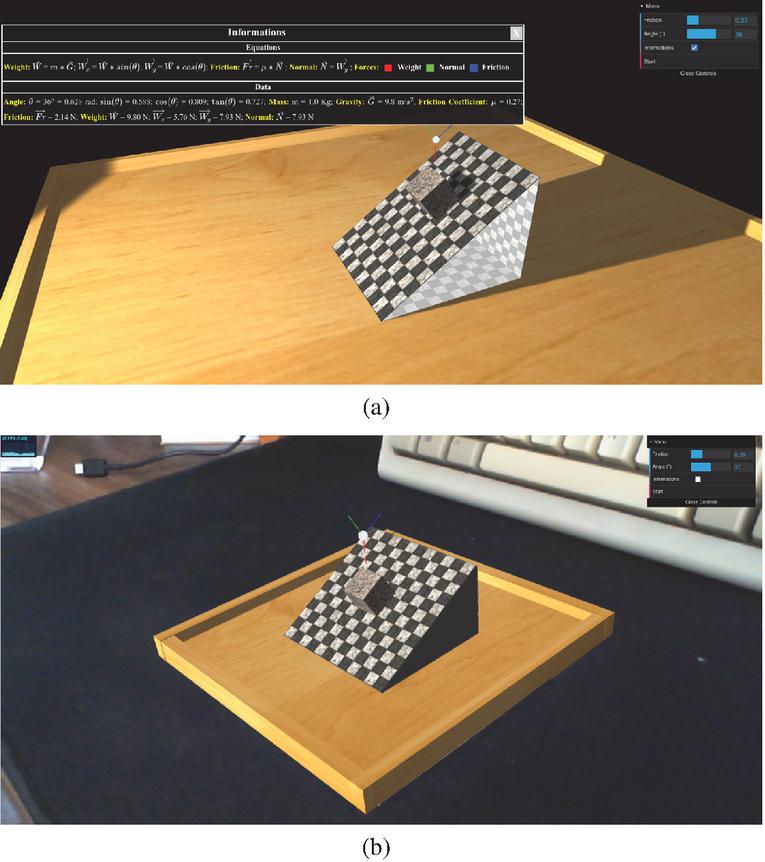
Figure 3 Inclined Plane Project. In (a), the CG view of the project with the corresponding equations and sliders. In (b), the AR view where multiple users can work together to study this physics exercise.
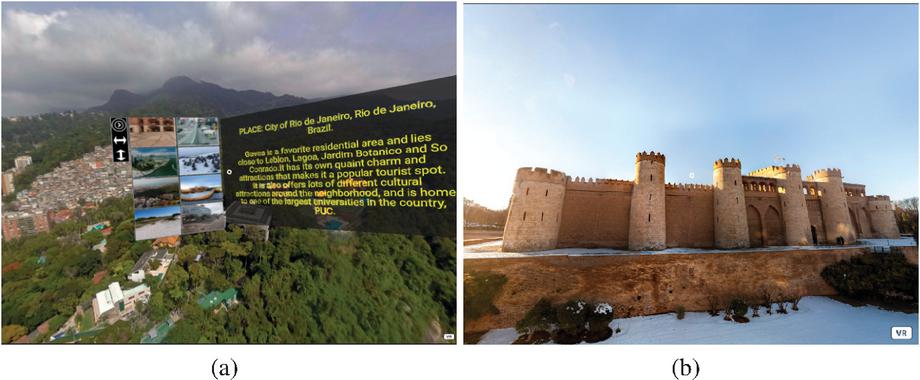
Figure 4 Virtual Travel selection menu and description (a) and Virtual Reality view of one of the projects (b).
3.3.4 Virtual travel
The main purpose of the Virtual Travel project is to allow the user to visit places around the planet virtually (Figure 4).
With places like the Aljafería Palace in Spain or the Fort Point in San Francisco, the project has a selection menu that provides eight locations in the most diverse countries that attract thousands of tourists annually, followed by a brief description with some curiosities about the locations. Figure 4(a) shows the main interface in which the user can select the place to visit and the main information about the place. The Figure 4(b) shows the preview of one of the places with the interface disabled.
3.3.5 Vascular diseases
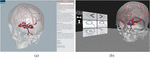
The Vascular Diseases application is an example of project applied to health learning. In this project the student can study vascular structures in detail and explore these structures in CG via a browser (Figure 5(a)) or using VR mode (Figure 5(b)).
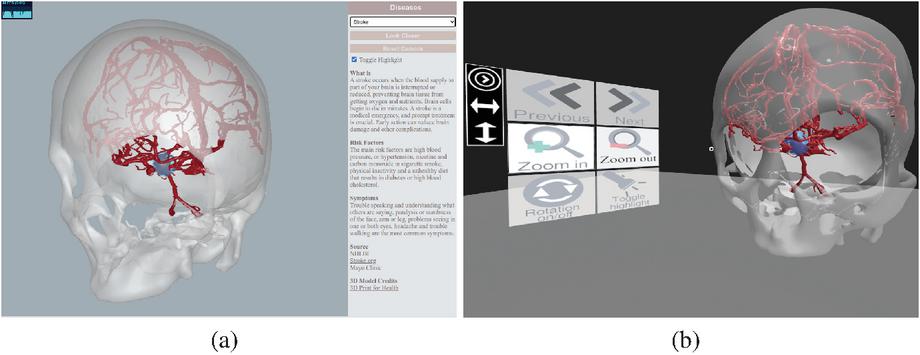
Figure 5 Vascular Diseases Project. In (a), the CG view of the project with detailed information of the selected structure. In (b), the VR showing the selected structure and the VR interface.
3.3.6 Projectile motion
This project was developed to help students understand how projectile motion works (Figure 6).
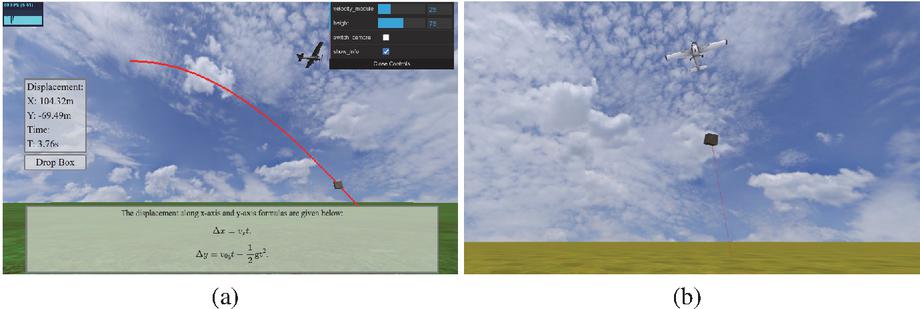
Figure 6 Projectile Motion Project. In (a) we have the CG view of the project with the corresponding equations and sliders. In (b), the VR view in which the user can choose when the plane will drop the wooden box.
The project has CG, VR and AR modes. The CG mode is the most instructive, with all the equations and sliders to help students understand the motion and general parameters. The VR and AR modes are more recreational, developed to catch the attention and interest of the students.
3.3.7 Architecture
This project aims to supply 3D navigation and AR/VR support to architectural visualization (Figure 7).
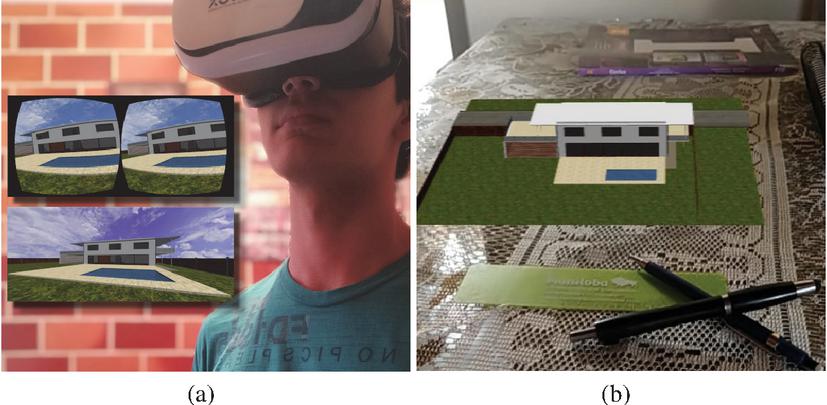
Figure 7 Virtual Architecture with a VR View (a) and AR representation (b).
When architects present their ideas for the customers, they usually present their architectural plans and sketches. However, the customers may not actually understand the plans and the sketches are limited in how well they can represent a real house. It is easier for common people to understand all of those plans and sketches when presented in 3D with the possibility to walk through, specially when using VR.
4 Platform Evaluation
As an initial feasibility study, the applications made available on the platform were used in a professional showcase in the second half of 2019. In this feasibility study, a field observation was conducted to elicit new requirements for the platform and to analyze the participants’ receptivity to the different contents presented. The target audience was constituted of elementary and high school students from public and private schools (Figure 8).
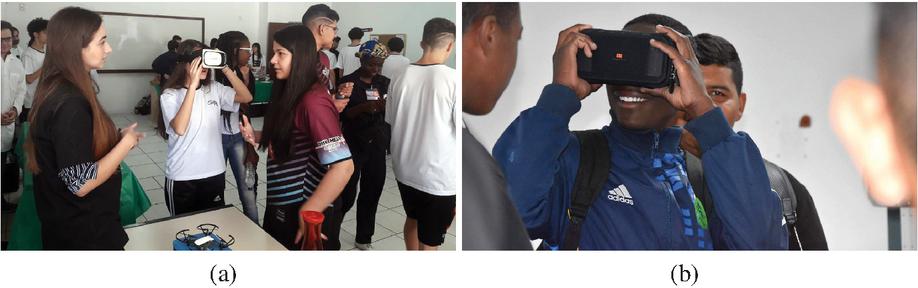
Figure 8 Experiment performed with elementary school students at a professional showcase using the applications available on the platform.
4.1 Qualitative Evaluation
The second study aimed to evaluate the platform in a distance learning context and it was conducted during the COVID-19 pandemic.
Due to social distancing, previous classroom training with the technologies as well as the sharing of low-cost HMDs, which were already acquired for the study, became impractical. In this sense, it was decided to conduct the study with undergraduate computer science students and those interested in the technology area who already had the necessary basic equipment (cell phone and computer), thus it was not necessary to expose anyone to the risk of contamination by the virus.
The emphasis in this evaluation was to understand, from the perspective of these participants, the potential of using the platform as a way to support a more motivating teaching-learning process.
The evaluation performed in this stage relates to the following research hypothesis: the use of VR Tools will positively impact the user’s motivation while performing learning activities.
This study had the collaboration of 21 participants. The participants were essentially composed of individuals aged 16 to 43 years. Regarding education, 61.9% have a high school or incomplete higher education and 38.1% have higher education or post-graduation.
When planning the evaluation, it was defined that the participants would initially receive basic instructions for participating in the study. Based on these instructions, the proposed platform was used to support the teaching-learning process of two projects: (a) Platonic Solids; (b) Solar system. Users were instructed to evaluate only the CG and AR versions of the projects, mainly because most of them did not have HMDs to evaluate the VR versions.
At the end, the participants answered a follow-up questionnaire that aimed to analyze the potential impact of the platform on the motivation of those involved. Also, we sought to collect different views on the applicability of the tool in teaching and suggestions for improvements.
The questionnaire was developed in Google Forms to facilitate remote access due to the social distancing. The questionnaire started with questions on the characterization of the participants. Then, the questionnaire continued with the presentation of statements related to the participants’ self-perception of motivation. The responses were associated with a five-level Likert scale, containing an intermediate level, as suggested by [10]. The statements were as follows: Interest in the content grew with the use of VR Tools; Using VR Tools made me more motivated than participating in traditional classroom activity; Using VR Tools made me more likely to explore the content covered; Viewing the contents three-dimensionally through VR Tools facilitated my understanding of the topics covered in comparison to viewing the two-dimensional images presented; I easily understood how to use the platform by following the instructions given; Not having to install applications contributed to the use of the platform. In the end, we included an open question where participants could indicate suggestions for improvement for the platform.
Before conducting the main assessment, a pilot was conducted with one participant. The pilot evaluation aimed to identify weaknesses in the evaluation plan and produce improvements before the main evaluation.
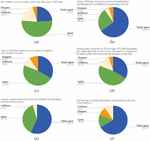
The results on the evaluation are summarized in Figure 9. It is noted that 76.2% of the participants had an increase in interest about the content when using the tool while 23.8% were indifferent or disagreed as represented in Figure 9(a).
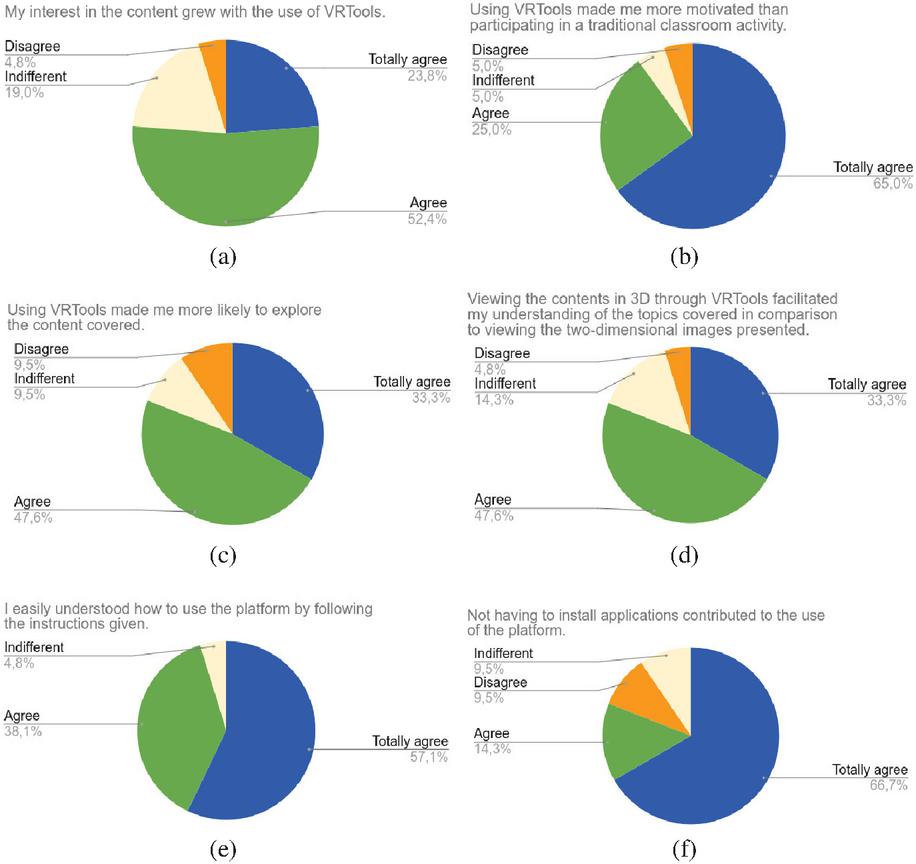
Figure 9 Results of the evaluation of the platform with the selected target audience.
Approximately 90% of participants reported that the tool would make them more motivated to learn compared to the same activity in the classroom. In this question 10% disagreed or were indifferent as illustrated in Figure 9(b).
The use of VR Tools increased the propensity to explore the content covered by 81% of the participants. For 19% the evaluation of the item was indifferent or in disagreement as illustrated in Figure 9(c). The visualization of the contents in three dimensions made it easier to understand the content for 80.9%. However, 4.8% disagreed and for 14.3% the influence of visualization on learning was indifferent (Figure 9(d)).
The instructions for using the tool were satisfactory for 95.2% of participants and indifferent for 4.8% (Figure 9(e)). Finally, 81% of the participants stated that not having to install applications contributed to the use of the platform (Figure 9(f)).
As users’ observations answered in the open question, it was reported that the use of augmented reality with the fiducial marker projected on a screen can result in an inefficient capture of the image unlike what occurs when printing the marker on a sheet. It happens because on the computer screen, depending on the angle of the image, reflections of the light source may appear on the screen, which in fact hinders the correct capture of the fiducial marker. Another problem reported was in not recognizing the marker very well on certain slopes. This is a feature of the Augmented Reality library used. This comment motivated us to correct this instruction on our platform, indicating the best positioning of the camera for recording the marker.
It was pointed out by one participant that the application menu running in the browser conceals the 3D object when the cell phone is in the vertical position, impairing the usage experience, being the most ideal to use the application with the cell phone in the horizontal position. This indication of use will be included in the platform.
Finally, there was criticism in the absence of interaction with 3D objects when in the AR environment, impairing the participant’s experience in learning that object of study. In RA, usually, the interaction with the object is performed by moving the camera or the fiducial marker. It is not common to provide ways to interact with the object directly. The best way to instruct this form of interaction on the platform is being analyzed.
Similar to the technical suggestions highlighted by users, a conceptual observation was made: the planets all presented the same scale in the solar system application and this could confuse those who learn about the topic. The choice to place planets with little variation in size between them was to improve the viewing experience, but following the participant’s questioning, we will include a caveat in the platform indicating that the scales have been changed to improve the visualization of all planets in the same environment.
5 Conclusions
This article aimed to introduce a free open-source web-based platform to serve as a repository of educational projects for viewing interactive content, using Computer Graphics, Augmented Reality, and Virtual Reality resources.
Two applications were evaluated, one in the area of mathematics dealing with the visualization of Platonic Solids and the other in the area of science, with information about our Solar System. All these projects have interactive visualization using CG, AR, and VR resources. The evaluation aimed to analyze, from the perspective of the participants, the potential for increasing the motivation of those involved in the study of the topics covered.
The evaluation of the platform was very positive and more than 70% of the participants thought that the platform could potentially increase interest in exploring the selected themes. It was also revealed that for more than 90% of participants, the platform would have the potential to increase motivation in the study of the contents. The visualization of the contents in three dimensions made it easier to understand the content in relation to the two-dimensional images for more than 80% of the participants and the instructions for using the platform were clear enough for more than 95% of them. Finally, more than 80% of the participants stated that not having to install additional applications contributed to the use of the platform.
In this way, the evidence collected indicate the potential of the platform to positively influence students’ motivation in distance teaching-learning processes. It was also observed that the platform is capable of being an ally in the educational context, even in the face of the restrictions imposed by the pandemic COVID-19, constituting an accessible, open, and free medium.
As future work, it is intended to include opportunities for improvement and new requirements elicited through the evaluation, as well as conducting new evaluations to collect evidence on the impact on content retention, on the feasibility of learning in collaborative teams, and on the perspective of the teacher when using the platform in their pedagogical practices.
Note
1Available at https://avrgroup.github.io/vrtools/ [Online; 26/05/2021]
References
[1] INTERNATIONAL LABOUR OFFICE. Global Employment Trends for Youth 2017: Paths to a better working future. International Labour Office, 2017.
[2] Carlos Borrego, Cristina Fernández, Ian Blanes, and Sergi Robles. Room escape at class: Escape games activities to facilitate the motivation and learning in computer science. JOTSE, 7(2):162–171, 2017.
[3] Manuel Fernandez. Augmented-virtual reality: How to improve education systems. Higher Learning Research Communications, 7(1):3, 2017.
[4] Jocelyn Parong and Richard E Mayer. Learning science in immersive virtual reality. Journal of Educational Psychology, 110(6):785, 2018.
[5] James O Woolliscroft. Innovation in response to the covid-19 pandemic crisis. Academic Medicine, 2020.
[6] Steven Arild Wuyts Andersen, Martin Frendø, and Mads Sølvsten Sørensen. Effects on cognitive load of tutoring in virtual reality simulation training. MedEdPublish, 9, 2020.
[7] Yu-Chih Huang, Sheila J Backman, Kenneth F Backman, Francis A McGuire, and DeWayne Moore. An investigation of motivation and experience in virtual learning environments: a self-determination theory. Education and Information Technologies, 24(1):591–611, 2019.
[8] Eric W Weisstein. Platonic solid. https://mathworld.wolfram.com/, 2003.
[9] Tobias C Owen. Solar system. https://www.britannica.com/science/solar-system, 2020.
[10] O. Laitenberger and H. M. Dreyer. Evaluating the usefulness and the ease of use of a web-based inspection data collection tool. In Proceedings Fifth International Software Metrics Symposium. Metrics (Cat. No.98TB100262), pages 122–132, 1998.
Biographies

Lucas Diniz da Costa is graduated in Exacts Science at Federal University of Juiz de Fora (2014–2019) and currently is undergraduate student in Computer Science at the Federal University of Juiz de Fora. His research interests are Computer Graphics, Augmented Reality, Virtual Reality and game development.

Paulo Victor de Magalhães Rozatto is an undergraduate student in Computer Science at the Federal University of Juiz de Fora. He has a IT Technician certificate from the Federal Institute of Rio de Janeiro (2018). His research interests are Computer Graphics, Augmented Reality, and Virtual Reality.

André Luiz Cunha de Oliveira is an undergraduate student in Computer Science at the Federal University of Juiz de Fora. His research interests are Computer Graphics, Augment Reality and Virtual Reality.

Rodrigo Luis de Souza da Silva is an Associate Professor in the Department of Computer Science at Federal University of Juiz de Fora. He has a B.S. in Computer Science from the Catholic University of Petropolis (1999), M.S. in Computer Science from Federal University of Rio de Janeiro (2002), Ph.D. in Civil Engineering from Federal University of Rio de Janeiro (2006) and a postdoc in Computer Science from the National Laboratory for Scientific Computing (2008). His main research interests are Augmented Reality, Virtual Reality, Scientific Visualization and Computer Graphics.
Journal of Mobile Multimedia, Vol. 18_1, 27–42.
doi: 10.13052/jmm1550-4646.1812
© 2021 River Publishers