3D Multimedia Packaging Design Based on Agile Software Development and IoT Platform
Patinya Sang-aroon1,*, Sethakarn Prongnuch2 and Suchada Sitjongsataporn3
1Branch of Packaging Design, Department of Design and Packaging,
Faculty of Industrial Technology, Suan Sunandha Rajabhat University, 1 U-Thong Nok Rd., Dusit, Bangkok, Thailand
2Department of Robotics Engineering, Faculty of Industrial Technology,
Suan Sunandha Rajabhat University, 1 U-Thong Nok Rd., Dusit, Bangkok, Thailand
3Department of Electronic Engineering, Mahanakorn Institute of Innovation (MII), Faculty of Engineering and Technology, Mahanakorn University of Technology, 140 Cheumsamphan Rd., Nongchok, Bangkok, Thailand
E-mail: patinya.sa@ssru.ac.th; sethakarn.pr@ssru.ac.th; ssuchada@mut.ac.th
*Corresponding Author
Received 22 May 2021; Accepted 05 November 2021; Publication 04 January 2022
Abstract
This paper aims to present the three-dimensional (3D) packaging structure design based on the agile software development and internet of things (IoT) platform, which an efficiency validation of IoT platform is required. The objective of this research is to investigate the model development of 3D multimedia-based packaging structure using the webserver design and agile software development applied in the design and implementation process. This model development methodology comprises how the IoT platform as the client-server architecture that is used to develop and support the orthographic projection techniques, information sheet, worksheet and multimedia presentation in the modern product design. The empirical results show the creative thinking of the group of young designers that can be achieved efficiently. The proposed model development can increase significantly the fundamental knowledge and interactive design ideas of young designers combining from the two-dimension to three-dimension packaging structure model.
Keywords: IoT platform, 3D packaging model development, agile software development.
1 Introduction
In this recent, an interactive 3D multimedia content has been widely used to support how to design in the areas of the software modeling, game creation, learning and management [1, 2]. In [1], the authors have summarized that students’ internal motivation could be evaluated through the creativity by the innovative teaching implementation for the packaging design course. In [2], the virtual reality (VR) and augmented reality (AR) technologies have been applied to solve the problems of packaging design, serve the modern education technology for learning, and improve the students’ effective learning.
Packaging design is the connection of form, structure, materials, color to create a product suitable for marketing. In [3], the authors have found that packaging design has an influence on the flavour perception, healthy eating behavior and food consumption.
Internet of things (IoT) system is a kind of physical objects or things network that are embedded with sensors, software, and other technologies for connecting and transferring data with other electronic devices over the internet system [4]. Examples of IoT platform are widely applied as the Parallella board [5, 6] and the Raspberry Pi board [8]. Parallella board is an embedded device with the high performance and credit card sized computer based on the Epiphany multi-core chips from Adapteva. Raspberry Pi is a series of small single-board computers with the low cost, modularity, and open-source design.
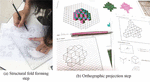
Packaging design process is a series of steps that an entrepreneur takes to prepare their own product for retail sales. The process includes the consideration of structure design and shape for displaying the material and artwork to touch most customers until payment. Because of the graphic design skill, new designers will have less experience and understanding about the packaging design process. There are two important problems of the packaging design process as the structural fold forming step and the orthographic projection step as shown in Figure 1. New designers must practice frequently about these steps to make their own skills.
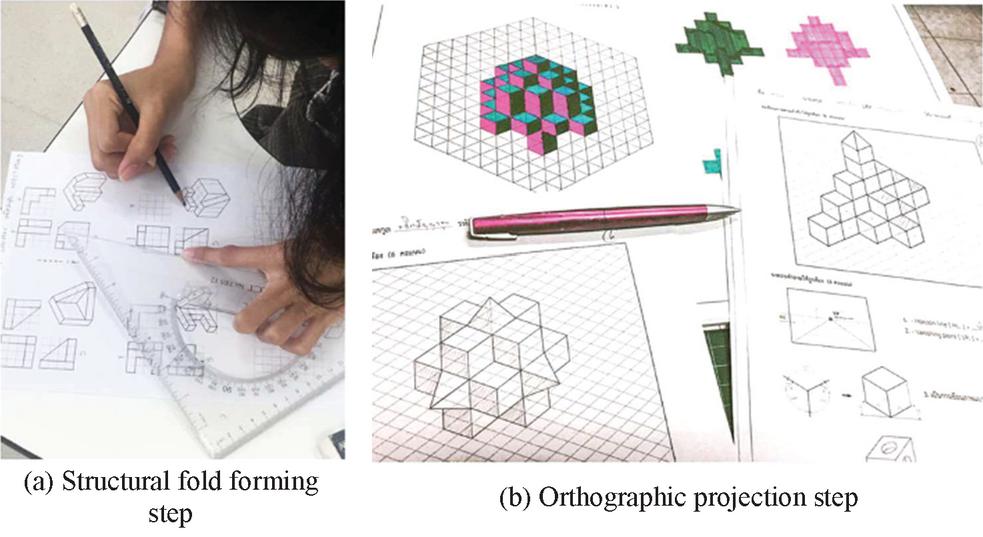
Figure 1 Problems of the packaging design learning.
According to the previous research, there is no idea using IoT platform based on the agile software development to progress the 3D multimedia packaging design model. Therefore, the objective of this paper is to investigate the 3D multimedia-based packaging structure model development using the webserver design. Meanwhile, 3D multimedia is the helpful way to learn about the graphic design. Agile software development (ASD) will be applied in the design and implementation process. This proposed model development methodology comprises how the IoT platform as the client-server architecture can assist to develop and support the graphic design skills.
In this paper, the motivation is to implement 3D multimedia-based packaging structure design by using the agile software development. An IoT platform as the client-server architecture is to support the efficiency validation during the packaging design process. The aim of this research composes the packaging structure design based on the webserver design using the ASD in the design and implementation process.
This paper will be arranged along these sections as follows. Section 2 introduces briefly the agile software development. Then, Section 3 describes the modern product design. Section 4 proposes the research methodology of this paper. Section 5 introduces the proposed 3D multimedia packaging design based on the ASD and IoT platform. The empirical results are detailed in Section 6. Finally, Section 7 concludes the research.
2 Agile Software Development
Agile software development (ASD) is a set of frameworks and practices involved the requirement and developing solutions through the collaborative effort of self-organizing and cross-functional teams. This makes the end users encourage flexible responses to develop ideas [7]. Accordingly, the team development concentrates on the functions needed at first hand, delivering them fast, collecting feedback and reacting to receive information.
ASD [8] was developed by James A. Highsmith III, and published in 2000 [9]. ASD focuses mainly on the problems in the developing complex and large systems. The ASD method strongly encourages incremental iterative development with the constant prototyping. Fundamentally, ASD is about how to make balance on the edge of chaos that aims to provide a framework with necessary guidance for creativity.
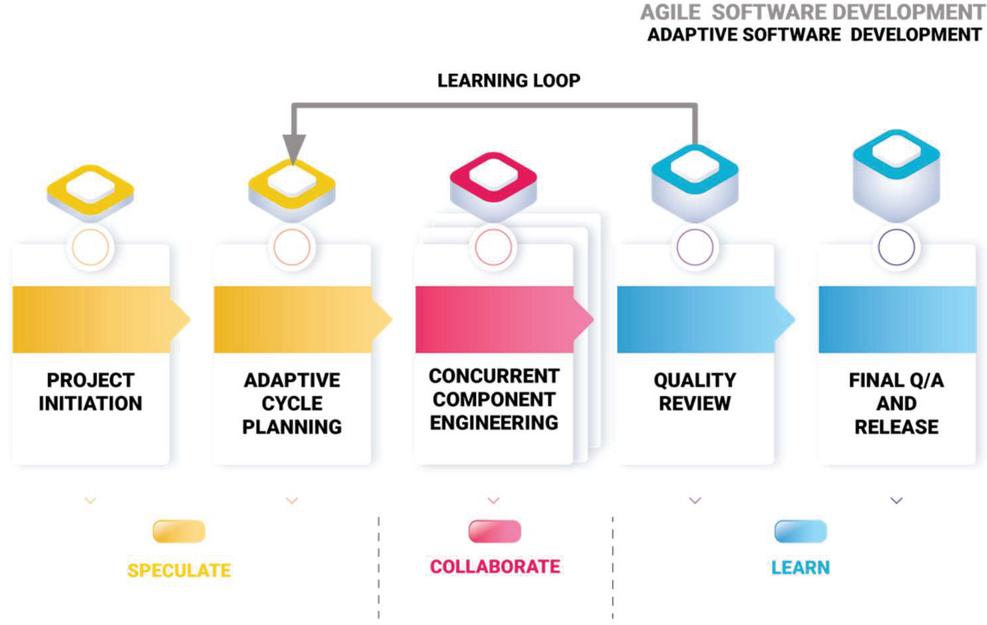
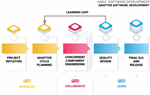
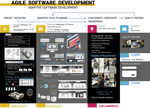
Figure 2 Agile software development process [10].
An ASD cycle consists of three phases as speculate, collaborate, and learn shown in Figure 2. The first phase is called ‘speculate’ phase includes the project initiation and the adaptive cycle planning. The second phase is named ‘collaborate’ phase that is the concurrent component engineering process. The final phase is called ‘learn’ phase including the quality review, final question/answer and release a beta design. Between the ‘speculate’ and ‘learn’ phases, the learning loop is the feedback information from the quality review that can help adaptively the cycle planning until releasing a beta design.
3 Modern Product Design
Recently, the product designs often need multi-disciplinary technical support together. In this section, the modern product design is proposed with the seven key-disciplines including with an ergonomics, user interface/user experience, packaging, 3D structural packaging design, active learning, web design, and internet of things. The details of the modern product design are described briefly as follows.
3.1 Ergonomics
The ergonomics [11] is the analysis and study of the interactions between people and machines, people and working environment as well as mechanic and environment. This design is a simple operation and labor saving and comfortable products for well-being life with the human-machine environment.
Ergonomics is the science of fitting a task into human and products [12]. Designers must consider how to design many products, environments and concerning systems in terms of the physical size and shape of target users frequently. It refers to physical accommodation in the essential workplace that is suited to the body size and mobility of operators.
3.2 User Interface/User Experience
User interface (UI) design is the main part for the usability of the software product [13]. The model proposes four dimensions to structure the user interface: the input/output dimension as ‘the look’, the dialog dimension as ‘the feel’, the technical or functional dimension as ‘the access to tools and services’, and the organizational dimension as ‘the communication and co-operation support’.
User experience (UX) is how a user interacts and experiences with a product. It includes a person’s perceptions of utility, ease of use, and efficiency. Improving user experience is important to most designers when creating and refining products.
3.3 Packaging
The packaging is an important instrument in commercial and trade role to increase the sales. The appropriate product packaging is to preserve and provide the customer with choosing the right products.
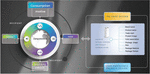
Consequently, a cognition model for comprehension of product packaging design is presented to understand the necessary environments shown in Figure 3. Starting from the left-side of Figure 3, the comprehension cycle of package design consists of the consumption, mood, attractiveness and memory from recipient that can adapt for package design at the right-side of Figure 3 in forms of the user experience of package design.
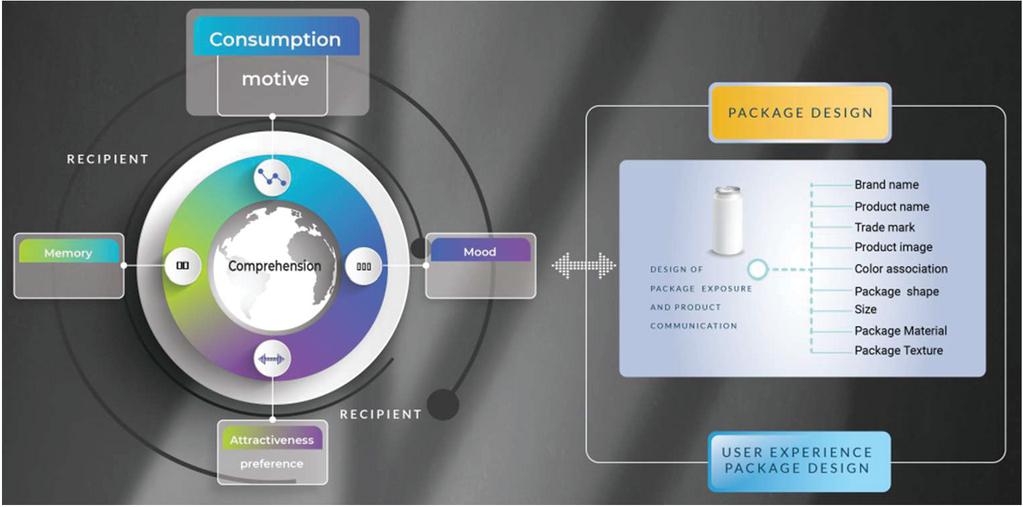
Figure 3 Cognition model for comprehension of product packaging.
3.4 3D Structural Packaging Design
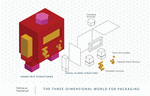
The 3D structural packaging design is a 2D design to showcase 3D work by explaining the concept to a new look by creating a 3D shape, linking the work from the original 2D shape [10]. The concept of how to create structures includes the serial planes structure, wall structures, prisms and cylinders, repetition structure, polyhedral structures, triangular planes structure, linear framework, and linear layers as shown in the right-side of Figure 4. Then, 3D shape structure for this packaging design is shown in forms of the isometric structure in the left-side of Figure 4. The key of the packaging structures pattern is to communicate and make understanding that designers can link with all packaging details by improving the thinking process from the 2D to 3D model of packaging prototypes or 3D sketches.
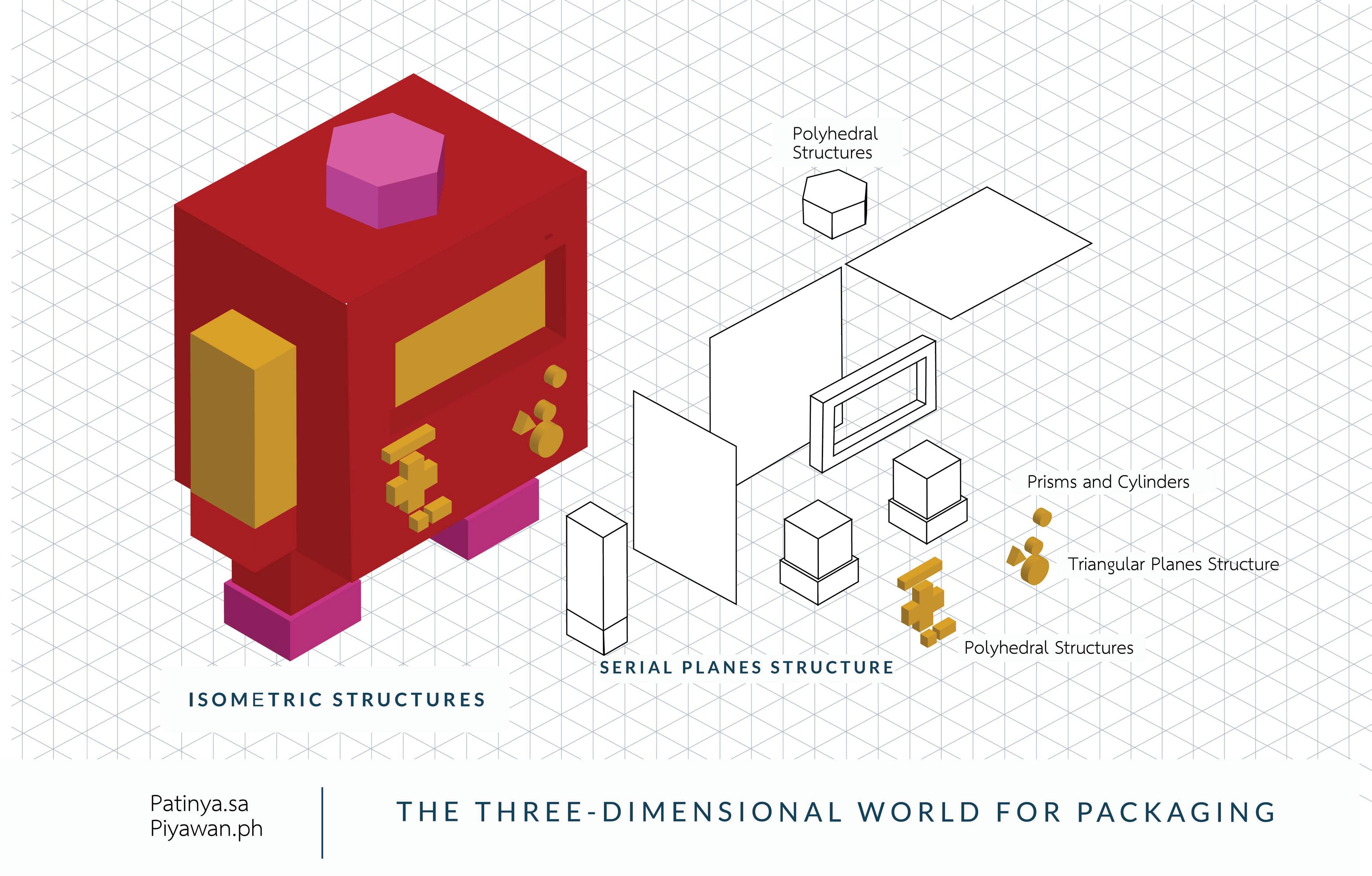
Figure 4 Creating a 3D shape structure for packaging design.
3.5 Active Learning
Active learning is a common technique used to improve learners’ comprehension in which learners are actively or experientially involved in the learning process both comprehension and memory. In [14], the empirical study offers a framework for designing activities that will promote learning systematically, which help to enable students to learn effectively.
3.6 Web Design
Web design encompasses many different skills and disciplines in the production and maintenance of websites. The different areas of web design conclude the web graphic design, user interface design (UI design) including with the standardized code and proprietary software, user experience design (UX design) and search engine optimization
Recently, the responsive web design approach suggests how to design and develop using the response from the user’s behavior and webpages render well based on a variety of devices, platform and orientation [15].
3.7 Internet of Things
The internet of things (IoT) is a novel paradigm that is rapidly gaining ground in the scenario of modern telecommunications [6]. IoT definition [4, 5] is the interconnection of machines and devices through the internet enabling the creation of data that can yield analytical insights and support new operations. In this paper, IoT platform is applied to collect and share sources supported the agile software development.
4 Proposed Methodology
The proposed research methodology of the agile development and efficiency validation of internet of things platform for packaging structure design is to improve the designers’ skills based on the seven key-disciplines of modern product design presented in Section 3.
An agile software development (ASD) method is proposed concerning with the modern product design developed by the internet of things (IoT) platform for 3D multimedia packaging structure design as shown in Figure 5.
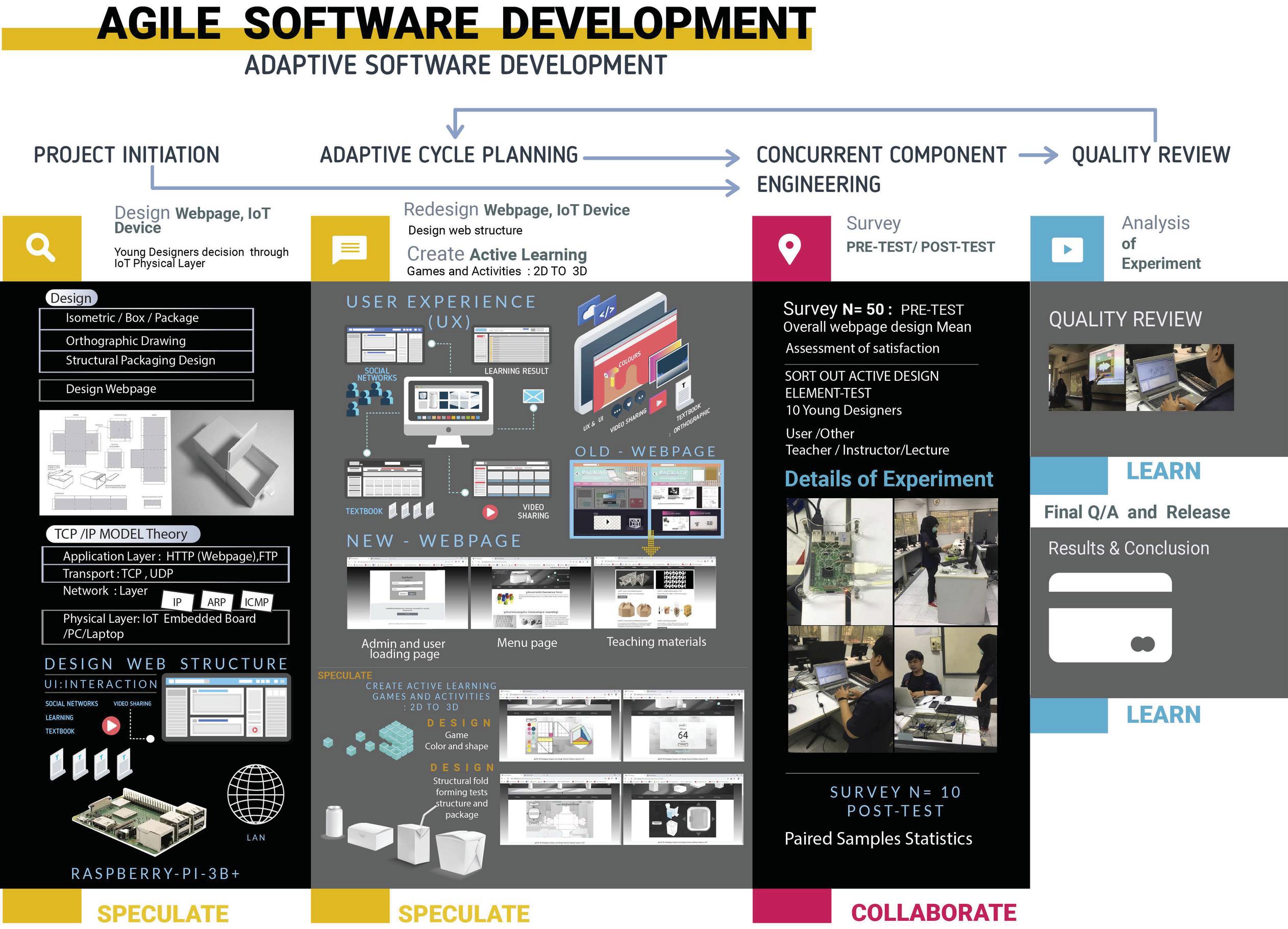
Figure 5 Proposed research methodology of 3D multimedia packing design.
We arrange the research methodology following the three-phase cycles of ASD shown in Figure 2. The ‘speculate’ phase includes the design through IoT platform and the redesign by games and activities. A ‘collaborate’ phase is the survey for pre-test and post-test of packaging design experiments. The ‘learn’ phase is a final step including the analysis of experiment results and conclusion.
A conceptualization based on an agile software development process shown in Figure 2 is to optimize and evaluate the potential success of project. In this section, the conceptualization of 3D multimedia packaging structure design in Figure 5 consists of two stages as a preliminary design and a packaging design as follows.
(1) A preliminary design is a trial stage between the design conception and detailed packaging design, which uses to evaluate firstly how a concept design of webpage is suitable by a set of pre-test survey question examples. Then, ASD is to analyze these survey questions for making a learning loop to redesign the next stage.
(2) A packaging design is to elaborate each aspect of the packaging design by the complete description of detailed design through the IoT platform. This stage involves the redesign from a learning loop for releasing the current webpage on IoT platform and then to do a set of post-test survey questions. Analysis of post-test survey examples will be reported.
5 Proposed 3D Multimedia Packaging Design Based on ASD and IoT Platform
In this section, the proposed 3D multimedia packaging structure design based on ASD and IoT platform includes the following additional parts as design, survey & analysis and game creation for active learning.
5.1 Design
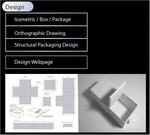
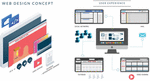
Proposed 3D packaging structure design through the IoT platform consists of four components including with the contents of packaging structure design, active learning events, webpage based on UI design and IoT platform as presented in Figure 6.
• The contents of packaging structure design, such as the 2D to 3D packaging structure model conversion, orthogonal projection techniques, 3D packaging drawing, coloring and worksheet of lessons as isometric, box, package, orthographic drawing which present in the webpage.
• Active learning practices are the worksheet of packaging structure design as shown at the left-side of Figure 6.
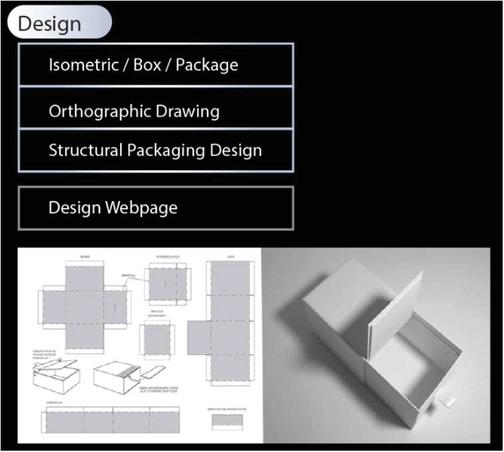
Figure 6 Concept design for packaging structure design [16].
• Webpage includes the packaging structure design course description, the lesson of packaging structure design, and practices. Figure 7 illustrates the beta version of proposed webpage of pre-test survey questions for the webpage assessment of satisfaction. Results from pre-test survey are used to redesign the webpage. Webpage design is created with HTML, CSS framework and JavaScript. HTML and CSS works as page structure and information while JavaScript is programming language to interpret them that are on the front end of web application.
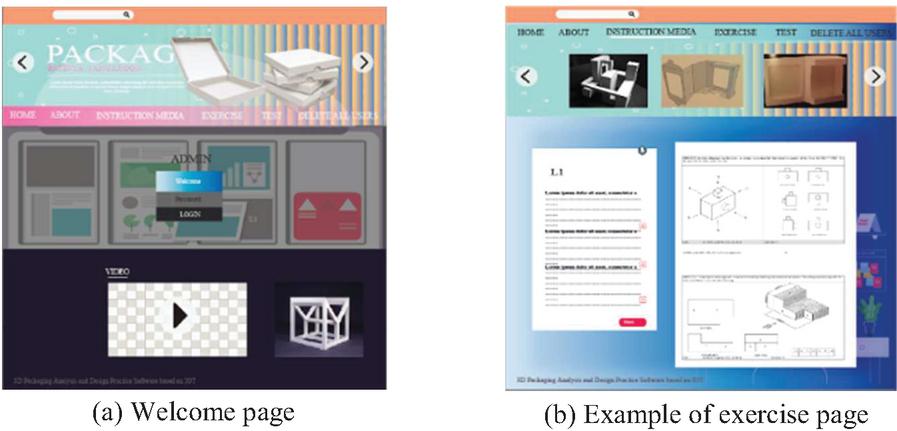
Figure 7 A beta version of proposed webpage for pre-test survey questions.
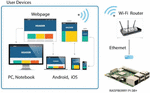
• IoT platform uses the client-server architecture and TCP/IP model from computer network as shown in Figure 8 in order to provide and collect the data from survey examples. The web-server is used the Raspberry Pi 3 model B+ as an embedded IoT board and the client-server side connects with the 30-personal computers. The specification of the Raspberry Pi 3 model B consists of the Cortex-A53 1.4 GHz quad-core processor, the operating system is Raspberry Pi OS, 1GB LPDDR2 SDRAM of memory, gigabit Ethernet, and 5V/2.5A DC power input. The personal computer specification includes the Intel Core i7-6700 3.4 GHz quad-core processor, the operating system is Microsoft Windows 8.1 64bit, 8 GB DDR3 SDRAM of memory, AMD Radeon R7340 2 GB of graphic processing unit, and 2 TB of storage.
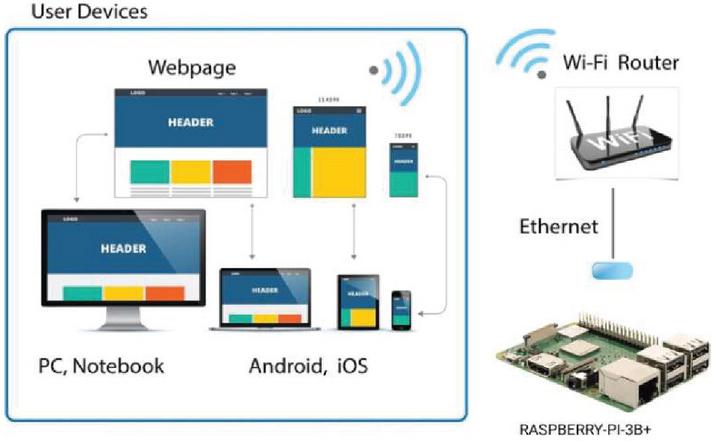
Figure 8 Internet of things platform system design.
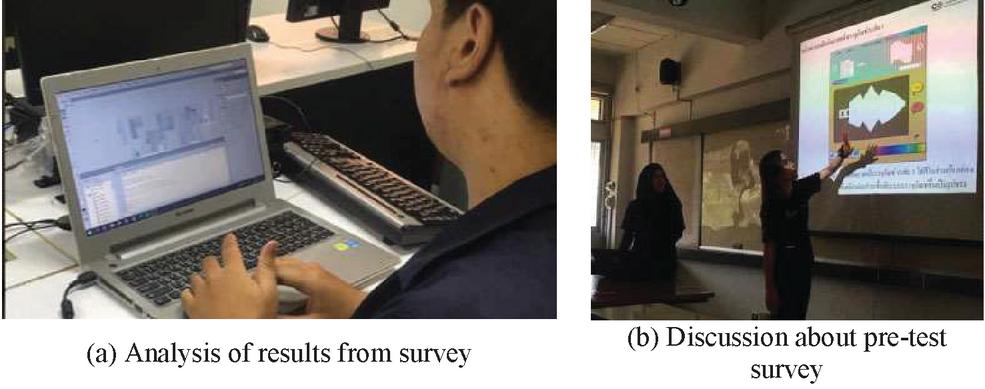
Figure 9 Survey & Analysis.
5.2 Survey & Analysis
There are two types of survey as a pre-test survey and a post-test survey as follows.
(1) A set of pre-test survey question is used to interview the random 50 people who have studied in Suan Sunandha Rajabhat University for the webpage assessment of satisfaction on a beta version of webpage as shown in Figure 9. Results from pre-test survey are analyzed by administration and instructors in order to redesign webpage for releasing the current webpage following the user experience (UX) such as coloring in the user interface (UI) part depicted in Figure 10.
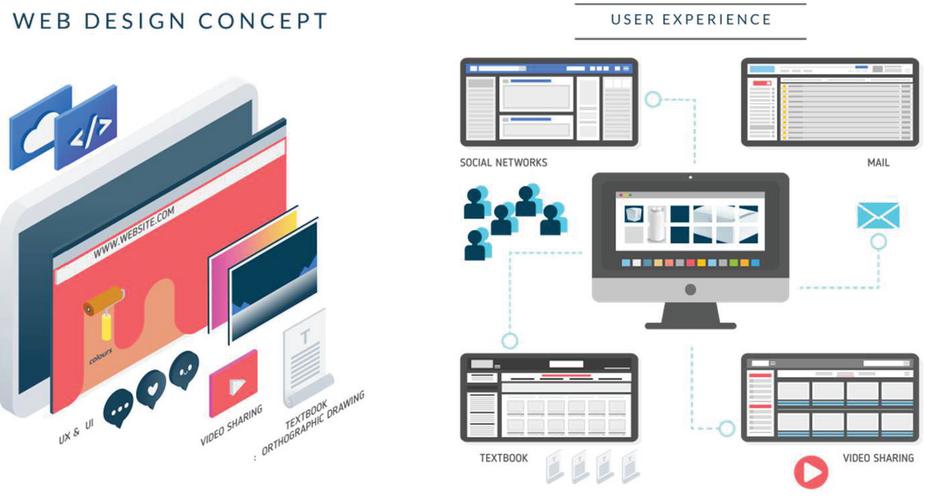
Figure 10 Redesign the Webpage through user experience.
(2) A set of post-test survey examples is applied to test the 10 young designers who have studied in the course of packaging structure design, department of design and packaging in Suan Sunandha Rajabhat University. The topics of interview are related to the contents of packaging structure design, active learning lessons, webpage based on the UI design and IoT platform in order to evaluate the learners through game for active learning.
5.3 Game Creation for Active Learning
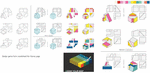
Additionally, the game creation on webpage is presented as detailed in Figure 11. The game creation for the active learning designs by following the idea of orthographic projection technique in forms of isometric box based on worksheets and exercises. The objective of game creation is to help the new learners understand through the game that will lead to reduce the time learning about the basic concept of fundamental packaging structure design course for young designers.
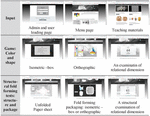
Proposed UI/UX webpage on IoT platform is illustrated in Figure 11 with 3 steps as follows.
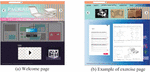
(1) Firstly, the input step consists of the welcome page, menu page and teaching material. While login to server, user can select the exercise concerning with the support teaching materials.
(2) Secondly, an user can learn and make the understanding about basic concept of packaging structure design through the game exercises with color and shape in terms of the isometric box and orthographic projection. Examples of design concept of game creation for active learning are presented in Figure 12. An examination of relational dimension is applied to evaluate the learners’ basic knowledge.
(3) Finally, an advance step of structural fold forming is used to test clearly about structure and package through the unfolded paper worksheet and fold forming packaging in forms of isometric box or orthographic projection. A structural examination of relation dimension is used to evaluate the learner’s knowledge.
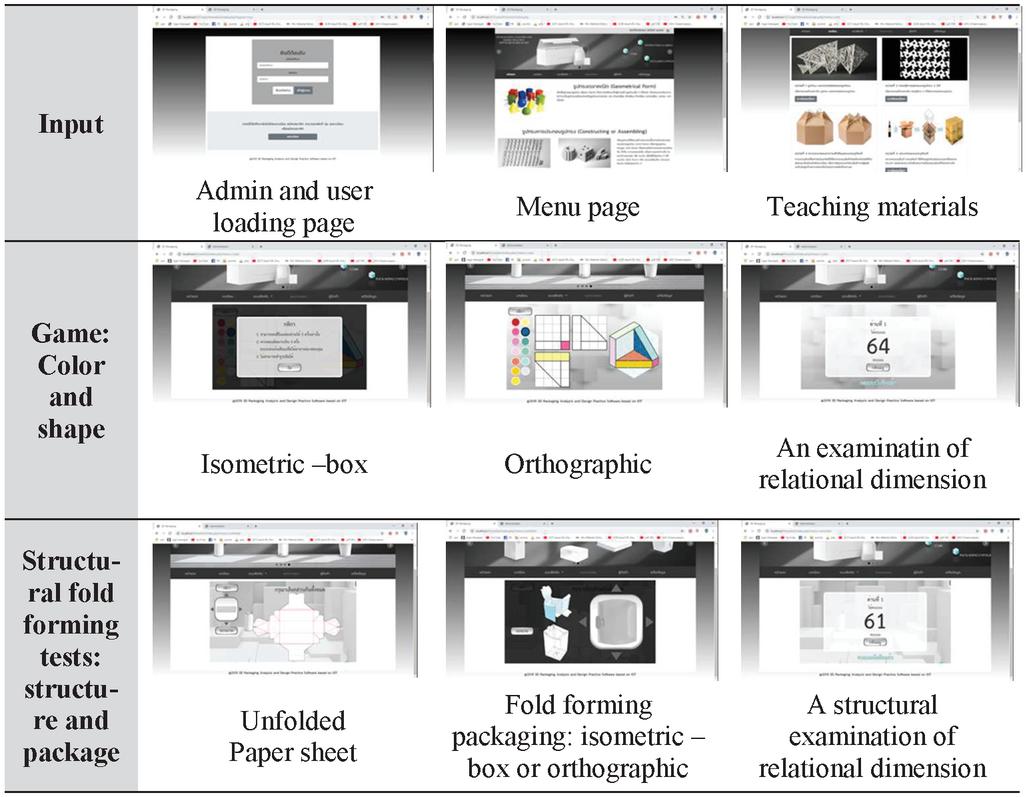
Figure 11 Game creation on webpage.
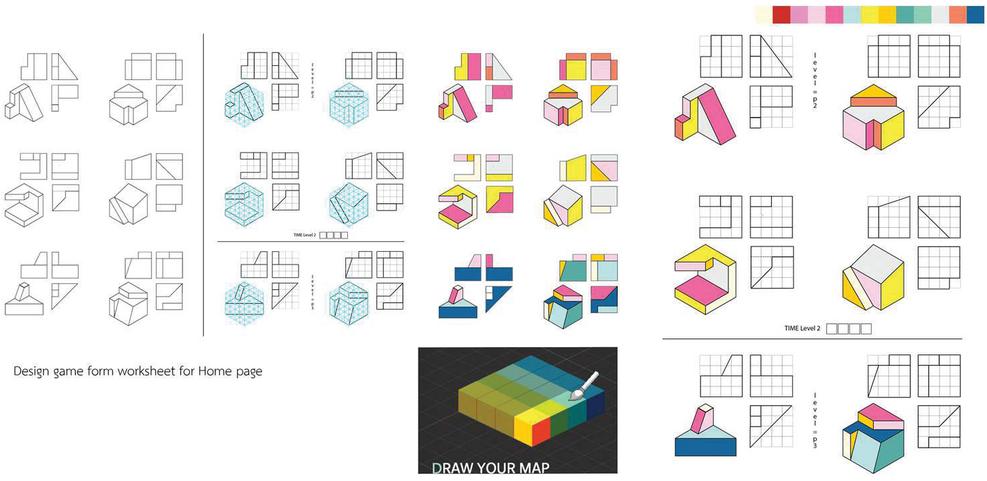
Figure 12 Design concept of game creation for active learning.
6 Experimental Results
6.1 A Preliminary Design: Pre-test Survey Experiment
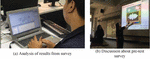
Pre-test survey experiment was of 50 undergraduate students in Suan Sunandha Rajabhat University (SSRU) when they had given a set of satisfaction survey questions on a beta version of packaging structure design webpage including with game for active learning, webpage based on user interface design, and internet of things platform as shown in Figure 13.
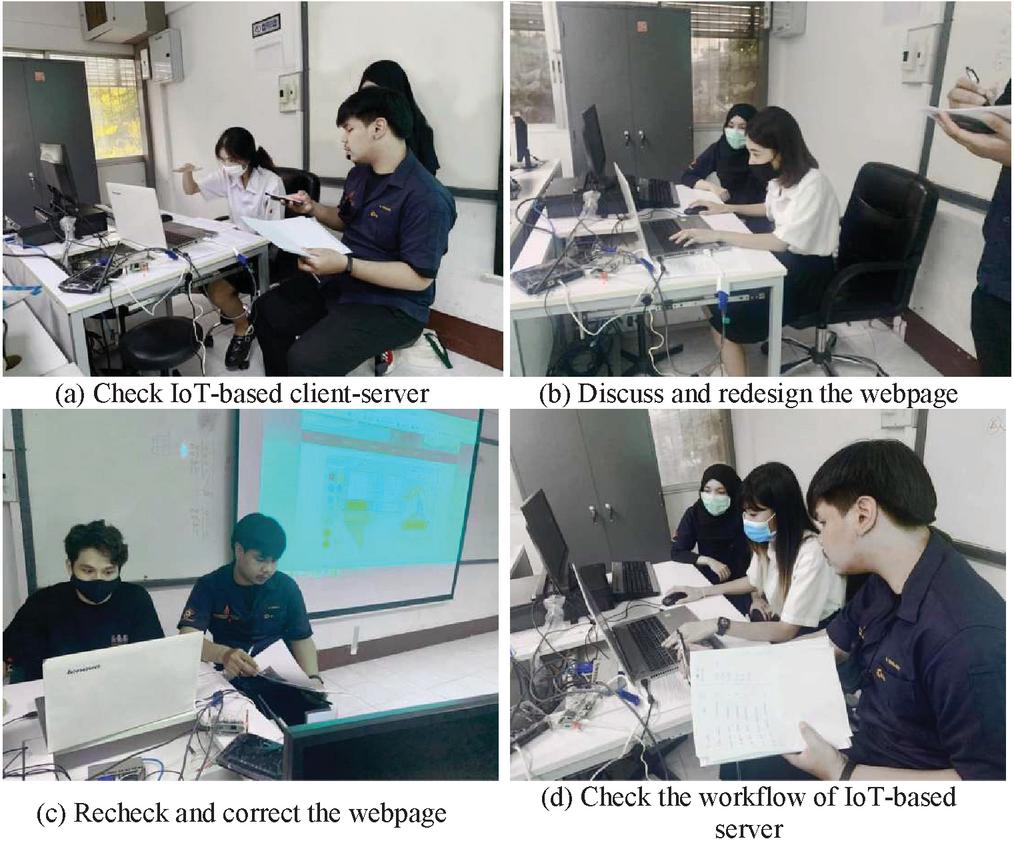
Figure 13 Survey and experiments.
The efficiency validation determination of agile development and efficiency validation of internet of things platform for packaging structure design in terms of attractive, readable, easy to use, colour and shape of game exercises, functionality and use of webpage are concerned in the pre-test satisfaction survey questions for the preliminary design.
Table 1 displays the mean values and standard deviation (SD) of results from pre-test survey questions. These results are analyzed to redesign webpage from user experience.
Table 1 Mean and standard deviation of overall beta-version of webpage design evaluation
| Question Description | N | Mean | (SD) | Results: Decision | |
| 1 | Attractive and beautiful on webpage interface. | 50 | 3.96 | 0.66 | Good |
| 2 | Design format on the website: readable and easy to use | 50 | 4.02 | 0.65 | Very Good |
| 3 | Colour balance | 50 | 3.22 | 0.58 | Good |
| 4 | Proportion of coordination menu | 50 | 4.86 | 0.40 | Very Good |
| 5 | Suitability of the colour, content and functionality | 50 | 3.56 | 0.64 | Good |
| 6 | Unique style Font: readable and beautiful | 50 | 3.48 | 0.64 | Fair |
| 7 | 7.1 Balance on space dimension 7.2 Texture matches function 7.3 Unified form and function | 50 | 3.44 | 0.57 | Fair |
| 8 | Operation conforms with force rules IoT | 50 | 3.79 | 0.59 | Good |
6.2 A Packaging Design: Post-test Survey Experiments
Post-test survey experiments were of 10 undergraduate students at the department of design and packaging in SSRU. This study used an independent-sample t-test in the post-test survey experiments to verify the proposed 3D multimedia packaging structure design based on IoT platform affected the creativity and understanding about the basic concept of packaging structure design.
Table 2 Paired Samples Statistics: mean and standard deviation of pre-test and post-test survey examination of packaging structure design on game learning
| Experiments | N | Mean | (SD) | t | df | Sig. | |
| Set 1 | Pre-test exam. | 10 | 206.60 | 32.483 | 3.467 | 9 | 0.007 |
| Post-test exam. | 10 | 211.20 | 29.264 | ||||
| Set 2 | Traditional time learning | 10 | 33.9840 | 6.05186 | 13.028 | 9 | 0.000 |
| Time learning on Game | 10 | 23.7190 | 5.10834 | ||||
Table 2 shows the paired-sample statistics of the pre-test and post-test examination of packaging structure design based on 3D multimedia game learning. The first experiment: pre-test and post-test examination results were as , p 0.005 (p 0.007). The second experiment: traditional time learning and time learning on game were as , p 0.001 (p 0.000). These results indicated that 3D multimedia game learning into the packaging structure design course can improve the students’ creativity and significantly reduce the time on learning. Figure 14 shows the examples of applied from packaging design learning. The young designers had learned efficiently to create the prototype of 3D packaging product correctly.
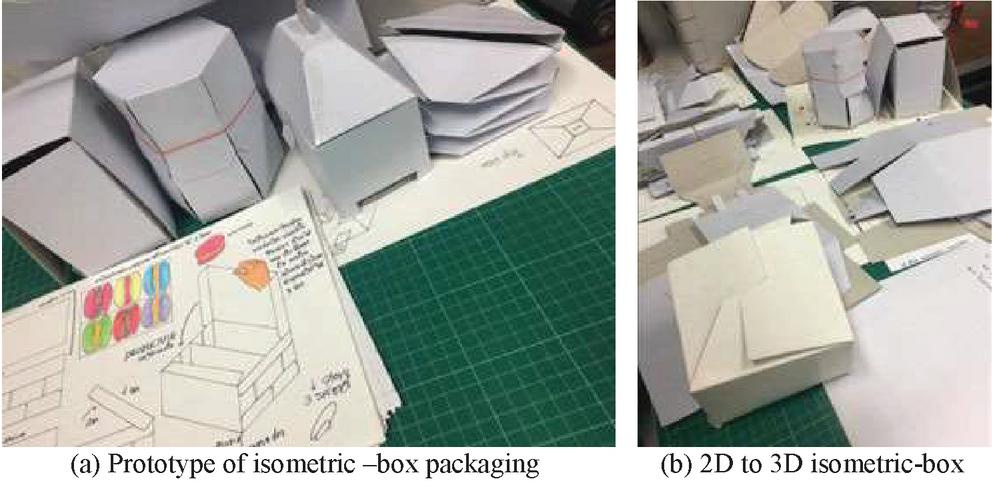
Figure 14 Examples of applied packaging design learning.
7 Conclusion
Proposed 3D multimedia packaging structure design based on the agile software development and internet of things (IoT) platform has been described and tested on efficiency validation of IoT platform. The objective of this research is to investigate the software model development of 3D multimedia-based packaging structure design based on the webserver design and agile software development in the preliminary design and packaging design process. This methodology combines how the IoT platform as the client-server architecture used to support the orthographic projection techniques, information sheet, worksheet and multimedia presentation in the modern product design. Experimental results show the creativity of young designers can be achieved efficiently. The proposed model development can increase significantly the fundamental knowledge and interactive design ideas combining the 2D to 3D packaging structure model by decreasing the time learning. The statistical results encourage lecturers and instructors that 3D multimedia and game learning based on active learning can be applied for teaching and learning to advance packaging design course efficiently.
Acknowledgment
We would like to thank Jurirat Lomloy, Teekayu Samanmitr, and Nuinee Dueraaor at Department of Computer Engineering, Faculty of Industrial Technology, Suan Sunandha Rajabhat University in Bangkok, Thailand for their support.
References
[1] Yang, Chao-Ming; Hsu, Tzu-Fan, ‘Integrating Design Thinking into a Packaging Design Course to Improve Students’ Creative Self-Efficacy and Flow Experience. Sustainability 12, No. 15: 5929, 2020.
[2] Yanyi Shao, Xiaojie Min, ‘VR and AR Technology used in Education in the Education of Packaging Design for Students’, Asia-Pacific Conference on Image Processing, Electronics and Computers (IPEC2021), pp. 1073–1076, Apr., 2021.
[3] Taku Togawa, Jaewoo Park, Hiroaki Ishii, and Xiaoyan Deng, ‘A Packaging Visual-Gustatory Correspondence Effect: Using Visual Packaging Design to Influence Flavor Perception and Healthy Eating Decisions’, Volume 95, Issue 4, pp. 204–218, Dec., 2019.
[4] Jerett Horn, Norda Alex Koohang, Joanna Paliszkiewicz, ‘The Internet of Things: Review and theoretical framework’, Expert Systems with Applications, Vol. 133, No. 1, pp. 97–108, Nov., 2019.
[5] S. Prongnuch, T. Wiangtong, and S. Sitjongsataporn, ‘Qualitative Precipitation Estimation from Satellite Data Based on Distributed Domain-Specific Architecture’, Modelling and Simulation in Engineering (MSE), Vol. 2021, 2021.
[6] S. Prongnuch, S. Sitjongsataporn and T. Wiangtong, ‘A Heuristic Approach for Scheduling in Heterogeneous Distributed Embedded Systems’, International Journal of Intelligent Engineering and Systems (IJIES), Vol. 13, No. 1, 2020.
[7] Yogeshwar Shastri, Rashina Hoda, Robert Amor, ‘The role of the project manager in agile software development projects’, Journal of Systems and Software, Vol. 173, Mar., 2021.
[8] N. Boonyathanmig, S. Gongmanee, P. Kayunyeam, P. Wutticho, and S. Prongnuch, ‘Design and Implementation of Mini-UAV for Indoor Surveillance’, The International Electrical Engineering Congress (iEECON), Pattaya, Thailand, 2021.
[9] Benjamin LaGrone, ‘Web Design Blueprints: Build websites and applications using the latest techniques in modern web development’, Packt Publishing, 2016.
[10] Patinya Sang-Aroon, ‘PTI2501: Lecture note for Packaging Structure Design’, Department of Design and Packaging, Suan Sunandha Rajabhat University, 2019.
[11] Dianat, Iman; Molenbroek, Johan; Castellucci, Hector Ignacio, ‘A review of the methodology and applications of anthropometry in ergonomics and product design’, Ergonomics: an international journal of research and practice in human factors and ergonomics, Vol. 61, No. 12, pp. 1696–1720, 2018.
[12] Yang Xi-Hui, Zhu Yuan-Peng, ‘Ergonomics in Product Design’, International Conference on Material, Mechanical and Manufacturing Engineering (IC3ME), 2015.
[13] Oppermann R, User-interface Design. In: Adelsberger H.H., Collis B., Pawlowski J.M. (eds) Handbook on Information Technologies for Education and Training. International Handbooks on Information Systems. Springer, Berlin, Heidelberg, 2002. https://doi.org/10.1007/978-3-662-07682-8_15
[14] Stephen M. Kosslyn; Ben Nelson, ‘Building the Intentional University: Minerva and the Future of Higher Education’. The MIT Press, 2017.
[15] Wikipedia. Responsive web design. [Online]. Available: https://en.wikipedia.org/wiki/Responsive_web_design. Accessed on: May. 21, 2021.
[16] Borwoo. The role of packaging structure design in custom packaging. [Online]. Available: https://www.tube-boxes.com/the-role-of-packaging-structure-design-in-custom-packaging?fbclid=IwAR1_XiqZ9V6l9GScO4Lwy57Iwzu5TRb5_TXp2XuLPd8V97aUfO6f8rlBPF0, Accessed on: May. 21, 2021.
Biographies

Patinya Sang-aroon received her B.A. degree in packaging design from the Naresuan University in Phitsanulok, Thailand in 2000, and the M.S.Tech.Ed. degrees in product design technology from the King Mongkut’s Institute of Technology Ladkrabang University in Bangkok, Thailand in 2013, respectively. She has worked as a lecturer at the department of Design and packaging, Suan Sunandha Rajabhat University in Bangkok, Thailand since 2015. Currently, she is the head of department. Her research interests include ergonomics in packaging design and ergonomics in manufacturing, the graphical work such as environmental graphics, branding and packaging, design and production develop, packaging for new type of top-quality, and industrial design system.

Sethakarn Prongnuch received his B.Eng. degree in computer engineering from the Rajamangala University of Technology Phra Nakhon in Bangkok, Thailand in 2011, and the M.Eng. and D.Eng. degrees in computer engineering from the Mahanakorn University of Technology in Bangkok, Thailand in 2013 and 2019, respectively. He has worked as a lecturer at the department of Robotics Engineering, Suan Sunandha Rajabhat University in Bangkok, Thailand since 2013. His research interests include computer architectures and systems, embedded system, FPGA, heterogeneous system architecture, IoT and robotics.

Suchada Sitjongsataporn received her B.Eng. (first-class honors) and D.Eng. degrees in electronic engineering from the Mahanakorn University of Technology, Bangkok, Thailand in 2002 and 2009, respectively. She has worked as a lecturer at the department of Electronic Engineering, Mahanakorn University of Technology since 2002. Currently, she is an Associate Professor and the Associate Dean for Research at Faculty of Engineering and Technology in the Mahanakorn University of Technology. Her research interests are in mathematical and statistical models in the area of adaptive signal processing for communications, networking, embedded system, and image & video processing.
Journal of Mobile Multimedia, Vol. 18_3, 475–494.
doi: 10.13052/jmm1550-4646.1831
© 2022 River Publishers