Futuristic IoT based Smart Precision Agriculture: Brief Analysis
Iwin Thanakumar Joseph Swamidason1,*, Shanthini Pandiyarajan2, Karunakaran Velswamy3 and P. Leela Jancy4
1Department of Computer Science and Engineering, Koneru Lakshmaiah Education Foundation, Vijayawada, Andhrapradesh, India
2Department of Electronics and Communication Engineering, Karunya Institute of Technology and Sciences, Coimbatore, Tamilnadu, India
3Department of Computer Science and Engineering (AI & ML) and (Cybersecurity), Jain University, Bengaluru, Karnataka, India
4Department of Information Technology, Sri Sai Ram Institute of Technology, Chennai, Tamilnadu, India
E-mail: iwineee2006@gmail.com
*Corresponding Author
Received 07 August 2021; Accepted 26 December 2021; Publication 22 January 2022
Abstract
Agriculture is considered as the backbone of any nation across the globe. With the advent of modern technologies, smart tools and techniques are used in the agriculture/farming to build on the quantity as well as quality of the agriculture production to feed the basic necessity of the humans. Smart technology such as Internet of Things play a vital role in monitoring and analyzing various environmental parameters such as water level, humidity, soil moisture, air quality, UV level, rain etc. which are highly essential to ensure the fruitful yield of any nutritious crops. In this research article, precision agriculture concepts are investigated widely with the focus of improving the productivity level and also the effective utilization of resources with the minimal cost while compared with the conventional methodologies.
Keywords: Precision agriculture, Internet of Things (IoT), sensors, irrigation, drones.
1 Introduction
It is highly crucial to focus on the development of smart methodologies in cultivation since agriculture field leads a major role in ensuring the wealth of several nations especially developing countries. Mostly, the agricultural products are not utilized only for their own country needs but also ensuring the quality food supply to the entire nation [1]. The resources are effectively managed in precision agriculture by using Internet of Things (IoT) technology along with big data concepts. Several appropriate actions are taken to ensure the proper utilization of resources such as Crop growth management, stock availability, seeding, usage of Fertilizers, water resources etc.
The main advantage of introducing precision agriculture [2] towards the traditional approach is
➢ It improves the profit margin
➢ It brings down the environment effect positively
The main reason for the poor rate of smart technological implementation [3] in the agriculture sector is due to the low economic level of majority of farmers in developing and under developed countries.
Two important scenarios that leads to the enormous need for agricultural products everyday across the globe is urbanization and over population.
Majority of agriculture lands are converted into infrastructure development for building various industries in last few decades and the lack of interest among second and third generation farmers towards farming due to the modern civilization and lack of recognition. These are all few key reasons for the drastic fall of agriculture sector that directly affects the crop production. Precision agriculture brings the next level revolution in the agriculture field grasp the attention of majority of educated peoples towards smart farming with limited resources.
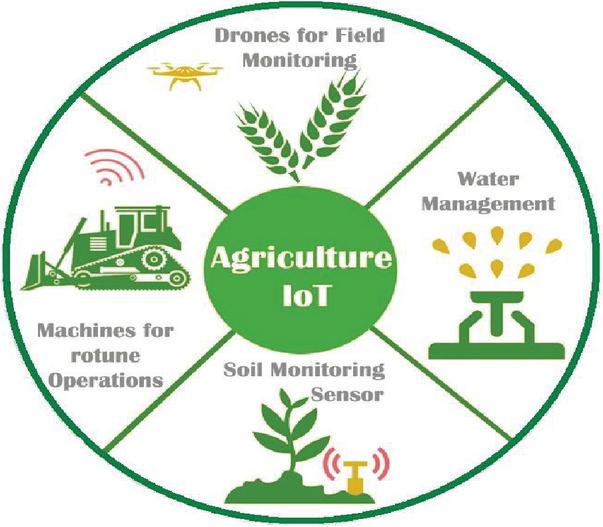
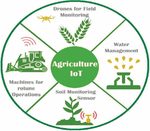
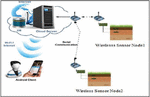
Figure 1 IoT in precision agriculture.
Figure 1 shows the key modules in the precision agriculture [25]. It consists of soil moisture sensing, intelligent water management systems, smart irrigation systems, smart drones for field monitoring and intelligent vehicle for various automated operations in the agriculture field.
The up gradations of technologies [4] are further progressed in last decade mainly focused on improving the productivity, yield as well as the safety of crops. The agriculture field has seen further growth in all aspects after the intervention of Internet of Things which enables low-cost sensors, open-source software’s for monitoring and tracking the entire agriculture or farming system with low capital investment. Another integration of machine learning, deep learning algorithms with IoT progressed towards improvement in the process of quality and optimized yield of crops.
The entire global population [5] raised from 1.65 billion in the year 1990 to 7.4 billion in the year 2020 as per the statistical report. It is predicted that human population growth will reach 11.2 billion scales by the end of 21st century, if the same growth rate proceeds. On the other side, the individual arable land per person falls from 0.5 Ha in the year 1967 to 0.2 Ha in the year 2020. So, concerning the global population growth rate, it is highly essential to revise the strategies and policies in the traditional agricultural field to improve the productivity rate in order to satisfy the basic human needs all over the world. Global warming is another major factor that threatens the entire world especially the agriculture field (i.e.) water scarcity since water is one of the major resources for crop irrigation. If it is not properly addressed, it leads to a negative impact in crop/food availability and economy of most countries.
The Internet of Things gives a major impact in the advancement of agricultural strategies especially among the small and middle level farmers by
➢ Introducing cutting edge technology in their farms
➢ Improving the soil yield
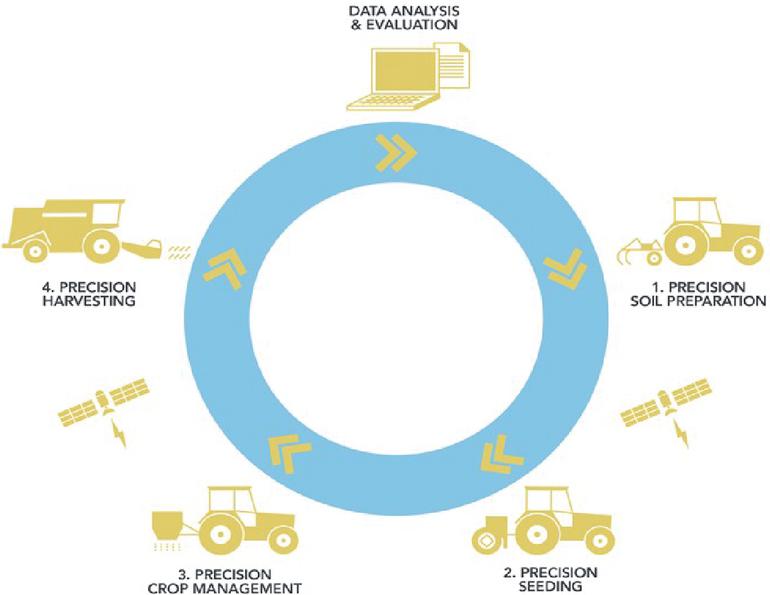
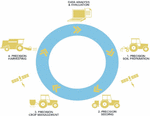
Figure 2 Steps in precision agriculture.
Figure 2 gives the pictorial representation of various steps involved in precision agriculture [26]. So, it is high time for any agriculturists to gear up towards the precision agriculture for improving the productivity as well as hygienic crops, fruits etc.
Smart agriculture is the futuristic way in building the agriculture domain to track and monitor all the necessary steps and processes by means of suitable
➢ Information technology
➢ Communication technology
IoT technology is used in smart agriculture for periodic monitoring of various factors such as temperature readings, oxygen level in soil, UV global radiation, short wave global radiation, soil moisture, air quality level index, irrigation level etc. through the appropriate sensors to raise the
➢ Livestock level
➢ Quality crop production
Precision agriculture improves the farming practice in a well modernized format through controlled and more accurate methodologies by means of combining sensors, information system, optimization process [28].
The basic steps involved in an appropriate observation of the environment and situation, strategic measurement and respond towards intra and inter field variability in crop production.
The primary objective of the precision agriculture is
1. Sensing and monitoring
2. Analytics and decision making
3. Intervention to improve the performance
The main challenge in the agriculture sector [7] is frequently changing climatic risks and weather management. Better analysis of climatic changes will enable the farmers to plan accordingly to effectively utilize the limited resources in the crop production improvement as well as risk reduction. The best way to increase the quality and quantity of crop production is by implementing intelligent technologies into the farming practice to build a connected precision agriculture to yield a better result in crop production.
Internet of Things (IoT) can be used [8] in different format in precision agriculture applications like
➢ Plant disease sensing
➢ Air pollution monitoring
➢ Water management, Smart Irrigation etc.
IoT platform ensures promising results in providing more reliable and perfect data in different applications that leads to better prediction and analysis [27].
The remaining section of the research article discussed the different smart technologies used in the precision agriculture, its advantages and limitations, conclusion and future scope.
2 Smart Methodologies in Precision Agriculture
Precision agriculture is focused on stepping in the direction of integrating information and communication technology towards the uplift of agriculture in terms of yielding high quality and quantity of hygienic crops. Precision agriculture involves the following four basic processes to effectively monitor, tracking the growth of crop as well as the environment in nurturing the quality crop from the seeding stage onwards.
1. Environment and soil fertility monitoring
2. Effective smart irrigation
3. Smart drones for field monitoring
4. Utilization of robots in farming field
2.1 Environment and Soil Fertility Monitoring
The soil quality, environmental conditions provide the greater impact in the crop cultivation. So, it is highly essential to monitor both the soil and environment conditions in order to ensure the yield of quality agricultural products.
Nisar Ahmed et al. [1] proposed an Internet of Things based precision agriculture. Numerous wireless sensors are installed in the agriculture field for an effective data acquisition. All wireless sensor nodes are configured in a cluster tree topology. Key information acquired by the following sensors: soil moisture sensor, humidity sensor, temperature sensor, UV index sensor and air quality sensor.
The data received from every sensor is further transmitted to the main server in the frame format. Manishkumar Dholu and K A Ghodinda [3] gives an overall view of effective monitoring and tracking of precision agriculture applications.
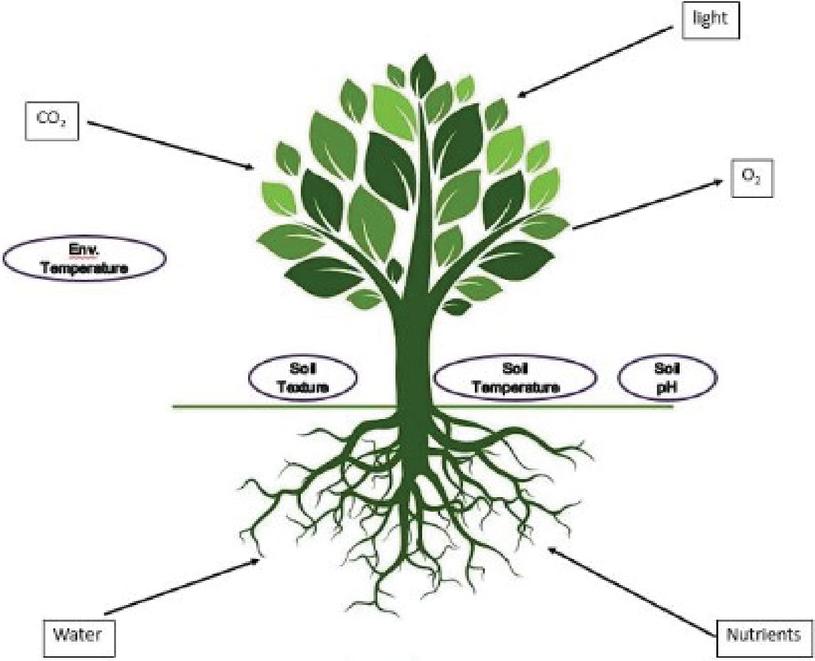
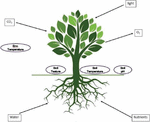
Figure 3 Physical Parameters influencing plant growth.
Figure 3 showcases various physical parameters influencing the plant growth [3]. Victor Grimblatt et al. [5] proposed an IoT based precision agriculture model exclusively for small and medium level farmers. Innovations and research on agriculture is key in countries like India, Algeria, China etc. due to the larger impact of agriculture products in the nation economy through satisfying basic food needs and export. Mostly soil consists of organic particles and minerals as half percent and the remaining half of the space composed of air and water. The condition of water in the soil proportionately affects the growth and health of the plant. The three main classification of soil water is given below:
1. Suitable for plants
2. Non-suitable for plants
3. Gravitational
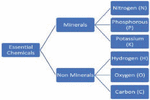
Sixteen important chemical elements are highly essential for the growth and survival of crop. It is further categorized into minerals and non minerals as shown in Figure 4.
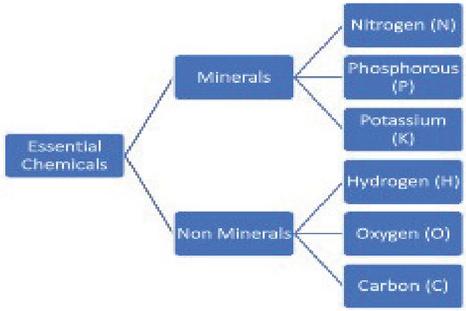
Figure 4 Essential chemical elements.
The above-mentioned minerals and non-minerals shown in Figure 4 are highly essential for the growth and protein building towards the yield of healthier crops. Most of the nutrients are available in the soil itself and it can also add through the appropriate usage of fertilizers.
Table 1 Sensors and platform used in precision agriculture applications
| Development | |||
| S.No | Manuscript Title | Sensors | Platform |
| 1 | IOT based Wireless Sensor Network for Precision Agriculture |
1. Soil Moisture Sensor 2. Humidity Sensor 3. Temperature Sensor 4. UV index Sensor 5. Air quality Sensor |
Arduino Mega |
| 2 | IOT Solutions for Precision Agriculture |
1. Pressure Sensor 2. Temperature Sensor 3. Moisture Sensor 4. Accelerometer Sensor |
Microcontroller |
| 3 | Internet of Things for Precision Agriculture applications |
1. Soil Moisture Sensor 2. Relative humidity Sensor 3. Light Intensity sensor |
NodeMcu |
| 4 | IOT solutions for precision farming and food manufacturing |
1. Temperature 2. Humidity 3. pH 4. CO2 |
Bayesian network analysis, multi-variate analysis |
| 5 | Precision Agriculture for small to medium size farmers – an IOT approach |
1. Soil moisture 2. Soil nutrients (NPK) 3. Soil pH 4. Soil Temperature 5. Soil Texture 6. Environment Temperature 7. Light |
ARC EM7D Processor |
| 6 | IOT based system for smart agriculture |
1. Contactless sensor for measuring surface temperature 2. sensor for leaf, flower bud temperature measurement 3. Shortwave global radiation sensor 4. UV global radiation sensor 5. Air Temperature sensor 6. Humidity sensor 7. Pressure sensor |
Libelium Platform |
| 7 | Efficient IOT system for Precision Agriculture |
1. Air temperature and humidity 2. Soil temperature and humidity 3. Evapotranspiration (ET) |
ADCON telemetry station SCADA system |
| 8 | IOT based versatile platform for precision farming |
1. Loop time control 2. specific time control 3. temperature hysteresis control 4. humidity hysteresis control 5. conditional control |
Arduino Mega2560 Hysteresis control |
| 9 | IOT based smart irrigation monitoring and controlling system |
1. Ambient temperature and humidity sensor 2. Soil Moisture Sensor 3. Water level sensor 4. zigbee transceiver |
AtMega 328 microcontroller |
| 10 | Smart Irrigation system using Internet of Things |
1. Temperature and humidity sensor 2. Water level sensor 3. soil moisture sensor |
Arduino UNO |
| 11 | Design and Optimization of IOT based smart irrigation system in Sri Lanka |
1. Soil moisture sensor 2. Temperature sensor 3. Humidity sensor |
NodeMcu |
| 12 | IOT based smart system for enhanced irrigation in agriculture |
1. Soil water content 2. Temperature and humidity sensor 3. Water proof sensor |
Arduino UNO |
Ioana M Marcu [6] developed an internet of things based smart agriculture system. Liberium platform is used to provide an accurate data especially for vegetable production and irrigation. The new generation libelium Xtreme device is used for various applications like Fruit orchards, Vineyards, Greenhouse crops.
The new generation device has nineteen sensors developed by few popular manufacturers like Apogee, Decagon, Ecomatic, Gill Instrument.
Even though several sensors are used in precision agriculture, few main sensors are listed here
1. Sensor for surface temperature measurement
2. Sensor for leaf and flower bud’s temperature measurement
3. Sensor for measuring humidity, temperature, pressure in air
4. Sensor for measuring shortwave global radiation
5. Sensor for measuring UV global radiation
The measured values are pushed to Meshlium Xtreme Gateway and transfer the data through 3G/GPRS or Wi-Fi protocol based on the connectivity choice in the particular region.
Rekha P et al. [7] proposed an automated precision farming framework based on internet of things for enhancing the yield of groundnut. The main intention of developing this framework is to provide all kind of guidance and support in different phases of crop production. The basic ambition of this framework is
➢ To develop a sensing system to measure different soil specifications.
➢ To develop a wireless sensor architecture to effectively track the field.
➢ To enhance the required coverage range and connectivity.
➢ To deploy a web-based application to initiate proper intimation to farmers and agriculturists.
The following Figure 5 gives the overview of smart irrigation system [10].
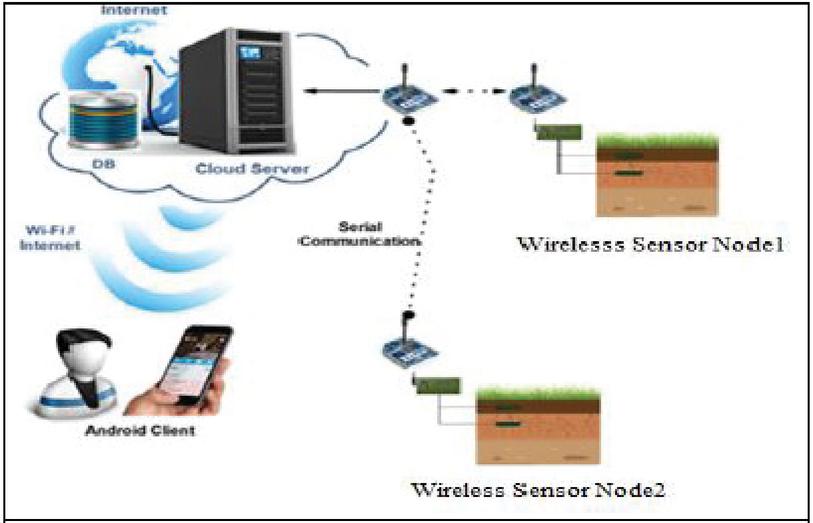
Figure 5 Smart irrigation system overview.
2.2 Effective Smart Irrigation
George Suciu et al. [8] give an insight about precision agriculture using internet of things. Figure 5 shows the overview of smart irrigation system. Two main challenges that has direct impact on agriculture and farming practices are
1. Population growth
2. Climatic changes
The key parameters tracked for an effective irrigation system is air temperature and its humidity level, soil temperature and its humidity level and evapotranspiration.
Shwetha B Saraf and Dhanashri H Gawali [10] proposed smart irrigation system for effective monitoring and controlling tasks. The main intention of this automated system is to monitor and track all key parameters essential for maintaining ambient environment in the agricultural field. Optimization in the smart irrigation system further increases the quality of the crop. Few advantages of IoT based smart irrigation system are given below:
1. It improves the quality and yield of crops.
2. Proper level of watering using an appropriate intelligent algorithm.
3. Effective utilization of water level by proper tracking of water resources.
4. It eliminates manual interventions.
5. Reduction in cost as well as power consumption.
A Anitha et al. [11] briefed an effective irrigation system for precision agriculture. The framework is designed for measuring the dampness level in the agriculture field through the appropriate use of dampness sensor and also temperature sensor measures the dampness rate. If the dampness rate goes below the coveted rate, framework enables the proper water supply to the monitored farm field.
H G C R Laksiri et al. [12] proposed an optimized smart irrigation system for srilankan farmers. The proposed system has three modules
1. Implementation of smart irrigation system.
2. Database implementation to load agriculture and weather parameters.
3. Implementation of weather forecasting.
Bhanu K N et al. [13] developed an enhanced irrigation system exclusively for agriculture using IoT. The basic steps of proposed smart irrigation system start with the appropriate sensing of suitable soil parameters and push the data to the cloud platform through arduino. Cloud platform is utilized for data storage as well as analysis and classification using intelligent algorithms. If the received data rate is below the threshold level, intimation will be sent to the registered user and the water pump is activated to enable watering to the particular monitored field. The key advantage of cloud utilization for data storage in IoT system [10] is data access from any remote places, reduction in hardware requirement and cost, improvement in data security.
2.3 Smart Drones for Field Monitoring
U M Rao Mogili and B B V L Deepak [14] reviewed the drone applications in smart agriculture. Developed countries adopted unmanned aerial vehicles technology already to assist the farmers in the field. The main role of drones in the agricultural field is
1. Monitoring crop
2. Spraying pesticides over large areas

Figure 6 Types of Unmanned Aerial Vehicle (UAV) (a) Fixed Wing (b) Single Rotor (c) Quad Copter (d) Hexa Copter (e) Octo Copter.
Major drone design includes the following key factors: cost, flight range, payload, weight, configuration etc.
In general, unmanned aerial vehicle is controlled through radio channel without any human flyer. Several categories of unmanned aerial vehicles are used for different applications. Major categorizations are fixed wing, single rotor helicopter, Quad Copter, Hexa Copter, Octo Copter as shown in Figure 6 [14].
Praveen Kumar Reddy Maddikunta et al. [15] gives a complete insight about the application of unmanned aerial vehicles in agriculture, its major requirements and challenges. The variety of smart sensors is used in smart agriculture applications. Location based sensors are typically used to locate the different regions and major spots in the farming land. Farmers use these kinds of sensors to monitor the growth of crops in all the stages and key functionalities of tracking the appropriate watering, weeds treatment and also fertilization.
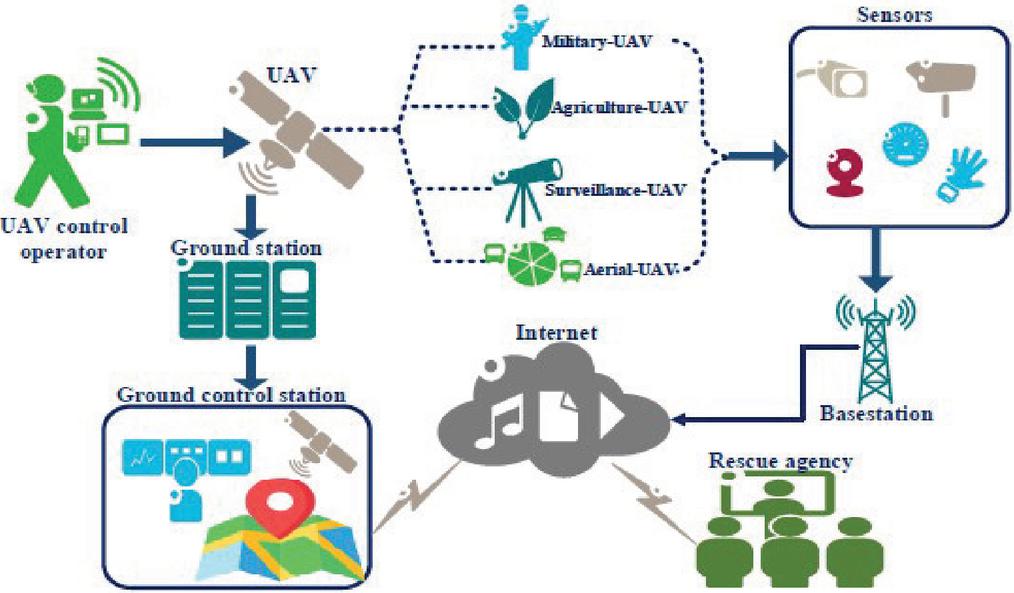
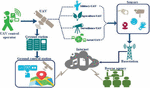
Figure 7 UAV based monitoring system.
Figure 7 gives the complete picture of UAV based monitoring system [15]. Electrochemical sensors are widely utilized in precision agriculture to extract the pH level and nutrient levels in the soil. Temperature and humidity sensors are used to monitor the field and based on those readings the farmers can adjust the level of watering and fertilizer. Several types of optical sensors are used in precision agriculture applications which are listed below:
➢ Visible light sensors (RGB)
➢ Multi Spectral Sensors
➢ Hyper Spectral Sensors
Table 2 List of few precision agriculture applications
| S.No | Author | Applications |
| 1 | Nisar Ahmad et al. (2019) | Smart Irrigation System |
| 2 | Richard Charles Andrew et al. (2018) | Smart Irrigation, livestock monitoring |
| 3 | Manishkumar Dholu et al. (2018) | Smart Irrigation in Precision Agriculture |
| 4 | Rob Dolci (2017) | Malthouse and medical marijuana cultivation |
| 5 | Victor Grimblatt et al. (2019) | To improve soil yield |
| 6 | Ioana M Marcu et al. (2019) | to assist the farmers in yielding healthy crops |
| 7 | George Suciu et al. (2019) | Energy efficient and cost effective agriculture crops |
| 8 | Theerayod Wiangtong et al. (2018) | Precision Farming |
| 9 | Shwetha et al. (2017) | Smart Farm Irrigation system |
| 10 | A Anitha et al. (2020) | Smart irrigation system |
| 11 | H G C R Laksiri et al. (2019) | Smart irrigation system |
| 12 | Bhanu K N et al. (2020) | Identification of soil suitability for agriculture |
The modern digital era in technology upgrades the agriculture field in all dimensions. The application of unmanned aerial vehicles in precision agriculture mainly targets appropriate monitoring of the crops in agriculture field under all circumstances with the equipped intensive sensors for capturing images in both spatial and temporal resolutions.
The major applications where smart drones are used in precision agriculture are mentioned below:
1. UAV as bird’s eye view
2. UAV in precision agriculture
3. UAV in irrigation monitoring
4. UAV in aerial mustering
5. UAV in artificial Pollination
Vippon Preet Kour and Sakshi Arora [16] gives a review of latest improvements in the field of smart agriculture. Jeongeun Kim et al. [17] discussed the applications of unmanned aerial vehicles in the agricultural field. The advancement in cutting edge technologies regularizes the farming practice in a smart manner by integrating leading technologies like robotics, big data, artificial intelligence, internet of things etc. Utilization of unmanned aerial vehicles becomes wide and popular nowadays in agricultural sector for various applications like seed sowing, spraying of Pesticides and fertilizers, crop growth assessment and appropriate mapping.
The main challenge in UAV is its battery backup and also its limited flying duration. Current UAVs can able to fly for 20–30 minutes continuously which cannot be sufficient for crop monitoring.
Pasquale Daponte et al. [18] reviewed the utilization of drones in precision agriculture for improving the productivity level in the agricultural sector. In smart drones, multispectral cameras are used for the monitoring of important following parameters in the vegetation field: content of water level in leaf, Leaf Area Index (LAI) and ground cover, chlorophyll Content, Normalized Difference Vegetation Index (NDVI).
The thermal cameras are utilized for analyzing the level of water stress in crops due to the temperature raise. The following basic functionalities are very important for any smart drones that have to be operated for agricultural applications.
1. Drone flies as per the defined path
2. Drone can have the capability to control its altitude
3. Drone has to detect and avoid any collision with the obstacles held during its flying period
4. During any critical situation like battery drainage, drone has to be landed automatically
5. Captured image needs to be properly stabilized
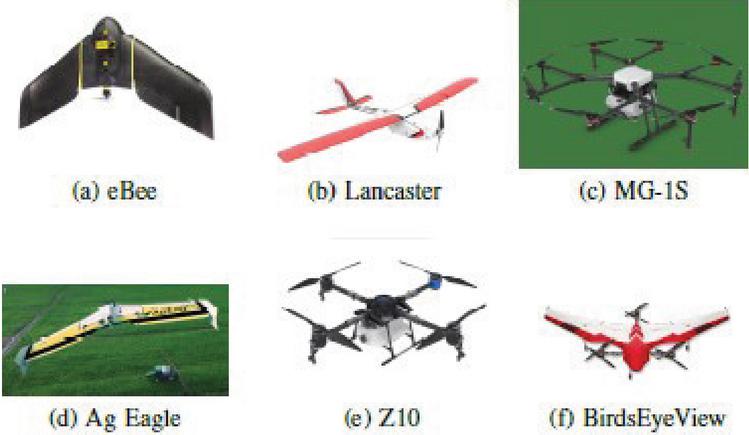
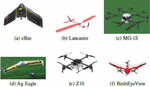
Figure 8 Popular drones used for agriculture.
Marek Kulbacki et al. [19] give a complete insight about the utilization of drones in the agricultural sector from the initial stage to the harvest stage. Unmanned Aerial System (UAS) consists of drone, Data Link System (DLS) and Ground Control System (GCS). Majority of the drones are classified into rotary wing UAVs and fixed wing UAVs. Figure 8 highlights the popular drones used in agriculture sector [19].
2.4 Utilization of Robots in Farming Field
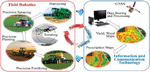
Neha S Naik et al. [20] discussed the utilization of robot in agriculture sector for seeding applications. The key purpose of using robotic technology in precision agriculture is to improve the time and energy savings by reducing the manual works. Most of the farming practice needs regular maintenance of crops which includes repetitive tasks in a periodical basis. Agriculture robots are designed for automated specific tasks such as sowing seeds etc. These robots had inbuilt cameras and machine vision concepts to enable the automated operations of sowing seeds and monitoring the field in terms of spraying pesticides and fertilizers. Figure 9 highlights the precision agriculture basic technologies that incorporate field robotics [24].
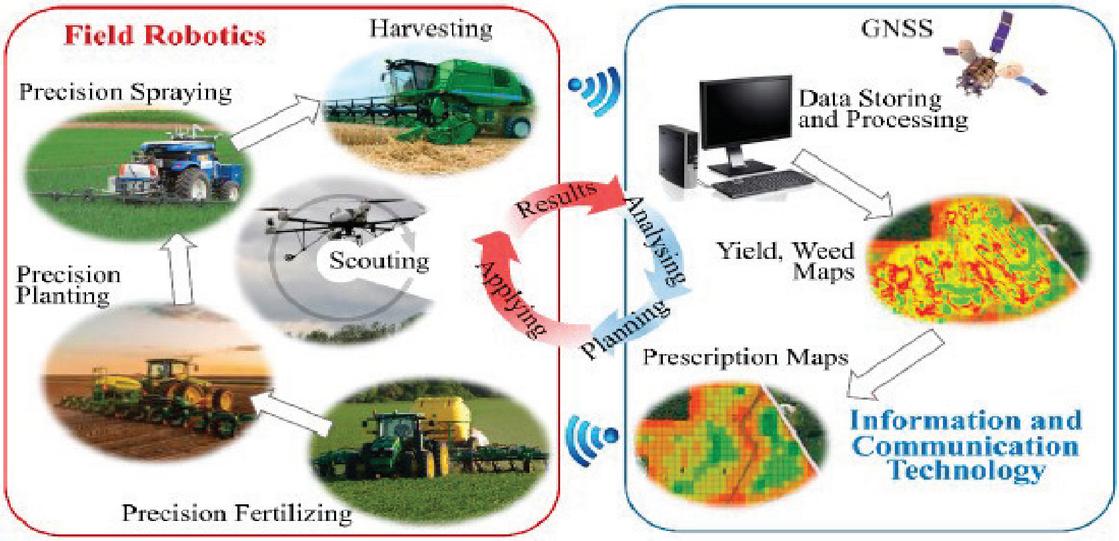
Figure 9 Precision agriculture basic technologies.
R. Eaton et al. [21] developed a unified framework especially for designing and controlling the agricultural machines towards autonomous farming. The main steps in automated machinery operations follow
1. Seeding
2. Crop sensing
3. Follow up process
4. Harvesting
K M Nielson et al. [22] discussed the process of controlling autonomous vehicle in precision agriculture. It mainly concentrated on the development of framework for controlling the autonomous vehicle used for mapping weed as well as vegetation crop in precision agriculture. The control framework consists of four layers.
➢ Bottom layer – controlling propulsion and steering of vehicle
➢ Second layer – wheel unit movement co-ordination
➢ Third layer – execution of path, perception
➢ Top layer – planning, reasoning
3 Conclusion and Future Scope
This research article provides a complete insight of internet of things on building the applications of precision agriculture. Various cost effective smart technological adaptations in the agriculture sector are analyzed towards the upgradation of the traditional approach and the lifestyle of the farmers. Major agriculture applications like environment and soil monitoring, smart irrigation system, utilization of intelligent drones in the agriculture field, smart robot integration for various automated works in agriculture field are also discussed in this research article. It highlighted the advantages and limitations of an IoT based smart precision agriculture that can be further enhanced by researchers in the future.
References
[1] Ahmad, Nisar, Ali Hussain, Ihsan Ullah, and Bizzat Hussain Zaidi. “IOT based wireless sensor network for precision agriculture.” In 2019 7th International Electrical Engineering Congress (iEECON), pp. 1–4. IEEE, 2019.
[2] Andrew, Richard Charles, Reza Malekian, and Dijana Capeska Bogatinoska. “IoT solutions for precision agriculture.” In 2018 41st International Convention on Information and Communication Technology, Electronics and Microelectronics (MIPRO), pp. 0345–0349. IEEE, 2018.
[3] Dholu, Manishkumar, and K. A. Ghodinde. “Internet of things (IoT) for precision agriculture application.” In 2018 2nd International conference on trends in electronics and informatics (ICOEI), pp. 339–342. IEEE, 2018.
[4] Dolci, Rob. “IoT solutions for precision farming and food manufacturing: artificial intelligence applications in digital food.” In 2017 IEEE 41st Annual Computer Software and Applications Conference (COMPSAC), vol. 2, pp. 384–385. IEEE, 2017.
[5] Grimblatt, Victor, Guillaume Ferré, Francois Rivet, Christophe Jego, and Nicolas Vergara. “Precision agriculture for small to medium size farmers—an IoT approach.” In 2019 IEEE International Symposium on Circuits and Systems (ISCAS), pp. 1–5. IEEE, 2019.
[6] Marcu, Ioana M., George Suciu, Cristina M. Balaceanu, and Alexandru Banaru. “IoT based System for Smart Agriculture.” In 2019 11th International Conference on Electronics, Computers and Artificial Intelligence (ECAI), pp. 1–4. IEEE, 2019.
[7] Rekha, P., Venkata Prasanna Rangan, Maneesha V. Ramesh, and K. V. Nibi. “High yield groundnut agronomy: An IoT based precision farming framework.” In 2017 IEEE Global Humanitarian Technology Conference (GHTC), pp. 1–5. IEEE, 2017.
[8] Suciu, George, Ioana Marcu, Cristina Balaceanu, Marius Dobrea, and Elena Botezat. “Efficient IoT system for precision agriculture.” In 2019 15th International Conference on Engineering of Modern Electric Systems (EMES), pp. 173–176. IEEE, 2019.
[9] Wiangtong, Theerayod, and Phaophak Sirisuk. “IoT-based versatile platform for precision farming.” In 2018 18th International Symposium on Communications and Information Technologies (ISCIT), pp. 438–441. IEEE, 2018.
[10] Saraf, Shweta B., and Dhanashri H. Gawali. “IoT based smart irrigation monitoring and controlling system.” In 2017 2nd IEEE International Conference on Recent Trends in Electronics, Information & Communication Technology (RTEICT), pp. 815–819. IEEE, 2017.
[11] Anitha, A., Nithya Sampath, and M. Asha Jerlin. “Smart Irrigation system using Internet of Things.” In 2020 Interntional Conference on Emerging Trends in Information Technology and Engineering (ic-ETITE), pp. 1–7. IEEE, 2020.
[12] Laksiri, H. G. C. R., H. A. C. Dharmagunawardhana, and J. V. Wijayakulasooriya. “Design and Optimization of IoT Based Smart Irrigation System in Sri Lanka.” In 2019 14th Conference on Industrial and Information Systems (ICIIS), pp. 198–202. IEEE, 2019.
[13] Bhanu, K. N., H. S. Mahadevaswamy, and H. J. Jasmine. “IoT based Smart System for Enhanced Irrigation in Agriculture.” In 2020 International Conference on Electronics and Sustainable Communication Systems (ICESC), pp. 760–765. IEEE, 2020.
[14] Mogili, UM Rao, and B. B. V. L. Deepak. “Review on application of drone systems in precision agriculture.” Procedia computer science 133 (2018): 502–509.
[15] Maddikunta, Praveen Kumar Reddy, Saqib Hakak, Mamoun Alazab, Sweta Bhattacharya, Thippa Reddy Gadekallu, Wazir Zada Khan, and Quoc-Viet Pham. “Unmanned aerial vehicles in smart agriculture: Applications, requirements, and challenges.” IEEE Sensors Journal (2021).
[16] Kour, Vippon Preet, and Sakshi Arora. “Recent Developments of the Internet of Things in Agriculture: A Survey.” IEEE Access 8 (2020): 129924–129957.
[17] Kim, Jeongeun, Seungwon Kim, Chanyoung Ju, and Hyoung Il Son. “Unmanned aerial vehicles in agriculture: A review of perspective of platform, control, and applications.” IEEE Access 7 (2019): 105100–105115.
[18] Daponte, Pasquale, Luca De Vito, Luigi Glielmo, Luigi Iannelli, Davide Liuzza, Francesco Picariello, and Giuseppe Silano. “A review on the use of drones for precision agriculture.” In IOP Conference Series: Earth and Environmental Science, vol. 275, no. 1, p. 012022. IOP Publishing, 2019.
[19] Kulbacki, Marek, Jakub Segen, Wojciech Knieć, Ryszard Klempous, Konrad Kluwak, Jan Nikodem, Julita Kulbacka, and Andrea Serester. “Survey of drones for agriculture automation from planting to harvest.” In 2018 IEEE 22nd International Conference on Intelligent Engineering Systems (INES), pp. 000353–000358. IEEE, 2018.
[20] Naik, Neha S., Virendra V. Shete, and Shruti R. Danve. “Precision agriculture robot for seeding function.” In 2016 International Conference on Inventive Computation Technologies (ICICT), vol. 2, pp. 1–3. IEEE, 2016.
[21] Eaton, Ray, Jay Katupitiya, Kheng Wah Siew, and Blair Howarth. “Autonomous farming: Modelling and control of agricultural machinery in a unified framework.” International journal of intelligent systems technologies and applications 8, no. 1–4 (2010): 444–457.
[22] Nielsen, Kirsten Mølgaard, Palle Andersen, Tom Søndergaard Pedersen, Thomas Bak, and J. D. Nielsen. “Control of an autonomous vehicle for registration of weed and crop in precision agriculture.” In Proceedings of the International Conference on Control Applications, vol. 2, pp. 909–914. IEEE, 2002.
[23] Duckett, Tom, Simon Pearson, Simon Blackmore, Bruce Grieve, Wen-Hua Chen, Grzegorz Cielniak, Jason Cleaversmith et al. “Agricultural robotics: the future of robotic agriculture.” arXiv preprint arXiv:1806.06762 (2018).
[24] Gonzalez-de-Santos, Pablo, Roemi Fernández, Delia Sepúlveda, Eduardo Navas, Luis Emmi, and Manuel Armada. “Field Robots for Intelligent Farms—Inhering Features from Industry.” Agronomy 10, no. 11 (2020): 1638.
[25] https://www.javatpoint.com/iot-smart-agriculture-domain
[26] https://www.scenario.co.za/en-ZA/News/Article/View/basic-concepts-of-precision-farming
[27] Velliangiri, S., Sekar, R., and Anbhazhagan, P. (2020). Using MLPA for smart mushroom farm monitoring system based on IoT. International Journal of Networking and Virtual Organisations, 22(4), 334–346.
[28] Velliangiri, S., and Alagumuthukrishnan, S. (2019). A review of dimensionality reduction techniques for efficient computation. Procedia Computer Science, 165, 104–111.
Biographies

Iwin Thanakumar Joseph Swamidason is an Assistant Professor in the Department of Computer Science and Engineering, Koneru Lakshmaiah Education Foundation, Vijayawada, Andhrapradesh, India. He has 13 plus years of teaching experience as well as research experience. He has done his Ph.D in the Department of Computer Science and Engineering in Annamalai University, Chidambaram, Tamilnadu, India.
His Research interest includes Artificial Intelligence, Machine Learning, Image Processing, Internet of Things. He published good number of research articles in this research area. He is a lifetime member of ISTE professional community.
Researchgate id: https://www.researchgate.net/profile/Iwin-Thanakumar-Joseph-Swamidason

Shanthini Pandiaraj completed her B.E in Electronics and Communication Engineering from Government College of Technology, Coimbatore in the year 1987 and M.E in Applied Electronics from Bharathiar University, Coimbatore in 2003. She was awarded her PhD degree by Anna University, Chennai in the year 2015, where she specialized in Speaker Recognition. She has over 25 years of teaching experience. She is working as Associate Professor in the department of Electronics and Communication Engineering, Karunya Institute of Technology and Sciences, Coimbatore, India. Her areas of interest include Speech Technology, IoT and Machine Learning.
Karunakaran Velswamy received his BE Degree from Mahindra Engineering College, Salem and ME Degree from National Engineering College, Kovilpatti, Tamilnadu, India. He completed PhD Degree from Anna University, Chennai, India. Currently, he is working as an Associate Professor in the Department of Computer Science and Engineering (AI & ML) and Cybersecurity, Jain University, Bengaluru. His area of interest is in the field of data mining, machine learning and big data analytics.

P. Leela Jancy is an Assistant Professor in the Department of Information Technology, Sri Sai Ram Institute of Technology, Chennai, Tamil Nadu, India since 2009. She has 14 plus years of teaching Experience. She has published several papers in International/National Conferences and Journals. Her Research interest includes Artificial Intelligence, Block chain, Deep learning, computer vision and Image Processing.
Journal of Mobile Multimedia, Vol. 18_3, 935–956.
doi: 10.13052/jmm1550-4646.18323
© 2022 River Publishers