Prediction of the Mean Time to Failures of a Complex System Using the Monte Carlo Simulation Method
Hedi A. Guesmi
Department of Electrical Engineering, College of Engineering, Qassim University, Saudi Arabia
E-mail: h.guesmi@qu.edu.sa
Received 06 March 2024; Accepted 04 October 2024
Abstract
This paper presents a Monte Carlo-based algorithm for predicting the Mean Time to Failure (MTTF) of complex structures, specifically a “Bridge-type network” with five elements exhibiting various failure distributions. The proposed algorithm involves generating element lifetimes through the inverse of their failure distribution functions, providing a robust approach to evaluating MTTF for systems beyond traditional series or parallel configurations.
The approach was implemented in MATLAB, and the software underwent extensive testing across different scenarios, including both exponential and Weibull distributions. The results demonstrated the method’s accuracy and its capability to handle diverse failure distributions with minimal error. This tool offers reliability engineers a versatile solution for predicting and improving the reliability of complex systems.
In summary, the proposed method and software significantly advance the reliability assessment of intricate structures and offer a solid foundation for further research and practical applications in the field of reliability engineering.
Keywords: Reliability, mean time to failure, tie set method.
Notations
| R(t) | : | Survivor function |
| f(t) | : | Failure density function |
| F(t) | : | Failure distribution function |
| R(t) | : | Survivor function of system |
| : | Hazard rate of element i | |
| MTTF | : | Mean time to failure |
| T | : | Mean time to failure of the system |
| N | : | Total number of simulation |
| n | : | Number of elements in the considered system |
| i | : | Label of component in the system: i 1, 2,…,n |
| j | : | Label of Paths in the system j 1,2,…,m |
| k | : | Label of iteration in the simulation k 1, 2,…,N |
| : | Lifetime of element “i” following the k system failure | |
| P | : | Minimal path j containing the elements i |
| : | Lifetime of minimal path “j” relative to element “i” in the | |
| k iteration | ||
| q | : | Lifetime of the system |
1 Introduction
The Mean Time to Failure MTTF represents a commonly used parameter to evaluate the reliability of non-repairable systems [1–7]. Assessing this parameter is an important step in project establishment, starting from the design phase and throughout their future development [8–13].
The literature regarding this topic is extensive, but it mainly consists of purely theoretical considerations, primarily based on the assumption that the studied structures are either in series or parallel [14–17]. Therefore, obtaining the MTTF poses no difficulty [18–27].
However, in reality, technical systems are often complex and composed of multiple components, leading to a more intricate relationship between the system’s reliability and its constituent elements [28–32]. Consequently, evaluating the MTTF requires a deeper understanding of two key aspects. Firstly, one must comprehend the topological reliability relationship between the system and its constituent elements. Secondly, a comprehensive understanding of the reliability characteristics of the constituent elements, specifically their reliability functions, is necessary [33, 35].
The topological reliability relationship refers to the interdependencies between the system and its components, taking into account their physical arrangement, connectivity, redundancy, and fault tolerance mechanisms. These factors influence the overall reliability of the system and its MTTF. Understanding the topological reliability relationship becomes particularly important as systems become more complex, involving intricate configurations and interactions among components.
Additionally, the reliability functions of the constituent elements play a crucial role in determining the overall reliability of the system. Reliability functions describe the probability distribution of the time until failure for each component. These functions capture important characteristics such as failure rates, failure modes, and time-dependent behavior. Accurate knowledge of these reliability functions is essential for estimating and predicting the MTTF of the system accurately.
Considering the complexity of technical systems and the interplay between their topological reliability relationship and the reliability functions of their components, determining the MTTF becomes a challenging task. It requires a multidisciplinary approach that combines expertise in system design, reliability engineering, probabilistic modeling, and statistical analysis. Researchers and practitioners must employ advanced analytical techniques, simulation methods, and optimization algorithms to accurately assess the MTTF and ensure the reliability of complex systems [36, 39].
This paper addresses the challenges of evaluating the MTTF of a complex technical system. It explores methodologies, techniques, and tools for modelling topological reliability relationships and estimating the reliability functions of constituent elements. A bridge-type network configuration is presented as a case study to illustrate the effectiveness of these approaches. The insights provided will benefit researchers, engineers, and decision-makers involved in designing and maintaining reliable systems. The findings contribute to improving system performance, minimizing downtime, and optimizing resource allocation, enhancing overall reliability and project success.
2 Evaluation of MTTF for the Basic Structures
For any given element, the MTTF can be evaluated by integrating the survivor function R(t) between the limits ().
Therefore, the MTTF is expressed by the following relationship.
| (1) |
Where: denotes the survivor function of a single element.
In the case of a system composed of multiple elements, the MTTF for the system can be determined by
| (2) |
Where: represents the survivor function of the considered system.
According to Equation (2), the determination of the MTTF of a system requires:
• Knowing the survivor function of the system , which depends on the survivor functions of its constituent elements.
• Analytically solving Equation (2).
2.1 Series Structure
In the case of a system composed of two elements arranged in series, as illustrated in Figure 1, where each element is characterized by a constant failure rate and the survivor functions of the individual elements are expressed as follows:
| (3) |

Figure 1 Series structure with 2 elements.
In a series configuration, the survivor of the entire system can be determined by multiplying the survivor functions of the individual components as follows.
| (4) |
Hence, the MTTF of the system can be obtained by integrating the survivor function over time:
| (5) |
In the general case where the system is composed of n elements in series as shown in Figure 2.

Figure 2 Series structure with n-elements.
With each element characterized by a constant failure rate , the survivor function of the series structure can be expressed as the product of the survivor function of the individual elements, and the MTTF of the system can then be calculated by integrating the survivor function over time
| (6) |
If the failure rate is not constant and follows a Weibull distribution, as given by the following equation:
| (7) |
Then the MTTF will be expressed by:
| (8) |
Where
R(t): represents the survivor function of the element,
a: scale parameter,
b: shape parameter.
: is the gamma function, given by a special table and defined for as:
| (9) |
The MTTF of a series structure composed of two elements can be determined as follows:
| (10) |
2.2 Parallel Structure
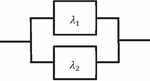
The survivor function of a parallel system with two elements, as shown in Figure 3, is given by:
| (11) |
where R(t), R(t) represents respectively the survivor function of first and second element.
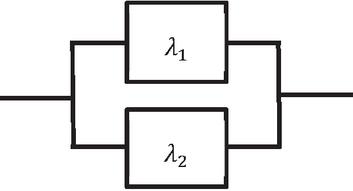
Figure 3 Parallel structure with 2-elements.
Consider now the particular case of the exponential distribution. If the elements have a constant failure rates, and respectively, then the MTTF of such an arrangement is given by
| (12) |
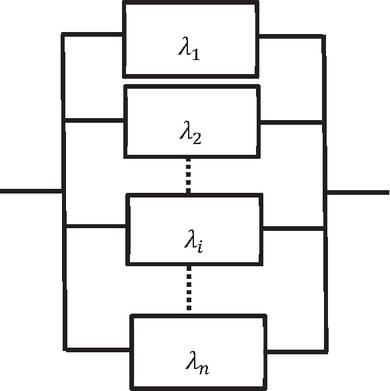
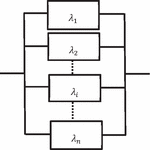
Figure 4 Parallel structure with n-elements.
In the general case where the system is composed of n elements in parallel, as shown in Figure 4, the survivor function of the system can be expressed by the Equation (13):
| (13) |
with representing the survivor function of i-th constituent element in the system, therefore the MTTF of such an arrangement is given by
| (14) |
The principle used to derive Equation (12) can also be applied to a parallel system consisting of any number of elements. Such a derivation would show that:
| (15) |
Formula (2.1) represents the MTTF for a two-element series system, while Formula (12) pertains to the MTTF for a two-elements parallel system. In these cases, the failure distribution of the elements is assumed to be exponential, which simplifies the calculations. However, when the failure distribution of the elements deviates from the exponential distribution, obtaining the MTTF becomes more analytically challenging. It may be necessary to employ advanced analytical methods such simulation techniques based on Monte Carlo Method to obtain an accurate estimate of the MTTF in such systems.
3 Studied Structure (Bridge-Type Network)
Evaluating the reliability characteristics of a complex system composed of a large number of elements can indeed be challenging. In many industrial products, the components are interconnected in intricate ways, forming complex structures that go beyond simple series or parallel configurations. These structures often involve a combination of series and parallel elements with non-constant failure rates, making reliability analysis more complex.
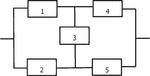
The structure discussed in this paper is a complex system composed of multiple components. It consists of a five distinct elements bridge-type network as shown in Figure 5 with distributions that follow the Weibull distribution with different parameters a, b as follows.
| (16) |
or by the distribution function of failure given by:
| (17) |
Where i represents the element number, with i 1, 2, 3, 4, 5, and
a: represents the parameter of scale
b: represents the parameter of form
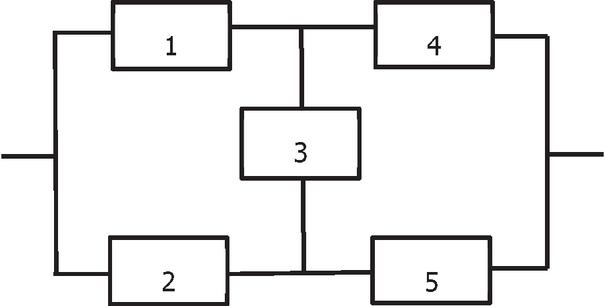
Figure 5 Bridge-type network.
None of the components in the network shown in Figure 5 are connected in a simple series or parallel arrangement. Therefore, alternative techniques are required to analyze and solve the network. Several methods are commonly used for this purpose, as mentioned, including the conditional probability approach, cut and tie set analysis, tree diagrams, logic diagrams, and connection matrix techniques.
Many of the advanced techniques mentioned, involve transforming the original network structure into an equivalent structure consisting of series and parallel components or paths. These transformations make the analysis more manageable and allow the application of well-established formulas and techniques for series and parallel configurations.
In this paper, the Tie Set method is used to evaluate the MTTF of a given system. Here, tie sets are defined as minimal paths of the system, meaning they are sets of system components connected in series. However, for the entire system to fail, all tie sets must fail simultaneously. Thus, the tie sets are effectively connected in parallel.
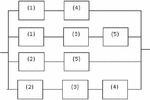
By identifying these possible combinations of available elements, we can determine the different paths or configurations that ensure the system’s mission is accomplished successfully. This analysis leads us to decompose the structure shown in Figure 5 in terms of minimal paths to fulfilling the mission imposed by the system up to time t as illustrated in Figure 6, either by the availability of:
– Element 1 and 4, or
– Element 1, 3, and 5, or
– Element 2 and 5, or
– Element 2, 3, and 4.
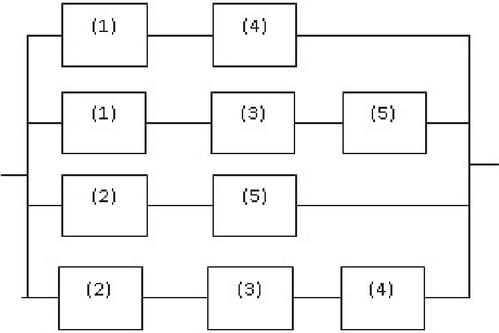
Figure 6 Set of minimal paths of Figure 5.
Therefore, we can express the reliability function of this system as follows
| (18) |
4 MTTF Evaluation Principle of the Studied Structure
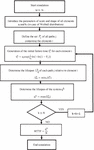
The evaluation of the MTTF using the statistical simulation method is primarily based on eight steps according to the algorithm shown in Figure 7:
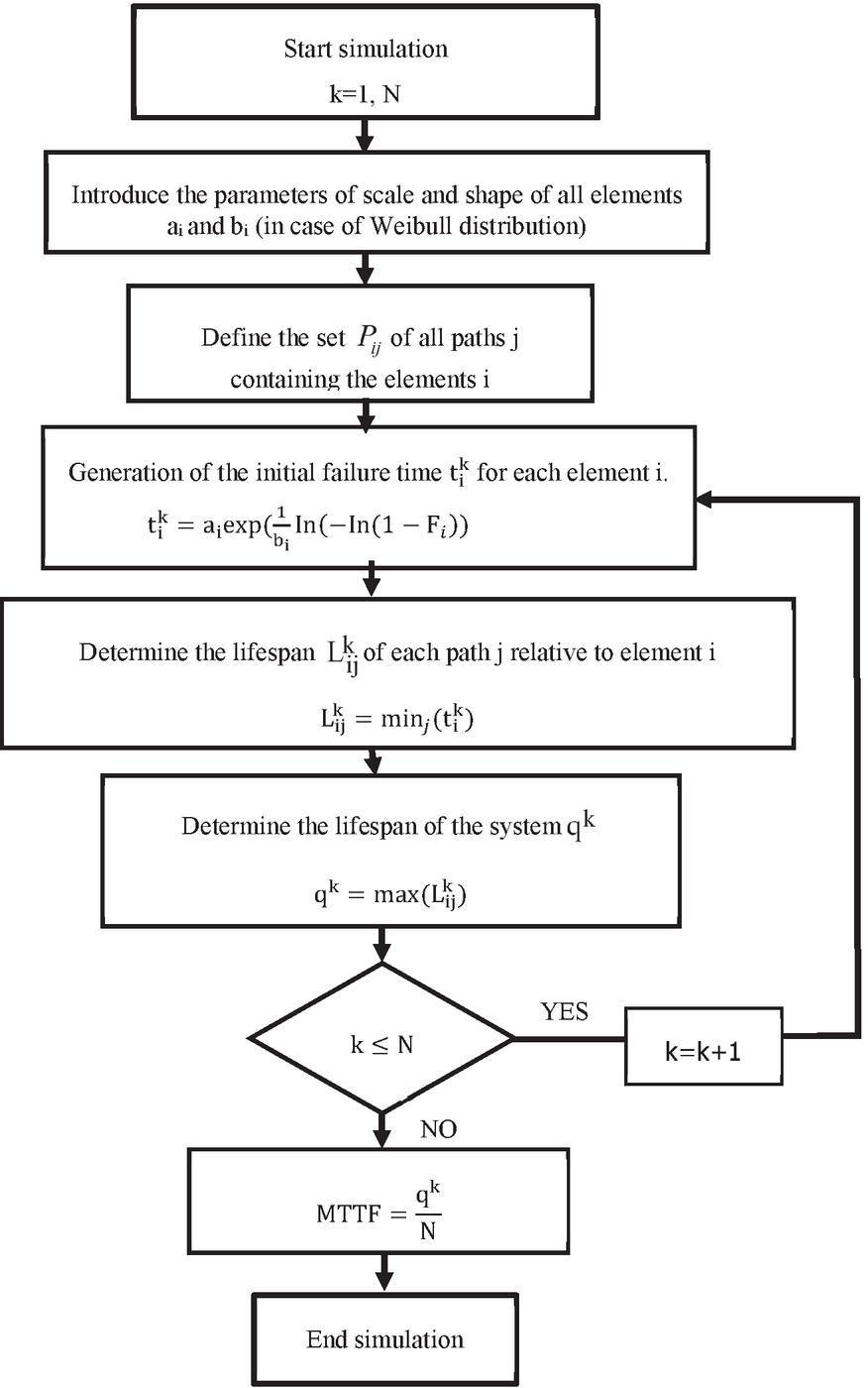
Figure 7 Algorithm for evaluation the MTTF of considered system.
Step 1: For a given structure, it is necessary to define first the set of minimal paths “j” containing the elements “i” These minimal paths represent the different combinations of elements that contribute to the overall functionality of the structure.
In our case, this set is composed of four minimal paths as illustrated in Table 1, which are:
Step 2: Initialize the simulation (k 1) and manage the initial generated lifetime of each element “i” in the system according to its failure distribution. In the case of the Weibull distribution with two parameters (a, b), the lifetimes are obtained by inverting the distribution given by expression (17):
| (19) |
and in case of exponential distribution with parameter , this lifetime can be generated by:
| (20) |
Where represents a random variable managed from the interval (0,1).
Step 3: Determine the lifetime of each path “j” relative to element “i,” considering that each minimal path represents a series structure of “i” elements. This allows us to write:
| (21) |
Step 4: Once we know the lifetime of each path , then the lifetime of the whole system, , which consists of a set of parallel paths, can be determined by the following expression.
| (22) |
Step 5: Generate a new simulation iteration by setting: k k 1 and compare the actual iteration with the total imposed number of simulation. At this stage, two cases are possible:
Table 1 Set of minimal paths for the structure of Bridge-type network
| Element i | ||||||
| P | 1 | 2 | 3 | 4 | 5 | |
| Path j | 1 | 1,4 | 2,5 | 1,3,5 | 1,4 | 2,5 |
| 2 | 1,3,5 | 2,3,4 | 2,3,4 | 2,3,4 | 1,3,5 | |
. In that case we return to step 2 and generate a new lifetime for each element and calculate the actual lifetime of the system at the k iteration. Otherwise, we proceed to the final step 6.
Step 6: Calculate the average lifetime of the system, which also represents the Mean Time to failure according to the following formula:
| (23) |
5 Simulation Results
The proposed algorithm and the developed software in MATLAB, used to generate the MTTF, were tested and checked in different cases:
– 1 element with exponential and Weibull distribution
– 2 elements in series with exponential and Weibull distribution
– 2 elements in parallel with exponential and Weibull distribution
– Bridge configuration with exponential and Weibull distribution
Case of a single element with exponential distribution.
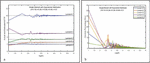
In this particular case, we generate N-times different time of failures using Equation (20). In accordance with the equality MTTF 1/, it is known in advance the theoretical value of the MTTF, for example MTTF 10 h for fr/h. Figure 8(a), illustrates the predicted and theoretical MTTF values for different values of (0.1, 0.2, 0.3, 0.4, 0.5) fr/h, showing that the predicted MTTF values from the proposed algorithm converge and stabilize towards the theoretical values after approximately N 10 simulations. Additionally, Figure 8(b) shows that the absolute percentage error diminishes towards zero as the number of simulations increases.
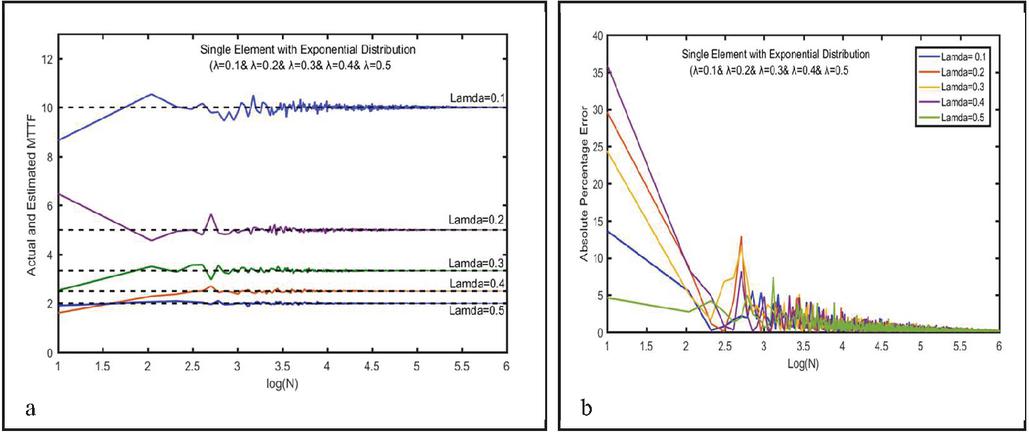
Figure 8 (a, b) MTTF and Absolute Percentage Error for 1 element with exponential distribution.
Case of a single element with Weibull distribution with parameters.
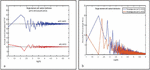
Similar to the previous case, we generate N-times different time of failures using Equation (19). In accordance with the equality (8): , it is known in advance the theoretical value of the MTTF for a given values of Weibull distribution parameters a and b. for example it is equal to 20 h for a 10 h and b 0.5.
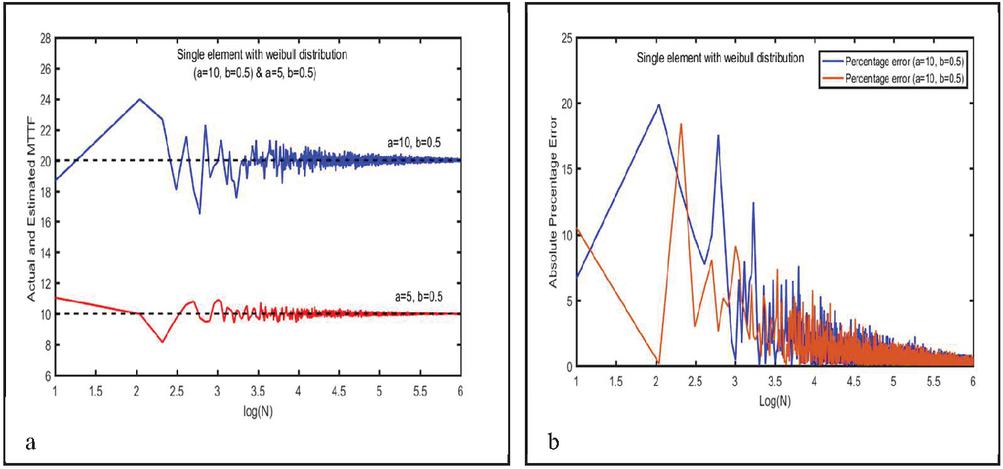
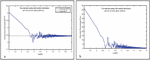
Figure 9 (a, b) MTTF and Absolute Percentage Error for 1 element with Weibull distribution a 10, 5 and b 0.5.
Figure 9(a), shows the predicted and theoretical values of the MTTF, it can be seen that the predicted values of MTTF converge and stabilize towards the theoretical values after N 10 simulations. Additionally, Figure 9(b) shows that the absolute percentage error decreases infinitely towards a value approaching zero after N 10 simulations.
Case of two elements in series with exponential distribution ( fr/h, fr/h)
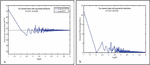
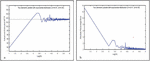
In this case, two elements in series with exponential distribution fr/h, fr/h are considered. We generate N times different time of failures of each element in the series configuration using Equation (20). In accordance with Equation (2.1), it is known in advance that the theoretically value of the MTTF is equal to 33.333 h. As shown in Figure 10(a), the predicted MTTF converges and stabilizes towards the theoretical value after around N 10 simulations. Figure 10(b) shows that the absolute percentage error decreases infinitely towards a value approaching zero after N simulations.
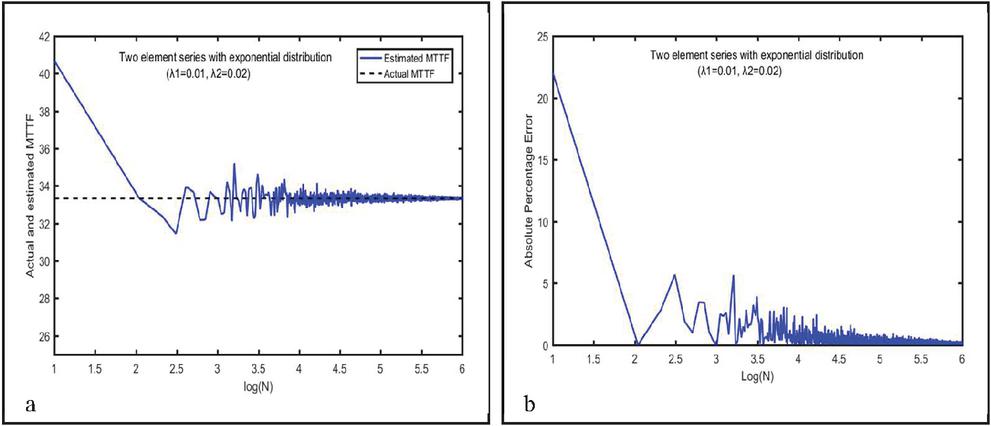
Figure 10 (a, b) MTTF and Absolute Percentage Error for 2 elements series with exponential distribution.
Case of two elements in series with Weibull distribution (a h, b) and (a h, b)
In this case, two elements in series with Weibull distribution of parameters (a h, b & a h, b) will be considered. We generate N-times different time of failures of each element using Equation (19). In accordance with the equality (10) we know in advance that the theoretically value of the MTTF is equal to 3.5 h. As seen in Figure 11(a), the value of the MTTF converges and stabilizes towards the theoretical value also after around N 10 simulations. Figure 11(b) shows that the absolute percentage error decreases infinitely towards a value approaching zero after N simulations.
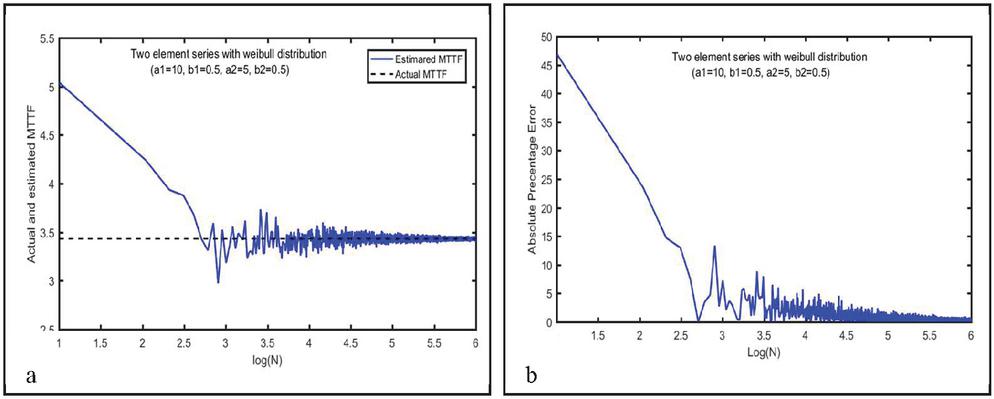
Figure 11 (a, b) MTTF and Absolute Percentage Error for 2 elements series with Weibull distribution.
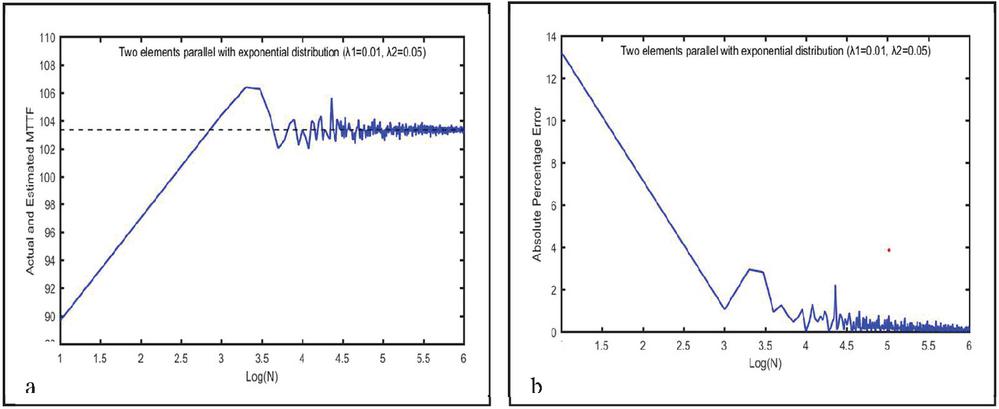
Figure 12 (a, b) MTTF and Absolute Percentage Error for two elements pin parallel with exponential distribution fr/h, fr/h.
Case of two elements in parallel with exponential distribution ( fr/h, fr/h)
For two elements in parallel with exponential distributions, we generate N- times different time of failures of each element using Equation (20). According to Equation (12), the theoretical value of the MTTF is known in advance to be 103.333 h. Figure 12(a), shows the value of the predicted MTTF converges and stabilizes towards the theoretical value after around N 10 simulations. Figure 12(b), demonstrates that the absolute percentage error decreases continuously, approaching zero after N simulations.
Case of two elements parallel with Weibull distribution (a h, b) and (a h, b)
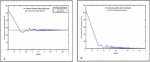
In this case, we generate by the same way N-times different time of failures of each element using Equation (19). According to equality (11) we know a priori that the theoretically value of the MTTF is equal to 26.5685 h. Figure 13(a), shows the value of the predicted MTTF converges and stabilizes towards the theoretical value after around N 10 simulations. Figure 13(b), demonstrates that the absolute percentage error decreases continuously, approaching zero after N simulations.
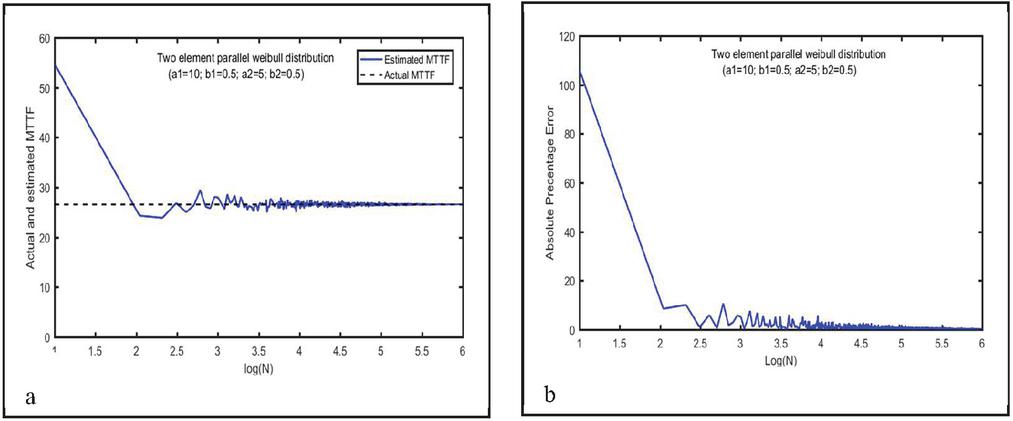
Figure 13 (a, b) MTTF and Absolute Percentage Error for 2 elements parallel with Weibull distribution.
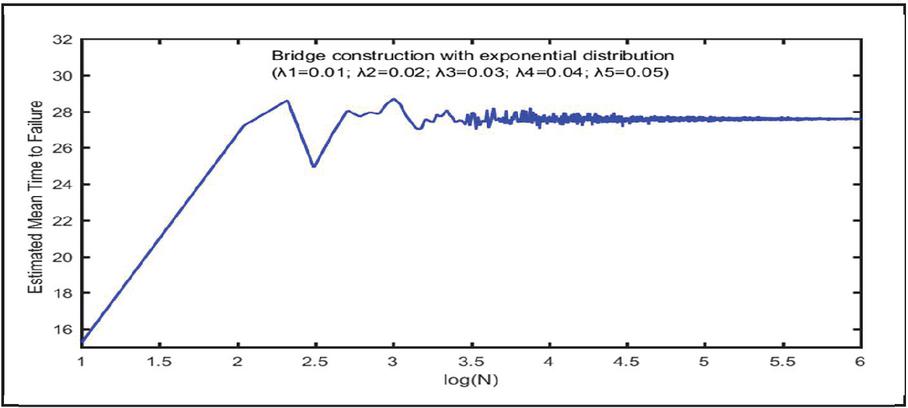
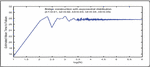
Figure 14 MTTF for Bridge configuration with exponential distribution.
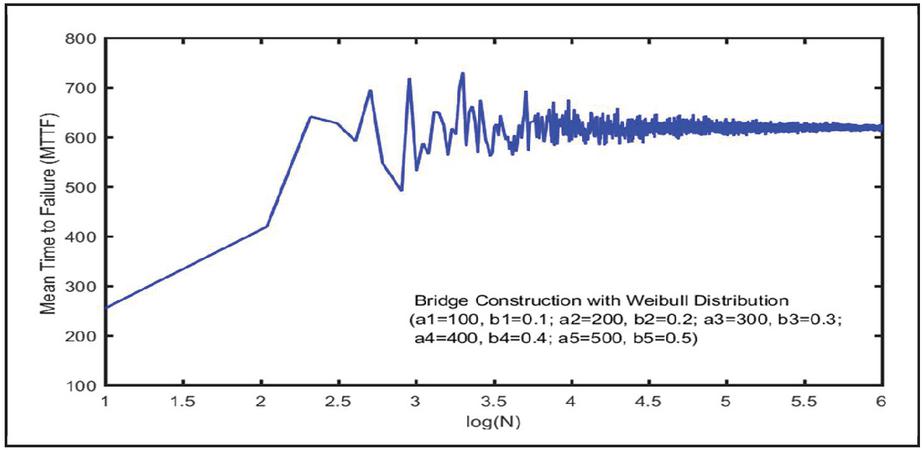
Figure 15 MTTF for Bridge configuration with Weibull distribution.
Case of a Bridge configuration
The approach adopted in the previous cases demonstrates that the proposed algorithm yields accurate MTTF evaluations with a very low error rate, around 0%. This consistency indicates the algorithm’s reliability. Therefore, in cases of highly complex system configurations, where mathematical calculations are complicated or impractical, we can confidently rely on statistical simulation results to evaluate the MTTF for any configuration with elements following any statistical distribution.
Therefore, based on the simulation results, we can confirm that for the bridge configuration, where the five system elements follow an exponential distribution with different parameters ( fr/h, fr/h, fr/h, fr/h, fr/h), the MTTF 27.58 h as shown in Figure 14. Also, in case of Weibull distribution with parameters (a h, b), (a h, b), (a h, b), (a h, b), (a h, b), the MTTF 619 h as illustrated in Figure 1.
6 Conclusion
The developed method, based on generating the lifetime of each element in a given system by the inverse of distribution function of failure, represents an important step in evaluating the MTTF of a complex structure from a reliability point of view, especially when dealing with structures that differ from classical series or parallel configurations and also when we applied a distribution of failure different of exponential model.
The proposed algorithm and the software implemented in MATLAB, used to generate the MTTF, have been tested and verified in various scenarios.
By using this method, it becomes easy to estimate the MTTF with a very low error and assess the reliability of complex systems. The ability to handle diverse failure distributions and consider different system configurations expands the applicability of the method to a wide range of engineering systems.
The software developed provides a practical tool for reliability engineers and designers to evaluate and predict the reliability of a complex structures. It offers flexibility in modelling various failure scenarios and supports decision-making processes related to maintenance planning, system design, and reliability improvement.
In summary, the proposed method and software contribute to the understanding and assessment of the reliability of complex structures. They provide valuable insights into the MTTF and offer a platform for further research and development in the field of reliability engineering.
7 Future Scope
It should be noted that the proposed algorithm to generate the MTTF (Mean Time to Failure) of the elements constituting the system and then the complete system is based on the possibility of inverting the failure distribution function. This is evident in most known failure distributions, but in other cases, this is not obvious, hence the need to develop other methods and more effective algorithms that allow for the management of the moments of failure of the elements constituting the system.
Acknowledgment
The Researchers would like to thank the Deanship of Graduate Studies and Scientific Research at Qassim University for financial support (QU-APC-2024-9/1).
References
[1] Dong, Qinglai, Pin Liu, and Xujie Jia. “Reliability analysis of k-out-of-n: G repairable systems considering common cause failure and multi-level maintenance strategy.” Proceedings of the Institution of Mechanical Engineers, Part O: Journal of Risk and Reliability 238, no. 1, 2024.
[2] Julian Salomon, Niklas Winnewisser, Pengfei Wei, Matteo Broggi, Michael Beer, Efficient reliability analysis of complex systems in consideration of imprecision, Reliability Engineering & System Safety, Volume 216, 2021.
[3] Pan, Guangze, Xiaojian Ding, Dan Li, Yaqiu Li, and Yuanhang Wang. “A reliability evaluation method of complex electromechanical products based on the multi-stress coupling acceleration model.” Engineering Failure Analysis 146, 2023.
[4] Q. Qiu, L. Cui, and D. Kong, “Availability and maintenance modeling for a two-component system with dependent failures over a finite time horizon,” Proceedings of the Institution of Mechanical Engineers, Part O: Journal of Risk and Reliability, vol. 233, no. 2, pp. 200–210, 2019.
[5] S. Yu, Z. Wang, and D. Meng, “Time-variant reliability assessment for multiple failure modes and temporal parameters,” Structural and Multidisciplinary Optimization, vol. 58, no. 4, pp. 1705–1717, 2018.
[6] Tieling Zhang, Min Xie, Michio Horigome. «Availability and reliability of k-out–of–(M+N):G warm standby systems». Reliability Engineering & System Safety 90, 2005.
[7] Lukitosari, Valeriana, Sentot Didik Surjanto, Sena Safarina, Komar Baihaqi, and Sri Irna Solihatun Ummah. “The Predicted Failure on A Two-Dimensional Warranty Using the Bayesian Approach.” Journal of Reliability and Statistical Studies (2023): 171–196.
[8] Jia-Qi, Liu, Feng Yun-Wen, Lu Cheng, and Pan Wei-Huang. “Decomposed-coordinated framework with intelligent extremum network for operational reliability analysis of complex system.” Reliability Engineering & System Safety 242, 2024.
[9] He, Jun, Zhijun Yuan, Xiaoling Yang, Wentao Huang, Yicong Tu, and Yi Li. “Reliability modeling and evaluation of urban multi-energy systems: A review of the state of the art and future challenges.” IEEE Access 8, 2020.
[10] Mi, Jinhua, Michael Beer, Yan-Feng Li, Matteo Broggi, and Yuhua Cheng. “Reliability and importance analysis of uncertain system with common cause failures based on survival signature.” Reliability Engineering & System Safety 201, 2020.
[11] Martyushev, Nikita V., Boris V. Malozyomov, Svetlana N. Sorokova, Egor A. Efremenkov, Denis V. Valuev, and Mengxu Qi.” Review models and methods for determining and predicting the reliability of technical systems and transport.” Mathematics 11, no. 15, 2023.
[12] Maurya, Ankur, and Divya Kumar. “Reliability of safety-critical systems: A state-of-the-art review.” Quality and Reliability Engineering International 36, no. 7, 2020.
[13] Guesmi, Hedi A., and Sayed O. Madbouly. “Evaluation of the Reliability of a Standby Redundancy System Under Real Conditions.” Journal of Reliability and Statistical Studies (2023): 357–372.
[14] Singh, V. V., Abubakkar Idris Mohhammad, Kabiru Hamisu Ibrahim, and Ibrahim Yusuf. “Performance assessment of the complex repairable system with n-identical units under (k-out-of-n: G) scheme and copula linguistic repair approach.” International Journal of Quality & Reliability Management 39, no. 2, 2022.
[15] Yuan, Kai, Ning-Cong Xiao, Zhonglai Wang, and Kun Shang. “System reliability analysis by combining structure function and active learning kriging model.” Reliability Engineering & System Safety 195, 2020.
[16] Gao, Shan. “Reliability analysis and optimization for a redundant system with dependent failures and variable repair rates.” Mathematics and Computers in Simulation 208, 2023.
[17] Edward Korczak, Gregory Levitin, Hanoch Ben Haim. «Survivability of series-parallel systems with multilevel protection». Reliability Engineering & System Safety 90, 2005.
[18] Wang, Rongxi, Zezhou Tang, Jianmin Gao, Zhiyong Gao, and Zhen Wang. “Probabilistic model-checking based reliability analysis for failure correlation of multi-state systems.” Quality Engineering 32, no. 4, 2020.
[19] Jun-Yu Chen, Yun-Wen Feng, Da Teng, Cheng Lu, Cheng-Wei Fei, Selective transmit modeling framework of complex system reliability analysis considering failure correlation, Engineering Failure Analysis, Volume 158, 2024.
[20] Ruiz, Cesar, Edward A. Pohl, and Haitao Liao. “Selective maintenance modeling and analysis of a complex system with dependent failure modes.” Quality Engineering 32, no. 3, 2020
[21] Abba, Badamasi, and Hong Wang. “A new failure times model for one and two failure modes system: A Bayesian study with Hamiltonian Monte Carlo simulation.” Proceedings of the Institution of Mechanical Engineers, Part O: Journal of Risk and Reliability, 2023.
[22] Xiahou, Tangfan, Yi-Xuan Zheng, Yu Liu, and Hong Chen. “Reliability modeling of modular k-out-of-n systems with functional dependency: A case study of radar transmitter systems.” Reliability Engineering & System Safety 233, 2023.
[23] Y.-F. Li, H.-Z. Huang, J. Mi, W. Peng, and X. Han, “Reliability analysis of multi-state systems with common cause failures based on Bayesian network and fuzzy probability,” Annals of Operations Research, pp. 1–15, 2019.
[24] Z. Ye, M. Revie, and L. Walls, “A load sharing system reliability model with managed component degradation,” Reliability, IEEE Transactions on, vol. 63, no. 3, pp. 721–730, 2014.
[25] S. Song, D. W. Coit, Q. Feng, and H. Peng, “Reliability analysis for multi-component systems 34 subject to multiple dependent competing failure processes,” IEEE Transactions on Reliability, vol. 63, no. 1, pp. 331–345, 2014.
[26] S. Song, D. W. Coit, and Q. Feng, “Reliability analysis of multiple-component series systems subject to hard and soft failures with dependent shock effects,” IIE Transactions, no. just-accepted, pp. 00–00, 2016.
[27] Y. M. Ko and E. Byon, “Reliability evaluation of large-scale systems with identical units,” IEEE Transactions on Reliability, vol. 64, no. 1, pp. 420–434, 2015.
[28] Wang, Rongxi, Yufan Li, Jinjin Xu, Zhen Wang, and Jianmin Gao. “F2G: A hybrid fault-function graphical model for reliability analysis of complex equipment with coupled faults.” Reliability Engineering & System Safety 226, 2022.
[29] Yang, Chen, Wanze Lu, and Yuanqing Xia. “Reliability-constrained optimal attitude-vibration control for rigid-flexible coupling satellite using interval dimension-wise analysis.” Reliability Engineering & System Safety 237, 2023.
[30] M. Parsa, A. Di Crescenzo, and H. Jabbari, “Analysis of reliability systems via Gini-type index,” European Journal of operational Research, vol. 264, no. 1, pp. 340–353, 2018.
[31] H. Peng, Q. Feng, and D. W. Coit, “Reliability and maintenance modeling for systems subject to multiple dependent competing failure processes,” IIE Transactions, vol. 43, no. 1, pp. 12–22, 2010.
[32] David, Ikwuoche John, Mathew Stephen, and Eghwerido Joseph Thomas. “Reliability Analysis with New Sine Inverse Rayleigh Distribution.” Journal of Reliability and Statistical Studies (2023): 255–268.
[33] N. Gorjian, L. Ma, M. Mittinty, P. Yarlagadda, and Y. Sun, “A review on degradation models in reliability analysis,” in Engineering Asset Lifecycle Management: Springer, 2010.
[34] X. Huang, L. J. Aslett, and F. P. Coolen, “Reliability analysis of general phased mission systems with a new survival signature,” Reliability Engineering & System Safety, vol. 189, pp. 416–422, 2019.
[35] Misra, Peeyush. “Generalized Estimator of Population Mean Using Auxiliary Information in Presence of Measurement Errors.” Journal of Reliability and Statistical Studies (2023): 269–280.
[36] Lee, Seunggyu. “Monte Carlo simulation using support vector machine and kernel density for failure probability estimation.” Reliability Engineering & System Safety 209, 2021.
[37] Wu, Hao, Yanwen Xu, Zheng Liu, and Pingfeng Wang. “Mean Time to Failure Prediction for Complex Systems with Adaptive Surrogate Modeling.” In International Design Engineering Technical Conferences and Computers and Information in Engineering Conference, vol. 87301, p. V03AT03A051. American Society of Mechanical Engineers, 2023.
[38] Abubakar, Hamza, and Shamsul Rijal Muhammad Sabri. “A Bayesian Approach to Weibull Distribution with Application to Insurance Claims Data.” Journal of Reliability and Statistical Studies (2023): 1–24.
Biography

Hedi A. Guesmi received the B.Sc./M.Sc., and Ph.D. degrees in Biomedical Engineering from Technical University of Gdansk, Faculty of Electronics – POLAND, in 1990, and 1994 respectively. From 2002–2003 he is an Assistant Professor in Biomedical Engineering Department, Higher Institute of Medical Technologies (ISTMT) Tunis, Tunisia. From 2003–2007 he is an Assistant Professor in Electronics Department, Higher Institute of Applied Sciences and Technology (ISSAT) Mateur, Tunisia. From 2007–2018 he is an Assistant Professor in Department of Medical Equipment Technology, College of Applied Medical Sciences-, Majmaah University, Saudi Arabia. From 2018–2021 he is an Assistant Professor in Biomedical Department, College of Applied Heath Sciences in Arrass Department of Biomedical Instrumentation – Qassim University, Saudi Arabia. From 2021 – Until now he is an Assistant Professor in the Electrical Engineering Department, College of Engineering, Qassim University, Saudi Arabia. His major research interests include reliability, safety, biomedical engineering and electronics.
Journal of Reliability and Statistical Studies, Vol. 17, Issue 2 (2024), 267–288.
doi: 10.13052/jrss0974-8024.1721
© 2024 River Publishers