Performance Evaluation of a Parallel System with Asymmetric Units and Dynamic Repair Prioritization
Amit Kumar*, Priya Baloda and Vikas Garg
Department of Mathematics, University Institute of Sciences, Chandigarh University, Gharuan, Mohali, Punjab 140413, India
E-mail: amitk251@gmail.com; priyabaloda17@gmail.com; gargvikas0314@gmail.com
*Corresponding Author
Received 06 June 2025; Accepted 05 November 2025
Abstract
In this paper, a parallel system consisting of two non-identical units has been studied. These dissimilar units of system are assumed to have different characteristics and different types of failure modes. All types of failures are treated by a single repairman who is made available to the system within no time. Some constraints for repair priorities are introduced for the system, which will vary as per unit undergoing failure. Failure rates of both units are assumed to follow exponential distribution, while repair rates are supposed to have any arbitrary distribution. To evaluate the system’s reliability measures, Regenerative Point Technique has been used. Also, graphical and numerical representations are provided to illustrate the variations in these measures with respect to all parameters involved within system.
Keywords: Non-identical units, parallel system, dual priority conditions, regenerative point technique.
1 Introduction
The emergence in technology substantially impacts economic development and in turn, to the overall growth of a nation. It acts as a fundamental factor in enhancing the quality of life, economic and social growth of any society. Overall, one can say technology has a serious impact on everyone’s life; from common man dependence on cellphones and various domestic appliances to industrialists relying on machines, using advanced equipment, machineries. Technological developments not only optimize processes, but also offer new opportunities, bridge gaps in various sectors like communication, healthcare, education, infrastructure etc.. In the midst of advancing technology, reliability is a prerequisite. In an era, when technology drives almost every aspect of life; reliable systems are crucial. Unreliability of systems may lead to certain major issues like financial losses, hazards to security and safety etc.. In modern world sectors like artificial intelligence, machine learning, digital transactions reliability ensures trustworthiness, accuracy and compatibility; all of which are criteria for their adoption and incorporation into every day life. Reliability is a key concept in the designing of systems, deciding various operational and repair phases of complex systems. Reliability is materializing as a significant area gaining awareness internationally and is vital for proper usage and maintenance of any industrial system. It demands technical knowledge for enhancement of system effectiveness by optimizing the occurrence of failures and lowering the value of maintenance. The configuration in which a system’s components are arranged whether in series or parallel; majorly decides how reliable is that system. Although series systems are simpler and much cost effective, they are not so reliable as failure of either one component leads to shut down of whole system. Series configurations are mostly preferred for use in cases where cost-effectiveness, and user-friendliness matters more than redundancy. In contrast, parallel systems having more than one component for performing the same task possess increased reliability. Parallel systems demand extra number of components, additional control mechanisms, and efficient load distribution to function at their best. As parallel systems offer robustness and fault tolerance, they are highly used in scenarios where failure is not an option.
In the literature of stochastic modeling, numerous work has been done on systems with series, parallel and mixed configurations. A detailed analysis of systems with same or different components have been conducted by many researchers. Feizabadi and Jahromi [1] have investigated systems having mixed configurations and non-homogeneous components. They highlighted the impact of variations in components’ characteristics on reliability and effectiveness of system. Ghinmi et al. [2] has estimated the reliability measures of a parallel system with provision of imperfect repair. They have studied the major issue of reduction in capacity of units due to improper repair services and showed its effect on profitability of system. For a parallel system following Weibull distribution failures, reliability and mean time to failure have been evaluated by Chauhan and Malik [3]. A complex system having mixed series-parallel configurations is investigated for its reliability measures by Ding et al. [4]. They have analyzed the impact of mixed arrangement of components on system reliability and availability. Analysis of system constituting non-identical components which are constrained to some particular weather conditions is performed by Kumar et al. [5]. A finite components redundant system along with provision of warm standby suspected to random failures is proposed by Shekhar et al. [6]. They have studied the effect of practical issues like imperfect switching of standby units, inferior repair of units etc. on system performance. Shekhar et al. [7] have also explored machining system with load shared among various units with special emphasis on certain hindrances for successful operation. They have delved into some major concerns of repairable and redundant systems like lag between switching, delay caused by reboot of system etc. and put forwarded optimal repair and maintenance policies.
Kumar et al. [8] have used Markovian process to mathematically formulate and evaluate the reliability, mean time to failure, availability etc. of a wireless communication system. They also performed sensitivity analysis of the obtained critical components to propose optimal maintenance and operation strategies. A mixed configuration system having four subsystems exposed to two types of failures is proposed by Khalil and Yusuf [9]. They have examined the impact of replacement of units as per the failure type on reliability and availability of the system. A two identical unit system having three modes of failure for each unit is given by Kumar et al. [10]. Systems having more than two units in operation are also studied as by endeavors like Goyal et al.[11], Monika et al. [12], Yadav et al.[13] etc.. They have put forwarded the profit optimization strategies in multi-components systems while managing costs of system using regenerative point technique.
Recently, in safety, risk and reliability evaluation of machine repair problems, the matrix method and fuzzy logic methodology are becoming very popular for performing sensitive analysis of systems exposed to standby, vacation, and common cause failure occurrences as investigated by many researchers like Shekhar et al. [14, 15]. Reliability modeling of systems plays vital role in their realistic applications as it ensures systems perform efficiently and effectively over time and helps in enabling proactive maintenance. Kumar et al. [16, 17] have developed mathematical models using reliability based approach and Markov processes to perform practical evaluations of smart trash bin and garbage data collection. Their studies has mainly focused on identifying the weakest components in these systems through sensitive analysis as it will support timely maintenance and consistent data collection. They have also proposed timely repair and maintenance services of critical component in each system which will lead to better waste management. Later on, Kumar and Ram [18] have proposed a stochastic model of a urea fertilizer plant(UFP) and examined the factors responsible for failures of decomposition unit of this plant using supplementary variable technique. In many practical situations, it has been observed that a unit doesn’t perform as good as new one after repair. Consequently, the repair time for each unit tends to increase progressively with each subsequent repair. This concept has been incorporated into a two unit warm standby system by Bhat and Simon [19] in which the repair capacity and efficiency of components decreases after each repair. Sonker and Bhardwaj [20] highlighted the strategical implementation of inspections post failure for deciding the appropriate actions like repair or replacement for units of redundant systems. They have offered the strategies for timely employment of repair and replacement services in a cold standby system of two identical units for restoring system back to operative state.
Nonetheless, in real life, there exists multi units complex systems in which each unit possess different characteristics. Also, it is not always profitable to employ costly and high standard components due to cost effectiveness of system. In literature, although there exist abundant of work on parallel systems, still there are certain gaps that have to be recovered. Parallel system having dissimilar units with varying qualities and failure types are narrowly studied. A parallel system of two distinct units with unique mode of failure for each unit has been researched by Baloda et al. [21], ignoring the impact of priority requirements. Kumar [22] studied repairable systems under uncertain failure and repair parameters, highlighting the need for fuzzy-based modelling. Motivated by this, the present work develops membership functions for a two-unit repairable system using fuzzified exponential distributions and the -cut method. Till now, no research has been made on dissimilar units parallel systems with constraint of dynamic repair policies. While considering all these facts and factors, this manuscript has been designed to overcome the gap. The prime objective of this paper is to estimate the reliability and availability of a parallel system consisting of two different units subjected to flexible repair priorities. The effect of such dynamic priorities has been extensively illustrated through graphical demonstrations with respect to varying operational and failure intensities.
2 Stochastic Model
This study introduces a parallel system incorporating two distinct components; and . These two components exhibit different failure properties. Unit being of merit characteristics, is assumed to have two types of failures while only one type of failure goes for small unit . Unit gives considerable output even in minor failure state. There is only one server facility available with the system, who performs repair of both types of units. For the repairing of units, some preferences are adopted which depend upon the unit undergoing failure and the failure type. It is assumed that if unit undergoes minor failures, it will be firstly prioritized for repair over all other repair tasks. Otherwise, priority for repair will be given to unit i.e., unit will be repaired first over major failures of unit . The repaired units will behave as good as new. Failure rates act in accordance with exponential distribution while repair rates of both units are guided by any general distribution. Semi-Markov approach has been used to model the system and reliability metrics are evaluated by regenerative point technique.
Notations:
| its minor failure. | |
The states involved in system model are defined as:
The state transition diagram defining all the possible states of the system is as shown in Figure 1.
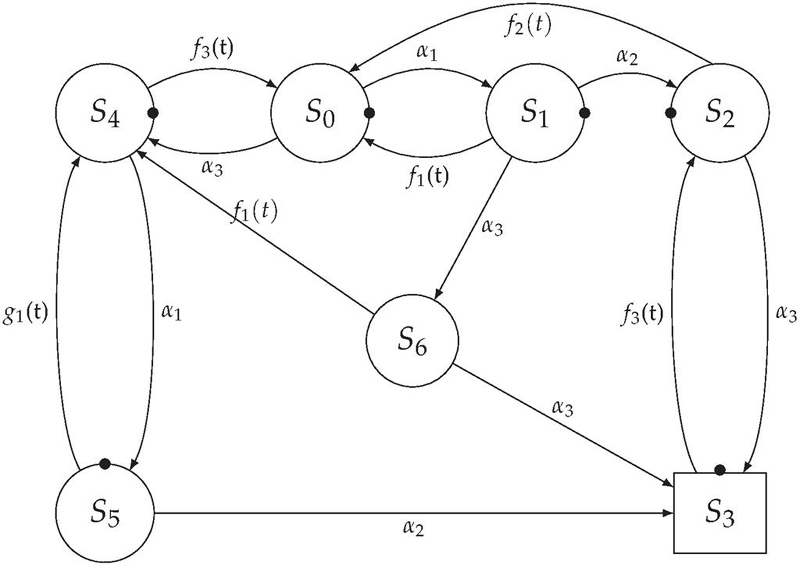
Figure 1 Transition diagram.
3 Transition Probabilities and Mean Sojourn Times
The transition probabilities governing shift from state to are estimated as follows:
| (1) |
where represents the probability density function of passage time from state to state in .
| (2) | ||
Also, the two step transition probabilities defining progress from state to via state are given as:
| (3) |
where represents the pdf of passage time from state to state visiting state once in .
| (4) | ||
From these transition probabilities, it can be deducted that
| (5) | ||
In this research, analysis is dependent on mean sojourn time for the semi-Markov states. When counting from the epoch of entry into state , the mean time for which system remains in state before transiting to any other state i.e., Mean Sojourn Time() is formulated mathematically as:
| (6) |
where calculates the unconditional time system remains in state before proceeding to state. The mean soujourn times () corresponding to state is estimated as:
| (7) | ||
Additionally, the mean time spent in any regenerative state before transiting to other regenerative state via non-regenerative states, denoted by is given by
| (8) | ||
4 Measures of System Effectiveness
Numerous reliability measures like mean time to system failure (MTSF), expected number of server’s visit, availability etc. are estimated using semi-Markov process and Regenerative Point Technique. The system’s profit is also evaluated for arbitrary values and shown graphically.
4.1 Reliability and MTSF
Let be the cdf of first passage from regenerative state to failed state which is then considered as absorbing state. By using simple statistical arguments, recursive relations for are obtained
| (9) |
MTSF of the system is calculated as:
| (10) |
where is obtained by L.S.T of relation (9). Inverse Laplace Transform of will measure the reliability of the system. The expression attained for MTSF is as follows:
| (11) |
where
| (12) | ||
4.2 Availability
Let governs the probability of system being functional at any instant entering that particular state at , where are regenerative states of system. The following relations are abided by :
| (13) |
where denotes the probability of system functioning in any regenerative state at any given instant .
| (14) | ||
evaluated by taking Laplace Transform of relations (13) gives the steady state availability of the system by following relation:
| (15) |
where
| (16) | ||
4.3 Busy Period of Server
Considering the system entered regenerative state at , let be the probability that the repairman is performing repair tasks at any given time , then adheres to the following relations:
| (17) |
which tell about the time for which repairman is busy in any state for the system model are given as:
| (18) | ||
In steady state, the time period for which server is busy in repairing is given by:
| (19) |
where is estimated by Laplace Transforms of relations (17).
| (20) | ||
and is defined in (16).
4.4 Server’s Estimated Number of Visits
Considering the system starts off initially in any regenerative state at , let and represents the expected times server visits for minor failure of , major failure of and failure of unit respectively. The following general relations are satisfied by and :
| (21) |
where .
Solving for , by having L.S.T. of (21), the estimated times of server’s visit for different repairs is defined by:
| (22) | ||
where
| (23) | ||
and is evaluated in (16).
4.5 System’s Profit
Considering a particular set of revenue generated and costs charged for repair of both components, the following equation is used to determine the system’s profit (P) at steady state:
| (24) |
For numerical and graphical evaluation, let the various costs assumed within the system model are as:
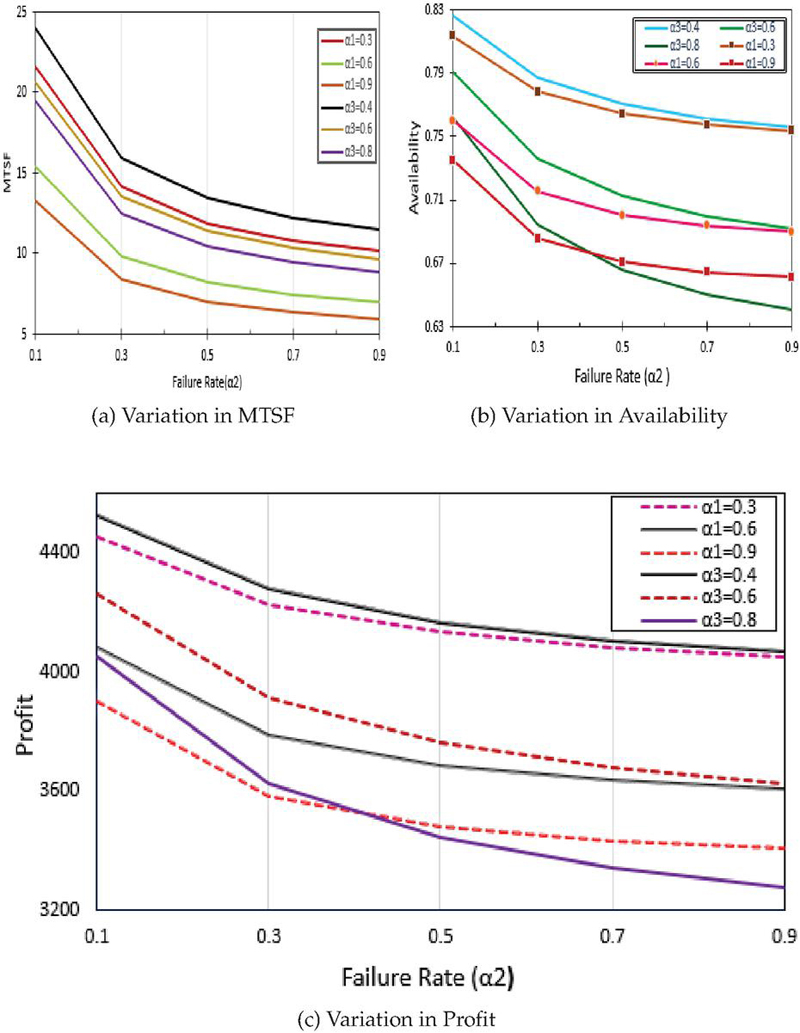
Figure 2 Effect of failure rates.
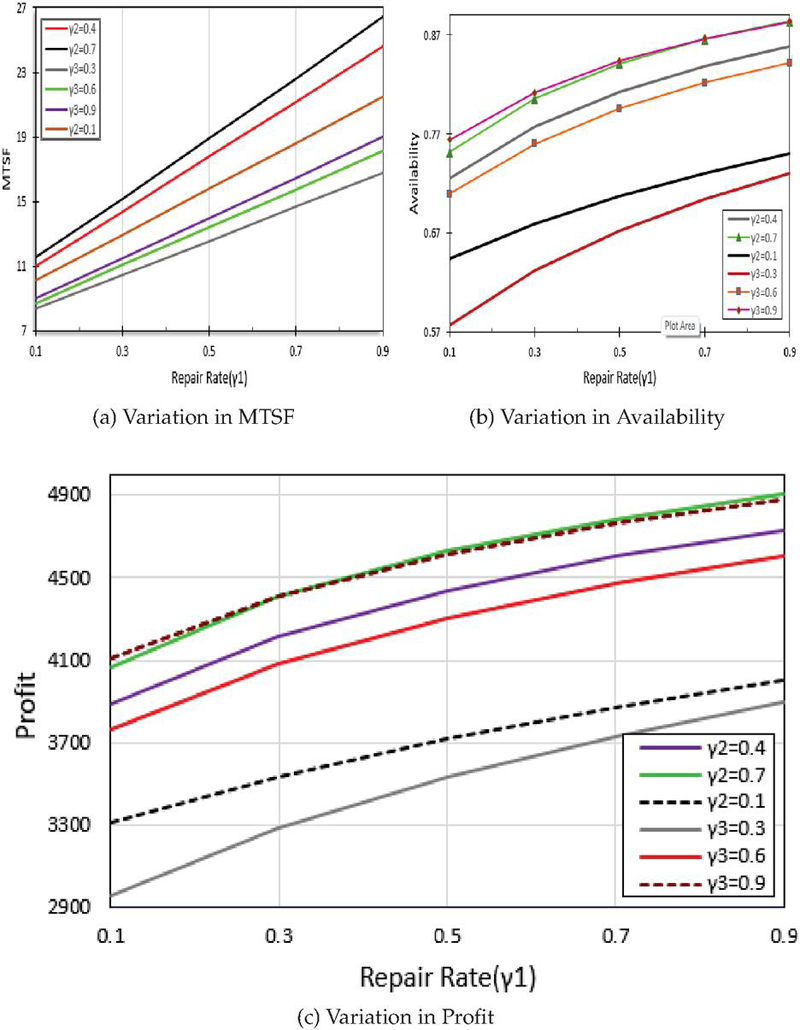
Figure 3 Effect of repair rates.
5 Graphical Analysis
All the reliability metrices of system effectiveness has been reviewed graphically for a specific case of all repair rates as
| (25) |
Variability in all these metrics like MTSF, availability and profit of system in terms of failure rates and repair rates of all components has been visualized graphically by assigning particular numeric values to parameters involved within the system. This particular set of failure and repair intensities will help in determining the critical parameters of the systems and highlighting the significant variation in reliability outcomes caused by even minor adjustments in operational and malfunctioning processes. Figure 2 describes the changes in reliability metrics like MTSF, availability and profit of system in accordance with failure rates of components and figure 3 illustrates the trends adopted by these measures in accordance with repair rates. It is very much evident from figure 2, that availability and profit follow the same graphical trend, whereas impact on MTSF of system differs from other measures as visible in 2(a). However, influence of various failure rates i.e., varies on each characteristics. As value of increases, there is a major decline in value of MTSF. Figures 2(b) and 2(c) tells that failure rates has strong negative impact on both availability and profit of system. However, this impact is not same for every , where . The effectiveness of seems less in contrast to , as the slope of availability and profit reduction is not as steep in former case. This concludes that even though influences these reliability parameters, but not as strongly as . In contrast, MTSF is affected by both and upto a very similar extent. It can be deduced that to optimize all characteristics, one should keep a check on .
All the reliability parameters follow upward trend with increasing repair rates() of both units. Figure 3(a) illustrates the changes in MTSF of system with increased repair rates. MTSF of the system boosts with increasing repair rates. Figures 3(b) and 3(c) shows effect of increased repair rates on availability and profit of system. These figures clearly indicate that both availability and profit are influenced in much similar manner by the repair intensities. Graphical curves of both these parameters goes upwards following same behavioral pattern with positive shift in all repair rates. However, the extent of each repair intensity is different in each measure. Among all the repair rates assumed within system, causes change in MTSF to a lesser extent as compared to other repair rates like Figure 3(a) suggests that MTSF is mostly influenced by the behaviour of Availability and profitability of the system shows maximum rise when and are increased, the impact of seems comparatively lessen. The repair rate has significant influence on all performance measures of the system. This shows how prioritizing some particular repairs can enhance system’s overall operative time and economic return.
6 Conclusion
In this study, a parallel system composed of two different components is explored numerically and graphically by evaluating its various reliability metrics which define system’s performance and efficiency. The graphical assessments make it clear that diminshing the failure rate and boosting the repair rates of both components will increase all the measures like MTSF, availability, and profitability. Graphical behaviour adopted by these measures make it evident that managing more effectively will provide a significant improvement in availability and profit of system. and still influences, but their effect is relatively moderate as compared to . MTSF is maximizingly influenced by , leading to comparatively much higher values of MTSF. Therefore, to maximize the system’s MTSF, repair rate() should be optimized keeping a view on system’s profit. Additionally, lowering the chances of failure of single failure mode unit will enhance profitability of system. While proposing optimal repair strategies, this work highlights the noteworthiness of employing proper repair preferences in order to minimize downtime. Specially, unit having only one type of failure mode should be checked more often for its failure as it affects operational effectiveness and profit of system to most extent.
7 Future Scope
This study makes the analysis convenient by assuming the repaired unit as good as new which contradicts practical scenarios where repeated repairs lead to deterioration in gradual performance of components. Additionally, choosing replacement over repair could be proven as more efficient approach in some scenarios depending over context. Such considerations suggest the refinement which may be essential to improve the system’s relevance with real world maintenance practices. To further improve proposed work, future studies might examine more intricate systems by developing mathematical models that incorporate more realistic features like degradation of components over time, constraint on operational and repair time, employment of multiple repair personnel. Incorporation of such aspects would substantially support the realism of proposed work, rendering it more aligned with the challenges of real world.
References
[1] Feizabadi, M., and Jahromi, A. E. (2017). A new model for reliability optimization of series-parallel systems with non-homogeneous components. Reliability Engineering and System Safety, 157, 101–112.
[2] Ghnimi, S., Gasmi, S., and Nasr, A. (2017). Reliability parameters estimation for parallel systems under imperfect repair. Metrika, 80, 273–288.
[3] Chauhan, S. K., and Malik, S. C. (2017). Evaluation of reliability and MTSF of a parallel system with Weibull failure laws. Journal of Reliability and Statistical Studies, 10(1), 137–148.
[4] Ding, Y., Lin, Y., Peng, R., and Zuo, M. J. (2019). Approximate reliability evaluation of large-scale multistate series-parallel systems. IEEE Transactions on Reliability, 68(2), 539–553.
[5] Kumar, A., Pawar, D., and Malik, S. C. (2020). Reliability analysis of a redundant system with FCFS repair policy subject to weather conditions. International Journal of Advanced Science and Technology, 29(3), 7568–7578.
[6] Shekhar, C., Kumar, A., Varshney, S., and Ammar, S. I. (2020). Fault-tolerant redundant repairable system with different failures and delays. Engineering Computations, 37(3), 1043–1071.
[7] Shekhar, C., Kumar, A., and Varshney, S. (2020). Load sharing redundant repairable systems with switching and reboot delay. Reliability Engineering and System Safety, 193, 106656.
[8] Kumar, A., and Kumar, P. (2020). Application of Markov process/mathematical modelling in analysing communication system reliability. International Journal of Quality and Reliability Management, 37(2), 354–371.
[9] Khalil, N., and Yusuf, I. (2021). Reliability models of a series-parallel system with replacement at failure. International Journal of Operational Research, 40(4), 524–543.
[10] Kumar, K., Kumar, B., and Ravi, V. (2021). Study of reliability measures of a two unit system with inspection and on-line/off-line repairs using the regenerative point technique. International Journal of Operations Research, 18(3), 57–66.
[11] Goyal, N., Ram, M., Amoli, S., and Suyal, A. (2017). Sensitivity analysis of a three-unit series system under k-out-of-n redundancy. International Journal of Quality and Reliability Management, 34(6), 770–784.
[12] Monika, Chopra, G., and Sheetal. (2024). Sensitivity and performance analysis of a three-unit soft biscuit manufacturing system with two types of repairers. International Journal of System Assurance Engineering and Management, 1–14.
[13] Yadav, A. D., Nandal, N., Malik, S., and Malik, S. C. (2023). Markov approach for reliability-availability-maintainability analysis of a three unit repairable system. Opsearch, 60(4), 1731–1756.
[14] Shekhar, C., Kumar, N., Gupta, A., Kumar, A., and Varshney, S. (2020). Warm-spare provisioning computing network with switching failure, common cause failure, vacation interruption, and synchronized reneging. Reliability Engineering and System Safety, 199:106910.
[15] Shekhar, C., Kumar, A., and Varshney, S. (2020). Parametric nonlinear programming for fuzzified queuing systems with catastrophe. International Journal of Process Management and Benchmarking, 10(1), 69–98.
[16] Kumar, P., and Kumar, A. (2023). Time dependent performance analysis of a Smart Trash bin using state-based Markov model and Reliability approach. Cleaner Logistics and Supply Chain, 9, 100122.
[17] Kumar, P., and Kumar, A. (2023). Quantifying reliability indices of garbage data collection IOT-based sensor systems using Markov birth-death process. International Journal of Mathematical, Engineering and Management Sciences, 8(6), 1255.
[18] Kumar, A., and Ram, M. (2023). Process modeling for decomposition unit of a UFP for reliability indices subject to fail-back mode and degradation. Journal of Quality in Maintenance Engineering, 29(3), 606–621.
[19] Bhat, K. S., and Simon, M. K. (2024). Stochastic analysis of a complex repairable system with a constrain on the number of repairs. Reliability: Theory and Applications, 19(2(78)), 178–187.
[20] Sonker, P., and Bhardwaj, R. K. (2024). Enhancing redundant system performance: A stochastic model for optimized inspection strategies post-failure. Reliability: Theory and Applications, 19(4(80)), 448–460.
[21] Baloda, P., Kumar, A., and Garg, V. (2024). Reliability estimation of parallel systems with diverse failure modes: Semi-Markov model approach. Journal of Reliability and Statistical Studies, 17(2), 351–366.
[22] Kumar, A. (2025). Parametric optimization of repairable systems in IoT: addressing detection delays, imperfect coverage, and fuzzy parameters. Life Cycle Reliability & Safety Engineering, 14, 329–-340.
Biographies
Amit Kumar is an Assistant Professor at the University Institute of Sciences, Chandigarh University, India. He holds a Ph.D. from the Birla Institute of Technology and Science (BITS), Pilani Campus, Rajasthan. His research interests include queueing theory, the machine repair problem, optimal control, reliability and maintainability, stochastic modeling, sensitivity analysis, evolutionary computation, statistical analysis, and fuzzy sets and logic. Dr. Kumar has published numerous research articles in reputed journals such as Reliability Engineering & System Safety, the Journal of Computational and Applied Mathematics, Quality Technology and Quantitative Management, and the Arabian Journal for Science and Engineering. He actively participates in conferences, Faculty Development Programs (FDPs), workshops, and symposiums as both a presenter and invited speaker. In addition, Dr. Kumar serves as a reviewer for several prestigious journals and has professional experience with the Irrigation Department, Roorkee, India. (ORCID: 0000-0001-5347-1808)
Priya Baloda is a research scholar in the Department of Mathematics at Chandigarh University. She earned her M.Sc. degree from Kurukshetra University, Kurukshetra in 2020. Her primary research interests lie in the field of queueing theory and stochastic processes. She has actively participated in several national and international conferences.
Vikas Garg is an Assistant Professor in the Department of Mathematics at Chandigarh University, Mohali. He earned his Ph.D. in Statistics from Kurukshetra University. His research interests include Reliability Theory and Stochastic Processes.
Journal of Reliability and Statistical Studies, Vol. 19, Issue 1 (2026), 23–42
doi: 10.13052/jrss0974-8024.1912
© 2025 River Publishers