Tourism Economies and Climate Change: A Brief Review of New Data and Quantitative Approaches
Marco Maialetti1 and Ioannis Konaxis2,*
1Independent researcher and lawyer, Rome, Italy
2Department of Tourism Studies, University of Piraeus, Karaoli & Dimitriou 80, EL-18534 Piraeus, Greece
E-mail: ikonaxis@unipi.gr
*Correspond ing Author
Received 07 August 2025; Accepted 14 September 2025
Abstract
Adopting a bio-geo-physical perspective, the present study briefly discusses the cumulative effect of weather events on tourism economies. Regional warming is herein regarded as a multidimensional process, whose economic repercussions can be systematically quantified through diverse sets of quantitative indicators. Such measures capture its variegated manifestations across spatial scales, from the regional to the local – ranging from incremental temperature increases and progressive soil aridification to the growing recurrence of droughts, the intensification of extreme meteorological events (e.g. strong winds), and the oscillation between water scarcity and abrupt surges in atmospheric humidity. The synthesis of these effects delineates the principal causal mechanisms through which climate change translates into tangible outcomes for tourism-related activities. This analytical framework is further enriched through the integration of recent statistical evidence released by official statistics estimating the monetary costs of climate change from both historical and prospective vantage points. The incorporation of such indicators within a broader interpretative scheme of local socio-economic systems provides a novel and methodologically robust approach to the assessment of climate-related costs across multiple spatial and temporal dimensions.
Keywords: Global warming, official statistics, economic costs, indicators, Europe.
Introduction
The profound transformations in economic structures that have unfolded over recent decades have inevitably entailed substantial shifts in social dynamics. Within this context, notions of uncertainty and risk emerge as defining features of a particularly intricate process that encompasses economic performance, demographic change, cultural development, and political action (Zuindeau, 2007). Both economic dynamics and climate change have increasingly captured the attention of scholars across environmental sciences and regional studies (Puigdefabregas and Mendizabal, 1998). Indeed, economic as well as ecological disciplines are deeply engaged in elucidating the implications of regional warming for both populations and economies, together with the ways in which societies respond to such transformations (Wilson and Juntti, 2005). Although affluent nations have experienced a significant development in recent times, it remains a matter of debate whether such growth has been acquired at the expense of environmental quality (Dinda, 2004; Stern, 2004; Galeotti, 2007). The interrelations among growth and local warming provide a knowledge base elucidating climate change (e.g., Singh and Singh, 1995; Chopra and Gulati, 1997; Barbier, 2000). Building on these premises (Knerr, 1998), the present contribution discusses approaches from an economic perspective and framed within a systemic view (Juntti and Wilson, 2004). Particular emphasis is devoted to: (i) the production processes most directly affected by global warming, (ii) the broader implications for local societies, and (iii) the potential economic responses that may be mobilized to counteract – or at the very least mitigate – the negative externalities associated with climate change (Le Houerou, 1993).
Tourism Activities and Climate Change
Tourism ranks among the world’s largest and most dynamic industries, contributing substantially to gross domestic product, employment, and international trade. Yet, as the sector continues to expand, so too does its exposure to global challenges, most notably climate change – manifested in global warming and heightened vulnerability to extreme meteorological events such as intense winds and heavy rainfall. The repercussions of climate change for tourism are multifaceted, shaping both the demand for and supply of travel experiences, and have become increasingly evident across diverse destinations, from coastal resorts to mountain regions. The economic implications of these transformations are profound, extending beyond the tourism industry itself to encompass wider effects on national economies, local communities, and governance structures. Direct impacts are particularly salient in several key domains: infrastructure, seasonality, natural attractions, and health-related risks (Watkiss and Hunt, 2012). Extreme weather events – including floods, hurricanes, and droughts – impact tourism infrastructure. Coastal resorts are especially exposed, as rising seas erode beaches, damage hotels and leisure facilities, and disrupt critical transport systems such as airports, seaports, and road networks. However, the increasing frequency and severity of such events also imperil non-coastal destinations. Furthermore, gradual shifts in climatic conditions are demonstrably altering seasonal patterns of tourism. Mountain resorts, in particular, are vulnerable to localized warming, which reduces the viability of winter sports and shortens peak tourism seasons. Such changes are expected to diminish visitor flows during traditional high-demand periods, compelling businesses either to adapt or face closure. In addition, rising temperatures and shifting precipitation regimes may facilitate the spread of infectious diseases in regions previously regarded as low-risk (e.g., Zelinka et al., 2020). These health-related risks not only jeopardize the safety of tourists but also reshape destination preferences, as travelers may opt for areas with lower perceived health threats. Beyond these direct consequences, climate change exerts broader, indirect economic pressures on the tourism sector. These include shifts in consumer behavior, the redistribution of expenditure across destinations, and heightened demands on public resources. Collectively, such dynamics underscore the urgent need for adaptive strategies capable of sustaining the sector’s long-term resilience.
The Economics of Global Change
Investigating trends in economic losses across Europe – widely recognized as a hotspot of global warming – presents particular challenges, largely due to the pronounced variability of both climatic regimes and production systems. In response to this complexity, the European Environment Agency (EEA) and Eurostat have established a standardized procedure for generating official statistics that estimate the monetary damage of atmospheric events at the NUTS-0 (country) level. These events are classified, in accordance with the International Council for Science (ICSU), into meteorological phenomena (e.g., storms, avalanches), hydrological phenomena (e.g., floods, landslides), and other phenomena (e.g., heatwaves, cold spells, droughts, wildfires). The underlying dataset, provided by CATDAT of RiskLayer under institutional agreement with the EEA, has been adjusted for inflation and expressed in constant 2022 prices. Data are available on an annual basis for the period 1980–2023, and include moving thirty-year averages beginning in 2009 (EEA, 2024). This use of thirty-year averages conforms to the World Meteorological Organization (WMO) definition of a climatological ‘normal’ period.
Table 1 Estimates of monetary damages between 1980 and 2023 by European country considering extreme events of climate
| Loss per | Losses | Insured | Insured | |||
| Total losses | sq.km | per capita | losses | losses | ||
| Country | (Million EURO) | (EURO) | (EURO) | (Million EURO) | (%) | Fatalities |
| Austria | 14726 | 175564 | 1806 | 2786 | 19 | 771 |
| Belgium | 16988 | 553942 | 1612 | 6679 | 39 | 4693 |
| Bulgaria | 5168 | 46564 | 650 | 93 | 2 | 265 |
| Croatia | 4154 | 73402 | 943 | 101 | 2 | 910 |
| Cyprus | 441 | 47626 | 618 | 8 | 2 | 68 |
| Czechia | 18533 | 234974 | 1783 | 2168 | 12 | 716 |
| Denmark | 8751 | 203867 | 1618 | 5443 | 62 | 533 |
| Estonia | 332 | 7333 | 236 | 51 | 15 | 5 |
| Finland | 2380 | 7034 | 457 | 73 | 3 | 7 |
| France | 129897 | 203449 | 2092 | 46052 | 35 | 50461 |
| Germany | 180372 | 504438 | 2225 | 54759 | 30 | 104544 |
| Greece | 16350 | 124155 | 1548 | 849 | 5 | 4690 |
| Hungary | 10444 | 112291 | 1026 | 587 | 6 | 874 |
| Ireland | 3955 | 56542 | 965 | 541 | 14 | 68 |
| Italy | 133934 | 443373 | 2311 | 5916 | 4 | 21822 |
| Latvia | 1250 | 19348 | 544 | 71 | 6 | 88 |
| Lithuania | 2283 | 34976 | 690 | 58 | 3 | 103 |
| Luxembourg | 1262 | 486143 | 2694 | 627 | 50 | 170 |
| Malta | 51 | 162361 | 128 | 2 | 4 | 5 |
| Netherlands | 10970 | 293491 | 688 | 4297 | 39 | 3918 |
| Poland | 20630 | 66138 | 545 | 1379 | 7 | 2553 |
| Portugal | 16671 | 180755 | 1628 | 578 | 3 | 10339 |
| Romania | 19628 | 82335 | 916 | 199 | 1 | 1445 |
| Slovakia | 1956 | 39893 | 367 | 84 | 4 | 121 |
| Slovenia | 17484 | 862448 | 8693 | 271 | 2 | 321 |
| Spain | 95966 | 189662 | 2258 | 5243 | 5 | 32053 |
| Sweden | 3703 | 8276 | 406 | 957 | 26 | 44 |
| EU-27 | 738280 | 139872 | 241587 | |||
| Source: Data retrieved and reorganized from European Environment Agency (EEA). | ||||||
Average figures derived from this approach help to identify long-term trends while excluding the substantial short-term variability attributable to natural climatic fluctuations. The values, reported in both millions of Euros and per-capita terms (constant 2022 prices), are disaggregated into three categories: (i) meteorological events, (ii) hydrological events, and (iii) climatological events. After normalizing for the economic scale exposed to climate- and weather-related hazards, the evidence indicates that, between the late 2000s and the early 2020s, the European Union’s mean GDP growth rate was approximately one-half of the corresponding growth rate in recorded losses. Estimates derived from World Bank data and related indicators suggest that, while part of the upward trend in damages can be explained by increasing economic value and exposure, aggregate climate- and weather-induced losses have expanded at roughly twice the pace of GDP (EEA, 2022).
Official Statistics and Indicators
Statistical analyses indicate a clear upward trend in economic losses attributable to climate change, with the last three years ranking among the five years with the highest annual losses on record. A reduction in associated economic losses by 2030 appears unlikely. A concise descriptive assessment of the dataset reveals estimated economic damages of approximately 738 billion Euros (2023 prices) across the European Union (Table 1). Notably, over 162 billion Euros – equivalent to 22% of the total – occurred between 2021 and 2023 alone. Breaking down the losses by hazard type, hydrological events, primarily floods, account for 44% of the total, while meteorological events, including storms, lightning, and hail, contribute nearly 29%. Within the category of climatological extremes, heatwaves represent the dominant source of human and economic impacts, accounting for nearly 19% of overall monetary losses and an overwhelming 95% of recorded fatalities, while droughts, wildfires, and cold spells jointly contribute the remaining share (EEA, 2008). Losses are also highly concentrated: a small fraction of events drives huge damages, with 5% of occurrences responsible for approximately 61% of aggregate losses and the most extreme 1% alone generating 28%. In contrast, the majority of minor events – roughly two-thirds of all recorded cases – produce only about 5% of total losses, as derived from the underlying dataset. The pronounced inter-annual variability in loss outcomes can be explained by a combination of structural drivers, including the expansion of exposed assets in risk-prone areas, temporal inconsistencies in disaster reporting, and the anthropogenically driven rise in critical conditions on a global scale (EEA, 2012).
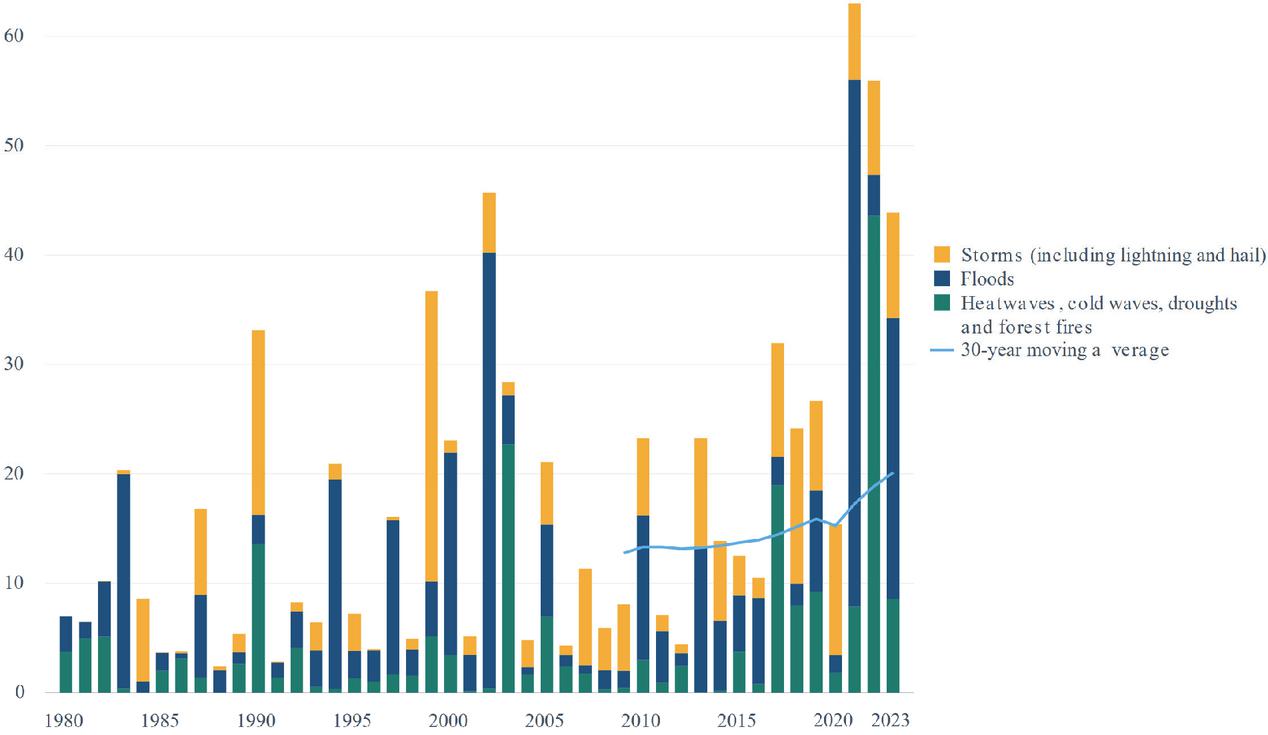
Figure 1 Annual estimate of monetary damage of extreme events in Europe (Billion Euros 2023 prices); Source: European Environment Agency.
When expressed in constant 2023 Euros, mean annual economic losses exhibit a persistent upward trajectory across recent decades. Analysis of 30-year moving averages confirms the monotonic escalation of losses, with a fitted linear trend indicating a 53% increase between 2009 and 2023, equivalent to an approximate annualized growth rate of 2.9%. Losses are further characterized by the dominance of a few extreme years: 2021, 2022, 2002, 2023 and 1999 represent the five costliest years in the record. Although significant losses are evident throughout the entire time series, the economic impact of climate-related extremes exhibits marked spatial variability across the European Union. In absolute terms, the highest cumulative losses from 1980 to 2023 were observed in Germany, Italy, and France. When expressed on a per-capita basis, the greatest losses occurred in Slovenia, Luxembourg, and, to a lesser extent, Italy. Unfortunately, insurance penetration remains limited, with official statistics indicating that less than 20% of aggregate losses were compensated by private insurance mechanisms. Cross-country heterogeneity is also pronounced, but only (approximately) one-third of losses attributable to meteorological events were insured, whereas the corresponding figures decline to below 15% for hydrological hazards and to just above 10% for climatological extremes – including heatwaves, droughts, and wildfires (EEA, 2020).
Discussion
This note delineates and critically reviews the effect of global warming on market dimensions in advanced countries, with a particular focus on Europe and the Mediterranean region. Variables identified as predictors of micro- and macroeconomic factors, which facilitate a comprehension of the climate and economic mechanisms harming socio-environmental systems and local communities, have been delineated and organized into key research and policy dimensions (e.g., Hausfather et al., 2022). At the microeconomic level, variables such as land and commodity prices, housing values, and wage levels – particularly, though not exclusively, within agriculture, indicate pathways through which climate change may exert influence. Moreover, technical change, fluctuations in agricultural input prices, and household income contribute to broader ecological challenges. Macroeconomic factors – including population density, income and wealth distribution, the capacity of regional and local labor markets to absorb workforce fluctuations, poverty, and territorial disparities – have been more extensively studied using both qualitative and quantitative approaches. Nevertheless, many aspects considered critical in modeling approaches remain relatively ambiguous or partially unexplored, highlighting the need for further quantitative and comparative research. The effectiveness of policies aimed at mitigating climate impacts ultimately depends on the quality and comprehensiveness of indicator dashboards capable of estimating social and economic consequences for local communities and regional systems. Repercussions are extensive and complex, affecting communities, industries, and economies worldwide (Salvati and Zitti, 2005). From elevated health risks to agricultural disruptions, infrastructure damage, and exacerbated economic inequalities, the consequences demand urgent scholarly and policy attention. Quantifying the economic impacts across different sectors remains particularly challenging, as each sector faces a spectrum of challenges, including rising operational costs, global supply chain disruptions, shifts in consumer preferences, and evolving regulatory frameworks, which complicate precise impact assessments (ESPON Climate, 2013). Empirical evidence indicates that individual adaptation strategies can manage residual risks not addressed by adaptation measures and to formulate strategies that enhance resilience (Daly, 1999). Effective monitoring of climate impacts is crucial for timely policy responses and the protection of vulnerable populations. By leveraging advanced technologies, including remote sensing, climate modeling, and socioeconomic data collection, it is possible to track the spatiotemporal dynamics of climate impacts, thereby enabling more informed and proactive decision-making (Kok et al., 2004).
Concluding Remarks
A rigorous examination of both direct and indirect methodologies for estimating the monetary costs associated with paradigmatic environmental processes, such as climate change, raises critical questions regarding the role of empirical data in determining the cost structure of specific interventions. Concurrently, carefully selected indirect indicators enable methodologies estimating monetary impacts, each with distinct data requirements and consequently yielding varying levels of precision in the resulting estimates. The development of improved analytical frameworks is therefore essential for designing more effective governance mechanisms that enhance public awareness of climate change costs through iterative learning and networking processes. Such frameworks also serve to optimize the capacity of existing institutional structures in environmental policy, facilitating the management of regional economic systems under the pressures of global warming.
References
Aaheim, A., Amundsen, H., Dokken, T., Wei, T. (2012). Impacts and adaptation to climate change in European economies. Global Environmental Change 22(4), 959–968.
Ackerman, F., DeCanio, S.J., Howarth, R.B., Sheeran, K. (2009). Limitations of integrated assessment models of climate change. Climatic Change 95, 297–315.
Amelung, B., Moreno, A. (2012). Costing the impact of climate change on tourism in Europe: results of the PESETA project. Climatic Change 112, 83–100.
Arrow, K., Bolin, B., Costanza, R., Dasgupta, P., Folke, C., Holling, C.S., Jansson, B.-O., Levin, S., Mäler, K.-G., Perrings, C., Pimentel, D. (1995). Economic Growth, Carrying Capacity, and the Environment. Science 268, 520–521.
Auci, S., Barbieri, N., Coromaldi, M., Vignani, D. (2021). Innovation for Climate Change Adaptation and Technical Efficiency: An Empirical Analysis in the European Agricultural Sector. Economia Politica 38(2), 597–623.
Auffhammer, M. (2018). Quantifying economic damages from climate change. Journal of Economic Perspectives 32, 33–52.
Bovari, E., Giraud, G., McIsaac, F. (2020). Financial impacts of climate change mitigation policies and their macroeconomic implications: a stock-flow consistent approach. Climate Policy 20(2), 179–198.
Ciscar, J.-C., Iglesias, A., Feyen, L., Szabo, L., Van Regemorter, D., Amelung, B., Nicholls, R., Watkiss, P., Christensen, O.B., Dankers, R., Garrote, L., Goodess, C.M., Hunt, A., Moreno, A., Richards, J., Soria, A. (2011). Physical and economic consequences of climate change in Europe. Proceedings of the National Academy of Sciences (PNAS) 108, 2678–2683.
Conte, B., Desmet, K., Nagy, D.K., Rossi-Hansberg, E. (2021). Local sectoral specialization in a warming world. Journal of Economic Geography 21, 493–530.
Diaz, D., Moore, F. (2017). Quantifying the economic risks of climate change. Nature Climate Change 7, 774–782.
Dietz, S., Stern, N. (2015). Endogenous growth, convexity of damage and climate risk: how Nordhaus’ framework supports deep cuts in carbon emissions Economic Journal 125, 574–620.
EEA (2020). Monitoring and evaluation of national adaptation policies throughout the policy cycle, 6/2020, European Environment Agency, Copenhagen, Denmark.
EEA (2008). Impacts of Europe’s changing climate – 2008 indicator-based assessment, Joint EEA-JRC-WHO report, European Environment Agency report 4/2008. EEA, Copenhagen.
EEA (2012). Climate change, impacts and vulnerability in Europe. EEA report 12/2012, Copenhagen.
EEA (2022). Advancing towards climate resilience in Europe – Status of reported national adaptation actions in 2021, EEA Report, 11/2022, Copenhagen.
EEA (2023). Is Europe on track towards climate resilience? Status of reported national adaptation actions in 2023, https://www.eea.europa.eu/publications/national-adaptation-actions-of-2023.
EEA (2024). European Climate Risk Assessment Executive summary, EEA Report, 01/2024, European Environment Agency, Copenhagen.
ESPON Climate (2013). Climate change and territorial effects on regions and local economies, Final report, ESPON and IRPUD. TU Dortmund, Dortmund.
EU (2022). Decision (EU) 2022/591 of the European Parliament and of the Council of 6 April 2022 on a general Union Environment Action Program to 2030, OJ L 114, 12.4.2022, p. 22–36.
EU Commission (2009). Adapting to climate change: towards a European framework for action, White paper of the Commission of the European Communities, COM(2009) 147 final, EU Commission, Brussels.
Garcia Latorre, J., Garcia-Latorre, J., Sanchez-Picon, A. (2001). Dealing with aridity: socio-economic structures and environmental changes in an arid Mediterranean region. Land Use Policy 18, 53–64.
Hassler, J., Krusell, P., Olovsson, C. (2018). The consequences of uncertainty: climate sensitivity and economic sensitivity to the climate. Annual Review of Economics 10, 189–205.
Held, D. (2016). Climate change, migration and the cosmopolitan dilemma Global Policy 7, 237–246.
Hinkel, J., Klein, R.J.T. (2009). The DINAS-COAST project: developing a tool for the dynamic and interactive assessment of coastal vulnerability. Global Environmental Change 19(3), 384–395.
Howard, P.H., Sterner, T. (2017). Few and not so far between: a meta-analysis of climate damage estimates Environmental and Resource Economics 68, 197–225.
Hubacek, K., van den Bergh, J.C.J.M. (2006). Changing concepts of ‘land’ in economic theory: from single to multi-disciplinary approaches. Ecological Economics 56, 5–27.
Incerti, G., Feoli, E., Giovacchini, A., Salvati, L., Brunetti, A. 2007. Drought estimation through a neural network approach. International Journal of Biometeorology 51, 253–263.
IPCC (2021). Climate Change 2021: the Physical Science Basis. Contribution of Working Group I to the Sixth Assessment Report of the Intergovernmental Panel on Climate Change. Cambridge, Cambridge University Press.
Leduc, M., Mailhot, A., Frigon, A., Martel, J., Ludwig, R., Brietzke, G.B., Gigu‘ere, M., Brissette, F., Turcotte, R., Braun, M., Scinocca, J. (2019). The ClimEx project: a 50-member ensemble of climate change projections at 12-km resolution over Europe and northeastern North America with the Canadian regional climate model (CRCM5). Journal of Applied Meteorology and Climatology 58(4), 663–693.
Loumou, A., Giourga, C., Dimitrakopoulos, P., Koukoulas, S. (2000). Tourism contribution to agro-ecosystems conservation; the case of Lesbos island, Greece. Environmental Management 26, 363–370.
Makhzoumi, J.M. (1997). The changing role of rural landscapes: olive and carob multi-use tree plantations in the semiarid Mediterranean. Landscape and Urban Planning 37, 115–122.
Mendelsohn, R., Dinar, A. (2003). Climate, water, and agriculture. Land Economics 79, 328–341.
Metroeconomica (2004). Costing the impacts of climate change in the UK: overview of guidelines, UKCIP technical report. UKCIP, Oxford.
Moore, F.C., Diaz, D.B. (2015). Temperature impacts on economic growth warrant stringent mitigation policy. Nature Climate Change 5, 127–131.
Naumann, G., Cammalleri, C., Mentaschi, L., Feyen, L. (2021). Increased Economic Drought Impacts in Europe with Anthropogenic Warming. Nature Climate Change 11(6), 485–491.
Nordhaus, W. (2018). Evolution of modeling of the economics of global warming: changes in the DICE model, 1992–2017. Climatic Change 148, 623–640.
Nordhaus, W.D., Yang, Z. (1996). A regional dynamic general-equilibrium model of alternative climate-change strategies American Economic Review 86, 741–765.
Nordhaus, W.D. (1991). To slow or not to slow: the economics of the greenhouse effect. Economic Journal 101(407), 920–937.
O’Neill, B.C., Kriegler, E., Riahi, K., Ebi, K.L., Hallegatte, S., Carter, T.R., Mathur, R., van Vuuren, D.P. (2014). A new scenario framework for climate change research: the concept of shared socioeconomic pathways Climatic Change 122, 387–400.
OECD (2007). Adapting Winter Tourism and Natural Hazards Management. Organisation for Economic Co-operation and Development, Paris.
Pastor-Paz, J., Noy, I., Sin, I., Sood, A., Fleming-Munoz, D., Owen, S. (2020). Projecting the effect of climate change on residential property damages caused by extreme weather events. Journal of Environmental Management 276, 111012.
Probstl-Haider, U., Lund-Durlacher, D., Olefs, M., Prettenthaler, F. (2021), Tourism and Climate Change. Springer Spektrum, Berlin, pp. 195–208.
Revesz, R.L., Arrow, K.J., Goulder, L.H., Howard, P., Kopp, R.E., Livermore, M.A., Oppenheimer, M., Sterner, T. (2014). Improve economic models of climate change. Nature 508, 173–175.
Salvati L., Zitti M. (2005). Desertification risk: linking bio-physical and social processes in an ecological perspective. Biota – Journal of Biology and Ecology, 5: 67–77.
Salvati, L., Zitti, M. (2008). Regional convergence of environmental variables: empirical evidences from land degradation. Ecological Economics 68, 162–168.
Scarascia, M.E., Di Battista, F., Salvati, L. (2006). Water resources in Italy: availability and agricultural uses. Irrigation and Drainage 55, 115–127.
Steiger, R., Damm, A., Prettenthaler, F., Probstl-Haider, U. (2021). Climate change and winter outdoor activities in Austria. Journal of Outdoor Recreation and Tourism 34, 100330.
Steiger, R., Scott, D. (2020). Ski tourism in a warmer world: increased adaptation and regional economic impacts in Austria. Tourism Management 77, 1–10.
Steininger, K.W., Konig, M., Bednar-Friedl, B., Kranzl, L., Loibl, W., Prettenthaler, F. (2015). Economic Evaluation of Climate Change Impacts: Development of a Cross-Sectoral Framework and Results for Austria. Springer International Publishing, Switzerland.
Stern, N. (2013). The Structure of Economic Modeling of the Potential Impacts of Climate Change: Grafting Gross Underestimation of Risk onto Already Narrow Science Models. Journal of Economic Literature 51, 838–859.
Stern, N. (2007). The economics of climate change: the Stern review. Cambridge University Press, Cambridge.
Tol, R.S.J. (2011). The social cost of carbon. Annual Review of Resource Economics 3, 419–443.
Wagner, G., Weitzman, M.L. (2015). Climate shock: the economic consequences of a hotter planet. Princeton University Press, Princeton.
Watkiss, P. (2011). Aggregate economic measures of climate change damages: explaining the differences and implications. Climatic Change 2(3), 356.
Weitzman, M.L. (2010). What is the “damage function” for global warming – and what difference might it make? Climate Change Economics 01, 57–69.
Weitzman, M.L. (2009). On modeling and interpreting the economics of catastrophic climate change. Review of Economics and Statistics 91(1), 1–19.
Weyant, J. (2017). Some contributions of integrated assessment models of global climate change. Review of Environmental and Economic Policy 11, 115–137.
Zuindeau, B. (2007). Territorial equity and sustainable development. Environmental Values 16, 253–268.
Biographies
Marco Maialetti is a lawyer and an independent researcher in environmental law, spatial planning, agriculture, landscape and sustainability. He was contract research fellow at the Faculty of Economics, Sapienza University of Rome, Italy. He is the author of several scientific contributions on articles, monographs and edited books published in the United States of America and Europe.

Ioannis Konaxis, PhD Architecture and landscape, Sapienza University of Rome (Italy), is assistant professor of sustainable eco-tourism and nature conservation at the Business School of the public University of Piraeus, Greece. He teaches several classes of tourism business and economics, ecological conservation of protected areas, landscape and sustainable development. He published theoretical and applied research in sustainable tourism management in prestigious international journals and book series.
Journal of Reliability and Statistical Studies, Vol. 18, Issue 2 (2025), 459–472.
doi: 10.13052/jrss0974-8024.1829
© 2025 River Publishers