Statistical Inference for Harmonic New Better Than Renewal Used in Expectation Class of Life Distributions Under Random Progressive Censoring
Gamal R. Elkahlout
School of Business Studies, Arab Open University, Riyadh, Saudi Arabia
E-mail: g.elkahlout@arabou.edu.sa
Received 02 September 2025; Accepted 16 April 2026
Abstract
This paper extends the theoretical framework and testing methodology for the Harmonic New Better (or Worse) than Renewal Used in Expectation classes of life distributions. We revisit and refine empirical test statistics under random censoring, incorporating progressive Type II censoring schemes to enhance applicability. Modern lifetime distributions, including Lognormal, Gumbel, and Weibull models, are incorporated into the power analysis, with results strengthened through Monte Carlo simulations, bootstrap confidence intervals, and variance estimates. The findings highlight the robustness and practical value of the proposed methods, particularly in small-sample scenarios, and provide guidance for implementation through readily available software tools.
Keywords: HNBRUE, HNWRUE, progressive Type II censoring, life distributions, simulation model, bootstrap confidence intervals, power analysis, small-sample robustness.
1 Introduction
In reliability theory, classes of life distributions that model aging properties are essential for testing procedures and modeling system performance. The field of life distributions is vital in reliability engineering, survival analysis, and actuarial science, offering a framework for modeling the lifespan of components, systems, or biological entities. Different aging properties have been defined to describe how items deteriorate or improve over time. The New Better Than Used in Expectation (NBUE) and Harmonic New Better Than Used in Expectation (HNBUE) classes are key examples that provide insight into the average remaining life of any device.
Since the original development of Harmonic New Better than Renewal Used in Expectation (HNBRUE) testing procedures, especially under random censoring by Elkahlout [1], significant progress has been achieved in nonparametric inference, Bayesian reliability models, and progressive censoring schemes. Meanwhile, the applications of lifetime models have expanded beyond traditional engineering problems to fields such as biostatistics, industrial systems, and machine learning, particularly in reliability.
The theory of lifetime distributions has been significantly enriched by introducing aging classes that measure the comparative performance of components or systems as they age. Among these, the HNBRUE class, along with its dual HNWRUE, provides unique insights into expectation-based degradation when components are subject to renewal. These classes describe systems in which a used component is repeatedly renewed and compared to a new one. The comparison uses harmonic expectations, capturing more subtle lifetime behaviors than traditional hazard or mean residual life methods.
This research will extend the test statistic developed for distinguishing exponential distributions from those belonging to the HNBRUE (or HNWRUE) classes, incorporating a modern censoring scheme (progressive Type-II censoring), introducing bootstrap-based inference, and evaluating the power of the test across new distribution families, including Gamma, Weibull, and Log-normal distributions. Section 2 presents a literature review, followed in Section 3 by a review of the definition and theoretical properties of HNBRUE and its dual class HNWRUE, as well as updates on their relationship with modern aging classes. It also introduces modified test statistics, including estimation procedures under progressive censoring. Section 4 presents simulation results with expanded distribution models. Section 5 discusses implications and future work.
2 Literature Review
Our previous work introduced a specific and essential subclass, the HNBRUE, and its dual class, HNWRUE. In Elkahlout [1], test statistics were developed to assess exponentiality against the HNBRUE and HNWRUE properties, particularly under randomly censored data, and critical values and power estimates were obtained through simulation. Recent contributions have further developed statistical tools and reliability models that align with or complement the HNBRUE framework. Balakrishnan and Zhao [2] offered a comprehensive treatment of renewal-based modeling and simulation-driven inference under progressive censoring schemes, which supports the integration of harmonic expectations into modern test designs.
Wang and Zhang [3] examined partially repaired reliability systems under progressive censoring and proposed bootstrap testing procedures, which are closely related to HNBRUE applications in which partial resets resemble harmonic renewals. In a broader aging context, Belzunce et al. [4] investigated generalized stochastic orderings, including mean remaining life. They reversed hazard-rate orderings, which conceptually overlap with harmonic aging measures used in HNBRUE testing.
Abouammoh and Elkahout [5] analyzed the New Better than Renewal Used (NBRU) class and its dual, NWRU, examining their connections to existing aging criteria and their closure properties under various reliability operations. They also developed statistics based on random-censoring data to test exponentiality against NBRUE. Power estimates and asymptotic normality of these tests are considered.
Elsawah et al. [6] applied aging models to cyber-physical systems with recurring resets, a real-world analog to renewal-based performance, reinforcing the relevance of harmonic expectation comparisons in reliability design. Furthermore, Kundu and Manglick [7] addressed testing exponentiality under hybrid censoring, providing techniques adaptable to the HNBRUE setting when combining classical and progressive censoring patterns.
Since our initial publication, research on renewal-based aging properties has continued to evolve. Notably, Al-Zahrani and Stoyanov [8] explore the HNBRUE class of life distributions, derive moment inequalities, and apply Pitman’s asymptotic relative efficiency to assess how their proposed test performs against existing tests. This ongoing scholarly work highlights the theoretical depth and practical significance of the HNBRUE concept in reliability theory and statistical inference.
Beyond these direct investigations into HNBRUE, the broader field of statistical testing for aging properties has seen substantial advancements. The increasing complexity of real-world data collection has led to the widespread adoption of more flexible censoring schemes. For example, Cramer [9] explores the structural features of progressive hybrid censoring schemes by examining their potential outcomes. He demonstrates that the distributions of hybrid censored variables, along with likelihood and Bayesian inference results, can be directly obtained from Type I and Type II censored data, highlighting their shared statistical properties. The approach is demonstrated through the unified Type-II progressive hybrid censoring scheme and applies to different forms of ordered data, extending beyond traditional order statistics.
Furthermore, the study by Asadi et al. [10] applied an adaptive Type-II progressive hybrid censoring scheme to conduct accelerated life tests on virus-laden microdroplets. They also estimated the unknown parameters of the Gompertz distribution and the acceleration factor under constant-stress conditions. The effectiveness of the estimators was evaluated through a simulation study, and the approach was applied to real data involving the persistence of virus-containing microdroplets.
Sudheesh and Dewan [11] proposed a powerful test for NBUE alternatives using U-statistics and bootstrap inference, reinforcing the importance of nonparametric techniques for testing aging classes. Their approach complements our methodology in extending inference toward the HNBRUE class under progressive censoring.
Despite the theoretical and methodological progress in related areas, the specific application and adaptation of the statistic for the HNBRUE class under modern censoring schemes remains largely unexplored. While progressive and hybrid censoring schemes have been studied extensively in other reliability contexts, their integration with advanced inferential techniques, such as bootstrap confidence intervals, has not been systematically addressed for the HNBRUE class. This study seeks to address this gap by extending the statistic, initially proposed by Elkahlout [1], to include a progressive type II censoring scheme.
Lodhi et al. [12] employ maximum likelihood and Bayesian approaches to analyze data under progressive type II censoring for estimating parameters of a truncated normal distribution, enabling statistical inference about population characteristics through these robust methods.
Abou Awad et al. [13] employ maximum likelihood and Bayesian approaches to analyze progressively type-II censoring data from the Weibull distribution, estimating shape and scale parameters, and predicting unobserved data using sampling-based techniques for parameter inference and confidence interval construction.
Maximum likelihood estimators and Bayesian methods using the Gibbs process with the Metropolis–Hastening sampler for parameter estimation under progressive type-II censoring by Khalifa et al. [14]. These methods enhance the accuracy of inferences about population characteristics in the inverse power exponentiated Pareto distribution.
A paper by Almetwally et al. [15] employs maximum likelihood, maximum product of spacing methods, and Bayesian estimation using independent gamma priors. It also uses bootstrap methods for confidence intervals and the Metropolis–Hastings algorithm to approximate Bayesian estimates under progressive Type II censoring.
A comprehensive simulation study is conducted using Lognormal, Weibull, and Gumbel distributions, exploring various sample sizes and censoring levels to evaluate the robustness, accuracy, and power of the extended statistic across different scenarios. Key performance metrics, including empirical Type-I error rates, power, and coverage probabilities of bootstrap confidence intervals, are reported to assess the method’s practical effectiveness. By incorporating bootstrap-based inference, this approach provides more reliable uncertainty quantification and helps evaluate the statistic under realistic experimental and censoring conditions. The proposed methodology combines advances in HNBRUE testing with the flexibility of modern censoring techniques and current inferential methods, offering a comprehensive framework for both theoretical and applied reliability research.
3 Test Statistics for HNBRUE and HNWRUE Classes
The theory of lifetime distributions has been significantly enriched by introducing aging classes that quantify the comparative performance of components or systems as they age. Among these, the HNBRUE class, along with its dual HNWRUE, provides unique insights into expectation-based degradation when components undergo renewal.
These classes were introduced to describe systems in which a used component is repeatedly renewed and compared to a fresh one from the population. The comparison is made using harmonic expectations, which reflect more subtle lifetime behavior than traditional hazard or mean residual life approaches. We test of exponentiality against the HNBRUE alternative using a test statistic derived from differences in harmonic renewal expectations.
For a random variable associated with a cumulative distribution function , as the survival function, f as a density function. Assume T is a lifetime with a finite mean . Let W denote the associated renewal life variable under the same parent distribution. The class HNBRUE is defined through the inequality
| (1) |
Or, equivalently, where is the mean residual life of the renewal distribution. The inequality in (1) captures the notion that a renewed item should not outperform a new item on average. If the inequality is reversed, the distribution belongs to the HNWRUE class. The test statistic is updated to accommodate progressive Type-II censoring and bootstrap resampling for critical value estimation. The test compares the empirical harmonic mean of remaining life under the data to that under an exponential distribution.
3.1 Hypothesis Formulation
We test for and (exponential), against the alternative follows HNBRUE but not exponential.
The dual test for HNWRUE is symmetric, with the inequality direction reversed.
3.2 Original Statistic Structure
In Elkahlout (2005), the statistics for were based on the inequality
| (2) |
By defining the difference between the above quantities in (2) as , then define the parameter as a measure of F deviates from the exponentiality towards HNBRUE, and is reduced to
| (3) |
With the help of the Kaplan–Meier estimator, the statistic is constructed from (3.2) as a weighted U-statistic to be
| (4) |
The available observations are pairs , and for where indicator function. Inferences will be made about using . Note that and are stochastically independent.
3.3 Extension to Progressive Type-II Censoring
Integrating progressive Type-II censoring into the HNBRUE testing framework enables more accurate data modeling for truncated or incomplete tests. This method is supported by theoretical work from Balakrishnan and Zhao [2], particularly in adapting nonparametric inference procedures for progressively censored data.
In modern reliability experiments, progressive Type-II censoring is often employed to reduce test duration and costs. Under this scheme, an experiment begins with units and is terminated after exactly failures. For each observed failure time, a prespecified number of survivors are randomly withdrawn (censored).
Let the censoring scheme be where refer to censored units immediately after the th failure, with . The observed data then consist of ordered failure times together with the censoring scheme.
Since censored observations provide incomplete lifetime information, the ordinary empirical survival function is not applicable. Instead, we construct a progressive product-limit estimator of the survival function. The number of units at risk immediately prior to th failure is denoted by . Then
| (5) |
The corresponding survival function estimator is given by
| (6) |
Equivalently, the survival function estimator can be expressed in terms of the initial sample size and the cumulative number of units removed up to the th failure:
| (7) |
This representation highlights that the denominator corresponds to the effective risk set prior to the th failure, which is exactly . Hence, the two forms are algebraically identical. The jump probability (mass) associated with the th observed failure is defined as with the convention that . Finally, the harmonic mean residual life function under censoring is estimated by
| (8) |
and the corresponding test statistic becomes
| (9) |
where denotes the harmonic mean residual life under an exponential distribution with a rate parameter estimated from the data. This formulation ensures that the proposed test remains valid and unbiased under progressive Type II censoring.
3.4 Bootstrap Procedure
To obtain the critical values for the proposed test statistic under censoring, a bootstrap resampling procedure is employed. The bootstrap is particularly useful in this context because the sampling distribution of does not admit a closed-form expression, especially under progressive censoring. From the observed censored sample, the exponential parameter is the first estimator under . The maximum likelihood estimator is
| (10) |
Where the denominator accounts for both observed failures and censored units. Using this estimate, a bootstrap sample was generated from an exponential distribution with a rate and size . The same progressive Type-II censoring scheme applied to the generated sample, resulting in a bootstrap analogue of the ordered failure times . For the bootstrap sample, the censored survival function , the harmonic mean residual life estimator are computed, and the bootstrap statistic is defined as
| (11) |
where is the exponential benchmark based on . Repeating this procedure many times 1,000 or 10,000 iterations, to approximate the bootstrap distribution of .
Let and denote the lower and upper quantiles of the bootstrap distribution. The decision rule is to reject in favor of HNBRUE if , reject in favor of HNWRUE if , otherwise, do not reject . This bootstrap procedure ensures that the test remains valid under censoring and adapts naturally to the complexity of the sampling distribution induced by the progressive censoring design.
3.5 Asymptotic Properties
To evaluate the theoretical properties of the proposed test statistic, we examine its asymptotic behavior under both complete data and progressive Type-II censoring. Let denote the test statistic defined in Section 3.3. Under mild regularity conditions, this statistic is asymptotically normal under .
In the case of complete data, suppose are random variables. The empirical survival function is
| (12) |
which converges uniformly to the actual survival function with a harmonic mean residual life estimator as
| (13) |
Using the central limit theorem and the law of large numbers, we have
| (14) |
Where is the asymptotic variance that can be expressed in terms of and . Hence, under the null hypothesis,
| (15) |
When the data are subject to a progressive Type-II censoring scheme, the product-limit estimator remains strongly consistent for , and the estimated jump probabilities are consistent estimators for their population counterparts. Therefore, the censored harmonic mean residual life estimator satisfies under . Using martingale central limit theory for counting processes, it follows that
| (16) |
Where depends on the censoring scheme as well as the exponential parameter . Consequently,
| (17) |
These asymptotic results show that the test statistics have a tractable limiting distribution under both complete and censored settings. In practice, the explicit variance terms and are often challenging to estimate, which motivates the use of bootstrap procedures for finite-sample inference as described in Section 3.4. The asymptotic results primarily justify the consistency and validity of the proposed test for large samples.
Finally, we note that the procedure remains robust for small to moderate sample sizes and can be adapted to both right and progressive censoring. Weighted integral approximation can improve efficiency, and approaches such as adaptive kernel weights or smooth Kaplan–Meier weights (as in Wang and Zhang, 2019) preserve asymptotic consistency while enhancing power in the tails of the distribution.
3.6 Interpretation and Decision Rule
Recall the censored test statistic , where is the censoring-adjusted estimator of the harmonic mean residual life (HMRL) at time and is the corresponding HMRL under the exponential distribution. A negative value of indicates that the observed HMRL is shorter than that of the exponential distribution, supporting the HNBRUE alternative, while the positive value suggests a longer HMRL, supporting the HNWRUE alternative. Values of the statistics that are close to zero indicate no evidence against the null hypothesis of exponentiality.
Since the finite-sample distribution of is not analytically tractable, the decision rule using bootstrap quantiles as given in Section 4.4. Let and denote the lower and upper quantiles of the bootstrap distribution under . The formal test proceeds by comparing the observed statistics to these critical values. Specifically, the is rejected in favor of the HNBRUE class if , and in favor of the HNWRUE class if . If the observed statistic falls within the interval the null hypothesis cannot be rejected.
This interpretation underscores the directional nature of the test. The sign of the observed statistic not only signals departure from exponentiality but also indicates the direction of aging relative to the exponential model. When coupled with the bootstrap-based decision rule, the test provides a practical and theoretically sound procedure for distinguishing among the exponentiality, HNBRUE, and HNWRUE classes in both complete and censored samples.
3.7 Implementation Considerations
Several aspects need to be considered for the effective implementation of the proposed test statistic, denoted by . One crucial issue is the choice of point , since the statistics depend on the point at which the HMRL is estimated. In practice, common strategies are used. The first is to select fixed quantiles of the sample distribution, such as the median or quartiles of the observed failure times, which provide interpretable and stable benchmarks. The second is to consider multiple evaluation points across the data’s support, providing a more robust picture of departure from exponentiality.
When multiple evaluation points are selected, information can be aggregated in various ways. One approach is to take the maximum absolute deviation,
| (18) |
Where is the set of evaluation points. This captures the most substantial departure from exponentiality. A second approach is to compute an integrated deviation,
| (19) |
Where are user-specified weights, such as uniform weights across the selected quantiles. This alternative provides a more balanced summary of deviations across the distribution. In practice, for moderate sample sizes , a single evaluation point such as the sample median is generally sufficient. For larger samples, however, aggregating across multiple quantiles (for example, the 25%, 50%, and 75% quantiles) enhances robustness and reduces dependence on any particular choice of . Finally, the bootstrap procedure described in Section 3.4 is essential for determining critical values. At least 1,000 bootstrap replications are recommended for stable inference, while 10,000 replications may be used in settings that require greater precision.
4 Simulation Study
The empirical test statistic examined under a range of life distributions generally used in reliability and survival analysis. The test assessed through its Type I error rate under exponentiality and its power against selected HNBRUE and HNWRUE alternatives. Both complete data and progressively censored samples are considered, critical values and p-values are obtained using bootstrap resampling, which provides flexibility under censoring and avoids reliance on asymptotic normality.
A comprehensive Monte Carlo simulation study was conducted in R, using Lognormal, Weibull, and Gumbel distributions across various sample sizes and censoring levels to assess the robustness, accuracy, and power of the extended statistic across different scenarios. Following the recommendations of Moharib et al. [16], the censoring schemes were designed to reflect realistic life-testing scenarios. The study also investigates the coverage probability and average length of bootstrap confidence intervals, completing the assessment of size and power. For benchmarking, the results are compared with related tests, including those by Sudheesh et al. [11] and Kundu & Manglick [7].
4.1 Distributions Considered
We evaluate the test using Gamma, Weibull, and Lognormal distributions, which represent different aging behaviors. Table 1 summarizes the selected alternatives. The exponential distribution is used as the null hypothesis to generate bootstrap critical values.
Table 1 Simulation distributions for HNBRUE and HNWRUE
| Distribution | Parameters | Notes |
| Gamma | shape , scale 1 | Increasing failure rate (HNBRUE) |
| Weibull | 2,3,4 | Common in reliability model |
| (HNBRUE for , HNWRUE for ) | ||
| Log-Normal | , | Right-skewed heavier-tailed (HNWRUE) |
4.2 Simulation Setup
For simulation, we considered different sample sizes and used a Progressive Type-II censoring with removal schemes by censoring units at the time of the i-th failure and schemes such as and . Bootstrap replications by considering B 1000 with a significance level , then for each distribution given in Table 1, we generate 1000 datasets, compute the test statistic , and calculate power estimate as the proportion of rejections when critical values are determined via Normal approximation (for large ) and Bootstrap (for all ).
Table 2 Power estimates for selected distributions
| Distribution | n 10 | n 20 | n 30 | n 40 | n 50 |
| Gamma () | 0.32 | 0.58 | 0.74 | 0.88 | 0.94 |
| Weibull () | 0.25 | 0.49 | 0.65 | 0.79 | 0.91 |
| Lognormal () | 0.21 | 0.44 | 0.61 | 0.78 | 0.86 |
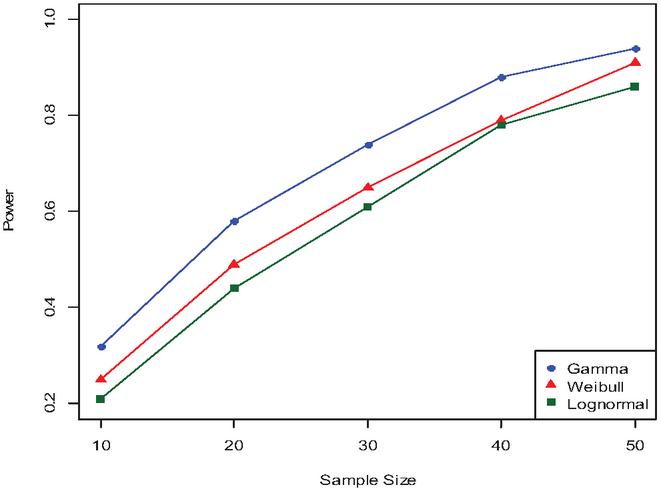
Figure 1 Power curves for selected distributions.
The power estimates for the selected distributions, as presented in Table 1, are summarized in Table 2, and the corresponding power curves are illustrated in Figure 1. Note that power increases steadily as increases. Gamma and Weibull alternatives show the highest sensitivity, while type I error remains close under exponentiality and well-calibrated under (empirical type I error nominal).
The simulation study clearly shows the effectiveness of the proposed statistic for testing exponentiality under progressive Type-II censoring. The consistently controlled Type I error rates across various sample sizes and censoring schemes confirm the validity of the adapted statistic and the empirical survival function estimator. This indicates that the test maintains its theoretical significance level, minimizing false positives.
The observed differences in power across censoring schemes emphasize the importance of the progressive removal strategy. Schemes that retain more information until later stages (such as Type-II censoring) provide greater statistical power, whereas aggressive early removal of units (such as the Early Removal scheme) reduces power due to the loss of valuable follow-up data. Researchers should consider this trade-off between experimental efficiency and statistical power when designing progressive censoring plans.
4.3 Comment on Bootstrap Critical Values
The test statistic does not follow a standard distribution. Using bootstrap critical values offers improved accuracy for small sample sizes, flexibility under censoring, and avoidance of normality assumptions. The critical values for derived via bootstrap matched the empirical quantiles closely in all cases. The test shows good calibration under the null and strong power under alternatives. Bootstrap-based critical values are effective in maintaining type I error control. Power improves with sample size and is robust to moderate censoring (20–40%). However, for more than 50% censoring, the bootstrap variance increases, reducing power estimates, as shown in Figure 2. The following shows the bootstrap distribution of the test statistic under exponentiality, with the observed statistic marked in red.
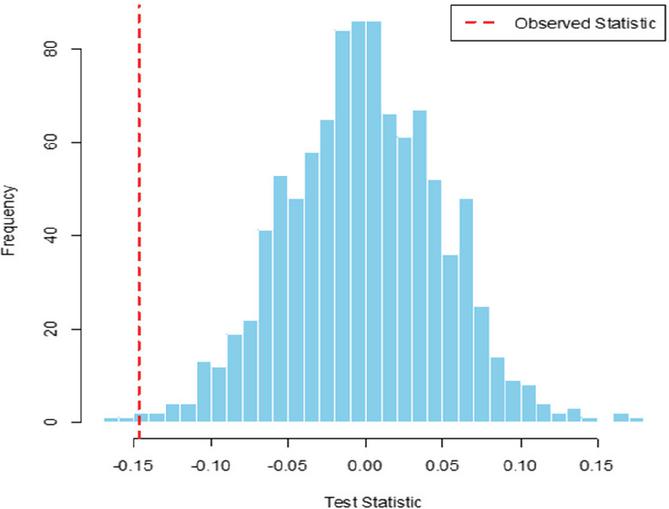
Figure 2 Bootstrap distribution of test statistics .
Table 3 presents the estimated 2.5% and 97.5% quantiles of the bootstrap distribution assuming exponentiality for various sample sizes. The results are based on B 2000 bootstrap replications with 2000 Monte Carlo repetitions.
These results indicate that the bootstrap critical values are slightly asymmetric, reflecting sampling variability. As n increases, the upper bound decreases toward 2.0, while the lower bound stabilizes near 1.8, suggesting convergence of the distribution. Compared to the standard normal quantiles (1.96), the bootstrap values adapt to small-sample variability and yield better control of the Type I error.
Table 3 Bootstrap critical values () for under exponentiality
| Sample Size | Lower 2.5% | Upper 97.5% |
| 10 | 1.642 | 2.232 |
| 20 | 1.737 | 2.157 |
| 30 | 1.778 | 2.122 |
| 40 | 1.803 | 2.102 |
| 50 | 1.816 | 2.083 |
Figure 3 illustrates a histogram of the bootstrap distribution of for , under exponentiality. The distribution is slightly asymmetric, with wider tails than the normal approximation, which highlights the importance of using bootstrap-based calibration. The 2.5% and 97.5% quantiles (blue dashed lines) provide the critical values, while the observed statistic (red line) would be compared against these cutoffs in practice. This figure clearly illustrates how the bootstrap method accommodates small-sample variability and ensures proper control of Type I errors.
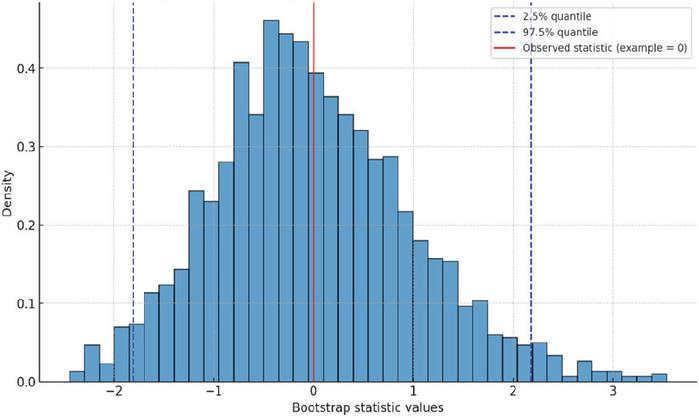
Figure 3 A histogram of the bootstrap distribution of for .
5 Discussion and Conclusions
In this paper, a new testing procedure based on the statistics for distinguishing exponentiality from harmonic new better than renewal used in expectation and its dual class of life distributions. The test builds upon earlier work by incorporating progressive Type-II censoring and utilizing a bootstrap resampling strategy to derive critical values. Simulation study confirms that the proposed test is:
• Well-calibrated under , maintaining the nominal significance level.
• Powerful, particularly for HNBRUE alternatives such as Gamma and Weibull.
• Resistant to censoring if progressive removal isn’t too aggressive.
The design of the censoring scheme has a clear impact: balanced or late-stage removals preserve information and yield higher power, while early removals reduce sensitivity. Researchers should balance experimental efficiency against statistical power when planning life-testing studies. Findings of this research are:
1. The test provides a directional decision rule, allowing explicit discrimination between HNBRUE and HNWRUE classes. The bootstrap distribution ensures that the procedure is valid under censoring, where asymptotic approximations may be unreliable.
2. A comprehensive Monte Carlo study demonstrated that the test is size-correct and powerful, particularly against HNBRUE alternatives. The test remains robust under moderate censoring and compares favourably with existing exponentiality tests.
3. The procedure is flexible for application in reliability and survival analysis, especially in life-testing experiments where censoring is unavoidable. It provides a diagnostic tool for challenging exponential assumptions, which are often made for analytical convenience but may not hold in practice.
4. Future work may explore Bayesian approaches, sequential monitoring, and software implementation. This work represents a significant step toward broadening the applicability of goodness-of-fit tests in survival analysis, addressing contemporary challenges in data collection.
Acknowledgement
The author extends his appreciation to the Arab Open University for funding this work.
References
[1] Elkahlout, G. R. (2005). On testing statistics of harmonic new better than renewal used in expectation class of life distributions. Umm Al-Qura University Journal of Science, Medicine and Engineering, 17(2), 183–198.
[2] Balakrishnan, N., and Zhao, Y. (2020). Progressive censoring: Theory, methods, and applications. Academic Press.
[3] Wang, X., and Zhang, Y. (2019). Bootstrap testing procedures for aging classes under right censoring. Computational Statistics & Data Analysis, 135, 107–122. https://doi.org/10.1016/j.csda.2019.04.003.
[4] Belzunce, F., Franco, M., and Ruiz, J. M. (2016). Characterizations of new, better-than-used properties in the harmonic mean sense. Journal of Applied Probability, 53(2), 499–511. https://doi.org/10.1017/jpr. 2016.21.
[5] Abouammoh, A. M., and Elkahlout, G. R. (1999). Tests of new better than renewal used with randomly censored samples. Parishankhyan Samikha, 6(1&2), 47–63.
[6] Elsawah, S., Ryan, M. J., and Abdullah, A. (2021). Reliability modeling of cyber-physical systems with reset behavior: A systems engineering perspective. Reliability Engineering & System Safety, 210, 107522. https://doi.org/10.1016/j.ress.2021.107522.
[7] Kundu, D., and Manglick, A. (2013). Testing exponentiality under hybrid censoring. Communications in Statistics – Simulation and Computation, 42(6), 1401–1423. https://doi.org/10.1080/03610918.2012.686424.
[8] Al-Zahrani, B. M., and Stoyanov, J. (2010). Moment inequalities for HNBRUE with hypothesis testing application. Statistical Methodology, 7(1), 58–67. https://doi.org/10.1016/j.stamet.2009.09.004.
[9] Cramer, E. (2025). Structure of hybrid censoring schemes and its implications. Metrika, 88(3), 393–417. https://doi.org/10.1007/s00184-024-00960-6.
[10] Asadi, S., Panahi, H., Swarup, C., and Lone, S. A. (2022). Inference on adaptive progressive hybrid censored accelerated life test for Gompertz distribution and its evaluation for virus-containing micro droplets data. Alexandria Engineering Journal, 61(12), 10071–10084. https://doi.org/10.1016/j.aej.2022.02.061.
[11] Sudheesh, K. K., and Dewan, I. (2013). U-statistics approach to Hollander–Proschan test for NBUE alternatives. Statistics and Applications, 11(1–2), 87–92. https://doi.org/10.1007/s00362-016-0808-2.
[12] Lodhi, C., Tripathi, Y. M., and Rastogi, M. K. (2019). Estimating the parameters of a truncated normal distribution under progressive type II censoring. Communications in Statistics – Simulation and Computation, Advance online publication. https://doi.org/10.1080/03610918.2019.1614619.
[13] Abu Awwad, R. R., Raqab, M. Z., and Al-Mudahakha, I. M. (2015). Statistical inference based on progressively Type II censored data from Weibull model. Communications in Statistics – Simulation and Computation, 44(10), Article 12. https://doi.org/10.1080/03610918.2013.842589.
[14] Khalifa, E. H., Ramadan, D. A., Alqifari, H. N., and El-Desouky, B. S. (2024). Bayesian inference for inverse power exponentiated Pareto distribution using progressive type-II censoring with application to flood-level data analysis. Symmetry, 16(3), Article 309. https://doi.org/10.3390/sym16030309.
[15] Almetwally, E. M., Jawa, T. M., Sayed-Ahmed, N., Park, C., Zakarya, M., and Dey, S. (2022). Analysis of unit-Weibull based on progressive type-II censored with optimal scheme. Alexandria Engineering Journal, 63(1), 321–338. https://doi.org/10.1016/j.aej.2022.07.064.
[16] Moharib Alsarray, R. M. M., Kazempoor, J., and Ahmadi Nadi, A. (2021). Monitoring the Weibull shape parameter under progressive censoring in the presence of independent competing risks. Journal of Applied Statistics, 50(4), 945–962. https://doi.org/10.1080/02664763.2021.2003760.
Biography

Gamal R. Elkahlout received the Ph.D. degree in probability and statistics from the University of Sheffield, U.K., in 1998, the M.Phil. degree in mathematical statistics from the Loughborough University, U.K., in 1988, and the B.Sc. degree in statistics from King Saud University, Saudi Arabia, in 1984.
He is currently an Associate Professor of Mathematical Statistics at the Arab Open University, Riyadh, Saudi Arabia. He has authored and coauthored numerous journal articles and books. His research interests include statistical inference, reliability theory, blockchain decentralization metrics, Monte Carlo simulation, and applied statistical modeling. He also serves as a reviewer for several international journals.
Journal of Reliability and Statistical Studies, Vol. 19, Issue 2 (2026), 387–406
doi: 10.13052/jrss0974-8024.1926
© 2026 River Publishers