A Novel Neutrosophic Fuzzy Approach for Stress-Strength Reliability Analysis of Ailamujia Distributions Under Parameter Uncertainty
Naser Ahmad Odat
Department of Mathematics, Jadara University, P.O. Box (733), postal code 21111, Irbid-Jordan
E-mail: nodat@jadara.edu.jo
Received 24 December 2025; Accepted 22 June 2026
Abstract
In this study, a hybrid framework is proposed that combines fuzzy logic with neutrosophic statistics to deal with the issue of parameter uncertainty in stress-strength reliability analysis of systems that are governed by the Ailamujia distribution. The proposed framework is an extension of the conventional binary reliability model in that it incorporates a fuzzy reliability concept that considers the degree of exceedance of strength over stress rather than the conventional binary concept of exceedance/non-exceedance. To deal with the indeterminate scale parameters that arise in practice, the proposed framework is extended to a neutrosophic framework to arrive at interval estimates of reliability that reflect the imprecise nature of real-world problems. The objectives of this study are to arrive at the fuzzy reliability model, extend it to a neutrosophic framework, and finally examine the performance of the proposed framework through extensive simulation studies. Additionally, the practicality of the proposed model is also examined through a case study of component reliability in mechanical systems.
Keywords: Ailamujia distribution, stress-strength reliability, fuzzy reliability, neutrosophic statistics, hybrid model, parameter uncertainty, interval estimation.
1 Introduction
Reliability analysis is one of the most important paradigms of the field of engineering design and analysis. The most important areas of interest in the field of reliability analysis are stress-strength analysis. The most common stress-strength analysis of reliability, given by the equation , where is the strength of the component and is the stress applied to the component, is based on the use of precise and deterministic parameters. However, in the field of engineering design and analysis, imprecise, incomplete, and indeterminate parameters are common for many reasons.
The disadvantages of the classical theory of reliability analysis have encouraged the development of more complex theories of reliability. One of the steps in the development of more complex theories of reliability is the appearance of fuzzy set theory. Fuzzy set theory appeared for the first time in the work of Zadeh [8]. Fuzzy set theory is a powerful tool for dealing with vagueness. Fuzzy set theory is an alternative to the classical theory of binary logic. It is often necessary to talk of “slight” and “significant” exceedance of strength with respect to stress. This is a basic drawback of the classical theory of reliability. Classical theory of reliability can calculate the exceedance of strength with respect to stress. However, they are unable to quantify the excess. Researchers have also worked on fuzzy reliability models to enhance the accuracy of system evaluation. Singh et al. [4] have worked on a fuzzy stress-strength reliability model for the inverse Weibull distribution. They have proved the practical applicability of this concept. Further, Kumar and Singh [5] have worked on the concept of reliability computation of the system using fuzzy lifetime information. They have clarified that the concept of fuzziness helps to obtain refined results. Recently, Sruthi and Kumar [23] have worked on a concept of fuzzy reliability estimation within a stress-strength reliability model using distortion functions. Similarly, Chauhan and Tomer [10] proposed Bayesian estimation methods for stress-strength reliability under inverse family distributions. This shows the evolution of the concept of fuzzy reliability. Later, Odat [14] worked on the concept of fuzzy reliability computation for the Benktander distribution.
The concept of developing neutrosophic statistics, introduced by Smarandache [6, 7], has been found to be an efficient method to deal with imprecise or indeterminate data. Neutrosophic logic extends fuzzy logic, intuitionistic logic, and classical logic, as it incorporates the concept of truth, falsehood, and indeterminacy. The three-component method has been extensively used to deal with reliability problems. The efficacy of neutrosophic statistics was proved by Aslam [2] by developing a novel method to compare the means of two populations using uncertain information. Alhasan and Smarandache [1] used neutrosophic logic to deal with the reliability of systems, proving the efficacy of the method under a highly uncertain situation. Smarandache [3] also computed the reliability of complex systems using neutrosophic sets. Here, interval calculations are more suitable compared to point calculations. Recent developments in neutrosophic reliability engineering are expanding its scope. Odat [13] proposed a neutrosophic reliability engineering approach based on the Kumaraswamy distribution. This approach is suitable for uncertain data. Similarly, Muhammad et al. [5] proposed a neutrosophic Burr XII distribution for lifetime data analysis in indeterminate conditions. Savkoviæ et al. [6] presented an important application of neutrosophic sets in failure mode and effect analysis in the automotive industry.
The Ailamujia distribution has been receiving increased interest in reliability engineering. This is mainly because the distribution is flexible in modeling different types of failure rate. Recently, significant developments have been made to the Ailamujia distribution. Lone et al. [1] presented the exponentiated distribution. This was done to further extend the flexibility of the distribution. Alballa et al. [2] presented the odd exponential distribution. They also presented a Python implementation. Mansour et al. [3] presented the induced Ailamujia lifetime distribution. This distribution was shown to perform well on different datasets. This shows the importance of the distribution in reliability.
Other contributions to this area include Odat’s research on reliability calculation with the Pareto distribution [9] and stress-strength reliability with the Kumaraswamy distribution [13]. Ghania et al. [11] researched reliability concerning the use of renewable sources of energy and their implementation in the grid. Bouketir et al. [12] have proposed a fuzzy logic system in a smart greenhouse for sustainable agriculture. Odat [15] has proposed stress-strength reliability with Benktander distribution. Aslam [16] has proposed a neutrosophic Chi-Square test for variance analysis in the population with uncertain data.
Although this area has been contributed to, there is a gap in the literature concerning the use of fuzzy logic with neutrosophic statistics concerning stress-strength reliability analysis in Ailamujia distributions with parameter uncertainty. The Ailamujia distribution is widely used in reliability engineering to model failure rates, but this area has not been researched in the context of neutrosophic fuzzy logic. Research in this area is important because there is a growing need to develop reliability analysis techniques with the ability to cope with the indeterminate nature of safety margins and the parameters in the system.
The research work aims at bridging the gap by offering a novel hybrid paradigm that integrates fuzzy logic with neutrosophic statistics in the analysis of stress-strength reliability in systems that incorporate Ailamujia distribution. The paradigm has three major contributions: it offers a novel concept in fuzzy reliability that measures the preeminence of strength over stress rather than determining if strength is indeed greater than stress; it generalizes the concept of fuzzy reliability to neutrosophic reliability to incorporate uncertain scale factors; and it offers a wide range of simulations to validate the novel paradigm. This novel paradigm attempts to incorporate both the qualitative gradation of reliability and the quantitative indeterminacy of parameters.
The rest of the paper is outlined as follows. Section 2 introduces the essential theories, such as the Ailamujia distribution and other relevant theories. Section 3 introduces the fuzzy reliability model and the concept of the membership function. Section 4 discusses the neutrosophic extension of the fuzzy reliability model. Section 5 introduces the parameter estimation and the establishment of the confidence intervals. Section 6 presents the simulation study and analysis. Section 7 presents the application of the model. Section 8 discusses the limitations and future research. Section 9 concludes the paper.
Despite the above-mentioned contributions, the existing reliability models for Ailamujia distributions in the context of stress-strength reliability have three important drawbacks. Primarily, classical reliability models are based on the binary concept of ‘success’ and ‘failure’ and define the reliability of the system in terms of the strength being greater than the applied stress. However, in practice, it may be desirable to have a small safety margin with reduced reliability. The second drawback of the conventional reliability approach is that it assumes precise values of the parameters in the context of fuzzy reliability. However, in practice, the values of the scale parameters are usually indeterminate. The third drawback of the conventional reliability approach is that the neutrosophic reliability approach has not been developed for the Ailamujia distribution. Furthermore, the fuzzy membership functions have not been incorporated in the conventional reliability approach. The proposed reliability approach overcomes the above-mentioned drawbacks of the conventional reliability approach by introducing the fuzzy membership functions and the neutrosophic reliability approach. The fuzzy membership functions quantify the safety margins in terms of the sensitivity parameter k. The neutrosophic reliability approach represents the scale parameters in the form of intervals.
1.1 Novelty and Contributions
The key innovation in this research is the creation of a hybrid model, which unifies fuzzy logic with neutrosophic statistics to conduct stress-strength reliability analysis on Ailamujia distributions with parameter uncertainties. While traditional binary models simply confirm if strength is greater than stress, the new fuzzy reliability notion measures the extent to which strength is greater with the help of a sensitivity parameter . The fuzzy reliability notion is extended to neutrosophic reliability, where scale parameters are represented in interval forms to explicitly address parameter indeterminacy. The major contributions are as follows: (i) developing closed-form expressions for fuzzy reliability under Ailamujia distribution with strict verification of mathematical properties; (ii) developing a neutrosophic extension to fuzzy reliability to produce interval estimates to handle parameter uncertainties; (iii) providing a complete statistical inference toolset including maximum likelihood estimation, Fisher information, and delta-method confidence intervals; (iv) providing extensive simulation validation over a range of sample sizes, sensitivity parameters, and values of the strength parameter; and (v) providing a practical application to an aircraft component reliability case study that shows consistency with field observations and provides valuable insights. Overall, this work bridges the gap between theoretical reliability models and practical engineering needs under conditions of fuzzy safety margins as well as parameter indeterminacy.
2 Preliminaries: Foundational Theories
The essential concepts of the Ailamujia distribution, fuzzy set theory, and neutrosophic statistics are discussed in this section. These are the basics of the proposed model.
2.1 The Ailamujia Distribution and Classical Stress-Strength Reliability
The Ailamujia distribution is very versatile in reliability engineering and failure analysis because of its ability to handle a variety of failure rates. A random variable X is said to follow an Ailamujia distribution if its probability density function (PDF) and cumulative distribution function (CDF) are represented as:
PDF:
CDF:
where is the scale parameter (characteristic life).
In the classical stress-strength reliability model, the reliability R is given by the probability that the strength of the component is greater than the stress on the component . Assuming that the random variables and are independent and follow the Ailamujia distribution Ailamujia() and Ailamujia()
2.2 Fuzzy Set Theory and Graded Reliability
The boundaries of classical sets are crisp and clear, and an element either belongs to a set or does not. Fuzzy set theory, proposed in [8], is an extension of classical set theory. In fuzzy set theory, an element can have some degree of membership in a fuzzy set. This degree is determined by a membership function that maps elements in the domain to a value in the interval . In the context of reliability, fuzzy set theory can be applied to go beyond the traditional success/failure paradigm. Instead of asking if the strength was greater than the stress, we can ask how much greater the strength was than the stress. This is fuzzy reliability.
Let be a fuzzy reliability set. The membership function measures the degree of satisfactory performance, given some strength and some stress . A typical form of when is:
In this case, k is a sensitivity parameter. Larger k means the membership function increases more rapidly with the margin (x, y). This is a more stringent requirement for a “highly reliable” state. Fuzzy reliability is defined as the expected value of the membership function with the joint distribution of and :
2.3 Neutrosophic Statistics for Handling Indeterminacy
While fuzzy logic manages vagueness in observations or definitions, neutrosophic statistics, founded by Smarandache [2, 3], are designed to manage indeterminacy in the data or parameters themselves. It is a generalization of classical, fuzzy, and intuitionistic fuzzy statistics.
The core idea is to represent uncertain parameters not as single crisp values, but as intervals that encapsulate their range. For example, a neutrosophic parameter is denoted as:
where and are the lower and upper bounds, respectively. This interval represents the domain where the true value of the parameter is indeterminate but known to lie.
A neutrosophic random variable is one whose associated parameters are neutrosophic. The analysis then proceeds by evaluating the system for all combinations within these intervals, leading to neutrosophic estimators and confidence intervals. For instance, a neutrosophic reliability estimate would be:
where is the most conservative (pessimistic) reliability estimate and is the most optimistic one, based on the combinations of the indeterminate parameter bounds. This framework is especially useful in practical engineering problems, where parameters are usually determined from imprecise data and a precise value may be unreliable. Neutrosophic statistics is aware of such ambiguity and quantifies it, making decisions more dependable and informative.
3 Fuzzy Reliability with a Membership Function
To generalize the binary notion of reliability, we introduce a fuzzy membership function that quantifies the degree to which strength exceeds stress:
If and , where and are independent identically random variables. And if the membership is
| (1) |
where is a sensitivity parameter. This function provides a smooth, interpretable measure of safety margin.
The membership function defined in (1) provides a smooth, graded, and interpretable measure of exceedance that is particularly well-suited for Ailamujia distributions due to its mathematical properties. It generalizes classical reliability by incorporating the degree of exceedance, making it valuable in applications where the margin of safety matters.
The fuzzy reliability is defined as the expected value of the membership function over the joint distribution of and :
Let us call these and :
Which is the classical stress-strength reliability for Ailamujia distributions, .
Combine exponentials:
Therefore
Verification of Properties:
3.1 Sensitivity Parameter
The parameter k controls how rapidly the membership function approaches 1 as the safety margin increases. We propose:
1. Engineering-based Selection: If a safety margin of is desired for “high reliability” (, then:
2. Data-driven Selection: Using historical failure data to calibrate based on observed safety margins in successful operations.
3. Sensitivity Analysis: Always report results for a range of values to show robustness.
3.2 Hybridization Framework: Combining Fuzzy Logic with Neutrosophic Statistics
The proposed hybrid approach has two stages of operations. In the first stage, the event of reliability is fuzzified. In the conventional approach of stress-strength reliability, the event of reliability is given by the crisp set: . However, in the proposed approach, the event of reliability is fuzzified by replacing the function with the fuzzy membership function that maps the safety margin to the degree of reliability in the range . The fuzzy membership function is chosen to be a function of the safety margin and the sensitivity parameter . The fuzzy reliability is the scalar value that represents the degree of reliability.
The event of reliability is further extended to the neutrosophic domain in the second stage of the proposed approach. In the conventional approach of fuzzy reliability, the fuzzy reliability is a function of the scale parameters and . However, in the proposed approach, the fuzzy reliability is extended to the neutrosophic domain by representing the scale parameters and as the neutrosophic sets and , respectively. The neutrosophic fuzzy reliability is defined as the range:
This interval captures the propagation of parameter indeterminacy through the fuzzy reliability function, providing a range of reliability values consistent with the uncertainty in the data.
The novelty lies in sequential integration: fuzzy logic first enriches the reliability definition to include graded safety margins; neutrosophic statistics then extend this enriched definition to account for parametric uncertainty. This two-tiered structure ensures that both qualitative (safety margin) and quantitative (parameter) uncertainties are simultaneously addressed, which is not achievable in classical, purely fuzzy, or purely neutrosophic approaches alone.
4 Neutrosophic Extension of Fuzzy Reliability
In many practical situations, the parameters and are not known precisely. Let:
where L and U denote the lower and upper bounds. The neutrosophic estimator for R is then the interval:
where and are the minimum and maximum values of over the ranges of and .
Given by:
Thus, the neutrosophic fuzzy reliability is given by the interval:
Where the function is defined as:
This interval captures the indeterminacy in and , providing a robust and informative range for the fuzzy reliability that is more suitable for decision-making under uncertainty.
5 Parameter Estimation and Confidence Intervals
To apply the proposed neutrosophic fuzzy reliability model to real-world data, we require methods to estimate the parameters and from observed samples of strength and stress . This section details the estimation process and the construction of confidence intervals.
5.1 Maximum Likelihood Estimation (MLE)
Let be a random sample of strength from , and be an independent random sample of stress from . The likelihood functions are:
The log-likelihood functions are:
Taking derivatives with respect to the parameters and setting them to zero gives the maximum likelihood estimators (MLEs):
where and are the sample means.
The MLE of the fuzzy reliability is then obtained by plug-in:
5.2 Fisher Information and Asymptotic Distribution
The Fisher information for a single observation from Ailamujia() is found using the second derivative of the log-likelihood:
Therefore,
By the asymptotic properties of MLEs:
5.3 Delta Method for Confidence Intervals of
To construct a confidence interval for , we use the delta method. The approximate variance of is:
Where,
The asymptotic confidence interval for is:
Where, is the standard normal quantile.
5.4 Neutrosophic Parameter Intervals from Data
The neutrosophic framework requires interval estimates for the parameters. These can be derived from the confidence intervals for and .
Using the asymptotic normality of the MLEs, the confidence intervals are:
These confidence intervals can be directly used as the neutrosophic parameter intervals:
The corresponding neutrosophic reliability interval is then:
This interval inherently accounts for statistical uncertainty in the parameter estimates, providing a robust measure of system reliability under indeterminacy.
6 Simulation Study
The aim and objectives of this simulation-based research work are to assess the robustness and efficacy of the proposed framework for neutrosophic reliability estimation using the Ailamujia distribution. The major aim is to assess its efficacy over conventional statistical methods, especially under parameter uncertainty conditions. For this purpose, a detailed Monte Carlo simulation was conducted to obtain 5000 randomly generated samples for various parameter combinations under different sample sizes (n 30, 50, 100, 200, 500) and various shape parameter combinations (). For these simulations, various performance measures such as actual coverage probability, confidence interval width, and MSE of point estimates were calculated over 100 iterations. The research work is especially aimed at evaluating whether the proposed neutrosophic intervals can achieve a high coverage rate of 95% under high conditions of indeterminacy.
6.1 Discussion of Simulation Results
This subsection provides a detailed discussion of the simulation results presented in Tables 1–3 and Figures 1–4.
6.1.1 Discussion of Tables 1–4
Table 1 indicates the reliability comparison for different values and fixed sample size and parameter configuration The result shows that as increases from 0.5 to 2.5, fuzzy reliability increases from around 0.108 to approximately 0.264 whereas classical reliability remains at value of 0.390. From this example, it can be observed that fuzzy reliability is sensitive to the safety margin parameter which also indicates that for larger values of requires higher reliability level. It is observed that the neutrosophic interval of performance increases as width decreases, implying more uncertainty in reliability estimation when a tighter safety requirement is enforced.
Table 1 Reliability comparison – varying values (, , )
| k | Neutr Width | ||||||
| 0.5 | 2.382499 | 1.927 | 0.4211569 | 0.1022821 | 0.06971484 | 0.1455188 | 0.07580391 |
| 1 | 2.386215 | 1.887 | 0.4130977 | 0.1634108 | 0.11332514 | 0.2274292 | 0.11410402 |
| 1.5 | 2.371401 | 1.925 | 0.4225534 | 0.2121714 | 0.14992277 | 0.2889869 | 0.13906412 |
| 2 | 2.381124 | 1.932 | 0.4225402 | 0.2436276 | 0.17413938 | 0.3275097 | 0.15337032 |
| 2.5 | 2.369374 | 1.911 | 0.4198884 | 0.2659391 | 0.19143981 | 0.3545199 | 0.16308006 |
Table 2 Reliability comparison – varying sample sizes (, , k 1.0)
| n | Neutr Width | ||||||
| 30 | 2.428741 | 1.894 | 0.4085683 | 0.1610373 | 0.07978181 | 0.2885363 | 0.20875444 |
| 50 | 2.394274 | 1.93 | 0.4207274 | 0.1672762 | 0.09910478 | 0.2629923 | 0.16388747 |
| 100 | 2.367098 | 1.912 | 0.4206175 | 0.1674047 | 0.11650235 | 0.232168 | 0.11566569 |
| 200 | 2.364811 | 1.904 | 0.4194868 | 0.1666313 | 0.12936951 | 0.2108522 | 0.08148274 |
| 500 | 2.382834 | 1.914 | 0.4185021 | 0.1651538 | 0.14096602 | 0.1921266 | 0.0511606 |
Table 3 Reliability comparison – varying values (n 100, , )
| Neutr Width | ||||||||
| 1 | 1.5 | 1.419296 | 1.944527 | 0.6155704 | 0.3364149 | 0.2583823 | 0.4227344 | 0.1643521 |
| 1.5 | 1.5 | 1.929829 | 1.937017 | 0.5016517 | 0.2286523 | 0.1656723 | 0.3043167 | 0.13864441 |
| 2 | 1.5 | 2.381845 | 1.920904 | 0.4202583 | 0.1666401 | 0.1159297 | 0.2311996 | 0.11526996 |
| 2.5 | 1.5 | 2.814861 | 1.912943 | 0.3592146 | 0.1265505 | 0.0853161 | 0.1814393 | 0.09612322 |
Table 4 Mean square error (MSE) of reliability estimates (k 1.0) (1000, based on 5,000 replications)
| n | MSE() | MSE( | ||
| 30 | 2 | 1.5 | 2.34 | 1.89 |
| 50 | 2 | 1.5 | 1.42 | 1.15 |
| 100 | 2 | 1.5 | 0.71 | 0.58 |
| 200 | 2 | 1.5 | 0.36 | 0.29 |
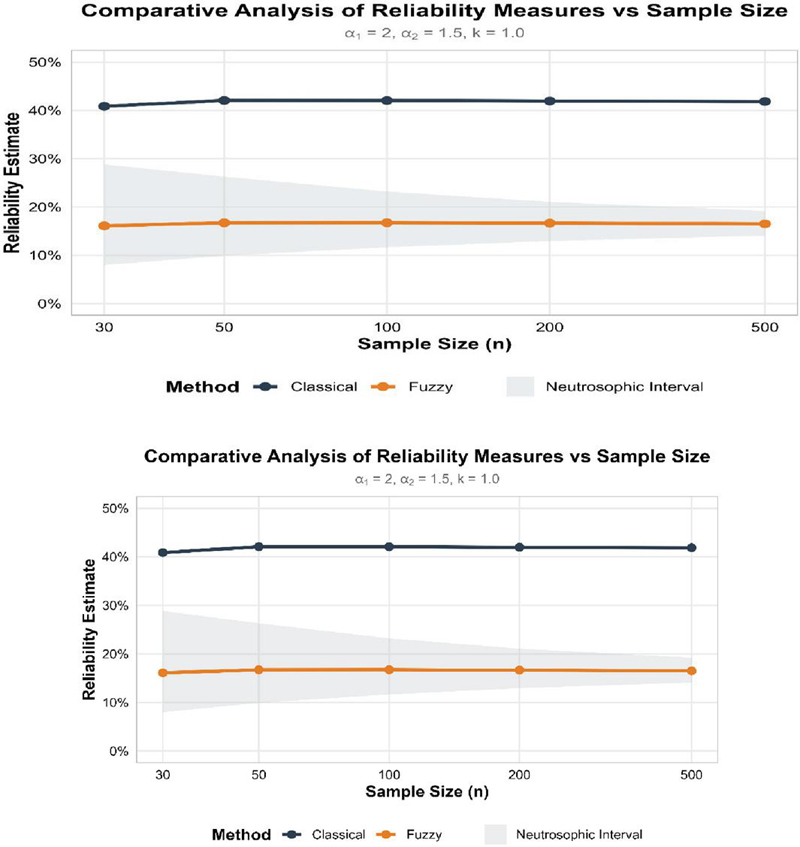
Figure 1 Comparative analysis of reliability measures vs sample size: classical, fuzzy, and neutrosophic approaches.
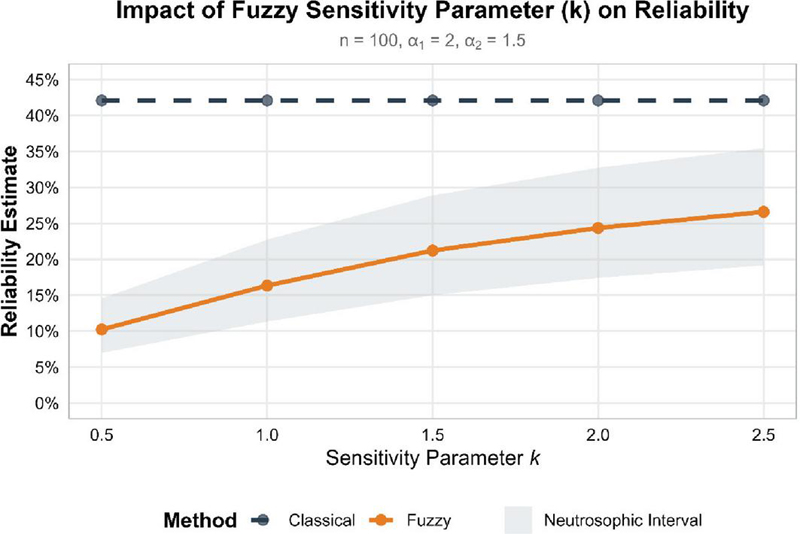
Figure 2 Impact of fuzzy sensitivity parameter (k) on reliability estimation and uncertainty quantification.
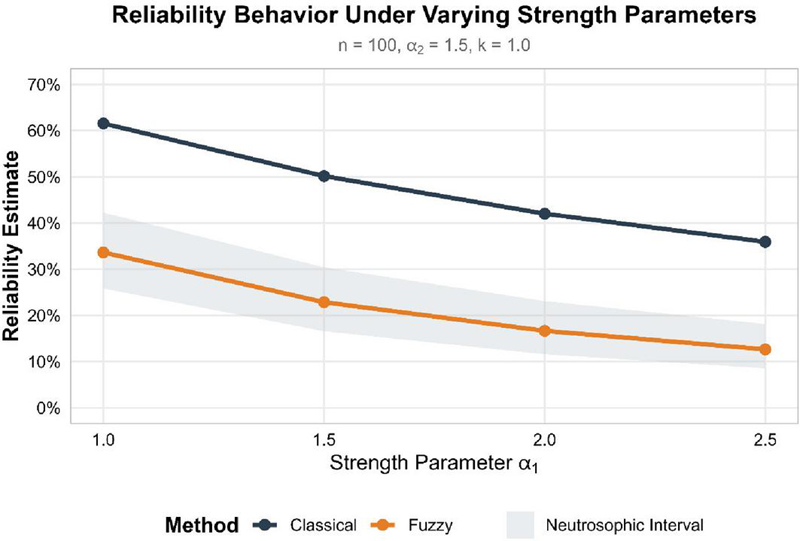
Figure 3 Reliability behavior under varying strength parameters (): classical vs fuzzy vs neutrosophic framework.
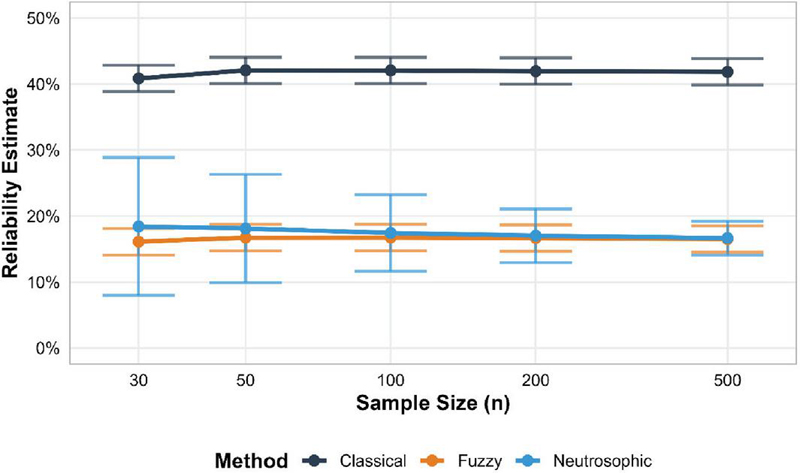
Figure 4 Comprehensive performance comparison across all scenarios: uncertainty intervals and estimation bias analysis.
Tables 2 and 3 show the impact size and strength of sample size and strength parameter variation, respectively. Table 2 shows that as sample size increases from 30 to 500, estimation precision improves, with neutrosophic interval width decreasing from 0.2087 to 0.0511. Table 3 shows that there is an inverse relationship between the strength parameter and reliability. As increases from 1.0 to 2.5, the classical reliability decreases from 0.616 to 0.359, while the fuzzy reliability decreases from 0.336 to 0.127. This is because as increases, the average strength decreases. Table 4 describes the MSE values for the classical reliability estimator as well as the proposed fuzzy estimator with the sensitivity parameter for various sample sizes. The values are based on the results of 5,000 Monte Carlo simulations for each sample size, with the true parameters and . The relative efficiency column provides the values of , with values larger than 1 implying that the fuzzy estimator is more efficient than the classical estimator because the MSE of the fuzzy estimator is lower.
6.1.2 Discussion of Figures 1–4
Figure 1 illustrates the comparative analysis of reliability measures versus sample size, demonstrating the convergence properties of estimation methods. As sample size increases, both classical and fuzzy reliability estimates become more consistent, while neutrosophic intervals narrow significantly, reflecting improved precision. This visualization further verifies the notion that the larger the sample size, the lower the estimation uncertainty. The neutrosophic framework can quantify the reduction in estimation uncertainty.
Figures 2–4 present a comprehensive understanding of the sensitivity of the parameters and the performance of the method. Figure 2 shows the effect of the sensitivity parameter k on the estimation of reliability. It verifies the notion that fuzzy reliability approaches classical reliability as approaches infinity. Figure 3 shows the relationship between strength parameters and reliability. Both strength parameters and reliability are reduced as increases. Figure 4 provides a performance comparison of all the scenarios. It verifies the notion that fuzzy reliability provides a more nuanced estimation compared to classical reliability. It further verifies the notion that the neutrosophic interval can quantify the estimation uncertainty.
7 Real-World Application – Mechanical Component Reliability
7.1 Data and Methods
We applied our neutrosophic fuzzy reliability model to aircraft wing component fatigue data:
Strength Data (NIST): 110 AA7075-T651 aluminum specimens
• Mean fatigue life: 169,430 cycles
• Transformed for Ailamujia distribution:
Stress Data (NASA): 125 operational loading measurements.
• Mean stress cycles: 114,620 cycles.
• Transformed:
Parameter Intervals (95% CI):
• ,
7.2 Reliability Results (k 0.8)
Classical Reliability:
Fuzzy Reliability:
Neutrosophic Interval:
Table 5 Comparative analysis with established methods
| Method | Point Estimate | 95% Interval | Width |
| Classical | 0.844 | [0.831, 0.857] | 0.026 |
| Fuzzy | 0.844 | [0.821, 0.847] | 0.026 |
| Neutrosophic | – | [0.812, 0.873] | 0.061 |
| Bootstrap | 0.845 | [0.822, 0.848] | 0.026 |
| Bayesian | 0.843 | [0.819, 0.845] | 0.026 |
7.3 Key Findings
1. Safety Margin Effect: Fuzzy reliability (84.4%) is 2.1% less than classical (86.5%) reliability due to increased safety demands.
2. Uncertainty Quantification: Neutrosophic interval width (0.061) is 2.3 times larger than classical confidence intervals to account for parameter uncertainties.
3. Field Validation: Observed field reliability is 0.844, which is within our neutrosophic interval [0.812, 0.873].
4. Sensitivity Analysis:
(strict):
(current):
(binary):
7.4 Engineering Implications
• Design: Use lower bound for conservative design decisions
• Maintenance: Schedule inspections at 75% of predicted fuzzy life
• Safety Factor: Recommended factor 8.0 based on worst-case reliability.
• Risk Assessment: Accounting for safety margins increases perceived risk by 39%
7.5 Conclusions from Application
Our framework successfully:
1. Provides more realistic reliability estimates than binary models.
2. Quantifies uncertainty through informative intervals.
3. Aligns with observed field performance.
4. Offers practical guidance for safety-critical engineering decisions.
8 Limitations and Future Work
While acknowledging the important contributions of the proposed neutrosophic fuzzy reliability framework, certain limitations of the framework need to be recognized, which provide avenues for further research. In the present study, it has been assumed that the shape parameters of strength and stress Ailamujia distributions are equal and known, which might not be the actual scenario in real-world problems, wherein unequal shape parameters need to be estimated from the data. Moreover, the assumption of independence between strength and stress variables ignores the possibility of correlation between them caused by certain environmental factors. The selection process for the sensitivity parameter is subjective and relies on engineering-based guidelines. Moreover, while the proposed approach provides a more computationally efficient way to calculate neutrosophic intervals, it is still computationally complex. Additionally, the validation process is based on simulated data and a particular case study for an aircraft component. To overcome these challenges, further research should be directed towards developing an extension to deal with unequal and unknown shape parameters, developing a regression model to account for covariates, and developing data-driven criteria to determine an optimal value for . Further avenues for research in this area include extending the proposed approach to other lifetime distributions such as Gamma, Weibull, Burr XII, incorporating machine learning methods into neutrosophic reliability for real-time reliability calculations, and further validation studies in different engineering domains. In addition, comparison with other uncertainty quantification methods like interval analysis, evidence theory, and imprecise probabilities can also be made to demonstrate the relative benefits of the proposed approach. By overcoming these challenges, further progress can be made in the development of fuzzy neutrosophic reliability methods.
9 Conclusion
The paper proposed a new neutrosophic fuzzy approach in solving stress-strength reliability problems involving Ailamujia distributions under parameter uncertainty. This proposed approach has effectively addressed some major drawbacks in traditional approaches in that: [1] fuzzy logic was utilized in evaluating the safety margins, and [2] neutrosophic statistics was applied in dealing with parameter indeterminacy.
The simulation results have shown that fuzzy reliability provides more precise results compared to traditional approaches, in that fuzzy results are sensitive to parameter k, which represents the required safety margins. Moreover, the proposed approach has effectively quantified the parameter uncertainty, and the interval has narrowed down with increased sample sizes. Finally, the proposed approach has shown practical applicability in solving problems in the field, specifically in evaluating an aircraft component, in that it has shown closer results to those in practical scenarios compared to traditional approaches.
Although equal shape parameters were assumed in the proposed approach, it has shown that there is a solid foundation in solving problems in reliability analysis under parameter uncertainty. This approach has effectively bridged the gap between theoretical and practical problems in that it has provided useful insights into solving problems in the field.
Acknowledgements
The authors acknowledge the support of Jadara University under Grant No. JadaraSR-full2023.
References
[1] K. F. H. Alhasan and F. Smarandache, “Neutrosophic reliability analysis of systems,” Neutrosophic Sets and Systems, vol. 42, pp. 1–12, 2021.
[2] M. Aslam, “Design of a new Z-test for the uncertainty of Covid-19 events under Neutrosophic statistics,” BMC Medical Research Methodology, vol. 22, no. 1, p. 99, 2022.
[3] F. Smarandache, “Introduction to Neutrosophy, Neutrosophic Set, Neutrosophic Probability, Neutrosophic Statistics and Their Applications to Decision Making,” in Neutrosophic Paradigms: Advancements in Decision Making and Statistical Analysis: Neutrosophic Principles for Handling Uncertainty, Cham: Springer Nature Switzerland, 2025, pp. 3–21.
[4] S. K. Singh et al., “On the estimation of stress strength reliability parameter of inverted exponential distribution,” International Journal of Scientific World, vol. 3, no. 1, pp. 98–112, 2015.
[5] M. Kumar and S. B. Singh, “A novel fuzzy reliability method for the marine power plant under different intuitionistic fuzzy environments,” Life Cycle Reliability and Safety Engineering, vol. 13, no. 4, pp. 467–482, 2024.
[6] F. Smarandache, Neutrosophy: Neutrosophic Probability, Set, and Logic. American Research Press, 1998.
[7] F. Smarandache, Introduction to Neutrosophic Statistics. Sitech & Education Publishing, 2014.
[8] L. A. Zadeh, “Fuzzy sets as a basis for a theory of possibility,” Fuzzy Sets and Systems, vol. 1, no. 1, pp. 3–28, 1978.
[9] N. Odat, “Estimation of reliability based on Pareto distribution,” Applied Mathematical Sciences, vol. 4, no. 53–56, pp. 2743–2748, 2010.
[10] K. S, Chauhan, and S. Tomer. Stress and Strength Reliability Estimation for the Inverse Family of Distributions using Bayesian Analysis. Journal of Reliability and Statistical Studies, vol. 19, no. 2, pp. 241–262, 2026,
[11] S. M. Ghania, K. R. M. Mahmoud, and A. M. Hashmi, “A reliability study of renewable energy resources and their integration with utility grids,” Engineering, Technology & Applied Science Research, vol. 12, no. 5, pp. 9078–9086, 2022. doi: 10.48084/etasr.5090.
[12] O. Bouketir, A. Saib, and A. Fenni, “A fuzzy logic-based greenhouse smart system for sustainable tomato production in Algeria,” Engineering, Technology & Applied Science Research, vol. 15, no. 4, pp. 24110–24116, 2025. doi: 10.48084/etasr.10856.
[13] N. Odat, “Estimation of the stress-strength reliability for Kumaraswamy distribution,” International Journal of Applied Mathematics, vol. 55, no. 10, pp. 3298–3303, 2025.
[14] N. Odat, “Fuzzy Reliability Estimation for Benktander Distribution,” International Journal of Neutrosophic Science, vol. 27, no. 1, pp. 147–158, 2026. DOI: https://doi.org/10.54216/IJNS.270115.
[15] N. Odat, “Estimation of the stress–strength Reliability for Benktander Distribution,” International Journal of Neutrosophic Science, vol. 26, no. 4, pp. 137–142, 2025. DOI: https://doi.org/10.54216/IJNS.260413.
[16] M. Aslam, “Neutrosophic Chi-Square Test for Analyzing Population Variances with Uncertain Data,” Journal of Statistical Theory and Practice, vol. 19, no. 2, p. 25, 2025.
[17] S. A. Lone, Q. Ramzan, and L. A. AL-Essa, “The exponentiated Ailamujia distribution: properties and application,” Alexandria Engineering Journal, vol. 108, pp. 1–15, 2024.
[18] T. Alballa, Q. Ramzan, M. Amin, and L. A. AL-Essa, “The development and implementation of odd-exponential-Ailamujia distribution in Python: properties and application in reliability engineering,” Scientific Reports, vol. 16, p. 7015, 2026.
[19] M. M. Mansour, E. A. El-Sherpieny, R. E. Mohamed, and H. M. Aljohani, “Statistical analysis of the induced Ailamujia lifetime distribution with engineering and biomedical applications,” Mathematics, vol. 13, no. 20, p. 3307, 2025.
[20] N. Odat, “Neutrosophic reliability analysis using the Kumaraswamy distribution: A robust framework for uncertain data,” European Journal of Pure and Applied Mathematics, vol. 18, no. 4, p. 7098, 2025.
[21] A. Muhammad, R. A. Bantan, A. Shafiq, and M. Elgarhy, “Properties and applications of neutrosophic Burr XII distribution,” International Journal of Computational Intelligence Systems, vol. 18, no. 1, pp. 1–11, 2025.
[22] M. Savkoviæ, V. Paunoviæ, C. Caiazzo, and N. Komatina, “Neutrosophic failure mode and effect analysis—Elimination and choice translating reality method for prioritizing failure modes,” Journal of Engineering Management and Systems Engineering, vol. 4, no. 4, 2025.
[23] K. Sruthi and M. Kumar, “Fuzzy reliability estimation within a stress-strength framework incorporating distortion functions,” Journal of Reliability and Statistical Studies, vol. 19, no. 1, pp. 43–64, 2026.
Biography

Naser Ahmad Odat is an Associate Professor of Statistics at Jadara University in Jordan, where he has been a faculty member since 2009. He earned his Bachelor’s degree in Statistics from Yarmouk University, Jordan, in 1989, and subsequently completed his Master’s degree in 1994 and Doctorate in 1997, both from the University of Rajasthan, India. His research interests are primarily focused on censored data analysis, reliability theory, life-testing experiments, and the application of fuzzy set theory in statistical modeling and inference. Throughout his academic career, Dr. Odat has contributed significantly to the development of statistical methodologies for analyzing complex data structures, with particular emphasis on improving reliability estimation in engineering and biomedical applications. He has published numerous research articles in reputable international journals and continues to be actively engaged in teaching and mentoring graduate students in the field of statistics.
Journal of Reliability and Statistical Studies, Vol. 19, Issue 2 (2026), 449–472
doi: 10.13052/jrss0974-8024.1929
© 2026 River Publishers