Transforming the Mediterranean into an Industrial Region: A Key to the Sustainability of the European Economy
Konstantinos Theodorakopoulos
Department of Economics, National and Kapodistrian University of Athens, Greece
E-mail: kosttheodorakopoulos@gmail.com
Corresponding Author: Konstantinos Theodorakopoulos; E-mail address: kosttheodorakopoulos@gmail.com
Received 05 February 2025, Accepted 25 March 2025; Published Online: 22 July 2026.
Abstract
This paper examines the structural macroeconomic challenges confronting the Mediterranean member states of the European Union, focusing on the persistent coexistence of high public debt and a weak industrial base. Using a comparative analysis of Greece, Italy, Spain, and Portugal, it highlights the central role of manufacturing capacity in shaping economic resilience, growth sustainability, and external balance within a monetary union. The analysis demonstrates that Greece represents an extreme case of deindustrialization combined with excessive reliance on tourism and services, resulting in heightened vulnerability to external shocks and chronic dependence on external financing. Italy, by contrast, illustrates how a strong and diversified industrial base can mitigate the destabilizing effects of high public debt, albeit without fully resolving long-term stagnation. Spain and Portugal occupy an intermediate position, combining moderate industrial capacity with rising dependence on tourism and services. This paper argues that the structural divergence between the industrial core of Northern Europe and the service-oriented economies of the South constitutes a fundamental threat to the cohesion and sustainability of the euro area. In the absence of exchange rate adjustment mechanisms, internal devaluation strategies have proven socially costly and economically insufficient to restore competitiveness. The findings underscore that a durable growth model for the Mediterranean cannot be built on services alone and that industrial capacity remains a key determinant of productivity growth, export performance, and technological upgrading. The study concludes that an industrial renaissance in the European South is not merely a regional development objective but a systemic necessity for the European Union. However, such a transformation cannot be achieved through financial instruments alone. It requires deep institutional reforms at the European level, including closer coordination of monetary and fiscal policy, the strengthening of collective economic sovereignty, and the explicit recognition of the structural North-South dependency embedded in the current architecture of the Economic and Monetary Union.
Keywords: Agro-industrial integration, common agricultural policy, deindustrialization, economic and monetary union, economic resilience, european union, external vulnerability, fiscal sustainability, greece, industrial policy, industrial renaissance, manufacturing capacity, mediterranean economies, monetary-fiscal coordination, North–South dependency, productive restructuring, public debt, structural asymmetries, sustainable development, tourism dependence..
1 Introduction
The Mediterranean member states of the European Union face a complex and dual macroeconomic challenge (Doukas, Maravegias, et al., 2024), consisting, on the one hand, of exceptionally high levels of public debt (Doukas, Maravegias, et al., 2025) and, on the other, of a persistently weak industrial base. Greece is emblematic in this regard as it records one of the highest public debt-to-GDP ratios in the European Union while simultaneously exhibiting an extremely limited share of industrial production in the composition of its GDP (Spilioti and Vamvoukas, 2015). By contrast, Italy, despite similarly high public debt, maintains a long-standing industrial tradition and constitutes the second-largest manufacturing economy in Europe, after Germany (Spilioti and Vamvoukas, 2015). This comparative observation raises fundamental questions about the cohesion and long-term stability of the European economy. More specifically, it calls into question the extent to which the euro area can function smoothly when a substantial part of the South lags substantially in productive capacity and relies disproportionately on non-tradable services. Continued reliance on sectors such as tourism (Vardopoulos et al., 2024a), coupled with the ongoing need to refinance public debt (Salvati, 2019), composes a growth model that appears unsustainable in the long run (Salvati et al., 2016). In order to explore potential axes of reorientation toward a more industrial Mediterranean, it is necessary to present a set of core macroeconomic and structural indicators for the region’s economies (Figure 1).
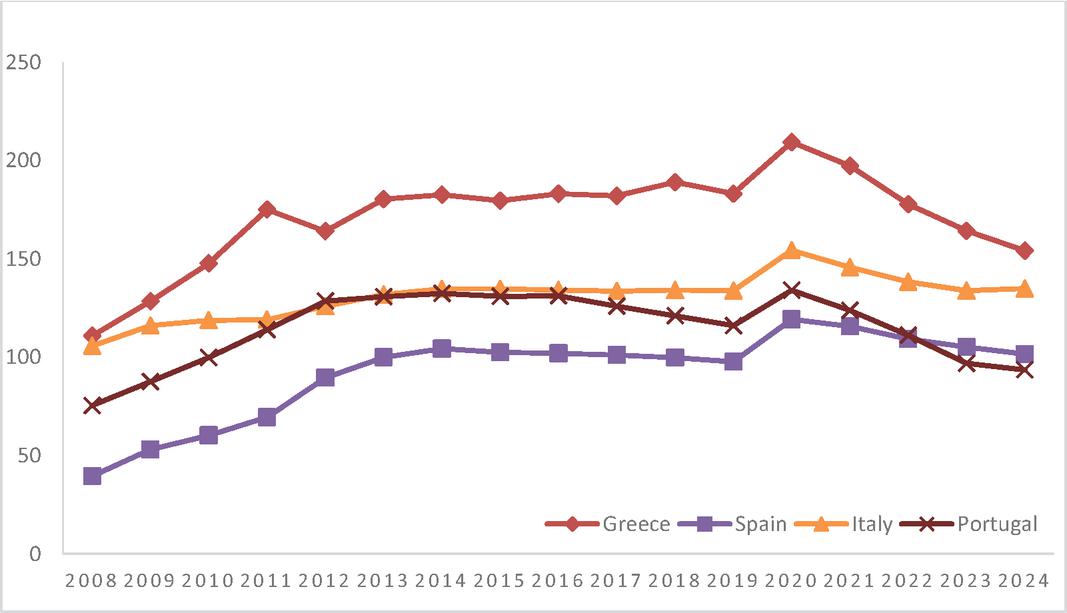
Figure 1 Evolution of general government gross debt as a percentage of GDP in selected Mediterranean EU economies 2008–2024.
Source: Author’s own elaboration based on publicly available data.
In Greece, the public debt-to-GDP ratio reached 166.5% in 2023 (Boumparis et al., 2017), while the share of manufacturing in GDP was 8.7% (Bertsatos and Chrysanthakopoulos, 2025). The economy exhibits a pronounced shift toward the tertiary sector (Markaki and Papadakis, 2023), with tourism (Prokopiou et al., 2019), directly (Rontos et al., 2017) and indirectly (Vardopoulos et al., 2023), accounting for more than 25% of GDP (Hackl and Hatzimarinakis, 2023). In Italy’s case, the debt-toGDP ratio amounted to 142.4% (Musiałkiewicz and Tomaszewski, 2024), while manufacturing accounted for 15.3% of GDP. Italy’s manufacturing output is estimated at USD 353 billion, making it significantly stronger than France’s in manufacturing terms (Hilmola et al., 2025).
Spain reports a debt-to-GDP ratio of approximately 111%, with manufacturing accounting for about 10.9% of GDP (García-Moral and Laporta-Corbera, 2024). The tourism sector occupies an almost equivalent position, with a contribution to GDP of roughly 14.5%, exceeding manufacturing (Melgosa Arcos, 2020). Portugal has a debt-to-GDP ratio of approximately 110%, with manufacturing accounting for 11.8% of GDP (Shibata, 2023). Here too, the economy remains significantly dependent on tourism and other services, despite a strengthening export orientation in recent years (Varum et al., 2016).
These numbers indicate a structural deficit in industrial development between the economies of the South and the broader European area (Ederer and Reschenhofer, 2018; Petrović and Gligorić Matić, 2023; Tsangaris et al., 2024) (Figure 2). While the average share of manufacturing in GDP across EU member states stands at 13.6% (2023), Mediterranean economies operate at levels markedly below this threshold (Accetturo et al., 2024; Ederer and Reschenhofer, 2018).
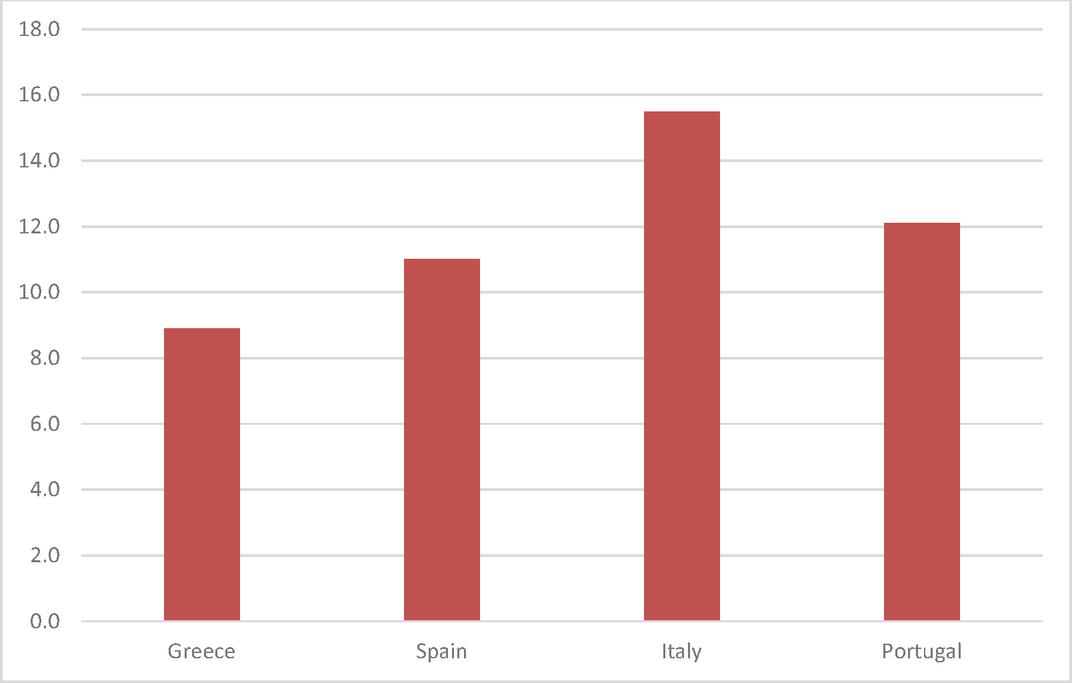
Figure 2 Manufacturing value added as a percentage of GDP in Greece, Italy, Spain, and Portugal, 2023.
Source: Author’s own elaboration based on publicly available data.
Hence, the analysis of the current study focuses on a comparative presentation of four representative cases, Greece, Italy, Spain, and Portugal, in order to highlight the causal mechanisms and consequences of this lag and to establish the necessity of a new strategic framework for productive transition.
2 Methodology
This study employs a comparative and longitudinal macroeconomic research design grounded in structural and interpretative political economy analysis. Its primary objective is to examine the relationship between public debt, productive structure, and external vulnerability in four Southern European member states of the euro area, Greece, Italy, Spain, and Portugal, within the institutional constraints of the Economic and Monetary Union. The methodological approach is structural-analytical, aiming to identify patterns of divergence, institutional asymmetries, and long-term transformations in the productive models of these economies. More specifically, the study applies a descriptive and diachronic macroeconomic analysis covering primarily the period from the introduction of the euro to 2023, while incorporating selective historical references to earlier decades where necessary in order to contextualize processes of de-industrialization and structural change. The comparative dimension of the research allows for the identification of both common characteristics and internal differentiation within the Mediterranean. Greece is the most representative case of deindustrialization combined with high public debt and heavy reliance on tourism. Italy constitutes a contrasting case of strong industrial capacity under high debt conditions. Spain and Portugal combine moderate manufacturing shares with increasing servicesector dependence. The selection of these four cases is therefore purposive, considering that they share a common monetary regime and exposure to the sovereign debt crisis, all while displaying meaningful variations(s) in industrial structure, which permits (the herewith) analytical comparison.
Empirical analysis is based on a set of structural macroeconomic indicators that capture fiscal sustainability, productive capacity, and external balance. These include the public debt-to-GDP ratio, manufacturing value added as a share of GDP, tourism’s direct and total contribution to GDP, trade and current account balances, manufacturing output in absolute terms, GDP per capita levels, and industrial employment trends. The combined use of these indicators enables an assessment of the structural composition of growth and the degree of external vulnerability associated with each national model. The study herewith attempts to interpret how differences in industrial capacity shape economic resilience within a monetary union lacking exchange-rate adjustment mechanisms.
The data utilized derive from internationally recognized publicly available statistical sources, primarily Eurostat, the World Bank (World Development Indicators), OECD Statistics, the IMF World Economic Outlook, and UNCTAD, complemented (where necessary) by national statistical authorities (ELSTAT, ISTAT), and secondary academic literature. By integrating quantitative macroeconomic evidence with institutional interpretation, the methodology situates empirical findings within the broader structural divide between the industrial core of Northern Europe and the service-oriented economies of the Mediterranean. In this sense, the research can be characterized as a structural-comparative macroeconomic analysis embedded in a political economy framework, aimed at diagnosing systemic imbalances rather than estimating short-run causal effects.
3 The Case of Greece: Debt without an Industrial Base
The Greek economy constitutes a characteristic case of pronounced deindustrialization combined with persistently high public debt (Frangakis, 2015). According to the most recently available data, public debt in 2023 stood at approximately 166% of GDP, the highest ratio within the European Union (Daniel and Nam, 2022; Vigny, 2022). At the same time, manufacturing accounts for less than 9% of overall economic activity, placing Greece among the lowest-ranked EU member states in terms of the contribution of industrial production (Chalikias, 2017; Kyriakopoulos and Petropoulos, 2025). Economic activity is clearly oriented toward the tertiary sector, with tourism and related services contributing more than 25% of GDP (Soklis et al., 2025; Spinthiropoulos et al., 2020).
From a historical perspective, the decline of Greek industry is particularly evident after the country’s accession to the European Community in 1981 (Giannitsis, 1993). During the 1980s and 1990s, numerous manufacturing firms ceased operations, resulting in the loss of approximately 160,000 jobs in the sector (Kyrkilis and Simeon, 2015; Petrakos et al., 2012). This dislocation was not the outcome of isolated factors, rather, it emerged from the interaction of external pressures, such as exposure to global competition and the influx of low-cost imported products, with domestic structural weaknesses and deficiencies in investment strategy (Bitros, 2013; Vettas et al., 2020). The choice to rely on extensive fiscal expansion and public borrowing as the primary instrument for financing public expenditure led to the accumulation of debt without a commensurate strengthening of the economy’s productive base (Economides et al., 2025; Pegkas, 2018).
The consequences of this prolonged weakening of productive capacity became especially visible during the sovereign debt crisis of the 2010s (Maravegias et al., 2025). With limited exports of manufactured goods and chronic current account deficits, the Greek economy became particularly vulnerable to external shocks (Gaki et al., 2025). The imposition of fiscal constraints and the implementation of adjustment programs led to a drastic reduction in industrial employment of approximately 42% over 2008–2014 (Carrasco et al., 2017), representing the largest relative decline at the European level. Despite partial consolidation of fiscal aggregates, the recovery remained weak, with GDP per capita in 2023 still roughly 28% below its 2008 level (Theodoropoulou, 2022). Based on publicly available official data, Greece ranks second-lowest among EU member states in per capita income, ahead only of Bulgaria, despite lacking a comparable history of economic exclusion to that experienced by former Eastern European countries.
Tourism, while having contributed substantially to short-term growth dynamics, raises significant concerns regarding the sustainability of the development model (Buhalis, 1999; Polyzos et al., 2013). Tourism revenues reached historic highs in 2024, exceeding € 21.7 billion (Vandarakis et al., 2023). Nevertheless, excessive reliance on low-technology activities (Deirmentzoglou et al., 2025), and limited productive linkages (Rodousakis and Soklis, 2024), may constrain long-run growth potential. Moreover, one-dimensional dependence on services is associated with lower productivity, seasonality, and high vulnerability to external shocks, as demonstrated during the COVID-19 pandemic (Mariolis et al., 2021; Pnevmatikos et al., 2024). The absence of a reconstructed and diversified productive base leaves the Greek economy exposed to future shocks and dependent on external financing or fiscal support (Makantasi and Valentis, 2024; Vardopoulos et al., 2025).
4 The Case of Italy: Industrial Strength under High Debt
Italy represents a contrasting case relative to Greece, combining high public debt approximately 142% of GDP for 2023, with a strong and diversified industrial base (Ciaschini and Salvati, 2026). Manufacturing accounts for approximately 15% of GDP, one of the highest shares in Western Europe (Salvati, 2025). In 2024, Italy produced manufactured goods valued at roughly USD 353 billion, making it Europe’s second-largest manufacturing economy after Germany (Muolo et al., 2026).
Italy’s industrial structure is characterized by a large number of small- and medium-sized enterprises, often family-owned, specializing in high-quality products with an export orientation. The industrial districts of Northern Italy (e.g., Lombardy, Emilia-Romagna) constitute dynamic production systems characterized by strong sectoral and spatial specialization, contributing to the resilience of the sector (Mariotti et al., 2020). The relative self-sufficiency in components and intermediate goods strengthens the country’s ability to maintain a comparatively balanced trade position, even during periods of international turbulence (Džajić Uršič and Jelen, 2022).
Despite these advantages, Italy faces significant macroeconomic challenges (Bull, 2018). Growth has remained persistently weak over a prolonged period, while the increase in GDP per capita since 1990 has remained below 20% (Angelone et al., 2025), the lowest among EU member states. Low productivity growth (Bugamelli et al., 2018), demographic ageing (Salvati, 2020), and slow progress in structural reforms (Mocetti et al., 2020), weigh on medium-term prospects. At the same time, Italian industry faces mounting pressures from high energy costs and intensified international competition (Giglioli and Giordano, 2024). The relative decline of manufacturing, from 17% of GDP in 2000 to about 15% in 2023, has been accompanied by the relocation of production units abroad and by acquisitions by international capital, developments that partly dilute national productive sovereignty.
The Italian case demonstrates that a strong manufacturing sector enhances economic resilience but is not in itself sufficient to secure a sustainable growth trajectory. The effective use of EU resources through the NextGenerationEU plan, amounting to more than € 190 billion, may strengthen efforts toward digital and green transformation and help counteract long-term stagnation.
5 Spain and Portugal: High Debt, Moderate Industrial Bases
Spain and Portugal exhibit substantial qualitative similarities despite differences in size and scale (Salvati, 2014). Both economies experienced a significant rise in public debt following the global financial crisis, with debt ratios reaching approximately 111% and 110% of GDP, respectively (Matthes, 2018). Manufacturing accounts for approximately 11–12% of GDP in the two countries, shares that, although higher than Greece’s, remain below those of the Northern European core economies (Panousis and Koukouritakis, 2020).
Spain developed notable industrial activity during its post-war industrialization, particularly during the so-called ”Spanish Miracle” of the 1960s-1970s (Tortella Casares, 2000). From the late twentieth century onward, however, a shift toward services became evident. In the twenty-first century, rapid growth in construction and the expansion of the tourism industry supported overall economic activity prior to the 2008 crisis (Somoza-Medina and Monteserín-Abella, 2021; Tapiador, 2020). Manufacturing, and the automotive sector in particular, remained significant, but after 2008 it contracted due to the recession and internal devaluation (Albors-Garrigos and Collado, 2019). Following 2015, the Spanish economy experienced a strong recovery, with tourism again serving as a key driver of growth (Cuadrado-Ciuraneta et al., 2017). In 2023, the direct and indirect contribution of tourism to GDP exceeded 14.5%, surpassing manufacturing for the first time (PerlesRibes et al., 2017). Despite its short-term positive effects, a one-sided dependence on tourism generates macroeconomic asymmetries and environmental pressures (SoyuYildirim et al., 2025). Spain, therefore, looks to EU funds to support investments in areas such as electromobility (Bravo et al., 2024; Cansino et al., 2018) and renewable energy (Labriet et al., 2010; Ma et al., 2025), aiming to reorient its productive base.
Portugal, smaller in scale but similarly vulnerable, followed a comparable trajectory. Following entry into the Economic and Monetary Union, the share of manufacturing in GDP declined, although certain export-oriented sectors (textiles, footwear, metallurgy) retained outward-oriented dynamism (Blanchard, 2007). Since 2015, Portugal has experienced export growth and attracted investment in sectors such as the automotive industry and digital innovation (Adamczyk and Westmore, 2020). Nonetheless, constraints persist due to small firm size, limited access to finance, and high energy costs (Ferraz, 2022). Public debt remains elevated, and overall productivity lags behind the EU average (Silva, 2020). Despite these challenges, Portugal benefits from European resources, primarily to finance investment in green technologies (such as hydrogen; Bianchini et al., 2023) and digital infrastructure (Gonçalves et al., 2022), which creates prospects for a more diversified development model.
6 The Necessity of an Industrial Renaissance in the Mediterranean
The absence of a robust productive base in the economies of the European South constitutes one of the most critical structural deficits undermining the cohesion and sustainability of the European Union as a whole (Bąk et al., 2022; Georgescu and Herman, 2019). In contrast to Northern core member states such as Germany and Ireland, where industrial activity represents shares on the order of 18% to as high as 29% of GDP, Mediterranean economies exhibit significantly lower manufacturing participation in total output (Rial et al., 2025; Sateriano, 2024). This divergence produces persistent trade imbalances, i.e., surplus economies with strong manufacturing sectors record positive balances across most branches, while Greece, Spain, and Portugal run deficits in the majority of production categories (Rial et al., 2025). These needs are met primarily through imports financed either by service revenues (such as tourism) or by external borrowing.
Such a structure cannot be sustained indefinitely within a single monetary framework. In the euro area, member states lack the instrument of nominal currency devaluation to regain competitiveness (Blanchard, 2007). “Internal devaluation” policies implemented in the South during the crisis, through wage compression and fiscal austerity, did lead to temporary improvements in external balances, but they were accompanied by high social and economic costs and produced only marginal gains in structural competitiveness (Villanueva et al., 2020). The persistence of productivity and technological specialization gaps between North and South renders balanced competitive convergence within the Union unattainable (Hoyos, 2025). Maintaining this configuration leads to the recycling of surpluses in the North and to the South’s dependence on transfers, subsidies, or renewed borrowing, an arrangement that is economically and institutionally unsustainable (Wang et al., 2020).
Strengthening manufacturing is a structural pillar of sustainable development at the European level (Pieloch-Babiarz et al., 2021). Manufacturing accounts for more than two-thirds of the European Union’s goods exports and generates a substantial share of private expenditure on research and development (Carboni and Medda, 2020). Jobs in manufacturing are typically more stable and, on average, better paid than those in many other sectors (Tito et al., 2022). Moreover, each new manufacturing job generates positive externalities and complementary employment in related industries, both within the secondary and the tertiary sector (Harris and McCall, 2019; Tsangaris et al., 2026). Conversely, an excessive shift toward services such as hospitality, retail, and tourism often entails lower productivity, more limited innovation capacity, and a weaker contribution to technological upgrading (Romão and Nijkamp, 2019).
The weakening of industry risks structurally trapping the regions that abandon it. For the past 15 years, the economies of the European South have offered precisely such an example, notwithstanding efforts at fiscal consolidation and a nominal return to growth (Heimberger, 2025), expansion remained subdued (Salvati et al., 2013), unemployment persisted at high levels (Salvati, 2020), and dependency on external conditions intensified (Salvati and Vardopoulos, 2024). In this light, the industrial reconstruction of the Mediterranean is not merely a regional development option, it is, rather, a necessary condition for establishing a more balanced, competitive, and resilient European Union.
7 Preconditions and Strategies for an Industrial Renaissance
Debates on the industrial renaissance of Mediterranean economies often focus on the availability of financial resources and the utilization of EU support mechanisms (Rial et al., 2025). Such an approach, however, is insufficient, as it overlooks the deeper institutional and macroeconomic constraints that shape the functioning of Southern European economies (Hurtado Ocaña et al., 2025). Funding, however sizeable in absolute terms, cannot by itself reconstruct the productive base unless accompanied by a radical rethinking of the framework within which monetary and fiscal policy is exercised (Boix-Domènech et al., 2025).
The experience of recent decades shows that the industrial weakening of the South is not merely the product of domestic shortcomings or institutional pathologies (Gambarotto et al., 2019). It is closely linked to the structure and operation of the Economic and Monetary Union (Gambarotto and Solari, 2015). The absence of a national monetary policy, combined with strict fiscal constraints and asymmetric adjustment rules, has severely limited Southern member states’ ability to pursue active industrial policy (Bassi and Durand, 2018). Without close and direct coordination between monetary and fiscal policy at the European level, investments financed through EU mechanisms risk remaining fragmented and failing to generate lasting changes in the structure of production (Saraiva et al., 2026).
It is also critical to emphasize that these policies are not technical or neutral choices; they are the outcome of political decisions and power relations (Tarlea et al., 2024). The institutional framework of the European Union is not exogenous or immutable; it is shaped primarily by member states, particularly those holding dominant economic and political positions (Schmidt, 2019). In this context, Southern economies are not merely “underdeveloped,” they are embedded in a relationship of structural dependence on the Northern core (Lopes, 2016). This dependence is most clearly visible in external balances. The persistent surpluses of Northern European economies are the necessary counterpart of Southern deficits. Put differently, the income of the North constitutes the expenditure of the South, hence the industrial superiority and export dynamism of the former are sustained by the demand and financial adjustment of the latter (Nomaler et al., 2024). Southern economies do not follow an autonomous development path but, rather, they are synchronized, often under adverse conditions, with the pace and requirements of the core economies (Raffer, 2022).
It is under these conditions that the European architecture emerges as inherently unstable and unequal (Jones et al., 2016). The absence of meaningful redistribution mechanisms, the lack of a permanent common fiscal capacity, and the onedimensional emphasis on monetary stability have resulted in the systematic reproduction of regional inequalities (Schreurs, 2025). The industrial renaissance of the European South, therefore, cannot be achieved within the existing framework without deep institutional reforms. Through this lens, debates on productive reconstruction must shift from the technocratic management of financial instruments to political contestation over the redesign of the European Union. Through a radical revision of monetary and fiscal architecture, the strengthening of collective economic sovereignty, and the explicit recognition of the structural North-South dependency can the foundations be laid for a sustainable and substantive industrial renaissance in the Mediterranean.
8 The Common Agricultural Policy and Structural Imbalances in the Mediterranean
Any discussion of productive reconstruction in Southern Europe would remain incomplete without reference to the Common Agricultural Policy, one of the oldest and most financially significant pillars of European integration (Doukas et al., 2023). For Mediterranean member states, agriculture has historically constituted a crucial component of productive activity, employment, regional cohesion, and export orientation (Maravegias and Doukas, 2011). Yet the design and evolution of the Common Agricultural Policy have had complex and often asymmetric effects across member states, contributing indirectly to the broader structural imbalances examined in this study (Chrysomallidis and Doukas, 2024).
From its inception, the Common Agricultural Policy was structured around the agricultural patterns of the core Western European economies, particularly France and Germany, where large-scale, high-productivity farming predominated (Doukas and Petides, 2021). By contrast, Mediterranean agriculture has traditionally been characterized by small and fragmented holdings, labor-intensive production, and specialization in products such as olive oil, wine, fruits, and vegetables (Vardopoulos et al., 2018). Although successive reforms introduced greater flexibility and rural development components, the distribution of subsidies has largely favored scale, capital intensity, and historical production levels (Maravegias et al., 2024). As a result, Southern European countries often receive support that stabilizes farm incomes but does not necessarily promote structural upgrading, technological innovation, or integration with domestic manufacturing chains (Doukas, 2019).
The interaction between the Common Agricultural Policy and industrial development is particularly relevant. In several Mediterranean economies, agricultural production has remained weakly connected to domestic agro-industrial processing (Doukas et al., 2022). Instead of fostering vertically integrated value chains capable of generating higher value added, export competitiveness, and technological diffusion, the prevailing model has often reinforced primary production with limited industrial transformation (Postigliola et al., 2025). This pattern contributes to a structural segmentation in which agriculture, tourism, and low-technology services coexist without generating strong productive multipliers (Doukas, Vardopoulos, et al., 2024).
Moreover, the Common Agricultural Policy has functioned, in part, as a compensatory transfer mechanism within the European budget. While such transfers have provided income stability and political cohesion, they have also, arguably, reduced incentives for deeper productive restructuring (Maravegias et al., 2023). In countries such as Greece, Spain, and Portugal, agricultural subsidies have mitigated social pressures in rural areas but have not fundamentally altered the productive hierarchy within the European division of labor (Maravegias et al., 2025). In this sense, the Common Agricultural Policy has played a dual role, meaning that it has supported income convergence while leaving structural divergence largely intact (Doukas, Maravegias, et al., 2024).
In the broader context of the Economic and Monetary Union, this dynamic acquires additional significance. Without autonomous monetary instruments and under fiscal constraints, Mediterranean economies rely heavily on European transfers, including Common Agricultural Policy funds, to sustain rural regions (Maravegias and Doukas, 2012). However, such transfers do not substitute for industrial policy, nor do they correct trade asymmetries stemming from differences in manufacturing capacity. Agricultural policy, therefore, cannot be viewed in isolation from the industrial question, as it is embedded in the same structural architecture that shapes North-South economic relations within the Union (Doukas and Maravegias, 2021).
If the Mediterranean is to undergo a genuine productive renaissance, agricultural policy must be reconsidered as part of a broader strategy of structural transformation (Maravegias et al., 2024). This would imply shifting emphasis from income support alone toward investment in agro-industrial integration, technological upgrading, energy transition in primary production, and stronger linkages between agriculture, manufacturing, and research systems (Doukas et al., 2026). Only through such integration can agriculture contribute not merely to income stabilization but also to a diversified and resilient productive model (Doukas, Salvati, et al., 2025).
Overall, the Common Agricultural Policy illustrates how European integration has combined redistribution with structural asymmetry. Addressing the industrial lag of the South requires not only rethinking monetary and fiscal governance, as argued earlier, but also reassessing sectoral policies such as agriculture that shape the longterm configuration of production (Doukas et al., 2023). Without integrating agricultural restructuring into the broader agenda of industrial renewal, the Mediterranean transformation will remain partial and incomplete.
9 Conclusion
Through the analysis undertaken herein, the current study argues that the structural weakness of the industrial base in the Mediterranean economies constitutes a systemic vulnerability not only for the countries concerned but also for the European Union as a whole (Postigliola and Salvati, 2023). The coexistence of high public debt with limited manufacturing capacity is not a temporary imbalance as it reflects a deeper structural asymmetry embedded in the architecture of the Economic and Monetary Union (Simoniello et al., 2024).
The comparative examination of Greece, Italy, Spain, and Portugal demonstrates that industrial capacity is a decisive determinant of economic resilience (Di Feliciantonio et al., 2018). Greece illustrates the risks of extensive deindustrialization combined with heavy dependence on tourism and services, resulting in persistent external deficits, low productivity growth, and structural fragility. Italy, despite facing similarly high public debt, benefits from a diversified and exportoriented manufacturing base that mitigates external vulnerability and stabilizes its macroeconomic position. Spain and Portugal occupy an intermediate position, showing partial industrial capacity but increasing exposure to service-sector dependence and tourism-driven growth.
Within a monetary union that lacks exchange-rate flexibility, structural divergence cannot be corrected through conventional adjustment mechanisms. The experience of internal devaluation has revealed its social costs and its limited effectiveness in restoring long-term competitiveness. As long as the productive gap between the industrial core of Northern Europe and the Mediterranean South persists, trade imbalances, capital flow asymmetries, and political tensions will continue to reproduce themselves (Vardopoulos et al., 2024b).
The discussion of the Common Agricultural Policy further reinforces this argument as the policy has functioned as an important mechanism of income support and territorial cohesion in Southern Europe, it has not fundamentally altered the structural hierarchy within the European division of labor (Coluzzi et al., 2025). In many Mediterranean economies, agricultural policy has stabilized primary production without sufficiently promoting agro-industrial integration, technological upgrading, or stronger linkages with domestic manufacturing systems. As a result, redistribution has partially mitigated social pressures but has not resolved the deeper productive asymmetries between North and South (Salvia et al., 2025).
An industrial renaissance in the European South is therefore not a sectoral policy option but a strategic necessity for the sustainability of the euro area (Mavrakis et al., 2015). Manufacturing remains central to productivity growth, technological upgrading, export performance, and stable employment creation (Duvernoy et al., 2018). At the same time, agricultural policy must be reoriented from predominantly income-based support toward integration with industrial value chains and innovation systems (Salvia et al., 2022). Economies structurally specialized in low-technology services and weakly industrialized primary sectors cannot generate the innovation dynamics required for sustained convergence within a highly competitive global environment (Egidi et al., 2020).
Industrial reconstruction cannot be achieved through financial transfers or temporary recovery instruments alone. It requires a reconfiguration of the European macroeconomic framework, including stronger coordination between monetary and fiscal policy, the establishment of a meaningful common fiscal capacity, a strategic rethinking of sectoral policies such as the Common Agricultural Policy, and explicit recognition of the structural interdependence between surplus and deficit economies (Rontos et al., 2019). Without such institutional reforms, Southern economies will remain locked into a subordinate position within the European division of labor.
In this light, the transformation of the Mediterranean into a dynamic industrial region, supported by coherent industrial, agricultural, fiscal, and monetary coordination, is not a peripheral development agenda but a prerequisite for restoring balance, cohesion, and long-term sustainability to the European project itself.
References
Accetturo, A., Albanese, G., De Paola, M., and Torrini, R. (2024). The North-South gap: Economic development and public intervention. Italian Economic Journal, 10(3), 957–975. https://doi.org/10.1007/s40797-024-00291-5
Adamczyk, P. and Westmore, B. (2020). Unpicking Portugal’s export performance: A microdata analysis. OECD Economics Department Working Papers, 1618. https://doi.org/10.1787/71df6aa3-en
Albors-Garrigos, J. and Collado, A. (2019). Success and threats in the clustering of the automotive industry in Spain: The role of public and private agents. Management: Journal of Sustainable Business and Management Solutions in Emerging Economies, 24(3), 1–20. https://doi.org/10.7595/management.fon.2019.0002
Angelone, P., Canale, R., and Ferreiro, J. (2025). Productivity, growth and labour market dynamics in Italy (1960-2023). Panoeconomicus, (00), 13–13. https://doi.org/10.2298/PAN240923013A
Ba̧k, I., Wawrzyniak, K., and Oesterreich, M. (2022). Competitiveness of the regions of the European Union in a sustainable knowledge-based economy. Sustainability, 14(7), 3788. https://doi.org/10.3390/su14073788
Bassi, F. and Durand, C. (2018). Crisis in the European Monetary Union: A core-periphery perspective. Economia Politica, 35(1), 251–256. https://doi.org/10.1007/s40888-018-0094-6
Bertsatos, G. and Chrysanthakopoulos, C. (2025). 4.4. GDP income approach: The case of Greece. Greek Economic Outlook, 57, 82–91.
Bianchini, S., Damioli, G., and Ghisetti, C. (2023). The environmental effects of the “twin” green and digital transition in European regions. Environmental and Resource Economics, 84(4), 877–918. https://doi.org/10.1007/s10640-022-00741-7
Bitros, G. C. (2013). From riches to rags or what went wrong in Greece. Journal of Economic and Social Measurement, 38(1), 5–39. https://doi.org/10.3233/JEM-130370
Blanchard, O. (2007). Adjustment within the Euro. The difficult case of Portugal. Portuguese Economic Journal, 6(1), 1–21. https://doi.org/10.1007/s10258-006-0015-4
Boix-Domènech, R., Sforzi, F., Galletto, V., and Capone, F. (2025). Born to innovate, not to produce: Three decades of compared change, evolution and innovation in the dynamic Marshallian Industrial Districts of Spain and Italy. European Planning Studies, 33(6), 899–916. https://doi.org/10.1080/09654313.2025.2525492
Boumparis, P., Milas, C., and Panagiotidis, T. (2017). On the Role of the Credit Rating Agencies in the Euro Zone Crisis. In T. Bournakis, I. Tsoukis, C. Christopoulos, D. Palivos (Eds.) Political Economy Perspectives on the Greek Crisis (pp. 177–203). Cham: Palgrave Macmillan. https://doi.org/10.1007/978-3-319-63706-8_8
Bravo, Y., Duarte, R., and Sarasa, C. (2024). Economic and environmental impacts of the shifts to electromobility in Spain: A multiregional input-output framework. Journal of Industrial Ecology, 28(6), 1743–1754. https://doi.org/10.1111/jiec.13565
Bugamelli, M., Lotti, F., Amici, M., Ciapanna, E., Colonna, F., D’Amuri, F., Giacomelli, S., Linarello, A., Manaresi, F., Palumbo, G., Scoccianti, F., and Sette, E. (2018). Productivity growth in Italy: A tale of a slow-motion change. SSRN Electronic Journal, 442. https://doi.org/10.2139/ssrn.3128850
Buhalis, D. (1999). Tourism on the Greek Islands: Issues of peripherality, competitiveness and development. International Journal of Tourism Research, 1(5), 341–358. https://doi.org/10.1002/(SICI)1522-1970(199909/10)1:5¡341::AID-JTR201¿3.0.CO;2-0
Bull, M. J. (2018). In the eye of the storm: The Italian economy and the Eurozone crisis. South European Society and Politics, 23(1), 13–28. https://doi.org/10.1080/13608746.2018.1433477
Cansino, J. M., Sánchez-Braza, A., and Sanz-Díaz, T. (2018). Policy instruments to promote electro-mobility in the EU28: A comprehensive review. Sustainability, 10(7), 2507. https://doi.org/10.3390/su10072507
Carboni, O. A. and Medda, G. (2020). Linkages between R&D, innovation, investment and export performance: Evidence from European manufacturing firms. Technology Analysis and Strategic Management, 32(12), 1379–1392. https://doi.org/10.1080/09537325.2020.1769841
Carrasco, I., Córcoles, C., and McCombie, J. (2017). The Economic Effects of the Implementation of the Greek Adjustment Plan in the Great Recession. In N. Schofield and G. Caballero (Eds.) State, Institutions and Democracy: Contributions of Political Economy (pp. 349–362). Cham: Springer. https://doi.org/10.1007/978-3-319-44582-3_15
Chalikias, J. (2017). The manufacturing sector of Greece before and during the financial crisis. International Journal of Economics and Business Administration, V(1), 3–17. https://doi.org/10.35808/ijeba/116
Chrysomallidis, C. and Doukas, Y. E. (2024). Building networks in the agri-food chain: EU as facilitator toward digital transformation and “greening” of agricultural sector. Journal of International Food & Agribusiness Marketing, 36(1), 47–67. https://doi.org/10.1080/08974438.2023.2281328
Ciaschini, C. and Salvati, L. (2026). Sustainable Development. Official Statistics and Thematic Indicators as a Compass to Understand Complexity. Cham: Springer. https://doi.org/10.1007/978-3-032-12559-0
Coluzzi, R., Sateriano, A., Salvati, L., Ciaschini, C., Rontos, K., Galella, M., and Lanfredi, M. (2025). Agriculture, Environment, and Sustainable Natural Resources: Approaching Land Classifications from the Perspective of Eco-Development. In C. Ciaschini and V. Imbrenda (Eds.) Local Development and Socio-Environmental Systems. Experiences and Practices Toward Sustainability in Mediterranean Europe (pp. 39–68). New York, NY: River Publishers. ISBN: 978877004 7609.
Cuadrado-Ciuraneta, S., Durà-Guimerà, A., and Salvati, L. (2017). Not only tourism: Unravelling suburbanization, second-home expansion and “rural” sprawl in Catalonia, Spain. Urban Geography, 38(1), 66–89. https://doi.org/10.1080/02723638.2015.1113806
Daniel, B. C. and Nam, J. (2022). The Greek debt crisis: Excusable vs. strategic default. Journal of International Economics, 138, 103632. https://doi.org/10.1016/j.jinteco.2022.103632
Deirmentzoglou, G. A., Anastasopoulou, E. E., and Vlassi, E. (2025). International economic relations and sustainable tourism: The case of Greece. International Conference on Tourism Research, 8(1), 73–80. https://doi.org/10.34190/ictr.8.1.3472
Di Feliciantonio, C., Salvati, L., Sarantakou, E., and Rontos, K. (2018). Class diversification, economic growth and urban sprawl: Evidences from a pre-crisis European city. Quality and Quantity, 52(4), 1501–1522. https://doi.org/10.1007/s11135-017-0532-5
Doukas, Y. E. (2019). The Common Agricultural Policy under the pressure of the new financial framework (2021-2027): Nationalization and adaptation. Region & Periphery, 8, 133–142. https://doi.org/10.12681/rp.21159
Doukas, Y. E. and Maravegias, N. (2021). European Agricultural Economics and Policy: Transformations and Adaptation Challenges. Athens: Kritiki. ISBN: 9789605863753.
Doukas, Y. E., Maravegias, N., and Chrysomallidis, C. (2022). Digitalization in the EU Agricultural Sector: Seeking a European Policy Response. In K. Mattas, G. Baourakis, C. Zopounidis, and C. Staboulis (Eds.) Food Policy Modelling. Responses to Current Issues (pp. 83–98). Cham: Cooperative Management, Springer Nature. ISBN: 9783031083167. https://doi.org/10.1007/978-3-031-08317-4_6
Doukas, Y. E., Maravegias, N., Ioannides, S., Salvati, L., and Vardopoulos, I. (2025). Economic Resilience and Sustainability in the European Union: A Comparative Analysis of Pre- and Post-Economic Crisis. In L. Salvati (Ed.) Environmental Sustainability and Global Change (pp. 257–273). Cambridge, MA: Elsevier. https://doi.org/10.1016/B978-0-443-31596-1.00018-0
Doukas, Y. E., Maravegias, N., Salvati, L., and Vardopoulos, I. (2024). Resilienza economica e sostenibilità: indicatori macroeconomici e dinamiche politiche pre- e post-crisi nell’Unione Europea. Documenti Geografici, 3, 491–525. https://doi.org/10.19246/docugeo2281-7549/202403_24
Doukas, Y. E., Maravegias, N., Zorpas, A. A., Sotiropoulos, A., and Vardopoulos, I. (2026). Integrating circular economy principles in the European farm-to-fork strategy for food waste prevention. Journal of Agribusiness in Developing and Emerging Economies, 1–24. https://doi.org/10.1108/JADEE-10-2025-0512
Doukas, Y. E. and Petides, P. (2021). The Common Agricultural Policy’s green architecture and the United Nation’s development goal for climate action: Policy change and adaptation. Region & Periphery, 11(11), 107–128. https://doi.org/10.12681/rp.27247
Doukas, Y. E., Salvati, L., and Petidis, P. (2025). Sustainability, Resilience, and Disparities in Regional Value Chains: Reframing Hegemonic Concepts from the ”Rural” Perspective of Greek Agro-Food Sector. In L. Salvati (Ed.) Environmental Sustainability and Global Change (pp. 275–289). Amsterdam: Elsevier. ISBN: 9780443315961. https://doi.org/10.1016/B978-0-443-31596-1.00019-2
Doukas, Y. E., Salvati, L., and Vardopoulos, I. (2023). Unraveling the European agricultural policy sustainable development trajectory. Land, 12(9), 1749. https://doi.org/10.3390/land12091749
Doukas, Y. E., Vardopoulos, I., and Petides, P. (2024). Challenging the Status Quo: A Critical Analysis of the Common Agricultural Policy’s Shift Towards Sustainability. In A. Ribeiro Hoffmann, P. Sandrin, and Y. E. Doukas (Eds.) Climate Change in Regional Perspective. European Union and Latin American Initiatives, Challenges, and Solutions. United Nations University Series on Regionalism, vol. 27 (pp. 115–134). Cham: Springer Nature. ISBN: 9783031493287. https://doi.org/10.1007/978-3-031-49329-4_8
Duvernoy, I., Zambon, I., Sateriano, A., and Salvati, L. (2018). Pictures from the other side of the fringe: Urban growth and peri-urban agriculture in a post-industrial city (Toulouse, France). Journal of Rural Studies, 57, 25–35. https://doi.org/10.1016/j.jrurstud.2017.10.007
Džajiæ Uršiè, E. and Jelen, I. (2022). From industrial district to industrial symbiosis: An opportunity. The case of the Ponte Rosso industrial area, Italy. Acta Geographica Slovenica, 62(3). https://doi.org/10.3986/AGS.10513
Economides, G., Koliousi, G., Miaouli, N., and Philippopoulos, A. (2025). From debt arithmetic to fiscal sustainability and fiscal rules: Taking stock and policy lessons. The Journal of Economic Asymmetries, 31, e00393. https://doi.org/10.1016/j.jeca.2024.e00393
Ederer, S. and Reschenhofer, P. (2018). Macroeconomic imbalances and structural change in the EMU. Structural Change and Economic Dynamics, 46, 59–69. https://doi.org/10.1016/j.strueco.2018.04.002
Egidi, G., Halbac-Cotoara-Zamfir, R., Cividino, S., Quaranta, G., Salvati, L., and Colantoni, A. (2020). Rural in town: Traditional agriculture, population trends, and long-term urban expansion in metropolitan Rome. Land, 9(2), 53. https://doi.org/10.3390/land9020053
Ferraz, R. (2022). The golden age of the world economy and Portuguese economic growth: Applied study, 1950–2018. Cogent Economics & Finance, 10(1). https://doi.org/10.1080/23322039.2022.2139915
Frangakis, M. (2015). Public debt crisis, austerity and deflation: The case of Greece. Review of Keynesian Economics, 3(3), 295–313. https://doi.org/10.4337/roke.2015.03.02
Gaki, E., Christofakis, M., and Gkouzos, A. (2025). Navigating turbulence to ensure sustainability: The role of economic sectors in shaping regional resilience in Greece amid the economic crisis and COVID-19. Sustainability, 17(5), 2127. https://doi.org/10.3390/su17052127
Gambarotto, F., Rangone, M., and Solari, S. (2019). Financialization and deindustrialization in the Southern European periphery. Athens Journal of Mediterranean Studies, 5(3), 151–172. https://doi.org/10.30958/ajms.5-3-2
Gambarotto, F. and Solari, S. (2015). The peripheralization of Southern European capitalism within the EMU. Review of International Political Economy, 22(4), 788–812. https://doi.org/10.1080/09692290.2014.955518
García-Moral, B. and Laporta-Corbera, M. I. (2024). Developments in Spanish public debt in 2023. Economic Bulletin (2024/Q3). https://doi.org/10.53479/36855
Georgescu, M.-A. and Herman, E. (2019). Productive employment for inclusive and sustainable development in European Union countries: A multivariate analysis. Sustainability, 11(6), 1771. https://doi.org/10.3390/su11061771
Giannitsis, T. (1993). The Greek Industry: Structure and Evolution. Krakow: Gutenberg.
Giglioli, S. and Giordano, C. (2024). Exploring the recent resilience of Italy’s goods exports: Competitiveness, energy intensity and supply bottlenecks. SSRN Electronic Journal, 785. https://doi.org/10.2139/ssrn.4848958
Gonçalves, A. R., Dorsch, L. L. P., and Figueiredo, M. (2022). Digital tourism: An alternative view on cultural intangible heritage and sustainability in Tavira, Portugal. Sustainability, 14(5), 2912. https://doi.org/10.3390/su14052912
Hackl, P. and Hatzimarinakis, S. (2023). Tourism GDP for 2010 to 2020: New TSA results for Greece. Statistical Journal of the IAOS, 39(1), 155–167. https://doi.org/10.3233/SJI-220081
Harris, K. and McCall, M. (2019). The relative weakness in earnings of production workers in manufacturing, 1990-2018. Monthly Labor Review. https://doi.org/10.21916/mlr.2019.27
Heimberger, P. (2025). Fiscal consolidation and its growth effects in euro area countries: Past, present and future outlook. Review of Evolutionary Political Economy, 6(3), 589–617. https://doi.org/10.1007/s43253-025-00146-4
Hilmola, O.-P., Li, H., Hilletofth, P., and Fjellström, D. (2025). Evaluation of EU-27 countries as manufacturing location: Strengths and weaknesses model. Operations Management Research, 18(3), 913–926. https://doi.org/10.1007/s12063-024-00539-4
Hoyos, M. (2025). North-South trade, technology diffusion, and uneven development. Economics of Innovation and New Technology, 34(4), 613–633. https://doi.org/10.1080/10438599.2024.2357791
Hurtado Ocaña, I., Fernández Sánchez, P., García-Centeno, M.-C., and Arroyo Fernández, M. J. (2025). Long and short-term economic convergence in southern Europe’s Mediterranean economies. Athens Journal of Mediterranean Studies, 11(3), 155–172. https://doi.org/10.30958/ajms.11-3-1
Jones, E., Kelemen, R. D., and Meunier, S. (2016). Failing forward? The euro crisis and the incomplete nature of European integration. Comparative Political Studies, 49(7), 1010–1034. https://doi.org/10.1177/0010414015617966
Kyriakopoulos, G. and Petropoulos, D. (2025). Contribution of European programs to development – competitiveness – innovation and generally to the economy for the region of Peloponnese over the last 20 years in the field of manufacturing. International Journal of Business and Economic Sciences and Applied Research, 18(1), 40–43. https://doi.org/10.25103/ijbesar.181.05
Kyrkilis, D. and Simeon, S. (2015). Greek Agriculture’s failure. The other face of a failed industrialization. From accession to EU to the debt crisis. Procedia Economics and Finance, 33, 64–77. https://doi.org/10.1016/S2212-5671(15)01 694-9
Labriet, M., Cabal, H., Lechón, Y., Giannakidis, G., and Kanudia, A. (2010). The implementation of the EU renewable directive in Spain. Strategies and challenges. Energy Policy, 38(5), 2272–2281. https://doi.org/10.1016/j.enpol.2009.12.015
Lopes, J. (2016). The euro area North-South structural economic divide: An input-output approach. Proceedings of the 23rd International Academic Conference, Venice. https://doi.org/10.20472/IAC.2016.023.061
Ma, S., Schaub, S., and Enguer, J. (2025). Regulatory and policy stability for renewable energy investment: An interdisciplinary analysis of the investment disputes against Spain. Review of European, Comparative & International Environmental Law, 34(2), 471–484. https://doi.org/10.1111/reel.12619
Makantasi, E. (Fay) and Valentis, H. (2024). Greece’s economic odyssey: Persistent challenges and pathways forward. Economies, 12(6), 139. https://doi.org/10.3390/economies12060139
Maravegias, N. and Doukas, Y. E. (2011). Traceability and the New CAP. In G. Baourakis, K. Mattas, C. Zopounidis, and G. van Dijk (Eds.) A Resilient European Food Industry in a Challenging World. (European Political, Economic, and Security Issues; Agriculture Issues and Policies). New York: Nova Science Publishers. https://doi.org/10.22004/ag.econ. 58089
Maravegias, N. and Doukas, Y. E. (2012). A strategy for rural development in Greece: The case of island areas. Region & Periphery, 1, 37. https://doi.org/10.12681/rp.16481
Maravegias, N., Doukas, Y. E., and Petides, P. (2023). The political economy of the Common Agricultural Policy’s green architecture. Sustainable Development, Culture, Traditions Journal, 1(B), 73–84. https://doi.org/10.26341/issn.2241-4010-2023-1b-6
Maravegias, N., Doukas, Y. E., and Petides, P. (2024). Climate Change Concerns and the Role of Research and Innovation in the Agricultural Sector: The European Union Context. In A. Ribeiro Hoffmann, P. Sandrin, and Y. E. Doukas (Eds.) Climate Change in Regional Perspective. European Union and Latin American Initiatives, Challenges, and Solutions. United Nations University Series on Regionalism, vol. 27 (pp. 135–151). Cham: Springer Nature. ISBN: 9783031493287. https://doi.org/10.1007/978-3-031-49329-4_9
Maravegias, N., Gourgiotis, A., Doukas, Y. E., and Vardopoulos, I. (2025). Lignes de faille de l’unité: ajustement économique et politiques spatiales de l’intégration européenne. Aeihoros: Textes d’aménagement Du Territoire, d’urbanisme et d’aménagement, 42, 49–70. https://doi.org/10.26253/heal.uth.ojs.aei.2025.2339
Mariolis, T., Rodousakis, N., and Soklis, G. (2021). The COVID-19 multiplier effects of tourism on the Greek economy. Tourism Economics, 27(8), 1848–1855. https://doi.org/10.1177/1354816620946547
Mariotti, I., Barzotto, M., Corò, G., and Saloriani, S. (2020). Industrial districts, urban areas or both? The location behaviour of foreign and domestic firms in an Italian manufacturing region. The Annals of Regional Science, 64(3), 523–546. https://doi.org/10.1007/s00168-020-00990-8
Markaki, M. and Papadakis, S. (2023). Greece Toward 2027: Structural Transformation, Industrial Policy, and Economic Development. In P. E. Petrakis (Ed.) Interconnections in the Greek Economy. The Political Economy of Greek Growth up to 2030 (pp. 31–57). Cham: Palgrave. https://doi.org/10.1007/978-3-031-31335-6_2
Matthes, J. (2018). Debt sustainability analyses for Italy, Spain and Portugal: Assessment and recommendations. Intereconomics, 53(1), 27–33. https://doi.org/10.1007/s10272-018-0715-x
Mavrakis, A., Papavasileiou, C., and Salvati, L. (2015). Towards (un)sustainable urban growth? Industrial development, land-use, soil depletion and climate aridity in a Greek agro-forest area. Journal of Arid Environments, 121, 1–6. https://doi.org/10.1016/j.jaridenv.2015.05.003
Melgosa Arcos, F. (2020). Turismo post COVID-19: El turismo después de la pandemia global. Análisis, perspectivas y vías de recuperación (F. J. Bauzá Martorell, Ed.). Ediciones Universidad de Salamanca. https://doi.org/10.14201/0AQ0296
Mocetti, S., Ciapanna, E., and Notarpietro, A. (2020). The effects of structural reforms: Evidence from Italy. SSRN Electronic Journal, 1303. https://doi.org/10.2139/ssrn.3746156
Muolo, A., Konaxis, I., and Salvati, L. (2026). Sustainable Urbanization and Local Development. Integrated Perspectives in Advanced Economies. Cham: Springer. https://doi.org/10.1007/978-981-95-6342-5
Musiałkiewicz, R. and Tomaszewski, P. (2024). The political function of public finance: The Poland example. AD ALTA: Journal of Interdisciplinary Research, 14(1), 145–148. https://doi.org/10.33543/j.1401.145148
Nomaler, Ö., Spinola, D., and Verspagen, B. (2024). Demand-led industrialisation policy in a dual-sector small open economy. Metroeconomica, 75(3), 339–376. https://doi.org/10.1111/meca.12457
Panousis, K. P. and Koukouritakis, M. (2020). Twin deficits: Evidence from Portugal, Italy, Spain and Greece. Intereconomics, 55(5), 332–338. https://doi.org/10.1007/s10272-020-0924-y
Pegkas, P. (2018). The effect of government debt and other determinants on economic growth: The Greek Experience. Economies, 6(1), 10. https://doi.org/10.3390/economies6010010
Perles-Ribes, J. F., Ramón-Rodríguez, A. B., Rubia, A., and Moreno-Izquierdo, L. (2017). Is the tourism-led growth hypothesis valid after the global economic and financial crisis? The case of Spain 1957-2014. Tourism Management, 61, 96–109. https://doi.org/10.1016/j.tourman.2017.01.003
Petrakos, G., Fotopoulos, G., and Kallioras, D. (2012). Peripherality and integration: Industrial growth and decline in the Greek regions. Environment and Planning C: Government and Policy, 30(2), 347–361. https://doi.org/10.1068/c10171r
Petrović, P. and Gligorić Matić, M. (2023). Manufacturing productivity in the EU: Why have Central and Eastern European countries converged and Southern EU countries have not? Structural Change and Economic Dynamics, 65, 166–183. https://doi.org/10.1016/j.strueco.2023.02.012
Pieloch-Babiarz, A., Misztal, A., and Kowalska, M. (2021). An impact of macroeconomic stabilization on the sustainable development of manufacturing enterprises: The case of Central and Eastern European countries. Environment, Development and Sustainability, 23(6), 8669–8698. https://doi.org/10.1007/s10668-020-00988-4
Pnevmatikos, T., Zouni, G., and Nasiou, P.-M. (2024). Effects of crises on the tourism sector: The case of Greece. Journal of Economics, Management and Trade, 30(9), 67–77. https://doi.org/10.9734/jemt/2024/v30i91242
Polyzos, S., Tsiotas, D., and Kantis, A. (2013). Determining the tourism developmental dynamics of the Greek regions, by using TALC Theory. Tourismos, 8(2), 159–178. https://doi.org/10.26215/tourismos.v8i2.362
Postigliola, M., Petrillo, C., Quaranta, G., Salvia, R., Doukas, Y. E., and Salvati, L. (2025). Spending for the Environment: The Long-Term Evolution of Italian Agriculture from a (Concise) Historical Perspective. In L. Salvati (Ed.) Environmental Sustainability and Global Change (pp. 95–105). Amsterdam: Elsevier. ISBN: 9780443315961. https://doi.org/10.1016/B978-0-443-31596-1.00008-8
Postigliola, M. and Salvati, L. (2023). There’s no time like the present: Path-dependent urban growth, agglomeration economies and congestion externalities in contemporary Athens. Urban History, 1–21. https://doi.org/10.1017/S096392682300041X
Prokopiou, D., Giannopoulos, K., Anagnostellos, K., Tselentis, B., and Mavridoglou, G. (2019). SWOT analysis of the tourist sector on Paros island, Greece. WIT Transactions on the Built Environment. 3rd International Conference on Coastal Cities and their Sustainable Future, 11–13 September 2019. Rome, Italy (pp. 165–176). https://doi.org/10.2495/CC19 0151
Raffer, K. (2022). Development, Underdevelopment, and the North-South Divide. In The Oxford Handbook of Economic Imperialism (pp. 195–212). Oxford: Oxford University Press. https://doi.org/10.1093/oxfordhb/9780197527085.013.8
Rial, A., Herrero, D., and Paternesi Meloni, W. (2025). Navigating competitiveness in Mediterranean countries: Drivers of manufacturing exports by technological intensity. International Economics, 183, 100625. https://doi.org/10.1016/j.inteco.2025.100625
Rodousakis, N. and Soklis, G. (2024). An “extended method” for measuring intersectoral linkages: The case of the Greek tourism sector. Structural Change and Economic Dynamics, 70, 594–606. https://doi.org/10.1016/j.strueco.2024.05.018
Romão, J. and Nijkamp, P. (2019). Impacts of innovation, productivity and specialization on tourism competitiveness – a spatial econometric analysis on European regions. Current Issues in Tourism, 22(10), 1150–1169. https://doi.org/10.1080/13683500.2017.1366434
Rontos, K., Salvati, L., Syrmali, M., Vavouras, I., and Karagkouni, E. (2017). Exploring tourism activity in countries and regions of Europe in the recent period of crisis. Current Politics and Economics of Europe, 28(1), 55–82.
Rontos, K., Syrmali, M.-E., and Salvati, L. (2019). The intrinsic link between social policy and development: An empirical study for Southern European countries. Autonomie Locali e Servizi Sociali, 3, 329–343. https://doi.org/10.1447/96697
Salvati, L. (2014). In-between Europe and the Mediterranean: Urban culture and the economic structure of the post-war “southern city.” Current Politics & Economics of Europe, 25(1), 39–63.
Salvati, L. (2019). Urban dispersion and economic crisis: Empirical evidence from a Mediterranean region. Journal of Environmental Planning and Management, 62(7), 1205–1226. https://doi.org/10.1080/09640568.2018.1489787
Salvati, L. (2020). Demographic dynamics, urban cycles and economic downturns: A long-term investigation of a metropolitan region in Europe, 1956-2016. Population Research and Policy Review, 39(3), 549–575. https://doi.org/10.1007/s11113-019-09550-1
Salvati, L. (2025). Economic Growth, Regional Disparities, and Urban Sprawl. The Mediterranean Experience. Cham: Springer. https://doi.org/10.1007/978-3-031-85799-7
Salvati, L., Morelli, V. G., Rontos, K., and Sabbi, A. (2013). Latent exurban development: City expansion along the rural-to-urban gradient in growing and declining regions of Southern Europe. Urban Geography, 34(3), 376–394. https://doi.org/10.1080/02723638.2013.778675
Salvati, L., Sateriano, A., and Grigoriadis, E. (2016). Crisis and the city: Profiling urban growth under economic expansion and stagnation. Letters in Spatial and Resource Sciences, 9(3), 329–342. https://doi.org/10.1007/s12076-015-0160-4
Salvati, L. and Vardopoulos, I. (2024). Intricacies of Mediterranean urban and regional dynamics. Euro-Mediterranean Journal for Environmental Integration, 9(1), 277–292. https://doi.org/10.1007/s41207-023-00434-7
Salvia, R., Colantoni, A., Bianchini, L., Egidi, G., Polinesi, G., Salvati, L., and Quaranta, G. (2022). “Old” territorial disparities and “New” spatial patterns: Unraveling the latent nexus between sustainable development and desertification risk in Italy. Economies, 10(2), 50. https://doi.org/10.3390/economies10020050
Salvia, R., Rossi, F., Stefanoni, A., Sateriano, A., Escrivà-Saneugenio, F., Quaranta, G., Scarpitta, D., and Salvati, L. (2025). Toward a “Mediterranean Model” of Rural Development? Land Degradation, Agricultural Intensification, Spatial Planning, and the Evolving Socio-Demographic Pressure in Italy. In L. Salvati (Ed.) Environmental Sustainability and Global Change (pp. 131–145). Amsterdam: Elsevier. https://doi.org/10.1016/B978-0-443-31596-1.00011-8
Saraiva, J., Gaspar, J. M., and Ikeda, K. (2026). On the disentanglement of an Economic Union. Journal of Regional Science, 66(1), 244–269. https://doi.org/10.1111/jors.70024
Sateriano, A. (2024). Urban Crisis: Social and Economic Implications for Southern Europe. Hauppauge, NY: Nova Science Publishers. ISBN: 9798891132429. https://doi.org/10.52305/TQJZ2310
Schmidt, V. A. (2019). Politicization in the EU: Between national politics and EU political dynamics. Journal of European Public Policy, 26(7), 1018–1036. https://doi.org/10.1080/13501763.2019.1619189
Schreurs, S. (2025). Introduction: The asymmetry of European integration – obstinate or obsolete? Journal of European Public Policy, 32(11), 2591–2594. https://doi.org/10.1080/13501763.2025.2510529
Shibata, I. (2023). Optimal fiscal path considerations. Selected Issues Papers, 2023(045), 1. https://doi.org/10.5089/9798400247231.018
Silva, J. (2020). Impact of public and private sector external debt on economic growth: The case of Portugal. Eurasian Economic Review, 10(4), 607–634. https://doi.org/10.1007/s40822-020-00153-2
Simoniello, T., Lanfredi, M., Coluzzi, R., D’Emilio, M., Salvati, L., Vardopoulos, I., Imbrenda, V., and Samela, C. (2024). Climate-Driven Dynamics in the Mediterranean Agri-Ecosystems and Land: A Pre-2007 Economic Crisis Satellite-Based Sustainability Analysis. In L. Salvati (Ed.) Environmental Sustainability and Global Change. Forests, Agriculture, and Soils vis à vis Human Disturbance. Amsterdam: Elsevier.
Soklis, G., Petrakos, G., and Panousi, S. (2025). The contribution of the hotel industry to the Greek economy. Tourism and Hospitality, 6(1), 11. https://doi.org/10.3390/tourhosp6010011
Somoza-Medina, X. and Monteserín-Abella, O. (2021). The sustainability of industrial heritage tourism far from the axes of economic development in Europe: Two case studies. Sustainability, 13(3), 1077. https://doi.org/10.3390/su1303 1077
Soyu-Yildirim, E., Dündar, Y., and Demirtaş, C. (2025). Causality relationship between economic policy uncertainty and tourism in Mediterranean countries: Evidence from dynamic symmetric and asymmetric bootstrap panel causality tests. European Journal of Tourism Research, 39, 3915. https://doi.org/10.54055/ejtr.v39i.3701
Spilioti, S. and Vamvoukas, G. (2015). The impact of government debt on economic growth: An empirical investigation of the Greek market. The Journal of Economic Asymmetries, 12(1), 34–40. https://doi.org/10.1016/j.jeca.2014.10.001
Spinthiropoulos, K., Nikas, C., and Zafeiriou, E. (2020). Sector Analysis and Economic Growth in Greece: The Domination of Tourism over Other Sectors. In C. Nikas (Ed.) Economic Growth in the European Union. Contributions to Economics (pp. 167–176). Cham: Springer. https://doi.org/10.1007/978-3-030-48210-7_12
Tapiador, F. J. (2020). Tourism: The Key Player. In The Geography of Spain. World Regional Geography Book Series (pp. 387–403). Cham: Springer. https://doi.org/10.1007/978-3-030-18907-5_23
Tarlea, S., Bailer, S., Kudrna, Z., and Wasserfallen, F. (2024). Executive power in European Union politics. Governance, 37(1), 161–178. https://doi.org/10.1111/gove.12761
Theodoropoulou, S. (2022). Recovery, resilience and growth regimes under overlapping EU conditionalities: The case of Greece. Comparative European Politics, 20(2), 201–219. https://doi.org/10.1057/s41295-022-00280-x
Tito, M. D., Bayard, K., Cajner, T., and Gregorich, V. (2022). Are manufacturing jobs still good jobs? An exploration of the manufacturing wage premium. Finance and Economics Discussion Series, 2022.0(10), 1–44. https://doi.org/10.17016/feds.2022.011
Tortella Casares, G. (2000). The Development of Modern Spain: An Economic History of the Nineteenth and Twentieth Centuries. Cambridge, MA: Harvard University Press.
Tsangaris, S., Michaelides, G. P., Salvati, L., and Vardopoulos, I. (2026). A non-linear input-output econometric model of intersectoral production for urban (and regional) economies. In Uneven Urban and Regional Growth. Amsterdam: Elsevier.
Tsangaris, S., Xepapadeas, A., Yannacopoulos, A. N., and Salvati, L. (2024). Spatial externalities, R&D spillovers, and endogenous technological change. Regional Science and Urban Economics, 109, 104055. https://doi.org/10.1016/j.regsciurbeco.2024.104055
Vandarakis, D., Malliouri, D., Petrakis, S., Kapsimalis, V., Moraitis, V., Hatiris, G.-A., and Panagiotopoulos, I. (2023). Carrying capacity and assessment of the tourism sector in the south Aegean region, Greece. Water, 15(14), 2616. https://doi.org/10.3390/w15142616
Vardopoulos, I., Escrivà Saneugenio, F., Sateriano, A., and Salvati, L. (2024a). Homage (and Criticism) to the Mediterranean City. Regional Sustainability and Economic Resilience. New York, NY: River Publishers. ISBN: 9788770041775. https://doi.org/10.1201/9781003517306
Vardopoulos, I., Escrivà Saneugenio, F., Sateriano, A., and Salvati, L. (2024b). Mediterranean Cities, Regional Sustainability, and Economic Resilience. In Homage (and Criticism) to the Mediterranean City. Regional Sustainability and Economic Resilience (pp. 1–26). New York, NY: River Publishers. ISBN: 9788770041775. https://doi.org/10.1201/9781003517306-1
Vardopoulos, I., Falireas, S., Konstantopoulos, I., Kaliora, E., and Theodoropoulou, E. (2018). Sustainability assessment of the agri-environmental practices in Greece. Indicators’ comparative study. International Journal of Agricultural Resources, Governance and Ecology, 14(4), 368. https://doi.org/10.1504/IJARGE.2018.10019355
Vardopoulos, I., Giannopoulos, K., Papaefthymiou, E., Temponera, E., Chatzithanasis, G., Goussia-Rizou, M., Karymbalis, E., Michalakelis, C., Tsartas, P., and Sdrali, D. (2023). Urban buildings sustainable adaptive reuse into tourism accommodation establishments: A SOAR analysis. Discover Sustainability, 4(1), 50. https://doi.org/10.1007/s43621-023-00166-2
Vardopoulos, I., Muolo, A., Konaxis, I., and Salvati, L. (2025). Dwelling size as a socio-spatial proxy. Planning-deficient urbanism, tourism-led gentrification, and macro-driven commodification in Athens. Habitat International, 166, 103614. https://doi.org/10.1016/j.habitatint.2025.103614
Varum, C., Madaleno, A., and Eusébio, C. (2016). Causal relationship between inbound tourism and exports of goods in Portugal: Evidence from cointegration and Granger causality tests. Global Business and Economics Review, 18(5), 567. https://doi.org/10.1504/GBER.2016.10000163
Vettas, N., Peppas, K., Stavraki, S., and Vasileiadis, M. (2020). The contribution of industry to the Greek economy: Facts and prospects. Economic Bulletin, 52, 29–67. https://doi.org/10.52903/econbull20205202
Vigny, L. (2022). The Greek sovereign crisis: A post-Keynesian synthesis. International Journal of Political Economy, 51(2), 151–169. https://doi.org/10.1080/08911916.2022.2086727
Villanueva, P., Cárdenas, L., Uxó, J., and Álvarez, I. (2020). The role of internal devaluation in correcting external deficits: The case of Spain. Structural Change and Economic Dynamics, 54, 282–296. https://doi.org/10.1016/j.strueco.2020.03.008
Wang, Y., Fan, R., Shen, L., and Miller, W. (2020). Recycling decisions of low-carbon e-commerce closed-loop supply chain under government subsidy mechanism and altruistic preference. Journal of Cleaner Production, 259, 120883. https://doi.org/10.1016/j.jclepro.2020.120883
Sustainability Research in the Mediterranean, 1(2), 73–88
DOI: 10.13052/srm2795-0514.006
© 2026 River Publishers