Startups and their Latent Tourism Potential in Post-Volume Mediterranean Economies
Konstantinos Giannopoulos and Paris Tsartas
Harokopio University of Athens, Athens, Greece
Corresponding Author: Konstantinos Giannopoulos; E-mail: kgiannopoulos@hua.gr
Received 18 June 2025, Accepted 06 August 2025; Published Online: 26 August 2026.
Sustainability Research in the Mediterranean, 1(3), 141–160. https://doi.org/10.13052/srm2795-0514.011
Abstract
Tourism-dependent Mediterranean economies face a structural dilemma. The volume-based growth that built their prosperity now reproduces seasonality, spatial concentration and stagnant value per visitor, while environmental and housing pressures accumulate in the most exposed destinations. This study asks whether startup ecosystems can operate as mechanisms of sustainable tourism value creation, combining a conceptual framework, an analytical reading of the Greek policy architecture anchored in the Elevate Greece registry and the Startup Visa, and exploratory evidence from a structured survey of 76 Greek startups. Categorical associations were assessed with and Fisher exact tests accompanied by Cramér’s V, ordinal relations with Spearman correlations and rank based comparisons, and an exploratory logistic model estimated the correlates of high perceived tourism applicability. Perceived applicability to tourism proved remarkably widespread, reaching 77.6% of ventures and extending well beyond firms declared in tourism related sectors, while access to finance, bureaucracy and marketing emerged as the dominant barriers and own capital dominated funding structures. The findings characterize the ecosystem as a broad reservoir of latent tourism relevance constrained by capital and coordination, and they position ecosystem policy as a complement to (destination) governance in Mediterranean sustainability transitions.
Keywords: Startup ecosystems, sustainable tourism, tourism value creation, entrepreneurship, innovation policy, Greece, Mediterranean..
1 Introduction
Mediterranean tourism confronts the consequences of its own success. In Greece, as across much of Southern Europe, decades of expansion built on rising arrivals delivered employment, foreign exchange and regional income, yet the same trajectory has concentrated visitors into a few months and a few places, strained housing, water and coastal infrastructure, and allowed the value generated per visitor to stagnate even as volumes reached historic highs (Sarantakou & Terkenli, 2019; Terkenli & Coccossis, 2024). Climate stress sharpens each of these pressures, and analyses of the wider basin situate them within a shared regional configuration of coastal urbanization, demographic rebalancing and economic fragility (Salvati & Vardopoulos, 2024). The policy question that follows is no longer how to attract more visitors but how to create more value, and more durable value, from the visitors who come (Astara et al., 2026).
Innovation driven entrepreneurship offers a candidate mechanism for that transition. The entrepreneurial ecosystem literature describes how talent, finance, knowledge, networks and institutions combine within a territory to enable productive new firms (Stam, 2015), and European policy has treated young innovative companies as instruments of structural renewal since the Start-up and Scale-up Initiative (European Commission, 2016). Startups matter for tourism not because they belong to the sector but because the sector consumes what they produce, from booking platforms and destination analytics to food certification, mobility services, heritage interpretation and environmental management. Where such ventures thrive, a tourism economy gains channels through which digital capability, experience design and sustainability-oriented services can raise the value of each visit rather than the number of visits (Buhalis, 2001; Hjalager, 2010).
The two literatures on which this argument rests rarely meet on empirical ground. Tourism innovation research has long observed that firms in the sector innovate mainly through adoption and has lamented the scarcity of firm level evidence outside metropolitan hospitality markets (Hjalager, 2010). Ecosystem research, meanwhile, has concentrated on technology clusters in large agglomerations and has paid little attention to economies in which tourism, culture and leisure constitute the dominant field of application for entrepreneurial activity (Audretsch et al., 2019; Stam, 2015). Tourism-dependent Mediterranean economies fall precisely into this blind spot, although they arguably have the most to gain from mechanisms that convert knowledge and entrepreneurial intention into higher value services.
This study addresses the gap through three connected moves. It first develops a conceptual framework that specifies the channels through which startup ecosystems can contribute to sustainable tourism value creation in tourism-dependent economies. It then reads the Greek policy architecture, anchored in the Elevate Greece registry, the Startup Visa and the surrounding fiscal instruments, through that framework rather than through the conventions of policy description. It finally reports exploratory evidence from a structured survey of 76 Greek startups, examining how widely founders perceive their offerings as applicable to tourism, culture and leisure, what constrains their development and how they judge the ecosystem around them. The analysis is deliberately supply side in scope, and it contributes to the emerging research agenda on sustainability in the Mediterranean (Passas, 2025). The argument proceeds from theory through institutional context to data, results and discussion, closing with implications for research, policy and practice.
2 Theoretical Background
2.1 From Volume to Value in Tourism-dependent Mediterranean Economies
The starting point is a development problem rather than a definition. Across the Mediterranean basin, tourism economies share a recognizable structure in which coastal settlement growth, pronounced seasonality and dependence on external demand coexist with demographic contraction and recurring macroeconomic stress (Salvati & Vardopoulos, 2024, 2025). Metropolitan evidence from Athens illustrates how these forces intersect, with population shrinkage entangled in socioeconomic restructuring (Vinci et al., 2023), declining central districts absorbing vulnerable migrant populations (Ciommi et al., 2022) and urban footprints expanding along the coast (D’Agata et al., 2023). Fringe areas across Southern Europe register the combined imprint of urban decline and economic crisis (D’Agata et al., 2024), and land degradation constrains the rural alternatives (Maialetti et al., 2024). Interdisciplinary collections treat these socioenvironmental dynamics as the shared context within which Mediterranean sustainability research now operates (Sateriano et al., 2024).
Tourism is woven through this configuration as both driver and dependent. Sociological work on the Greek islands documented early how mass tourism reshaped local economies and social structures (Tsartas, 1992), and later studies traced the policy dilemmas of insular and coastal development through successive European frameworks (Tsartas, 2003; Tsartas et al., 2014). The multipliers of the sector still propagate through intersectoral production linkages that regional models can quantify (Tsangaris et al., 2027), and long run evidence identifies tourism as a growth factor for Greece (Dritsakis, 2004). Yet recent syntheses read the Greek trajectory as a qualified success confronting saturation in its core products (Terkenli & Coccossis, 2024), climate effects propagate to the sector through multiple direct and indirect channels (Vardopoulos & Karytsas, 2019) and the expansion of accommodation outside institutional frameworks transforms places and communities in emblematic destinations (Sarantakou & Terkenli, 2019).
Against this background, sustainable tourism value creation acquires a precise meaning. The canonical formulation of sustainable development, meeting present needs without compromising future capacity (World Commission on Environment and Development, 1987), was contested from the outset for leaving open what is sustained and for whom (Lélé, 1991), and the measurement debate has established that output growth is a poor proxy for wellbeing (Easterlin & Angelescu, 2007; Stiglitz et al., 2009) and difficult to decouple from environmental impact (Ward et al., 2016). Human-centered indicator systems (Panagiotopoulos et al., 2024) and the internalization of environmental externalities (Kopsidas et al., 2026) express the same conviction in operational form. Applied to tourism, the resulting model asks destinations to meet visitor and host needs while protecting the resource base (Liu, 2003), to treat destinations as commons rather than as inexhaustible inputs (Briassoulis, 2002; Butler, 1991) and to pursue competitiveness through quality rather than against it (Streimikiene et al., 2021). Sustainable tourism value creation, in this reading, denotes the shift from revenue growth through volume toward income, employment and resource outcomes secured through higher value per visit, longer seasons, wider spatial diffusion and lower environmental intensity (Coccossis & Tsartas, 2019; Li et al., 2018).
Delivering that shift is an institutional task. Comparative assessments find persistent gaps between declared sustainability objectives and the instruments that European policy actually deploys (European Environment Agency, 2019), while Greek scholarship documents the disconnect between tourism development and spatial planning (Stamatiou, 2024), proposes geographical typologies for destination planning under contemporary pressures (Sarantakou, 2023) and identifies the determinants of resident support for sustainable tourism (Karytsas et al., 2019). Special interest and alternative forms of tourism hold a strategic position in this literature because they diversify products, extend seasons and spread demand across space (Coccossis et al., 2020; Tsartas et al., 2001), and community based and collaborative governance supplies the participatory foundation on which such diversification can rest (Dangi & Jamal, 2016; Jamal & Stronza, 2009). What the literature has specified far less clearly is where the new products, services and capabilities required by this agenda are supposed to come from. The present study locates one answer in the startup ecosystem.
2.2 Startup Ecosystems as Mechanisms of Value Creation
An entrepreneurial ecosystem denotes the set of interdependent actors and framework conditions, spanning talent, finance, knowledge, networks and institutions, whose coordination enables productive entrepreneurship within a territory (Stam, 2015). The concept shifts analytical attention from individual firms to the conditions under which many firms can form, survive and grow, and it has become the organizing frame for a generation of policy initiatives whose evaluation remains demanding because outcomes unfold over long horizons (Audretsch et al., 2019). Within the frame, finance holds a privileged position, since the depth and composition of small firm funding shape growth trajectories across economies and the escalator from seed to growth capital is precisely where young peripheral ecosystems tend to fail (Moroni et al., 2015; OECD, 2022).
The ventures that populate such ecosystems share traits that bear directly on tourism. The startup is conventionally understood as an organization searching for a repeatable and scalable business model (Blank, 2010) and as a company defined by its capacity for fast growth rather than by industry membership (Graham, 2012), a combination that produces novelty, dependence on external finance, elevated failure risk and an international outlook from inception (Cantamessa et al., 2018; Skawińska & Zalewski, 2020). Definitional boundaries remain unsettled, with studies grouping startups variously as early-stage companies, as new technology-based firms or as digital ventures (Szarek & Piecuch, 2018). For a tourism economy the salient point is not the label but the behavioral profile, since scalable service models, digital delivery and global orientation are exactly the attributes through which small firms can serve a large, dispersed and internationally sourced visitor market.
Recent research specifies the capabilities that such ventures deploy. Strategic ambidexterity and open innovation characterize small firms operating under volatility (Ragazou et al., 2022), digital transformation accelerated sharply among European small and medium sized enterprises after the pandemic (Petropoulou et al., 2024; Ragazou, Passas, & Sklavos, 2022) and business intelligence tools now reach decision making even in very small organizations (Ragazou et al., 2023). Human capital feeds the pipeline, with Greek evidence showing that entrepreneurial intention among higher education students responds to education, perceived support and crisis conditions (Ragazou et al., 2022), while green human resource management marks a research frontier for agile small firms (Papademetriou et al., 2023). Sustainability behavior itself has moved from the periphery to the mainstream of corporate legitimacy, as work on environmental, social and governance disclosure demonstrates (Karagiannopoulou et al., 2023; Zopounidis et al., 2020). An ecosystem that assembles these capabilities does not merely add firms to an economy. It changes what the economy is able to produce, which is the sense in which Schumpeter (1942) cast innovation as the engine of structural transformation and in which European strategy elevated it to a headline priority (European Commission, 2010).
Table 1. Conceptual dimensions linking startup ecosystems and sustainable tourism value creation
| Dimension | Ecosystem function | Channel of tourism value creation | Sustainability relevance | Indicative sources |
| Knowledge and talent | Universities, research spin-offs and skilled founders | Experience design, destination analytics and heritage interpretation | Human capital for quality upgrading | Audretsch et al. (2019), Ragazou et al. (2022) |
| Entrepreneurial agency | Search for repeatable models, strategic agility | New services, products and platforms across the travel value chain | Diversification beyond volume growth | Blank (2010), Ragazou et al. (2022) |
| Finance | Angel, venture and public funding escalator | Scale up of tourism platforms and operators | Patient capital directed to productive rather than asset uses | Moroni et al. (2015), OECD (2022) |
| Digital capability | Data infrastructures, platforms and artificial intelligence | Smart destination services and disintermediation | Efficiency combined with human centric service quality | Buhalis (2001), Vardopoulos, Giannopoulos, et al. (2024) |
| Policy and institutions | Registries, certification, fiscal and migration incentives | Visibility, legitimacy and market entry support | Conditionality can embed environmental and social criteria | Stam (2015), Elevate Greece (2025) |
| Demand articulation | Market signals from sustainability conscious visitors | Willingness to pay for certified, local and experience rich products | Alignment of value creation with conservation | Panagiotopoulos (2026), Karytsas et al. (2019) |
2.3 Channels of Ecosystem Contribution to Tourism Value
Tourism offers the ecosystem an unusually wide surface of application. The sector innovates predominantly through adoption and imitation rather than formal research, which means its capacity to renew itself depends on suppliers of innovation located largely outside its own boundaries (Hjalager, 2010). Information and communication technologies transformed distribution and consumption earlier in tourism than in most sectors, a transformation identified in the Greek context at an early stage (Buhalis, 2001), and the smart destination literature now traces an evolution from technology centric toward human centric configurations in which digital innovation serves livability, cultural value and sustainability rather than efficiency alone (Vardopoulos, Giannopoulos, et al., 2024). Culture led readings of urban tourism connect these configurations to the governance of touristified centers and to the global repositioning of urban property markets (Vardopoulos, Papoui-Evangelou, et al., 2023).
The channels are concrete rather than abstract. Documented Greek cases run from seaplane connectivity that addresses insular accessibility (Sitzimis et al., 2025) to analytics applied to hotel demand under crisis conditions (Vortelinos et al., 2025). Adaptive reuse of urban building stock converts idle assets into accommodation and cultural venues, as shown by assessments of reuse potential for tourism establishments (Vardopoulos, Giannopoulos, et al., 2023), integrated evaluations of landmark conversions (Vardopoulos et al., 2021) and studies of industrial buildings transformed into museums (Tsilika & Vardopoulos, 2022; Vardopoulos, 2022). Sustainability assessment practices link the operations of tourist accommodation to real estate value (Vardopoulos, Dimitriou, & Astara, 2024), circular economy monitoring gives operators tools for tracking material transitions (Papamichael et al., 2023) and waste governance in insular settings remains a weakness that innovation can address (Loizia et al., 2021). Service quality ultimately rests on people, and evidence on front office job satisfaction shows that labor conditions in customer facing roles feed directly into the visitor experience (Zaroulea & Kyriakogkonas, 2025). Emerging technologies extend the frontier, with artificial intelligence, blockchain and financial technology increasingly framed as instruments of environmental, social and governance compliance in urban and tourism governance (Petropoulou et al., 2026).
A final channel concerns the quality of the capital that tourism economies attract. Immigrant investor programs across the European Union exchange residence for capital under widely varying conditions (Džankić, 2018), and the European Commission has scrutinized their integrity risks (European Commission, 2019). Where such programs channel funds into residential property they interact with tourism led gentrification and housing commodification, as Athens demonstrates (Vardopoulos, Muolo, et al., 2025), whereas equity-oriented alternatives tie the same capital to employment creation and knowledge spillovers. Resilience research suggests that European economies with diversified productive structures absorbed successive crises better than asset inflated ones (Doukas et al., 2025), and agricultural and food policy displays a parallel movement toward circularity and away from extractive volume (Doukas et al., 2023, 2026). Table 2.2 draws these strands into a framework of six dimensions through which startup ecosystems can generate sustainable tourism value, pairing each ecosystem function with a channel of value creation and a sustainability rationale. The framework guides the reading of the Greek case in Section 3 and the interpretation of the survey evidence in Section 5.
3 The Greek Startup Ecosystem and its Policy Architecture
Greek tourism supplies both the motive for ecosystem policy and the market that makes it consequential. In 2023 the direct contribution of the sector reached €28.5 billion, or 13% of gross domestic product, with total effects including indirect and induced channels estimated at roughly 30% (INSETE, 2024). Tourism directly supported about 697,000 jobs, equal to 16.4% of employment, and total employment effects exceeded one-third of the national workforce (World Travel and Tourism Council, 2024). The same statistics expose the exhaustion of the volume model, since 69.6% of the 32.7 million international arrivals occurred between June and September, 67% of hotel beds remained concentrated in only four areas of the country and average expenditure stood at €603 per visitor against receipts of €19.7 billion (INSETE, 2024). Strategic analyses called for value-oriented repositioning more than two decades ago (Buhalis, 2001), and the long run growth contribution of the sector makes the quality of that repositioning a matter of national consequence (Dritsakis, 2004).
The organizational fabric of the ecosystem has thickened rapidly. Incubators provide early ventures with housing, administration, mentoring and legal and financial consultation, accelerators run programs of roughly six months oriented toward product completion and market entry, and a small community of angel investors and institutional funds supplies risk capital and advisory engagement (Cantamessa et al., 2018). Universities anchor the knowledge side through research centers, laboratories and spin-off support, a role whose importance grows with evidence that entrepreneurial intention among Greek students is malleable and responsive to educational context (Ragazou et al., 2022). By international standards the financing tier remains thin, far removed from the mature ecosystems in which hundreds of thousands of individual investors circulate capital and experience (Moroni et al., 2015), so the framework conditions that Stam (2015) enumerates are unevenly developed, strong on knowledge and improving on institutions while lagging on finance.
Elevate Greece, the official registry operated under the Ministry of Development, functions as the certification gateway of this system. Registration attests the innovative and scalable character of a venture, renders it visible to investors and establishes eligibility for the fiscal and migration incentives that surround the platform (Elevate Greece, 2025). The sectoral taxonomy of the registry reaches far beyond travel, spanning fields whose research frontiers are well documented, including agritech and food technology (Ragazou et al., 2022; Vardopoulos, Abeliotis, & Lasaridi, 2025), environment and energy (Vardopoulos & Vassiliades, 2025), maritime activity (Kyramargiou & Vardopoulos, 2019), environmental education (Moustairas et al., 2022), big data analytics (Salvucci et al., 2025), wellbeing oriented real estate (Cortesi et al., 2022) and cultural infrastructure through adaptive reuse (Tsilika & Vardopoulos, 2022). This breadth grounds the central empirical proposition of the study. Because tourism consumes services from nearly every one of these fields, ventures registered elsewhere in the taxonomy may hold substantial latent tourism applicability, and the extent of that latency is a measurable property of the ecosystem rather than a matter of assertion. Section 5 measures it.
Four instruments complete the architecture. A Startup Visa, effective from 1 January 2025, grants third country nationals a residence permit against an investment of at least €250,000 in a registered startup, conditional on the creation of at least two jobs within the first year, an ownership stake capped at 33% and employment retention over at least five years, with initial permits of one year renewable for successive two year periods and without access to dependent employment in the Greek labor market (Elevate Greece, 2025). Angel investors may deduct up to 50% of invested capital, with the ceiling raised from €300,000 to €900,000, research and development expenditure attracts deductions reaching 315% under conditions that favor knowledge intensive small firms, and a Patent Fund operated by the Hellenic Development Bank finances international patent acquisition and the development of minimum viable products (Elevate Greece, 2025). Read against Table 2.2, the architecture concentrates on certification, finance and investor attraction while leaving demand articulation and sustainability conditionality comparatively undeveloped, an imbalance to which the discussion returns.
The contrast with the Golden Visa gives the architecture its analytical interest. Asset based investment migration ties residence to property retention, imposes no employment requirement and channels capital predominantly into real estate (Džankić, 2018; European Commission, 2019). Greek evidence associates precisely this channel with housing commodification, tourism led gentrification and affordability pressure in central Athens (Vardopoulos, Muolo, et al., 2025), dynamics that interact with short term rental expansion and the repositioning of urban property markets (Vardopoulos, Papoui-Evangelou, et al., 2023). The Startup Visa reverses each element by directing capital into productive equity, mandating job creation and linking renewal to continued economic engagement. The reversal does not abolish spatial risk, since successful innovation districts generate amenity premiums of their own, yet it changes the default destination of incoming capital from the housing stock to the enterprise sector, and in doing so it converts a distributional liability of the tourism economy into a potential source of value creating investment.
4 Data and Methods
4.1 Research Design and Scope
The empirical component of the study consists of a single structured survey of Greek startups. The survey does not constitute a probability sample, and the analysis is accordingly framed as exploratory and descriptive throughout, with inferential statistics used to organize patterns rather than to establish causal claims. The scope of the evidence is deliberately confined to the supply side of tourism-oriented innovation, namely the characteristics, capabilities, constraints and perceptions of the ventures themselves. Demand for the services that such ventures produce is treated conceptually in Section 2 and through the published literature rather than through primary evidence, and the implications of that boundary are drawn explicitly in the discussion. The analytical register follows recent Greek studies that combine ordinal survey measurement with categorical modelling under small sample conditions (Ragazou et al., 2022; Sitzimis et al., 2025).
4.2 Survey Instrument and Sample
The instrument was administered electronically to founders and executives of Greek startups between July 2024 and June 2026 and returned 77 responses. Part A recorded identification details, the year of establishment and the operating status. Part B covered the legal form, the founding motivation, the number and educational level of founders, the scientific field of the founding team, the educational level of employees, previous startup experience and the size of permanent and part-time staff. Part addressed the products and services offered, the business to business or business to consumer orientation, the target market and the perceived applicability of the venture’s offerings to tourism, culture and leisure on a 4-point scale. Part measured the intensity of eight development barriers on 5-point scales, the use, sources, volume and difficulties of financing, the intensity of use of eight marketing channels, the perceived usefulness of seven policy measures and three ordinal perceptions concerning satisfaction with the national ecosystem, the openness of tourism enterprises to innovation and the perceived advantage of tourism related startups.
Data cleaning removed one clearly labelled test entry, leaving an analytical sample of 76 ventures, and one implausible year of establishment was recoded as missing so that year statistics rest on 75 cases. Greek response labels were translated into the English analytical categories reported in Table 4.3 without altering their ordering. Identification fields, including company names, respondent names, websites and email addresses, were excluded from the analytical dataset at the outset, no individual venture is identifiable in any table or figure and the anonymized data are available from the authors upon reasonable request.
4.3 Variable Coding and Analytical Strategy
Table 4.3 documents the coding of every variable retained in the analysis together with its treatment. Ordinal grid items were mapped to integer scores preserving the direction of the original scales, multiple selection fields were decomposed into binary indicators, free text fields were recoded into the smallest defensible number of categories and financing sources reported as share bands were treated as ordered categories, with substantive reliance defined as a share of the funding mix above 20%. High applicability denotes a score of 3 or above on the 4-point scale and intensive marketing use a score of 4 or above on the 5-point scale.
Table 2. Variable coding and analytical treatment of the survey data
| Variable | Source item | Coding | Analytical treatment |
| Foundation year | A5 | Calendar year, one implausible entry set to missing | Median with IQR, five period bands |
| Operating stage | A6 | Three categories after merging the two idea stage labels | Counts and % |
| Legal form | B1 | Six statutory categories | Counts and % |
| Number of founders | B3 | One, two, more than two | Counts and % |
| Founder education | B4 | Five ordered levels | Counts and %, postgraduate indicator for tests |
| Scientific field | B5 | Free text recoded to seven categories | Counts and %, informatics indicator |
| Employee education | B6 | Five ordered levels | Counts and % |
| Previous startup experience | B7 | Yes or no | Counts and %, association tests |
| Permanent and part-time staff | B8, B9 | Four ordered bands each | Counts and %, Kruskal–Wallis grouping |
| Market orientation | 2 | B2B only, B2C only, both | Counts and %, B2B only indicator |
| Target market | 3 | Indicators for domestic, European and global markets | Counts and %, global indicator |
| Declared sector | 1 | Free text recoded to indicators for tourism and transport, culture, leisure | Counts and %, combined indicator |
| Applicability to tourism, culture and leisure | 4 grid, three items | 4-point scores from 1 (not at all) to 4 (absolute) | Distributions, high applicability defined as scores of 3 or above |
| Development barriers | 1 grid, eight items | 5-point scores from 1 (not at all) to 5 (extreme) | Median with IQR, share at least considerable and at least very high |
| Use of external finance | 2 | Yes or no | Counts and %, association tests |
| Financing sources | 3 grid, nine items | Share bands recoded 1 to 5 | Share of funding mix above 20% and above 60% |
| Financing volume | 4 | Seven ordered bands | Counts and %, ordinal score |
| Marketing channels | 6 grid, eight items | 5-point intensity scores | Median, share of intensive use |
| Policy measures | 7 grid, seven items | 5-point usefulness scores | Share rating much or absolute |
| Ecosystem perceptions | 8 to 10 | 5-point scores | Median with IQR, Spearman and rank based tests |
Note: IQR denotes the interquartile range. Greek item identifiers follow the original instrument.
Table 3. Profile of the surveyed startups
| Characteristic | Category | n (%) |
| Operating stage | Consolidation in the market | 41 (53.9) |
| Fundraising | 32 (42.1) | |
| Early idea stage | 3 (3.9) | |
| Legal form | Private company (IKE) | 63 (82.9) |
| Joint stock company (AE) | 6 (7.9) | |
| Other statutory forms | 7 (9.2) | |
| Number of founders | One | 16 (21.1) |
| Two | 26 (34.2) | |
| More than two | 34 (44.7) | |
| Founder education | Doctorate | 16 (21.1) |
| Master | 38 (50.0) | |
| University degree | 17 (22.4) | |
| Secondary or compulsory | 5 (6.6) | |
| Scientific field | Informatics and computer science | 32 (42.1) |
| Economics and management | 14 (18.4) | |
| Engineering | 9 (11.8) | |
| Environment | 7 (9.2) | |
| Marketing | 6 (7.9) | |
| Multidisciplinary | 5 (6.6) | |
| Other | 3 (3.9) | |
| Previous startup experience | Yes | 21 (27.6) |
| No | 55 (72.4) | |
| Permanent staff | 0 to 2 employees | 28 (36.8) |
| 2 to 5 employees | 19 (25.0) | |
| 5 to 10 employees | 16 (21.1) | |
| More than 10 employees | 13 (17.1) | |
| Market orientation | Business to business only | 36 (47.4) |
| Both orientations | 36 (47.4) | |
| Business to consumer only | 4 (5.3) | |
| Target market | Domestic | 36 (47.4) |
| European | 42 (55.3) | |
| Global | 45 (59.2) | |
| Declared sector | Tourism and transport | 42 (55.3) |
| Culture | 12 (15.8) | |
| Leisure | 3 (3.9) | |
| Any of the three | 48 (63.2) |
Note: Target market and declared sector categories are non-exclusive.
Categorical associations were assessed with chi-square tests of independence, replaced by Fisher exact tests wherever expected cell counts fell below 5, with effect sizes reported as Cramér’s V, computed as the square root of the chi-square statistic divided by the product of the sample size and 1 less than the smaller table dimension. Ordinal relations were estimated with Spearman rank correlations. Two group comparisons used the Mann–Whitney U test with the effect size computed as the absolute standardized statistic divided by the square root of the sample size, and comparisons across more than two groups used the Kruskal–Wallis H test with epsilon squared computed as the statistic less the group count plus 1, divided by the sample size less the group count. An exploratory binary logistic regression modelled high perceived tourism applicability on four prespecified indicators and reported odds ratios with 95% confidence intervals, a likelihood ratio test against the intercept only model and the McFadden pseudo-. Significance was assessed at the 5% level, exact p values are reported and no adjustment for multiple comparisons was applied given the exploratory purpose, a choice that argues for caution in reading marginal results. All computations used Python with the pandas, SciPy and stats models libraries.
The limitations of the design bound the evidentiary claims. The sample is self-selected and modest in size, all measurement is categorical or ordinal, common method variance cannot be excluded, the cross-sectional design precludes causal inference and the evidence speaks to founder perceptions rather than to realized market performance. The statistics that follow are therefore read as structured description of a young ecosystem at a particular moment rather than as estimates of population parameters.
5 Empirical Results
5.1 Profile of the Surveyed Ventures
The analytical sample comprises 76 Greek startups whose year of establishment clusters strongly in the recent past, with a median founding year of 2021, an interquartile range from 2019 to 2022 and 78.7% of ventures established from 2019 onward. The great majority operate beyond the earliest phase, since 53.9% describe themselves as consolidating in the market and a further 42.1% as actively raising funds, while only 3.9% remain at an early idea stage. The private company form is the dominant legal type at 82.9%, in keeping with its low capital requirement and administrative simplicity, and the remaining ventures divide between joint stock companies and other statutory forms. Team based founding prevails, with 34.2% of ventures created by two founders and 44.7% by more than two, and human capital runs high, since 71.1% of founding teams hold a postgraduate qualification and 21.1% hold a doctorate. Informatics and computer science supply the single largest disciplinary background at 42.1%, followed by economics and management at 18.4% and engineering at 11.8%. Only 27.6% of founders report previous startup experience, which marks the sample as a largely first-generation entrepreneurial cohort. Table 4.3 reports the full profile.
5.2 Perceived Applicability to Tourism, Culture and Leisure
The central descriptive finding of the survey concerns the perceived applicability of venture offerings to tourism. On the 4-point scale, 39 of 76 founders selected the highest category and a further 20 the second highest, so that perceived applicability reaches at least a considerable level in 77.6% of ventures and the absolute maximum in 51.3%, giving a median score of 4. Applicability to culture and to leisure follows at a lower level, with high applicability reported by 46.1% and 42.1% of ventures respectively. The gap between the declared sector and the perceived field of application is instructive, since 63.2% of ventures declare a primary sector within tourism, culture or leisure yet more than three-quarters perceive their offerings as applicable to tourism. The pattern indicates a reservoir of latent tourism relevance among ventures nominally registered in adjacent fields, and it supplies the empirical motivation for the association analysis of Section 5.4. The three applicability dimensions are themselves strongly interrelated, since applicability to tourism correlates with applicability to culture at a Spearman coefficient of 0.41 and with applicability to leisure at 0.42, while culture and leisure correlate at 0.66, all three coefficients significant below the 0.001 level, which suggests that founders perceive the experience economy as a connected field rather than as separate silos.
5.3 Barriers, Financing and Marketing
Founders were asked to rate the intensity of eight development barriers on 5-point scales. Access to finance emerges as the most severe constraint, rated at least considerable by 69.7% of ventures and very high or extreme by 40.8%, followed closely by marketing and promotion at 68.4% and by bureaucracy at 64.5%, the latter attracting the highest share of extreme ratings at 42.1%. Staff recruitment forms a fourth substantial barrier at 59.2%, while business planning, legal issues, intellectual property and equipment register as secondary concerns. Figure 1 arranges the barriers by severity and distinguishes the share rating each constraint at least considerable from the share rating it very high or extreme.
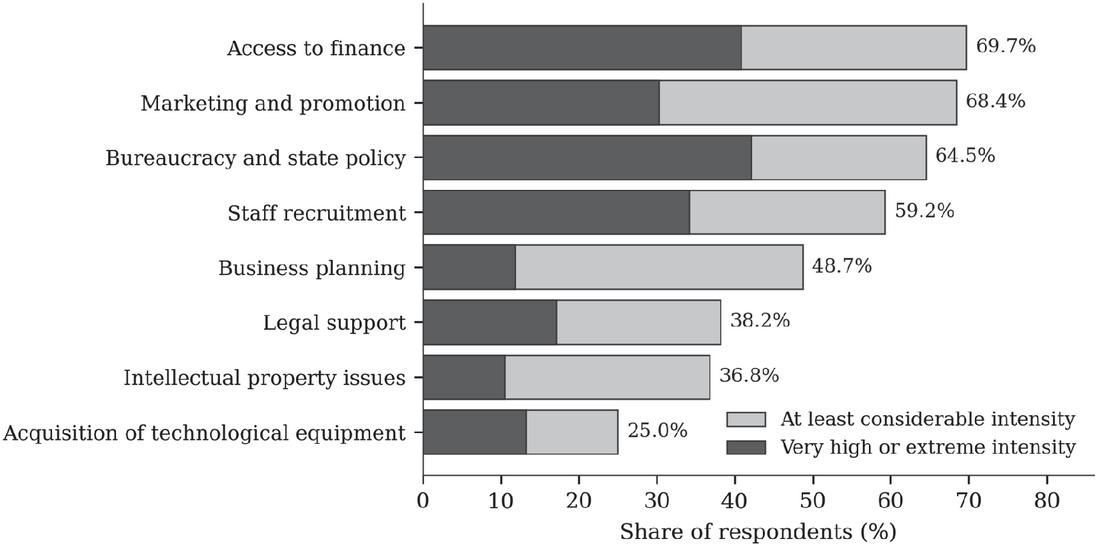
Figure 1 Development barriers reported by the surveyed startups, ordered by severity. Bars show the share of ventures rating each barrier at least considerable and the share rating it very high or extreme on a 5-point scale.
Financing patterns reinforce the salience of the capital barrier. External finance had been used by 63.2% of ventures, yet the structure of that finance is heavily weighted toward internal resources. Own funds constitute more than 20% of the funding mix for 75.0% of ventures and more than 60% of the mix for 52.6%, a dominance of bootstrapping that no other source approaches. Business angels and state funding each exceed the 20% threshold for roughly 23% of ventures, friends and family for 17.1%, while bank lending, venture capital and startup competitions remain marginal and crowdfunding is effectively absent. Among ventures that sought finance, 45 identified limited sources of funding as their principal difficulty, and the volume raised was substantial in a minority of cases, with 35.5% securing at least €100,000. Panel (a) of Figure 2 displays the share of ventures for which each source exceeds 20% of the funding mix.
Marketing practice tilts decisively toward direct and relational channels. Word of mouth attains intensive use in 53.9% of ventures and any substantial use in 81.6%, the company website follows at 52.6% intensive use and direct sales at 51.3%, whereas digital and social media, though widely present, reach intensive use in only 46.1% of ventures. Email marketing and events occupy intermediate positions, telephone outreach trails the field, and artificial intelligence tools remain nascent, attaining intensive use in just 19.7% of ventures and any substantial use in 34.2%. Panel (b) of Figure 2 reports the share of ventures making intensive use of each channel, and Table 5.3 consolidates the numeric detail behind the two figures across barriers, financing sources and marketing channels.
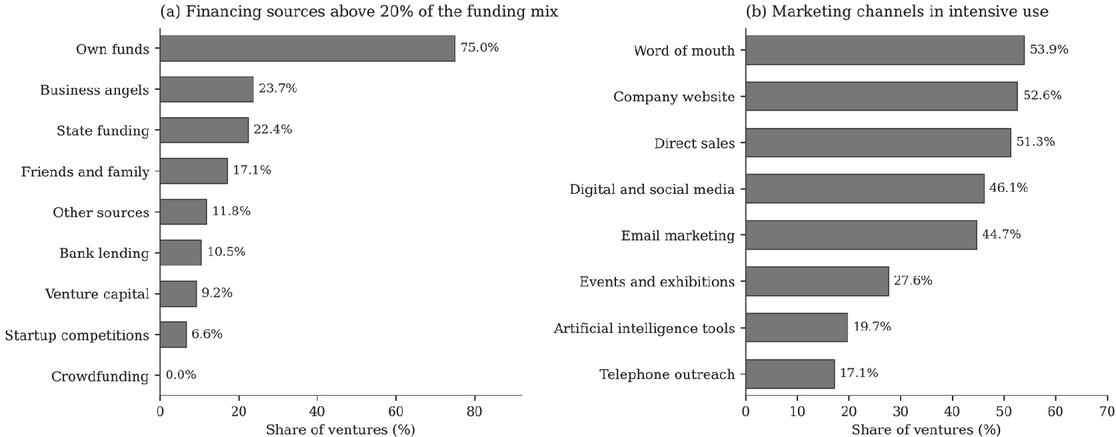
Figure 2 Financing sources and marketing channels among the surveyed startups. Panel (a) shows the share of ventures for which each source exceeds 20% of the funding mix. Panel (b) shows the share making intensive use of each marketing channel, defined as a score of 4 or 5.
Table 4. Development barriers, financing sources and marketing channels
| A. Development barriers | At least considerable (%) | Very high or extreme (%) |
| Access to finance | 69.7 | 40.8 |
| Marketing and promotion | 68.4 | 30.3 |
| Bureaucracy | 64.5 | 42.1 |
| Staff recruitment | 59.2 | 34.2 |
| Business planning | 48.7 | 11.8 |
| Legal issues | 38.2 | 17.1 |
| Intellectual property | 36.8 | 10.5 |
| Equipment and infrastructure | 25.0 | 13.2 |
| B. Financing sources | Above 20% of mix (%) | Above 60% of mix (%) |
| Own funds | 75.0 | 52.6 |
| Business angels | 23.7 | 2.6 |
| State funding | 22.4 | 2.6 |
| Friends and family | 17.1 | 5.3 |
| Other sources | 11.8 | 10.5 |
| Bank lending | 10.5 | 1.3 |
| Venture capital | 9.2 | 1.3 |
| Startup competitions | 6.6 | 0.0 |
| Crowdfunding | 0.0 | 0.0 |
| C. Marketing channels | Intensive use (%) | At least substantial use (%) |
| Word of mouth | 53.9 | 81.6 |
| Company website | 52.6 | 80.3 |
| Direct sales | 51.3 | 73.7 |
| Digital and social media | 46.1 | 64.5 |
| Email marketing | 44.7 | 64.5 |
| Events and exhibitions | 27.6 | 53.9 |
| Artificial intelligence tools | 19.7 | 34.2 |
| Telephone outreach | 17.1 | 27.6 |
Note: Intensive use denotes a score of 4 or 5 and substantial use a score of 3 or above on 5-point scales.
Respondents leave little doubt about the policy measures they consider effective. Expansion of startup funding programs attracts ratings of much or absolute usefulness from 84.2% of founders, reduced taxation during an initial period from 80.3% and a simple and stable tax system from 77.6%, followed by reduction of bureaucracy at 65.8%, education and training at 56.6%, easy and rapid business establishment at 51.3% and hosting infrastructure at 40.8%. The ordering mirrors the barrier ranking almost exactly, which strengthens the internal consistency of the survey and gives the policy discussion of Section 6 its empirical anchor.
5.4 Correlates of Perceived Tourism Applicability and Ecosystem Perceptions
The near universal perception of tourism applicability invites a search for its correlates. Table 5.4 cross-tabulates high tourism applicability against six venture characteristics. The association with the declared tourism, culture or leisure sector is strong and highly significant, since 91.7% of ventures in these sectors report high applicability against 53.6% of ventures elsewhere, giving a chi-square of 14.78 on 1 degree of freedom with a Cramér’s V of .44. None of the remaining characteristics reaches significance. Ventures oriented solely to business customers report high applicability slightly less often than those serving consumers, and ventures targeting global markets report it less often than domestically focused ventures, yet both associations remain weak and statistically indistinguishable from independence. Postgraduate education and previous startup experience display negligible associations, the latter almost exactly at the point of independence. The results indicate that perceived tourism applicability is broadly distributed across the ecosystem rather than confined to any particular educational, experiential or market profile, with sectoral self-classification the only strong marker.
Table 5. Correlates of high perceived tourism applicability
| Characteristic | High in group (%) | High in reference (%) | Test | p |
| Declared tourism, culture or leisure sector | 91.7 | 53.6 | , | |
| Business to business only | 69.4 | 85.0 | , | 0.104 |
| Global market orientation | 71.1 | 87.1 | , | 0.100 |
| Postgraduate founder | 74.1 | 86.4 | Fisher, | 0.365 |
| Previous startup experience | 76.2 | 78.2 | Fisher, | 1.000 |
| Use of external finance | 75.0 | 82.1 | , | 0.471 |
Note: All chi-square tests carry 1 degree of freedom with . Reference column reports the complementary category. Fisher exact tests were used where expected counts fell below 5.
An exploratory logistic regression estimated high tourism applicability as a function of four prespecified indicators, namely declared tourism, culture or leisure sector, business to business only orientation, global market orientation and postgraduate founding team. The model is jointly significant against the null with a likelihood ratio p below .001 and a McFadden pseudo- of 0.27. Declared sector carries a large positive coefficient with an odds ratio of 7.89 and a 95% confidence interval from 2.03 to 30.70, while business to business only orientation attaches to lower applicability with an odds ratio of 0.21 and an interval from 0.05 to 0.90. Global orientation points in the same negative direction with an odds ratio of 0.21 though its interval marginally includes unity, and postgraduate education is not distinguishable from a null effect. The estimates are read as descriptive associations conditional on a small sample rather than as causal parameters, and the wide confidence intervals counsel corresponding caution.
Perceptions of the wider ecosystem are markedly less sanguine than the perceptions of own applicability. Satisfaction with the national startup ecosystem records a median of 3 on the 5-point scale with an interquartile range from 2 to 3, and only 19.7% of founders express satisfaction at the two highest levels against 43.4% who express dissatisfaction at the two lowest. Founders judge established tourism enterprises to be only moderately open to cooperation with startups, with a median of 3 and high openness reported by 30.3%, and they assess the competitive advantage of tourism related startups in similar terms, with high advantage reported by 26.3%. The three perceptions move together, since openness correlates with perceived advantage at a Spearman coefficient of 0.38 and satisfaction with openness at 0.31, both significant, whereas the correlation between a venture’s own tourism applicability and its perception of sector openness remains weak, , . Ventures using external finance report somewhat higher satisfaction than those relying on own capital, with medians of 3 against 2, though the Mann–Whitney comparison does not reach significance, and satisfaction does not differ significantly across staff size bands. The overall configuration portrays a community that believes in the tourism relevance of its work while remaining skeptical of the surrounding support system and of the absorptive capacity of incumbent tourism firms.
5.5 Consolidated Inferential Summary
Table 5.5 assembles the inferential results of the survey in a single view, reporting the test statistic, the effect size and the exact probability for each analysis. One association stands out for strength and robustness, the link between perceived tourism applicability and declared activity in tourism, culture or leisure, while a set of moderate correlations connects the applicability dimensions to one another and the ecosystem perceptions to one another. The remaining comparisons return small effects that the sample size cannot distinguish from chance, a pattern consistent with the exploratory design, and the results are best read as structured description that motivates confirmatory work rather than as established regularities.
Table 6. Consolidated inferential results
| Analysis | Statistic and effect size | p |
| Tourism applicability declared sector | , | 0.001 |
| Tourism applicability business to business only | , | 0.104 |
| Tourism applicability global market | , | 0.100 |
| Tourism applicability postgraduate founder | Fisher exact, | 0.365 |
| Tourism applicability previous experience | Fisher exact, | 1.000 |
| Tourism applicability external finance | , | 0.471 |
| Logistic model of tourism applicability | McFadden , LR | 0.001 |
| Applicability tourism culture | Spearman | 0.001 |
| Applicability tourism leisure | Spearman | 0.001 |
| Applicability culture leisure | Spearman | 0.001 |
| Openness perceived advantage | Spearman | 0.001 |
| Satisfaction openness | Spearman | 0.007 |
| Satisfaction by external finance use | Mann–Whitney , | 0.175 |
| Satisfaction by permanent staff size | Kruskal–Wallis , | 0.088 |
Source: Authors’ elaboration from survey data (N=76). No adjustment for multiple comparisons is applied given the exploratory design.
6 Discussion
The central finding concerns the breadth of perceived tourism applicability. More than three-quarters of the surveyed ventures regard their offerings as applicable to tourism at a considerable level, and the perception extends far beyond the 63.2% of ventures that declare a sector within tourism, culture or leisure, since a majority of ventures classified elsewhere report high applicability as well. Within the framework of Table 2.2, the ecosystem behaves as a horizontal reservoir of tourism relevant capability rather than as a vertical tourism technology niche, which accords with the observation that tourism renews itself mainly by adopting innovations produced elsewhere (Hjalager, 2010). The finding also refines the ecosystem literature in a specific direction, because the framework conditions that Stam (2015) enumerates acquire, in a tourism-dependent economy, a sectoral orientation that emerges from the perceptions and positioning of founders rather than from any explicit sectoral policy (Audretsch et al., 2019).
The constraint structure identifies where that latent capability stalls. Access to finance leads the barrier ranking, bootstrapping dominates funding structures, venture capital reaches fewer than 1/10 of ventures and crowdfunding is absent, a configuration that reproduces at firm level the seed to growth escalator gap regarded as the signature weakness of young peripheral ecosystems (Moroni et al., 2015; OECD, 2022). The policy preferences of founders align with this diagnosis, since funding programs and tax relief attract the strongest endorsement, and the prominence of bureaucracy and marketing among the leading barriers points to complementary interventions in administrative simplification and market access that fiscal incentives alone do not supply. The muted satisfaction with the national ecosystem, and its correlation with perceptions of sector openness, suggests that founders experience these constraints as systemic rather than as private failings.
Digital capability presents an encouraging picture with a defined frontier. Roughly half of the ventures already operate websites, direct channels and social media marketing at intensive levels, situating them within the mainstream that transformed travel distribution over the past two decades (Buhalis, 2001), while artificial intelligence tools, used intensively by one in five ventures, mark the next capability wave and connect the ecosystem to the transformation pathways documented for European small firms after the pandemic (Petropoulou et al., 2024; Ragazou, Passas, & Sklavos, 2022). The human centric smart destination agenda supplies the normative direction for this diffusion, insisting that digital innovation serve livability, cultural value and sustainability rather than efficiency alone (Vardopoulos, Giannopoulos, et al., 2024), and business intelligence research shows that even modest analytical tooling shifts the competitive position of small enterprises (Ragazou et al., 2023).
Perceptions of the established tourism industry deserve particular weight. Fewer than one-third of founders judge tourism enterprises open to innovative products and services, openness correlates with the perceived advantage of tourism related startups and satisfaction correlates with openness, which indicates that founders read the market for their offerings through the receptiveness of incumbents. Because tourism firms innovate predominantly through adoption, the absorptive capacity of hotels, operators and destination organizations conditions the demand that startups actually face (Hjalager, 2010), and cases such as analytics applied to hotel demand under crisis conditions show how adoption creates value on both sides (Vortelinos et al., 2025). Innovation that improves working conditions in customer facing roles can raise the visitor experience as well (Zaroulea & Kyriakogkonas, 2025). Closing this coordination gap through intermediation, matchmaking and demonstration is a task for destination governance and business associations as much as for startup policy (Streimikiene et al., 2021).
The Mediterranean frame extends the argument beyond Greece. Seasonality, coastal pressure, fragmented enterprise structures and exposure to climate stress recur across Southern Europe (Salvati & Vardopoulos, 2024, 2025), and several states in the region operate residence by investment schemes weighted toward real estate that face comparable tensions between capital attraction and housing affordability (Džankić, 2018; European Commission, 2019). The Greek reorientation toward a productive Startup Visa models an instrument that aligns incoming capital with employment and knowledge spillovers rather than with property appreciation, addressing a distributional pathology documented most sharply in Athens (Vardopoulos, Muolo, et al., 2025), and resilience research suggests that such productive diversification strengthens the capacity of economies to absorb shocks (Doukas et al., 2025). Figure 3 integrates the supply side evidence into the framework of the study, linking ecosystem inputs through startup capabilities to channels of tourism value creation and to sustainability outcomes, with the financing and governance constraints documented in the survey positioned as the gate through which the sequence must pass. Transfer across the basin appears most feasible for the registry and certification layer, whose fixed costs are modest, and most demanding for the finance layer, where market depth cannot be legislated (Audretsch et al., 2019; Stam, 2015).
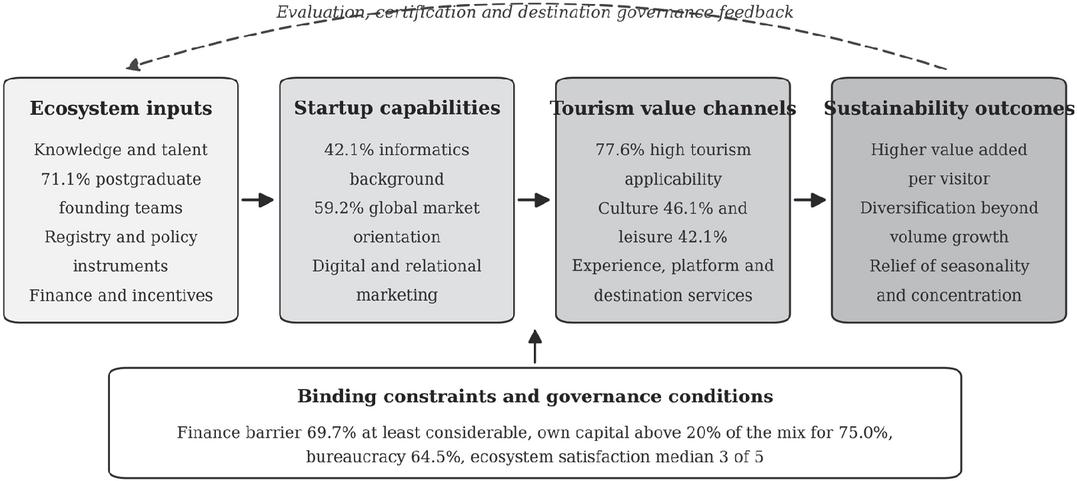
Figure 3 Integrated framework of sustainable tourism value creation through startup ecosystems. The framework links ecosystem inputs to entrepreneurial capabilities, to channels of tourism value creation and to sustainability outcomes, moderated by the constraints documented in the survey evidence.
Two qualifications discipline the interpretation. First, the evidence assembled here is confined to the supply side. The survey measures what founders perceive, offer and lack, and it says nothing directly about whether visitors will reward the resulting services, so the demand articulation dimension of the framework remains empirically unexamined in this study. Representative demand evidence for Greek destinations exists, including a recently published open dataset of 1503 tourist responses on attitudes toward economy and sustainability (Panagiotopoulos, 2025), and pairing such data with venture level evidence is the natural next step. Second, perception is not performance, and green transitions carry material and social costs of their own (Zorpas et al., 2026). The defensible conclusion is therefore conditional. Startup ecosystems can complement destination governance, tourism policy, financing instruments and sustainability planning by enabling innovation across the tourism value chain, and they do not substitute for planning, regulation or the internalization of environmental costs (European Environment Agency, 2019; Kopsidas et al., 2026).
7 Conclusion
This study examined whether startup ecosystems can operate as mechanisms of sustainable tourism value creation in tourism-dependent Mediterranean economies, combining a conceptual framework, an analytical reading of the Greek policy architecture and exploratory evidence from a structured survey of 76 Greek startups. Three conclusions carry the weight of the argument. Perceived applicability to tourism, culture and leisure is pervasive across the ecosystem and extends far beyond ventures formally classified in those sectors, so the potential contribution of entrepreneurship to the sector is broad rather than confined. Access to finance, bureaucracy and marketing constitute the binding constraints on that potential, with own capital dominating funding structures and the seed to growth escalator visibly incomplete. Founders combine confidence in the tourism relevance of their work with skepticism toward the surrounding support system and toward the openness of incumbent tourism enterprises, which locates the decisive frictions in capital and coordination rather than in capability.
The implications follow the diagnosis. For policy, the Greek architecture rightly prioritizes certification and investor attraction, yet the evidence argues for rebalancing toward capitalization through a deeper public and private funding escalator, for embedding sustainability conditionality in the deduction and visa instruments so that support privileges ventures with demonstrable environmental and social value, and for publishing systematic survival, employment and sustainability indicators from the registry so that evaluation can replace advocacy (Audretsch et al., 2019). For destination managers and business associations, the coordination gap between young ventures and established operators marks a field for deliberate intermediation, since fiscal incentives cannot close it. The reorientation of investment migration from asset based toward productive equity models an instrument of broad Mediterranean relevance, aligning incoming capital with employment and knowledge rather than with property (Džankić, 2018).
The limitations of the evidence define the agenda that should follow. The self-selected sample, the ordinal measurement and the cross-sectional design confine the results to the exploratory register, and the study observes perceptions on the supply side alone. Confirmatory research on representative samples of ventures, longitudinal tracking of registered startups through the funding escalator, the pairing of venture level evidence with representative visitor data (Panagiotopoulos, 2025) and comparative designs spanning several Mediterranean jurisdictions would test the regularities suggested here, while research on the distributional consequences of startup led tourism development would illuminate the conditions under which innovation serves inclusive destination futures (Vardopoulos, Muolo, et al., 2025). Pursued together, these lines would clarify when entrepreneurial ecosystems genuinely advance the sustainability transition of tourism-dependent economies (Passas, 2025), and they would give Greece, having assembled the institutional foundations, the evidence needed to demonstrate that an emerging startup nation can also be a sustainable one.
References
Astara, O.-E., Tsirmpinis, Z., Kopsidas, O., & Vardopoulos, I. (2026). Tourism as a catalyst for economic stability and environmental sustainability in Mediterranean landscapes. In Sustainable Landscapes across the Mediterranean (pp. 235–246). Springer. https://doi.org/10.1007/978-3-032-07255-9_25
Audretsch, D. B., Cunningham, J. A., Kuratko, D. F., Lehmann, E. E., & Menter, M. (2019). Entrepreneurial ecosystems: Economic, technological, and societal impacts. Journal of Technology Transfer, 44(2), 313–325. https://doi.org/10.1007/s10961-018-9690-4
Blank, S. (2010, January 25). What’s A Startup? First Principles. Steve Blank. https://steveblank.com/2010/01/25/whats-a-startup-first-principles/
Briassoulis, H. (2002). Sustainable tourism and the question of the commons. Annals of Tourism Research, 29(4), 1065–1085. https://doi.org/10.1016/S0160-7383(02)00021-X
Buhalis, D. (2001). Tourism in Greece: Strategic analysis and challenges. Current Issues in Tourism, 4(5), 440–480. https://doi.org/10.1080/13683500108667898
Butler, R. W. (1991). Tourism, environment, and sustainable development. Environmental Conservation, 18(3), 201–209. https://doi.org/10.1017/S0376892900022104
Cantamessa, M., Gatteschi, V., Perboli, G., & Rosano, M. (2018). Startups’ roads to failure. Sustainability, 10(7), 2346. https://doi.org/10.3390/su10072346
Ciommi, M., Egidi, G., Vardopoulos, I., Chelli, F. M., & Salvati, L. (2022). Toward a “migrant trap”? Local development, urban sustainability, sociodemographic inequalities, and the economic decline in a Mediterranean metropolis. Social Sciences, 12(1), 26. https://doi.org/10.3390/socsci12010026
Coccossis, H., & Tsartas, P. (2019).  . Kritiki.
Coccossis, H., Tsartas, P., & Grimpa, E. (2020).  :
: 

 . Kritiki.
Cortesi, A., Vardopoulos, I., & Salvati, L. (2022). A partial least squares analysis of the perceived impact of sustainable real estate design upon wellbeing. Urban Science, 6(4), 69. https://doi.org/10.3390/urbansci6040069
D’Agata, A., Nosova, B., Vardopoulos, I., Rontos, K., Clemente, M., Colombo, C., Sateriano, A., & Salvati, L. (2024). Urban decline, economic crisis and fringe landscapes: The Mediterranean experience. In Urban Crisis: Social and Economic Implications for Southern Europe. Nova Science Publishers.
D’Agata, A., Ponza, D., Stroiu, F. A., Vardopoulos, I., Rontos, K., Escrivà Saneugenio, F., Chelli, F., Alaimo, L. S., Salvati, L., & Nickyain, S. S. (2023). Toward sustainable development trajectories? Estimating urban footprints from high-resolution Copernicus layers in Athens, Greece. Land, 12(8), 1490. https://doi.org/10.3390/land12081490
Dangi, T. B., & Jamal, T. (2016). An integrated approach to “sustainable community-based tourism.” Sustainability, 8(5), 475. https://doi.org/10.3390/su8050475
Doukas, Y. E., Maravegias, N., Ioannides, S., Salvati, L., & Vardopoulos, I. (2025). Economic resilience and sustainability in the European Union: A comparative analysis of pre- and post-economic crisis. In Environmental Sustainability and Global Change (pp. 257–273). Elsevier. https://doi.org/10.1016/B978-0-443-31596-1.00018-0
Doukas, Y. E., Maravegias, N., Zorpas, A. A., Sotiropoulos, A., & Vardopoulos, I. (2026). Integrating circular economy principles in the European farm-to-fork strategy for food waste prevention. Journal of Agribusiness in Developing and Emerging Economies, 1–24. https://doi.org/10.1108/JADEE-10-2025-0512
Doukas, Y. E., Salvati, L., & Vardopoulos, I. (2023). Unraveling the European agricultural policy sustainable development trajectory. Land, 12(9), 1749. https://doi.org/10.3390/land12091749
Dritsakis, N. (2004). Tourism as a long-run economic growth factor: An empirical investigation for Greece using causality analysis. Tourism Economics, 10(3), 305–316. https://doi.org/10.5367/0000000041895094
Džankić, J. (2018). Immigrant investor programmes in the European Union (EU). Journal of Contemporary European Studies, 26(1), 64–80. https://doi.org/10.1080/14782804.2018.1427559
Easterlin, R. A., & Angelescu, L. (2007). Modern economic growth and quality of life: Cross-sectional and time series evidence (IZA Discussion Paper No. 2755). Institute for the Study of Labor.
Elevate Greece. (2025). National Startup Registry and Startup Visa Framework. Hellenic Ministry of Development. https://elevategreece.gov.gr
European Commission. (2010). Europe 2020: A Strategy for Smart, Sustainable and Inclusive Growth (COM(2010) 2020 final). Publications Office of the European Union.
European Commission. (2016). Europe’s Next Leaders: The Start-up and Scale-up Initiative (COM(2016) 733 final). Publications Office of the European Union.
European Commission. (2019). Investor Citizenship and Residence Schemes in the European Union (COM(2019) 12 final). Publications Office of the European Union.
European Environment Agency. (2019). Sustainability Transitions: Policy and Practice (EEA Report No. 09/2019). Publications Office of the European Union.
Graham, P. (2012, September). Startup=Growth. Paul Graham. http://www.paulgraham.com/growth.html
Hjalager, A.-M. (2010). A review of innovation research in tourism. Tourism Management, 31(1), 1–12. https://doi.org/10.1016/j.tourman.2009.08.012
INSETE. (2024). Greek Tourism: Developments and Prospects–Annual Report 2023. Institute of the Greek Tourism Confederation.
Jamal, T., & Stronza, A. (2009). Collaboration theory and tourism practice in protected areas: Stakeholders, structuring and sustainability. Journal of Sustainable Tourism, 17(2), 169–189. https://doi.org/10.1080/09669580802495741
Karagiannopoulou, S., Sariannidis, N., Ragazou, K., Passas, I., & Garefalakis, A. (2023). Corporate social responsibility: A business strategy that promotes energy environmental transition and combats volatility in the post-pandemic world. Energies, 16(3), 1102. https://doi.org/10.3390/en16031102
Karytsas, S., Vardopoulos, I., & Theodoropoulou, E. (2019). Factors affecting residents’ attitude toward sustainable tourism development. Tourismos, 14(1), 1–40. https://doi.org/10.26215/tourismos.v14i1.558
Kopsidas, O., Panagiotopoulos, P., Passas, I., Doukas, Y. E., Salvati, L., & Vardopoulos, I. (2026). Integrating externalities into economic systems for long-term environmental sustainability. In Spatial Analysis for Complex Territorial Systems (pp. 201–213). Elsevier. https://doi.org/10.1016/B978-0-443-44133-2.00018-1
Kyramargiou, Z., & Vardopoulos, I. (2019). Use and sustainability of the ships’ waste reception facilities: Evidence from the Port of Corinth, Greece. Journal of Management and Regional Development, 15(3), 93–106. https://doi.org/10.54399/rbgdr.v15i3.4670
Lélé, S. M. (1991). Sustainable development: A critical review. World Development, 19(6), 607–621. https://doi.org/10.1016/0305-750X(91)90197-P
Li, K. X., Jin, M., & Shi, W. (2018). Tourism as an important impetus to promoting economic growth: A critical review. Tourism Management Perspectives, 26, 135–142. https://doi.org/10.1016/j.tmp.2017.10.002
Liu, Z. (2003). Sustainable tourism development: A critique. Journal of Sustainable Tourism, 11(6), 459–475. https://doi.org/10.1080/09669580308667216
Loizia, P., Voukkali, I., Zorpas, A. A., Navarro Pedreño, J., Chatziparaskeva, G., Inglezakis, V. J., Vardopoulos, I., & Doula, M. (2021). Measuring the level of environmental performance in insular areas, through key performed indicators, in the framework of waste strategy development. Science of the Total Environment, 753, 141974. https://doi.org/10.1016/j.scitotenv.2020.141974
Maialetti, M., Halbac-Cotoara-Zamfir, R., Vardopoulos, I., & Salvati, L. (2024). Early desertification risk in advanced economies: Summarizing past, present and future trends in Italy. Earth, 5(4), 690–706. https://doi.org/10.3390/earth5040036
Moroni, I., Arruda, A., & Araujo, K. (2015). The design and technological innovation: How to understand the growth of startups companies in competitive business environment. Procedia Manufacturing, 3, 2199–2204. https://doi.org/10.1016/j.promfg.2015.07.361
Moustairas, I., Vardopoulos, I., Kavouras, S., Salvati, L., & Zorpas, A. A. (2022). Exploring factors that affect public acceptance of establishing an urban environmental education and recycling center. Sustainable Chemistry and Pharmacy, 25, 100605. https://doi.org/10.1016/j.scp.2022.100605
OECD. (2022). Financing SMEs and Entrepreneurs 2022: An OECD Scoreboard. OECD Publishing. https://doi.org/10.1787/e9073a0f-en
Panagiotopoulos, P. (2025). Dataset of 1503 tourists’ survey concerning their attitudes towards sports, economy and sustainability. Sustainability Research in the Mediterranean, 1(1), 67–72. https://doi.org/10.13052/srm2795-0514.005
Panagiotopoulos, P., Vardopoulos, I., Maialetti, M., Ciaschini, C., Koundouri, P., & Salvati, L. (2024). Reimagining sustainable development and economic performance indicators: A human-centric Maslow–Bossel blueprint. Economies, 12(12), 338. https://doi.org/10.3390/economies12120338
Papademetriou, C., Ragazou, K., Garefalakis, A., & Passas, I. (2023). Green human resource management: Mapping the research trends for sustainable and agile human resources in SMEs. Sustainability, 15(7), 5636. https://doi.org/10.3390/su15075636
Papamichael, I., Voukkali, I., Loizia, P., Stylianou, M., Economou, F., Vardopoulos, I., Klontza, E. E., Lekkas, D. F., & Zorpas, A. A. (2023). Measuring circularity: Tools for monitoring a smooth transition to circular economy. Sustainable Chemistry and Pharmacy, 36, 101330. https://doi.org/10.1016/j.scp.2023.101330
Passas, I. (2025). Editorial: Opening the Sustainability Research in the Mediterranean. Sustainability Research in the Mediterranean, 1(1), i–ii. https://journals.riverpublishers.com/index.php/JSRM/article/view/31945
Petropoulou, A., Angelaki, E., Rompogiannakis, I., Passas, I., Garefalakis, A., & Thanasas, G. (2024). Digital transformation in SMEs: Pre- and post-COVID-19 era: A comparative bibliometric analysis. Sustainability, 16(23), 10536. https://doi.org/10.3390/su162310536
Petropoulou, A., Garefalakis, A., & Passas, I. (2026). Leveraging artificial intelligence, blockchain, and FinTech to enhance ESG compliance and urban governance. In Futureproofed Sustainability amidst Climate Change Polycrisis: Advancing SDGs and ESG for the Cities of Tomorrow (pp. 43–72). IGI Global. https://doi.org/10.4018/979-8-3373-2327-5.ch002
Ragazou, K., Passas, I., Garefalakis, A., & Dimou, I. (2022). Investigating the research trends on strategic ambidexterity, agility, and open innovation in SMEs: Perceptions from bibliometric analysis. Journal of Open Innovation: Technology, Market, and Complexity, 8(3), 118. https://doi.org/10.3390/joitmc8030118
Ragazou, K., Passas, I., Garefalakis, A., Kourgiantakis, M., & Xanthos, G. (2022). Youth’s entrepreneurial intention: A multinomial logistic regression analysis of the factors influencing Greek HEI students in time of crisis. Sustainability, 14(20), 13164. https://doi.org/10.3390/su142013164
Ragazou, K., Passas, I., Garefalakis, A., & Zopounidis, C. (2023). Business intelligence model empowering SMEs to make better decisions and enhance their competitive advantage. Discover Analytics, 1, 2. https://doi.org/10.1007/s44257-022-00002-3
Ragazou, K., Passas, I., & Sklavos, G. (2022). Investigating the strategic role of digital transformation path of SMEs in the era of COVID-19: A bibliometric analysis using R. Sustainability, 14(18), 11295. https://doi.org/10.3390/su141811295
Salvati, L., & Vardopoulos, I. (2024). Intricacies of Mediterranean urban and regional dynamics. Euro-Mediterranean Journal for Environmental Integration, 9(1), 277–292. https://doi.org/10.1007/s41207-023-00434-7
Salvati, L., & Vardopoulos, I. (2025). Into the kaleidoscopic urbanization of Southern Europe: Modelling “form-function” relationships through partial least squares regression. Cities, 162, 105933. https://doi.org/10.1016/j.cities.2025.105933
Salvucci, G., Salvati, L., Alaimo, L. S., & Vardopoulos, I. (2025). Settlement patterns, official statistics and geo-economic dynamics: Evidence from a LADISC approach to Italy. Big Data Research, 100525. https://doi.org/10.1016/j.bdr.2025.100525
Sarantakou, E. (2023). Contemporary challenges in destination planning: A geographical typology approach. Geographies, 3(4), 687–708. https://doi.org/10.3390/geographies3040036
Sarantakou, E., & Terkenli, T. S. (2019). Non-institutionalized forms of tourism accommodation and overtourism impacts on the landscape: The case of Santorini, Greece. Tourism Planning and Development, 16(4), 411–433. https://doi.org/10.1080/21568316.2019.1569122
Sateriano, A., D’Agata, A., & Vardopoulos, I. (Eds.). (2024). Socio-Environmental Change: The Path toward Sustainability. Nova Science Publishers.
Schumpeter, J. A. (1942). Capitalism, Socialism and Democracy. Harper and Brothers.
Sitzimis, I., Dimou, I., Xanthos, G., & Passas, I. (2025). Seaplane adoption in Greece: From ordinal intent to Firth-penalized logistic inference. AppliedMath, 5(4), 152. https://doi.org/10.3390/appliedmath5040152
Skawińska, E., & Zalewski, R. I. (2020). Success factors of startups in the EU—A comparative study. Sustainability, 12(19), 8200. https://doi.org/10.3390/su12198200
Stam, E. (2015). Entrepreneurial ecosystems and regional policy: A sympathetic critique. European Planning Studies, 23(9), 1759–1769. https://doi.org/10.1080/09654313.2015.1061484
Stamatiou, E. (2024). Spatial planning and tourism development in Greece: Institutional gaps and prospects. Aeihoros, 39, 41–68.
Stiglitz, J. E., Sen, A., & Fitoussi, J.-P. (2009). Report by the Commission on the Measurement of Economic Performance and Social Progress. Commission on the Measurement of Economic Performance and Social Progress.
Streimikiene, D., Svagzdiene, B., Jasinskas, E., & Simanavicius, A. (2021). Sustainable tourism development and competitiveness: The systematic literature review. Sustainable Development, 29(1), 259–271. https://doi.org/10.1002/sd.2133
Szarek, J., & Piecuch, J. (2018). The importance of startups for construction of innovative economies. International Entrepreneurship Review, 4(2), 69–78.
Terkenli, T. S., & Coccossis, H. (2024). Greek tourism revisited: A qualified success story confronting saturation. In Tourism in Mediterranean Europe (pp. 45–64). Springer.
Tsangaris, S., Michaelides, G. P., Salvati, L., & Vardopoulos, I. (2027). A non-linear input-output econometric model of intersectoral production for urban (and regional) economies. In Uneven Urban and Regional Growth (pp. 109–122). Elsevier. https://doi.org/10.1016/B978-0-443-45332-8.00005-X
Tsartas, P. (1992). Socioeconomic impacts of tourism on two Greek isles. Annals of Tourism Research, 19(3), 516–533. https://doi.org/10.1016/0160-7383(92)90134-B
Tsartas, P. (2003). Tourism development in Greek insular and coastal areas: Sociocultural changes and crucial policy issues. Journal of Sustainable Tourism, 11(2–3), 116–132. https://doi.org/10.1080/09669580308667199
Tsartas, P., Manologlou, E., & Markou, A. (2001). Domestic tourism in Greece and special interest destinations: The role of alternative forms of tourism. Anatolia, 12(1), 35–42. https://doi.org/10.1080/13032917.2001.9686997
Tsartas, P., Papatheodorou, A., & Vasileiou, M. (2014). Tourism development and policy in Greece. In European Tourism Planning and Organisation Systems (pp. 297–312). Channel View Publications.
Tsilika, E., & Vardopoulos, I. (2022). The FIX-up mix-up; Undue façadism or adaptive reuse? Examining the former FIX brewery transformation into the National Museum of Contemporary Art in Athens. Archnet-IJAR: International Journal of Architectural Research, 16(3), 688–709. https://doi.org/10.1108/ARCH-09-2021-0255
Vardopoulos, I. (2022). Industrial building adaptive reuse for museum: Factors affecting visitors’ perceptions of the sustainable urban development potential. Building and Environment, 222, 109391. https://doi.org/10.1016/j.buildenv.2022.109391
Vardopoulos, I., Abeliotis, K., & Lasaridi, K. (2025). A systematic informetric analysis and literature review of food waste quantification studies in the food service industry. Sustainability, 17(1), 103. https://doi.org/10.3390/su17010103
Vardopoulos, I., Dimitriou, K., & Astara, O.-E. (2024). Tourist accommodation facilities sustainability assessment practices: Implications for real estate. In Recent Advancements in Tourism Business, Technology and Social Sciences (pp. 767–788). Springer. https://doi.org/10.1007/978-3-031-54338-8_45
Vardopoulos, I., Giannopoulos, K., Kalli, S., & Salvati, L. (2024). From tech-centric to human-centric smart tourist destinations: Innovations in real estate, urban planning, and sustainability. In Socio-Environmental Change: The Path toward Sustainability (pp. 65–96). Nova Science Publishers.
Vardopoulos, I., Giannopoulos, K., Papaefthymiou, E., Temponera, E., Chatzithanasis, G., Goussia-Rizou, M., Karymbalis, E., Michalakelis, C., Tsartas, P., & Sdrali, D. (2023). Urban buildings sustainable adaptive reuse into tourism accommodation establishments: A SOAR analysis. Discover Sustainability, 4(1), 50. https://doi.org/10.1007/s43621-023-00166-2
Vardopoulos, I., & Karytsas, S. (2019). An exploratory path analysis of climate change effects on tourism. Sustainable Development, Culture, Traditions Journal, Special Volume in Honor of Professor George I. Theodoropoulos, 132–152. https://doi.org/10.26341/issn.2241-4002-2019-sv-13
Vardopoulos, I., Muolo, A., Konaxis, I., & Salvati, L. (2025). Dwelling size as a socio-spatial proxy: Planning-deficient urbanism, tourism-led gentrification, and macro-driven commodification in Athens. Habitat International, 166, 103614. https://doi.org/10.1016/j.habitatint.2025.103614
Vardopoulos, I., Papoui-Evangelou, M., Nosovo, B., & Salvati, L. (2023). Smart “tourist cities” revisited: Culture-led urban sustainability and the global real estate market. Sustainability, 15(5), 4313. https://doi.org/10.3390/su15054313
Vardopoulos, I., Tsilika, E., Sarantakou, E., Zorpas, A. A., Salvati, L., & Tsartas, P. (2021). An integrated SWOT-PESTLE-AHP model assessing sustainability in adaptive reuse projects. Applied Sciences, 11(15), 7134. https://doi.org/10.3390/app11157134
Vardopoulos, I., & Vassiliades, C. (2025). Energy-active architectures and the struggle for sustainable Mediterranean cities. In Energy-Efficient Buildings in the Mediterranean: Challenges, Strategies, and Innovations (pp. 1–29). River Publishers. https://doi.org/10.1201/9788743809784-1
Vinci, S., Vardopoulos, I., & Salvati, L. (2023). A tale of a shrinking city? Exploring the complex interplay of socio-demographic dynamics in the recent development of Attica, Greece. Cities, 132, 104089. https://doi.org/10.1016/j.cities.2022.104089
Vortelinos, D., Floros, C., Apostolakis, A., & Passas, I. (2025). Hotel sales during COVID-19. In Data Analysis and Related Applications 5 (pp. 333–348). Wiley. https://doi.org/10.1002/9781394401604.ch21
Ward, J. D., Sutton, P. C., Werner, A. D., Costanza, R., Mohr, S. H., & Simmons, C. T. (2016). Is decoupling GDP growth from environmental impact possible? PLOS ONE, 11(10), e0164733. https://doi.org/10.1371/journal.pone.0164733
World Commission on Environment and Development. (1987). Our Common Future. Oxford University Press.
World Travel and Tourism Council. (2024). Travel and Tourism Economic Impact 2024: Greece. WTTC.
Zaroulea, T., & Kyriakogkonas, P. (2025). What influences job satisfaction among front office customer service employees? Sustainability Research in the Mediterranean, 1(1), 45–66. https://doi.org/10.13052/srm2795-0514.004
Zopounidis, C., Garefalakis, A., Lemonakis, C., & Passas, I. (2020). Environmental, social and corporate governance framework for corporate disclosure: A multicriteria dimension analysis approach. Management Decision, 58(11), 2473–2496. https://doi.org/10.1108/MD-10-2019-1341
Zorpas, A. A., Economou, F., Naddeo, V., Stylianou, M., Voukkali, I., Vardopoulos, I., Tsiarta, N., Samanides, C. G., Zarra, T., Wern, B., Vyzikas, T., Inglezakis, V. J., & Samaras, P. (2026). The darkest shade of green transition. Energy Reports, 15, 109099. https://doi.org/10.1016/j.egyr.2026.109099