Predicted and Documented Construction-Stage Impacts of Urban Mega Infrastructure Projects: Environmental Follow-Up, Material Circularity and Social Acceptance in Athens Metro Line 4
Simos Tsilikas
Democritus University of Thrace, Greece; Regulatory Authority for Energy, Waste and Water (RAAEY), Greece
Corresponding Author: Simos Tsilikas; E-mail address: sitsili@fmenr.duth.gr
Handling Editor: Marinos Stylianou
Received 11 November 2025, Accepted 4 February 2026; Published Online: 04 November 2026.
Citation: Tsilikas, S. (2025). Predicted and Documented Construction-Stage Impacts of Urban Mega Infrastructure Projects: Environmental Follow-Up, Material Circularity and Social Acceptance in Athens Metro Line 4. Sustainability Research in the Mediterranean, 1(4), 235–254. https://doi.org/10.13052/srm2795-0514.018
© 2026 River Publishers
Abstract
Urban mega infrastructure projects are justified by long-term mobility, and environmental and social benefits, yet their construction imposes pressures that are concentrated in particular neighborhoods and periods and whose magnitude is rarely quantified at the assessment stage. This study examines the relationship between anticipated and documented construction-stage impacts in Section A of Athens Metro Line 4, from Alsos Veikou to Goudi, and extends the comparison to excavation-related material flows and to the conditions of social acceptance. A qualitative case-study design analyses the environmental permitting framework, the annual environmental reports of Elliniko Metro S.A. 2021–2025, the applicable waste legislation and the relevant literature, applying an analytical sequence that links predicted pressure, documented condition, management response, residual effect, resource-recovery pathway and social relevance. The documentation confirms that management mechanisms corresponding to the anticipated pressures were in place for noise, vibration, dust, traffic and public-space occupation, although it does not allow their effectiveness to be verified quantitatively. The clearest documented outcome concerns materials, since excavation products were directed to quarry restoration, fill and cover applications and cement production, while construction and demolition waste (C&DW) arising from archaeological works and utility relocations was transferred to licensed facilities. The findings indicate that separating excavation products from C&DW is necessary for an accurate reading of project circularity and that social acceptance can be addressed only conceptually in the absence of representative survey data. The framework offers a transferable basis for construction-stage follow-up of mega infrastructure projects and waste-management facilities.
Keywords: Environmental impact assessment, construction and demolition waste, excavation products, waste hierarchy, environmental governance, sustainable development, urban rail..
1 Introduction
Urban mega infrastructure projects occupy an ambivalent position in the pursuit of sustainable development, because the interventions that are expected to reorganize metropolitan mobility, reduce dependence on private vehicles and sustain long-term economic and social development (Banister, 2008; Ward & Skayannis, 2019) also impose some of the most intrusive environmental pressures that cities experience during construction (Thounaojam & Laishram, 2022). Such undertakings are commonly described as megaprojects or mega infrastructure projects, terms that denote large-scale and technically intricate initiatives requiring substantial investment, extended delivery periods and the coordination of numerous public and private actors (Priemus & van Wee, 2013; Skayannis, 2021; Söderlund et al., 2017). Their effects on the environment, the economy and society are strong and durable (Mitoula & Papavasileiou, 2023; Vardopoulos et al., 2024), and research on the Greek experience emphasizes that they are typically costly and intricate projects that shape the social, economic and environmental conditions of the regions they affect, both directly and indirectly (Papavasileiou, 2024).
This ambivalence has a temporal and a spatial dimension, since construction burdens such as noise, vibration, dust, traffic disruption and the temporary occupation of public space are experienced around individual worksites over periods of months or years, whereas the benefits invoked to justify the investment accrue over decades of operation and are distributed across the metropolitan population (Vickerman, 2008). The burdens also tend to combine, because the same residents may be exposed simultaneously to noise, dust and visual intrusion, an interaction whose significance may exceed that of each effect considered separately (Cooper & Sheate, 2002; Vardopoulos, 2019). The communities that bear the most direct costs of a project are therefore not necessarily those that perceive its benefits most clearly, and the literature on megaproject conflict associates such distributional conditions with opposition, delay and contested legitimacy (Jia et al., 2011; Jordhus-Lier, 2015; Vanclay, 2016).
Environmental impact assessment (EIA) is designed to anticipate these consequences before a decision is taken, by identifying likely effects, evaluating their significance and specifying measures to avoid, reduce or offset them (Directive 2011/92/EU, 2011; Glasson et al., 2013). Its anticipatory character means that predictions of construction-stage effects are formulated under considerable uncertainty and depend on choices made at the scoping stage about which issues deserve detailed assessment (Snell & Cowell, 2006; Wood et al., 2006). Whether anticipated pressures materialized as expected, and whether prescribed mitigation performed as intended, can be established only through monitoring and auditing after consent, a stage that has historically received less attention than pre-decision assessment (Glasson et al., 2013). The revision of the European EIA framework in 2014 reinforced this stage by requiring consent decisions to specify, where appropriate, monitoring measures for significant adverse effects (Directive 2014/52/EU, 2014), and construction-stage environmental reporting has consequently become a potential basis for comparing what was predicted with what is subsequently documented.
Construction-stage impacts also include a material dimension, because construction and demolition waste (C&DW), a category that in Greek and European regulation also encompasses excavation waste1, is among the heaviest and most voluminous waste streams in the European Union, and its disposal in landfills or through uncontrolled deposition carries risks for soil, groundwater, landscape quality and human health (Chen et al., 2021; Pavlides et al., 2023). The circular economy reframes such flows as potential resources and assigns priority to prevention, reuse, recycling and other recovery over disposal (Ghisellini et al., 2018; Papamichael et al., 2023; Zhang et al., 2022). Underground urban rail gives the issue particular weight, because subway engineering generates construction waste with distinctive characteristics (Ma et al., 2020) and because excavated soil and rock constitute a separate category within classifications of construction-related materials (Chen et al., 2021). In Greece, where the management of these streams long relied on landfilling and where organized alternative management systems developed only after 2010, the destination of excavated material from large public works is an environmentally consequential question (Fatta et al., 2003; Pavlides et al., 2023).
Social acceptance constitutes the third dimension of the problem, since mega infrastructure is ultimately addressed to society as its final recipient. Research on 12 Greek mega infrastructure projects has argued that genuine sustainable progress is unattainable without broad social contribution, and it has examined acceptance, understanding and satisfaction in relation to the economic, social and environmental pillars of sustainability, identifying a gap in comprehensive empirical evidence on how society perceives and accepts such projects (Papavasileiou, 2024). A related gap concerns the connection between the burdens imposed during construction, the environmental governance through which they are managed and the conditions under which acceptance is formed, a connection that studies of megaproject sustainability acknowledge in general terms (Thounaojam & Laishram, 2022; Wang et al., 2020) but seldom examine together with the documented management of construction materials.
Against this background, the present study examines Section A of Athens Metro Line 4, from Alsos Veikou to Goudi2, as a case in which anticipated construction pressures, documented environmental management, excavation-related material flows and their potential social implications can be analyzed together. The analysis draws on the environmental permitting framework of the project and on the annual environmental reports of Elliniko Metro S.A.3 for the construction period from 2021 to 2025, and it addresses five interrelated questions concerning the construction pressures that were anticipated, those that are documented in construction-stage reporting, the manner in which they were managed, the extent to which the management of excavation products and C&DW converts part of the construction burden into resource recovery, and the relationship between these burdens and responses, reported social concerns and anticipated benefits. The contribution of the study is twofold, since empirically it offers a structured comparison between ex-ante expectations and construction-stage documentation for a metro megaproject in a Southern European metropolis, and conceptually it proposes an analytical sequence connecting environmental follow-up with material circularity and social acceptance, in which measured performance, reported conditions, inferred relationships and anticipated benefits are kept analytically distinct.
2 Conceptual and Analytical Framework
2.1 Mega Infrastructure, Sustainable Development and the Distribution of Burdens and Benefits
The literature on megaprojects converges on a set of attributes that distinguish them from ordinary capital works, including exceptional scale and cost, long planning and delivery horizons, technical and institutional intricacy, a multiplicity of actors with divergent interests and effects that extend well beyond the project boundary (Priemus & van Wee, 2013; Salet et al., 2013; Söderlund et al., 2017). These attributes are associated with persistent difficulties of cost and schedule performance (Denicol et al., 2020; Priemus, 2010) and expose decision making to uncertainty, which may be treated as an obstacle or as a condition to be managed adaptively (Salet et al., 2013). Greek scholarship has traced the evolution of mega infrastructure provision since the country’s accession to the European Union (Skayannis, 2021) and, within the Athens metropolitan area, the megaprojects associated with the 2004 Olympic Games have been assessed critically for their medium-term effects on urban policy and state capacity (Souliotis et al., 2014). Metro construction in Athens therefore takes place in a context in which the capacity of megaprojects to deliver durable public value, and the manner in which their local consequences are governed, are established subjects of scholarly attention.
The relationship between such projects and sustainable development is correspondingly equivocal. Sustainable development, in the formulation associated with the Brundtland Commission, combines economic development, environmental protection and social equity, and its three pillars are understood as equally important and mutually reinforcing (Papavasileiou, 2024). Mega infrastructure can contribute to several sustainable development goals (SDGs), notably those concerned with resilient infrastructure, sustainable cities and climate action (Fei et al., 2021; United Nations, 2015; Vardopoulos et al., 2024), yet the same projects are associated with high resource consumption, emissions, land take and the disruption or displacement of communities (del Cerro Santamaría, 2021; Thounaojam & Laishram, 2022). Reviews of sustainability in megaproject management identify the absence of a comprehensive sustainability framework, the difficulty of balancing economic, environmental and social considerations and weak stakeholder engagement as persistent obstacles (Thounaojam et al., 2022; Wang et al., 2020), and they point to the need to monitor project performance against explicit sustainability indicators (Lin et al., 2017; Wu et al., 2018). Multi-case evaluation of international practice has likewise drawn lessons on the conditions under which mega transport projects contribute to sustainable development (Ward & Skayannis, 2019).
For urban rail, the sustainability case rests largely on operational effects, including improved accessibility and a shift from private cars to public transport with associated reductions in congestion and emissions, which correspond to the objectives of the sustainable mobility paradigm (Banister, 2008), together with the wider economic benefits that transport investment may generate beyond direct user savings (Vickerman, 2008). The Athens Metro has itself been examined as a mega infrastructure project with respect to its contribution to sustainable development (Mitoula & Papavasileiou, 2023). These operational benefits materialize only after commissioning, whereas construction pressures are concentrated at the beginning of the project life cycle, and the two are distributed across different populations and spatial units. The temporal component of this asymmetry opposes a finite but intense construction period to an operational life measured in decades, while its spatial component opposes burdens concentrated around worksites and haulage routes to benefits dispersed across the metropolitan network. Keeping both components analytically separate allows local burdens and project-wide benefits to be assessed on their own terms, and it prevents the justification of the investment from being used to discount the experience of the neighborhoods that host its construction, a concern that social impact assessment places at the center of megaproject appraisal (Vanclay, 2016).
2.2 Environmental Assessment, Prediction and Construction-Stage Follow-Up
EIA is conventionally organized as a sequence of screening, scoping, baseline description, prediction and evaluation of effects, identification of mitigation and, in more developed systems, monitoring and auditing after the decision (Glasson et al., 2013). Scoping determines which issues are carried forward for detailed assessment and thereby conditions the information later available for comparison, and practice-based studies show that it is shaped by the tension between precaution and efficiency, by practitioner judgement and by institutional constraints (Hansen & Wood, 2016; Kennedy & Ross, 1992; Snell & Cowell, 2006; Wood et al., 2006). In Greece, the environmental licensing of projects is regulated by Law 4014/20114, which classifies projects according to criteria that include their type and size, the nature and quantity of the pollutants they may emit and the risk of accidents, and which assigns the depth of assessment accordingly (Law 4014/2011, 2011; Vardopoulos, 2019). A scoping methodology developed for a development in the Attica region illustrates how anticipated effects are characterized at this stage by direction, magnitude, geographic extent, duration, reversibility, frequency and probability before a significance rating is assigned (Vardopoulos, 2019), and the same attributes define what any later comparison between prediction and outcome would need to observe.
Construction-stage effects occupy a particular position within this sequence. Noise, vibration, dust, construction traffic and the temporary occupation of land are among the most foreseeable consequences of megaproject construction, yet their magnitude depends on phasing, construction methods and the proximity of sensitive receptors, parameters that are known only in outline when the assessment is prepared (Glasson et al., 2013). Scoping practice accordingly provides for the identification of sensitive receptors, the prediction of noise and vibration levels for each phase of works, the formulation of dust-control proposals and the assessment of temporary disruption to pedestrians, cyclists and road users (Vardopoulos, 2019). These effects also interact, since the combination of noise, dust and visual intrusion affecting the same residents during construction constitutes an impact interaction, whereas the incremental accumulation of effects from several activities or projects in the same area constitutes a cumulative impact in the stricter sense (Cooper & Sheate, 2002; Vardopoulos, 2019). In urban metro construction, where several worksites may operate simultaneously within residential fabric, both forms of accumulation can be expected and should inform the interpretation of construction-stage evidence.
Post-decision monitoring and auditing close the loop between prediction and outcome, serving both to manage effects as they arise and to improve the quality of future predictions (Glasson et al., 2013). In the case examined here, the permitting framework establishes obligations for construction management, pollution prevention, waste management, restoration and monitoring, and the annual environmental reports issued by the operator provide a recurrent record of implementation. Reports of this kind nevertheless have evidentiary limits, because they are prepared by the party responsible for compliance, because they may record the application of measures more consistently than the measured outcomes of those measures, and because their spatial and temporal resolution may not match the scale at which residents experience construction. Reliance on publicly available documentation is a recognized limitation of case-based research on megaprojects (Vardopoulos et al., 2024), and incoherent data quality has been identified as an obstacle to evaluating the recovery performance of construction and demolition waste across the European Union (Villoria Sáez & Osmani, 2019). A comparison between documented conditions and ex-ante expectations therefore requires an explicit typology of evidence that separates what is measured from what is reported and from what is inferred, and this typology is set out in Section 3.2.
2.3 Excavated Material, C&DW and the Circular Economy
Construction-related material flows are heterogeneous, and classifications drawn from the international literature distinguish excavation soil (comprising topsoil, soil, sand, gravel, rock and clay) from roadwork waste, demolition waste and mixed construction waste, each associated with different activities and compositions (Chen et al., 2021; Papamichael et al., 2023). Pavlides et al. (2023) similarly separate excavation waste, consisting mainly of soils, sand, gravel and stones, from demolition waste, from road construction waste, which includes material from urban technical works on pipelines and networks and from subway construction, and from site-operation waste such as paper, metals, cables and plastics. Demolition and mixed construction waste are characterized by the inhomogeneity of their components and may contain hazardous substances, including asbestos, so that reuse and high-quality recycling depend on separating materials at the earliest possible stage (Papamichael et al., 2023; Pavlides et al., 2023). Excavated natural material raises questions of a different kind, centered on its legal status and on the destination to which it is directed.
European waste law reflects this distinction, since the Waste Framework Directive excludes from its scope uncontaminated soil and other naturally occurring material excavated in the course of construction activities where it is certain that the material will be used for construction in its natural state on the site from which it was excavated, allows materials arising from a production process to be treated as by-products under specified conditions and defines the conditions under which waste ceases to be waste (Directive 2008/98/EC, 2008, Articles 2, 5 and 6). Its target of 70% by weight for the preparation for reuse, recycling and other material recovery of non-hazardous construction and demolition waste by 2020 excludes naturally occurring material classified as soil and stones in the European List of Waste, while counting backfilling operations that use waste to substitute other materials (Directive 2008/98/EC, 2008, Article 11), a provision that has allowed some Member States to rely heavily on backfilling and other low-grade recovery (Papamichael et al., 2023). Excavated material directed to other projects therefore falls outside the on-site exclusion and must be characterized as a by-product or as waste destined for recovery, and the same physical material may occupy different positions in the waste hierarchy according to the route it follows (Zhang et al., 2022).
In Greece, C&DW is defined in national regulation to include waste from excavation, and its management is governed by Joint Ministerial Decision 36259/1757/E103/2010 and organized through alternative management systems within which the collection and processing of the waste take place (Joint Ministerial Decision 36259/1757/E103/2010, 2010; Pavlides et al., 2023). Before this framework, most such waste ended in regulated or unregulated landfills without prior processing or subsequent use, and the waste hierarchy was transposed into national law in 2012 (Pavlides et al., 2023). The first alternative management system was established in 2011 and 11 further systems followed between 2012 and 2021, so that the network now covers 90.54% of Greek territory, with units that sort recyclable fractions, produce secondary materials and supply inert material for the rehabilitation of degraded sites such as inactive quarries (Pavlides et al., 2023). The national framework has since been consolidated by Law 4819/20215, which transposed the 2018 amendments to the Waste Framework Directive (Law 4819/2021, 2021). Assessments of Greek practice nevertheless report that the relevant regulations are not yet strictly applied, that information on quantities is lacking, that on-site sorting is limited and that landfilling has remained the dominant practice, with recycling a secondary one (Fatta et al., 2003; Pavlides et al., 2023).
Because C&DW as a regulatory category includes excavation waste, the separation drawn in this study between excavation products and C&DW concerns the legal and functional status of excavated material. Excavated soil and rock become C&DW when they are discarded and enter the corresponding management system, whereas material directed to a documented use, such as quarry restoration, filling or industrial raw material, may be managed as a product or by-product within the construction economy. The distinction follows the route of the material and the regulatory status attached to it, and it prevents the whole excavated volume of an underground project from being counted automatically as waste. It also requires caution, since restoration of inactive quarries is an outlet foreseen within the Greek C&DW management system itself (Pavlides et al., 2023) and backfilling counts as a recovery operation for waste (Directive 2008/98/EC, 2008), so that the same destination is compatible with more than one legal characterization. The analytical value of the separation therefore depends on documentation that states the legal basis on which each flow was directed.
Within a circular-economy perspective, the value of excavation-related flows lies mainly in their volume. Directing excavated material to restoration, filling or industrial uses reduces demand for primary aggregates and raw materials and relieves pressure on disposal capacity, which construction-related waste consumes rapidly because of its bulk (Ghisellini et al., 2018; Kabirifar et al., 2020; Papamichael et al., 2023). The international literature ranks such applications by quality, placing environmental filling and the rehabilitation of depleted quarries among the low-quality uses of recovered aggregates, road, airport and harbor works among the medium-quality uses and concrete production among the high-quality uses (Papamichael et al., 2023), while Greek analyses identify co-processing in the cement industry as a route combining material and energy recovery and as a potential anchor of circular-economy strategies (Pavlides et al., 2023). The environmental gain of any route depends on the volumes involved, the quality of the substituted material and transport distances, which in Greece have been reported to impose prohibitive costs where treatment facilities are remote from waste sources (López Ruiz et al., 2020; Pavlides et al., 2023). Assessing circularity therefore requires indicators such as generation rates, material recovery rates and diversion from landfill, supported by reliable mass balances (Loizia et al., 2021; Papamichael et al., 2023).
2.4 Social Perception, Acceptance and the Governance of Construction Burdens
Social impact assessment (SIA) extends the appraisal of projects to their consequences for people’s way of life, culture, community, political systems, environment, health and well-being, personal and property rights and fears and aspirations, and it treats equity as a fundamental element of impact assessment and development planning (Vanclay, 2003). For megaprojects, SIA has been advocated as a means of improving how projects anticipate and respond to their consequences for affected communities (Vanclay, 2016), while stakeholder management has become an established field within megaproject management (Winch, 2017). Construction-related waste and material flows form part of this social dimension, since poorly managed construction waste has been associated with health risks from airborne pollutants, traffic congestion and blocked drainage, particularly where it is deposited near residential areas (Tafesse et al., 2022), and with safety hazards, degraded surroundings, reduced property values and diminished quality of life for nearby residents (Wu et al., 2023, as cited in Papamichael et al., 2023).
Social acceptance of infrastructure is multidimensional, encompassing perceptions of nuisance, safety and access, judgements about the fairness with which burdens and benefits are distributed, trust in the responsible institutions and expectations regarding long-term benefits, and it may differ between the users of a completed facility and the residents who host its construction. Research on Greek mega infrastructure has operationalized this multidimensionality through the concepts of acceptance, understanding and satisfaction, examined in relation to the pillars of sustainability and with attention to the perceptions of both society and project users (Papavasileiou, 2024). Survey research on a proposed environmental education and recycling center in the municipality of Megara, close to Athens, found that acceptance depended on demographic characteristics, environmental consciousness, recycling habits and financial incentives, and that it would increase with emphasis on local development, improved urban infrastructure and job creation (Moustairas et al., 2022). These findings indicate that the perceived local balance of costs and benefits enters directly into the formation of acceptance.
Where burdens are experienced as imposed, disproportionate or poorly communicated, opposition may follow, and the megaproject literature documents how community resistance and stakeholder conflict translate into legal disputes, delays and reputational damage (Jia et al., 2011; Jordhus-Lier, 2015; Vardopoulos et al., 2024). An environmental-justice reading adds that the spatial concentration of construction burdens on particular neighborhoods raises distributive questions independent of the net balance of project benefits (Vanclay, 2003), and procedural qualities such as transparency, timely information and responsiveness to complaints can be expected to condition whether temporary burdens are tolerated. Environmental governance during construction, understood as the ensemble of permitting conditions, monitoring, reporting, mitigation and communication through which pressures are managed, can therefore be regarded as a mediating mechanism between construction burden and social response. Material circularity enters this relationship indirectly, since the destination of excavated material determines where haulage and deposition burdens fall, and directing it to documented uses reduces the risk of uncontrolled deposition, which is associated with soil and groundwater pollution, landscape degradation, loss of land value and risks to human health (Pavlides et al., 2023). Without direct social data, this chain of relationships remains an interpretive proposition, and the framework developed below treats it as such.
3 Athens Metro Line 4 and Research Design
3.1 Case Rationale and Analytical Time Frame
Athens Metro Line 4 is a new line of the Athens metro network, and its Section A, connecting Alsos Veikou with Goudi, crosses densely populated urban areas. Its construction combines underground works with surface interventions, including station construction, utility relocations, archaeological investigations and the temporary occupation of public space, and it is implemented within an environmental permitting framework that establishes obligations for construction management, pollution prevention, waste management, restoration and monitoring. Annual environmental reporting by Elliniko Metro S.A. provides the record through which the implementation of these obligations can be traced and through which recurring or site-specific environmental issues can be identified.
The case was selected as an information-rich instance for examining the relationship between ex-ante expectations and construction-stage documentation. It concerns an underground mega infrastructure project under construction within dense urban fabric during a period for which annual environmental reporting is available, its excavation was anticipated to generate a large material flow whose destination is environmentally consequential, and it combines the neighborhood-scale pressures characteristic of urban construction with project-wide benefits that will be realized only after commissioning. The case is instrumental in the methodological sense, since its value lies in what it reveals about the analytical relationship between prediction, follow-up, circularity and acceptance, and it is not claimed to be statistically representative of metro projects in general. Case-based research on megaprojects has recognized that carefully selected cases can yield transferable insights while remaining bounded by the context, objectives and stakeholders of each project (Vardopoulos et al., 2024).
The analytical time frame corresponds to the construction-stage reporting sequence from 2021 to 2025. The period is treated as a sequence of distinct reporting years, because the location, intensity and type of works change as construction advances and the pressures documented in one year cannot be assumed to characterize the whole period. The reports for 2024 and 2025 carry particular weight for the analysis of material flows, since they contain the documentation of excavation-product destinations and C&DW management on which the circularity assessment relies (Elliniko Metro S.A., 2024, 2025). The study therefore addresses the construction stage exclusively, and the operational benefits of the line enter the analysis as anticipated effects.
3.2 Sources, Document Analysis and Evidence Categories
The evidence base comprises the environmental permitting framework of the project, including the obligations attached to it under Law 4014/2011 and the European EIA framework (Directive 2011/92/EU, 2011; Directive 2014/52/EU, 2014), the annual environmental reports of Elliniko Metro S.A., the European and Greek waste legislation that defines the status of excavated material and C&DW (Directive 2008/98/EC, 2008; Joint Ministerial Decision 36259/1757/E103/2010, 2010; Law 4819/2021, 2021), and the academic literature on mega infrastructure, EIA, SIA and the circular economy in construction. Documents were included because they record either the obligations under which the project operates or their implementation, and literature was included where it informs a specific analytical step, from the characterization of construction pressures to the interpretation of material pathways and social acceptance.
The documents were examined through structured qualitative content analysis organized around eight categories, namely noise and vibration, dust and air quality, traffic and access, occupation of public space and urban vegetation, archaeological and utility-related works, excavation products, C&DW and reported social reactions. For each category, the analysis recorded the ex-ante expectation, the construction-stage condition as documented or reported, the management or mitigation response, the type of evidence, the spatial scale, the temporal pattern and the potential relevance for sustainability and social acceptance. Where the ex-ante assessment was not available in the reviewed documentation, anticipated pressures were identified from the obligations imposed by the permitting framework, on the reasoning that a condition requiring the monitoring or mitigation of a pressure presupposes its anticipation. This procedure identifies the categories of pressure foreseen at consent more reliably than their predicted magnitudes, and the limitation is carried through the interpretation.
Evidence was classified into five types, which structure both the analysis and its presentation (see Table 1). Documented evidence consists of conditions or actions recorded in an identifiable source document and is treated as establishing that a condition occurred or that a measure was applied. Reported evidence consists of the operator’s characterization of an outcome, which the available documentation does not allow to be verified independently. Inferred relationships are derived by the author from documented evidence in combination with the literature, anticipated effects are expected but not yet observable within the analytical time frame, and interpretive propositions are advanced as elements of the analytical framework that remain open to empirical testing. No numerical index or composite score is constructed, because the documentation reviewed does not provide a reproducible quantitative dataset for the pressures examined.
Table 1. Analytical framework and evidence categories
| Analytical stage | Guiding question | Evidence sought | Principal evidence type | Boundary of inference |
| Predicted pressure | Which pressures were anticipated before or at consent? | Obligations of the permitting framework and the ex-ante assessment where available | Anticipated, reconstructed from permitting obligations | Identifies categories of pressure and not their predicted magnitudes |
| Documented or reported condition | Which pressures are recorded during construction, where and when? | Annual environmental reports for 2021 to 2025 | Documented or reported | Establishes occurrence and management, and effectiveness only where measurements are reported |
| Management and mitigation response | Which measures were applied, and under which obligation? | Environmental reports and permitting conditions | Documented | Implementation of a measure does not demonstrate its effectiveness |
| Residual effect | What burden plausibly remains after mitigation, and at which scale? | Documented conditions read against the literature | Inferred | Qualitative characterization without a quantified residual |
| Circularity or resource-recovery pathway | Where were excavation products and C&DW directed, and under which regime? | Destination records and waste legislation | Documented for destinations and reported for the overall balance | Rates and substitution estimates require quantities and the legal basis of each flow |
| Social and sustainability relevance | How do burdens and responses relate to social concerns and anticipated benefits? | Literature and reported reactions with source attribution | Interpretive or anticipated | No representative measure of social acceptance |
C&DW = construction and demolition waste, including excavation waste. The evidence types are defined in Section 3.2.
3.3 Material Flows, Social Evidence and Boundaries of Inference
Material flows were analyzed separately for excavation products and C&DW, following the distinction developed in Section 2.3. For excavation products, the analysis traced the documented destinations and the operator’s characterization of the overall balance of excavated materials, and for C&DW it traced the activities from which the waste arose and the documented management route. Because the evidence assembled for the analysis records destinations without a complete mass balance, the indicators required for a quantitative circularity assessment are specified as a follow-up framework in Section 4.2 and are not populated with estimated values.
Social evidence was handled with particular caution. The study did not include a representative survey, a structured consultation record or a systematic analysis of complaints or media content, and it therefore does not measure social acceptance. Social reactions are considered only where they can be attributed to an identifiable source, and the social dimension of the framework is developed at two levels, as a set of plausible relationships between documented burdens and determinants of acceptance identified in the literature, and as anticipated long-term benefits whose realization lies beyond the analytical time frame. Primary survey research of the kind undertaken for 12 Greek mega infrastructure projects (Papavasileiou, 2024) would be required to convert these relationships into measured findings.
The boundaries of inference follow from these choices. Findings about implementation are as reliable as the operator’s reporting, findings about effectiveness are limited to what reported measurements permit, findings about circularity remain qualitative until quantities and legal characterizations are available, and findings about social acceptance are conceptual. Figure 1 summarizes the resulting analytical sequence, which links ex-ante assessment to construction-stage follow-up, management response, residual burden and material recovery, and from these to environmental and social implications and to the long-term sustainability contribution of the infrastructure.
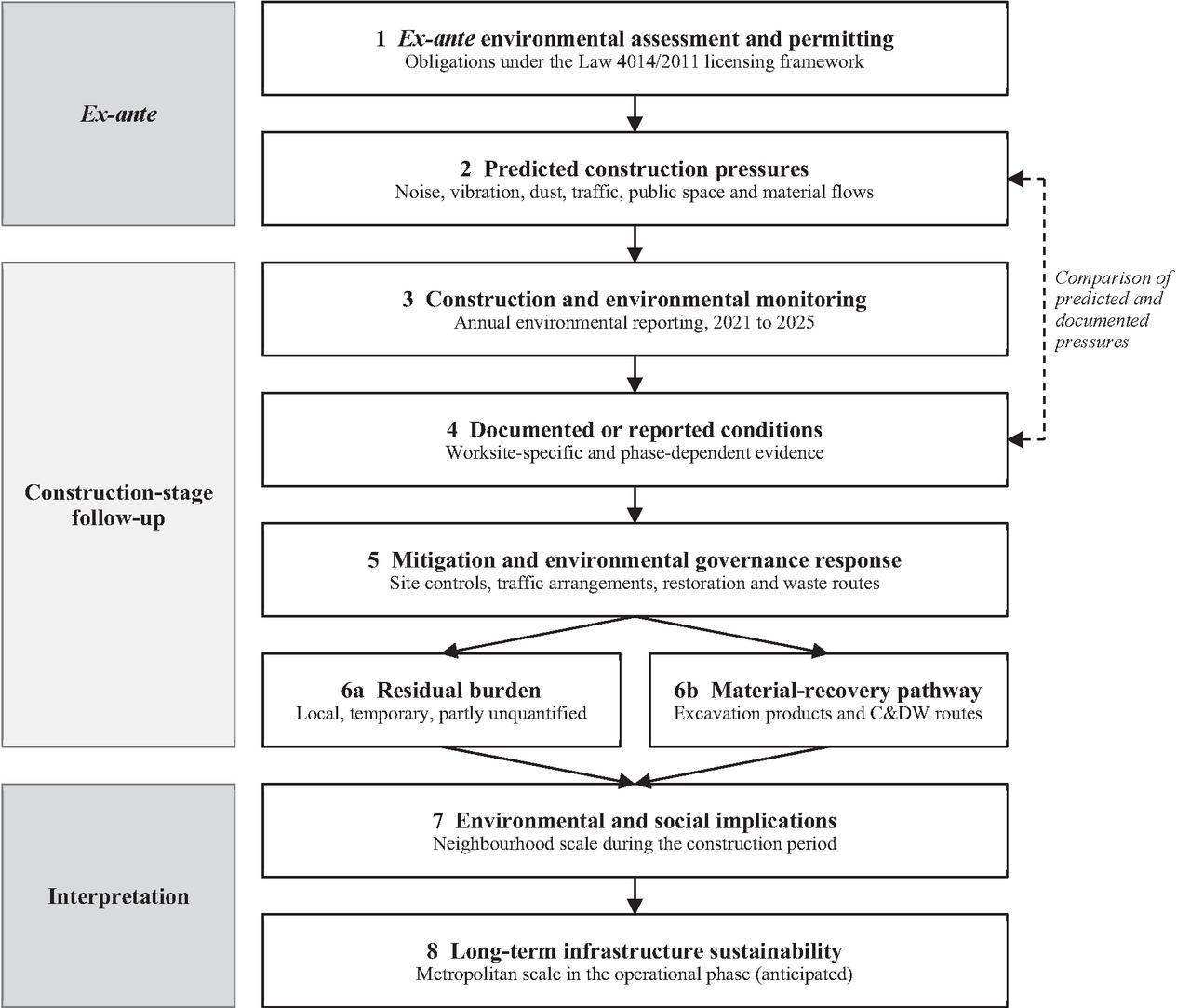
Figure 1 Integrated analytical framework linking ex-ante assessment, construction-stage follow-up, material recovery and long-term sustainability. Shaded bands indicate the analytical phase to which each stage belongs. At the residual stage, the framework distinguishes the burden that remains after mitigation from the resource-recovery pathway through which part of the material burden is redirected.
4 Results and Comparative Assessment
4.1 Anticipated and Documented Construction Pressures
Table 2 consolidates the comparison between anticipated and documented construction pressures for Section A of Line 4. Across the five categories of pressure unrelated to material flows, the permitting framework anticipated effects of the kind associated with urban underground construction, and the construction-stage documentation confirms that corresponding management mechanisms were in place. Within the evidence assembled for this study, the documentation does not establish the measured performance of those mechanisms, since quantitative monitoring results were not available at a resolution that would allow effectiveness to be verified site by site and year by year. The comparison therefore confirms the correspondence between anticipated categories of pressure and documented management responses, while the correspondence between anticipated and actual magnitudes remains open.
Table 2. Anticipated and documented construction-stage pressures in Section A of Athens Metro Line 4
| Pressure | Ex-ante expectation | Documented or reported condition | Management response | Evidence type and verifiability | Spatial and temporal scale |
| Noise and vibration | Anticipated near active worksites | Monitored through project procedures | Monitoring and operational mitigation | Implementation documented. Effectiveness verifiable only where site measurements are reported | Worksite-specific. Varies with phase and intensity of works |
| Dust and air quality | Anticipated from excavation, material handling and haulage | Construction dust management recorded | Watering, covered transport and site controls | Documented and qualitative. Particulate concentrations not available | Worksite- and route-specific. Varies with excavation volume |
| Traffic and access | Anticipated local and temporary disruption | Varies by worksite and phase | Traffic arrangements and site management | Documented and phase-dependent. No project-wide measure | Worksite-specific. Changes as works progress |
| Public space and urban vegetation | Anticipated temporary occupation and disturbance | Site-specific effects recorded | Restoration and landscaping obligations | Documented where specified. Completion assessable only at reinstatement | Site-specific. Extends over the construction period |
| Archaeological and utility works | Anticipated as sources of C&DW | Recorded as the origin of a separate C&DW stream | Separate C&DW management route | Documented in the 2025 reporting | Site-specific. Linked to surface works |
| Excavation products | Anticipated as a large material flow | Destinations recorded as quarry restoration, fill and cover and cement production. Positive balance reported | Reuse and alternative uses | Destinations documented and balance reported. Quantities not assembled | Project-wide flow with destinations outside the project area |
| C&DW | Anticipated from construction, archaeology and utilities | Generated in specific activities | Transfer to licensed management facilities | Documented up to the point of transfer | Activity-specific |
| Social reactions | Nuisance and access concerns anticipated | Require attribution to an identifiable source | Communication and mitigation | No representative measure of acceptance | Neighborhood scale |
C&DW = construction and demolition waste, including excavation waste. Ex-ante expectations are identified from the obligations of the environmental permitting framework. Documented and reported conditions refer to the annual environmental reports of Elliniko Metro S.A. for 2021 to 2025, and material-flow information is drawn from the 2024 and 2025 reports. Author’s analysis based on Elliniko Metro S.A. (2024, 2025).
Noise and vibration were anticipated at active worksites and are likely to be the pressures most directly experienced by residents adjacent to surface works and station construction. The documentation records that they were monitored through project procedures and addressed through operational mitigation, which establishes that the monitoring obligation was implemented. The material reviewed does not provide the site-specific measurements needed to compare observed levels with predicted levels or with limit values, so that the comparison envisaged in scoping practice, which requires sensitive receptors to be identified and levels to be predicted for each phase of works (Vardopoulos, 2019), cannot be completed. The effect is worksite-specific and temporally variable, depending on the phase and intensity of works at each location. Its connection with local social burden is direct, because noise and vibration bring construction into the domestic sphere, and it is precisely for these pressures that the absence of published measurements most constrains the assessment of residual effect.
Dust and related air-quality pressures were anticipated from excavation, material handling and haulage. The documentation records site controls, watering and the covered transport of materials, measures that correspond to the dust-control proposals formulated in scoping practice (Vardopoulos, 2019). The evidence is qualitative, since it demonstrates the application of measures without quantifying particulate concentrations at receptors, and the effectiveness of dust control cannot therefore be verified from the material reviewed. Dust is both worksite-specific and route-specific, because haulage extends the pressure beyond the site boundary along transport corridors, and it can be expected to vary with the volume of excavation in each period. Its social relevance is linked to comfort, cleanliness and perceived health risk, dimensions that the literature associates with community concern about construction waste and airborne pollutants (Tafesse et al., 2022).
Traffic and access disruption was anticipated as a local and temporary effect, and the documentation indicates that its manifestation varied by worksite and phase and that it was addressed through traffic arrangements and site management. It is the pressure least amenable to a single project-wide characterization, because the configuration of diversions, lane closures, parking restrictions and pedestrian routes can be expected to differ between worksites and to change as works progress. Its social relevance extends beyond nuisance to accessibility and local economic activity, and scoping practice treats temporary disruption to pedestrians, cyclists and road users, heavy goods vehicle movements and parking supply as distinct assessment topics (Vardopoulos, 2019). No data on effects for local businesses were available to this study, and the relationship between access disruption and local economic activity remains inferred, consistent with the association between construction activity and traffic congestion reported in the literature (Tafesse et al., 2022).
The temporary occupation of public space and the disturbance of urban vegetation were anticipated and are subject to restoration and landscaping obligations, which the documentation records where they are specified. Their fulfilment can be assessed only as sections of the works are completed, and for the reporting period examined the evidence concerns the existence of obligations more than their completed outcomes. Archaeological investigations and utility relocations form a further category of works, whose principal documented consequence for this analysis is the generation of C&DW as a distinct material stream, examined in Section 4.2. Both categories are site-specific, and their social relevance concerns the perceived quality and fairness of the urban environment during construction and the eventual reinstatement of public space.
Read together, the non-material pressures display a consistent pattern, in which anticipated categories correspond to documented management responses, the evidence is predominantly qualitative, effects are worksite-specific and phase-dependent, and effectiveness remains unverified. The pattern is itself a finding about the informational structure of construction-stage follow-up, which records compliance more fully than outcomes, and it defines the first limit on what a comparison between predicted and documented impacts can establish for this project.
4.2 Excavation Products and C&DW
The clearest documented outcome concerns material flows. The 2024 and 2025 environmental reports state that excavation materials generated by the project were used in other projects and activities, including quarry restoration, fill and cover applications, and cement production, and the operator characterizes the result as a positive balance of excavated materials (Elliniko Metro S.A., 2024, 2025). The 2025 reporting further distinguishes C&DW arising from archaeological works and utility relocations and records its transfer to appropriately licensed management facilities (Elliniko Metro S.A., 2025). These statements establish that excavated material was directed to identified uses, that the operator treated excavation products and C&DW as separate streams and that the C&DW stream entered the licensed management system. In the form available to this analysis, they do not establish the quantities involved, the proportion of excavated material directed to each destination, the transport distances or the legal basis under which each destination was used.
Each documented destination corresponds to a recognized circular-economy function, although of different kinds (see Figure 2). Quarry restoration uses excavated material to rehabilitate degraded extraction sites, an outlet foreseen in Greek C&DW management practice and placed by the international literature among the lower-grade but high-volume applications of recovered material (Papamichael et al., 2023; Pavlides et al., 2023). Fill and cover applications substitute excavated material for primary fill and correspond to the backfilling operations recognized in European waste law as a form of material recovery (Directive 2008/98/EC, 2008; Ivannikov et al., 2019). The use of excavated material in cement production connects the project with an industrial sector that Greek policy analysis regards as a potential anchor of circular-economy strategies for construction-related materials (Pavlides et al., 2023). In all three cases, the environmental benefit derives mainly from the substitution of primary materials and from the avoidance of disposal, and its magnitude depends on the volumes involved, the quality of the substituted material and the transport burden associated with each route (Ghisellini et al., 2018; López Ruiz et al., 2020).
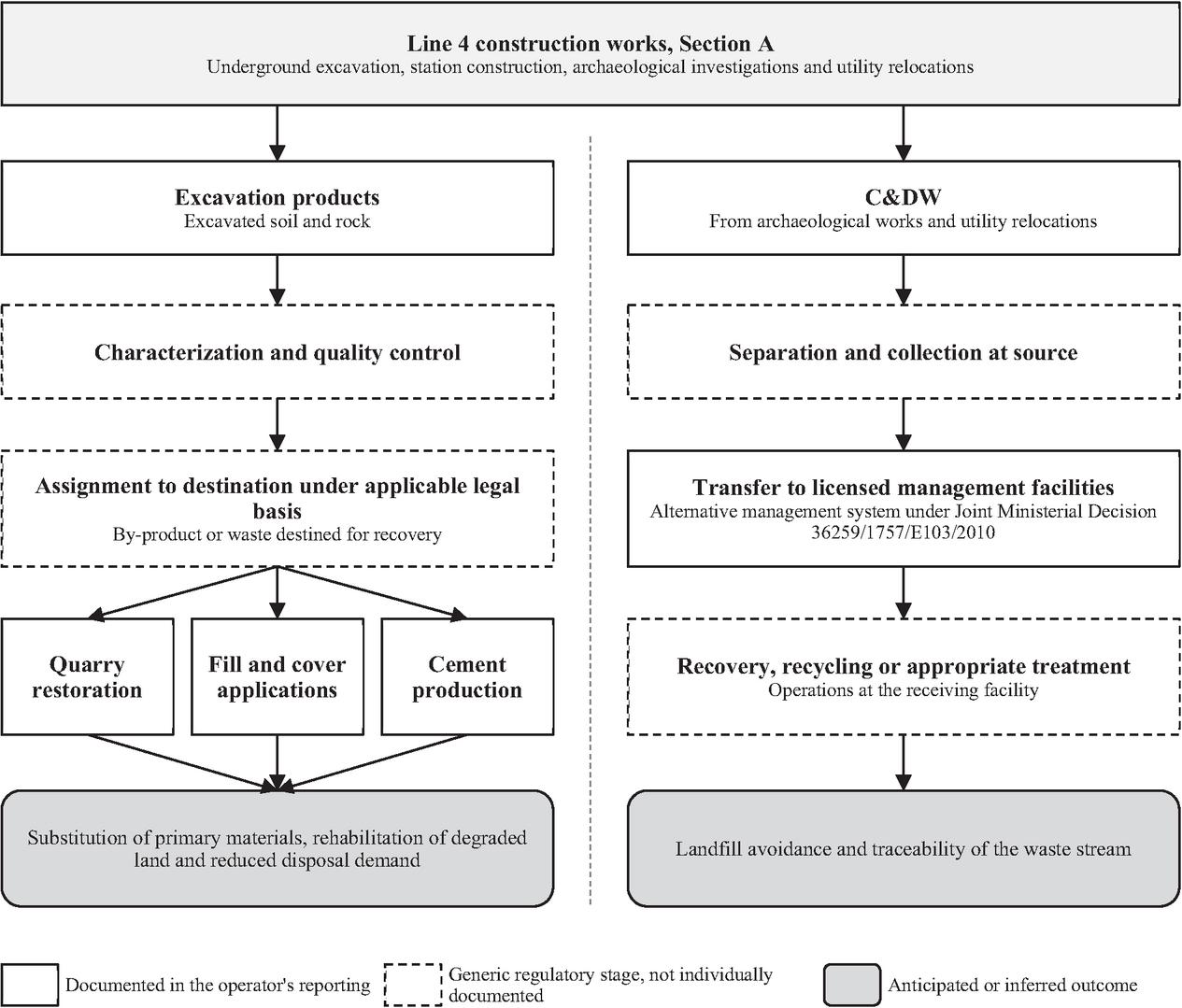
Figure 2 Material pathways for excavation products and C&DW in Section A of Athens Metro Line 4. C&DW = construction and demolition waste, including excavation waste. Solid outlines denote stages documented in the operator’s reporting, dashed outlines denote stages of the generic regulatory pathway that are not individually documented for Line 4, and shaded boxes denote anticipated or inferred outcomes. Author’s elaboration based on Elliniko Metro S.A. (2024, 2025), Directive 2008/98/EC (2008) and Pavlides et al. (2023).
The separation between excavation products and C&DW in the operator’s reporting is analytically necessary. If the entire excavated volume were counted as C&DW, the project would appear to generate a very large waste stream and its circularity would be measured solely by the recovery rate of that stream, while treating all excavated material as a product would obscure the waste-management obligations attached to any portions that are discarded or contaminated. The separation nevertheless requires qualification, because the exclusion of uncontaminated excavated soil from waste law applies only to material used in its natural state on the site of excavation, so that material directed to other projects must be characterized as a by-product meeting the conditions of the Waste Framework Directive or as waste destined for recovery (Directive 2008/98/EC, 2008), and because restoration of inactive quarries is also an outlet foreseen within the Greek C&DW management system (Pavlides et al., 2023). The documented destinations alone therefore do not determine the legal status of the material, and the distinction is best understood as one of regulatory route and documentation, whose analytical value depends on reporting that states, for each destination, whether the material was managed as a by-product or as recovered waste.
The C&DW stream is analytically distinct, since it arises from archaeological works and utility relocations, activities that disturb existing urban surfaces and networks and that belong to the category of urban technical works which Pavlides et al. (2023) associate with road construction waste, including asphalt mixtures, gravel and sand. Its transfer to licensed facilities places it within the alternative management system established under Joint Ministerial Decision 36259/1757/E103/2010, whose units sort recyclable fractions, produce secondary materials and supply inert material for the rehabilitation of degraded land (Pavlides et al., 2023). Transfer to a licensed facility establishes compliance with the management obligation and improves the traceability of the stream, although it does not by itself establish the final recovery outcome, which depends on the operations performed at the receiving facility, so that the C&DW pathway should be read as documented up to the point of transfer and as generic beyond it.
These findings support a qualified answer to the question of whether circular management converts part of the construction burden into environmental benefit. The conversion is real in kind, since excavated material that would otherwise require disposal was directed to uses that substitute primary resources and restore degraded land, in accordance with the priority that European and Greek law assigns to reuse and recovery over disposal (Directive 2008/98/EC, 2008; Law 4819/2021, 2021), although its magnitude cannot yet be stated. A measurable benefit requires the indicators set out in Table 3, beginning with the mass balance of excavated material, its allocation to each destination and the associated transport distances, and extending to estimates of primary-material substitution and avoided emissions based on verified factors (Loizia et al., 2021; Papamichael et al., 2023). The data required are in principle generated by the project itself, since Greek public-works and environmental legislation already require studies that quantify excavation and embankment volumes (Pavlides et al., 2023), and the operator’s reference to a positive balance of excavated materials could become a verifiable measure once these data are published.
Table 3. Excavation products and C&DW within the circular material-management framework
| Dimension | Excavation products | C&DW from archaeological works and utility relocations |
| Origin in Line 4 works | Excavation for the underground works | Archaeological investigations and utility relocations |
| Regulatory framing | Excluded from waste law only when reused in the natural state on the site of excavation. Use elsewhere requires by-product status or management as waste destined for recovery | Waste under Joint Ministerial Decision 36259/1757/E103/2010, managed through licensed alternative management systems |
| Documented management route | Quarry restoration, fill and cover applications and cement production | Transfer to appropriately licensed management facilities |
| Operator characterization | Positive balance of excavated materials (reported) | Separate management of the stream (documented) |
| Position in the waste hierarchy | Reuse or other material recovery, depending on the legal basis of each destination | Recycling or other recovery at the receiving facility, not documented beyond transfer |
| Circular-economy function | Substitution of primary materials, rehabilitation of degraded land and reduced demand for disposal capacity | Landfill avoidance, traceability and potential production of secondary materials |
| Indicators for follow-up | Utilization rate = utilized excavation products / total excavation products 100. Mass directed to quarry restoration, to fill and cover and to cement production. Estimated primary-material substitution. Estimated avoided CO2e | C&DW recovery or management rate = recovered or appropriately managed C&DW / generated C&DW 100 |
| Data requirements | Mass balance, destination records, legal basis of each destination, transport distances and verified emission factors | C&DW records and facility documentation of final operations |
| Evidentiary status in this study | Destinations documented and balance reported. Quantities not assembled | Transfer documented. Final recovery outcome not documented |
C&DW = construction and demolition waste, including excavation waste. CO2e = carbon dioxide equivalent. The indicators are proposed for quantitative follow-up and are not populated in this study. Author’s analysis based on Elliniko Metro S.A. (2024, 2025), Directive 2008/98/EC (2008), Joint Ministerial Decision 36259/1757/E103/2010 (2010), Papamichael et al. (2023) and Pavlides et al. (2023).
4.3 Construction Burdens, Governance Responses and Social Relevance
Table 4 relates construction-stage burdens to their governance responses, to the benefits anticipated from operation and to their potential implications for social acceptance. Its final columns are interpretive, and their purpose is to make explicit the relationships that the evidence permits to be hypothesized, without presenting them as findings about public opinion. Reported social reactions are included only as a category requiring source attribution, since no systematic record of complaints, consultation outcomes or survey responses was available to the study.
Table 4. Construction burdens, governance responses, anticipated benefits and potential implications for social acceptance
| Dimension | Construction-stage burden | Governance or mitigation response | Anticipated operational benefit | Potential implication for acceptance | Evidence status |
| Local environmental quality | Noise, vibration and dust at neighborhood scale, worksite-specific and phase-dependent | Monitoring, watering, covered transport and site controls | Potential reduction of car-related emissions through modal shift, at metropolitan scale after commissioning | Tolerance of nuisance conditioned by visible mitigation and accessible information | Measures documented, outcomes not measured, implication interpretive |
| Accessibility and mobility | Disruption of access around worksites, phase-dependent | Traffic arrangements and site management | Improved accessibility by rail, at metropolitan scale after commissioning | Burdens borne locally before benefits accrue may weaken local support | Measures documented, benefit anticipated, implication interpretive |
| Public space and urban vegetation | Temporary occupation and disturbance, site-specific | Restoration and landscaping obligations | Reinstated public space, at local scale after completion | Perceived fairness and quality of the urban environment | Obligations documented, outcomes pending |
| Material resources | Large excavated volume and associated haulage, project-wide during construction | Reuse of excavation products and licensed C&DW management | Reduced demand for primary materials and disposal capacity, at regional scale during construction | Indirect, and visible to residents only if communicated | Destinations documented, quantities not assembled |
| Procedural and distributive fairness | Concentration of burdens on host neighborhoods | Environmental reporting and public communication | Legitimacy of the metropolitan project | Trust and perceived fairness depend on transparency and responsiveness | Interpretive, requiring survey or consultation data |
C&DW = construction and demolition waste, including excavation waste. Entries in the last two columns are interpretive propositions and are not findings about public opinion. Author’s elaboration based on Banister (2008), Moustairas et al. (2022), Pavlides et al. (2023), Vanclay (2003, 2016) and Elliniko Metro S.A. (2024, 2025).
The reading of burdens and responses suggests that the pressures most likely to shape local perception, namely noise, vibration, dust and access disruption, are also those for which the documentation records management measures without measured outcomes, so that the component of governance most visible to residents, the demonstrable reduction of nuisance, is the component least documented in the material reviewed. The material-management outcomes, which are the best documented, bear on social experience mainly indirectly, through the avoidance of uncontrolled deposition and through the pattern of haulage, and they are unlikely to be perceived by neighborhood residents unless they are communicated. The benefits used to justify the project, including improved accessibility and reduced reliance on private vehicles, are anticipated at metropolitan scale and will be experienced after commissioning, whereas the burdens are experienced at neighborhood scale during construction (Banister, 2008; Mitoula & Papavasileiou, 2023). Each of these relationships separates, in space or in time, the documented governance of the project from the experience of those who host its construction.
The social relevance of environmental governance during construction therefore depends on communication as much as on compliance. Measures that are implemented but not reported in terms meaningful to residents, and circular outcomes that are documented but not communicated, contribute little to the perceived fairness of the construction process, whereas publicly available, site-specific information on nuisance levels and on the destination of excavated material could strengthen the procedural dimension of acceptance that the SIA literature emphasizes (Vanclay, 2003, 2016). This proposition remains interpretive, and its empirical test would require survey or consultation data collected at the neighborhood scale.
5 Discussion
5.1 Temporal and Spatial Asymmetry as the Organizing Problem of Construction-Stage Assessment
The Line 4 case illustrates in concrete form the asymmetry that the megaproject literature identifies in general terms. The construction pressures documented in the results are intense, spatially concentrated and temporary, while the benefits used to justify the project are dispersed across the metropolitan area and will accrue over the operational life of the line (Vickerman, 2008; Ward & Skayannis, 2019). This configuration corresponds to what reviews of megaproject sustainability describe as the difficulty of balancing economic, environmental and social considerations across stakeholders whose interests and time horizons diverge (Thounaojam & Laishram, 2022; Wang et al., 2020), and to the recognition that megaprojects can have positive and negative consequences for the environment and for surrounding communities at the same time (Vardopoulos et al., 2024).
The analytical consequence is that the net balance of a project’s costs and benefits, however favorable at metropolitan scale, cannot settle the question of local burden. Aggregation across scales conceals distributional effects, and an assessment that reports project-level benefits alongside neighborhood-level burdens without distinguishing their scales implies an equivalence that the evidence does not support. The framework proposed here addresses this problem by requiring every pressure to be characterized by spatial and temporal scale before its relevance is interpreted, a requirement already present in scoping methodologies that rate effects by geographic extent and duration (Vardopoulos, 2019), and one that the construction-stage reporting examined here satisfies only partially.
The Greek context gives this issue additional weight. Mega infrastructure provision in Greece has developed through successive investment cycles since accession to the European Union (Skayannis, 2021), and episodes such as the 2004 Olympic Games have left a legacy of critical assessment of the medium-term urban effects of megaprojects in Athens (Souliotis et al., 2014). Research on the social evaluation of Greek mega infrastructure holds that genuine sustainable progress is unattainable without broad social contribution and that society is the final recipient of such projects (Papavasileiou, 2024). In this light, construction-stage follow-up forms part of the relationship between a project and the society that will use it, and its quality bears on the legitimacy of the infrastructure as well as on its environmental performance.
5.2 Environmental Governance and Material Circularity as Mediating Mechanisms
Environmental governance during construction mediates between burden and outcome in two ways, by reducing the magnitude of pressures through mitigation and by generating the information on which any later evaluation depends. The Line 4 documentation shows the first function to be institutionalized, since measures for dust, traffic, public space and material management are recorded, while the second function is developed unevenly, since implementation is documented more consistently than measured performance. The imbalance reflects a wider pattern in the governance of construction and demolition waste, in which incoherent data quality and limited reporting of quantities have been identified as obstacles to evaluating recovery performance across the European Union (Villoria Sáez & Osmani, 2019), and in which Greek assessments have noted the lack of reliable information on quantities as a weakness of the national system (Pavlides et al., 2023). Indicator-based monitoring of the kind proposed for waste strategies and for circularity in construction offers a route to closing this gap (Loizia et al., 2021; Papamichael et al., 2023).
Material circularity occupies a distinctive position within this governance. Of the construction-stage pressures examined, excavation is the one whose environmental consequence can be partly reversed in sign, because the same material that constitutes a disposal burden when discarded becomes a resource input when it is directed to restoration, filling or industrial use (Ghisellini et al., 2018; Purchase et al., 2022). This is the specific sense in which a construction burden can be transformed into a resource flow, and it explains why the separation of excavation products from C&DW matters for the environmental interpretation of the project. The literature also sets limits to this transformation, since low-grade applications such as filling and quarry restoration retain less material value than high-grade recycling, reliance on backfilling can inflate recovery performance and transport distances can offset the gains of substitution (Papamichael et al., 2023; Pavlides et al., 2023; Zhang et al., 2022). In a national context where the circular economy has been adopted only partially in construction-related waste and where landfilling has remained dominant (Pavlides et al., 2023), a documented diversion of excavated material from disposal to use nevertheless represents a meaningful departure from established practice, provided that its scale and legal basis are made transparent.
Circularity also modifies the temporal asymmetry described above. Most operational benefits of Line 4 lie in the future, whereas the environmental benefit associated with the reuse of excavated material accrues during construction itself, in the form of avoided disposal and substituted primary materials. Circularity thus introduces a construction-stage benefit into a period otherwise characterized by burdens, although its beneficiaries, located at quarries, receiving projects and cement plants, differ from the residents who experience construction pressures. The spatial asymmetry is thereby relocated, and the relocation is itself a matter for distributive analysis, particularly where haulage routes and receiving sites lie close to other residential communities. Metropolitan and regional authorities are well placed to address such effects, since cities and regions shape the circular-economy transition through their responsibilities for local public services such as transport and solid waste (OECD, 2020).
5.3 Interpreting Social Acceptance without Representative Data
The absence of a representative survey defines the principal methodological boundary of this study and determines what can be said about social acceptance. Acceptance, understanding and satisfaction are empirical attributes of populations, and their measurement for Greek mega infrastructure and waste facilities has required dedicated survey instruments and statistical analysis (Moustairas et al., 2022; Papavasileiou, 2024). Documentary evidence produced by a project operator cannot substitute for such data, and converting reported reactions or the existence of mitigation measures into an acceptance score would attribute to the evidence a meaning that it does not carry.
What the analysis can contribute is a structured set of propositions about the conditions under which acceptance is likely to be formed. The literature indicates that acceptance of infrastructure and waste facilities is associated with perceived local benefits, environmental consciousness and incentives (Moustairas et al., 2022), that opposition is more likely where burdens are perceived as imposed or inequitably distributed (Jia et al., 2011; Jordhus-Lier, 2015) and that outcomes for affected communities improve when projects anticipate and manage their social consequences throughout the project cycle (Vanclay, 2003, 2016). Read against these findings, the Line 4 evidence identifies the construction-stage pressures on which local judgements are most likely to depend, the governance responses available to influence them and the informational gaps that limit their visibility. These are hypotheses for empirical testing, and they define the variables that a neighborhood-scale survey or a systematic analysis of complaints and consultation records would need to capture.
The distinction between residents and users adds a further consideration. The populations that will use Line 4 after commissioning overlap only partly with those who experience its construction, and acceptance measured among users of an operating system may differ from the judgements formed by residents during construction. The operating Athens Metro has been examined with respect to its contribution to sustainable development (Mitoula & Papavasileiou, 2023), and the social evaluation of Greek mega infrastructure has considered the perceptions of both society at large and project users (Papavasileiou, 2024), which suggests that a complete assessment of Line 4 would require data at both stages of the project and at both spatial scales.
5.4 Transferability and Limitations
Within urban transport infrastructure, the analytical sequence applies directly to other underground and surface projects in which excavation volumes are large and worksites are embedded in residential fabric. It is compatible with indicator systems proposed for evaluating megaproject social responsibility and sustainable construction performance (Lin et al., 2017; Wu et al., 2018), and its emphasis on documented material routes corresponds to the European protocol for construction and demolition waste, which prioritizes waste identification, separation and collection, optimized logistics and quality management (European Commission, 2018; Papamichael et al., 2023). Its central requirement, that every stage be supported by evidence of the appropriate type, is independent of the transport sector and can be applied wherever construction-stage reporting exists.
The framework is also transferable to waste-management infrastructure, including waste treatment plants, sanitary landfills, landfills for residues, waste transfer stations and waste-to-energy plants. In such facilities, the stages of predicted pressure, documented condition, management response, residual effect, material pathway and social relevance can be retained, although the dominant pressures, the material flows and the temporal profile differ, since these facilities tend to concentrate burdens locally throughout their operating life, whereas the burdens of a metro line are concentrated in construction. Public acceptance of such facilities has been shown to depend on environmental awareness, local development benefits and incentives (Moustairas et al., 2022), and Greek analyses note that inadequate public awareness may lead to protests and to delays in waste-management projects (Pavlides et al., 2023), which underlines the relevance of the social component of the framework.
Several limitations qualify these conclusions. The analysis depends on operator-produced reporting, whose scope and resolution determine what can be compared, and it does not include independent measurements. Ex-ante expectations were identified from permitting obligations, which recover the categories of anticipated pressure more reliably than their predicted magnitudes. Quantities of excavation products and C&DW, the legal basis of each destination and transport distances were not available in a form that permits the calculation of circularity indicators, and the social dimension is developed conceptually because no representative survey, consultation record or systematic complaints analysis was undertaken. Claims regarding long-term mobility benefits, property values, local economic effects and public acceptance would each require dedicated datasets. These limitations define a research agenda comprising the population of the indicators in Table 3, the extension of the time frame to the operational phase and the collection of neighborhood-scale social data, consistent with the recommendation that sustainability assessment of megaprojects should extend beyond construction and initial operation (Vardopoulos et al., 2024).
6 Conclusions
Comparison between anticipated and documented construction-stage impacts of Athens Metro Line 4 establishes a correspondence between the categories of pressure foreseen in the permitting framework and the management responses recorded during construction for noise and vibration, dust, traffic and access, public space and vegetation, and archaeological and utility works. It does not establish a correspondence between predicted and actual magnitudes, because the documentation assembled for the analysis records the implementation of measures more fully than their measured outcomes. Environmental follow-up matters for this reason, since it is the only stage at which ex-ante expectations can be confronted with evidence, and the quality of that confrontation depends on reporting that is quantitative, site-specific and temporally resolved.
The case shows that construction-stage material management can alter the environmental interpretation of an urban mega infrastructure project. The documented direction of excavation products to quarry restoration, fill and cover applications, and cement production, together with the separate transfer of C&DW from archaeological works and utility relocations to licensed facilities, demonstrates a concrete pathway through which part of the construction burden becomes a resource flow during construction itself. Separating excavation products from C&DW is necessary for this reading, because it follows the regulatory route of excavated material and prevents the whole excavated volume from being counted as waste, and the separation becomes fully meaningful only where reporting states the quantities, destinations and legal basis of each flow.
On social acceptance, the study reaches conclusions at the conceptual level only. The evidence identifies the burdens on which neighborhood judgements are likely to depend, the governance responses available to influence them and the informational gaps that limit their visibility, and it shows that the benefits used to justify the project and the burdens imposed by its construction fall on different populations at different times. It does not measure acceptance, and it does not permit reported reactions to be converted into acceptance scores.
The analytical sequence linking predicted pressure, documented condition, management response, residual effect, resource-recovery pathway and social relevance is transferable to other mega infrastructure projects and to waste-management facilities, provided that each stage is supported by evidence of the appropriate type and that measured, reported, inferred and anticipated elements are kept distinct. For Line 4 and comparable projects, the practical implication is that construction-stage reporting should be designed from the outset to support evaluation, with mass balances for excavated material, site-specific measurements for nuisance pressures and systematic records of public complaints and consultation.
References
Banister, D. (2008). The sustainable mobility paradigm. Transport Policy, 15(2), 73–80. https://doi.org/10.1016/j.tranpol.2007.10.005
Chen, K., Wang, J., Yu, B., Wu, H., & Zhang, J. (2021). Critical evaluation of construction and demolition waste and associated environmental impacts: A scientometric analysis. Journal of Cleaner Production, 287, 125071. https://doi.org/10.1016/j.jclepro.2020.125071
Cooper, L. M., & Sheate, W. R. (2002). Cumulative effects assessment: A review of UK environmental impact statements. Environmental Impact Assessment Review, 22(4), 415–439. https://doi.org/10.1016/S0195-9255(02)00010-0
del Cerro Santamaría, G. (2021). Megaprojects, ecology, and the environment: Dimensions of sustainability in global cities. In F. Trapani, N. Mohareb, F. Rosso, D. Kolokotsa, S. Maruthaveeran, & M. Ghoneem (Eds.), Advanced studies in efficient environmental design and city planning (pp. 135–144). Springer. https://doi.org/10.1007/978-3-030-65181-7_11
Denicol, J., Davies, A., & Krystallis, I. (2020). What are the causes and cures of poor megaproject performance? A systematic literature review and research agenda. Project Management Journal, 51(3), 328–345. https://doi.org/10.1177/8756972819896113
Directive 2008/98/EC of the European Parliament and of the Council of 19 November 2008 on waste and repealing certain Directives. (2008). Official Journal of the European Union, L 312, 3–30. https://eur-lex.europa.eu/eli/dir/2008/98/oj
Directive 2011/92/EU of the European Parliament and of the Council of 13 December 2011 on the assessment of the effects of certain public and private projects on the environment. (2011). Official Journal of the European Union, L 26, 1–21. https://eur-lex.europa.eu/eli/dir/2011/92/oj
Directive 2014/52/EU of the European Parliament and of the Council of 16 April 2014 amending Directive 2011/92/EU on the assessment of the effects of certain public and private projects on the environment. (2014). Official Journal of the European Union, L 124, 1–18. https://eur-lex.europa.eu/eli/dir/2014/52/oj
Elliniko Metro S.A. (2024). Ετήσια περιβαλλοντική έκθεση 2024 [Annual environmental report 2024].
Elliniko Metro S.A. (2025). Ετήσια περιβαλλοντική έκθεση 2025 [Annual environmental report 2025].
European Commission. (2018). EU construction and demolition waste protocol and guidelines. https://single-market-economy.ec.europa.eu/news/eu-construction-and-demolition-waste-protocol-2018-09-18_en
Fatta, D., Papadopoulos, A., Avramikos, E., Sgourou, E., Moustakas, K., Kourmoussis, F., Mentzis, A., & Loizidou, M. (2003). Generation and management of construction and demolition waste in Greece—An existing challenge. Resources, Conservation and Recycling, 40(1), 81–91. https://doi.org/10.1016/S0921-3449(03)00035-1
Fei, W., Opoku, A., Agyekum, K., Oppon, J. A., Ahmed, V., Chen, C., & Lok, K. L. (2021). The critical role of the construction industry in achieving the sustainable development goals (SDGs): Delivering projects for the common good. Sustainability, 13(16), 9112. https://doi.org/10.3390/su13169112
Ghisellini, P., Ripa, M., & Ulgiati, S. (2018). Exploring environmental and economic costs and benefits of a circular economy approach to the construction and demolition sector. A literature review. Journal of Cleaner Production, 178, 618–643. https://doi.org/10.1016/j.jclepro.2017.11.207
Glasson, J., Therivel, R., & Chadwick, A. (2013). Introduction to Environmental Impact Assessment. 4th ed. Abingdon: Routledge.
Hansen, E., & Wood, G. (2016). Understanding EIA scoping in practice: A pragmatist interpretation of effectiveness. Environmental Impact Assessment Review, 58, 1–11. https://doi.org/10.1016/j.eiar.2016.01.003
Ivannikov, A. L., Kongar-Syuryun, C., Rybak, J., & Tyulyaeva, Y. (2019). The reuse of mining and construction waste for backfill as one of the sustainable activities. IOP Conference Series: Earth and Environmental Science, 362(1), 012130. https://doi.org/10.1088/1755-1315/362/1/012130
Jia, G., Yang, F., Wang, G., Hong, B., & You, R. (2011). A study of mega project from a perspective of social conflict theory. International Journal of Project Management, 29(7), 817–827. https://doi.org/10.1016/j.ijproman.2011.04.004
Joint Ministerial Decision 36259/1757/E103/2010. (2010). Μέτρα, όροι και πρόγραμμα για την εναλλακτική διαχείριση των αποβλήτων από εκσκαφές, κατασκευές και κατεδαφίσεις [Measures, terms and programme for the alternative management of waste from excavation, construction and demolition]. Government Gazette of the Hellenic Republic, B 1312/24.08.2010.
Jordhus-Lier, D. (2015). Community resistance to megaprojects: The case of the N2 Gateway project in Joe Slovo informal settlement, Cape Town. Habitat International, 45, 169–176. https://doi.org/10.1016/j.habitatint.2014.02.006
Kabirifar, K., Mojtahedi, M., Wang, C., & Tam, V. W. Y. (2020). Construction and demolition waste management contributing factors coupled with reduce, reuse, and recycle strategies for effective waste management: A review. Journal of Cleaner Production, 263, 121265. https://doi.org/10.1016/j.jclepro.2020.121265
Kennedy, A. J., & Ross, W. A. (1992). An approach to integrate impact scoping with environmental impact assessment. Environmental Management, 16(4), 475–484. https://doi.org/10.1007/BF02394123
Law 4014/2011. (2011). Περιβαλλοντική αδειοδότηση έργων και δραστηριοτήτων [Environmental licensing of projects and activities]. Government Gazette of the Hellenic Republic, A 209/21.09.2011.
Law 4819/2021. (2021). Ολοκληρωμένο πλαίσιο για τη διαχείριση των αποβλήτων [Integrated framework for waste management]. Government Gazette of the Hellenic Republic, A 129/23.07.2021.
Lin, H., Zeng, S., Ma, H., Zeng, R., & Tam, V. W. Y. (2017). An indicator system for evaluating megaproject social responsibility. International Journal of Project Management, 35(7), 1415–1426. https://doi.org/10.1016/j.ijproman.2017.04.009
Loizia, P., Voukkali, I., Zorpas, A. A., Navarro Pedreño, J., Chatziparaskeva, G., Inglezakis, V. J., Vardopoulos, I., & Doula, M. (2021). Measuring the level of environmental performance in insular areas, through key performed indicators, in the framework of waste strategy development. Science of The Total Environment, 753, 141974. https://doi.org/10.1016/j.scitotenv.2020.141974
López Ruiz, L. A., Roca Ramón, X., & Gassó Domingo, S. (2020). The circular economy in the construction and demolition waste sector - A review and an integrative model approach. Journal of Cleaner Production, 248, 119238. https://doi.org/10.1016/j.jclepro.2019.119238
Ma, J., Zhang, G., & Ren, F. (2020). Study on the characteristics and reduction measures of construction waste generated in subway engineering. IOP Conference Series: Earth and Environmental Science, 555(1), 012041. https://doi.org/10.1088/1755-1315/555/1/012041
Mitoula, R., & Papavasileiou, A. (2023). Mega infrastructure projects and their contribution to sustainable development: The case of the Athens Metro. Economic Change and Restructuring, 56(3), 1943–1969. https://doi.org/10.1007/s10644-023-09493-w
Moustairas, I., Vardopoulos, I., Kavouras, S., Salvati, L., & Zorpas, A. A. (2022). Exploring factors that affect public acceptance of establishing an urban environmental education and recycling center. Sustainable Chemistry and Pharmacy, 25, 100605. https://doi.org/10.1016/j.scp.2022.100605
OECD. (2020). The circular economy in cities and regions: Synthesis report. OECD Publishing. https://doi.org/10.1787/10ac6ae4-en
Papamichael, I., Voukkali, I., Loizia, P., & Zorpas, A. A. (2023). Construction and demolition waste framework of circular economy: A mini review. Waste Management & Research, 41(12), 1728–1740. https://doi.org/10.1177/0734242X231190804
Papavasileiou, A. (2024). Μεγάλα έργα υποδομών και η συμβολή τους στη βιώσιμη ανάπτυξη: Η μελέτη περίπτωσης 12 μεγάλων έργων υποδομής στην Ελλάδα κάτω από το πρίσμα της κοινωνίας [Mega infrastructure projects and their contribution to sustainable development: The case study of 12 mega infrastructure projects in Greece under the prism of society] [Doctoral dissertation, Harokopio University of Athens]. National Archive of PhD Theses. https://doi.org/10.12681/eadd/56377
Pavlides, T., Vardopoulos, I., Papamichael, I., Voukkali, I., Stylianos, M., & Zorpas, A. A. (2023). Environmental sustainability assessment of excavation, construction, and demolition waste conditions and practices across Greece and Cyprus. IOP Conference Series: Earth and Environmental Science, 1196(1), 012037. https://doi.org/10.1088/1755-1315/1196/1/012037
Priemus, H. (2010). Mega-projects: Dealing with pitfalls. European Planning Studies, 18(7), 1023–1039. https://doi.org/10.1080/09654311003744159
Priemus, H., & van Wee, B. (2013). Mega-projects: High ambitions, complex decision-making, different actors, multiple impacts. In H. Priemus & B. van Wee (Eds.), International Handbook On Mega-Projects (pp. 1–8). Cheltenham: Edward Elgar Publishing. https://doi.org/10.4337/9781781002308.00006
Purchase, C. K., Al Zulayq, D. M., O’Brien, B. T., Kowalewski, M. J., Berenjian, A., Tarighaleslami, A. H., & Seifan, M. (2022). Circular economy of construction and demolition waste: A literature review on lessons, challenges, and benefits. Materials, 15(1), 76. https://doi.org/10.3390/ma15010076
Salet, W., Bertolini, L., & Giezen, M. (2013). Complexity and uncertainty: Problem or asset in decision making of mega infrastructure projects? International Journal of Urban and Regional Research, 37(6), 1984–2000. https://doi.org/10.1111/j.1468-2427.2012.01133.x
Skayannis, P. (2021). Mega infrastructure projects in Greece after its accession to the EU (1981–2021). Region & Periphery, 12(12), 41–63. https://doi.org/10.12681/rp.28887
Snell, T., & Cowell, R. (2006). Scoping in environmental impact assessment: Balancing precaution and efficiency? Environmental Impact Assessment Review, 26(4), 359–376. https://doi.org/10.1016/j.eiar.2005.06.003
Söderlund, J., Sankaran, S., & Biesenthal, C. (2017). The past and present of megaprojects. Project Management Journal, 48(6), 5–16. https://doi.org/10.1177/875697281704800602
Souliotis, N., Sayas, J., & Maloutas, T. (2014). Megaprojects, neoliberalization, and state capacities: Assessing the medium-term impact of the 2004 Olympic Games on Athenian urban policies. Environment and Planning C: Government and Policy, 32(4), 731–745. https://doi.org/10.1068/c1136r
Tafesse, S., Girma, Y. E., & Dessalegn, E. (2022). Analysis of the socio-economic and environmental impacts of construction waste and management practices. Heliyon, 8(3), e09169. https://doi.org/10.1016/j.heliyon.2022.e09169
Thounaojam, N., Devkar, G., & Laishram, B. (2022). A review of drivers of sustainability in mega infrastructure projects: An institutional approach. In Proceedings of 10th World Construction Symposium 2022 (pp. 27–38). https://doi.org/10.31705/WCS.2022.3
Thounaojam, N., & Laishram, B. (2022). Issues in promoting sustainability in mega infrastructure projects: A systematic review. Journal of Environmental Planning and Management, 65(8), 1349–1372. https://doi.org/10.1080/09640568.2021.1941810
United Nations. (2015). Transforming Our World: The 2030 Agenda for Sustainable Development (A/RES/70/1). https://www.un.org/ga/search/view_doc.asp?symbol=A/RES/70/1&Lang=E
Vanclay, F. (2003). International principles for social impact assessment. Impact Assessment and Project Appraisal, 21(1), 5–12. https://doi.org/10.3152/147154603781766491
Vanclay, F. (2016). The potential contribution of social impact assessment to megaproject developments. In M. Lehtonen, P.-B. Joly, & L. Aparicio (Eds.), Socioeconomic Evaluation of Megaprojects. Dealing with Uncertainties (pp. 199–216). Abingdon: Routledge. https://doi.org/10.4324/9781315622125-18
Vardopoulos, I. (2019). Environmental impact assessment scoping report. Residential complex in Rafina - Pikermi city, Greece. Sustainable Development, Culture, Traditions, 1a, 63–79. https://doi.org/10.26341/issn.2241-4002-2019-1a-5
Vardopoulos, I., Georgiou, C., Voukkali, I., Vassiliades, C., & Salvati, L. (2024). Case-based exploration of the nexus between transformative urban megadevelopments and sustainability. Theoretical and Empirical Researches in Urban Management, 19(3), 5–30. https://www.jstor.org/stable/27321372
Vickerman, R. W. (2008). Cost-benefit analysis and the wider economic benefits from mega-projects. In H. Priemus, B. Flyvbjerg, & B. van Wee (Eds.), Decision-Making on Mega-Projects (pp. 66–83). Cheltenham: Edward Elgar Publishing. https://doi.org/10.4337/9781848440173.00010
Villoria Sáez, P., & Osmani, M. (2019). A diagnosis of construction and demolition waste generation and recovery practice in the European Union. Journal of Cleaner Production, 241, 118400. https://doi.org/10.1016/j.jclepro.2019.118400
Wang, G., Wu, P., Wu, X., Zhang, H., Guo, Q., & Cai, Y. (2020). Mapping global research on sustainability of megaproject management: A scientometric review. Journal of Cleaner Production, 259, 120831. https://doi.org/10.1016/j.jclepro.2020.120831
Ward, J., & Skayannis, P. (2019). Mega transport projects and sustainable development: Lessons from a multi case study evaluation of international practice. Journal of Mega Infrastructure & Sustainable Development, 1(1), 27-53. https://doi.org/10.1080/24724718.2019.1623646
Winch, G. M. (2017). Megaproject stakeholder management. In B. Flyvbjerg (Ed.), The Oxford Handbook of Megaproject Management (pp. 339-361). Oxford: Oxford University Press. https://doi.org/10.1093/oxfordhb/9780198732242.013.14
Wood, G., Glasson, J., & Becker, J. (2006). EIA scoping in England and Wales: Practitioner approaches, perspectives and constraints. Environmental Impact Assessment Review, 26(3), 221–241. https://doi.org/10.1016/j.eiar.2005.02.001
Wu, G., Qiang, G., Zuo, J., Zhao, X., & Chang, R. (2018). What are the key indicators of mega sustainable construction projects? – A stakeholder-network perspective. Sustainability, 10(8), 2939. https://doi.org/10.3390/su10082939
Wu, H., Zuo, J., Zillante, G., Wang, J., Yuan, H., & Huo, X. (2019). Status quo and future directions of construction and demolition waste research: A critical review. Journal of Cleaner Production, 240, 118163.
Zhang, C., Hu, M., Di Maio, F., Sprecher, B., Yang, X., & Tukker, A. (2022). An overview of the waste hierarchy framework for analyzing the circularity in construction and demolition waste management in Europe. Science of the Total Environment, 803, 149892. https://doi.org/10.1016/j.scitotenv.2021.149892
Footnotes
1In Greek regulation, construction and demolition waste is defined to include waste from excavation. Its management is governed by Joint Ministerial Decision 36259/1757/E103/2010, published in the Government Gazette of the Hellenic Republic, in which laws appear in Issue A and ministerial decisions in Issue B. The Decision organizes the alternative management of the stream, a Greek regulatory expression denoting management through reuse, recycling and recovery systems as an alternative to disposal. The first such system was established in 2011, and according to Pavlides et al. (2023) the network of systems now covers 90.54% of Greek territory. European waste law treats excavated soil and stones as part of the same category, since its recovery target for construction and demolition waste expressly excludes them (Directive 2008/98/EC, 2008). The abbreviation C&DW is therefore used throughout this article in this inclusive sense.
2Alsos Veikou and Goudi are the terminal points of Section A of Line 4 within the Athens urban area. Place names follow their customary transliteration.
3Elliniko Metro S.A. is the Greek State-owned company responsible for the development and construction of the metro systems of Athens and Thessaloniki and of related metropolitan rail infrastructure. It operated as Attiko Metro S.A. until May 2023, and reports issued before that date may therefore carry the former name. In the present study it is the body that issues the annual environmental reports on which the construction-stage analysis relies.
4Law 4014/2011 (Government Gazette A 209/2011) is the framework law on the environmental licensing of projects and activities in Greece. It classifies projects into categories according to their type, size and expected environmental pressure. For projects in the higher category, an environmental impact study leads to a decision approving environmental terms, which sets the conditions of construction and operation, whereas projects in the lower category are subject to standard environmental commitments (Vardopoulos, 2019).
5Law 4819/2021 (Government Gazette A 129/2021) is the current integrated framework law on waste management in Greece. It transposed Directive (EU) 2018/851, which amended the Waste Framework Directive, into national law.