Quantum in the Classroom: A Project-based Approach to Building Awareness and Workforce Readiness in Emerging Technologies
Kristen Outler*, Vanessa Mahoney, Robert Vigneau and Kevin McComber
Spark Photonics Foundation, Waltham, MA 02451, USA
E-mail: info@sparkphotonics.org
*Corresponding Author
Received 17 June 2025; Accepted 23 July 2025
Abstract
As global demand for a quantum-ready workforce accelerates, there is an urgent need to introduce students to quantum information science (QIS) well before post-secondary education. However, most K–12 learning environments lack accessible, standards-aligned tools to make this possible. This article presents a case study of SparkAlpha Explore, a cross-curricular, project-based education program developed by Spark Photonics Foundation to address gaps in emerging technology awareness, particularly in the photonics and semiconductor industries, among students at both pre-college and college levels. The program integrates QIS with related fields such as photonics, semiconductors, and advanced manufacturing while supporting educators with professional development, classroom-ready materials, and a digital community of practice. A key focus of the article is Quantum Impact, a recent extension to the SparkAlpha Explore program that introduces foundational QIS concepts like quantum sensing to middle and high school students. This article also discusses the program’s adaptability for international use, its train-the-teacher implementation model, and the broader importance of collaborative partnerships in scaling quantum education globally.
Keywords: Quantum information science (QIS), K–12 STEM education, workforce development, project-based learning, teacher professional development, photonics, semiconductors, education-to-workforce pipeline.
1 Introduction
Quantum technologies are rapidly transforming fields ranging from communications and computing to healthcare and national security. As global investment in quantum information science (QIS) accelerates, so does the need for a skilled and diverse workforce that can support continued innovation and deployment. However, the current education-to-workforce pipeline is not equipped to meet this demand. Most students encounter quantum topics only at the postsecondary level, if they encounter them at all, which limits both awareness and access.
Developing a globally competitive quantum workforce requires early engagement [1]. Students must be introduced to foundational QIS concepts well before they enter college or the workforce. At the same time, educators need high-quality resources and professional learning opportunities that make this content accessible and relevant within existing curricula. This dual imperative, consisting of early exposure for students and support for teachers, forms the foundation for Spark Photonics Foundation’s approach to quantum education.
This article presents a case study of Spark Photonics Foundation’s SparkAlpha Explore program and its recent Quantum Impact extension. From this point forward, SparkAlpha Explore will be referred to as “Explore.” Designed to integrate emerging technology content into K–14 classrooms through project-based learning, Explore addresses key gaps in quantum literacy and workforce readiness. The program emphasizes accessibility, teacher empowerment, and industry alignment, offering a scalable model for integrating QIS concepts into all educational settings. Through this lens, the article explores broader themes of global adaptability, collaborative implementation, and the role of nonprofit-industry-academic partnerships in shaping the future of quantum education.
2 The Importance of Pre-college Engagement
Most students are introduced to quantum topics only at the university level, if at all [2]. This late exposure limits student awareness and contributes to a shortage of talent in the growing quantum workforce. Early engagement with all student populations is essential to build interest and lay the foundation for continued study in emerging technologies.
These challenges are recognized globally. Countries such as the United Kingdom, Canada, and Australia are piloting K–12 outreach efforts in quantum education [3–5]. However, many of these programs are small-scale or tied to specific research institutions.
Introducing QIS at the pre-college level supports long-term workforce development and helps students understand how quantum technologies impact society. Spark Photonics Foundation’s Quantum Impact initiative responds to this need by offering scalable, accessible, and teacher-ready resources that integrate quantum content into existing middle and high school learning environments. These tools help students see the relevance of quantum science and its connection to future opportunities.
3 Explore: A Cross-curricular Model for Quantum and Emerging Tech Education
Explore is a scalable, project-based education program developed by the Spark Photonics Foundation to address critical gaps in workforce readiness across quantum information science (QIS), integrated photonics, semiconductors, and advanced manufacturing. By empowering educators with accessible resources and professional development, Explore introduces students to advanced technologies through engaging, standards-aligned classroom instruction. The program’s flexible, cross-curricular design allows educators to integrate emerging STEM topics into a variety of learning environments, including science, engineering, entrepreneurship, career exploration, and afterschool settings, thus lowering the entry barrier for both students and teachers.
3.1 Program Origins and Goals
Explore was born out of the urgent need to address looming workforce shortages in technical fields, including optics, photonics, and semiconductor manufacturing. Projections indicate that the US photonics industry alone will face a shortfall of 85,000 workers by 2030 [6]. Recognizing that these challenges cannot be met solely through postsecondary interventions, Spark Photonics Foundation launched SparkAlpha as a direct-to-student outreach program in 2021 and transitioned to a scalable, train-the-teacher model called SparkAlpha Explore by 2023.
The Foundation’s mission is to democratize access to STEM career pathways and strengthen the education-to-workforce pipeline, as depicted in Figure 1. Explore reflects this mission by combining workforce relevance with pedagogical best practices that meet educators where they are.
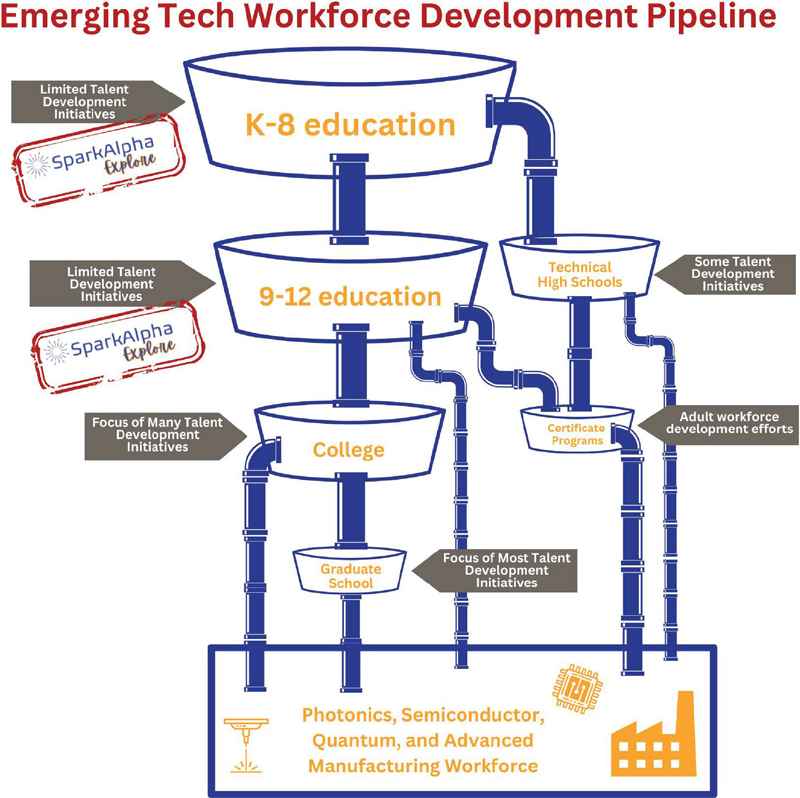
Figure 1 Emerging tech workforce development pipeline.
3.2 Integrating Quantum, Photonics, and Semiconductors Across Disciplines
Explore embeds advanced technologies within the context of real-world problem solving, engaging students through hands-on exploration and interdisciplinary connections. Educators deliver the program through four structured project phases, during which students learn about photonics, sensing, and chip-based technologies, and conceptualize their own sensing devices to address a real-world problem. The recent Quantum Impact extension allows these projects to incorporate core QIS concepts such as quantum sensing into student learning.
The content is intentionally cross-curricular; lessons support science, technology, engineering, and career and technical education (CTE) standards, while also cultivating entrepreneurship, design thinking, and systems thinking skills. Students not only learn about how light behaves or how chips are made, but they are also asked to think like innovators, identifying potential users, designing practical devices, and presenting their ideas. These activities promote relevance and reinforce why these emerging technologies matter in daily life and the global economy.
3.3 Emphasis on Career Awareness and Industry Connections
Students cannot aspire to careers they have never seen or heard of [7]. Explore introduces students to a wide range of education and career pathways in photonics, semiconductors, quantum, and advanced manufacturing. The program makes these fields visible and relevant by showing students how their interests and skills can align with real opportunities.
When available, students visit colleges and technical programs that offer degrees and certificates tied to in-demand STEM careers, attend career fairs and roundtables coordinated by educators, and visit companies in manufacturing and emerging technology. To overcome geographic and logistical barriers, Spark Photonics Foundation has developed a library of digital resources that educators can easily bring into their classrooms. These include virtual college tours, industry talks, career research activities, and engaging multimedia content. By demystifying education pathways and linking classroom learning to future careers, Explore motivates students to see themselves as part of the next generation of STEM professionals.
3.4 Accessibility and Flexible Implementation for Educators
One of Explore’s key strengths is its ability to adapt to varied school settings, class schedules, and educator backgrounds. The curriculum is aligned to state and national standards and includes multiple entry points, allowing teachers to select science, engineering, or career-based pathways through the program.
Importantly, the program is designed to be implemented by teachers who may not have prior experience with photonics or QIS. This approach is especially important given the time constraints teachers face and the demand for plug-and-play resources aligned with existing goals. Explore’s lessons can be integrated into core classes, elective offerings, or afterschool enrichment, giving educators the flexibility they need to serve their students.
3.5 Educator Training and Community of Practice
To scale, Explore relies on a train-the-teacher model that includes asynchronous and synchronous professional development, pre-built materials, and direct support. Educators begin with a structured onboarding process and continue to receive short, phase-based trainings as they move through the program. This makes professional learning digestible and directly tied to what teachers are about to deliver.
Explore’s accompanying Community of Practice (CoP) ensures educators are supported through the implementation process. Hosted on a digital platform, the CoP offers discussion threads, technical support, live Q&A sessions, and a growing repository of differentiated classroom resources. It also fosters collaboration across geographies and disciplines, allowing teachers to learn from peers and share ideas. For a visual representation of the Explore project phases, the resources provided to educators, and the digital Community of Practice support, see Figure 2 [8].
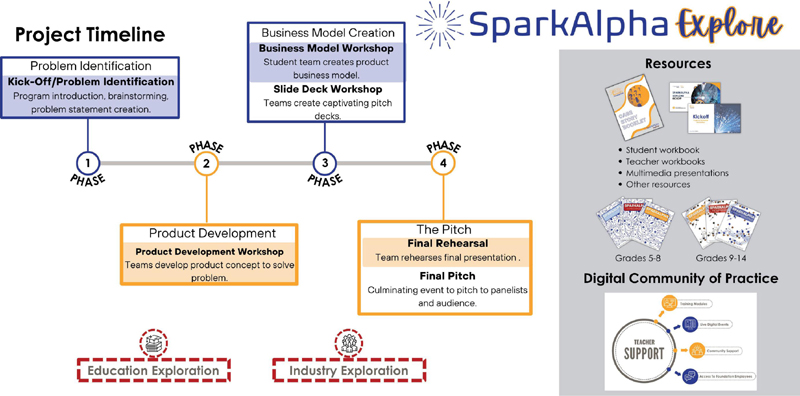
Figure 2 Overview of the SparkAlpha Explore program structure, educator resources, and community of practice support.
4 Case Study: The “Quantum Impact” Extension of Explore
The Quantum Impact extension serves as a case study for how Explore can be adapted to address a specific emerging technology, in this case, quantum information science. This addition reflects both the rising importance of quantum literacy and the program’s potential to evolve with workforce and educational priorities.
4.1 Launching Quantum Impact: Bringing QIS into the Classroom
The Quantum Impact extension was developed to introduce foundational concepts in quantum information science to middle and high school students through the Explore platform. Spark Photonics Foundation recognized that early exposure to quantum topics is critical for workforce awareness and equitable access, especially as quantum technologies gain momentum across global industries.
Quantum Impact includes a series of freely available resources such as student readings, classroom activities, and application-based challenges that support deeper engagement with quantum sensing, computing, and communications. While designed to be used independently, these resources also serve as a natural extension of Explore, offering additional context and career relevance for schools that have implemented the full program.
4.2 Scalability to Different Education Systems
Though Quantum Impact is currently launching in the United States, its design makes it adaptable for use in global education systems. The resources are not tied to any one curriculum or set of standards, making them suitable for classrooms with different instructional models and national benchmarks. Educators can easily incorporate these materials into science, engineering, and career exploration courses.
Language, culture, and regional context are critical considerations for future adaptation. The modular structure of Quantum Impact allows for the development of translated content and localized examples, expanding access across geographies and student populations.
The train-the-teacher model at the core of Explore is also scalable across borders. As Spark Photonics Foundation builds professional learning pathways that help educators deliver QIS content effectively, the goal is to support a broad network of teachers prepared to engage students with quantum concepts in meaningful and sustainable ways.
5 Conclusion: A Vision for Global QIS Education and Collaboration
Preparing a quantum-ready generation will require shared investment, inclusive design, and sustained collaboration across sectors and borders. SparkAlpha Explore and its Quantum Impact extension represent a model for how complex STEM content can be translated into accessible, high-impact educational experiences.
The success of these initiatives relies on content delivery and the partnerships that power them. Collaboration between nonprofits, government, industry, higher education, and educators is essential to building scalable solutions that serve all learners.
Spark Photonics Foundation remains committed to staying at the forefront of emerging technologies and providing educators with timely, relevant resources. As part of this mission, the Foundation actively engages with current and prospective partners to support the development of new materials and the continued expansion of impactful programming.
A global quantum future is already in motion. With intentional design and collective effort, we can ensure that students have the opportunity to understand, engage with, and shape the technologies that will define their futures.
References
[1] National Quantum Coordination Office, “Workforce,” Quantum.gov. [Online]. Available: https://www.quantum.gov/workforce/. [Accessed: Jun. 5, 2025].
[2] National Quantum Coordination Office, Summary of the Quantum Workforce: Q-12 Actions for Community Growth Meeting, Jul. 2022. [Online]. Available: https://www.quantum.gov/wp-content/uploads/2022/07/2022-Q12-Quantum-Workforce.pdf.
[3] UK Department for Science, Innovation and Technology, National Quantum Strategy, Mar. 2023. [Online]. Available: https://assets.publishing.service.gov.uk/media/6411a602e90e0776996a4ade/national\_quantum\_strategy.pdf.
[4] Stewart Blusson Quantum Matter Institute, “Student Development and Services,” University of British Columbia. [Online]. Available: https://qmi.ubc.ca/programs/student-development-and-services/. [Accessed: Jun. 2, 2025].
[5] Quantum Australia, “Empowering women to lead the quantum revolution,” Quantum Australia. [Online]. Available: https://quantum-australia.com/empowering-women-lead-quantum-revolution. [Accessed: Jun. 2, 2025].
[6] M. Gandal, “The Case For Starting Career Exploration As Early As Middle School,” Forbes, Mar. 14, 2024. [Online]. Available: https://www.forbes.com/sites/mattgandal/2024/03/14/the-case-for-starting-career-exploration-as-early-as-middle-school/?sh=33c4df7b3d77.
[7] World Economic Forum, “Children’s career ambitions are lagging behind the new world of work,” World Economic Forum, Feb. 26, 2020. [Online]. Available: https://www.weforum.org/stories/2020/02/childrens-career-ambitions-world-of-work/. [Accessed: Jun. 5, 2025].
[8] V. Mahoney, K. Outler, R. Vigneau, and K. McComber, “Middle school matters: Pioneering photonics education using SparkAlpha Explore,” in Proc. IEEE 67th Int. Midwest Symp. Circuits Syst. (MWSCAS), Springfield, MA, USA, 2024, pp. 1281–1285, doi: 10.1109/MWSCAS60917.2024.10658709.
Biographies

Kristen Outler is the Educational Development Manager at Spark Photonics Foundation, where she designs and implements K–14 STEM programs focused on photonics, semiconductors, quantum information science, and advanced manufacturing. She holds a B.S. in Biology and Biotechnology from Worcester Polytechnic Institute and has spent 12 years as a certified science and special education teacher in New Jersey and Massachusetts.

Vanessa Mahoney is the Educational Outreach Manager at Spark Photonics Foundation, where she leads community engagement and partnerships to expand access to STEM education. She holds a B.S. in Mathematics from Worcester State University and an M.Ed. from American International College. Prior to joining the Foundation, she taught sixth-grade math in Massachusetts public schools for 15 years.

Robert Vigneau is the Director of Educational Outreach at Spark Photonics Foundation, where he oversees programs that promote student awareness of STEM careers. He has 20 years of experience in education and nonprofit leadership, including roles at Northeastern University and Commonwealth Corporation’s YouthWorks program, supporting student success and career readiness.

Kevin McComber is the Executive Director of Spark Photonics Foundation and CEO of Spark Photonics Design, Inc. He holds dual bachelor’s degrees in Materials Science and Physics and a Ph.D. in Materials Science from MIT, with a research focus in photonics. His career includes roles in photonics research, semiconductor manufacturing, consulting, and STEM workforce development.
Quantum Information Technologies Journal, Vol. 1_1, 1–10.
© 2025 River Publishers