The Quantum Communication Frontier: From Entanglement Research to Global Networks
Paulo Mendes
Airbus Central Research and Technology, Munich, Germany
E-mail: paulo.mendes@airbus.com
Received 31 July 2025; Accepted 13 August 2025
Abstract
Quantum information technologies are poised to fundamentally transform global communication. Unlike classical systems, quantum communication leverages phenomena like quantum entanglement to offer unprecedented capabilities. This not only revolutionizes security and computational methods, but also drives advancements in specialized applications such as advanced sensing and precise time synchronization. These developments hold significant implications for critical sectors including medicine and health, materials science, and energy. At the core of this transformation is the concept of a quantum Internet, built upon the unique properties of quantum entanglement. The strategic use of entanglement as a communication resource is expected to profoundly impact the future evolution of the Internet and the development of 6G networks. This paper explores the path from current quantum entanglement research to a global quantum network. It highlights the advantages of satellite-based quantum communications for routing quantum information and discusses the simulation tools essential for designing and optimizing these advanced communication systems.
Keywords: Quantum, communications, entanglement, quantum Internet.
1 Introduction
Quantum information technologies are set to revolutionize global communication, promising capabilities far beyond what classical systems can offer. By harnessing fundamental quantum phenomena, quantum communication is transforming not only security protocols but also computational paradigms and specialized applications like advanced sensing and precise time synchronization [26].
This revolutionary potential stems from the ability of quantum communications to provide information-theoretic security, a level of protection theoretically immune to cyberattacks. The bedrock of this security lies in the principles of quantum mechanics: any attempt to intercept or observe quantum states inherently disturbs them. This disturbance makes eavesdropping immediately detectable and renders the compromised information unusable. This inherent security mechanism fundamentally differentiates quantum cryptography, such as quantum key distribution (QKD) [39, 40], from classical encryption methods. Classical methods rely on computational assumptions that could, in principle, be broken by sufficiently powerful future computing systems.
Beyond its foundational role in QKD, the scope of quantum communications is expanding rapidly. At the heart of this evolving landscape lies quantum entanglement, a unique quantum phenomenon that forms the very core of quantum networks. Entanglement refers to a system prepared such that correlations exist among quantum bits (qubits) or states, irrespective of the physical distance separating them.
Quantum networks are expected to significantly improve distributed quantum computing, enabling computations across vastly larger Hilbert spaces [14] and facilitating multi-party computational protocols that are currently intractable for even the most powerful classical supercomputers.
The expanding scope of quantum networks will lead to systemic integration with existing classical infrastructures rather than operating as a standalone niche technology. This points towards a future where quantum capabilities augment and synergize with the classical internet, profoundly impacting societal and economic structures. This integration of quantum communications and the classical internet will ultimately lead to a future quantum Internet.
This article provides an overall perspective on the major technologies and tools fundamental to developing a global quantum network. Section 2 elaborates on the fundamentals of quantum entanglement and its properties for quantum networks. In Section 3 we offer insights into the benefits and challenges of building a global quantum network with the support of spacecraft, such as satellites. Section 4 explores routing as the cornerstone of the vision for quantum networks. These networks extend far beyond simple point-to-point communication links, encompassing sophisticated nodes that act as integral processing units within a distributed quantum system. The complexity of quantum networks, particularly as they scale in size and functionality, quickly renders analytical methods intractable. Therefore, in Section 5 we provide a brief analysis of quantum network simulators that have emerged as indispensable tools for designing, optimizing, and validating future quantum communication infrastructures before their costly physical deployment. Finally, Section 6 points to several major research directions poised to define the next era of quantum network development, and Section 7 summarizes our contribution.
2 Quantum Entanglement
Quantum entanglement, a fundamental phenomenon in quantum mechanics, describes a state in which two or more particles become intrinsically connected such that their properties are correlated, regardless of the distance separating them [26]. This profound linkage means that measuring one entangled particle instantaneously influences the state of its distant counterpart, even if they are separated by light-years. Such unique correlations form the basis of quantum teleportation, a process that enables the transfer of quantum information encoded in qubits from one location to another without physically transmitting the qubits themselves.
The ability to establish non-local correlations is crucial for the development of quantum networks. It allows for the transfer of quantum states across vast distances without direct physical transmission, effectively circumventing the signal loss challenges inherent in classical communication channels.
2.1 Quantum Entanglement Components
Optical sources for entanglement are essential building blocks of any quantum communication network. These sources, often based on spontaneous parametric down-conversion, generate pairs of photons that are quantum mechanically entangled. The properties of these photons, such as polarization or temporal modes, are intrinsically linked: measuring one photon instantaneously reveals information about its partner, regardless of their separation. To be effective, these sources must produce entangled photons with high brightness and fidelity, as transmission losses and environmental noise can easily degrade the delicate quantum states. These sources essentially generate the qubits that carry information across the network.
However, transmitting entangled photons over long distances through optical channels faces significant hurdles due to inevitable photon loss and decoherence. This is where quantum memories become indispensable. A quantum memory can temporarily store the quantum state of a photon without destroying its coherence. By capturing an entangled photon and converting its quantum state into a stable, stationary form, such as in an atomic ensemble or a solid-state system, quantum memories act as buffers. They enable synchronization of network operations and allow quantum information to be held until the entire network segment is ready, overcoming the probabilistic nature of entanglement generation and transmission.
Materials such as europium-doped yttrium orthosilicate (Eu:Y2SiO5) and praseodymium-doped yttrium orthosilicate (Pr3+:Y2SiO5) have emerged as excellent candidates for optical quantum memories. These systems boast exceptionally long spin coherence times—extending to hours in some cases, making them well-suited for encoding long-lived qubits and establishing stable spin–photon or spin–spin entangled states [37].
The integration of entanglement sources with quantum memories is central to the concept of quantum repeaters. These devices divide a long-distance quantum channel into smaller, more manageable segments. Each segment employs an entanglement source to generate photon pairs, with each photon sent to a quantum memory at adjacent repeater nodes. This approach facilitates the creation of entanglement across extended distances by sequentially linking shorter entangled segments.
Implementing practical quantum repeaters presents significant challenges. The fragility of quantum states, the need for efficient system integration, and the demanding requirements for high-performance memories pose substantial technical hurdles [41]. Achieving long storage times with high fidelity at telecom wavelengths compatible with fiber optics remains a challenge. Additionally, coupling quantum memories efficiently with entangled photon sources and single-photon detectors is challenging, as current interfaces often suffer from low efficiency and introduce noise. Precise synchronization and control of distributed quantum nodes, along with the need for low-error Bell-state measurements (BSM) for entanglement swapping, require sophisticated quantum control systems and robust error correction protocols. Overcoming these technical complexities is vital for reliably distributing entanglement over global scales, paving the way for a fully operational quantum Internet [44].
2.2 Quantum Entanglement Protocols
The creation and maintenance of quantum networks require the generation of entangled links over long distances. However, this process may exceed the typical coherence lengths of photons, requiring a sophisticated suite of quantum protocols operating in concert.
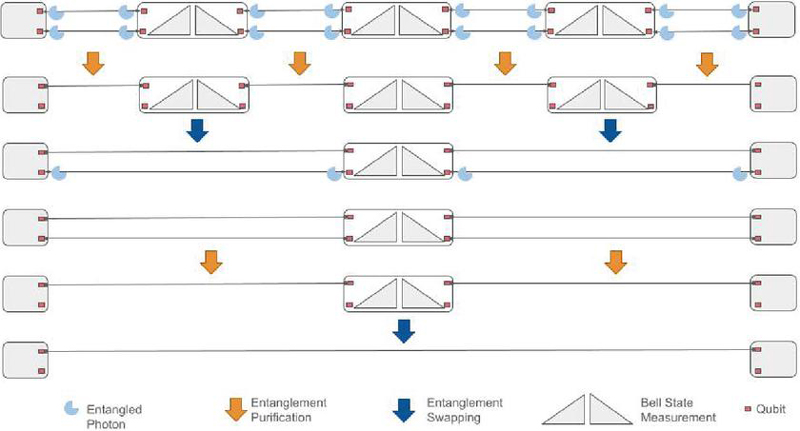
Figure 1 Quantum entanglement process.
Building a quantum network starts with generating entangled photon pairs. This is typically done through spontaneous parametric down-conversion (SPDC) or spontaneous four-wave mixing (SFWM), where a high-energy pump photon splits into two lower-energy entangled photons. As shown in Figure 1, these pairs are then distributed to a series of quantum repeaters, which act as intermediary nodes. Each repeater receives one photon from two adjacent entangled pairs.
A significant challenge in quantum communication has been the inherently probabilistic nature of current entanglement generation methods, which limits the rate and reliability of communication. However, recent research is proposing new protocols that aim for near-deterministic entanglement generation. For instance, weak-coherent-state-assisted protocols leverage weak coherent states (or pulses) to achieve quantum information tasks like entanglement generation. Cui et al. [11] demonstrated that such protocols can generate entanglement between reflective-cavity-based quantum memories at success rates exceeding the 50% limit of single-photon-mediated schemes. Another example involves simple modifications to state-carving protocols, a quantum control technique that uses measurements and feedback to generate specific quantum states, often entangled ones. Goswami et al. propose a state-carving protocol capable of generating high-fidelity entangled states at an atom–cavity interface without requiring high cavity cooperativity [18].
This shift from probabilistic to near-deterministic entanglement generation marks a critical engineering advancement. It moves the focus from simply achieving entanglement to actively controlling its quality and rate. This directly addresses the need for a sufficient number of entangled qubits and reliable long-distance communication. By making entanglement more reliable and robust against decoherence, these advancements are crucial for the practical, large-scale deployment of quantum networks.
Despite recent developments in entanglement generation processes, noise and imperfections inevitably degrade entangled states during transmission and storage. To combat this, entanglement purification protocols (EPPs) are essential to increase the fidelity (quality or purity) of entangled quantum states. EPPs take multiple copies of noisy or lower-fidelity entangled pairs and distills them into a smaller number of higher-fidelity entangled pairs, enabling higher-quality quantum links. Current research in EPPs focuses on guaranteeing fidelity improvement for various protocols, such as the CNOT-based recurrence EPP, and optimizing their timing in realistic network scenarios, which often involve the interplay of probabilistic entanglement generation and quantum memory decoherence [45]. This focus on quality control is vital to ensure that entangled qubits remain useful for their intended applications.
Besides EPPs, quantum error correction also aims to combat noise and preserve quantum information, although addressing different aspects of the problem. Quantum error correction aims to protect arbitrary quantum information (including logical qubits, which may or may not be entangled) from various types of errors (bit flips, phase flips, or combinations) that occur due to decoherence and noise. It aims to prevent errors from accumulating and spreading during quantum computation or storage. With this in mind some contributions aim to use lattice surgery-based protocols (local and nonlocal) to establish logical Bell states between distant nodes using an intermediary node, highlighting the need for significant hardware improvements to implement logical Bell state protocols with quantum memories [17].
Once entanglement is successfully established across adjacent segments (verified through classical communication), entanglement swapping is performed at each repeater node. This fundamental protocol is a cornerstone for extending entanglement across multiple nodes in a quantum network. This crucial step involves performing a BSM on the two “inner” photons deployed in adjacent repeaters, one from each of the purified entangled pairs that meet at the repeater. This measurement effectively projects the two “outer” photons, which have never directly interacted, into an entangled state, thereby extending entanglement across the repeater station [34].
By sequentially applying generation, distribution, purification, and swapping across multiple repeater segments, a robust, high-fidelity entangled link can be established over arbitrarily long distances. This process allows quantum information to traverse distances far exceeding the direct transmission limits imposed by photon loss in optical fibers.
2.3 From Laboratory Experiments to Real-world Networks
Recent developments in hardware and connectivity are crucial to transform quantum communication from experimental demonstrations to practical, real-world networks. A notable milestone was achieved in February 2025, when researchers successfully transmitted an entangled quantum signal over a commercial fiber-optic network for more than 30 hours uninterrupted [9]. This was made possible through an automatic polarization compensation (APC) technique, which actively mitigates environmental factors that can disturb photon polarization and disrupt quantum signals. This breakthrough provides strong evidence for the feasibility of integrating quantum communication technologies into existing classical network infrastructure, paving the way for future hybrid networks where quantum and classical systems coexist and complement each other. Such integration minimizes the need for entirely new physical infrastructure, potentially accelerating deployment and reducing costs.
The vision for future quantum networks involves the development of a quantum repeater, which is capable of hosting one or more long-lived qubits for reliable information storage, and performing complex quantum operations such as single- and multi-qubit gates and measurements [37]. These capabilities are essential to executing complex quantum information processing tasks directly within the network, moving beyond mere data transmission. The evolution toward fully quantum-enabled nodes signifies a shift from basic QKD endpoints to sophisticated processing units capable of supporting distributed quantum computation and sensing. This progression entails nodes that can perform localized quantum operations and facilitate intricate inter-node coordination, integrating quantum computing and networking into a unified architectural framework.
A variety of physical platforms are under active exploration to construct these quantum network nodes and memory systems, each offering distinct advantages. These include systems based on rare-earth ions, solid-state defects such as nitrogen-vacancy centers in diamond, superconducting circuits, trapped ions, and semiconductor quantum dots [23]. The diversity of these approaches reflects ongoing efforts to identify the most scalable, robust, and suitable technologies for different network requirements.
To combat the fundamental challenge of decoherence, which severely limits quantum memory lifetimes, researchers are developing innovative methods to improve memory fidelity. One promising approach involves using spectator qubits combined with real-time decision-making and feedforward control. This technique has demonstrated enhanced memory fidelity in nitrogen-vacancy centers by mitigating dephasing effects during remote entanglement sequences [29]. Such advancements in quantum memory fidelity directly address the physical limitations imposed by decoherence, enabling the longer storage times necessary for repeater architectures and indicating the growing engineering maturity of the field in overcoming fundamental physical constraints.
3 Space-based Quantum Communication
Space-based quantum communication is rapidly emerging as the essential backbone for a truly global quantum Internet, overcoming the inherent distance limitations and photon loss encountered in terrestrial fiber-optic networks.
Satellites, particularly those in low-Earth orbit (LEO), offer a unique advantage by transmitting quantum signals through the near-vacuum of space, significantly reducing decoherence and attenuation over thousands of kilometers. This satellite backbone facilitates several critical functions: direct QKD between distant ground stations, acting as trusted nodes for secure key exchange; distributing entangled photon pairs over intercontinental distances, enabling future applications like distributed quantum computing and quantum sensing; and serving as relays for entanglement swapping, extending entanglement across vast swathes of the Earth.
Ongoing efforts by various nations and consortia, like the European Quantum Communication Infrastructure (EuroQCI) and some initiatives by the National Aeronautics and Space Administration (NASA), are focused on developing robust satellite constellations and advanced quantum payloads, paving the way for a resilient and unhackable quantum communication infrastructure that complements and expands upon existing fiber networks.
3.1 Advantages of Satellite-based Quantum Communication
The dream of a global quantum Internet faces a major hurdle: exponential photon loss. Directly transmitting qubits through optical fibers severely limits communication to short distances. This is due to attenuation, which scales exponentially with distance.
Consider optical fibers designed for classical communications, with an attenuation coefficient as low as 0.16 dB/km (e.g., Corning Vascade). This means a staggering 100 dB (or ) loss over just 625 km (the distance from Boston to Washington DC). Even with a 10 GHz source, this translates to a mere 1 Hz transmission rate [6]. Similarly, ground-to-ground free-space optical links are limited to about 150 km due to attenuation, atmospheric turbulence, and the curvature of the Earth [42].
In stark contrast, free-space optical links between ground stations and satellites, or between satellites themselves, experience fundamentally different and significantly lower photon loss mechanisms. The atmosphere of Earth, which is the primary source of absorption and scattering for ground-based links, is effectively only 10–20 km thick for vertical transmission. For example, at the 1550 nm telecommunication wavelength, vertical atmospheric attenuation loss is only around 10% (or 0.5 dB) [16]. For the vast majority of their journey, photons travel through the near-vacuum of space, resulting in negligible depolarization of the photon state and almost no exponential absorption loss.
Crucially, direct photon transmission through empty space primarily faces quadratic beam divergence loss (diffraction loss) rather than the exponential absorption loss characteristic of terrestrial media. This fundamental physical advantage makes satellite-based architectures the most promising, and arguably necessary, path for realizing quantum communication over large intercontinental distances, spanning ranges of 4000 to 20,000 km. The shift from exponential to quadratic loss fundamentally alters the architectural possibilities for a truly global quantum Internet, bypassing the most significant distance-limiting factor of terrestrial quantum communication.
Furthermore, rapid advancements in the space launch industry, including the development of reusable rocket technology [15], coupled with the exponential growth and increasing affordability of classical satellite communications [30], provide a strong tailwind for quantum communication. These developments promise a more economical and easier deployment of quantum communication satellites, accelerating the timeline for the implementation of a global quantum network.
3.2 Low Earth Orbit and Geostationary Earth Orbit Satellites
Establishing a global quantum internet hinges on careful consideration of satellite orbital altitudes. Due to the curvature of the Earth, single LEO satellites (200–2000 km altitude) have a limited visibility range, typically a few thousand kilometers. Additionally, highly oblique transmissions through the atmosphere suffer from increased absorption, further restricting their reach. While higher orbits like geostationary orbits at 36,000 km offer broader coverage, they introduce significant diffraction loss, leading to low data rates and high communication latency.
To achieve intercontinental and global distances (e.g., 4000 to 20,000 km), several quantum repeater proposals combine satellites with quantum memories. These architectures envision quantum memories either in ground stations [7] or on board satellites [20, 27], including schemes where satellites transfer stored photons over time [21]. This means the deployment of a global quantum Internet demands a careful assessment of the distinct advantages and challenges presented by LEO and geostationary Earth orbit (GEO) satellites.
3.2.1 LEO satellites
LEO satellites operate at lower altitudes (160–2000 km), which directly translates to significantly lower photon loss compared to GEO satellites. This is due to shorter transmission distances through the atmosphere and less beam divergence over vacuum links [33].
Groundbreaking demonstrations, such as those by China’s Micius satellite, have already proven the viability of this approach, achieving satellite-based entanglement distribution over approximately 1200 km and entanglement-based QKD over 1120 km. The dynamic movement of LEO satellites allows them to rapidly service different locations as they traverse their orbits, potentially covering every point on Earth within specific intervals, particularly with polar orbits.
However, LEO satellites also present unique challenges. Due to their lower altitude and the curvature of the Earth, single LEO satellites have narrower ground coverage and limited flyby times for any given ground station. These satellites typically move at speeds around 8 km/s, meaning a satellite in 500 km orbit, with a 1000 km tracking distance, has a flyby time of approximately two minutes.
Another significant technical hurdle is daylight uplink (ground-to-satellite) communication, which remains highly challenging due to a very low signal-to-noise ratio (SNR). This is primarily caused by extremely high background noise from reflected sunlight, which can be nearly six orders of magnitude higher than at night time, combined with significant signal attenuation over the uplink path. Achieving high SNR requires reducing background noise and/or increasing signal strength through reduced transmission loss, improved filtering, or enabling large multiplexing capacity for the signal [32]. Additionally, atmospheric turbulence, most pronounced near the Earth’s surface, can cause beam spreading, wandering, and fragmentation of the quantum signal, leading to further losses.
3.2.2 GEO satellites
GEO satellites, positioned at a much higher altitude (35,786 km), offer the distinct advantage of continuous coverage over a wider range than a single LEO satellite. They appear stationary relative to a specific ground station, allowing for significantly longer flyby times and continuous availability for communication. This continuous link can be beneficial for applications requiring persistent quantum channels in a regional area.
Despite this benefit, GEO satellites suffer from very high diffraction loss due to the immense distances involved. This results in very small projected entanglement distribution rates, estimated to be around 1 Hz for ground links. These high orbits are also associated with substantially higher communication latency due to the extended travel time for photons. Furthermore, even with continuous coverage, GEO satellites cannot establish direct links for truly global distances (10,000–20,000 km) due to the curvature of the Earth and the grazing incidence angles required for such long-range terrestrial connections.
3.2.3 LEO vs. GEO
Current research proposals for building a global quantum Internet backbone increasingly prioritize the reduction of total channel loss. This has led to a strategic focus on LEO satellite constellations, often at altitudes around 500 km, despite the need for a more complex network of satellites to achieve continuous global coverage [33]. This preference indicates that minimizing loss and maximizing entanglement rates are currently prioritized over the continuous, wide-area coverage offered by a single GEO satellite. This strategic choice reflects the understanding that a constellation-based approach with LEO satellites is deemed more viable for establishing the initial backbone of a global quantum Internet, where overcoming fundamental physical limitations like photon loss and achieving high entanglement rates are paramount.
The LEO vs. GEO discussion reveals a fundamental trade-off between coverage/persistence and signal integrity/rate. The current research preference for LEO constellations suggests that minimizing loss and maximizing entanglement rates are prioritized over continuous, wide-area coverage from a single satellite, indicating that a constellation-based approach is deemed more viable for the initial backbone.
To provide a concise overview of the comparative characteristics of LEO and GEO satellites for quantum communication, Table 1 summarizes their key features.
Table 1 Comparative characteristics of LEO and GEO satellites. [19, 33]
| Characteristic | LEO Satellite | GEO Satellite |
| Altitude Range | 160–2000 km | 35,786 km |
| Coverage | Narrower (requires constellation for global coverage) | Wider (continuous for a region) |
| Primary photon loss mechanism | Quadratic beam divergence (in vacuum) | High diffraction loss (due to distance) |
| Typical photon loss (link) | Lower (e.g., 0.5–5% per inter-satellite link) | Very high (e.g., dB for ground link) |
| Entanglement distribution rate (projected) | Few MHz (for intercontinental links) | 1 Hz (for ground link) |
| Communication latency | Lower | Higher |
| Typical flyby time (for ground station) | Limited (–10 minutes per pass) | Continuous (from single satellite) |
| Primary application/role | Global backbone/intercontinental links | Regional coverage/specific high-latency links |
| Current research focus | High Priority (for constellations) | Less priority for global backbone (due to high loss) |
3.3 Satellite-aided Entanglement Distribution
Independently of the usage of LEO or GEO satellites to realize a global quantum internet, proposed architectures for space-based quantum networks typically uses satellites that either host entangled photon sources or function as relays to redirect photon paths in space [33]. This design significantly lessens the dependence on nascent quantum memory and repeater technologies, presenting a more pragmatic path to establishing a global quantum entanglement network.
With satellite-based entangled photon sources generating pairs at significant rates, such as 10 GHz, this approach projects substantial entanglement distribution rates between ground optical ground stations. For example, projected rates include 5.5 MHz between Los Angeles and New York, 0.2 MHz between London and New York, and 0.3 MHz between Los Angeles and Tokyo [33]. These rates, while varying based on geographical separation and constellation parameters, clearly demonstrate the potential for high-capacity quantum links across continents.
Beyond direct point-to-point links, satellite-aided entanglement distribution is being explored as a method to strategically place entanglement between nodes that are not directly connected through the terrestrial optical network. This capability effectively shortcuts the network topology, reducing the number of qubits required for entanglement distribution and minimizing the risk of decoherence over long, terrestrial paths [36]. This innovative use of satellites provides a flexible and efficient means to establish quantum links where direct fiber connections are impractical or too lossy.
Furthermore, a practical strategy to boost performance with current and near-term technology involves utilizing time-bin encoded photonic qudits (higher-dimensional quantum states) from satellite-based spontaneous parametric down-conversion (SPDC) sources. This approach can lead to significantly higher entanglement distribution rates, orders of magnitude faster compared to traditional qubit-based operations, without requiring substantial upgrades to existing satellite quantum hardware [38].
4 Routing and Protocols in Emerging Quantum Networks
Independently of the usage of space-based quantum network segments of just terrestrial segments, a critical area of research emerges as a core pillar for a future quantum internet: quantum routing protocols. This scientific field investigates how to efficiently and reliably transmit qubits across interconnected quantum devices, considering the unique challenges posed by quantum phenomena such as entanglement, superposition, and the no-cloning theorem. Developing robust routing algorithms and communication protocols is paramount for maximizing network capacity and ensuring data integrity.
4.1 From Quantum Repeaters to Quantum Routers
The journey from quantum repeaters to quantum routers represents a crucial evolution in the development of a fully functional global quantum internet. While both are essential components, they serve distinct, although complementary, roles.
Quantum repeaters aim to extend the reach of entanglements, being designed to overcome the challenge of photon loss in quantum channels, which scales exponentially with distance. Due to the no-cloning theorem, quantum states cannot simply be amplified like classical signals. Instead, repeaters employ a “divide and conquer” strategy based on complementary operations such as entanglement generation, purification, and swapping, while integrating quantum memories.
Entanglement generation aims to create entangled pairs over shorter, manageable segments, while entanglement purification enhances the quality (fidelity) of these entangled pairs, discarding noisier ones to ensure a high-quality entanglement resource. Entanglement swapping is the core mechanism that links together shorter entangled links into longer ones[44]: by performing a joint measurement on “inner” photons from two adjacent entangled pairs, the entanglement is effectively “swapped” to the “outer” photons, extending the entangled link without direct interaction between the end nodes. All this is made possible with the existence of quantum memories, which are essential for storing quantum states temporarily while waiting for classical communication feedback or for synchronizing entanglement generation across different segments.
Various physical platforms are being explored to build quantum repeaters. Solid-state defects, such as diamond nitrogen-vacancy centers, are emerging as promising platforms for quantum network nodes. They offer a dual advantage: an optical interface for remote entanglement distribution, allowing them to connect to the broader network, and a nuclear-spin register for robust storage and processing of quantum information locally [29].
In essence, the primary role of a quantum repeater is to establish and extend high-fidelity entangled links over distances far exceeding direct transmission limits. For this repeaters are capable of containing one or several long-lived qubits for robust information storage, and allowing for complex single and multi-qubit unitary operations (gates) and measurements [37]
Quantum repeaters have promised efficient scaling of quantum networks. However, the realization of large-scale networks remains elusive, indicating that the resources required to do have so far been underestimated [13]. Therefore, it is important to understand the dependence of resource scaling of networks on realistic experimental errors in order to be able to predict substantially stricter thresholds for efficient network operation.
While repeaters are about extending entanglement, quantum routers are about managing and directing the flow of quantum information and entanglement within a complex network. Think of them as the traffic controllers of the quantum internet, analogous to how classical routers direct data packets.
A quantum router builds upon the capabilities of a quantum repeater and adds sophisticated functionalities, including multipath routing, resource management, quantum error correction, being integrated with an internet classic control plane allowing a join orchestration of connectivity.
Quantum routers offer the ability to receive quantum information (qubits or entangled states) from multiple input channels and direct it to specific output channels based on quantum “addresses” or protocols. This is far more complex than classical routing because quantum information cannot be simply copied or inspected. Research is actively developing protocols for distributing collective quantum operations between quantum routers, enabling multi-party computations that leverage the collective power of networked quantum devices [28].
For this purpose, quantum routers can dynamically distribute entanglement to multiple nodes in the network as needed, optimizing resource allocation. In general, resources refer to pools of entangled pairs and quantum memories, allocating them efficiently to various communication requests. This might involve prioritizing certain connections or reconfiguring quantum links on the fly.
While quantum information flows quantum mechanically, the control and signaling layers remain classical. A quantum router needs robust classical interfaces to manage its quantum operations, communicate with other nodes, and implement routing decisions. One of these decisions may be related to quantum error correction. While repeaters may use simpler forms of purification, true quantum routers in a mature network would likely incorporate more advanced quantum error correction measures to protect the integrity of quantum states as they are processed and forwarded.
The transition from quantum repeaters to quantum routers involves significant advancements in complexity and functionality, namely increased connectivity, programmability, and integration with quantum memories and processors. In terms of connectivity, simple repeaters might only connect two segments (e.g. Alice-Repeater, Repeater-Bob). A quantum router would need to handle multiple incoming and outgoing quantum channels, acting as a true hub. This means that routing decisions in a quantum network require complex quantum logic gates and coherent control over many qubits, going beyond the BSM and entanglement purification typically associated with repeaters. In more complex scenarios, a quantum router may need to be programmable to adapt to different network topologies, traffic demands, and application requirements, enabling dynamic configuration of quantum paths, as well as quantum memories and, eventually, quantum processing capabilities to manipulate and redirect quantum states without destroying their coherence.
In essence, while quantum repeaters are the vital pipes that allow quantum information to travel long distances, quantum routers are the traffic controllers that enable complex, many-to-many quantum communication and distributed quantum applications across a global network. The development of robust, scalable quantum routers is a critical step towards realizing the full potential of a truly interconnected quantum internet.
4.2 Fundamental Challenges to Quantum Routing
Routing in quantum networks faces unique and intrinsic challenges, dictated by the laws of quantum mechanics, which fundamentally distinguish it from classical routing [26]. One of the most significant obstacles is the no-cloning theorem, which prohibits the perfect copying of arbitrary and unknown quantum states. This restriction eliminates the possibility of using classical signal amplifiers or traditional repeaters that rely on data replication and retransmission, nullifying capabilities such as data duplication and replication common in classical systems.
Another pressing challenge is decoherence, the gradual loss of a quantum state due to its interaction with the environment. This phenomenon destroys superposition and entanglement, leading to short coherence times that severely limit the distance and duration over which quantum states can be reliably maintained and used for communication [1]. Furthermore, entanglement generation through quantum channels is inherently probabilistic, with success rates decreasing drastically over longer distances, leading to frequent “link failures” in quantum networks [46].
Fidelity degradation is an additional concern; entanglement swapping operations, while essential for long-range distribution, can exponentially degrade the quality of entangled pairs [4]. While entanglement purification protocols can improve fidelity, they do so at the cost of reducing the number of entangled pairs and require substantial classical communication overhead [43]. Quantum error correction is a critical technique for encoding states to make them robust against errors [26]. Finally, quantum memory limitations, both in capacity and their contribution to decoherence, represent a bottleneck for storing and re-emitting qubits. The interconnectedness of these challenges is profound: a solution to one problem, such as extending distance via entanglement swapping, can exacerbate another, such as fidelity degradation or resource consumption. Consequently, the development of successful quantum routing protocols requires a holistic and multifaceted approach that carefully balances these interdependencies and inherent trade-offs, such as fidelity versus rate, or resource consumption versus robustness.
4.3 Classification of Quantum Routing Protocols
Quantum routing protocols are broadly categorized from well-established classical network routing strategies, including reactive, proactive, opportunistic, and virtual routing [1]. These diverse approaches offer different trade-offs in terms of efficiency, resource utilization, and adaptability to dynamic network conditions. Most quantum routing algorithms follow a two-step process to establish end-to-end entanglement: (i) selection of links for initial entanglement generation and (ii) selection of those established entangled links to combine through subsequent entanglement swapping operations [35].
The adoption of classical routing paradigms, while useful as a starting point, requires substantial modifications to accommodate the unique properties of quantum mechanics. Entanglement fidelity, the probabilistic nature of swapping operations, and the short coherence times of bipartite entangled states are crucial constraints that must be considered. Such requirement for adaptation means that while the high-level conceptual frameworks of classical routing provide a valuable foundation, their direct application is insufficient. Quantum physical properties fundamentally alter the underlying “costs” and “constraints” of routing decisions, driving the development of new metrics (such as entanglement rate and fidelity) and optimization strategies tailored to the quantum domain. Table 2 provides an overview of different quantum routing protocol categories.
Table 2 Comparison of quantum routing protocol categories
| Category | Main Mechanism | Key Advantage | Key Limitation | Example |
| Reactive | On-demand path discovery upon request arrival | Adaptability to current network state | Potential for resource contention; higher latency for initial requests | Q-CAST |
| Proactive | Pre-computation or pre-establishment of entanglement paths | Anticipatory resource allocation; potentially lower latency for anticipated requests | High computational cost; resource waste if demand does not materialize | REPS |
| Opportunistic | Dynamic, progressive forwarding; does not wait for full path readiness | Reduced average waiting time; higher resource efficiency | Complexity in managing partial path progress; memory constraints | K-opportunism |
| Virtual | Abstraction of the physical network into a simplified virtual network state | Simplifies routing in heterogeneous networks; enhances scalability | Complexity of virtual layer management; ensuring fidelity on virtual links | Generic virtual |
| Asynchronous | Event-driven operations; avoids synchronized time slots | Significantly higher entanglement rate; better coherence time utilization; distributed | Requires sophisticated distributed graph maintenance | General asynchronous |
4.3.1 Asynchronous routing protocols
Asynchronous protocols represent a significant advancement in quantum routing, operating on an event-driven basis, where they react to connection requests as they occur, rather than relying on rigid, synchronized time slots prevalent in earlier approaches [43]. Their core mechanism involves maintaining an instant topology as a distributed graph (e.g., a destination-oriented directed acyclic graph or a spanning tree), which is continuously updated based on successful or failed entanglement generations.
Crucially, they are designed to preserve unused direct-link entanglements for future use, leading to significantly higher entanglement rates and improved scalability compared to their synchronous counterparts.
The algorithmic steps combine classical operations (such as event listening and request handling) with quantum operations (such as entanglement generation and swapping). The advantages of asynchronous protocols are multifaceted. They achieve significantly higher entanglement rates compared to synchronous approaches, preserving direct-link entanglements that are not on the immediate route, preventing their blind consumption and allowing for their future use. Furthermore, asynchronous protocols eliminate the need for synchronized executions, which is critical given the restricted coherence times.
A key advantage of asynchronous protocols is that their entanglement rate increases with coherence time, since intermediate entanglements established through swapping also refresh the coherence time, further contributing to higher entanglement rates. In terms of scalability, tree-like instant topologies, such as DODAGs, are able to address challenges related to scaling larger quantum infrastructures. Their distributed nature reduces reliance on global knowledge of link states (which is impractical due to short coherence times) and allows for adaptive routing and identification of alternative paths, enhancing network robustness. Efficiency is also improved, as entanglement swapping at a repeater only occurs when that node is part of a selected path, leading to more efficient resource utilization.
The observation that synchronous approaches result in inefficiencies and that asynchronous protocols achieve a significantly higher entanglement rate points to a fundamental design principle for practical quantum networks: rigid time-slot-based synchronization is inherently inefficient given the probabilistic and transient nature of quantum entanglement. Event-driven, asynchronous protocols are not just an improvement, but a necessary paradigm shift to accommodate the non-deterministic success of entanglement generation and limited coherence times. This approach is crucial for achieving the high entanglement rates and scalability required for a functional quantum internet.
4.3.2 Reactive routing
Reactive routing protocols respond to connection requests as they arrive, determining paths and allocating resources on demand [1]. A prominent example is Q-CAST, which aims for contention-free path selection at runtime [35]. This protocol utilizes a greedy algorithm to find paths based on the expected number of ebits. Q-CAST eliminates the need for offline path pre-computation, which is computationally expensive, demonstrating higher throughput and better fairness compared to some proactive methods. However, the used algorithm is known to be suboptimal and can fall into local minima, and the problem of finding a truly optimal and contention-free path selection remains computationally hard.
4.3.3 Proactive routing
In contrast, proactive routing protocols attempt to establish entanglement resources or pre-compute paths in anticipation of future demand, aiming to reduce latency when a request arrives. In this regards, the REPS algorithm is an example that employs computationally intensive methods, such as integer linear programming (ILP), for both initial link selection and subsequent path selection to maximize the success probability [3]. The reliance on ILP makes REPS computationally very expensive, often unable to produce results in a timely manner even for moderately sized networks. This poses a significant challenge for its application in dynamic and large-scale quantum networks.
Proactive swapping can be combined with caching of unused entanglements to significantly improve request success rates and reduce average network distance. Recent research suggests that deep reinforcement learning (DRL) can be integrated into protocols like REPS to accelerate the link selection phase by up to 20 times, without sacrificing performance.
The need for computationally efficient solutions is evident, as finding optimal routing solutions in quantum networks is inherently complex. REPS, while aiming for optimality, is slow, and Q-CAST resorts to heuristics due to computational difficulty. The rise of DRL as a faster alternative to achieve comparable performance illustrates a clear trend: the future of quantum routing will likely lean towards heuristic, approximation, and machine learning based algorithms, prioritizing real-time computational feasibility over theoretical optimality.
Some proactive routing algorithms specifically designed for QKD networks leverages multiple non-overlapping paths to distribute keys between remote nodes. This approach significantly enhances security by requiring an eavesdropper to compromise trusted nodes from each of the M paths to reconstruct the entire secret key, thereby minimizing vulnerabilities associated with individual trusted nodes. Furthermore, this algorithm aims to balance the workload across QKD network links, ensuring efficient resource utilization [25]. This specialized routing strategy for QKD highlights the need for tailored solutions for different quantum applications.
4.3.4 Opportunistic routing
Opportunistic routing aims to increase efficiency by allowing routing requests to progress as quickly as possible, even if not all resources on their path are immediately available [2]. This contrasts with conventional methods, which typically wait for all necessary links to be established.
Opportunistic routing can be implemented through progressive forwarding technics, where a request is physically forwarded as swapping steps are successfully completed, or delayed physical transfer, where the request waits for the entire swapping process to complete before a single teleportation step The concept of k-opportunism introduces a spectrum of choices, allowing for distributed control over the “greediness” of requests and enabling prioritization. Simulations have demonstrated significant improvements, including a 30–50% reduction in average total waiting time, increased resource efficiency (due to “swapping gain” and “reservation gain”), and higher transmission rates [18]. However, current models often do not fully consider the limited quantum memory capacity of devices, and simulations are primarily restricted to specific network topologies.
4.3.5 Virtual routing
The concept of virtual routing focuses on abstracting the underlying physical quantum network. The goal is for a routing protocol to generate a virtual network state between routers of different quantum networks. This virtual state is then combined with the internal network state to facilitate entanglement transfer to the requesting devices, allowing for the direct application of higher-layer graph state linking protocols [31]. This approach aims to simplify routing decisions and manage complexity in interconnected quantum domains.
Both opportunistic and virtual routing represent a departure from rigid, deterministic routing. Opportunistic routing adapts to real-time link availability, maximizing resource utilization in a probabilistic environment. Virtual routing, in turn, provides a necessary abstraction layer for managing interconnected quantum domains, similar to software-defined networking (SDN) principles being explored [1]. This evolution is crucial for scaling quantum networks from local experimental setups to a global, interconnected quantum internet.
4.4 Key Performance Metrics
The evaluation of quantum routing protocols requires a distinct set of performance metrics that consider the unique properties of quantum information and network operations, namely:
Entanglement rate (throughput) [46] quantifies the number of end-to-end entangled states (ebits) successfully established between user pairs per unit time; maximizing this rate is a primary objective for many protocols.
Entanglement fidelity [1] measures the quality or purity of the established entangled states, with protocols often needing to consider and maintain a requested fidelity level.
Coherence time refers to the duration during which a quantum state maintains its superposition and entanglement properties, and protocols are designed to operate within or effectively extend this crucial time limit.
Resource utilization measures how efficiently network resources, such as qubits, quantum channels, and quantum memories, are used to establish entanglements.
Success probability/request satisfaction rate [24] indicates the likelihood that an end-to-end entanglement request will be successfully fulfilled.
Latency/waiting time [2] is the total time elapsed from the initiation of a request to the successful establishment of end-to-end entanglement.
Scalability [43] denotes the protocol’s ability to maintain performance and efficiency as network size and the volume of concurrent requests increase.
Fairness ensures an equitable distribution of successful entanglement connections and resource allocation among multiple competing user pairs.
Such a wide range of performance metrics reveals that the design of quantum routing protocols is not about optimizing a single parameter. For example, entanglement purification improves fidelity but reduces the number of entangled pairs. Some approaches like REPS aims for near-optimal performance but are computationally expensive. Others, like Q-CAST, prioritize throughput and fairness but is acknowledged as suboptimal in some cases.
This suggests inherent trade-offs between different desired outcomes. The absence of a single best quantum routing protocol implies that the optimal choice critically depends on the specific application requirements and the current technological stage of the quantum network. Designers must navigate a complex landscape of trade-offs, prioritizing certain metrics over others.
5 Quantum Network Simulators
The complexity of quantum networks, particularly as they scale in size and functionality, quickly renders analytical methods intractable. Consequently, quantum network simulators have emerged as indispensable tools for designing, optimizing, and validating future quantum communication infrastructures before their costly physical deployment. These simulators [10] provide a controlled environment for tuning hardware parameters, optimizing control protocols, and testing various network configurations.
5.1 Overview of Prominent Simulators and Their Capabilities
A growing ecosystem of quantum network simulators offers diverse capabilities to address various aspects of quantum network research, such as the following ones.
Simulator of Network Quantique (ShaNQar)[10]: This is a modular and customizable photonic quantum network simulator. ShaNQar features realistic models of physical components, including photons, lasers, entangled photon pair sources, communication channels, mirrors, waveplates, beam splitters, single photon detectors, and nodes. It allows for a wide range of tunable parameters, enabling variability and versatility in simulations. A key capability is its adaptive timing control and synchronization, supported by a Python-based discrete event simulation framework (SimPy), which allows for virtually unlimited simulation time resolution. ShaNQar adopts a “plug and play” design, facilitating faster coding and efficient execution, and currently supports polarization-based encoding of quantum information.
Network simulator for quantum information using discrete events (NetSquid) [8]: Developed at QuTech, NetSquid is a discrete event simulator that operates at the physical layer of the network. It employs a bottom-up approach to simulate intricate quantum processes that qubits undergo, offering high customization in network elements and communication protocols. NetSquid is particularly adept at modeling the effects of time on quantum network performance, which is crucial for mitigating the limited lifetime of qubits. It supports representing quantum states as ket vectors, stabilizer states, and density matrices, providing trade-offs in performance, scalability, and versatility. Available as a Python package, it uses optimized C and Cython code and features an asynchronous framework for programming quantum network protocols and their classical control planes.
Quantum network simulator (QuNetSim) [26]: This Python-based simulation framework focuses on the network and application layers, allowing users to develop and test protocols for transmitting and storing quantum information. QuNetSim comes with pre-built common networking tasks such as qubit teleportation, entanglement distribution, superdense coding, and QKD. A notable feature is its ability to create separate network structures for classical and quantum communications, enabling users to develop custom routing functions based on both network states. It is an event-driven simulator, where events happen asynchronously, and it provides detailed logs for protocol tracing. While valuable for learning and high-level protocol development, QuNetSim is not primarily designed for accurate quantum physics simulation and makes some simplifying assumptions.
Quantum Internet Simulation Package (QuISP) [3]: This simulator is particularly useful for optimizing quantum network utility functions by tuning parameters that control the trade-off between entanglement generation rate and fidelity. QuISP can simulate complex discrete random behavior inherent in quantum networks, which is difficult to capture analytically. It supports optimizing parameters like bright-state parameters, photon detection time windows, and mean photon numbers for SPDC sources, often by assuming elementary links produce Werner states.
Simulator for quantum network communication (SeQUeNCe) [26]: SeQUeNCe is another prominent open-source quantum network simulator, often cross-validated with QuISP due to their similar design objectives.[39] It emphasizes user-friendliness and is a significant area of research and development within quantum network simulation.
SimulaQron [12]: This simulator focuses on the end nodes of a future quantum internet, specifically designed to support application development. SimulaQron allows for the distributed simulation of local quantum processors, providing the illusion of a local quantum processor to applications. It enables the exchange of qubits and the generation of entanglement between remote processors. Written in Python, it supports various backends for local qubit simulation (e.g., QuTip, Project Q) and features a modular design for distributed simulation.
Q-Gear [22]: This tool serves as a lightweight, efficient interface between Qiskit and Cuda-Q, accelerating quantum circuit simulations when GPUs are available. It enables simulations of up to 42 qubits on a cluster of 1024 GPUs by spreading a single circuit across all GPUs, demonstrating its capability for large-scale quantum circuit simulation relevant to network components.
5.2 Applications and Validation Methods
Quantum network simulators are indispensable for modeling entanglement distribution and assessing network performance. They are used to explore new networking protocols, physics-based hardware, and novel experiments to understand how quantum distribution will work over large distances [5]. Simulators help define use cases and collect data to build reliable devices, exposing flaws in network designs (e.g., unsustainable topologies) and developing protocols that efficiently utilize network resources.
Validation of simulation results is critical to ensure their consistency and accuracy. This is often achieved by comparing simulation outputs with known analytical solutions for specific quantum algorithms or network scenarios. For entanglement distribution, validation methods include comparing the success rates, fidelity, and speed of entanglement generation against theoretical expectations and experimental data [35].
Another approach involves comparing the simulated behavior to an idealized solution, where noise and errors are minimized or absent, to verify the correctness of the simulator’s fundamental quantum operations. Cross-validation between different simulators, such as QuISP and SeQUeNCe, is also performed to highlight discrepancies in how they handle connections, internal node processing time, and classical communication, leading to a deeper understanding of network design choices and protocol impacts.[39] This rigorous validation process strengthens confidence in the predictions derived from these simulation tools.
6 Major Research Directions and Future Outlook
Quantum communications are moving quickly from a theoretical concept to practical, real-world applications. Based on current research, several key areas are set to define the next major phase of development.
Enhancing entanglement: Improving the generation and quality of entanglement is a top priority. Future research will focus on creating reliable, high-rate sources for entangled pairs. This includes refining techniques that use weak-coherent states to generate entanglement more consistently. To ensure these entangled states remain high-quality over long distances and noisy channels, scientists will also continue to improve EPPs. The goal is to optimize when and how these protocols are used to keep entanglement fidelity high as networks grow larger and more complex.
Advancing quantum memory: Quantum memories are a significant bottleneck for scaling up quantum networks. The next generation of research will focus on extending their coherence times. Researchers will also work to increase their multi-mode capacity, allowing them to store multiple qubits at once. Techniques like spectator qubits and other noise mitigation strategies will be crucial to protect quantum states during entanglement and swapping operations. Ultimately, the goal is to develop robust, portable, and integrated on-chip quantum memories that are essential for building practical quantum repeaters and satellite systems.
Developing satellite-based architectures: Space-based quantum communication offers a powerful way to achieve global coverage. Research will concentrate on creating optimized LEO satellite constellations that can maximize inter-satellite link efficiency. A key focus will be on building strong ground-to-satellite and satellite-to-ground quantum links, especially for use during daylight hours. To achieve high entanglement distribution rates over intercontinental distances, researchers will also explore using repeater-less architectures with passive optics and integrating higher-dimensional quantum states (qudits) into satellite systems. This work will require overcoming challenges related to precise pointing, tracking, and atmospheric compensation for optical links.
Sophisticated network routing: The unique challenges of quantum networks, like probabilistic operations and short coherence times, require a new kind of routing. Future research will focus on creating dynamic, adaptive, and asynchronous routing protocols that can establish and maintain entanglement paths in real time. These new algorithms will be optimized for specific applications, such as distributed quantum computing, rather than just general entanglement distribution. This also includes developing hybrid routing and resource management protocols to seamlessly integrate quantum and classical network layers.
Standardization and interoperability: As quantum networks move from experimental labs to wider deployment, it will become critical to standardize hardware interfaces, communication protocols, and performance metrics. This will allow different quantum technologies to work together smoothly and integrate quantum networks into the existing global information infrastructure. International collaboration will be key to establishing these standards and building a supportive ecosystem for future development.
Advanced simulation tools: The complexity of future quantum networks demands sophisticated simulation tools. Research will focus on developing simulators that can accurately model complex quantum phenomena, noise, and decoherence in large-scale networks without being too computationally demanding. This includes integrating realistic hardware parameters and exploring new network topologies. Cross-validation and benchmarking of these different simulators will be essential to ensure their reliability and predictive power.
7 Summary
The field of quantum communications is at a turning point, shifting from foundational research to building a global quantum internet. A critical step in this journey is entanglement routing, which is essential for making a functional quantum internet a reality. Unlike classical networks, quantum networks must contend with unique challenges such as the no-cloning theorem, decoherence, and the probabilistic nature of entanglement generation. These fundamental properties require specialized solutions like entanglement swapping and quantum repeaters.
Existing routing protocols can be categorized as reactive, proactive, opportunistic, and virtual. Asynchronous approaches, in particular, are showing great promise for achieving higher entanglement rates and making better use of limited coherence times. While we have made significant progress in developing new algorithms and metrics, more research is needed to overcome current limitations related to quantum memory, computational scalability, and the need for robust error correction.
Going forward, entanglement routing will likely be defined by the integration of machine learning, hybrid control architectures, and adaptive strategies. These advancements will pave the way for building scalable, robust, and efficient quantum networks, ultimately unlocking the full potential of quantum information.
References
[1] A. Abane, M. Cubeddu, V. Mai, and A. Battou. Entanglement routing in quantum networks: A comprehensive survey. EEE Transactions on Quantum Engineering, Jul 2025.
[2] Chen Feng Ali Farahbakhsh. Opportunistic routing in quantum networks. arXiv:2205.08479, May 2022.
[3] Guus Avis and Stefan Krastanov. Optimization of quantum-repeater networks using stochastic automatic differentiation. arXiv:2501.06291v1, Jan 2025.
[4] Leonardo Bacciottini, Matheus Guedes De Andrade, Shahrooz Pouryousef, Emily A. Van Milligen, Aparimit Chandra, Nitish K. Panigrahy, Nageswara S. V. Rao, Gayane Vardoyan, and Don Towsley. Leveraging internet principles to build a quantum network. arXiv:2410.08980v2, Apr 2025.
[5] Oceane Bel and Mariam Kiran. Simulators for quantum network modelling: A comprehensive review. arXiv:2408.11993v1, Aug 2024.
[6] A. Boaron, G. Boso, D. Rusca, C. Vulliez, C. Autebert, M. Caloz, M. Perrenoud, G. Gras, F. Bussieres, M. J. Li, D. Nolan, A. Martin, and H. Zbinden. Secure quantum key distribution over 421 km of optical fiber. Physical Review Letters 121, 190502, Nov 2018.
[7] K. Boone, J.-P. Bourgoin, E. Meyer-Scott, K. Heshami, T. Jennewein, and C. Simon. Entanglement over global distances via quantum repeaters with satellite links. Physical Review A 91, 052325, May 2015.
[8] David Perez Castro, Juan Fernández-Herrerín, Ana Fernandez Vilas, Manuel Fernandez-Veiga, and Rebeca P. Diaz Redondo. Simulation of entanglement based quantum networks for performance characterizations. arXiv:2501.03210v1, Jan 2025.
[9] Joseph C. Chapman, Muneer Alshowkan, Kazi Reaz, Tian Li, and Mariam Kiran. Continuous automatic polarization channel stabilization from heterodyne detection of coexisting dim reference signals. arXiv:2411.15135, Nov 2024.
[10] Anand Choudhary and Ajay Wasan. Shanqar: Simulator of network quantique. arXiv:2411.15865v2, Mar 2025.
[11] Chaohan Cui, Prajit Dhara, and Saikat Guha. Coherent state assisted entanglement generation between quantum memories. arXiv:2504.20344v2, May 2025.
[12] Axel Dahlberg and Stephanie Wehner. Simulaqron - a simulator for developing quantum internet software. arXiv:arXiv:1712.08032, Jan 2018.
[13] Manik Dawar, Ralf Riedinger, Nilesh Vyas, and Paulo Mendes. Quantum internet: Resource estimation for entanglement routing. arXiv:2410.10512, Apr 2025.
[14] R. de la Madrid. The role of the rigged hilbert space in quantum mechanics. arXiv:quant-ph/0502053, Feb 2025.
[15] M. Elvis, C. Lawrence, and S. Seager. Accelerating astrophysics with the spacex starship. Physics Today 76, 40, Feb 2023.
[16] S. K. Gagliardi and M. Robert. Satellite communications. John Wiley & Sons, 1995.
[17] Vladlen Galetsky, Nilesh Vyas, Alberto Comin, and Janis Nötzel. Feasibility of logical bell state generation in memory assisted quantum networks. Physical Review Research, Jul 2025.
[18] S. Goswami, C. Chien, N. Sinclair, B. Grinkemeyer, S. Bennetts, Y. Chen, and H. Jen. Efficient and high-fidelity entanglement in cavity qed without high cooperativity. arXiv:2505.02702v1, May 2025.
[19] Sumit Goswami, Sayandip Dhara, Neil Sinclair, Makan Mohageg, Jasminder S. Sidhu, Sabyasachi Mukhopadhyay, Markus Krutzik, John R. Lowell, Daniel K. L. Oi, Mustafa Gundogan, Ying-Cheng Chen, Hsiang-Hua Jen, and Christoph Simon. Satellites promise global-scale quantum networks. arXiv:2505.06693, May 2025.
[20] M. Gundogan, J. S. Sidhu, V. Henderson, L. Mazzarella, J. Wolters, D. Oi, and M. Krutzik. Proposal for space-borne quantum memories for global quantum networking. Quantum Information 7, 1, Aug 2021.
[21] M. Gundogan, J. S. Sidhu, M. Krutzik, and D. K. L. Oi. Time-delayed single satellite quantum repeater node for global quantum communications. Optica Quantum 2, 140, 2024.
[22] Ziqing Guo, Jan Balewski, and Ziwen Pan. Q-gear: Improving quantum simulation framework. arXiv:2504.03967, Jun 2025.
[23] D. Hucul, I. V. Inlek, G. Vittorini, C. Crocker, S. Debnath, S. M. Clark, and C. Monroe. Modular entanglement of atomic qubits using photons and phonons. Nature Physics 11, 37, Nov 2015.
[24] Tasdiqul Islam, Md Arifuzzaman, and Engin Arslan. Adaptive entanglement generation for quantum routing. arXiv:2505.08958v1, May 2025.
[25] Evgeniy O. Kiktenko, Andrey Tayduganov, and Aleksey K. Fedorov. Routing algorithm within the multiple non-overlapping paths approach for quantum key distribution networks. arXiv:2411.07810v2, Mar 2025.
[26] Vinay Kumar, Claudio Cicconetti, Marco Conti, and Andrea Passarella. Quantum internet: Technologies, protocols, and research challenges. arXiv:2502.01653v1, Jan 2025.
[27] C. Liorni, H. Kampermann, and D. Bruß. Quantum repeaters in space. New Journal of Physics 23, 053021, May 2021.
[28] I. F. Llovo, G. Dıaz-Camacho, N. Costas, and A. Gomez. Network-assisted collective operations for efficient distributed quantum computing. arXiv:2502.19118v1, Feb 2025.
[29] S. J. H. Loenen, Y. Wang, N. Demetriou, C. E. Bradley, and T. H. Taminiau. Quantum-network nodes with real-time noise mitigation using spectator qubits. arXiv:2505.05582, May 2025.
[30] O. B. Osoro and E. J. Oughton. A techno-economic framework for satellite networks applied to low earth orbit constellations: Assessing starlink, oneweb and kuiper. Access 9, 141611, Oct 2021.
[31] A. Pirker and W. Dür. A quantum network stack and protocols for reliable entanglement-based networks. New Journal of Physics, Mar 2019.
[32] M. G. Raymer and K. Banaszek. Time-frequency optical filtering: efficiency vs. temporal-mode discrimination in incoherent and coherent implementations. Optics Express 28, 32819, 2020.
[33] Alireza Shabani. Building a global quantum internet using a satellite constellation with inter-satellite links. arXiv:2505.08075v1, May 2025.
[34] Evgeny Shchukin and Peter van Loock. Optimal entanglement swapping in quantum repeaters. arXiv:2109.00793, Sept 2021.
[35] YShouqian Shi and Chen Qian. Concurrent entanglement routing for quantum networks: Model and designs. In ACM SIGCOMM, New York, USA, Aug 2020.
[36] Jakob Kaltoft Søndergaard, Rene Bødker Christensen, and Petar Popovski. Satellite-aided entanglement distribution for optimized quantum networks. arXiv:2502.18107v1, Feb 2025.
[37] Wolfgang Tittel, Mikael Afzelius, Adam Kinos, Lars Rippe, and Andreas Walther. Quantum networks using rare-earth ions. arXiv:2501.06110v1, Jan 2025.
[38] V. Domınguez Tubıo, M.C. Dijksman, and J. Borregaard. Satellite-assisted entanglement distribution with high-dimensional photonic encoding. arXiv:2505.16751v1, May 2025.
[39] Nilesh Vyas and Paulo Mendes. Relaxing trust assumptions on quantum key distribution networks. arXiv:2402.13136, Dec 2024.
[40] Nilesh Vyas and Paulo Mendes. Relaxing trust assumptions on quantum key distribution networks. In EuCNC & 6G Summit, Poznan, Poland, Jun 2025.
[41] S. Wehner, D. Elkouss, and R. Hanson. Quantum internet: A vision for the road ahead. Science Vol. 362, No. 6412, Oct 2018.
[42] F. Xu, X. Ma, Q. Zhang, H.-K. Lo, , and J.-W. Pan. Secure quantum key distribution with realistic devices. Reviews of Modern Physics 92, 025002, May 2020.
[43] Zebo Yang, Ali Ghubaish, Ali Ghubaish, Raj Jain, Raj Jain, Hassan Shapourian, and Alireza Shabani. Asynchronous entanglement routing for the quantum internet. Quantum Science 6(1), Jan 2024.
[44] J. Zajac, T. Huber-Loyola, and S. Hofling. Quantum dots for quantum repeaters. arXiv:2503.13775, Mar 2025.
[45] Allen Zang, Xin-An Chen, Eric Chitambar, Martin Suchara, and Tian Zhong. Entanglement purification in quantum networks: Guaranteed improvement and optimal time. arXiv:2505.02286v1, May 2025.
[46] Yiming Zeng, Jiarui Zhang, Ji Liu, Zhenhua Liu, and Yuanyuan Yang. Entanglement routing over quantum networks using greenberger-horne-zeilinger measurements. In IEEE ICDCS, Hong Kong, China, Jul 2023.
Biography

Paulo Mendes (PhD 2004) is Expert in Network Architectures and Design at Airbus Central Research and Technology (Munich, Germany). He is also an Associate Researcher of the Technical University of Munich.
His current research interests are: Internet architectures and protocols; self-organized wireless networks; information-centric and service-centric networks; and quantum networking. Paulo holds over 100 peer-reviewed publications, 11 book chapters and 20 patents. He is an ACM member and an IEEE senior member.
Paulo holds a B.Eng. in Informatics Engineering from the University of Coimbra (1993), an M.Sc. (1998) in Electronic and Computer Engineering from the Technical University of Lisbon, and a Ph.D. (2004) in Informatics from the University of Coimbra (Dr.-Ing., summa cum laude). During his Ph.D. studies, he was a visiting scholar (2000–2003) at the Internet Real Time Laboratory at Columbia University in New York. In 2019 Paulo got his habilitation from University of Coimbra.
Quantum Information Technologies Journal, Vol. 1_1, 11–42.
© 2025 River Publishers