Tourism Growth and Local (Sustainable) Development: The Role of Background Landscapes in Pre-crisis Attica, Greece
Ioannis Konaxis
Department of Tourism Studies, University of Piraeus, Karaoli & Dimitriou 80, EL-18534 Greece
E-mail: ikonaxis@unipi.gr
Received 21 May 2025; Accepted 23 June 2025
Abstract
Tourism is a major engine of urbanization in Europe and significantly contributes to local incomes, regional cohesion and sustainable development at large. As a matter of fact, the local economic structure of Southern European regions relies heavily on tourism revenues. In those areas, tourism supports infrastructure development, revitalizes urban centers, and promotes socioeconomic progress, while also posing challenges related to sustainability and over-tourism. A large metropolitan region such as Athens, Greece, represents a peculiar example of such kinds of urban-metropolitan dynamics in Southern Europe. Based on this assumption, the present study focuses on pre-crisis Athens’ expansion centered on tourism development. This issue was assumed inextricably associated with the latent decline of manufacturing and the slow contraction of the industrial hub of mainland Attica, the administrative region of Athens. Based on official statistics, the empirical analysis adopts diachronic indicators of consistency and performance of tourism companies on a regional scale compared with industry and service, overall. Other indicators that allow an indirect interpretation of the latent dynamics of territorial infrastructure and local development will also be considered and discussed in this work. The contribution finally delineates the evolution of tourism settlements in Attica, as a basis for understanding the most recent dynamics of tourism in Mediterranean urban hotspots.
Keywords: Urbanization, sprawl, recession, second-home, indicators.
Introduction
Tourism plays a crucial role in driving short-term economic growth, local development, and urbanization processes worldwide (e.g. Cuadrado-Ciuraneta et al., 2017). By generating employment, stimulating investment, and increasing demand for goods and services, tourism acts as a catalyst for economic activity, particularly in regions with rich cultural, historical, or natural attractions (Fujita and Mori, 1997; Gabaix, 1999; Egidi et al., 2020). In Europe, tourism is a major economic sector, contributing to local incomes and regional cohesion (Partridge et al., 2009; Dijkstra et al., 2015; McFarlane et al., 2023). Mediterranean Europe, including countries like Spain, Italy, Greece, and Portugal, relies heavily on tourism revenues, especially during peak travel seasons (Carlucci et al., 2017). In these areas, tourism supports infrastructure development, revitalizes urban centers, and promotes socioeconomic progress, while posing challenges related to sustainability and over-tourism (Scott et al., 2013; Brenner and Schmid, 2014; Yue et al., 2022). A large metropolitan region such as Attica, Central Greece, and its capital city, Athens, represents a peculiar example of such kinds of economic dynamics in Southern European countries (e.g. Gounaridis et al., 2019).
With this perspective in mind, the present contribution delineates the recent, pre-crisis dynamics of metropolitan Athens (e.g. Colantoni et al., 2017), focusing on the transition from an economic structure grounded on industrial functions (from the 1950s to the 1980s) to a more recent spatial configuration grounded on services (especially between the 1990s and the 2000s). This process has involved many industrial cities on the northern shore of the Mediterranean basin before the great recession in the late 2000s (Serra et al., 2014; Lauf et al., 2016; Zambon et al., 2018). The associated transition, interpreted at a local scale, but framed in the dynamics that occurred on a broader, regional and national scale, allows us to discuss the current role of the capital city and its region in the Greek economic system (Boussauw et al., 2012). The analysis should delineate - at both urban and metropolitan scales - the possible determinants of the transition from compact to dispersed settlements (Colantoni et al., 2016). The main themes at stake concern, in fact, the processes of industrial localization and delocalization in Attica, the slow transition to an economy dominated by the tertiary sector, and the dynamics of district specialization, with particular reference to the tourism sector (e.g. Di Feliciantonio et al., 2018).
Athens’ expansion (at least in the phases of greatest demographic expansion) was inextricably related with the location of manufacturing and, more generally, of a unique industrial hub on the Greek territory (Salvati et al., 2018). This has attracted, from the second half of the nineteenth century, significant flows of population from the countryside and the islands (Polyzos and Minetos, 2013). Population movements determined a process of rural exodus and depopulation especially of the mountains, which is still ongoing, more than a hundred years after its beginning, although with rates decidedly lower than in the past (Jimenez, 2009). Based on this assumption, the analysis can be carried out using the diachronic indicators of consistency and performance of tourism companies on a regional scale, after comparison with similar indicators describing industry and service sectors (Li et al., 2022). Other indicators that indirectly read the dynamics of territorial infrastructure and local development will also be considered here. The empirical results of this study specifically refer to a pre-crisis (economically homogeneous) time interval, assuming the great recession of 2008–2009 as a breakpoint in the socioeconomic dynamics of Greece, determining important changes in the production structure of the country – with significant (and often unexpected) impacts on tourism development. A discussion through secondary sources of a historical nature schematically illustrates the evolution of tourism settlements in Attica, as a basis for understanding consolidated dynamics of tourism in a characteristic Mediterranean hotspot.
Study Area and Methodology
In this work, we analyzed official statistics provided by Hellenic Statistical Office (ELSTAT). The official statistics from the Urban Audit project developed by Eurostat, and based on ELSTAT data for Greece, provides a brief profile of European cities and their metropolitan regions. For each key variable, the position of the city under examination is identified with respect to the statistical distribution within the whole sample of European cities (e.g. Biasi et al., 2015). Demographic, economic, social, and environmental dimensions were considered in the statistical portfolio of indicators (Salvati and Serra, 2016). The ‘city profile’ that emerges from this analysis therefore outlines the critical issues and strengths of each city, being useful for policy purposes (Wissen Hayek et al., 2011). As regards the resident population, Athens is placed high in the rank for demographic size, growth rate and average family size. On the contrary, the city is ranked low for the presence of single-parent families or families formed by a single member. Significant differences were observed, for all variables, comparing central settlements (hereafter ‘Athens conurbation’) with the remaining part of the metropolitan region (Grekousis et al., 2013). From a social point of view, the percentage of families living in owner-occupied homes is rather low (52%), even if it increases significantly moving from the urban area to the metropolitan region (63%). The average size of homes, however, places Athens high in the European ranking, with 32 m per inhabitant (33 m in the metropolitan region). Finally, the participation of children aged 0–4 in preschool is one of the lowest in Europe, reflecting the limited family policies developed at central level by the Greek government, a situation relatively comparable throughout Southern Europe (Parr, 2014).
Labor market variables also place Athens in the medium-low range of European cities: unemployment rates (total and for women) are quite high in the urban area and increase when considering the entire metropolitan area. Employment and activity rates also indicate a relatively low participation in the labor market (with marked gender segregation) – with further disparities observed between Athens’ conurbation and the metropolitan area at large (Salvati et al., 2019). Despite the adoption of energy policies in favor of air quality, following the intense process of industrialization and urbanization (also due to the peculiar orographic conditions of the region) indicators quantifying air pollution still record values well above the European averages, with particular reference to fine dust, ozone and PM10. In common with many other Mediterranean cities, even the waste cycle does not seem to have taken a ‘virtuous’ path given the low use of separate waste collection and the high proportion of waste disposed to landfill (Robin and Acuto, 2018). Finally, despite the complex strategy for greenery developed by the municipality of Athens, we still observe a completely unsatisfactory position in the ranking of European cities with regard to the availability of public greenery per-capita (Biasi et al., 2015), a proportion that further decreases moving from the urban area to the metropolitan region.
Empirical Results
The analysis of regional added value before the great recession of 2008–2009 (Table 1) confirms a prolonged trend highlighting the progressive importance of services (which went from 72% in 1988 to 87% in 2007), and a corresponding decline in the secondary sector (which went from 27% in 1988 to 13% in 2007), partly due to the intrinsic dynamics of construction and manufacturing sectors.
Table 1 Per cent share in total value added, pre-crisis Attica, 1988–2007 (‘tourism’ is a part of services); source: elaboration of ELSTAT data; selected years
| Year | Agriculture | Industry | Services | Tourism |
| 1988 | 1.2 | 26.6 | 72.2 | – |
| 1995 | 1.2 | 17.7 | 81.1 | 6.3 |
| 2002 | 0.6 | 14.2 | 85.2 | 5.3 |
| 2007 | 0.5 | 12.7 | 86.9 | 7.9 |
Despite the slow decline of the industrial city, light manufacturing with high labor intensity maintains a fairly significant role in the economic structure of metropolitan Athens. This is demonstrated by industrial statistics which show, over the last fifteen years, a substantial stability of this economic sector in Attica, especially when compared with the dynamics observed at a national level. The growing role of suburban Attica follows a process of industrial delocalization. This process is moving in the direction of a more evident de-concentration of the industrial centers of Piraeus, Athens and the northern districts, in favor of a widespread distribution of industrial settlements in the extra-urban centers of Thriasio, Messoghia and Oropos.
In 2005, the number of companies registered in the Chambers of Commerce with headquarters in Attica was just over 317 thousand, with an increase of 3.1% compared to 2002 (Table 1). As regards the sectoral composition, it is highlighted that 76% of the companies operate in the tertiary sector (an increase of 2% compared with 2002). In this context, the per cent share of communication (12%) and tourism sectors (6%) is noteworthy, while the diffusion of companies operating in the real estate and financial intermediation sector (1%) as well as in the high-tech sector, which includes the sectors of ’research and development’ and information technology (2%), appears rather limited.
Consolidation or Decline? The Tourism Sector
Tourism is a sector on which much was bet before and during the Olympic decade (1995–2004) for the local development of Attica. Athens boasts a relatively good tradition of hotels, even of high quality, since the city represents both the main tourist attraction of Greece in the cultural segment and a crucial transit hub for seasonal flows of seaside tourism directed toward the Aegean islands. In the 1990s, the sector contributed about 6–7% to the regional added value, while stabilizing in the 2000s. As in many other Mediterranean cities (e.g. Rome, Naples, Barcelona, Madrid, Valencia, Lisbon), tourism accommodations concentrate in inner cities (Table 2). Over time, however, this pattern has changed, with a progressive de-concentration in the urban area in favor of the rest of Attica, which has seen the number of beds almost double (from 4.7 to 9.1 per km) in about thirty years (1980–2008), reaching figures significantly higher than those recorded in the entire national territory.
Table 2 Hotel bed density (per square km) in pre-crisis Greece and Attica by district and year; source: elaboration of ELSTAT data; selected years
| Year | Greece | Athens’ Conurbation | Rest of Attica |
| 1980 | 2.1 | 115.7 | 4.7 |
| 1986 | 2.7 | 127.9 | 3.2 |
| 2000 | 4.7 | 121.6 | 3.5 |
| 2004 | 5.0 | 71.3 | 8.7 |
| 2008 | 5.7 | 71.9 | 9.1 |
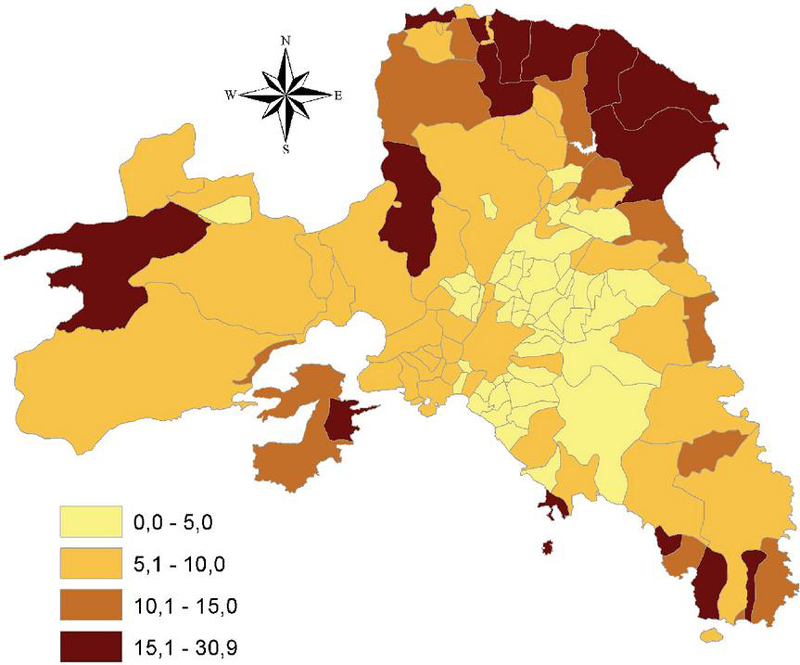
Figure 1 Per cent share of tourism enterprises in total registered businesses at the municipal scale in metropolitan Athens, 2005; source: elaboration of ELSTAT data.
The progressive ‘suburbanization’ of the tourism sector in pre-crisis Athens is also well illustrated in the distribution of tourist establishments (hotels + restaurants) in the municipalities of the metropolitan area (Figure 1) for the last available year (2005). The largest share of establishments in the total number of businesses operating at a local level, is concentrated in the northern coastal area (Grammatiko – Marathon – Oropos), along the southern coast near Cape Sounion and Vouliagmenis, and on the island of Salamina.
A progressive concentration of high-quality tourism accommodations was also observed in the study area (Table 3). The number of beds offered by 5-star hotels has increased in central Athens by 12% and by as much as 40% in the suburban area, compared to an even greater increase recorded throughout the country (65%).
Table 3 Per cent share of beds in five-star hotels in total hotels and per cent change over time by district (2001–2008); source: our elaboration of ELSTAT data; selected years
| Year | Greece | Athens’ Conurbation | Rest of Attica |
| 2001 | 6.3 | 21.6 | 9.4 |
| 2004 | 6.8 | 22.9 | 9.1 |
| 2008 | 10.3 | 24.2 | 13.1 |
| Difference (2001–2008) | 65.2 | 12.0 | 39.9 |
Overall, metropolitan Athens is characterized by an increase in overnight stays by Greeks compared to those of tourists from abroad (Figure 2). On the other aspects, the urban area shows a rather stable trend in terms of flows and stays. In terms of performance, however, the positioning of the suburban region of Athens appears rather weak for all the indicators considered.
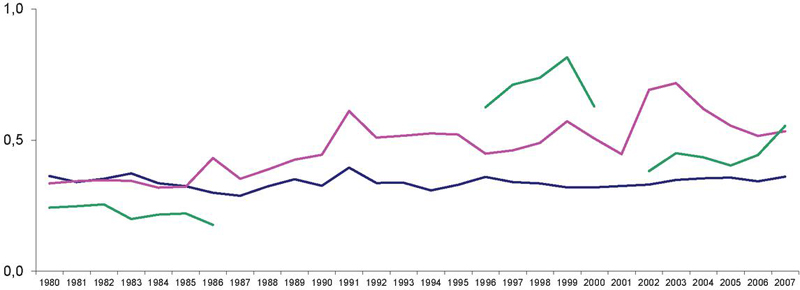
Figure 2 The ratio of native to foreign visitors’ night stays in hotels by district and year; blue: Greece; pink: Athens’ conurbation; green: rest of Attica; source: elaboration of ELSTAT data.
The bed occupancy rate (Figure 3) further highlights the limited tourism performance of the suburban area of Athens when compared with the central area, where this indicator is growing thanks to processes of urban rehabilitation and recovery fueling aggregation processes in the largest tourism accommodations.
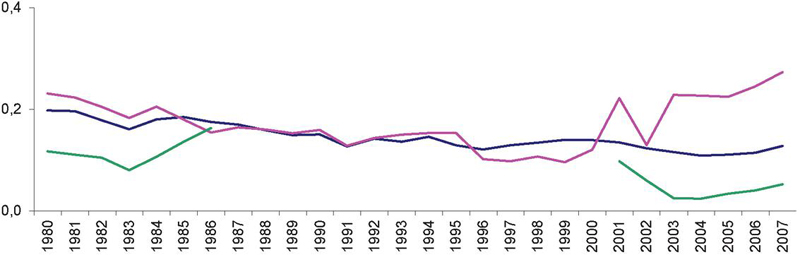
Figure 3 Occupancy rate (nights spent to available beds multiplied by 730 by district and year; blue: Greece; pink: Athens’ conurbation; green: rest of Attica; source: elaboration of ELSTAT data.
Discussion
With the Olympic Games, the Greek Ministry of Tourism has promoted a sector plan focused on several intervention axes. The first axis concerns the redevelopment of the tourist offer in the historical center through the decongestion of traditional attractions (Acropolis, Temple of Olympian Zeus, Ancient Agora, Plaka, National Archaeological Museum) and the promotion of new destinations (Gazi-Technoupolis, Network of Municipal Museums, minor archaeological sites). The second axis addresses a progressive de-seasonalization of tourist flows by promoting the image of the city as the main destination (and not secondary, as is typical of the summer period) for weekend tourism, Christmas and Easter periods, and other time schedules all over the year (Salvati et al., 2016).
The objective was to increase overnight stays (on average, 1 or 2 days only) with massive advertising campaigns especially aimed at a non-European public. The third axis focuses on the suburban tourism accommodations, identifying the coast south of Athens (from Vouliagmenis to Cape Sounion) and the Messoghia coastline (from Rafina to Lavrio) as the main poles of attraction for seaside and cultural tourism. The reasons for this choice lie in the economic re-launch of the suburban area under a potentially favorable context due to lower costs, accessibility to the international airport ‘E.Venizelos’, and proximity to the eastern port of Rafina allowing rapid connection to Aegean islands. The outcomes of this plan, however, have been (and still are) very uncertain (e.g. Polyzos and Minetos, 2013).
In particular, the last axis, the one that contributes most as a potential driver of sprawl in Messoghia and, more generally, along the sea coast, does not seem to have produced interesting effects. On the one hand, tourism infrastructure in suburban Attica has remained stationary and the performance indicators do not seem to highlight particularly favorable trends in recent times (Salvati and Carlucci, 2011). On the other hand, continental Attica has always represented an area with a tourism attractiveness exclusively concentrated in a few hot spots (Gounaridis et al., 2018).
In line with tourism development, sports infrastructure in Attica – also following the 2004 Olympics – has followed complex logics. On the one hand, the attempt to relocate the facilities on a progressively larger area (e.g. Schiniàs, Markopoulo, Kinetta) has contributed to settlement sprawl (sensu Berry, 1964; Pan et al., 2024; Schuster-Olbrich et al., 2024). On the other hand, the construction of the Olympic center of Maroussi and the renovation of other attraction centers (Faliro, ‘South riviera’, Peristeri) has promoted further residential and service concentration around the most densely populated neighborhoods (e.g. Ho et al., 2024).
To summarize, the balance of this economic stage is rather poorly defined and substantially perpetuates the dualism found in contemporary Athens’ development (Hsu, 2012). A trend towards a progressive settlement dispersion, driven by infrastructures and the relocation of productive activities, is evident (Sinclair, 1967; Inostroza et al., 2010; Pan et al., 2024). At the same time, managerial functions in both central and semi-central areas, which consolidate the ‘capital’ role of Athens, perpetuate and even consolidate.
Concluding Remarks
Tourism development in Mediterranean cities has long been a cornerstone of economic strategy, driven by the region’s unique cultural heritage, favorable climate, and geographic appeal. However, the intense concentration of tourism activities – particularly in historical urban centers – has prompted a need for more sustainable, inclusive, and resilient tourism policies. In some cities, policymakers have begun shifting from volume-based models toward quality-oriented approaches. These include promoting off-season travel, diversifying tourism offerings, and investing in smart infrastructure to manage visitor flows and reduce pressure on urban ecosystems. The emphasis has increasingly turned toward safeguarding local identity, preserving public space, and ensuring that tourism generates tangible benefits for local communities.
Taken as a prominent example, Athens encapsulates both the opportunities and the challenges of different ‘urban tourism’ models in the Mediterranean region. Over the last decade, the Greek capital city has experienced a significant tourism revival, largely driven by low-cost air travel, the rise of short-term rentals, and a growing international interest in Greek history and culture. While this resurgence has stimulated job creation and urban regeneration, it has also led to rising housing costs, displacement of local residents, and increasing strain on public infrastructure. To address these issues, Athens has begun implementing a range of policy responses aimed at balancing economic growth with environmental sustainability. These include stricter regulations on short-term rentals, incentives for cultural and alternative tourism development, and initiatives to spread tourism beyond the city center. Collaboration with regional and EU-level stakeholders has also been key to aligning local strategies with broader development goals, such as the European Green Deal and the United Nations Sustainable Development Goals (SDGs). Ultimately, the future of tourism in Athens and other Mediterranean cities will depend on the ability to integrate tourism planning with broader urban development strategies. This includes fostering public participation, investing in digital and green transitions, and managing tourism not as an end in itself, but as a tool for inclusive and sustainable urban futures.
Acknowledgments
This work has been partly supported by the University of Piraeus Research Center.
References
Berry, B. J. (1964). Cities as systems within systems of cities. Papers in regional science, 13(1), 147–163.
Biasi, R., Colantoni, A., Ferrara, C., Ranalli, F., and Salvati, L. (2015). In-between sprawl and fires: Long-term Forest expansion and settlement dynamics at the wildland–urban interface in Rome, Italy. International Journal of Sustainable Development & World Ecology, 22(6), 467–475.
Boussauw, K., Neutens, T., Witlox, F. (2012). Relationship between spatial proximity and travel-to-work distance: the effect of the compact city. Regional Studies, 46(6), 687–706.
Brenner, N., Schmid, C. (2014). The ‘urban age’ in question. International Journal of Urban and Regional Research, 38(3), 731–755.
Carlucci, M., Grigoriadis, E., Rontos, K., Salvati, L. (2017). Revisiting an Hegemonic Concept: Long-term “Mediterranean Urbanization” in between city re-polarization and metropolitan decline. Applied Spatial Analysis and Policy, 10(3), 347–362.
Colantoni, A., Grigoriadis, E., Sateriano, A., Venanzoni, G., Salvati, L. (2016). Cities as selective land predators? A lesson on urban growth, deregulated planning and sprawl containment. Science of the Total Environment, 545, 329–339.
Colantoni, A., Grigoriadis, E., Sateriano, A., Sarantakou, E., Salvati, L. (2017). Back to Von Thunen: A Southern European perspective on mono-centric urban growth, economic structure and non-urban land decline. International Planning Studies, 22(3), 173–188.
Cuadrado-Ciuraneta, S., Durà-Guimerà, A., Salvati, L. (2017). Not only tourism: Unravelling suburbanization, second-home expansion and ‘rural’ sprawl in Catalonia, Spain. Urban Geography, 38(1), 66–89.
Di Feliciantonio, C., Salvati, L., Sarantakou, E., Rontos, K. (2018). Class diversification, economic growth and urban sprawl: Evidence from a pre-crisis European city. Quality & Quantity, 52, 1501–1522.
Dijkstra, L., Garcilazo, E., McCann, P. (2015). The effects of the global financial crisis on European regions and cities. Journal of Economic Geography, 15(5), 935–949.
Egidi, G., Salvati, L., Vinci, S. (2020). The long way to tipperary: City size and worldwide urban population trends, 1950–2030. Sustainable Cities and Society, 60, 102148.
Fujita, M., Mori, T. (1997). Structural stability and evolution of urban systems. Regional science and urban economics, 27(4–5), 399–442.
Gabaix, X. (1999). Zipf’s law for cities: an explanation. The Quarterly Journal of Economics, 114(3), 739–767.
Gounaridis, D., Chorianopoulos, I., Koukoulas, S. (2018). Exploring prospective urban growth trends under different economic outlooks and land-use planning scenarios: The case of Athens. Applied Geography, 90, 134–144.
Gounaridis, D., Chorianopoulos, I., Symeonakis, E., Koukoulas, S. (2019). A Random Forest-Cellular Automata modelling approach to explore future land use/cover change in Attica (Greece), under different socio-economic realities and scales. Science of the Total Environment, 646, 320–335.
Grekousis, G., Manetos, P., Photis, Y.N. (2013). Modeling urban evolution using neural networks, fuzzy logic and GIS: The case of the Athens metropolitan area. Cities, 30, 193–203.
Ho, Y., Sarkar, S., Alizadeh, T. (2024). City sizes and economic roles: Urban typologies within the Australian urban system. Cities, 149, 104986.
Hsu, W. (2012). Central place theory and city size distribution. The Economic Journal, 122 (563), 903–932.
Inostroza, L., Baur, R., Csaplovics, E. (2010). Urban sprawl and fragmentation in Latin America: A comparison with European cities. The myth of the diffuse Latin American city. Journal of Environmental Management, 115, 87–97.
Jiménez, F. (2009). Building boom and political corruption in Spain. South European Society and Politics, 14(3), 255–272.
Lauf, S., Haase, D., Kleinschmit, B. (2016). The effects of growth, shrinkage, population aging, and preference shifts on urban development – A spatial scenario analysis of Berlin, Germany. Land Use Policy, 52, 240–254.
Li, H., Chen, J., Chen, Z., Xu, J. (2022). Urban population distribution in China: Evidence from internet population. China Economic Review, 74, 101808.
McFarlane, N., Hurley, J., Sun, Q. C. (2023). Private-led land assembly and urban consolidation: The relative influence of regulatory zoning mechanisms. Land Use Policy, 134, 106904.
Pan, Y., Liu, J., Cheng, C. (2024). Research on Urban Resilience from the Perspective of Land Intensive Use: Indicator Measurement, Impact and Policy Implications. Buildings, 14(8), 2564.
Parr, J.B. (2014). The regional economy, spatial structure and regional urban systems. Regional Studies, 48(12), 1926–1938.
Partridge, M.D., Rickman, D.S., Ali, K., Olfert, M. R. (2009). Do new economic geography agglomeration shadows underlie current population dynamics across the urban hierarchy? Papers in Regional Science, 88(2), 445–467.
Polyzos, S., Minetos, D. (2013). Informal housing in Greece: A multinomial logistic regression analysis at the regional level. European Spatial Research and Policy, 20(2), 57–85.
Robin, E., Acuto, M. (2018). Global urban policy and the geopolitics of urban data. Political Geography, 66, 76–87.
Salvati, L., Carlucci, M. (2011). The economic and environmental performances of rural districts in Italy: Are competitiveness and sustainability compatible targets? Ecological Economics, 70(12), 2446–2453.
Salvati, L., Ciommi, M.T., Serra, P., Chelli, F.M. (2019). Exploring the spatial structure of housing prices under economic expansion and stagnation: The role of socio-demographic factors in metropolitan Rome, Italy. Land Use Policy, 81, 143–152.
Salvati, L., Ferrara, A., Chelli, F. (2018). Long-term growth and metropolitan spatial structures: An analysis of factors influencing urban patch size under different economic cycles. Geografisk Tidsskrift – Danish Journal of Geography, 118(1), 56–71.
Salvati, L., Sateriano, A., Grigoriadis, E. (2016). Crisis and the city: Profiling urban growth under economic expansion and stagnation. Letters in Spatial and Resource Sciences, 9(3), 329–342.
Salvati, L., Serra, P. (2016). Estimating rapidity of change in complex urban systems: A multidimensional, local-scale approach. Geographical Analysis, 48(2), 132–156.
Schuster-Olbrich, J.P., Marquet, O., Miralles-Guasch, C., Arce, L.F. (2024). Spatial patterns and drivers of urban expansion: An exploratory spatial analysis of the Metropolitan Region of Santiago, Chile, from 1997 to 2013. Cities, 153, 105305.
Scott, A.J., Carter, C., Reed, M.R., Larkham, P., Adams, D., Morton, N., Coles, R. (2013). Disintegrated development at the rural–urban fringe: Re-connecting spatial planning theory and practice. Progress in planning, 83, 1–52.
Serra, P., Vera, A., Tulla, A.F., Salvati, L. (2014). Beyond urban–rural dichotomy: Exploring socioeconomic and land-use processes of change in Spain (1991–2011). Applied Geography, 55, 71–81.
Sinclair, R. (1967). Von Thünen and urban sprawl. Annals of the Association of American Geographers, 57(1), 72–87.
Wissen Hayek, U., Jaeger, J. A., Schwick, C., Jarne, A., Schuler, M. (2011). Measuring and assessing urban sprawl: What are the remaining options for future settlement development in Switzerland for 2030? Applied Spatial Analysis and Policy, 4, 249–279.
Yue, L., Zhao, H., Xu, X., Gu, T., Jia, Z. (2022). Quantifying the Spatial Fragmentation Pattern and Its Influencing Factors of Urban Land Use: A Case Study of Pingdingshan City, China. Land, 11(5), 686.
Zambon, I., Benedetti, A., Ferrara, C., Salvati, L. (2018). Soil matters? A multivariate analysis of socioeconomic constraints to urban expansion in Mediterranean Europe. Ecological Economics, 146, 173–183.
Biography

Ioannis Konaxis, PhD Architecture and landscape, Sapienza University of Rome (Italy), is assistant professor of sustainable eco-tourism and nature conservation at the Business School of the public University of Piraeus, Greece. He teaches several classes of tourism business and economics, ecological conservation of protected areas, landscape and sustainable development. He published theoretical and applied research in sustainable tourism management in prestigious international journals and book series.
Strategic Planning for Energy and the Environment, Vol. 44_3, 603–616.
doi: 10.13052/spee1048-5236.4436
© 2025 River Publishers