Sustainable Social Development and User Experience in EU Framework: Metaverse Gaming as ‘Third Space’ of Communication and Interaction
Vassilis Bokolas1,*, Stavros Kaperonis2 and Efstathia (Efi) Ntrouva3
1Scientific director, XENIOS POLIS, Greece, Neapolis University, Pafos-Cyprus
2University of Social and Political Sciences, Department of Communication, Media and Culture, Greece
3Department of International Relations and European Union, Panteion University of Social and Political Sciences, Greece
E-mail: vbokolas@xeniospolis.gr; skap@panteion.gr; e.ntrouva@panteion.gr
*Corresponding Author
Received 07 June 2025; Accepted 19 July 2025
Abstract
Based on the principles of sustainable social development, this study examines the dynamic relationship that develops between the multiple dimensions of the evolving interplatform digital space and (the experience of) citizens and online users. The current, ‘big technology’ set of the – so called – metaverse is transforming all areas of human activity by creating ‘third spaces’ of communication, entertainment and wider connection between people and services/products provided. These digital spaces in turn are gradually forming ‘virtual cities’, which have (or plan to have) their own formative practices, spheres of action, rights, obligations and governance structures. Digital, online games are the harbingers of this new emerging situation. Literary data – with references from the context of the American and especially the European paradigm – outline the reality of so-called metaverse gaming and the development of dynamic virtual networks, highlighting their potential and noting obstacles and relevant concerns. The present study searches for the sustainable development dynamics of the field through a content analysis of the European Union databases concerning the funding of relevant programmes, with a focus on Southern European countries (Greece, Italy, Spain, Cyprus and Portugal).
Keywords: Social development, digital transformation, EU, user, space, metaverse gaming.
1 Introduction⋅ Setting the Scene of a New Space of (Inter)Action
It has been some years now [1] that the achievement of the Sustainable Development Goals (SDGs) has been inextricably linked to their social orientation and the corresponding policies for poverty eradication, promotion of decent work, social inclusion, equitable access to resources and services, strengthening quality education, protection of citizens/consumers, support for specific groups (youth, elderly, people with disabilities, etc. etc.) [2, 3].
The priority for social progress was also directly related to the ongoing, rapid process of digital transformation. The United Nations with The United Nations Environment Programme [4] on sustainable digitalization aims to mitigate the negative environmental and social impacts of digital technologies and their supply chains. Emphasis was also placed on addressing the social inequalities that digital transformation causes or – on the other hand – can address [5].
At the same time, nowadays, the European Union (EU) strategy framework focuses on policies that promote social cohesion towards the social sustainability of digital transformation (SOSDIT) [6]. The EU is oriented towards empowering both institutions and actors, as well as citizens (consumers, users, learners, etc.). In this direction, Europe’s Digital Decade 2030 is being implemented, which invests in the development of digital infrastructure, the upgrading of digital skills, the digital transformation of businesses and public services, with the aim of a competitive and environmentally sustainable economy that includes every citizen [7]. Particular importance is given to educating citizens in new digital – and not only digital – skills, but also to protecting their rights in a constantly evolving and complex digital environment [8, 9].
This vigilance is justified as many aspects as possible of modern life – work, socialisation, shopping, education, entertainment choices – are digitally mediated. Further, physical spaces are also mediated by technologies to the extent that attempts to understand the concept of ‘space’ are deemed incomplete without considering digital and virtual levels [10]. This trend towards hybridity has been accelerated by the recent concept/forming reality of the metaverse. This is the possibility of extending the physical world using augmented and virtual reality technologies, technologies that allow users to interact in real and simulated environments using avatars and holograms [11].
Gaming virtual environments and Massively Multiplayer Online role-playing games (MMOs) have emerged and been described as precursors of the metaverse. It is those digital environments that offer a first insight into the future socio-economic impact of a fully functional, persistent and cross-platform metaverse [12]. The dimension of the metaverse as a ‘place’ where the physical and digital worlds meet is familiar to users of multiplayer online games, who spend a lot of time in the socialisation forums of these games. In these ‘third spaces’ communities of players meet, connect, communicate and interact in many ways laying the foundations of so-called metaverse gaming [11, 13].
The mutual growth and potential for coupling metaverse and online digital games seems a certainty [14]. It could not be otherwise as digital games are now a universal phenomenon with complex socio-cultural dimensions, but at the same time a booming industry with a global reach and a very large, ever-growing, economic potential [15, 16]. In the US digital game users reach 65%, most of whom (80%) tend to play with others, revealing the increasing connectivity/connectivity of people through digital games [17]. In the EU-27, in 2022 the digital games market generated revenues of e23.48 billion. This sector is an important part of the cultural and creative industries ecosystem and is experiencing significant growth, with revenues expected to reach around e34 billion by 2027. Similarly, the number of European users has grown significantly and today more than half of the European population are regular users of digital games (people aged 6–64 years) [16, 18].
The term ‘user’ represents the multifaceted relationship between people and technology, incorporating both definitions of people using IT services and perceptions of how people engage with social media and gaming platforms. User-generated content (UGC) is an expression of this engagement, as users are no longer mere consumers but active creators and shapers of digital content [19, 20]. It is the diversity of user experiences that highlights the importance of person-centred approaches. By identifying users’ unique characteristics, needs and behaviours, digital platforms attempt to create more engaging, accessible and meaningful experiences [21]. At the same time, as technology continues to develop, the relationship between users and digital systems is transformed and creates new demands in terms of understanding how people (especially younger generations) interact with and through digital media [22]. Indeed, as modes of action and interaction are transferred (and in many cases restricted) to virtual environments, there is now talk of the progressive formation of ‘virtual cities’.
The term “virtual city” is often used in literature. It was originally utilized to convey the concept of virtual settings in digital games [23]. Nowadays, however, the term ‘virtual city’ is framed by the processes of ‘dialogue’ and (co-) operation of physical and virtual spaces, resulting in the creation of a virtual dimension, which gradually establishes its own shaping practices, delimits the scope of action of people within it, institutionalises – over time – the rights and obligations of its ‘citizens’ and ultimately ‘generates’ (corresponding) governance structures [10].
This study outlines the field of so-called metaverse gaming – and the development of dynamic virtual networks – highlighting at the same time their potential and noting obstacles and related concerns. Based on the European example, the sustainable development dynamics of the field are sought by analysing the content of EU databases on the funding of relevant programmes, with emphasis on the countries of Southern Europe (Cyprus, Greece, Italy, Portugal and Spain).
2 Theoretical Framework; Digital Game, User Experience and Networking in Virtual Spaces
The concept of gamification is related to the use of game elements in (game and) non-game environments, such as the fields of commerce, catering, education/training, etc. [24] Review studies have demonstrated the positive role of gamification in communication, entertainment and education in both conventional and digital environments. The emphasis is on enhancing user attention and participation, the dynamics of interaction, the possibility of respecting personal needs and interests, and the development of modern – digital and not only – skills [25, 26].
The “playful experience”, which is seen as the essence of gamification, plays an important role in the positive impact of behaviour both institutionally, in foundations and organisations and on members of society. Qualitative research has attempted to understand the role of gamification in the development of the metaverse from the perspective of designers from different disciplines and parts of the world. The analysis led to four general theoretical components, specifically the thrust experience, flow experience, alternate reality experience and hedonic experience. These elements demonstrated that gamification is inextricably linked to positive psychology and is shaped by – yet shapes – the new reality of the metaverse [27].
Studies on user interactions in social and gaming networks reveal changing social behaviours that depend on technology. A current study [28], which analysed user interaction through posts and comments on platforms such as Reddit and Wikipedia, revealed characteristic patterns of participation and behaviour in digital communities. The researchers found that active engagement is associated with social cohesion, while systematic observation or casual participation is associated with differential patterns of trust and interaction. Other studies highlighted recurring patterns of negative (‘toxic’) behaviours on social media platforms, such as aggression, harassment and spreading misinformation. The researchers emphasized the difficulties platforms face in effectively identifying and mitigating these phenomena, due to the anonymity of users and the rapid diffusion of content [29, 30].
Recent study used technology similar to GPT to predict how user behaviour changes and how network dynamics evolve, helping to clarify how people interact on social media [31]. In parallel, another research developed an analytical framework for measuring centralization on social networking platforms, highlighting five critical factors that directly affect user engagement and content flow: the size of dominant communities, their interconnectedness with other groups, the distribution of influence, the resilience of the platform to user movement, and the level of trust in governance transparency. The researchers stressed that high centralisation leads to limited participation, increases information isolation and makes platforms less flexible in the face of critical changes. This analysis allows for a more systematic understanding of how the structure of platforms shapes user experience and behaviour [32]. Finally, newly conducted research [33] revealed that user acceptance of key platform changes can be measured by migration patterns after notable changes (such as users migrating from Twitter to Mastodon after the former’s ownership change).
Based on the above framework, the category of digital games that deserves special mention are multiplayer games (e.g. Word of Warcraft, League of Legends, Fortnite, Minecraft, Among Us, etc.) and especially online games that allow the involvement of a large number of players, MMOs [34]. For several years these games have been labelled “social spaces” or “third spaces”, spaces where players/users interact, create groups and communities, collaborate to solve problems, compete, discuss and develop social practices [35–37]. These interactions are a means of learning to play, a motivation to engage with the game and a basis for alternative communication.
Nowadays, popular gaming platforms such as Roblox, Fortnite and Minecraft are creating entire online multiplayer worlds. These are popular spaces for entertainment but also for meeting and socializing people with a common interest base. In this context, ‘there’ activities that do not involve gaming have typically increased. In 2021, about 60% of players in the United States had participated in non-gaming activities, with virtual re-enactments of social or life events within games being the most popular of these. Also, in these online venues, players/users watched movies, TV shows and in-game previews together [13].
In addition, in a 2023 survey of online gambling, non-gambling related activities (non-gaming related activities) also form an important part of the gaming environment. Approximately 64% of super gamers in the United States have engaged in non-gaming activities, with socializing and meeting new people being the most popular activity, followed by watching entertaining videos and documentaries, attending live events, organizing virtual or real-world trips, and attending work-related educational programs and seminars [38].
A current study [39] analyzed the behaviour and preferences of players in the metaverse gaming environment specifically, considering it vital for both academic and practical applications. Their work highlighted the importance of factors that the medium raises and offers as a possibility, such as those of self-expression, challenges and personal achievement. However, by measuring user satisfaction they concluded that the most critical factor is the social interaction dimension within the game. In fact, they put emphasis that the possibility of social interaction is a key prerequisite for the user to continue to remain in the game environment.
Today we have to separate the advertising campaign and the rebranding of “meta…”, the well-known internet giant,1 from the image of a current, “big technology” that presents us with the transformative nature of the metaverse and how it will affect people’s work, services, social interaction and leisure time [12]. Latest research attempted a comprehensive overview of those current techniques and technologies on which metaverse development is based. “Extended Reality (XR)”, “Artificial Intelligence (AI)”, and “Decentralized Technologies” were the three most frequently cited technologies, appearing (respectively) in 73%, 40%, and 30% of the articles reviewed. But while the technological infrastructure does not yet allow for the development of new virtual worlds at scale – worlds that our avatars could move across platforms, researchers recognize the transformative impact of the metaverse [40]. The areas of activity that appear to be affected are marketing, education, healthcare, manufacturing, real estate, and of course entertainment and social interaction fields. At the same time, issues relating to trust, privacy, bias, misinformation, law enforcement, and the psychological dimensions associated with addiction and the impact on vulnerable individuals are highlighted [12].
From the above it seems that the metaverse, as a three-dimensional digital space is announced – among other things – as a trend of future education. The debate has identified specific dimensions of metaverse applications, such as blended learning, language learning, competency and skills training, and accessibility (inclusive) education [41]. Indeed, it is argued that a central role will be played by the trend towards edutainment, a hybrid type of pedagogical approach that combines learning and entertainment and relies heavily on visual materials, narrative or playful forms and a more informal, less teacher-centered pedagogical style [42, 43]. There is a growing interest in incorporating entertainment features into informal and formal education and the term ‘edutainment’ is also used to describe games that, while having an educational content and/or purpose, retain their entertainment dimension [44].
The educational potential of digital games and their gradual integration into educational systems has long been demonstrated in international literature [45]. Indeed, nowadays digital games are emerging as a serious area of skills development [46]. Interestingly, however, alongside studies highlighting the pedagogical value of digital games, it is those, the commercial digital games themselves (AAA2) that are both developing educational initiatives (cf. Ubisoft, Discovery Tour3) but are also being rapidly integrated into educational systems at all levels, either with their commercial version or with a version specifically designed for educational use (cf. Minecraft Education Edition, CivilizationEDU) [47].
In a global study, ESA [48] presented statistical data on user behaviours and interests. The researchers found that playing digital games is now much more than just entertainment. More than half of gamers worldwide say that digital games offer them a healthy outlet (64%), help them feel happier (63%) and help them get through difficult times (52%). At the same time, digital gaming appears to be a powerful way to connect with others. Half of the world’s gamers play with others on a weekly basis online and more than a third play with other people in person. Also, for the first time, research cites researchers’ findings that digital games can help to enhance basic cognitive skills and improve attention, control and reading [49, 50].
The EU is working institutionally to encourage the development of the digital – online – games sector, but also to protect users and ensure social cohesion. In recent years, a number of general EU directives, regulations and policies have directly or indirectly affected and regulated the field, whether this has to do with the development of the creative industry or with the regulation of the framework for the use of these media by individuals or specific groups (age, occupational, etc.).
The Creative Europe programme,4 already in place since 2014, was set up to support the creative content development industry by funding new games and digital projects. The “General Data Protection Regulation”5 has since 2016 been central to the protection of users’ personal data, which directly affects the creation, operation, use and commercial exploitation of digital games. In 2018, the “Content for Children and Adolescents Directive”6 was adopted, which regulates audiovisual media services, including digital games, with a focus on the protection of minors from harmful content. In 2019, the EU adopted the “Directive on Intellectual Property Rights in the Digital Single Market”,7 which prevents illegal use of content. Furthermore, the “EU Industrial Strategy”,8 2021, foresees actions to support innovation and digital transition in European industries, including the digital games industry. The economic development of European organisations is also supported by the ‘European Investment Bank (EIB) Report’,9 which provides – among other industries – annual data on the European economic development of the digital games industry.
Regarding focused policies specific to digital games, the Pan-European Game Information (PEGI)10 system was initially established to assess the appropriateness of digital games in terms of their content in relation to the age of users. The updated (2017) “Policy on Transparency and Consumer Protection in Digital Games” protects consumers in their in-game purchases from misleading practices, while ensuring transparency of payments. Also, in early 2023, the European Parliament adopted a report on online games, calling for harmonisation of rules on online games and information for parents, emphasising data protection, gender balance and avoiding discrimination against people with disabilities. In addition, it proposes a European strategy for digital games to enable this creative sector to reach its full potential [51]. Finally, the European Parliament is promoting a number of measures to ensure that people can enjoy safe gaming: protection against “loot boxes” (bundles of virtual items purchased by users for the purpose of gaming), simplifying procedures for cancelling subscriptions to online games, protecting children and vulnerable groups from the potential negative effects of online games, and ensuring the protection of personal data [52].
Guided by the above guidelines, the Council of the EU [53] defines the potential of the digital games industry: a major economic boom and tangible benefits in terms of job creation; contribution to GDP, creativity, research and innovation; representation of social diversity and pluralism; promotion of positive social change. The Council also invites Member States to: (a) support the creative and cultural dimension of digital games; (b) assist and fund European businesses; (c) attract and retain the talent of professionals in the field; (d) promote responsible gaming and ensure a safe environment. Finally, the Council also calls on the Commission to: (a) promote equality in the sector (with specific reference to equal pay); (b) encourage cross-border co-productions between Member States; (c) support cooperation with other cultural industries and sectors of the European economy; (d) enhance the competitiveness of European digital games companies.
These are policies and actions that in their essence promote the sustainable social dimension of digital transformation (see introduction), as reflected in the development of the field of online gaming or metaverse gaming, as it concerns (and) dimensions that precede, parallel or lie beyond the game. Recent research using quantitative empirical evidence has shown that SOSDIT leads countries to perform better in achieving the SDGs. Nevertheless, sustainable digital transformation varies significantly within the EU, with countries in central and northern Europe achieving better results, compared to countries in southern and eastern Europe. According to the data, Finland, the Netherlands, Denmark, Germany, Cyprus and France received the highest SOSDIT scores while Italy, Slovenia, Poland, Slovakia, Greece, Romania, Bulgaria and Portugal performed the lowest [6].
A major survey by the European Commission [54], involving over 400 representatives of the digital games industry, attempted to capture the economic, social and cultural impacts of the sector. In the EU, the estimated number of digital games companies is 4,500, with the majority concentrated in Germany, 749, France, 700, Sweden, 667, Poland, 440, Spain, 427, the Netherlands, 330 and Finland, 200, while fewer companies are found in Malta, 15, Greece, 25, Slovenia, 25, Latvia, 44 and Lithuania, 47. Among the remaining Southern European countries, 160 companies were found in Italy, 72 in Portugal and no data were collected for Cyprus.
In the same survey it is found that, despite the high growth of the sector and the supply of jobs, there is no satisfactory link and cooperation between higher education institutions and (the needs of) the digital games industry (e.g. 40% of companies report difficulties in recruiting and finding people with the required skills). This challenge is exacerbated by the rapidly changing needs of a rapidly growing sector which can make it difficult for researchers and education professionals to design educational activities that remain up-to-date and relevant. This research also notes the importance of funding university-level projects to support education in the field of digital games. The data on the number of European educational institutions offering game development programmes is also interesting: France with 130 programmes, Germany with 117, Greece with 70, Spain with 67, Poland with 50, Finland with 34, the Netherlands with 21 and Italy with 20. Of the remaining Southern European countries, Portugal has 10 programmes, while no data were collected for Cyprus [16].
3 The European Framework for a Socially Sustainable Development of Online Digital Gaming
3.1 Institutional Support and Research Direction
The EU is institutionally committed to promoting the development of the digital – specifically online – gaming sector, while also safeguarding users and ensuring social cohesion. In recent years, a series of general directives, regulations, and policies have directly or indirectly affected and regulated this field, whether concerning the development of the creative industry itself or the regulation of the framework surrounding the use of such media by individuals or specific groups (e.g., age-based, professional).
The “Creative Europe” programme, launched in 2014, was established to support the creative content development industry by funding new games and digital projects. The General Data Protection Regulation (GDPR), since 2016, plays a central role in protecting users’ personal data – directly impacting the creation, operation, use, and commercial exploitation of digital games. In 2018, the Directive on Audiovisual Content for Children and Adolescents was enacted, regulating audiovisual media services – including digital games – with a focus on protecting minors from harmful content. In 2019, the Directive on Copyright in the Digital Single Market was introduced to prevent the illegal use of content. Furthermore, the EU Industrial Strategy (2021) outlines actions to support innovation and digital transition within European industries, including the digital games sector. The economic development of European organisations is also supported by the European Investment Bank (EIB) report, which annually provides data on the European economic development of the digital games industry.
As for targeted policies specifically addressing digital games, the Pan-European Game Information (PEGI) system was initially established to assess the age-appropriateness of games based primarily on their content. The revised (2017) Policy on Transparency and Consumer Protection in Digital Games safeguards consumers from misleading practices in in-game purchases, while also ensuring payment transparency. In early 2023, the European Parliament approved a report on online games, calling for the harmonisation of regulations, greater parental awareness, and emphasis on data protection, gender balance, and the avoidance of discrimination against people with disabilities. Moreover, the Parliament proposed a European strategy for digital games to enable this creative sector to fully realise its potential [51]. Finally, the European Parliament is promoting a range of measures aimed at ensuring a safe gaming experience for citizens: protection from loot boxes (bundles of virtual items purchased for gameplay purposes), simplification of subscription cancellation processes, protection of children and vulnerable groups from possible adverse effects of online gaming, and safeguards for personal data [52].
Guided by the above directives, the Council of the EU [53] defines the sector’s potential: strong economic growth, tangible benefits in job creation, contribution to GDP, creativity, research, and innovation; representation of social diversity and plurality; promotion of positive social change. The Council also calls on Member States to: (a) support the creative and cultural dimension of digital games, (b) assist and fund European businesses, (c) attract and retain professional talent in the sector, (d) promote responsible gaming and ensure a safe environment. The Council further urges the Commission to: (a) promote equality in the sector (including equal pay), (b) encourage cross-border co-productions among Member States, (c) support cooperation with other cultural industries and sectors of the European economy, (d) enhance the competitiveness of European digital game companies.
These policies and initiatives essentially promote the socially sustainable dimension of digital transformation (see Introduction), as reflected in the development of the online or metaverse gaming sector, encompassing aspects that precede, run parallel to, or extend beyond gameplay itself. A recent study using quantitative empirical data demonstrated that the Socially Sustainable Digital Transformation Index (SOSDIT) leads countries to perform better in achieving the Sustainable Development Goals (SDGs). Nevertheless, significant disparities in sustainable digital transformation exist within the EU, with Central and Northern European countries achieving better results compared to those in Southern and Eastern Europe. According to the data, Finland, the Netherlands, Denmark, Germany, Cyprus, and France scored highest in SOSDIT, while Italy, Slovenia, Poland, Slovakia, Greece, Romania, Bulgaria, and Portugal had the lowest scores [6].
In a large-scale study by the European Commission [54] involving over 400 representatives of the digital gaming industry, the economic, social, and cultural impacts of the sector were assessed. The estimated number of digital gaming companies in the EU is 4,500, with the majority located in Germany (749), France (700), Sweden (667), Poland (440), Spain (427), the Netherlands (330), and Finland (200). The lowest numbers were found in Malta (15), Greece (25), Slovenia (25), Latvia (44), and Lithuania (47). Among other Southern European countries, Italy hosts 160 companies and Portugal 72, while no data were available for Cyprus.
The same study revealed that, despite the sector’s rapid growth and its employment opportunities, there is an insufficient connection and collaboration between higher education institutions and the digital gaming industry (e.g., 40% of companies report difficulties in recruiting individuals with the necessary skills). This challenge is exacerbated by the rapidly evolving needs of a swiftly developing sector, which may hinder researchers and educators in designing curricula that remain current and relevant. The study also highlights the importance of funding university-level programmes to support education in digital game development. Notably, the number of educational institutions offering game development programmes in Europe varies widely: France leads with 130 programmes, followed by Germany (117), Greece (70), Spain (67), Poland (50), Finland (34), the Netherlands (21), and Italy (20). Among other Southern European countries, Portugal offers 10 programmes, with no data available for Cyprus [54].
3.2 European Funding and Development Dynamics
Based on the above guidelines, the link between sustainable social development and the ongoing digital transformation of our society was investigated. Digital games are a key factor in the development of this relationship, which are increasingly taking place in virtual spaces, where they develop new forms of communication and interaction. The research was carried out in the EU databases, which collect data on the funding of transnational projects. The interest was particularly focused on the countries of Southern Europe (Greece, Italy, Spain, Cyprus and Portugal).
The research had a twofold orientation. At the first level, the ERASMUS+ PROJECT11 database was studied. These are small and medium-sized funding programmes focusing on education, training, youth and sports. At a second level, the CORDIS EU RESULTS12 database was searched, which mainly concerns large-scale funding programmes and the development of transnational research and cooperation.
For ERASMUS+ programmes, the search was carried out by keywords on the total number of funded programmes (277,369 programmes). A search using the combination of the words ‘sustainable’, “social”, ‘games’, in order to study the social dimension, produced 2,315 programmes. The vast majority (more than 2,000) were carried out in the last decade (2014–2024). Searching for another combination of the words ‘sustainability’, “gaming”, ‘virtual’, in order to study the dimension of the virtual (space), 25 cases of funded projects appeared. In this case all the projects were conducted recently and, specifically, from 2018 to 2024.
More specifically, as regards the programmes that emerged from the search for the words “sustainable”, ‘social’, “games”, the vast majority concern the mobility programmes KA1: Learning Mobility of Individuals (total 1,882) and KA2: Partnerships for cooperation and exchanges of practices (total 400). These programmes belong to the following thematic categories: (a) Environment and climate change (795), (b) Green skills (325), (c) Youth (Participation, Youth Work, Youth Policy (315), (d) Inclusion-Equity (224), (e) Enterpreneurial Learning-enterpreneurship education (223). It can be seen that the majority of the programmes concern the environment, the fight against climate change and the cultivation of green skills. Finally, the survey identified these programmes as being developed in the following specific categories of ERASMUS+: Youth, 1,723 programmes; School Education, 412; Vocational Education and Training, 64; Adult Education, 55; Higher Education, 28; Sport, 6.
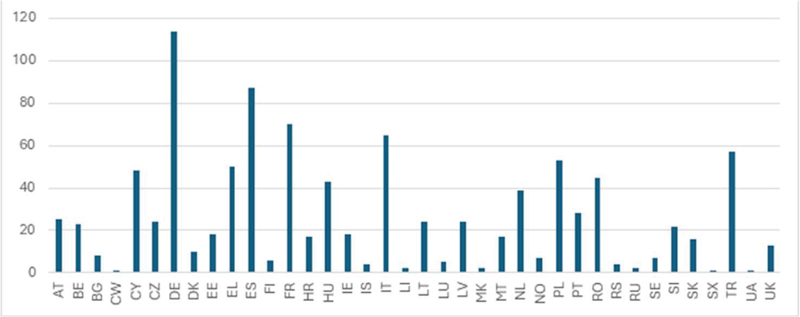
At the same time, a further search was attempted to find out which countries led these programmes. In the one thousand (1,000) most recent programmes covering the period 2014–2024, Germany leads the way (114), followed by Spain (87), France (70), Italy (65), Turkey (57), Poland (53), Greece (50), Cyprus (48) and – after other countries – Portugal (28). In a general context, Southern European countries concentrate a significant number of programmes in this category.
Table 1 Graph showing the countries that have led successful financing efforts
In the second combination of words the majority of the findings concern KA2: Partnerships for cooperation and exchanges of practices (19 projects) and KA1: Learning Mobility of Individuals (6 projects). The projects are developed in the following thematic areas: (a) ICT – new technologies – digital competences (7 projects), (b) New innovative curricula/educational methods/development of training courses (7 projects), (c) Cultural heritage (4 projects), (d) Enterpreneurial learning, enterpreneurship education (3 projects), (e) Civic engagement/ responsible citizenship (3 projects). The emphasis is on new technologies and education. Furthermore, these programmes should be developed in the following specific categories of ERASMUS+: Youth, 9 programmes; School Education, 6; Vocational Education and Training, 4; Adult Education, 3; Higher Education, 3.
It is worth noting the low development of relevant programmes in higher education and vocational education, as opposed to primary/secondary education and the youth sector. Nevertheless, the position of the southern European countries is also significant here. In a parallel search for which countries have led these programmes, Italy is in the lead (5), followed by Greece (3), Turkey (3), France (2) and Slovenia (2). Of the remaining southern European countries, both Spain and Portugal have coordinated one programme.
The CORDIS EU RESULTS database was also searched by keywords on all the projects funded. 551 results were found based on the search with the terms “sustainable”, ‘social’, “games”. The second combination of the words “sustainability”, ‘gaming’, “virtual” resulted in 281 cases of funded projects. For both searches, the vast majority of the projects concern projects carried out within the last decade.
A content analysis of the titles of these programmes was attempted. The most frequently identified words (terms) were collected (see graph, Table 2), which highlighted five (5) categories: “environment/climate change”, “technologies/digital media”, “education/didactics”, “society/sustainability”, “entrepreneurship/applications”.
Table 2 Graph showing the most frequently found words in the titles of the programmes
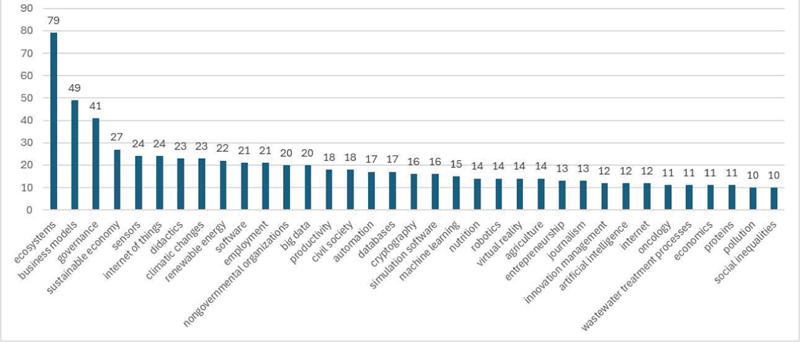
In the first search with 551 results, 170 references were found in the category “environment/climate change”, 207 in the category “technologies/digital media”, 38 in the category “education/didactics”, 145 in the category “society/sustainability” and 133 in the category “entrepreneurship/ applications”. In the second search with 281 results, 60 references were found in the category ‘environment/climate change’, 129 in the category ‘technologies/digital media’, 26 in the category ‘education/didactics’, 26 in the category ‘society/sustainability’ and 42 in the category “entrepreneurship/applications”. The representation of terms is considered to be relatively balanced for four of the five categories. The exception is the category “education/teaching”, which seems to have a limited footprint.
Table 3 Graph showing the concentration of programmes in the countries that applied for and won European funding
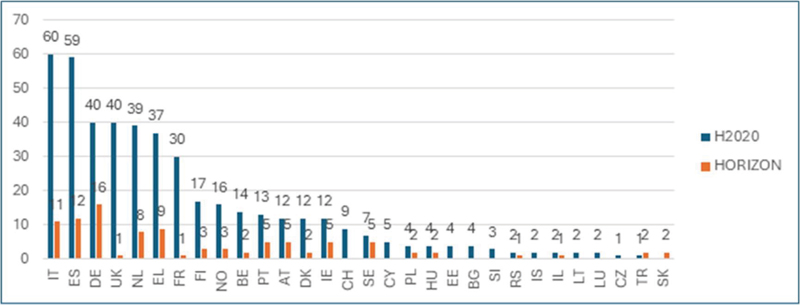
The analysis of the data also shows that of the 551 programmes (see graph, Table 3), the majority of programmes are concentrated in Italy (71), Spain (71), Germany (56), the Netherlands (47) and Greece (46), while the fewest programmes are found in Iceland (2), Lithuania (2), Luxembourg (2), Slovakia (2) and the Czech Republic (1). Of the other southern European countries not mentioned, Portugal is mentioned in 18 programmes and Cyprus in 5. In a parallel search for which countries led these programmes (i.e. with the corresponding organisation coming from the country in question) out of a total of 551 programmes, the 5 southern European countries were involved as ‘leaders’ in 211 programmes.
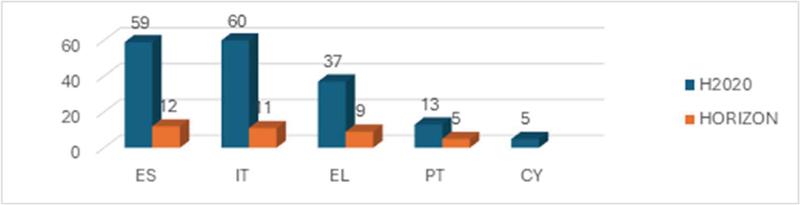
In the second search (281 projects), the majority of projects are concentrated in Italy (39), Spain (36), Germany (29), the United Kingdom (26) and France (22), while the fewest projects are found in Estonia, Serbia, North Macedonia, Slovakia and Turkey (1 each). Of the remaining Southern European countries not mentioned, Greece is mentioned in 18 programmes, Portugal in 8 and Cyprus in 5. In a parallel search for which countries led these programmes, out of a total of 281 programmes, the 5 Southern European countries were involved as “leaders” in 106 programmes, which are considered significant numbers (see bar chart, Table 4).
Table 4 Bar chart showing the concentration of funded projects in Southern European countries
4 Conclusions; Towards a Sustainable Metaverse Gaming
We are entering a new digital age of communication, entertainment and education. The contemporary challenge is to achieve sustainable digital growth with a social dimension while ensuring individual well-being. Based on this reasoning, representatives of digital communication studies place particular emphasis on the reasons why users choose specific online platforms and digital media for communication and entertainment, as well as the ways in which they use them. At the same time, scholars in the field focus on how the digital dimension influences the social construction of human contact [55].
A new interplanetary world seems to be taking shape, with expanded virtual spaces (“virtual cities”), which are rapidly developing and demanding our attention. The role of digital games, among other technologies, is becoming central in shaping this world. Metaverse gaming is a new contemporary field, the mapping of which is thought-provoking, as – in addition to its great development potential – ethical issues such as property rights, privacy concerns, potential exploitation and susceptibility to manipulation are emerging [56]. Also, particular emphasis seems to be placed on the growing presence of artificial intelligence in digital games. On the one hand, the positive dynamics of this relationship are examined [57], but on the other hand, its role in addiction mechanisms, the possible spread of harmful behaviours and the reinforcement of cultural biases is explored [58]. In any case, the data from the use of digital games demonstrate the positive role of gamification and digital games in communication, entertainment, education, etc. Indeed, such data can confirm, challenge and extend the existing evidence on the psychology of knowledge, allowing understanding and coupling the multiple factors that influence learning [46]. Recently, Video Games Europe [59], which represents the European digital games industry, welcomed the European Commission’s “Skills Union” initiative [9], an action on skills development, digital education, upskilling and retraining of individuals, as a crucial step to strengthen Europe’s citizens/professionals and competitiveness.
From the analysis of the EU’s databases, it became apparent that there is an increasing funding of European programmes investing in environmental protection and sustainable development with a parallel interest in the field of digital games and their exploitation. Most of these programmes have been developed in recent years. The majority of these programmes focus on environmental protection, (green) entrepreneurship and the development of green and digital skills. Both the literature in the field and the research data have revealed regional variations within the European context, with central and northern European countries generally developing greater momentum in the desired sustainable social dimension of digital transformation than southern and eastern European countries [6, 54]. On the other hand, in the context of European funding, the position of the southern countries is prominent, while the presence of organisations from these countries is active and leading. In addition, both the literature search [54] and the research on the bases of European funded programmes have highlighted the limited activity of university institutions in the fields of sustainable social development [55], sustainable digital transformation and research regarding the development of digital games and the exploration of its role in the new digital, virtual age.
Attention is directed towards training and retraining citizens, users and professionals in the new skills [9] in order to keep pace with technological developments, but also to be able to functionally master the new virtual environments that are rapidly emerging and affecting all areas of human activity. In any case, the focus of both research and investment should be on the citizen (user, consumer, player) and his or her needs, which is the direction that this research should continue to focus on.
Footnotes
2The term Triple-A is an informal classification used for video games, which typically have higher development and marketing budgets than other categories of games. These are high production/marketing value games, similar to blockbuster films of global reach.
3Discovery Tour by Ubisoft: Teacher Learning Resources |Ubisoft (US).
4Creative Europe – Culture and Creativity (europa.eu).
5Regulation – 2016/679 – EN – gdpr – EUR-Lex (europa.eu).
6AVMSD – Audiovisual Media Services Directive, AVMSD, Directive – 2018/1808 – EN – EUR-Lex (europa.eu).
7DSM Directive, Directive – 2019/790 – EN – dsm – EUR-Lex (europa.eu).
8EU Industrial Strategy, Strategy – European Commission (europa.eu).
9EIB Investment Report 2021/2022: Recovery as a springboard for change.
11ERASMUS+ PROJECT RESULTS https://ec.europa.eu/programmes/erasmus-plus/projects.
12CORDIS EU RESULTS Search |CORDIS |European Commission (europa.eu).
References
[1] United Nations, Commission for Social Development. (2015). Chair’s Summary: Panel Discussion on Emerging Issues: Contributions of social development to the transition from the Millennium Development Goals to Sustainable Development Goals, 6 February 2015.
[2] Mitoula, R. (2023). Sustainable Development. Individual actions for the implementation of the 17 Global Goals of Sustainable Development. Special Volume SUSTAINABLE DEVELOPMENT, Sustainable Development, Culture, Traditions Journal (SDCT-Journal). doi: 10.26341/issn.2241-4010-2023-1c.
[3] Stefanou, J., and Mitoula, R. (2024). Global Goal 11 for Sustainable City Development. Sustainable Development. Culture, Traditions Journal (4), 58–68. https://doi.org/10.26341/issn.2241-4002-2024-4c-5-T02188.
[4] UNEP (n.d.). Sustainable Digitalization. https://www.unep.org/topics/digital-transformations/sustainable-digitalization.
[5] CODES (Coalition for Digital Environmental Sustainability) (2022). Action Plan for a Sustainable Planet in the Digital Age. https://doi.org/10.5281/zenodo.6573509.
[6] Nosratabadi, S., Atobishi, T., and Hegedűs, S. (2023). Social sustainability of digital transformation: Empirical evidence from EU-27 countries. Administrative Sciences, 13(5), 126. https://doi.org/10.3390/admsci13050126.
[7] European Commission (2023a). 2030 Digital Decade – Report on the state of the Digital Decade 2023. DOI 10.2759/318547.
[8] Vuorikari, R., Kluzer, S. and Punie, Y. (2022). DigComp 2.2: The Digital Competence Framework for Citizens – With new examples of knowledge, skills and attitudes, EUR 31006 EN. Publications Office of the European Union, Luxembourg, ISBN 978-92-76-48882-8. doi: 10.2760/115376, JRC128415.
[9] European Commission (2025). The Union of Skills. Brussels, March 5, 2025, https://op.europa.eu/en/publication-detail/-/publication/d9d9adad-c71b-11ee95d9-01aa75ed71a1/language-en.
[10] Kamols, N., Foth, M., and Hearn, G. (2025). The Citizen’s Right to the Virtual City: Urban Governance in the Metaverse Through an Exploration of Decentraland. Journal of Urban Technology, 1–28. https://doi.org/10.1080/10630732.2025.2464525.
[11] Bokolas, V. (2024). Metaverse gaming⋅ a new era of entertainment, communication and education. WAKEUP – Raising Youth Awareness on the Metaverse. https://xeniospolis.gr/el/metaverse-gaming\%e2\%88\%99-a-new-era-of-entertainment-communication-and-education-2/.
[12] Dwivedi, Y. K. et al. (2022). Metaverse beyond the hype: Multidisciplinary perspectives on emerging challenges, opportunities, and agenda for research, practice and policy. International journal of information management, 66. doi.org/10.1016/j.ijinfomgt.2022.102542.
[13] Clement, J. (2024a). Video gaming and the metaverse – Statistics & Facts. Statista. https://www.statista.com/topics/9490/metaverse-and-video-gaming/\#topFacts.
[14] Mohammed, S. Y., Aljanabi, M., Gadekallu, T. R. (2024). Navigating the Nexus: A systematic review of the symbiotic relationship between the metaverse and gaming, International Journal of Cognitive Computing in Engineering, 5, 88–103, https://doi.org/10.1016/j.ijcce.2024.02.001.
[15] ESA (Entertainment Software association) (2024). Video Games in the 21st century: the 2024 economic impact report. https://www.theesa.com/wp-content/uploads/2024/02/EIR\_ESA\_2024.pdf.
[16] European Commission (2023b). Directorate-General for Communications Networks, Content and Technology, Understanding the value of a European video games society – Final report. Publications Office of the European Union https://data.europa.eu/doi/10.2759/332575.
[17] ESA (Entertainment Software association) (2023a). Essential Facts About the U.S. Video Game Industry. ESA_2023_Essential_Facts_FINAL_07092023.pdf (theesa.com).
[18] Video Games Europe (2021). Key facts from 2021 about the european video games sector – VIDEOGAMES EUROPE. https://www.videogameseurope.eu/data-key-facts/key-facts-from-2021-europe-video-games-sector/.
[19] Santos, F. (2021). The “so-called” UGC: an updated definition of user-generated content in the age of social media. Online Information Review, 45(5), 789–805. https://doi.org/10.1108/OIR-06-2020-0258.
[20] Johnson, K. (2020). User engagement strategies. Journal of Digital Marketing, 5(1), 12–20.
[21] Brown, J. (2020). Engaging users in digital spaces. Journal of User Experience, 10(2), 1–10.
[22] Kaperonis, S. (2019). Virtual networks: Why do students use Instagram? Homo Virtualis, 2(1), 43–49. https://doi.org/10.12681/homvir.20193.
[23] Dimopoulos, K. (2020). Virtual Cities: An Atlas & Exploration of Video Game Cities. Unbound Publishing.
[24] Deterding, S., Dixon, D., Khaled, R., and Nacke, L. (2011). From game design elements to gamefulness: defining “gamification”. In Proceedings of the 15th international academic MindTrek conference: Envisioning future media environments, 9–15.
[25] Abadi, M. F., B., Khalili Samani, N., Akhlaghi, A., Najibi, S., and Bolourian, M. (2022). Pros and Cons of Tomorrow’s Learning: A Review of Literature of Gamification in Education Context. Medical Education Bulletin, 3(4), 543–554.
[26] Sailer, M., Homner, L. (2020). The Gamification of Learning: A Meta-analysis. Educational Psychology Review, 32, (1), 77–112. https://doi.org/10.1007/s10648-019-09498-w.
[27] Thomas, N. J., Baral, R., Crocco, O. S., and Mohanan, S. (2023). A framework for gamification in the metaverse era: How designers envision gameful experience. Technological Forecasting and Social Change, 193, 122544. https://doi.org/10.1016/j.techfore.2023.122544.
[28] Medvedev, M., García-Gavilanes, R., and Yasseri, T. (2023). Patterns of online user participation: A data-driven analysis of comments and posts across digital communities. Journal of Computational Social Science, 6(1), 1–20. https://doi.org/10.1007/s42001-022-00162-4.
[29] Liu, X., Wan Abas, W. A., and Wan Mohtar, W. I. (2024). The influence of social media usage motivations on psychological well-being. International Journal of Academic Research in Business and Social Sciences, 14(11). https://doi.org/10.6007/IJARBSS/v14-i11/23501.
[30] Xu, W., Fan, W., Lu, S., Li, T., and Wang, B. (2025). Polarized patterns of language toxicity and sentiment of debunking posts on social media. arXiv preprint arXiv:2501.06274. https://arxiv.org/abs/2501.06274.
[31] Chen, T., Huang, J., Wu, X., and Shao, C. (2024). Predicting social media popularity with large language models: Transforming metadata into semantic-enriched and contextualized text. IEEE Access, 12, 1–12. https://doi.org/10.1109/ACCESS.2024.3484762.
[32] Trujillo, M. Z., Hébert-Dufresne, L., and Bagrow, J. (2023). Measuring centralization of online platforms through size and interconnection of communities. arXiv preprint. arXiv:2307.15027. https://arxiv.org/abs/2307.15027.
[33] Jeong, U., Sheth, P., Tahir, A., Alatawi, F., Bernard, H. R., and Liu, H. (2024). Exploring platform migration patterns between Twitter and Mastodon: A user behavior study. Proceedings of the International AAAI Conference on Web and Social Media, 18, 738–750. https://arxiv.org/abs/2305.09196.
[34] Bartle, R. A. (2016). MMOs from the Outside In: The Massively-Multiplayer Online Role-Playing Games of Psychology, Law, Government, and Real Life. Apress: Springer.
[35] Dalgarno, B., and Lee, M. J. W. (2010). What are the learning affordances of 3-D virtual environments?. British journal of educational technology, 41(1), 10–32. https://doi.org/10.1111/j.1467-8535.2009.01038.x.
[36] Steinkuehler, C. A., Williams, D. (2006). Where Everybody Knows Your (Screen) Name: Online Games as ‘Third Places’. Journal of Computer-Mediated Communication 11, 885–909. https://doi.org/10.1111/j.1083-6101.2006.00300.x.
[37] Kolo, C., Baur, T. (2004). Living a Virtual Life: Social Dynamics of Online Gaming. Game Studies 4, 1–31. http://gamestudies.org/0401/kolo/.
[38] Clement, J. (2024b). Video gaming and the metaverse – Statistics & Facts. Statista. https://www.statista.com/topics/9490/metaverse-and-video-gaming/\#topicOverview.
[39] Jo, H., Park, S., Jeong, J., Yeon, J., and Lee, J. K. (2023). Metaverse gaming: analyzing the impact of self-expression, achievement, social interaction, violence, and difficulty. Behaviour & Information Technology, 44(4), 749–763. https://doi.org/10.1080/0144929X.2024.2341059.
[40] Tukur, M., Schneider, J., Househ, M., Dokoro, A. H., Ismail, U. I., Dawaki, M., and Agus, M. (2024). The Metaverse digital environments: A scoping review of the techniques, technologies, and applications. Journal of King Saud University-Computer and Information Sciences, 36(2). https://doi.org/10.1016/j.jksuci.2024.101967.
[41] Zhang, X., Chen, Y., Hu, L., and Wang, Y. (2022). The metaverse in education: Definition, framework, features, potential applications, challenges, and future research topics. Frontiers in Psychology, 13, 1016300. https://doi.org/10.3389/fpsyg.2022.1016300.
[42] Buckingham, D., and Scanlon, M. (2000). That is edutainment: Media, pedagogy and the marketplace. In International forum of researchers on young people and the media, Sydney.
[43] Egenfeldt-Nielsen, S. (2005). Beyond edutainment: Exploring the educational potential of computer games. (Unpublished dissertation). Copenhagen, Denmark: IT University of Copenhagen. http://www.itu.dk/people/sen/egenfeldt.pdf.
[44] Jarvin, L. (2015). Edutainment, Games, and the Future of Education in a Digital World. New Directions for Child and Adolescent Development 147, 33–40. http://onlinelibrary.wiley.com/doi/10.1002/cad.20082/full.
[45] European Schoolnet (2024). Video Games in European Schools: Results from the Games in Schools 2023–2024. Research Project, Brussels, Belgium, European Schoolnet EUN Partnership AISBL. https://www.videogameseurope.eu/games-in-society/education/about-games-in-schools/.
[46] Stafford, T., Vaci, N. (2022). Maximizing the Potential of Digital Games for Understanding Skill Acquisition. Current Directions in Psychological Science 31(1), 49–55. https://doi.org/10.1177/09637214211057841.
[47] Bokolas, V. (2019). History and video games: development of pedagogical criteria for the evaluation and construction of digital games. (Postdoctoral thesis). Thessaloniki: Aristotle University of Thessaloniki.
[48] ESA (Entertainment Software association) (2023b). Power of Play. https://www.theesa.com/wp-content/uploads/2024/05/PowerOfPlay2023\_Final-esa.pdf.
[49] Pasqualotto, A., Altarelli, I., De Angeli, A. et al. (2022). Enhancing reading skills through a video game mixing action mechanics and cognitive training. Nature Human Behaviour, 6, 545–554. https://doi.org/10.1038/s41562-021-01254-x.
[50] Chaarani, B., Ortigara, J., Yuan, D., Loso, H., Potter, A., and Garavan, H. P. (2022). Association of video gaming with cognitive performance among children. JAMA network open, 5(10). doi: 10.1001/jamanetworkopen.2022.35721.
[51] European Parliament (2023a). Protecting gamers and encouraging growth in the video games sector. Press Release (18-01-2023) https://www.europarl.europa.eu/news/en/press-room/20230113IPR66646/protecting-gamers-and-encouraging-growth-in-the-video-games-sector.
[52] European Parliament (2023b). Five ways the European Parliament wants to protect online gamers(18/01/2023). https://www.europarl.europa.eu/news/en/headlines/society/20230112STO66402/five-ways-the-european-parliament-wants-to-protect-online-gamers.
[53] Council of the European Union (2023). Council conclusions on enhancing the cultural and creative dimension of the European video games sector, Brussels (24/11/2023). https://data.consilium.europa.eu/doc/document/ST-15901-2023-INIT/en/pdf.
[54] European Commission (2023b). Directorate-General for Communications Networks, Content and Technology, Understanding the value of a European video games society – Final report. Publications Office of the European Union https://data.europa.eu/doi/10.2759/332575.
[55] Gazi, M. A. I., Rahaman, M. A., Rabbi, M. F., et al. (2024). The Role of Social Media in Enhancing Communication among Individuals: Prospects and Problems. Environment and Social Psychology, 9(11), 2979. https://doi.org/10.59429/esp.v9i11.2979.
[56] Tariq, S., Abuadbba, A., and Moore, K. (2023). Deepfake in the metaverse: Security implications for virtual gaming, meetings, and offices. In Proceedings of the 2nd Workshop on Security Implications of Deepfakes and Cheapfakes, 16–19.
[57] Alotaibi, O. (2023). New Metaverse Games Based on Artificial Intelligence: A Review. International Journal of Metaverse, 2, 20–32. https://doi.org/10.54536/ijm.v2i1.3230.
[58] Gil, R. M., Gutiérrez-Ujaque, D., and Teixidó, M. (2024). Analyzing the metaverse: Computer Games, Blockchain, and 21st-century Challenge. International Journal of Human–Computer Interaction, 40(21), 6758–6775. https://doi.org/10.1080/10447318.2023.2290380.
[59] Video Games Europe (2025). Video Games Europe welcomes the Union of Skills. https://www.videogameseurope.eu/news/video-games-europe-welcomes-the-union-of-skills/.
Biographies

Vassilis Bokolas research interests are concentrated in cultural and educational research with a special emphasis on the dimension of digital media and especially digital games (PhD 2007, University of Crete, EU scholarship/ Post-doc 2019, AUTH/ PhD 2025, Panteion University). Currently, he is the director of research institution, “XENIOS POLIS”. He is responsible for the application, undertaking and implementation of several European funded research projects. Alongside the above, in recent years he has been teaching at Neapolis University of Paphos (Cyprus) and at the Athens College. He has taught at AUTH, the University of Crete and the A.S.PAI.T.E. Furthermore, has collaborated with the Cyprus University of Technology, the Harokopeio University of Athens and the University of Tuscia. His scientific experience concerns – among others – projects for the functional integration of digital media in education (scientific responsibility, coordination, etc.). His writing activity includes scientific monographs, educational material, publications from European projects/research, digital material/platforms, original teaching scenarios and many research publications. In addition, he has made a very large number of presentations in international and national scientific conferences and workshops, and has organized and coordinated major scientific events (international conferences, kick-off meetings, etc.).

Stavros Kaperonis is an Assistant Professor at the Department of Communication, Media and Culture of Panteion University of Social and Political Sciences in Athens, Greece. He has also worked as an Adjunct Professor at Athens University of Economics and Business (AUEB). Dr. Kaperonis holds a BSc (Hons) from the School of Science and Technology, Department of Natural Sciences (HOU), an MSc in Services Management from the Department of Business Administration of the Athens University of Economics and Business, and a Ph.D. in Web Aesthetics and Usability from the Department of Public Administration of the Panteion University of Athens, Greece. He has been involved in numerous research projects. Since 2015, he has been teaching in undergraduate and postgraduate programmes in the fields of media, communication and design in Greece. In addition, he has also been invited to give guest lectures in Italy and in China. His main research interests are UX, CX, UI, HCI, AI/AR/VR/XR/MR environments, e-aesthetics, e-atmospheres, communication management, design and communication strategy, web design, brand design, visual identity, social media, video storytelling, new media tools, data visualisation, strategic information systems planning, service customisation and business process modelling and management. He has published research papers at conferences and in journals and has edited a book. Expertise: S.K. expertise is in UX, CX, UI, and HCI environments. His academic expertise and research contributions include communications design, program design, and innovative technologies.

Efstathia (Efi) Ntrouva, is a PhDc in Sociology, holds two bachelor’s degrees in human and social sciences and a master in gender studies. She is a Project Coordinator for the Erasmus+ ICM Programme in the IR&EU Department at Panteion University since 2018. She is involving as a researcher in European and National projects since 2014 and she is responsible for planning, implementation, evaluating, and monitoring (HORIZON, KA2, and CBHE, ELIDEK). Since October 2023 she has a research grant “Analysis and geo-social impact of Data Sciences and digitalization in projects in the European context”, for the scientific-disciplinary area SSD M-GGR/01, CUN 11, /DICE, UniTus. From 2004 to 2013 she belonged also to the scientific coordination team for the social inclusion of sensitive and vulnerable groups projects that were confounded by ESF who worked with vulnerable groups, domestic violence victims, early school leave youth, and law qualification adults. She has authored and co-authored scientific articles and participated in several scientific and technical conferences.
Strategic Planning for Energy and the Environment, Vol. 44_4, 819–844.
doi: 10.13052/spee1048-5236.4448
© 2025 River Publishers