Age-Reversal
Advances in Regenerative Interventions
DOI:
https://doi.org/10.13052/ijts2246-8765.2026.007Keywords:
Biological aging, cellular reprogramming, senolytics, epigenetic clock, regenerative medicine, longevityAbstract
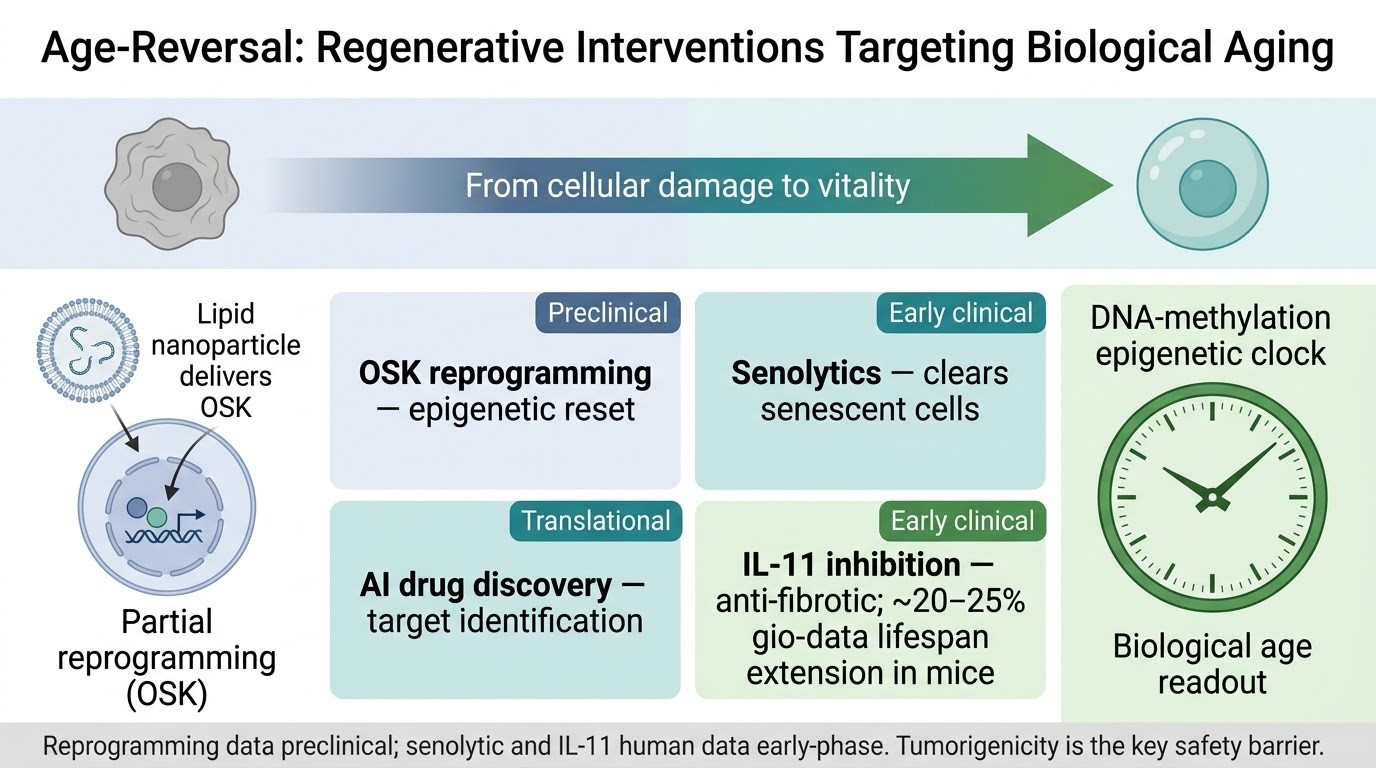
This perspective discusses emerging regenerative interventions that target biological aging. Over recent decades, scientific advances have expanded understanding of aging as a potentially modifiable biological process. Technologies under investigation include partial cellular reprogramming, senescent cell clearance, artificial-intelligence-driven drug discovery, organ regeneration, and modulation of epigenetic aging clocks.
Preclinical studies indicate that aged cells may regain more youthful functional characteristics under specific experimental conditions. For example, inhibition of interleukin-11 signaling initiated in late life extended median lifespan by approximately 20–25% in mice and partial reprogramming has improved tissue function and survival in aged mouse model. Developments in DNA-methylation-based biomarkers now permit estimation of biological age, allowing more efficient assessment of candidate interventions. All reprogramming data to date are preclinical, and human senolytic and IL-11 data are early-phase.
Although many findings remain experimental or early translational, they represent a convergence of approaches that may influence future biomedical research. This paper summarizes selected topics related to biological age modulation and highlights ongoing areas of investigation.
Downloads
References
A. Ocampo et al., “In vivo amelioration of age-associated hallmarks by partial reprogramming,” Cell, vol. 167, no. 7, pp. 1719–1733, Dec. 15, 2016.
S. K. Sahu et al., “Targeted partial reprogramming of age-associated cell states improves markers of health in mouse models of aging,” Sci. Transl. Med., vol. 16, no. 764, p. eadg1777, Sep. 11, 2024.
S. Chaib, T. Tchkonia, J. L. Kirkland, “Cellular senescence and senolytics: The path to the clinic,” Nat. Med., vol. 28, no. 8, pp. 1556–1568, Aug. 2022.
S. Arora et al., “Discovering geroprotectors through the explainable artificial intelligence-based platform AgeXtend,” Nat. Aging, vol. 5, no. 1, pp. 144–161, Jan. 2025.
H. Li et al., “Artificial intelligence across the aging continuum: Mechanistic geroscience, therapeutic innovation, and clinical impact,” Ageing Res. Rev., vol. 120, p. 103205, Jun. 10, 2026.
J. H. Elisseeff, S. F. Badylak, J. D. Boeke, “Immune and genome engineering as the future of transplantable tissue,” N. Engl. J. Med., vol. 385, no. 26, pp. 2451–2462, Dec. 23, 2021.
A. A. Johnson, D. A. Sinclair, “Turning back time: A comprehensive list of interventions that decrease nextgeneration epigenetic aging clocks in humans,” Front. Genet., vol. 17, p. 1836446, 2026.
K. N. Fitzgerald et al., “Potential reversal of epigenetic age using a diet and lifestyle intervention: A pilot randomized clinical trial,” Aging (Albany NY), vol. 13, no. 7, pp. 9419–9432, Apr. 12, 2021.
K. Takahashi, S. Yamanaka, “Induction of pluripotent stem cells from mouse embryonic and adult fibroblast cultures by defined factors,” Cell, vol. 126, no. 4, pp. 663–676, Aug. 25, 2006.
C. C. Macip et al., “Gene therapy-mediated partial reprogramming extends lifespan and reverses age-related changes in aged mice,” Cell Reprogram., vol. 26, no. 1, pp. 24–32, Feb. 2024.
W. Zhang et al., “The ageing epigenome and its rejuvenation,” Nat. Rev. Mol. Cell Biol., vol. 21, no. 3, pp. 137–150, Mar. 2020.
M. Dhar et al., “Endothelial KLF4 depletion drives age-related neurovascular dysfunction,” Proc. Natl. Acad. Sci. U.S.A., vol. 123, no. 25, p. e2426990123, Jun. 23, 2026.
M. E. Levine et al., “An epigenetic biomarker of aging for lifespan and healthspan,” Aging (Albany NY), vol. 10, no. 4, pp. 573–591, Apr. 18, 2018.
J. L. Kirkland, T. Tchkonia, “Cellular senescence: A translational perspective,” EBioMedicine, vol. 21, pp. 21–28, Jul. 2017.
J. Kaur, J. N. Farr, “Cellular senescence in age-related disorders,” Transl. Res., vol. 226, pp. 96–104, Dec. 2020.
D. E. Forman et al., “Impact of geroscience on therapeutic strategies for older adults with cardiovascular disease,” J. Am. Coll. Cardiol., vol. 82, no. 7, pp. 631–647, Aug. 15, 2023.
P. D. Robbins et al., “Senolytic drugs: Reducing senescent cell viability to extend health span,” Annu. Rev. Pharmacol. Toxicol., vol. 61, pp. 779–803, Jan. 6, 2021.
K. Huanbutta et al., “Artificial intelligence-driven pharmaceutical industry: A paradigm shift,” Eur. J. Pharm. Sci., vol. 203, p. 106938, Dec. 1, 2024.
M. Selman, A. Pardo, “Fibroageing: An ageing pathological feature,” Ageing Res. Rev., vol. 70, p. 101393, Sep. 2021.
L. L. Ren et al., “TGF-beta as a master regulator of aging-associated tissue fibrosis,” Aging Dis., vol. 14, no. 5, pp. 1633–1650, Oct. 1, 2023.
D. C. Rockey, P. D. Bell, J. A. Hill, “Fibrosis – a common pathway to organ injury and failure,” N. Engl. J. Med., vol. 372, no. 12, pp. 1138–1149, Mar. 19, 2015.
S. Schafer et al., “IL-11 is a crucial determinant of cardiovascular fibrosis,” Nature, vol. 552, no. 7683, pp. 110–115, Dec. 7, 2017.
S. A. Cook, S. Schafer, “Hiding in plain sight: Interleukin-11 as a master regulator of fibrosis,” Annu. Rev. Med., vol. 71, pp. 263–276, Jan. 27, 2020.
A. A. Widjaja et al., “Inhibition of IL-11 signalling extends mammalian healthspan and lifespan,” Nature, vol. 632, no. 8023, pp. 157–165, Aug. 2024.
S. A. Cook, “Understanding interleukin-11 as a disease gene and therapeutic target,” Biochem. J., vol. 480, no. 23, pp. 1987–2008, Dec. 13, 2023.
B. Ng et al., “Interleukin-11 is a therapeutic target in idiopathic pulmonary fibrosis,” Sci. Transl. Med., vol. 11, no. 511, Sep. 25, 2019.
S. B. Kritchevsky, S. R. Cummings, “Geroscience: A translational review,” JAMA, vol. 334, no. 12, pp. 1094–1102, Sep. 23, 2025.