Combining Senolytic, Stem Cell, and NAD+ Strategies as an Integrated Protocol
Based on a lecture delivered at the HEALinc Future Health Innovation Summit, May 2026.
DOI:
https://doi.org/10.13052/ijts2246-8765.2026.003Keywords:
Healthspan, NAD , senolytic, stem cellsAbstract
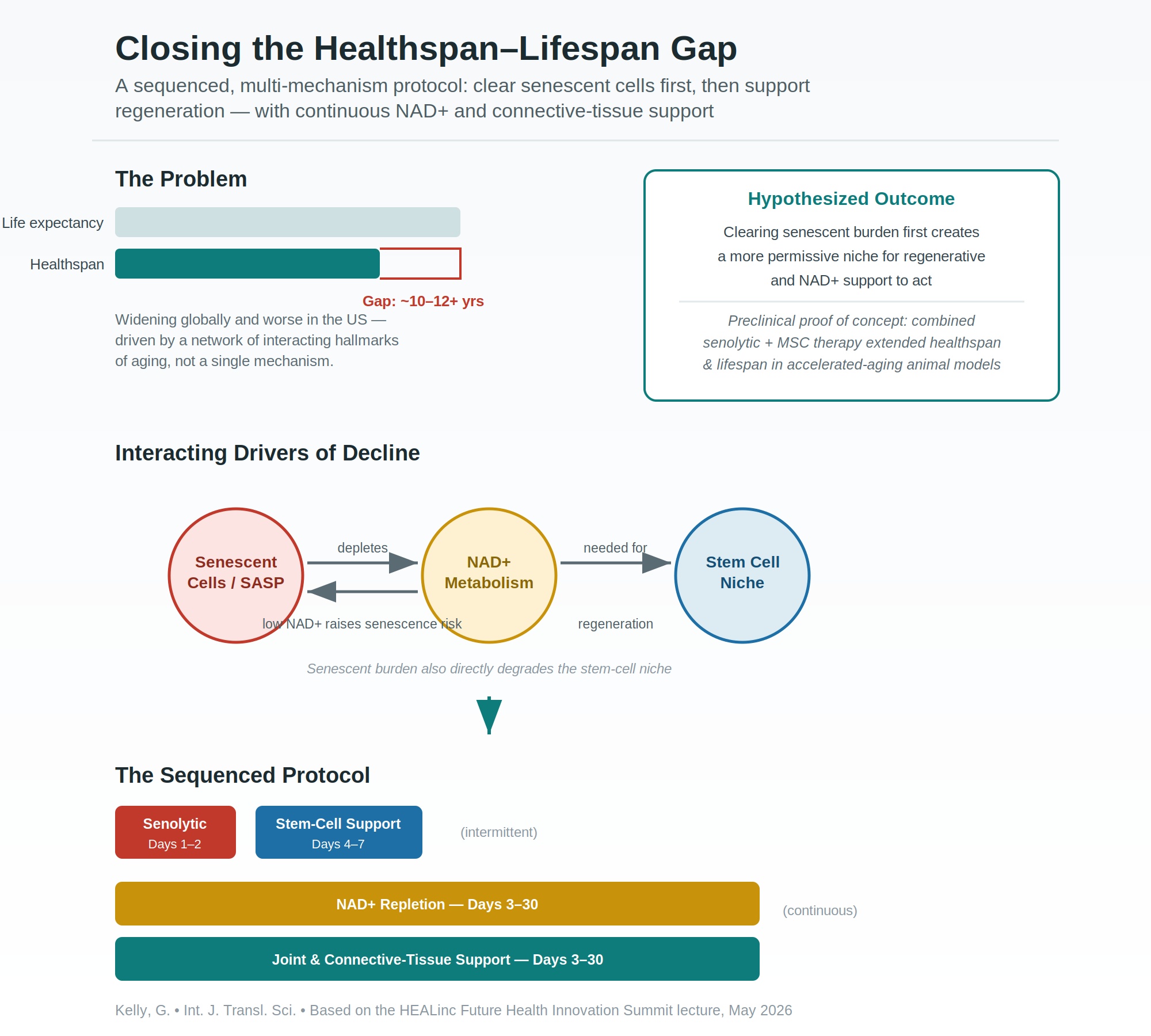
Human life expectancy has risen faster than the span of life spent in good health, producing a widening healthspan–lifespan gap that now approaches a decade globally and exceeds 12 years in the United States. Conceptual approaches for aging intervention range from largely mechanistic-based frameworks, such as the hallmarks of aging, to more function-first approaches like the World Health Organization’s intrinsic capacity model. Because biological aging is driven not by a single mechanism, but by a network of interacting hallmarks, and because many aspects of physical and cognitive function can be declining together leading up to the time period spent in the healthspan–lifespan gap, interventions that target only one process or area of function are unlikely to compress this gap substantially. This perspective makes the translational case for combining – and deliberately sequencing – potentially complementary categories of intervention: senolytics that clear senescent cells, regenerative support that supports stem cell function, joint support to enhance mobility, and nicotinamide adenine dinucleotide (NAD+) repletion that supports cellular energetics. The rationale rests on documented cross-talk among these mechanisms: as an example, senescent cells consume NAD+ and impair the niches in which stem cells operate, so clearing senescent burden plausibly creates a more permissive environment for both NAD+ restoration and regenerative signaling. A recently published preclinical study demonstrated synergistic healthspan and lifespan extension when a senolytic immunotherapy was combined with personalized mesenchymal stem cells in accelerated-aging models, providing proof of concept for the combination principle. A 12-week pilot trial using newer generation methylation clocks (e.g., DunedinPACE, OMICmAge) is planned to test an integrated nutraceutical and botanical protocol directly.
Downloads
References
A. Garmany and A. Terzic, “Global healthspan-lifespan gaps among 183 World Health Organization member states,” JAMA Netw. Open, vol. 7, no. 12, p. e2450241, Dec. 2024, doi: 10.1001/jamanetworkopen.2024.50241.
C. López-Otín, M. A. Blasco, L. Partridge, M. Serrano, and G. Kroemer, “The hallmarks of aging,” Cell, vol. 153, no. 6, pp. 1194–1217, Jun. 2013, doi: 10.1016/j.cell.2013.05.039.
C. López-Otín, M. A. Blasco, L. Partridge, M. Serrano, and G. Kroemer, “Hallmarks of aging: An expanding universe,” Cell, vol. 186, no. 2, pp. 243–278, Jan. 2023, doi: 10.1016/j.cell.2022.11.001.
A. G. Tartiere, J. M. P. Freije, and C. López-Otín, “The hallmarks of aging as a conceptual framework for health and longevity research,” Front. Aging, vol. 5, p. 1334261, Jan. 2024, doi: 10.3389/fragi.2024.1334261.
G. Kroemer et al., “From geroscience to precision geromedicine: Understanding and managing aging,” Cell, vol. 188, no. 8, pp. 2043–2062, Apr. 2025, doi: 10.1016/j.cell.2025.03.011.
N. A. Grande de França, Y. Rolland, S. Guyonnet, and P. de Souto Barreto, “The role of dietary strategies in the modulation of hallmarks of aging,” Ageing Res. Rev., vol. 87, no. 101908, p. 101908, Jun. 2023, doi: 10.1016/j.arr.2023.101908.
S. Zhu, L. Tao, C. Fan, Y. Wei, J. K. Chhetri, and P. Chan, “Aligning intrinsic capacity and geroscience: Linking function with biology,” Aging Dis., Jan. 2026, doi: 10.14336/AD.2025.1419.
S. E. Lakhan, “The brain is the rate-limiting organ of longevity: A brain-first systems framework for aging,” Cureus, vol. 18, no. 1, p. e101106, Jan. 2026, doi: 10.7759/cureus.101106.
K. Pfleger, “The 2 longevity fields: Broadly slowing aging vs. divide-and-conquer rejuvenation,” Karl Pfleger. Accessed: Jun. 23, 2026. [Online]. Available: https://karlpfleger.substack.com/p/the-2-longevity-fields-broadly-slowing.
T. C. Bitencourt, J. E. Vargas, A. O. Silva, L. R. Fraga, and E. Filippi-Chiela, “Subcellular structure, heterogeneity, and plasticity of senescent cells,” Aging Cell, vol. 23, no. 4, p. e14154, Apr. 2024, doi: 10.1111/acel.14154.
C. C. S. Chini, H. S. Cordeiro, N. L. K. Tran, and E. N. Chini, “NAD metabolism: role in senescence regulation and aging,” Aging Cell, vol. 23, no. 1, p. e13920, Jan. 2024, doi: 10.1111/acel.13920.
T. A. Rando, A. Brunet, and M. A. Goodell, “Hallmarks of stem cell aging,” Cell Stem Cell, vol. 32, no. 7, pp. 1038–1054, Jul. 2025, doi: 10.1016/j.stem.2025.06.004.
P. Milić, M. J. Kjuder, K. J. Gradišar, U. Švajger, and P. Rožman, “Differential effects of young and old hematopoietic stem cell niches on bone marrow-derived dendritic cells,” Immun. Ageing, vol. 22, no. 1, p. 26, Jul. 2025, doi: 10.1186/s12979-025-00517-9.
B. Wang et al., “Transplanting cells from old but not young donors causes physical dysfunction in older recipients,” Aging Cell, vol. 19, no. 3, p. e13106, Mar. 2020, doi: 10.1111/acel.13106.
M. G. Rizzo et al., “Therapeutic perspectives for inflammation and senescence in osteoarthritis using mesenchymal stem cells, mesenchymal stem cell-derived extracellular vesicles and senolytic agents,” Cells, vol. 12, no. 10, p. 1421, May 2023, doi: 10.3390/cells12101421.
L. Poisa-Beiro et al., “A senescent cluster in aged human hematopoietic stem cell compartment as target for senotherapy,” Int. J. Mol. Sci., vol. 26, no. 2, p. 787, Jan. 2025, doi: 10.3390/ijms26020787.
T. E. Ichim et al., “Synergistic senolytic-regenerative therapy significantly extends healthspan and lifespan,” J. Transl. Med., vol. 24, no. 1, Jun. 2026, doi: 10.1186/s12967-026-08221-y.
B. Pospieszna, K. Kusy, E. M. Slominska, J. Zieliński, and M. Ciekot-Sołtysiak, “Erythrocyte nicotinamide adenine dinucleotide concentration is enhanced by systematic sports participation,” BMC Sports Sci. Med. Rehabil., vol. 16, no. 1, p. 216, Oct. 2024, doi: 10.1186/s13102-024-00999-y.
S. Blomquist et al., “Qualia NAD+® Increases NAD+ Levels In Human Participants: A Double-Blind, Placebo-Controlled Study,” medRxiv, medRxiv, 2025. doi: 10.1101/2025.03.19.25324259.
S. A. Blomquist et al., “A Novel NAD+ Supporting Supplement Increased NAD+ Levels, Improved Well-Being, and Alleviated Aging Symptoms: A Double-Blind, Placebo-Controlled Study,” medRxiv, May 16, 2025. [Online]. Available: https://www.medrxiv.org/content/10.1101/2025.05.14.25327611v1.
A. Kemppainen, J. Tapio, M. T. Nieminen, S. Saarakkala, and M. T. Nevalainen, “Structural knee MRI findings are already frequent in a general population-based birth cohort at 33 years of age,” Osteoarthritis Cartilage, vol. 33, no. 6, pp. 753–763, Jun. 2025, doi: 10.1016/j.joca.2025.04.008.
Qualia Life Sciences. “Qualia Joint Health® beta study.” Accessed Jun. 23, 2026. [Online]. Available: https://www.qualialife.com/studies/qualia-joint-health-beta-study.
Qualia Life Sciences. “Qualia Senolytic® placebo-controlled clinical study results.” Accessed Jun. 23, 2026. [Online]. Available: https://www.qualialife.com/studies/qualia-senolytic-placebo-controlled-clinical-study-results.
S. A. Blomquist et al., “Exploratory effects of a novel nutraceutical on senescence-related protein biomarkers in healthy adults: a pilot proteomics study.” Int. J. Mol. Sci. vol. 27, no. 10, p. 4406, May 2026, https://doi.org/10.3390/ijms27104406.