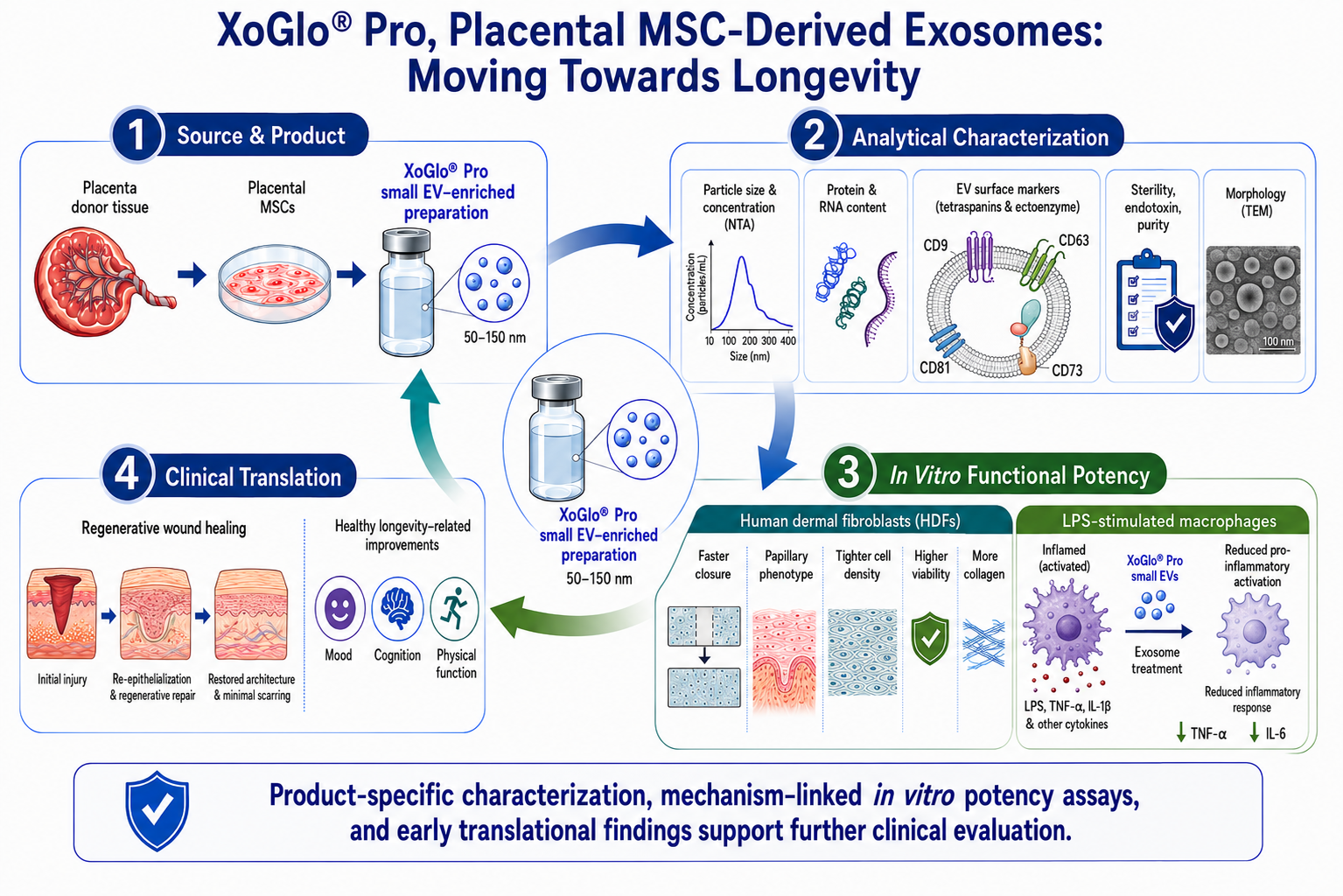
XoGlo® Pro, Placental MSC-Derived Exosomes: Moving Towards Longevity
DOI:
https://doi.org/10.13052/ijts2246-8765.2026.006Keywords:
Extracellular vesicles, exosomes, mesenchymal stromal cells, placental MSCs, XoGlo® Pro, regenerative medicine, tissue repair, wound healing, healthy longevity, functional resilience, cognitive function, immune modulation, macrophage immunomodulation, fibroblast reprogramming, collagen deposition, potency assays, translational medicine, biologics manufacturing, clinical case studies, patient accessAbstract
Regenerative medicine requires scalable, well-characterized biologic platforms that support tissue repair and immune modulation while meeting standards for quality, safety, reproducible manufacturing, and ethical clinical development. Mesenchymal stem cell-derived extracellular vesicles (MSC-EVs), including small EVs and exosome-enriched preparations, are being investigated as cell-free biologics because they transfer regulatory proteins, lipids, metabolites, and nucleic acids to recipient cells. This translational study evaluated XoGlo® Pro, a placental MSC-derived EV preparation, using multimodal analytical characterization, dermal repair-relevant in vitro assays, observational clinical case materials, and a small open-label proof-of-concept clinical study (n=5) in adults with healthy longevity-related functional concerns. Participants received a single 15 ml intravenous administration of XoGlo® Pro (1 mg ml-1 total protein; 15 mg total protein) and were followed for 1 month for safety and exploratory changes in function, fatigue, mood, cognition, and physical performance. No serious adverse events were observed. XoGlo® Pro was produced from human placental MSCs under serum-free conditions and characterized by nanoparticle tracking analysis, transmission electron microscopy, dSTORM imaging, and immunoblotting. Functional assays assessed fibroblast wound closure, phenotype-associated marker expression, viability, proliferation, collagen-associated deposition, and macrophage cytokine responses following lipopolysaccharide stimulation. XoGlo® Pro demonstrated a small-EV-enriched analytical profile with EV-associated markers. In vitro, XoGlo® Pro enhanced fibroblast gap closure, viability, proliferation, phenotype-associated modulation, collagen-associated deposition, and attenuated inflammatory macrophage cytokine secretion. De-identified clinical images provided observational context for dermatologic and wound-repair applications. In the proof-of-concept cohort, directional improvements were observed across selected functional, fatigue, mood, cognitive, and performance measures. These findings are exploratory and hypothesis-generating and support further controlled investigation of XoGlo® Pro in tissue repair, immune modulation, healthy longevity, and functional resilience.
Downloads
References
M. Gimona et al., “Critical considerations for the development of potency tests for therapeutic applications of mesenchymal stromal cell-derived small extracellular vesicles,” Cytotherapy, vol. 23, no. 5, pp. 373–380, 2021.
C. Raggi and A. C. Berardi, “Mesenchymal stem cells, aging and regenerative medicine,” Muscles Ligaments Tendons J., vol. 2, no. 3, pp. 239–242, 2012.
M. D. Hade, C. N. Suire, and Z. Suo, “Mesenchymal stem cell-derived exosomes: Applications in regenerative medicine,” Cells, vol. 10, no. 8, 2021.
T. Lener et al., “Applying extracellular vesicles based therapeutics in clinical trials – an ISEV position paper,” J. Extracell. Vesicles, vol. 4, p. 30087, 2015.
A. T. Reiner et al., “Concise review: Developing best-practice models for the therapeutic use of extracellular vesicles,” Stem Cells Transl. Med., vol. 6, no. 8, pp. 1730–1739, 2017.
B. Claridge et al., “Development of extracellular vesicle therapeutics: Challenges, considerations, and opportunities,” Front. Cell Dev. Biol., vol. 9, p. 734720, 2021.
M. Gimona et al., “Manufacturing of human extracellular vesicle-based therapeutics for clinical use,” Int. J. Mol. Sci., vol. 18, no. 6, 2017.
E. M. Crimmins, “Lifespan and healthspan: Past, present, and promise,” Gerontologist, vol. 55, no. 6, pp. 901–911, 2015.
J. J. Baechle et al., “Chronic inflammation and the hallmarks of aging,” Mol. Metab., vol. 74, p. 101755, 2023.
C. López-Otín et al., “Hallmarks of aging: An expanding universe,” Cell, vol. 186, no. 2, pp. 243–278, 2023.
Y. Zhu et al., “Application of mesenchymal stem cell therapy for aging frailty: From mechanisms to therapeutics,” Theranostics, vol. 11, no. 12, pp. 5675–5685, 2021.
Z. Zhao et al., “The role of mesenchymal stem cell-derived exosome in epigenetic modifications in inflammatory diseases,” Front. Immunol., vol. 14, p. 1166536, 2023.
P. Zhao et al., “Exosomes derived from bone marrow mesenchymal stem cells improve osteoporosis through promoting osteoblast proliferation via MAPK pathway,” Eur. Rev. Med. Pharmacol. Sci., vol. 22, no. 12, pp. 3962–3970, 2018.
Q. L. Zeng and D. W. Liu, “Mesenchymal stem cell-derived exosomes: An emerging therapeutic strategy for normal and chronic wound healing,” World J. Clin. Cases, vol. 9, no. 22, pp. 6218–6233, 2021.
A. Uccelli, L. Moretta, and V. Pistoia, “Mesenchymal stem cells in health and disease,” Nat. Rev. Immunol., vol. 8, no. 9, pp. 726–736, 2008.
Y. Shahsavandi et al., “miRNAs from mesenchymal-stem-cell-derived extracellular vesicles: Emerging players in regenerative medicine and disease therapy,” Mol. Ther. Nucleic Acids, vol. 36, no. 4, 2025.
S. Maacha et al., “Paracrine mechanisms of mesenchymal stromal cells in angiogenesis,” Stem Cells Int., vol. 2020, p. 4356359, 2020.
K. W. Witwer et al., “Defining mesenchymal stromal cell (MSC)-derived small extracellular vesicles for therapeutic applications,” J. Extracell. Vesicles, vol. 8, no. 1, p. 1609206, 2019.
M. R. Mohammadi et al., “Isolation and characterization of microvesicles from mesenchymal stem cells,” Methods, vol. 177, pp. 50–57, 2020.
K. Yin, S. Wang, and R. C. Zhao, “Exosomes from mesenchymal stem/stromal cells: A new therapeutic paradigm,” Biomark. Res., vol. 7, p. 8, 2019.
F. Tan et al., “Clinical applications of stem cell-derived exosomes,” Signal Transduct. Target. Ther., vol. 9, no. 1, p. 17, 2024.
Y. S. Chen et al., “Exosomes in clinical trial and their production in compliance with good manufacturing practice,” Ci Ji Yi Xue Za Zhi, vol. 32, no. 2, pp. 113–120, 2020.
L. Wang et al., “Characterization of placenta-derived mesenchymal stem cells cultured in autologous human cord blood serum,” Mol. Med. Rep., vol. 6, no. 4, pp. 760–766, 2012.
M. Wu et al., “Comparison of the biological characteristics of mesenchymal stem cells derived from the human placenta and umbilical cord,” Sci. Rep., vol. 8, no. 1, 2018.
M. Komaki et al., “Exosomes of human placenta-derived mesenchymal stem cells stimulate angiogenesis,” Stem Cell Res. Ther., vol. 8, no. 1, p. 219, 2017.
A. Papait et al., “Mesenchymal stromal cells from fetal and maternal placenta possess key similarities and differences: Potential implications for their applications in regenerative medicine,” Cells, vol. 9, no. 1, 2020.
Y. Zhu et al., “Placental mesenchymal stem cells of fetal and maternal origins demonstrate different therapeutic potentials,” Stem Cell Res. Ther., vol. 5, no. 2, p. 48, 2014.
R. A. Pelekanos et al., “Isolation and expansion of mesenchymal stem/stromal cells derived from human placenta tissue,” J. Vis. Exp., no. 112, 2016.
D. G. Janson et al., “Different gene expression patterns in human papillary and reticular fibroblasts,” J. Invest. Dermatol., vol. 132, no. 11, pp. 2565–2572, 2012.
A. Korosec et al., “Lineage identity and location within the dermis determine the function of papillary and reticular fibroblasts in human skin,” J. Invest. Dermatol., vol. 139, no. 2, pp. 342–351, 2019.
D. Janson et al., “Papillary fibroblasts differentiate into reticular fibroblasts after prolonged in vitro culture,” Exp. Dermatol., vol. 22, no. 1, pp. 48–53, 2013.
J. E. Park et al., “Fibroblast activation protein, a dual specificity serine protease expressed in reactive human tumor stromal fibroblasts,” J. Biol. Chem., vol. 274, no. 51, pp. 36505–36512, 1999.
J. Roman, “Fibroblasts – warriors at the intersection of wound healing and disrepair,” Biomolecules, vol. 13, no. 6, 2023.
M. F. Griffin et al., “JUN promotes hypertrophic skin scarring via CD36 in preclinical in vitro and in vivo models,” Sci. Transl. Med., vol. 13, no. 609, p. eabb3312, 2021.
P. Lin, G. Zhang, and H. Li, “The role of extracellular matrix in wound healing,” Dermatol. Surg., vol. 49, no. 5S, pp. S41–S48, 2023.
C. Théry et al., “Minimal information for studies of extracellular vesicles 2018 (MISEV2018): A position statement of the International Society for Extracellular Vesicles and update of the MISEV2014 guidelines,” J. Extracell. Vesicles, vol. 7, no. 1, p. 1535750, 2018.
J. A. Welsh et al., “Minimal information for studies of extracellular vesicles (MISEV2023): From basic to advanced approaches,” J. Extracell. Vesicles, vol. 13, no. 2, p. e12404, 2024.
C. McLaughlin et al., “Mesenchymal stem cell-derived extracellular vesicles for therapeutic use and in bioengineering applications,” Cells, vol. 11, no. 21, 2022.
S. S. Kuppa et al., “Role of mesenchymal stem cells and their paracrine mediators in macrophage polarization: An approach to reduce inflammation in osteoarthritis,” Int. J. Mol. Sci., vol. 23, no. 21, p. 13016, 2022.
Y. Shi et al., “Exosomes derived from bone marrow stromal cells (BMSCs) enhance tendon-bone healing by regulating macrophage polarization,” Med. Sci. Monit., vol. 26, p. e923328, 2020.
X. He et al., “MSC-derived exosome promotes M2 polarization and enhances cutaneous wound healing,” Stem Cells Int., vol. 2019, p. 7132708, 2019.
J. Boulestreau et al., “Mesenchymal stem cell derived extracellular vesicles in aging,” Front. Cell Dev. Biol., vol. 8, p. 107, 2020.
A. Dorronsoro et al., “Mesenchymal stem cell-derived extracellular vesicles reduce senescence and extend health span in mouse models of aging,” Aging Cell, vol. 20, no. 4, p. e13337, 2021.
K. A. Cho et al., “Mesenchymal stem cell-derived exosomes protect muscle loss by miR-145-5p activity targeting activin A receptors,” Cells, vol. 10, no. 8, 2021.
S. E. Byun et al., “Skeletal muscle regeneration by the exosomes of adipose tissue-derived mesenchymal stem cells,” Curr. Issues Mol. Biol., vol. 43, no. 3, pp. 1473–1488, 2021.
E. Mahindran et al., “Mesenchymal stem cell-derived extracellular vesicles: Hype or hope for skeletal muscle anti-frailty,” Int. J. Mol. Sci., vol. 24, no. 9, 2023.
C. Porcu, G. Dobrowolny, and B. M. Scicchitano, “Exploring the role of extracellular vesicles in skeletal muscle regeneration,” Int. J. Mol. Sci., vol. 25, no. 11, 2024.
K. Wang et al., “Nanotopographical cues tune the therapeutic potential of extracellular vesicles for the treatment of aged skeletal muscle injuries,” ACS Nano, vol. 17, no. 20, pp. 19640–19651, 2023.
H. Ni et al., “Exosomes derived from bone mesenchymal stem cells ameliorate early inflammatory responses following traumatic brain injury,” Front. Neurosci., vol. 13, no. 14, 2019.
Y. Chen et al., “MSC-derived exosomes promote recovery from traumatic brain injury via microglia/macrophages in rat,” Aging (Albany NY), vol. 12, no. 18, pp. 18274–18296, 2020.
L. Wen et al., “Exosomes derived from bone marrow mesenchymal stem cells inhibit neuroinflammation after traumatic brain injury,” Neural Regen. Res., vol. 17, no. 12, pp. 2717–2724, 2022.
Y. Wang et al., “Trends in mesenchymal stem cell-derived extracellular vesicles clinical trials 2014–2024: Is efficacy optimal in a narrow dose range?” Front. Med., vol. 12, p. 1625787, 2025.