An Integrative Interim Safety Overview of Two Open Label Studies with BM-MSCs
DOI:
https://doi.org/10.13052/ijts2246-8765.2026.004Keywords:
StromaForte, mesenchymal stromal cells, allogeneic cell therapy, safety, adverse events, Phase I/IIa, pooled analysisAbstract
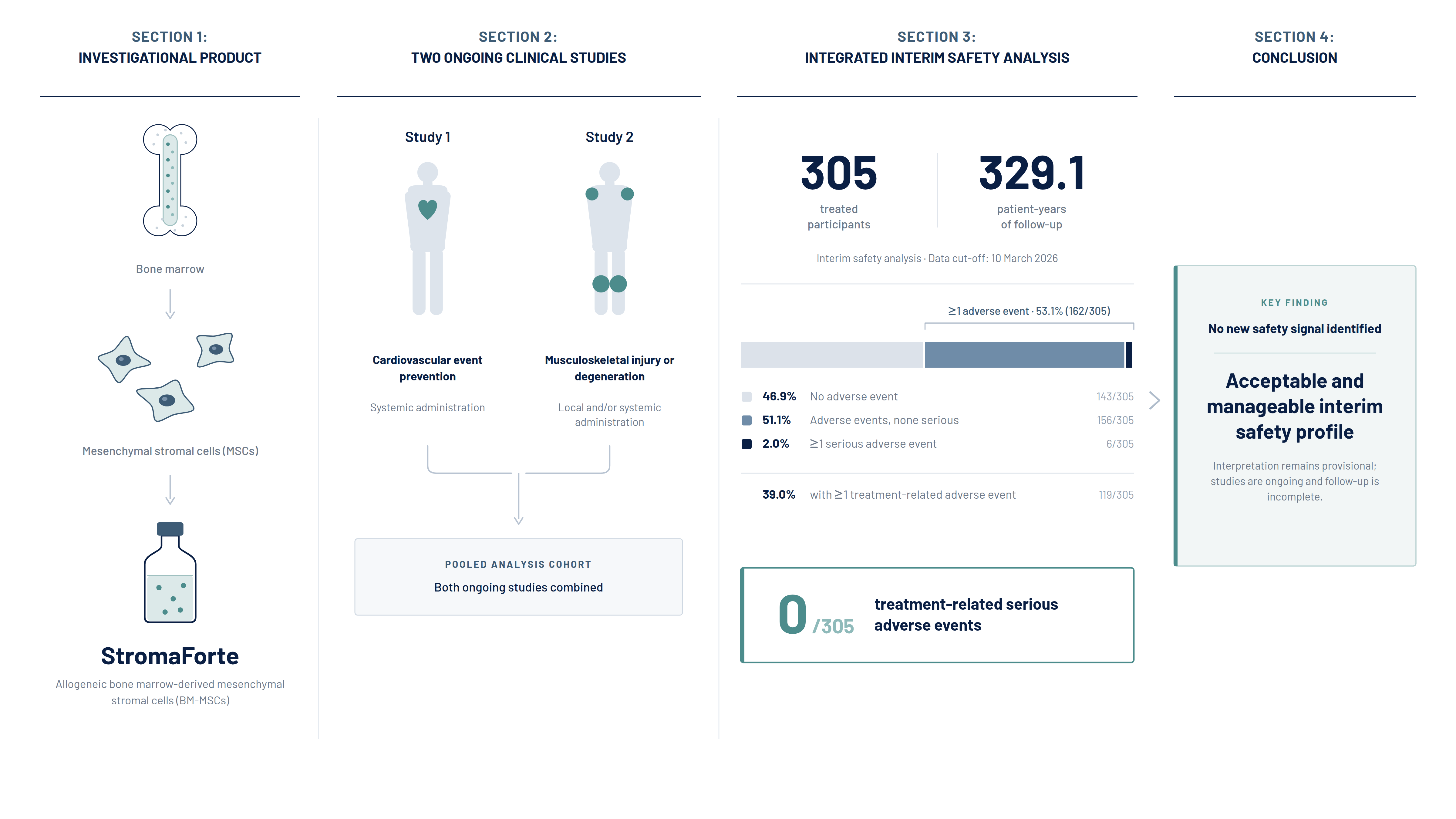
StromaForte is an allogeneic bone marrow-derived mesenchymal stromal cell (BM-MSC) investigational medicinal product under evaluation in two ongoing open-label clinical studies in The Bahamas. One study evaluates systemic administration in participants enrolled for cardiovascular-event prevention, and the second evaluates local and/or systemic administration in participants with musculoskeletal injury or degeneration.
This manuscript summarizes an integrated interim safety analysis with a data cut-off of 10 March 2026. The safety population included all treated participants. Adverse events, serious adverse events, deaths, laboratory abnormalities reported as adverse events, vital signs, and supportive follow-up-time adjusted incidence rates were summarized descriptively.
The pooled safety population comprised 305 treated participants, contributing 329 patient-years of follow-up. Overall, 162 participants (53.1%) reported at least one adverse event, and 119 (39.0%) reported at least one treatment-related adverse event. Events were predominantly non-serious and were most often recorded under MedDRA System Organ Class (SOC) Investigations, largely reflecting protocol-defined clinically significant blood pressure or laboratory findings. Six participants (2.0%) experienced a serious adverse event; none were assessed as related to the study treatment. One death due to pancreatic carcinoma occurred 585 days after treatment and was assessed as unrelated. No adverse events leading to treatment discontinuation or dose modification were reported. No new safety signal, urgent safety measure, or safety-driven change to reference safety information was identified.
Based on available interim data, StromaForte demonstrated an acceptable and manageable safety profile in the studied populations and administration settings. Interpretation remains provisional because both studies are ongoing, follow-up is incomplete, laboratory follow-up is sparse, and repeated-dose experience remains limited.
Downloads
References
WHO, “Ageing and health,” World Health Organization, 2025. [Online]. Available: https://www.who.int/news-room/fact-sheets/detail/ageing-and-health. [Accessed: Aug. 24, 2026].
L. Ferrucci and E. Fabbri, “Inflammageing: chronic inflammation in ageing, cardiovascular disease, and frailty,” Nat. Rev. Cardiol., vol. 15, no. 9, pp. 505–522, Sep. 2018.
C. Franceschi et al., “Inflammaging: a new immune–metabolic viewpoint for age-related diseases,” Nat. Rev. Endocrinol., vol. 14, no. 10, pp. 576–590, Oct. 2018.
P. M. Ridker et al., “Antiinflammatory Therapy with Canakinumab for Atherosclerotic Disease,” N. Engl. J. Med., vol. 377, no. 12, pp. 1119–1131, Sep. 2017.
W. H. Robinson et al., “Low-grade inflammation as a key mediator of the pathogenesis of osteoarthritis,” Nat. Rev. Rheumatol., vol. 12, no. 10, pp. 580–592, Oct. 2016.
E. Sanchez-Lopez et al., “Synovial inflammation in osteoarthritis progression,” Nat. Rev. Rheumatol., vol. 18, no. 5, pp. 258–275, May 2022.
M. A. Terkawi et al., “Low-Grade Inflammation in the Pathogenesis of Osteoarthritis: Cellular and Molecular Mechanisms and Strategies for Future Therapeutic Intervention,” Biomedicines, vol. 10, no. 5, Art. no. 1109, May 2022.
M. Dominici et al., “Minimal criteria for defining multipotent mesenchymal stromal cells. The International Society for Cellular Therapy position statement,” Cytotherapy, vol. 8, no. 4, pp. 315–317, Aug. 2006.
M. Krampera and K. Le Blanc, “Mesenchymal stromal cells: Putative microenvironmental modulators become cell therapy,” Cell Stem Cell, vol. 28, no. 10, pp. 1708–1725, Oct. 2021.
N. S. Mabotuwana et al., “Paracrine Factors Released by Stem Cells of Mesenchymal Origin and their Effects in Cardiovascular Disease: A Systematic Review of Pre-clinical Studies,” Stem Cell Rev. Rep., vol. 18, no. 8, pp. 2606–2628, Dec. 2022.
M. M. Lalu et al., “Safety of Cell Therapy with Mesenchymal Stromal Cells (SafeCell): A Systematic Review and Meta-Analysis of Clinical Trials,” PLoS ONE, vol. 7, no. 10, p. e47559, Oct. 2012.
Y. Wang, H. Yi, and Y. Song, “The safety of MSC therapy over the past 15 years: a meta-analysis,” Stem Cell Res. Ther., vol. 12, no. 1, Art. no. 545, Oct. 2021.